“Some benefits of electric vehicles are hard to put a price on, like the peace of mind that comes from not being at the mercy of geopolitics,” reports the New York Times.
“‘There are tentative signs that “people want to be taken off the gas-price roller coaster’ said Jessica Caldwell, head of insights at Edmunds. “
The fact that Iran War is expected to generate the biggest shock to global energy and economy in history is why New York State, states, localities and the nation should not be retreating from clean renewable energy. Rather, it should be the added incentive to accelerate the transition and break the dependence on tyrantss, Big Oil billionaires and conglomerates.
Energy independence is why the dictator wannabe trump, with aspirations of Empire, is going in the opposite direction – reversing all that Biden and Hochul accomplished in transitioning to clean, renewabale energy. It should inform Americans all they need to know when he attacks windpower and declares no windmills will be built while he reigns, as he tries to actually deconstruct the projects already well underway.
New York State has been a stellar leader combating trump’s anti-climate actions since his first term when his first action was to withdraw the US from the Paris Climate Accord. New York is a founding member of the bipartisan U.S. Climate Alliance since 2017. The Alliance members represent 55% of the US population and 60% of GDP. The Alliance continues to lead in state-level climate action. Governor Kathy Hochul currently serving as a co-chair.
The state is committed to reducing net greenhouse gas emissions by 50-52% by 2030 and achieving net-zero by 2050. Recent actions include joining the Alliance’s Climate-Ready Workforce Initiative to train 1 million apprentices by 2035.
But now Governor Hochul is saying it will be too expensive for New Yorkers to meet the 2030 commitment, which is enshrined in law. She is asking the Legislature to amend the law to delay the transition because of her affordability goal – the hallmark of her reelection campaign. But dependence on fossil fuel is more costly in the short term, medium term and especially the long term, so what we spend on meeting that goal is an investment in a future of less costly utilities and energy, less costly healthcare and climate disaster.
It is clear that Governor Hochul is trying to go all-in on affordability in order to win reelection this November, but in the process, she will alienate young, progressive voters and environmentalists.
And that might cause the biggest problem of all, just as when these voters “showed” Biden (he didn’t completely end fossil fuel or break with Israel over Gaza, and he was old) and didn’t come out to vote for Kamala Harris. The result was returning Trump to office, where he has aggressively overturned all that Biden-Harris accomplished in implementing historic Climate Action. Republican Nassau County Executive Bruce Blakeman is a mini-trump who would overturn New York’s Climate Agenda entirely (along with women’s reproductive freedom, gun control, voting rights, criminal justice reform).
This op-ed by Governor Hochul better explains her position but may not succeed in mollifying environmentalists. We hope the State Legislature, especially in light of the evidence of the Iran War’s impact on fossil-fuel dependency, will reject delaying implementation of the Climate Agenda. (She may have a point about adopting more reasonable standards that are more commonly held.) –Karen Rubin, editor@news-photos-features.com
Today, Empire Report published an op-ed by Governor Kathy Hochul regarding her commitments to clean energy and climate action while ensuring that New York becomes more affordable. Text of the op-ed can be viewed online and here:
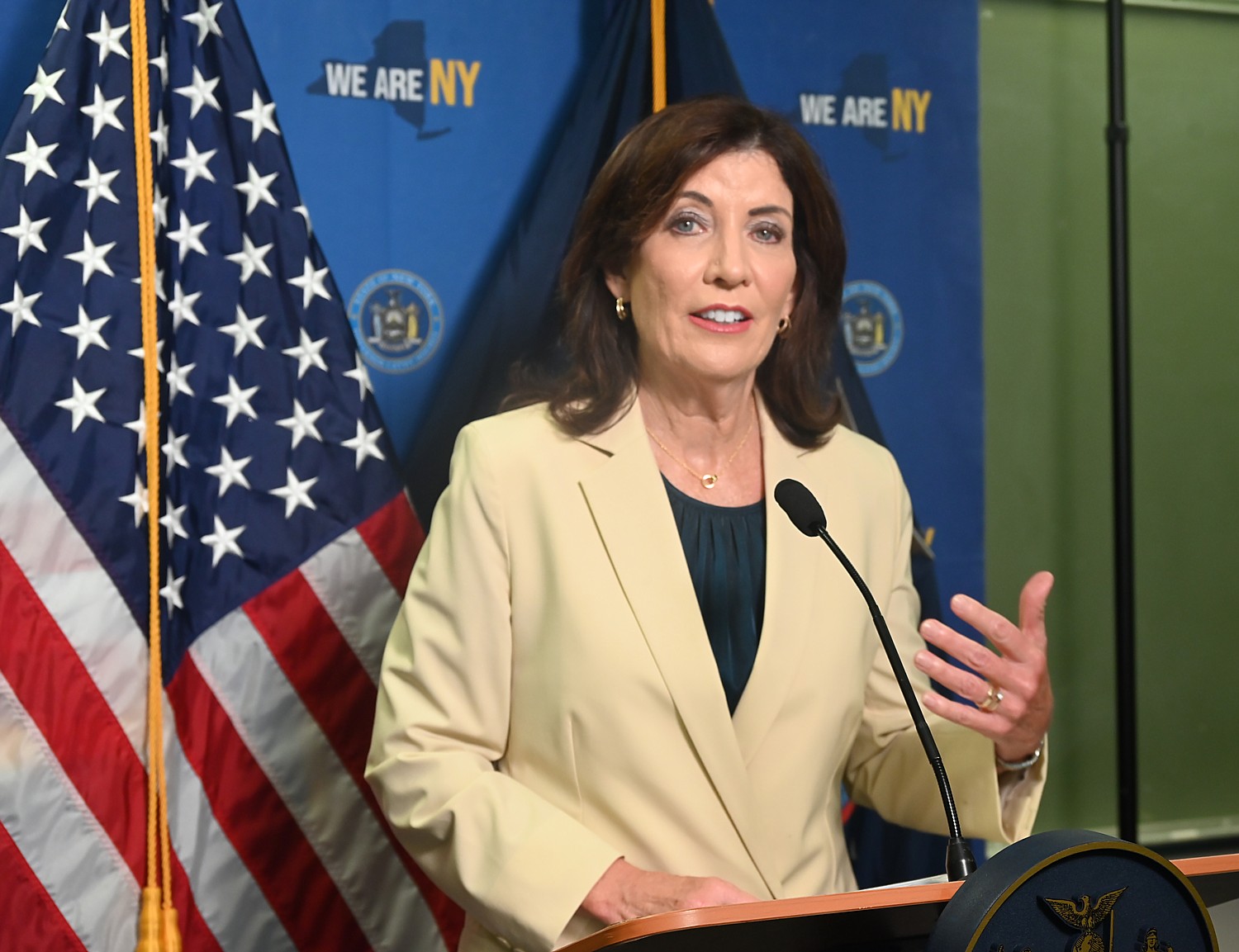
All New Yorkers should be immensely proud that their home state is a national leader for clean energy and climate action. As Governor, I take that role very seriously, knowing it is our mission to leave our world better than we inherited it.
My worldview was shaped growing up in Western New York during the era of the toxic Love Canal, swimming in a Great Lake contaminated by industrial pollution, and breathing the orange smoke emitted from nearby smokestacks. That’s why leading the fight against climate change and protecting our environment is deeply personal for me.
Since I have been Governor, more than $88.7 billion has been invested in clean energy through programs that have made us an example for the rest of the nation.
We have the first-ever utility-scale offshore wind farm in the United States, and two more under construction that we have protected from Trump administration efforts to stop these fully-permitted projects dead in their tracks. Just one of those projects will power half a million homes in Brooklyn later this year.
My efforts to reduce emissions meant taking on tough fights, including stopping the White House from killing congestion pricing – a program that’s already delivering results, even as it faces fierce opposition from the President.
We met our 2025 solar goals a year early, positioning New York as a national leader, approved 31 large-scale solar and wind projects, and just last year allocated the largest investment to address climate change in state history
While other states wavered, New York remains a backbone of the Regional Greenhouse Gas Initiative and its early efforts to keep the multi-state climate partnership strong.
And in just a few months, the Champlain Hudson Power Express (CHPE) that I championed will become operational, delivering clean hydroelectric power to New York City, and helping to compensate for the increase in emissions driven by the shutdown of the Indian Point nuclear plant.
All of these actions have brought us closer to the goals of the Climate Leadership & Community Protection Act passed by the State Legislature back in 2019. And I remain fully committed to the blueprint for a sustainable future laid out in that landmark legislation.
But so much has radically changed since the Climate Act was enacted, necessitating common-sense adjustments that keep us on our path to a greener future in a way that is affordable for New Yorkers.
Post-COVID inflation and supply chain disruptions have created a far more challenging economic landscape. That has been compounded by federally imposed illegal tariffs that have driven up project costs, and a dramatic shift in Washington. We have moved from a federal government eager to partner on the clean energy transition to a White House under Donald Trump, aided by a Republican-controlled Congress, that launched a full-on assault on renewables and the tax incentives that encouraged companies to build and residents to convert.
President Trump has denied the science, calling climate change a hoax. Just this week, he again vowed to block all new offshore wind projects and is actively attempting to dismantle those already under construction. At the same time, the federal government is also canceling grants and tax credits for solar and wind, electric vehicles, heat pumps, and other pollution-reduction initiatives while rolling back key scientific findings and regulations that would have helped the nation move toward reducing greenhouse gas emissions.
Without a federal partner, there is only so much states can do on their own. It is impossible to push new offshore wind projects and the clean energy they would produce when we have a President who prefers a “drill baby drill” mantra that focuses on oil and coal. And even within our own borders, we have been dealing with NIMBYism, moratoriums and outright bans that have made siting alternative energy facilities such as on-land wind, utility-scale solar and battery storage impossible in too many parts of our state.
Meanwhile, the war in Iran is driving up gas prices at the pump to the breaking point for too many New Yorkers. With energy demand growing and the state having retired far more fossil fuel plants than it’s been able to replace with renewable sources, our electric system operator is projecting potential energy shortages, particularly downstate, that could lead to brownouts and blackouts.
Put simply, something has to give.
It’s why I am pushing a Ratepayer Protection Plan that will hold utilities accountable, reform the process by which regulators consider rate hike requests, and make it easier for working families to learn about and access the state’s Energy Affordability Programs.
And to make sure we keep the lights and heat on and costs down for New Yorkers, I have adopted an all-of-the-above approach to energy that includes more renewables, emission-free, reliable round-the-clock nuclear, and other needed power sources.
It’s also why, despite supporting the intentions of the Climate Act, I am pushing changes to the law as part of our budget discussions with the Legislature. This is solely out of necessity – to protect New Yorkers’ pocketbooks and economy. Despite all the headwinds and obstacles that could not have been foreseen when the law was enacted in 2019, advocates still took the extreme step of suing the state to force it to issue regulations to meet the Climate Act’s 2030 emission reductions targets.
A judge agreed and ruled that the state must swiftly issue regulations to achieve what now would be costly and unattainable targets, unless the law is changed.
I have repeatedly said that utility rates in our state are too high. And while the Climate Act is not the driver of the high energy prices we are experiencing, the undeniable fact is we cannot meet the Climate Act’s 2030 targets without imposing new and additional crushing costs on New York businesses and residents.
Absent changes to the law, the New York State Energy Research and Development Authority found the impact of meeting the Climate Act’s 2030 targets would be staggering—more than $4,000 a year for upstate oil and natural gas households, and $2,300 more for New York City natural gas households. And gas prices at the pump would jump an additional $2.23 per gallon above where it would otherwise be.
As Governor, I can’t let that happen. While I am still committed to working toward our targets, with all the stress our residents are under, New Yorkers expect their elected officials to prioritize affordability. They are suffering from high costs every single day and I for one will not ignore their cries for relief.
The fact is, we will be dealing with a White House outright hostile toward renewable energy for at least another three years, making it impossible for us to meet our targets without imposing higher costs on homeowners, renters, and businesses.
We need more time, and so I am proposing we amend the law to require regulations to reduce statewide greenhouse gas emissions to be issued at the end of 2030. We are seeking to change what emission limits the regulations are tied to – including a new 2040 target as well as the existing 2050 statewide emission limits. Nothing else in the CLCPA is changing regarding the existing statewide emission limit targets and these new regulations would still require the state to make timely progress, ensuring long-term policy stability.
Additionally, we need to change the accounting methodology we use to count emissions to align with the international standards used by the global community and nearly every other U.S. state. Otherwise, these impossible emission reduction targets…only used by NY and one other state…will ensure our failure despite all of our efforts and billions of dollars spent.
These proposed changes preserve the intent of the law while realistically recognizing the economic and political challenges we face. Even with these adjustments – which bring us in line with other climate leading states like California, Washington, and Colorado – New York will still boast one of the most ambitious laws in the country. And it’s important to note that our state is not alone in dealing with these issues. A number of other states with aggressive climate goals are also struggling to meet them given the current federal headwinds and have had to make amendments.
I cannot make these changes alone. We need our partners in the Legislature to enact these needed and practical revisions. I look forward to working with lawmakers to achieve an outcome that will make our state both more sustainable and more affordable. The people of New York are counting on us to get this right.