Today, the Houston Chronicle published an op-ed by Governor Kathy Hochul outlining her commitment to protecting New Yorkers amidst the redistricting battle happening out in the state of Texas. The Governor discussed how Democrats across the nation must stand up to these brazen attacks to undermine democracy and the sacred practice of voting in the United States. Here is the text:
Up until now, Democrats have treated our political system like it’s still governed by norms, guarded by limits and rooted in fairness. Rules were meant to be followed. It hurts to say it, but that era has come to an end. Since Donald Trump’s rise, Republicans have declared war on the American people. They slashed health care, gutted nutrition programs and stacked the Supreme Court to rip away freedoms we once took for granted. And now, they’re trying to rig the rules of democracy itself.
At President Trump’s direction, Texas state House Republicans are attempting to redraw their congressional maps mid-decade, an aggressive power grab designed to flip as many as five current Democratic seats. They’ve carved up diverse communities in Houston, Dallas and along the border to silence the voters who live there.
What Texas is doing isn’t a clever strategy, it’s political arson — torching our democracy to cling to power. The only viable recourse is to fight fire with fire. This isn’t just a Texas issue. When Republicans rig congressional maps in one state, it weakens representation in every state. Every unfair seat they create tilts Congress further out of balance. If they get away with it now, 2026 will be the first of many stolen elections.
I may be governor of New York, but I will not sit on the sidelines with timid souls and merely watch while Republicans dismantle democracy. That’s not who we are. And that is certainly not the leadership that this moment calls for.
That’s why I was proud to host Texas House Democrats this week. These public servants left the state to follow a legitimate and legal tactic to deny Republicans a quorum and stop this scheme in its tracks. As John Lewis said, sometimes you have to get into good trouble. That’s what they’re doing — and they’re not alone.
Before our meeting in the New York State Capitol, I invited the delegation members to the governor’s residence, a home once occupied by former Governor Franklin Delano Roosevelt. I wanted them to draw strength from his example. He led this nation through some of its darkest days. Like FDR, we know who we’re fighting for and who we’re fighting against.
Because this fight isn’t about maps. It’s about values. Fairness. Freedom. Representation. The very essence of our republic.
In New York, we’ve shown what’s possible when you expand access to the ballot instead of suppressing it. I signed the John R. Lewis Voting Rights Act in 2022, the strongest law of its kind in the nation. I expanded voter registration and implemented early voting by mail. When Democrats lead, democracy gets stronger.
But we can’t do it alone. That’s why I’m in close touch with House Democratic Leader Hakeem Jeffries and others working on how states can coordinate legal, legislative and constitutional strategies to fight back. We are also reviewing every legal and legislative option to redraw our own maps in New York. If Republicans are changing the rules, we’ll meet them on the same field, with strategy, with resolve and without apology.
Some will say this is too aggressive. I say it’s necessary.
What Texas Republicans are doing under Trump’s direction is nothing short of a legal insurrection on our Capitol. But using a legal system doesn’t make it legitimate. It’s a hijacking of democracy. And it must be stopped. A newsflash for Texas Republicans: this is not the Wild West. We will not be bystanders as our democracy is stolen in a modern-day stagecoach heist.
I fundamentally believe that while Texans and New Yorkers have our share of differences, we agree on basic fairness. You shouldn’t cheat to get ahead. And you must be willing to stand up for the democratic institutions that make this nation so exceptional. Americans are done with the cruelty, chaos and cowardice they have witnessed since 2025 began. They’re ready to vote Republicans out — and Republicans know it. That’s why they’re rigging the game before the next whistle blows.
But we can’t let them get away with it without a fight. Not on my watch.
If you refuse to fight for democracy, you’re doomed to lose it. I didn’t get into public service to lose. I got in to fight and to win on behalf of the people I serve. To every Texan standing up to Trump and Abbott’s scheme, you’re on the right side of history. We’re proud to stand with you.
To the rest of America, don’t be afraid to join this fight. If they rewrite the rules, then so will we.
All’s fair in love and war. Bring it on.
Kathy Hochul is the 57th and first female governor of New York State.
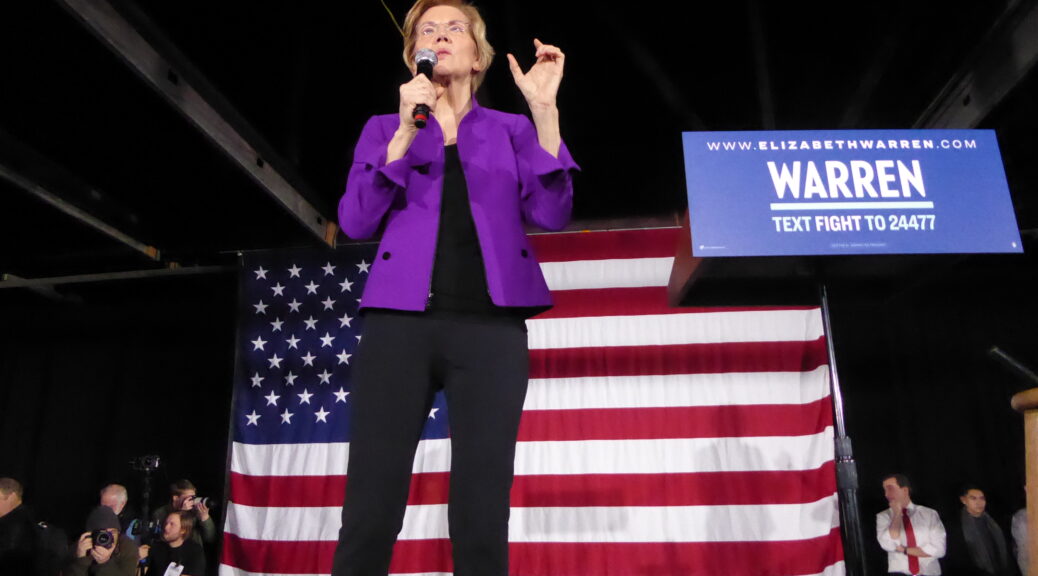
Charlestown, MA – Presidential candidate Elizabeth Warren, Democratic US
Senator from Massachusetts, released her plan to make voting easy and
convenient and secure our elections from threats both foreign and domestic:
Elections are the foundation of our democracy, but in the United
States – the greatest democracy in the world – our government treats voting
like it’s one of the least important things we do. We have around 8,000
election jurisdictions all doing their own thing. They are overstretched,
under-resourced, and their technology is often laughably out of date.
Voting should be easy. But instead, many states make it hard for
people to vote. We have all heard stories about polling places running
out of ballots, computer problems causing delays, ballot designs confusing voters, and
extremely long
lines preventing
working people from voting. And on top of these administrative issues, racist
and partisan officials often deliberately seek to stop citizens from exercising
the right to vote. States have purged names from the voter rolls, limited
same-day registration, closed polling places
in communities of color, used
voter ID laws to try to disenfranchise
Native Americans, and even placed restrictions and
criminal penalties on efforts to
register new voters.
Our elections should be as secure as Fort Knox. But instead,
they’re less secure than your Amazon account. State and local
officials take their jobs seriously, but they often don’t have the resources to
secure their elections. Even then, it’s hard for local officials to defend
against attacks from foreign governments. In the 2016 election, the Russian
government tried to infiltrate at
least39
state election systems and at least one election equipment company. They
tried to spear-phish more
than 100 local election officials’ email accounts. They even successfully broke into several
voter registration databases.
The harsh truth is that our elections are extremely vulnerable
to attack: Forty-two states use voter registration databases that are more than
a decade old. Laughably, in 2019, some still use Windows
2000 and Windows XP. Twelve
states still use paperless machines, meaning there’s no paper trail to
verify vote counts. Some states don’t require post-election audits.
And ten
states don’t
train election officials to deal with cybersecurity threats. This is a national
security threat, and three years after a hostile foreign power literally
attacked our democracy, we’ve done far too little to address it.
We need a constitutional amendment to guarantee the right to
vote. But the moral necessity of this amendment shouldn’t stop us from acting
now. The federal government already has the power to regulate federal elections,
secure our democracy, and put a stop to racist voter suppression.
Under our Constitution, Congress can regulate the “Times,
Places, and Manner,” of federal elections. This power is so broad that
even Justice
Scalia believed
this provision gives Congress “authority to provide a complete code for
congressional elections.” Congress also has the power to enforce the 14th and
15th Amendments to prevent voting discrimination, and the power of the purse to
grant money to the states to meet federal standards. It’s time to draw on these
constitutional powers to strengthen our democracy.
Enough is enough. It is time to make high-quality voting in the
greatest democracy in the world easy, convenient, and professional. It’s time
to secure our elections from all threats, foreign and domestic. It’s time to
address election security, administration problems, and voter suppression.
Here’s how my plan will work:
Federal elections get state-of-the-art federal machines, federal
ballots, and federal security. Right now some jurisdictions use dated
machines that are easily hackable with no paper trail. Ballot design is all
over the place. No more. The federal government will replace every voting
machine in the country with state-of-the-art equipment and require adoption of
a uniform federal ballot. And we will lock all federal voting technology
systems behind a security firewall like it’s Fort Knox.
Federal standards for federal elections. We have 8,000
election jurisdictions running elections. Problems with resources, malfeasance,
and errors are rampant. No more. We will have federal standards to ensure
everyone can vote, including mandating automatic and same-day registration,
early voting, and vote by mail. My plan will mean no more arbitrary voter
purges. No more registration issues. And no more gerrymandering. We will also
make Election Day a holiday to make it easier for people to get to the polls.
Enforce the law and expand access – through incentives where
possible, and with federal authority where necessary. My plan will give
states cutting-edge voting equipment and election security protocols, all paid
for by the federal government, and states will be required to follow all
federal standards for federal elections. States who also choose to meet these
requirements in their state elections can work through federal-state
partnership agreements to have those elections fully funded by the federal
government, too – and we’ll give them a bonus for achieving high voter turnout
rates. And where racist or corrupt politicians refuse to follow the law, the
federal government will temporarily take over the administration of their
federal elections to guarantee the fundamental right to vote.
Securing Our Elections
Under my plan, federal elections will get state-of-the-art
federal machines, federal ballots, and federal security. The federal
government will replace insecure and outdated systems with hand-marked,
voter-verified paper ballot machines. To prevent
hanging-chads and other confusing ballot designs, we’ll have uniform federal
ballots all across the country that are based on easy-to-use design principles.
The federal government will also provide every polling location with accessible
ballot machines for people with disabilities and conduct research into how to
improve voting security and accessibility for all people, including those with
disabilities and people for whom English isn’t their primary language.
Through a new independent Secure Democracy Administration, which
will replace the Election Assistance Commission and be staffed by civil
servants, the federal government will manage the cybersecurity aspects of
elections and develop additional security procedures for election
administration and the end-to-end handling of ballots. States will implement
these additional security measures, and will receive technical assistance and
training from the Secure Democracy Administration. In addition, states will be
required to conduct risk-limiting audits prior to certifying elections – and
we’ll have independent oversight of those audits.
Establishing Binding Federal Standards for Federal Elections
Our elections are never going to be secure, fair, or workable
with so many jurisdictions each making their own rules — especially when some
officials deliberately manipulate those rules to stop people from voting. Under
my plan, we’ll have a uniform set of federal election standards that achieve four
goals:
No more registration problems. My plan will mandate
automatic voter registration and same-day registration for federal elections.
State and federal government agencies will automatically register voters and
transfer that information to state elections officials, and voters can opt-out,
if they choose. Every state will also be required to offer same-day
registration, which acts as a fail-safe for anyone who is mistakenly left off
the rolls.
No more voter purges. Under my plan,
states will be banned from removing voters from the election rolls unless the
voter affirmatively requests to be removed or there is objective evidence of a
legitimate reason to remove them, like death, change of address, or loss of
eligibility to vote. We will also re-enfranchise those who have served their
time and left prison.
No more difficulties voting. We will make
Election Day a national holiday, and all federal elections will have a minimum
of 15 days of early voting, expanded voting hours, the option to vote with a sworn
statement of identity instead of an ID, convenient polling locations, and
voting by mail. And we will pass the Voting Rights Advancement Act and the
Native American Voting Rights Act to shut down a host of festering
discriminatory practices.
No more gerrymandering.Under my plan,
states will be required to use independent redistricting commissions to draw
federal congressional districts to prevent gerrymandering. Both parties should
compete on a level playing field; not in a rigged game designed to suppress the
will of the people.
Enforcing the law and expanding access – through incentives
where possible, and with federal authority where necessary
Our democracy shouldn’t be about keeping people out – it should
strive to bring everyone to the polls. Under my plan, states will receive new
state-of-the-art machines and federal election security, all paid for by the
federal government, and they will also be obligated to comply with the federal
standards for federal elections. But we should make voting easier in all
elections – federal, state, and local. I’m
proposing a federal-state partnership so that states will have a strong
financial incentive to follow these rules in their state and local elections as
well — and to maximize voter turnout.
Here’s how it will work: the federal government will pay the
entirety of a state’s election administration costs, as long as the state meets
federal standards in its state and local elections and works to make voting
more convenient. States will create state implementation plans, describing how
they will adhere to federal law and increase access to voting (e.g. location of
polling places). The Secure Democracy Administration will review state
implementation plans for compliance with federal law, election security protocols,
potentially racially discriminatory impacts, and efforts to make voting more
convenient. States that achieve high percentage voter turnout, including across
racial, gender, and age groups, will be awarded additional bonus payments. All
plans will be finalized well in advance of Election Day, and states will
provide data on their election activities. If a state does not participate in
the federal-state partnership, but a local jurisdiction within the state wishes
to do so, the local jurisdiction can work with the federal government to create
a local implementation plan and it will get access to federal funds to cover
its election administration costs.
States can choose to follow their own rules for their state and
local elections. But if they do, they won’t receive new funding for
administering state elections beyond election security measures, and they will
still have to administer federal elections in accordance with federal law –
including preclearance for any changes that might have a discriminatory impact
under the Voting Rights Advancement Act.
If state or local election officials choose to ignore these
federal rules and instead move to violate them, my plan will give the Secure
Democracy Administration the authority to seek a court order to step in and
guarantee that every voter has access to the polls unless or until the state
shows its intent to fully comply with federal law. The right to vote is a fundamental
right, and we will not let racist and corrupt politicians undermine it or our
democracy.
Our democracy is too important for it to be under-resourced and
insecure. We need to do everything we can to make sure our elections are
convenient, professional, and secure — and we should be willing to pay for it.
Based on estimates of national
election administration expenses, recentstateefforts to upgrade their election systems, and
assessments of the costs of newmachines and audits, to cover these
costs, we would allocate around $20 billion over ten years, which includes
around $15 billion for election administration and around $5 billion for
election security. This investment can be fully paid for with revenue generated
from the Ultra-Millionaire
Tax.
Democracy hangs on the idea that whoever gets the most votes
wins. Politicians are supposed to compete over how many voters they can
persuade, not how many they can disqualify or demoralize. And we have a solemn
obligation to secure our elections from those who would try to undermine them.
That’s why the Constitution gives Congress the tools to regulate the administration
of federal elections. It’s time to pick up those tools and use them.
There is no question that the will of the majority was thwarted in the presidential Election of 2016 – but if ever there was a time when the Electoral College should have proved its purpose, it was this election.
Instead, the Electoral College demonstrated the worst of all anti-democratic worlds: denying the popular will while also enabling the exact sort of candidate that Alexander Hamilton described in justifying the Electoral College: so “that the office of President will never fall to the lot of any man who is not in an eminent degree endowed with the requisite qualifications,” and to prevent a “desire in foreign powers to gain an improper ascendant in our councils”. Trump fails on all accounts.
And here, you have not only Hillary Clinton receiving nearly 3 million more votes than Donald Trump – the most in history for any candidate who did not go on to win the presidency – but you have clear evidence of foreign manipulation (the Russian hacking, very possibly with collusion by the Trump campaign), fake news, not to mention voter suppression (interesting that every battleground state where Clinton lost was also where Republican legislators had imposed measures designed to suppress the vote of groups inclined to vote Democratic; in Wisconsin, 300,000 registered voters lacked the photo ID necessary to cast their ballots. Indeed, two weeks after the election, a federal court struck down Wisconsin’s legislative map as illegally partisan. And, “on Election Day, there were 868 fewer polling places in states with a long history of voting discrimination, like Arizona, Texas, and North Carolina,” (www.thenation.com/…)
The result was that Democratic-leaning voters had hours-long waits which many could not afford. And then there was the call-out by Donald Trump for vigilantes to police “you know which” neighborhoods. Turnout was affected. Indeed, despite historic levels of engagement in Election 2016, the number of votes cast in Ohio was down 1.1% and down 4.0% in Wisconsin – more than the margin of victory for Trump. That’s the art and the science of voter suppression, which was the primary strategy for the Trump campaign.
But instead of serving properly as a check-and-balance, everything that is undemocratic and archaic about the Electoral College (devised to give disproportionate power to slave-holding states and small rural states) was in play. As a result, a single voter in Wyoming is worth 200 times a voter in California, rendering this country’s notion of “one person, one vote” and “equal justice” a fraud.
(Why is it that only rural, white Middle Americans are considered “Real Americans,” but coastal, urbanites, professionals, college-educated people are considered “elites” not deserving of a say in their governance?)
Its malfeasance justifies the rising calls to abolish the Electoral College altogether – which would require amending the Constitution which is unlikely. Instead, there are calls to dramatically reform it to more properly address 21st century America, through changes that the states can make to the regulations that bind their Electoral Voters, now termed “faithless” if they vote against their state’s popular vote.
The predominant reform is for states to join the National Popular Vote (NPV) compact would require participating states to award all their electoral votes to whichever presidential candidate wins the national popular vote. It wouldn’t take effect until enough states joined in to add up to the 270 electoral votes required to elect the president– ten states and the District of Columbia have already signed on, totaling 165 electoral votes.
If the compact were in place, Hillary Clinton, who received nearly 3 million more popular votes than Donald Trump, who only won the Electoral College by winning the slimmest of margins (less than 1%) in a few battleground states (amounting to about 70,000 votes altogether, the result of concerted voter suppression actions by Republicans), would have been President.
But this election also demonstrated how easily even a 21st century populace can be manipulated by fake news, social media and a populist snake-oil salesman, not to mention the possibility of hacking the election architecture. Indeed, it would seem that the Electoral College does have a purpose as envisioned by the founders of the Republic, as a check on populism.
Still, there are ways to make the Electoral College more democratically representative, while still functioning as a “check and balance.”
First, there needs to be an end to “winner take all” which basically erases the votes of millions of voters. Instead, states should apportion their electoral votes based on the popular vote in the state. That would be a much more representative method and more efficiently make each state and each person’s vote count.
During this election, we kept hearing how discouraged and disaffected those who would vote for third-party candidates, and their complaint that the two-party system is what is so detrimental to a true democracy. But multiple candidates virtually guarantee that the winner does not represent the majority, as is clear in 2016, where the scant votes for Jill Stein in Michigan gave the state to Trump, putting him over the Electoral top despite winning only 46% of the national popular vote.
So the second element is to allow the lowest vote-getting candidates to give their Electoral Votes to one of the top two candidates.
Another idea which would be very possible in the age of sophisticated electronic voting, is for “second choice” weighting, and if no candidate gets 50.1%, then a run off of the two top vote getters (as is the case in some primaries).
The end to “winner-takes-all” and allocation by popular vote in a state could not happen until virtually all the states (and not just Blue states or Red states which have voted for a Democratic president) have approved the policy.
Federal Government Needs to Guarantee Minimum Standards for Voting
It may surprise people to realize the federal government has no authority over elections, which are controlled by states – even within states, counties may have different rules (so much for Equal Protection). Indeed, the Constitution does not actually provide a right to vote at all, and the Roberts right wing Majority on the Supreme Court did its damage to remove what oversight the federal government had when it eviscerated the 1965 Voting Rights Act.
There needs to be a new Voting Rights Act that protects the essential principle of one-person, one vote and the federal government, under the Equal Protection clause of the Constitution, should have the ability to establish minimum standards for access to the ballot box. It should protect more than racial discrimination, but should acknowledge partisan discrimination as a threat to the spirit and essence of democracy.
What else is needed to reform a weakened election system in these days of technological sophistication, a sprawling and diverse voter population, and the huge stakes to controlling the political reins of power? Here are more ideas:
An end to partisan-control of drawing district lines; standards that affirm – as the Voting Rights Act did – that districts have to be contiguous and make sense
And end to partisan control of state elections (like Katherine Harris, Secretary of State in Florida 2000 and also the chair of George W Bush’s campaign who purged voting rolls of 20,000 people and did all she could to insure Gore never got a fair count)
Requiring notification to every voter before an election confirming their registration, voting place and hours, and if a voter has been removed or purged or changed for any reason, timely notification with a process to challenge
A standard to allow voters to vote where they were last registered
To address the very real possibility of hacked black-boxes, require a paper trail and mandatory audits of a certain number of voting places to confirm the veracity
Minimum national standards for where polling places can be designated, how many voting machines per voting-age population, minimal number of hours open, early voting days, including spreading voting to the weekend before Election Day, and making Election Day a national holiday
A requirement that if a voter moves and re-registers, that notice be sent back to the prior voting place to be removed
Clearer, more uniform regulations about where people can vote if they are in college or have moved (for example, allowing people to vote by absentee at the last previous registered place)
Automatic sending of voter registration materials upon 18th birthday
Establish criminal penalties for interfering with voting, whether fraudulently telling people the wrong date, time or place to vote, ripping up voter registrations or interfering with voter registration; penalties for states that impede voter registration such as failing to process registrations in a timely way
Restore reasonable controls on spending – by wealthy donors and corporations – eliminate SuperPacs, pass the DISCLOSE Act, overturn Citizens United
A new Voting Rights Act that goes beyond racial discrimination but includes any type of systematic discrimination to dilute “one-person, one-vote”
Constitutional amendment that affirms the right to vote (the Constitution doesn’t actually provide it now)
None of this will happen because the Republicans have realized they can keep power without ever having to worry about the demographic shifts and pesky things like needing a majority. Putting a gate at the ballot box has worked very well.