President Bill Clinton reminds us that the Founding Fathers were fallible humans, who knew they were fallible, not omniscient gods, that they were creating an experiment in self-governance, and that they were forced to compromise to achieve consensus. They purposefully built in the ability to amend the Constitution, in recognition of all they did not know, could not foresee and were forced to accept. When the Declaration of Independence is read aloud today, all the grievances mounted against King George III can be leveled today against a dictator wannabe, willfully ignorant of history, shamelessly uncaring about his responsibilities, obsessed with his personal aggrandizement, who never had an ounce of “public service” in his being. We are living in a time not unlike the colonists, not unlike the Americans called up to defend the Union in the Civil War, which led to the “Second Founding” of the United States, correcting much of what was left out of the Constitution, and not unlike the Freedom Fighters of the 1960s. We are again asked to put our bodies as well as our values and all the force of our being on the line to restore America on the path to that idealized “more perfect union” and the values of the Declaration:“We hold these truths to be self-evident, that all men are created equal, that they are endowed by their Creator with certain unalienable Rights, that among these are Life, Liberty and the pursuit of Happiness.”
Statement from President Clinton on America at 250 and the State of the Country
Two hundred and fifty years ago in Philadelphia, our Founders embarked on a radical experiment and declared a new nation rooted in the ideal of equality, with an elected government charged to advance life, liberty, and the pursuit of happiness.
Since then, our government of, by, and for the people has become the longest-lasting continuous democracy in the history of the world.
Our road from 1776 to today has been, in Abraham Lincoln’s words, “piled high with difficulty.” At every turn, there have been forces of reaction seeking to claw back the extension of our rights and liberties to more people. But by and large, thanks to celebrated leaders and everyday Americans alike, we have stumbled in the right direction—widening the circle of opportunity, deepening the meaning of freedom, and strengthening the bonds of our community.
Today, we celebrate this milestone amid another period of deep division, renewed questions about America’s future and role in the world, and serious threats to our own institutions and to our democracy itself.
The people in charge have unleashed masked agents on American communities to seize people from their homes, workplaces, and the street. They have started an unconstitutional war on a whim, with no clear objectives or exit strategy, and zero regard for the consequences to the lives of millions of people around the world. With the help of lifetime appointees to the Supreme Court and a compliant Congress, they have weaponized government to settle personal scores, prosecute enemies, stamp out free speech, and made the federal government a new profit center for themselves and their allies. Their New Deal is socialism for the super-rich (and their own enrichment) even if it means increasing poverty, inequality, and illness at home and around the world. They also want to rewrite history to ignore and outright deny our past flaws while banning books that say otherwise from our libraries. And they select even our military leaders based on their version of political correctness over ability.
But this isn’t the first time we’ve come close to the edge. Throughout our history, we’ve fought about what it means to make our union more perfect and who belongs. So far, at every major turning point, we have chosen inclusion over division: in the early days of the Republic, by building a national economic and legal system; during the Civil War, by preserving the Union and ending slavery; in the early 20th century, as we moved from an agricultural to an industrial society, by making our government stronger to preserve competition, promote basic safeguards for labor, and provide for the poor, the elderly, and the infirm; in the 60s and 70s, by advancing civil rights and women’s rights and protecting our natural resources from plunder; and at the dawn of the new millennium, by moving into the global information age in a way that distributed the benefits of our interdependence to more people.
Our Founders were wise when they gave us our mission to form a more perfect union. They knew America would never be perfect but could always be better. That’s what they meant by “more perfect.” We’ve done that by being courageous enough to acknowledge our flaws and missteps—and then bold enough to leave them behind for brighter tomorrows.
That’s the lesson of our first 250 years: we can always do better. In how we treat one another, in person and online; in building a better future for ourselves, our families, and our communities; and in standing up, showing up, and speaking out for our democracy.
There is still nothing wrong with America that cannot be cured by what’s right with America. We see it in the people lining up to vote, no matter how hard some may try to prevent them. We see it in those bringing groceries to their neighbors, donating to charities in record numbers, and serving their country and communities in countless ways. And we see it in the immigrants eager to bring their talents, hard work, and dreams to our country.
So today, celebrate the miracle that has brought us this far. I know I will, because I love my country so much. Then tomorrow, wake up, and ask yourself what part you will play to keep making our union more perfect by keeping our country in the future business. We owe that much to those who struggled and sacrificed to bring us this far, and to our children and grandchildren who soon will inherit that future.
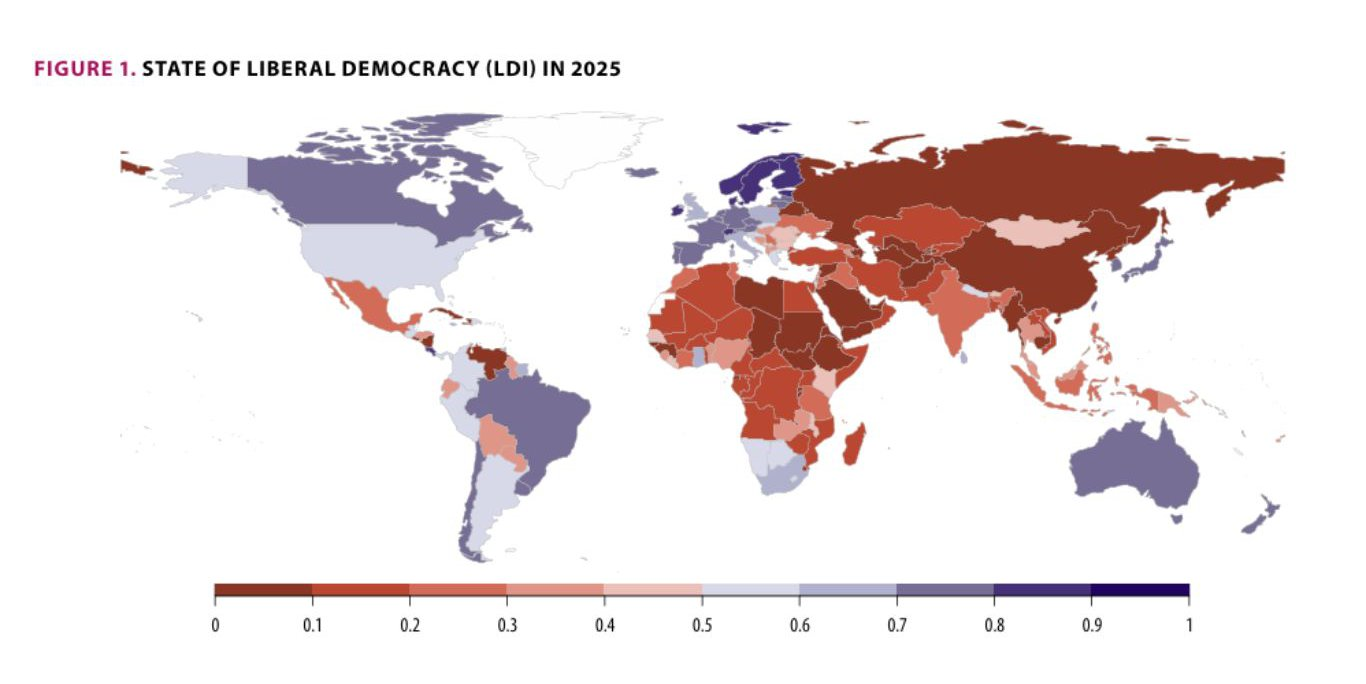
(Source: V-Dem Institute, University of Gothenburg)
Back to 1965 – before the Civil Rights Act, Voting Rights Act, Fair Housing Act. You name it. That’s the finding of the latest Democracy Report from the V-Dem Institute at the University of Gothenburg, which concludes that the USA’s “democratic backsliding is unprecedented.”
Democratic backsliding is now happening in well-established democracies. Democracy in the USA is deteriorating at unprecedented speed, and media and journalists are increasingly targeted across the world. This, and more, is reported in the latest Democracy Report from the V-Dem Institute at the University of Gothenburg. “The U.S. democracy is currently in a much faster deterioration process than any other democracy in modern times. Within only one year, the USA’s score on the V-Dem Liberal Democracy index has declined by 24 percent, while its world rank dropped from 20th to 51st place out of 179 nations.” – Karen Rubin, editor@news-photos-features.com
Nearly a quarter of the world’s nations are going through democratic backsliding, or autocratization, in 2025, and six out of the ten new autocratizing countries identified in the 2026 Democracy Report are in Europe and North America. Among them are large and influential countries like Italy, the United Kingdom and the USA, according to the report authored by a team led by Professor Staffan I Lindberg at the V-Dem Institute, University of Gothenburg.
“The fact that many populous and economically powerful countries are autocratizing is especially worrying. Several of these countries have the economic and political weight to reshape international organizations, norms, and trade, effectively reshaping the global order. I think we are already seeing the effect of that,” says Staffan I Lindberg.
Three major trends in democratic backsliding
The report finds three clear patterns in the current trend of democratic backsliding. The first one is the democratic backsliding in some traditionally stable democracies; the second is significant reversals and often breakdown of democracy in countries that successfully democratized during the late 20th and early 21st centuries; and thirdly, the deepening of autocracy in already autocratic states.
Freedom of Expression, a core aspect of democracy, shows the most drastic global decline, and is the most common target among autocratizing leaders over the past 25 years.
“The second most common target are the liberal aspects of democracy, like rule of law, and checks and balances that prevent the abuse of powers, which are deteriorating in a worrying number of countries. For example, rule of law is deteriorating in 22 countries, including the USA,” says Staffan I Lindberg.
Democracy in the USA deteriorating at unprecedented scale and speed
The U.S. democracy is currently in a much faster deterioration process than any other democracy in modern times. Within only one year, the USA’s score on the V-Dem Liberal Democracy index has declined by 24 percent, while its world rank dropped from 20th to 51st place out of 179 nations.
The liberal aspects of democracy show the largest decline in the U.S. President Donald Trump’s second term can be summarized as a rapid concentration of powers in the presidency, according to the report.
“The current U.S. administration has been undercutting institutionalized checks and balances, politicizing civil service and oversight bodies, and intimidating the judiciary, alongside attacks on the press, academia, civil liberties, and dissenting voices,” says Staffan I Lindberg.
Since election specific indicators are only evaluated during national election years, there has not been a change in those indicators in 2025 for the U.S.
“The 2026 American midterm elections will be a critical test for the quality of elections, and democracy, in the United States. If election indicators also decline, the U.S. will fall even further,” says lead author Professor Staffan I Lindberg.
Trump Action Tracker
The report finds that since returning to office, Trump has had 2651 instances of Actions & Statements that Echo Authoritarian Regimes:
-704 Directly Undermining Democracy
-459 Weakening Civil Rights
-689 Suppressing Dissent
-172 “Hollowing the State”
(V-Dem Institute, University of Gothenburg)
The democratizers
On a more positive note, the report shows that 18 nations worldwide (10 percent) are currently democratizing, with large countries such as Brazil and Poland continuing their democratization processes. In the majority of these countries, media freedom is improved. Botswana, Guatemala, and Mauritius are the three new democratizing countries identified in the 2025 data.
WASHINGTON—The Century Foundation and Nate Schenkkan, Freedom House’s former director of research, announced the development of a new democracy index, United States Democracy Meter, which finds that the U.S. government under Trump in 2025 “slid well into authoritarianism.” While other established indices have previously found the United States to be gradually declining over the past twenty years, no measure has yet tracked the historic collapse of U.S. democracy on the scale we’ve seen in the last 12 months.
Based on in-depth analyses of the health of state institutions, non-state sectors, individual rights and elections, Century’s Democracy Meter scored the U.S. at a 57 out of 100 this year, down from 79 in 2024—an astonishing 28 percent drop in just one year, a decline so large that it’s typically only seen when countries have coups, our researchers say. To put this in context, our analysis suggests U.S. democracy is at greater risk than at any time since Watergate, and it may even be approaching its pre-Civil Rights Movement lowpoint.
“It’s no secret to anyone watching the world around them that America is suffering from a surge in authoritarianism,” said Nate Schenkkan, the report’s lead author. “But seeing it all laid out—especially against the backdrop of what’s happened in 2026 so far—is staggering and should force everyone to think about how seriously we take preserving and restoring our democracy.”
“Our democracy is not self-executing. Failing to vigorously defend and improve it only sows the ground for authoritarian movements and actors,”said Thanassis Cambanis, Director of Century International and coauthor of the report. “While it’s clear that authoritarianism has taken hold in America, we are not without recourse through elections and mass mobilization.”
The report reveals that the core problem for the United States is the expansion of the executive branch’s powers, aided by a Republican-controlled Congress’s acquiescence and abetted by a highly ideologically aligned Supreme Court. More than half of America’s overall drop in score was in the evaluation of the category “state institutions,” which covers the executive branch, Congress, the judiciary, and grand corruption. This category fell from 22/30 points to 10/30.
The only category that did not have a decline was elections, with the score holding at 12/15 both years, as the lack of federal authority over election administration has so far prevented the Trump administration from changing the rules of the game. Elections can still be a means of contesting and changing power.
“American democracy is at greater risk than at any time since Watergate, and it may even be approaching its pre-Civil Rights Movement lowpoint.
“The U.S. government has become authoritarian in its intentions and its practices, even if it cannot always achieve its authoritarian goals.”
Alarming but Not Irreversible
“The swift decline of U.S. democracy this year is alarming. It is the result of choices by the right wing of American politics, which is committed to transforming the state from the inside out, and complacency, particularly from elite institutions, about the risk of authoritarianism. Importantly, however, the right wing has not yet succeeded in consolidating an authoritarian system. The United States’ size and diversity, tradition of independent civil society, its wealth, and its decentralized electoral system all make it difficult to keep power.
“The typical post-World War II democracies to which the United States is most often compared—Canada, Japan, and those in Europe—have not had these sorts of democratic declines. Other less healthy democracies have experienced similar collapses, but only after coups, attempted coups, or major shocks. The democratic decline in the United States over the last year is remarkable in modern history.
“The first priority for action is to defend the areas that are still robust, and will be needed for democracy to make a comeback. Media, civil society, and the protection of individual rights are essential to halting and then reversing democratic decline. For the opposition to have a chance of winning power, the electoral system needs to be sustained. These institutions need to be protected through legal campaigns, but also through protests, donations, and individual choices.
“The second priority—possible to pursue if there is a change in political power—must be to remedy the gaping structural weaknesses in the U.S. system. The executive’s ability to enact such rapid and extralegal changes in such a short time has been conditional, first and foremost, on the Supreme Court’s highly partisan tilt and the Republican Congress’s abdication of its role. Neither branch has acted to check the executive, and have mostly supported it running roughshod over the law and the constitutional order. When even federal judges are no longer extending to the government the “presumption of regularity,” and are expressing frustration that the Supreme Court operates without clear reasoning, the system is broken.
“Democracy is not self-implementing. Without decisive action to address these issues, it will remain vulnerable to concerted efforts to undermine it. The first responsibility is to defend democracy, and the second one is to rebuild it.”
See the report: https://tcf.org/content/report/centurys-new-democracy-meter-shows-america-took-an-authoritarian-turn-in-2025/
Berlin – Freedom is in retreat worldwide. Have pluralism, freedom and democracy had their day? What role do economics, technology and the media play? How do we defend freedom? Berlin, a city that stands for freedom and the overcoming of dictatorship like no other, is hosting the Berlin Freedom Conference, 10 November 2025, Gasometer (EUREF Campus) to address these difficult issues.
The event is open to the public. Tickets are available from 19 euros.
The more than 60 international speakers include Masih Alinejad (Iranian women’s rights activist and president of the World Liberty Congress), Garry Kasparov (world chess champion, Chairperson of the Renew Democracy Foundation and outspoken critic of Putin), Leopoldo López (Venezuelan opposition leader and co-founder of the World Liberty Congress), Oleksandra Matviichuk and María Corina Machado (both Nobel Peace Prize laureates, with Machado joining virtually), the legitimate President of Venezuela, Edmundo González Urrutia and Audrey Tang (Taiwan’s digital ambassador), winner of the Alternative Nobel Prize.
German politicians participating include Bundestag President Julia Klöckner and Education Minister Karin Prien. The patron is the Governing Mayor of Berlin, Kai Wegner. Evelyn Zupke (former civil rights activist and SED victims’ commissioner at the German Bundestag) will open the conference by drawing parallels between today’s struggle for freedom and democracy and Berlin’s historical legacy, the peaceful revolution and the fall of the Berlin Wall. For 1989 showed that democratic change is possible and walls can come down – even those of today.
Important voices for freedom and democracy
Other international guests at the Berlin Freedom Conference include Prof. Dr. Michael Hüther (Director of the German Economic Institute), Larry Diamond (Professor at Stanford University) and Annie Boyajian (President of Freedom House). Lithuanian politician Mantas Adomėnas represents the Community of Democracies as its Secretary General.
International human rights lawyers Brandon Silver and Irwin Cotler (former Minister of Justice of Canada) will speak about supporting political prisoners.
The role of business and global cooperation will be discussed by Mariana Oleskiv (European Affairs Advisor to the World Travel and Tourism Council), Franziska Giffey (Berlin Senator for Economics, Energy and Public Enterprises) and Ulrich Reuter (President of the German Savings Banks and Giro Association), among others.
Speaking in defence are Ben Hodges (former Commanding General of the US Army in Europe), Damon Wilson (President of the National Endowment for Democracy) and Major Philipp Wolf (German-French Corps).
Audrey Tang, Taiwan’s cyber ambassador, first minister for digital affairs and winner of the alternative Nobel Prize, the Right Livelihood Award, and Lieutenant Yulia Mykytenko of the Ukrainian Army will speak about the connection between freedom and technology, media and artificial intelligence. Other guests include Ahmad Ahmadian (President of Holistic Resilience) and Hannah Neumann (Member of the European Parliament).
The significance of art for freedom is discussed by Chinese exile artist Badiucao and American journalist and author Melissa Chan.
A stage for 5-minute ideas: courage meets practice
Another special feature of the Berlin Freedom Conference programme is the “Ignite Talks” format: on stage, personalities from various fields present their “Freedom Ideas” – new perspectives, initiatives and practical solutions – in five-minute, concise short presentations. The format underlines the conference’s claim to not only discuss freedom, but to actively shape it.
Berlin as a stage for freedom
The Berlin Freedom Conference is part of Berlin Freedom Week, which begins on 8 November and features more than 130 events at over 80 locations throughout the city, bringing freedom to life in both the past and the present. The initiative stems from the World Liberty Congress, whose two-day general assembly will take place on 8 and 9 November in Berlin’s House of Representatives. Around 200 dissidents and democracy activists from over 50 autocratically ruled countries will gather there. In doing so, the city is sending a strong signal to the world: those who are oppressed and persecuted elsewhere will find a parliament in Berlin.
Initiators, media partners and sponsors
The patron of the Berlin Freedom Conference is Berlin’s Governing Mayor Kai Wegner. The Berlin Freedom Conference is a joint initiative of visitBerlin, the Axel Springer Freedom Foundation and the World Liberty Congress, the largest global democracy alliance with more than 200 dissidents from over 50 autocratically ruled countries around the world.
The Berlin Freedom Conference is sponsored by the LOTTO Foundation Berlin, with Airbnb and Berliner Sparkasse as sponsoring partners. The media partners are Die Zeit, Politico, radio3, Tagesspiegel, Wall GmbH and Welt. Details and the programme can be found at berlin-freedom-conference.com and berlin-freedom-week.com; Instagram: @berlinfreedomconference and @berlinfreedomweek.
Berlin Freedom Conference The Berlin Freedom Conference will take place for the first time on 10 November 2025 at the Gasometer Schöneberg. It will bring together leading voices from politics, business, civil society, culture, and the media to launch new democratic alliances and powerfully advance the global commitment to freedom and democracy. More information and tickets at berlin-freedom-conference.com.
Berlin Freedom Week
Berlin Freedom Week (8–15 November 2025) is a new event week that focuses on the idea of freedom. With a diverse programme of conferences, art, culture and public dialogue, it aims to inspire Berliners and international guests and promote exchange on the importance of democratic values in today’s world. berlin-freedom-week.com and visitBerlin.de/de/berlin-freedom-week
World Liberty Congress
The World Liberty Congress is the largest global democracy alliance, with more than 200 dissidents from more than 50 autocratically ruled countries around the world. It will take place on 8 and 9 November in the Berlin House of Representatives. Its goal is to support the fight for freedom in autocratic regimes, promote international solidarity and develop a common strategy for the advancement of democracy. worldlibertycongress.org
Axel Springer Freedom Foundation
The Axel Springer Freedom Foundation is a non-profit organisation that supports human rights defenders from countries where freedom is restricted. Defending freedom and democracy and showing solidarity with those who live and suffer under authoritarian rule were always guiding principles for our company founder Axel Springer, and the Axel Springer Freedom Foundation is continuing his legacy with renewed determination. Supported by a strong advisory board of experienced human rights defenders, the Axel Springer Freedom Foundation organises events, installations and publications. It also collects donations to directly support the work of dissidents and their organisations. freedom.axelspringer.com
visitBerlin “Inspiring the world for Berlin.” With this mission, Berlin Tourismus & Kongress GmbH promotes Berlin’s destination management as well as the city’s tourism and congress marketing. Under the visitBerlin brand, the company is a partner, actor, source of creative ideas, and networker. Its remit is focused on sustainable product development and marketing city-compatible tourism services in all twelve Berlin boroughs with the aim of maintaining the life quality of local residents and harmoniously increasing experience value for visitors. As a tour operator, visitBerlin also issues the Berlin WelcomeCard, the city’s official tourist ticket. The company also operates the Berlin Tourist Info Centres and the Berlin Service Center advice line on +49-30-25 00 25. On visitBerlin.de, Berlin’s official tourism website, visitors can find all the information they need on every aspect of their trip to the city. Find out more about visitBerlin on about.visitBerlin.de
Each year for the past 20, there has been a respite, an oasis of hope, positivity, possibility and promise: the Clinton Global Initiative (CGI). The invention of the Clinton Foundation, CGI devised a platform and mechanisms to actually solve the most intractable problems confronting the world, that politicians love to talk about but are too hamstrung to.
Each year there were challenges to overcome, but this year, there was an unusual pall over the gathering as the reality of backsliding on all the progress that has been made in health care, clean air and water (which 3 billion people lack), democracy, free press, conflict resolution, education, poverty, women’s rights and empowerment, gender rights, climate change, global migration. In many ways, there were the same topics of 20 years ago, but instead of focusing on the crisis in democracy, free press, disease and health care in developing countries across oceans, there was equal focus on the USA.
In the past, there have been American administrations which did not further the aims of a more just, equitable future in which each could fulfill their potential, but never in the past was an administration using the might and wealth its predecessors built to actively undermine and reverse the progress of 150 years.
They are up against huge forces – the US with just 5% of the world’s population, has amassed 35% of global wealth and generates 14% of the carbon emissions (down from 20% thanks to Obama and Biden) that so endanger public health, food and water supply, and created the disasters that forced millions to flee their homes, creating the migrant crisis that has destabilized liberal democratic governments.
The conference convened just a day after Donald Trump, who has made good on his fantasy to tear up the Constitution and become a “dictator on day 1”, who effectively made illegal DEI (Diversity, Equity, Inclusion – foundational principles of CGI) and who clawed back billions in foreign aid and humanitarian aid, and withdrawn from agencies including the World Health Organization, addressed the United Nations (a “failed” organization). Trump told the General Assembly that climate change was a “hoax” and a “green scam” and that as nations, they should do what the US has done: evict migrants and shut their borders to refugees in order to preserve their “heritage” and nationhood or else, “your countries are going to hell.”
In the final CGI panel discussion, “We’re Next,” Tedros Adhanom Ghebreyesus, Director-General of the World Health Organization (WHO), recalled where he was on the day he heard (was not informed by Trump) that the USA, its largest donor, was withdrawing and taking with it its funding, immediately – not in six months to give the WHO time to reorganize. He noted that where he was when he heard was in Sana’a, capital of Yemen, when Israel bombed it, killing someone close to him and wounding others. It triggered memory as a child of war in his native country of Ethiopia –“the smell, image, even the sound” – when close relatives were killed, and reignited the PTSD.
“In 2020, with the first US withdrawal, the first round of cuts came, and war in my country and Covid. it was difficult situation. but if there is one thing that But I try to see what is beyond my control and focus on what I can do. It encourages me encourages me to do more as an individual.” And so he will figure out a way for the World Health Organization to continue to function.
Another child of war, President Vjosa Osmani of Kosovo told President Bill Clinton, that it is peace and democracy that brings economic prosperity and progress (not tariffs and authoritarianism). “When you never take your freedom, your freedoms for granted, when you focus on the rule of law, democracy, human rights, then economic empowerment and prosperity comes. What you stand for in the most difficult times matters.”
But in inimitable fashion, the Clintons set a tone of positivity and everyone set out with renewed resolve, determination and resilience to figure “workarounds” to the unprecedented challenge.
CGI, offered panels themed “A Critical Moment for Humanitarian Response,” “Protecting Progress, Prevention and Management of Infections and NonCommunicable Diseases,” “A New Blueprint for Global Health,” “New Approaches to Climate Finance,” “Bold Solutions for Effective Philanthropy,” “Protecting Truth and Information in a Fractured World,” “Putting People First,” all asking the question, “What’s Next,” and, finally, “We’re Next.” It went back to an earlier framework to focus on “working groups” – small groups focused around a particular issue to bring together NGOs, business entities, philanthropists, activists and experts who could form partnerships to fulfill innovative commitments.
Matt Damon, the acclaimed actor, relayed how Clinton Global Initiative 17 years ago helped him realize his goal of bringing safe water and sanitation to the millions upon millions of people who lacked such basic necessities. CGI introduced him to Gary White, an engineer, who also had no idea how to achieve that goal, and together they formed Water.org.
“It was like a first date – nervousness, awkwardness. But we realized that together could do a lot more than on own and really scale.” The first year’s CGI commitment was to build systems to serve 100,000. “Innovation-led, partners would follow. We got bigger and the numbers ran up. We hoped to reach 1 million a year. Today, we reach 1 million every six weeks.
“Our current commitment is already underway. In 2022, we pledged to help 100 million in Africa, Asia, and Latin America gain access to water, sanitation. We have already reached more than 30 million people who no longer have to take long walk for water.
“For Gary and me, CGI was the start. We thank President Clinton for introducing us, inspiring us to think better and doing all he can to help us reach those goals. There is more distance to go, with more than 2 billion people who lack access to safe water; 3 billion to sanitation.”
It was an invitation for others to join the partnership, or form their own, which is the essence of CGI.
We saw it in real time when Hawaii Governor Josh Green, on the “Investing in Community Resilience” panel with Jennifer Pryce, CEO of Calvert Impact Capital, learned about new ways to multiply the benefit of Hawaii’s newly imposed climate fee on visitors through community development bond instruments such as issued by Calvert Impact. Hawaii hopes to use the fee (about $3 on a $400/night hotel stay) to bond out $2 billion which will go to sustainability, environmental protection, prevention, resiliency (helps with insurance costs), and to sustain tourism, replenish coral reefs and beaches.
4,200 Commitments, 500 Million People, 180 Countries, 10,000 Partners
This year President Bill Clinton, Secretary Hillary Rodham Clinton, and Foundation Vice Chair Dr. Chelsea Clinton concluded the Clinton Global Initiative (CGI) 2025 Annual Meeting with the launch of 106 new Commitments to Action.
Since President Clinton founded CGI in 2005, the convening has asked attendees to come with Commitments to Action — specific, measurable partnerships and projects that address an urgent global challenge (there are regular reports issued).
Over the last 20 years, members of the CGI community across business, philanthropy, and government – more than 10,000 organizations and individuals – have partnered to launch more than 4,200 commitments that have improved the lives of more than 500 million people in over 180 countries. As a result of these partnerships:
Nearly 78 million people have improved access to financial services or capital.
More than $1.6 billion has been invested or loaned to small- and medium-sized enterprises.
Nearly 2.7 billion metric tons of CO2 were cut or abated.
More than 402 million acres of forest have been protected or restored.
Nearly 4 million clean jobs have been created.
More than 130 million people can more easily access maternal and child health and survival programs.
Nearly 38 million people can more easily access safe drinking water and sanitation.
More than 36 million people have received treatment for neglected tropical diseases.
More than $362 million in research and development funds has been spent on new vaccines, medicines, and diagnostics.
A bold opening address by President Clinton, condemning political violence, defending free speech, the free press and democracy, and how to bring the divided country together.
The Clinton Health Access Initiative (CHAI), along with Unitaid, Wits RHI, and Dr. Reddy’s Laboratories, announced a groundbreaking agreement on HIV prevention to dramatically open access to lenacapavir, a revolutionary medicine that effectively prevents HIV transmission with two injections a year. Under the CHAI-negotiated deal, this will be affordable and available for just $40 per year in 120 low- and middle-income countries by 2027.
Secretary Clinton marked the 30th anniversary of her remarks at the UN World Conference on Women, and announced a new Commitment to Action – a landmark report by the Women’s Initiative at Columbia SIPA’s Institute of Global Politics (IGP) and GWL Voices: Beijing+30: A Roadmap for Women’s Rights for the Next Thirty Years. The report outlines policy priorities critical to advancing the full and equal participation of women and girls in the twenty-first century, including in the areas of democracy and human rights, technology, economic participation, and conflict and climate.
Dr. Chelsea Clinton spoke with Audrey Tang, the cyber Ambassador of Taiwan, about overcoming polarization, how the public views democracy, and the importance of media literacy.
The Clinton Presidential Center, along with the City of Little Rock and ENFRA, announced a partnership to build the Clinton Sustainable Energy District (CSED) to offset carbon emissions and reduce utility costs through a new district energy system and a 5-megawatt solar array.
This year’s CGI Annual Meeting was reimagined to promote collaboration through Working Groups – facilitated, action-focused sessions where leaders will collaborate with mission-aligned organizations to drive real solutions in the areas that matter most and are under the greatest threat. Secretary Clinton announced progress from these Working Groups that CGI will build action on in the coming years and months:
Out of the Innovative Finance Working Group, Kiva Microfunds will launch a new social enterprise fund of at least $10 million in 2026, in partnership with corporate foundations.
The Health Working Group focused on using AI to overcome systemic gaps in chronic care; one project that came out of this group will expand maternal telehealth in Zimbabwe.
In the Education Working Group, the Clinton Foundation’s Too Small to Fail initiative and UNIDOS US led a conversation about expanding access to early learning. The group is exploring a pilot program in three U.S. cities in 2026 to provide immigrant families with early education resources.
The Human Rights and Democracy Working Group focused on issues including accelerating women’s democratic participation and defending LGBTQ+ rights, and developed ideas from civic education programs for at-risk youth in Northern Ireland to anti-authoritarian initiatives worldwide.
Members of the Climate Working Group dug into the tough realities of climate change and mapped out bold plans, including creating a water fund to unlock economic opportunities for millions; building climate adaptation hubs across the tropical belt, starting at COP30 in November; and opening new markets to support regenerative farmers.
The Economy Working Group focused on challenges like the care economy and access to capital. Out of that discussion came a commitment to launch a Global Network for National Service that will strengthen, expand, and scale national service programs around the world.
The Truth and Information Working Group discussed ways to cut through misinformation and focus on building community. In the next year, a top priority will be advocating for state and local leaders to enact responsible regulations on tech platforms and give users more ownership over their data.
The Humanitarian Response Working Group emphasized the need for innovation, preparedness, and localized responses to humanitarian crises around the world; with action items including a shared information system among responding NGOs, new funding opportunities, and innovative research-based tools.
President Bill Clinton, Secretary Hillary Clinton and Dr. Chelsea Clinton award the Clinton Global Citizen Award to entrepreneur and philanthropist B. Thomas Golisano for his transformative philanthropic work, including contributing $900 million to disability services, education, animal welfare, healthcare and numerous other community focused non-profits. Golisano was also an early supporter of the Clinton Global Initiative.
President Clinton also awarded the Clinton Global Citizen Award to entrepreneur and philanthropist B. Thomas Golisano for his transformative philanthropic work. As Founder of Paychex, a human resources software and service provider for small to medium sized businesses, Golisano has invested in endeavors that advance entrepreneurship and drive the success of numerous businesses and start-ups; he has also made more than $900 million in philanthropic contributions to disability services, education, animal welfare, healthcare — including four children’s hospitals that bear his name; Rochester, Syracuse, Ft. Myers and Buffalo — and numerous other community focused non-profits. Past recipients of the Clinton Global Citizen Award include President Joseph R. Biden, Jr., First Lady of Ukraine Olena Zelenska, Nadia Murad, and Dr. Muhammad Yunus.
Find information on all 106Commitments to Action announced at CGI 2025 at clintonglobal.org.
Twenty years after the launch of the Clinton Global Initiative, President Clinton has issued a stark Call to Action: “Given the scope of the challenges we face, this year’s CGI meeting will be different – by necessity. We need to redefine how we show up, how we work, and how we find ways to honor our common humanity.” Read President Clinton’s Call to Action here.
President Clinton, Secretary Hillary Clinton, and Dr. Chelsea Clinton will convene global leaders for the 2025 CGI Meeting September 24-25 in New York City to chart out “What’s Next.”
Learn more about this year’s meeting, including working group topics and early participants, at https://clintonglobal.org/2025
If you want to be reminded that there is good in the world, that progress to solve the most intransient problems and existential crises of our time is possible, to hear and learn from the smartest, most successful, most accomplished people on the planet, the place to be is the Clinton Global Initiative. Since its founding in 2005, each session has been like an alternate universe to the dystopia contrived by evil forces digging deeper into society and eroding civilization. –Karen Rubin/news-photos-features.com
NEW YORK, NY — President Bill Clinton issued a Call to Action to the Clinton Global Initiative (CGI) community to come together at a re-imagined Annual Meeting this September 24-25 designed to promote collaboration and take action to confront new and worsening challenges on climate, health, the economy, and more.
President Clinton outlined that this year’s meeting will look different than previous years to most effectively confront the challenges of 2025 and lay the groundwork for what’s next:
“The global development community is at an unprecedented crossroads, with growing humanitarian needs, fewer resources, and the landscape changing every day. Given the scope of the challenges we face, this year’s CGI meeting will be different – by necessity. We need to redefine how we show up, how we work, and how we find ways to honor our common humanity. This September, our goal will be to connect dots across issues, expose the consequences, and confront the complicated issues in front of us.”
To tackle these challenges, President Clinton, Secretary Clinton, and Dr. Chelsea Clinton have called together leaders of major charitable foundations, nonprofits, businesses, governments, unions, and more to chart solutions in 2025. More speakers will be announced in the coming weeks; today, CGI announced initial featured participants at the CGI 2025 Annual Meeting:
Heads of State and government leaders including Prime Minister Gaston Browne of Antigua and Barbuda; Prime Minister Philip Davis of The Bahamas; Prime Minister Mia Mottley of Barbados, President Vjosa Osmani of Kosovo, and Amy Pope, Director General, International Organization for Migration (IOM);
Business leaders including Priscilla Sims Brown, President and CEO, Amalgamated Bank, Rolando Gonzalez Bunster, Chairman and CEO, InterEnergy Group; Tim Cadogan, CEO, GoFundMe; James Mwangi, Group CEO, Equity Group Holdings; Daniel O’Day, Chairman and CEO, Gilead Sciences; and Bill Ready, CEO, Pinterest;
Philanthropic leaders including Nancy Lindborg, President and CEO, The David and Lucile Packard Foundation; Patricia McIlreavy, President and CEO, Center for Disaster Philanthropy; Binaifer Nowrojee, President, Open Society Foundations; Maribel Pérez Wadsworth, President and CEO, John S. and James L. Knight Foundation; Karlee Silver, CEO, Grand Challenges Canada; and Darren Walker, President, Ford Foundation;
Nobel Laureates including Denis Mukwege, President and Founder, Panzi Hospital; Maria Ressa, Co-Founder and CEO, Rappler; and Ellen Johnson Sirleaf, Founder and Chair Emeritus, The Ellen Johnson Sirleaf Presidential Center for Women and Development;
Civil society and multi-lateral organization leaders including Nazanin Ash, CEO, Welcome.US; Ann Lee, Co-Founder and CEO, Community Organized Relief Effort (CORE); Lisha McCormick, CEO, Last Mile Health; Michelle Nunn, President and CEO, CARE USA; and Kennedy Odede, Co-Founder and CEO, Shining Hope for Communities;
Global Activists and Advocates including Suyen Barahona Cuan, Executive Director, Colmena Fund; Ai-jen Poo, President and Executive Director, National Domestic Workers Alliance (NDWA) and Caring Across Generations; Liz Shuler, President, AFL–CIO; Randi Weingarten, President, American Federation of Teachers; and more.
CGI 2025 will have a sharper focus on CGI Working Groups – facilitated, action-focused sessions where leaders will collaborate with mission-aligned organizations to drive real solutions in the areas that matter most and are under the greatest threat. CGI Working Groups at this year’s meeting include:
Climate: scaling investment in transformative climate solutions; group leaders and select participants include Sarah Chandler, Vice President, Environment and Supply Chain Innovation, Apple; Reema Nanavaty, Director, Self-Employed Women’s Association (SEWA); and Sophia Kianni, Founder, Climate Cardinals;
Democracy and Human Rights: protecting democratic principles and upholding equality and justice; group leaders and select participants include Suyen Barahona Cuan, Executive Director, Colmena Fund; Gary Barker, Founder and CEO, Equimundo: Center for Masculinities and Social Justice; Mona Sinha, Global Executive Director, Equality Now; and Melanne Verveer, Executive Director, Georgetown Institute for Women, Peace & Security;
Economy: building resilient and inclusive global economic development amid widening inequalities; group leaders and select participants include Chetna Sinha, Founder, Mann Deshi Bank; Priscilla Sims Brown, President and CEO, Amalgamated Bank; John Hope Bryant, Founder, Chairman and CEO, Operation HOPE, Inc.; and Ai-jen Poo, President and Executive Director, National Domestic Workers Alliance (NDWA) and Caring Across Generations;
Education: advancing equitable and quality education for all; group leaders and select participants include Marci Alboher, Chief Engagement Officer, CoGenerate; John MacFee, CEO, JED Foundation; and Randi Weingarten, President, American Federation of Teachers;
Health: safeguarding public health gains and increasing global health equity; group leaders and select participants include Brendan Carr, CEO, Mount Sinai Health System; Tabinda Sarosh, CEO, Pathfinder International; Jeff Sturchio, Chair, Friends of the Global Fight Against AIDS, Tuberculosis and Malaria, and Lisha McCormick, CEO, Last Mile Health;
Humanitarian Response: building response models to be more resilient, collaborative, and adequately resourced; group leaders and select participants include Rez Gardi, Co-Managing Director, R-SEAT; Patricia McIlreavy, President and CEO, Center for Disaster Philanthropy; Ann Lee, Co-Founder and CEO, Community Organized Relief Effort (CORE); Denis Mukwege, President and Founder, Panzi Hospital; and Charlotte Slente, Secretary General, Danish Refugee Council;
Innovative Finance: building investment opportunities for more flexible, impact-driven funding; group leaders and select participants include Vishal Ghotge, CEO, Kiva; Joan M. Larrea, CEO, Convergence; and Karlee Silver, CEO, Grand Challenges Canada;
Truth and Information: revitalizing information ecosystems to uphold trust, truth, and transparency; group leaders and select participants include Dan Foy, Principal, Gallup; Wame Jallow, Executive Director, MTV Staying Alive Foundation; and Maria Ressa, Co-Founder and CEO, Rappler.
The sessions are designed for strategic collaboration, problem-solving, and the development of new CGI Commitments to Action.
This year marks the 20th anniversary of CGI. At the World Economic Forum in Davos in January 2005, President Clinton announced that he would be convening the first CGI meeting that September, timed to the U.N. General Assembly, with the requirement that attendees make a commitment to act on a pressing global challenge. Since then, more than 500 million people in more than 180 countries have had their lives improved by more than 4,000 Commitments to Action launched through CGI.
In his letter to the CGI Community, President Clinton wrote:
“The CGI community is built for moments like this. This year marks two decades of our community convening and responding directly to global crises — from the devastating 2010 earthquake in Haiti; to the U.S. economic downturn in 2009 with the launch of CGI America; to the Ebola outbreaks in 2014, 2015, and 2016; to the Caribbean hurricanes in 2017; to the COVID-19 pandemic; and more. We’ve launched more than 4,100 Commitments that have improved the lives of over 500 million people worldwide.
“We’re drawing on 20 years of lessons, momentum, and partnerships to meet this moment and build what’s next.
“Our programming and our physical space will be designed for action. Our time together will be focused on new working group convenings — sessions where project plans are drafted, commitments are accelerated, and coalitions begin to take root. Every participant will be urged to ask the hard questions, contribute their expertise, and identify paths forward.
“Now is the time to stand up and roll up our sleeves — and do our part to reverse the trend lines and begin charting a brighter future.”
Learn more about this year’s meeting, including working group topics and early participants, at https://clintonglobal.org/2025
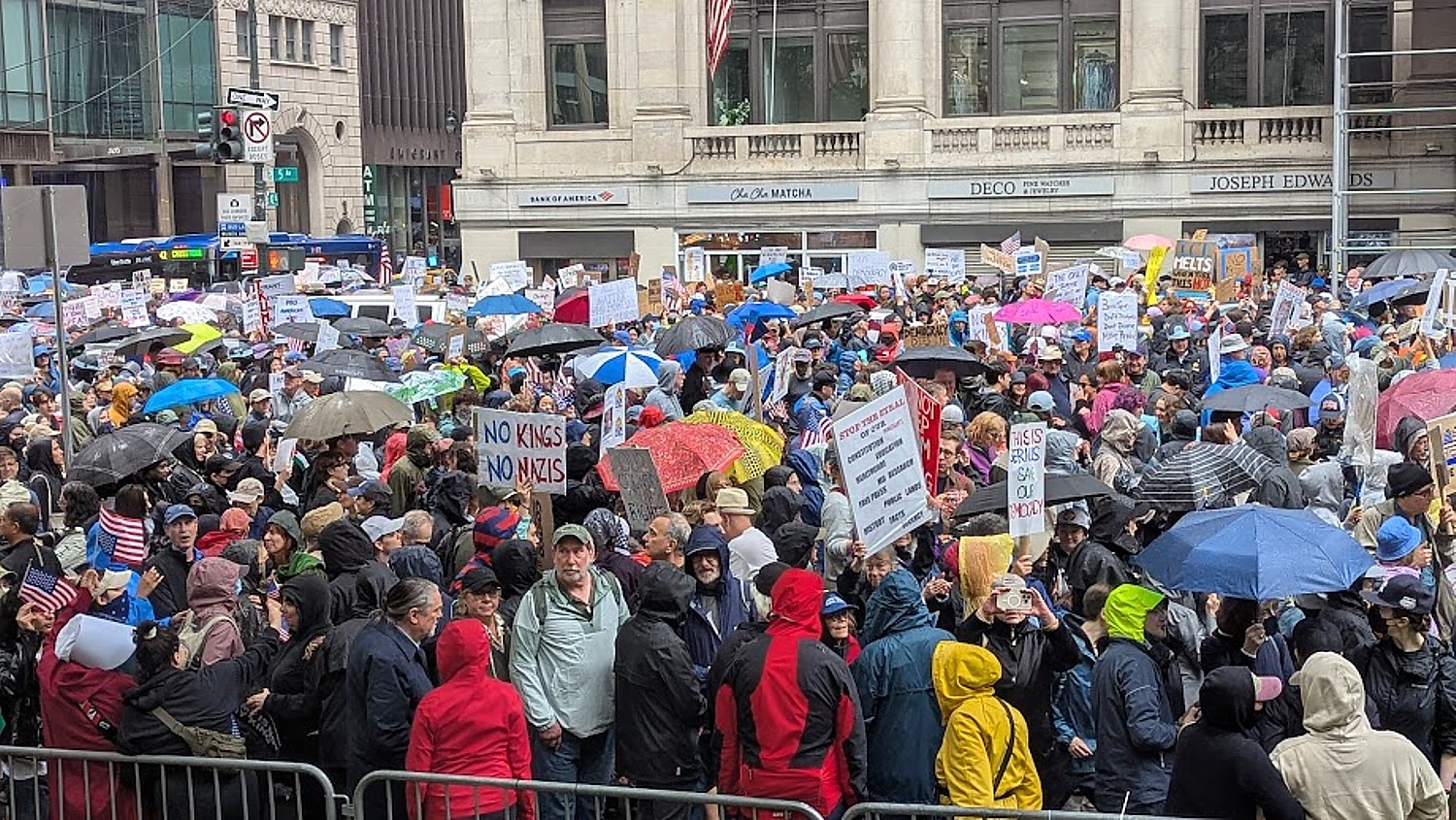
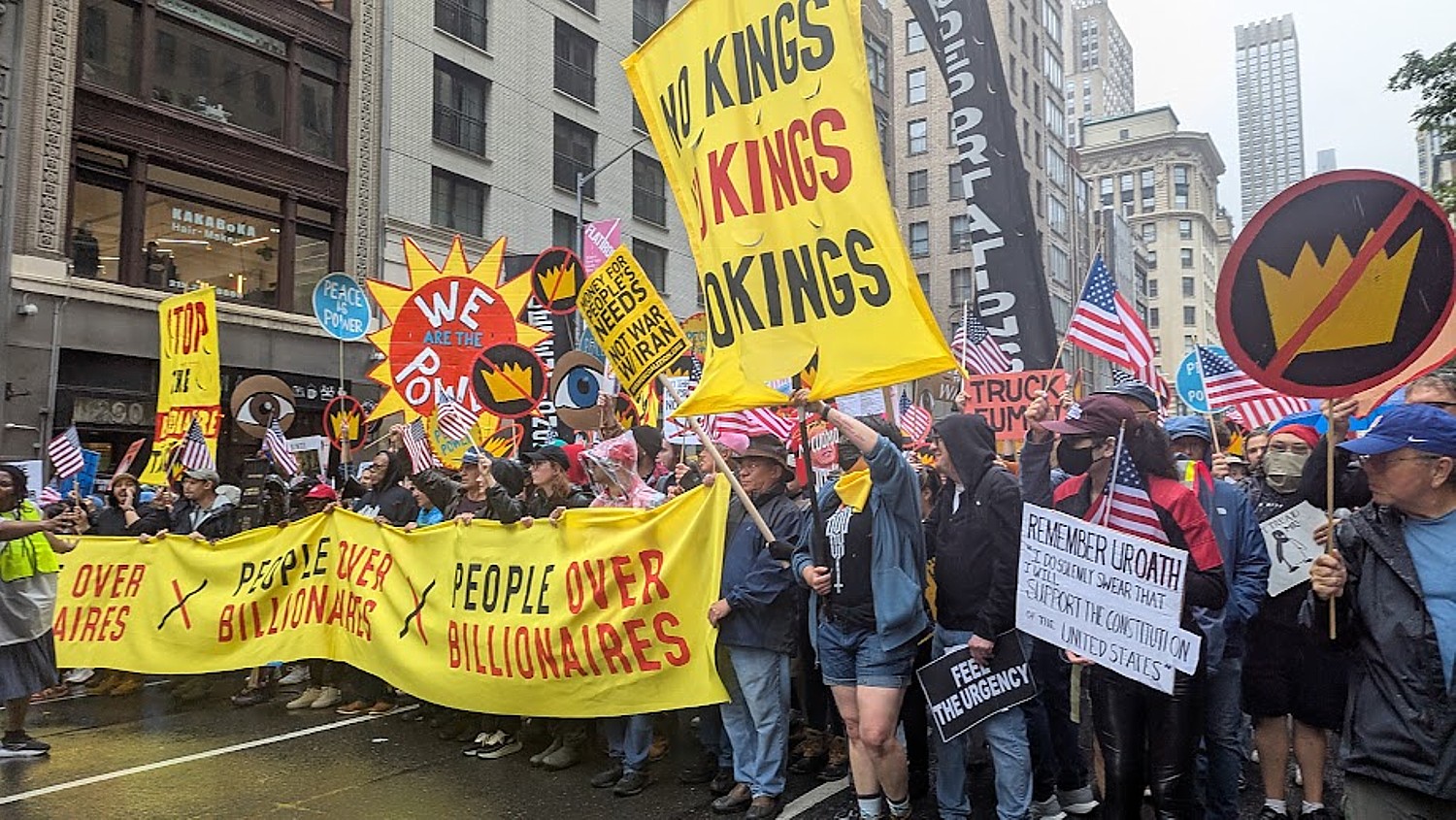
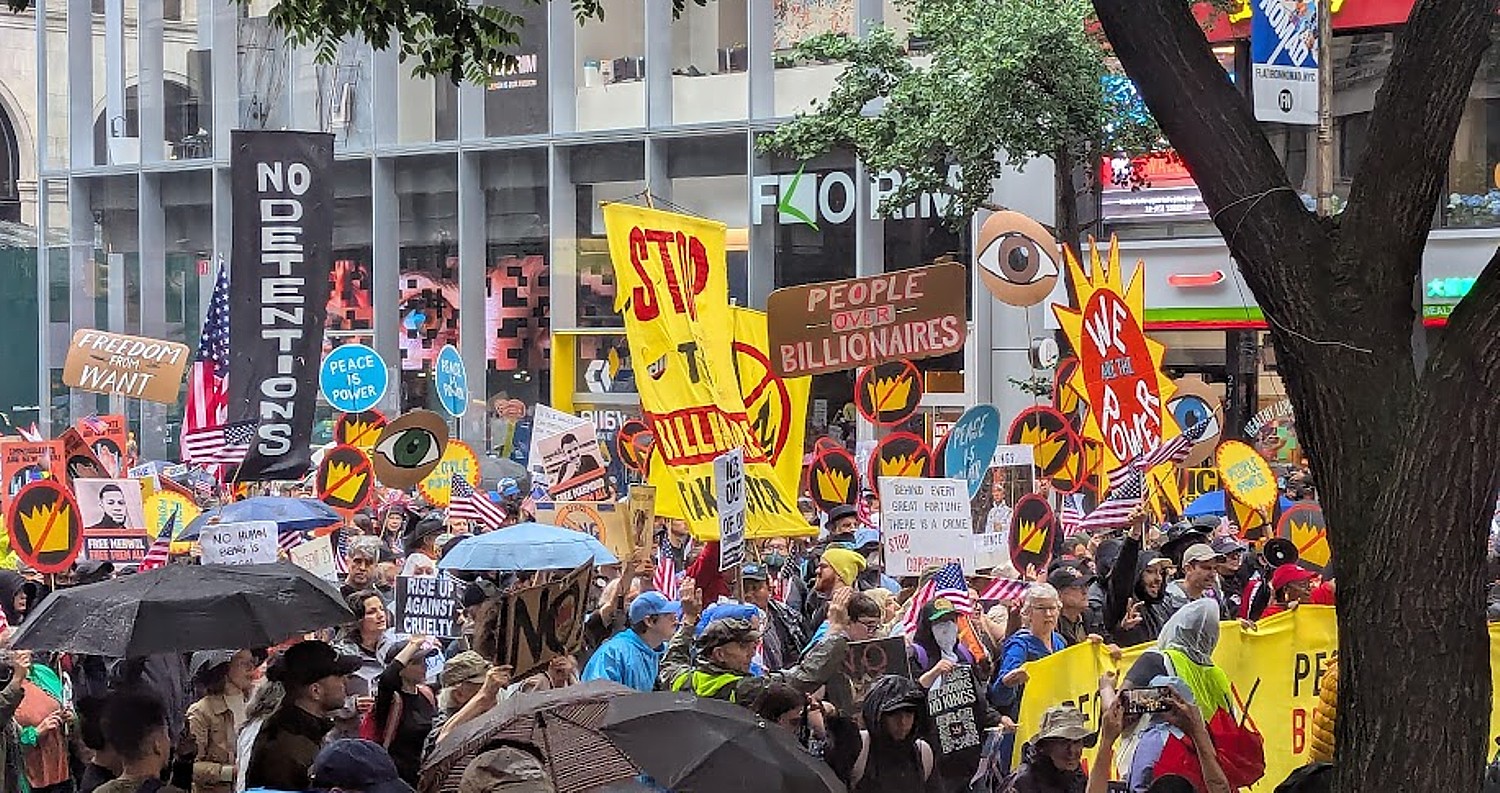
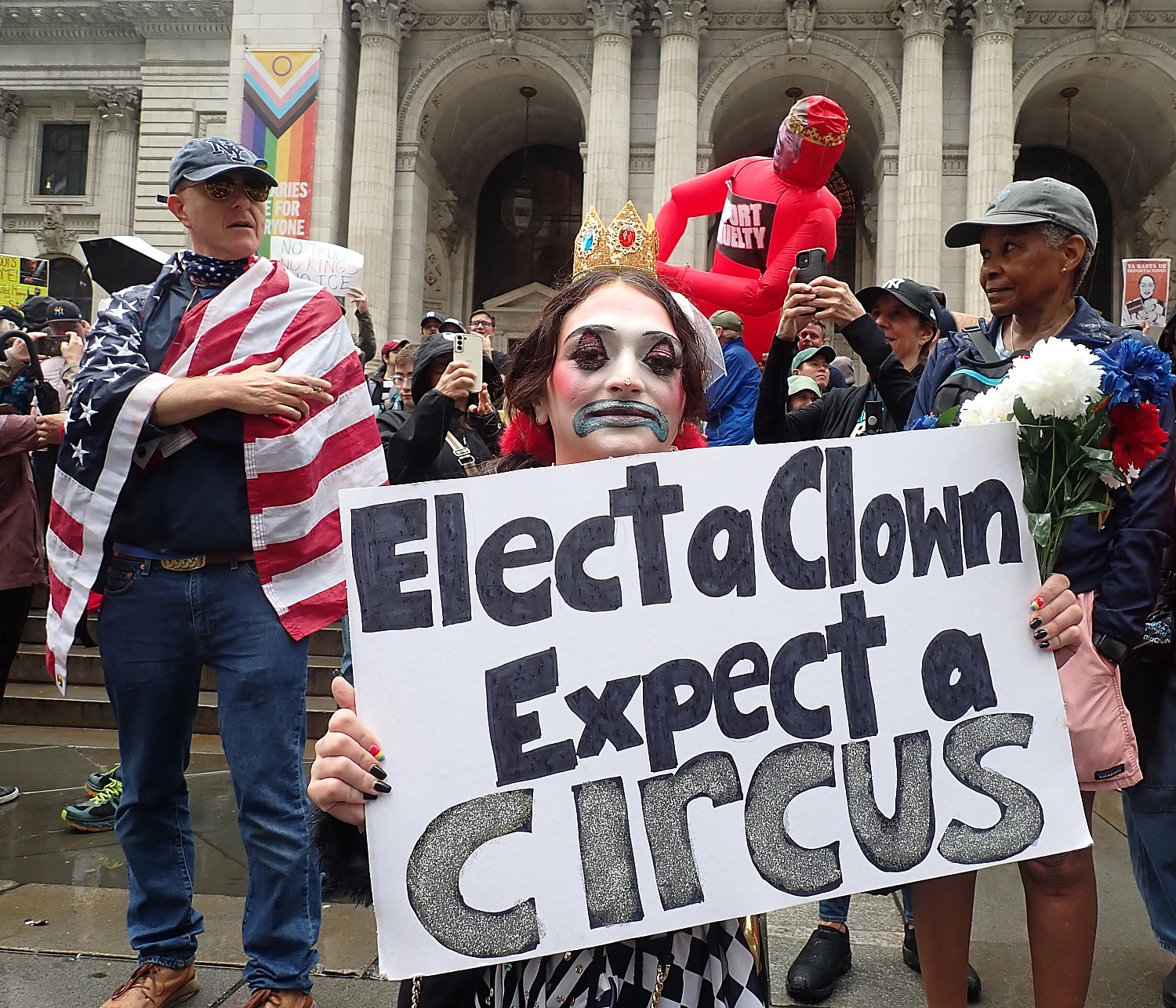
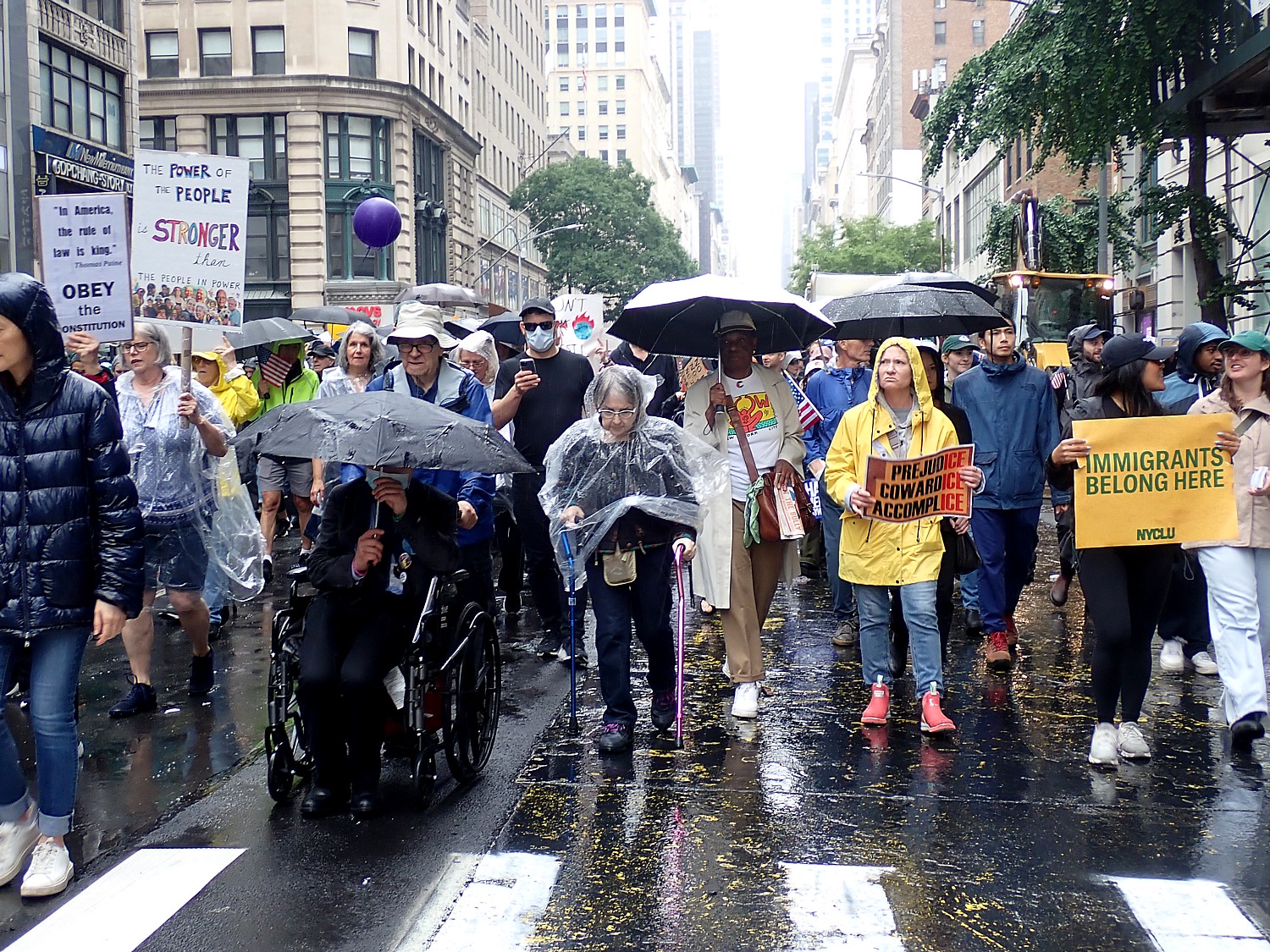
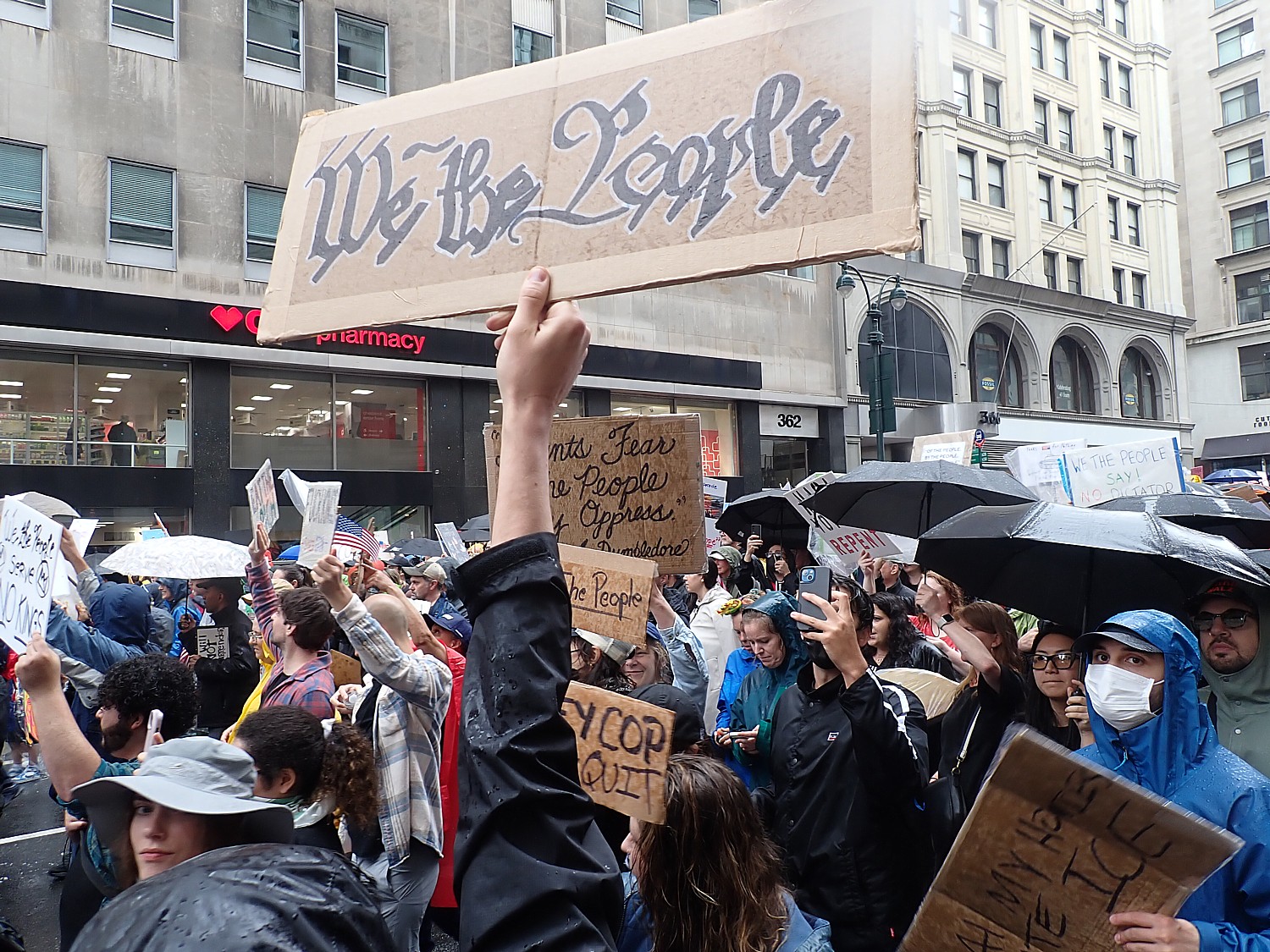
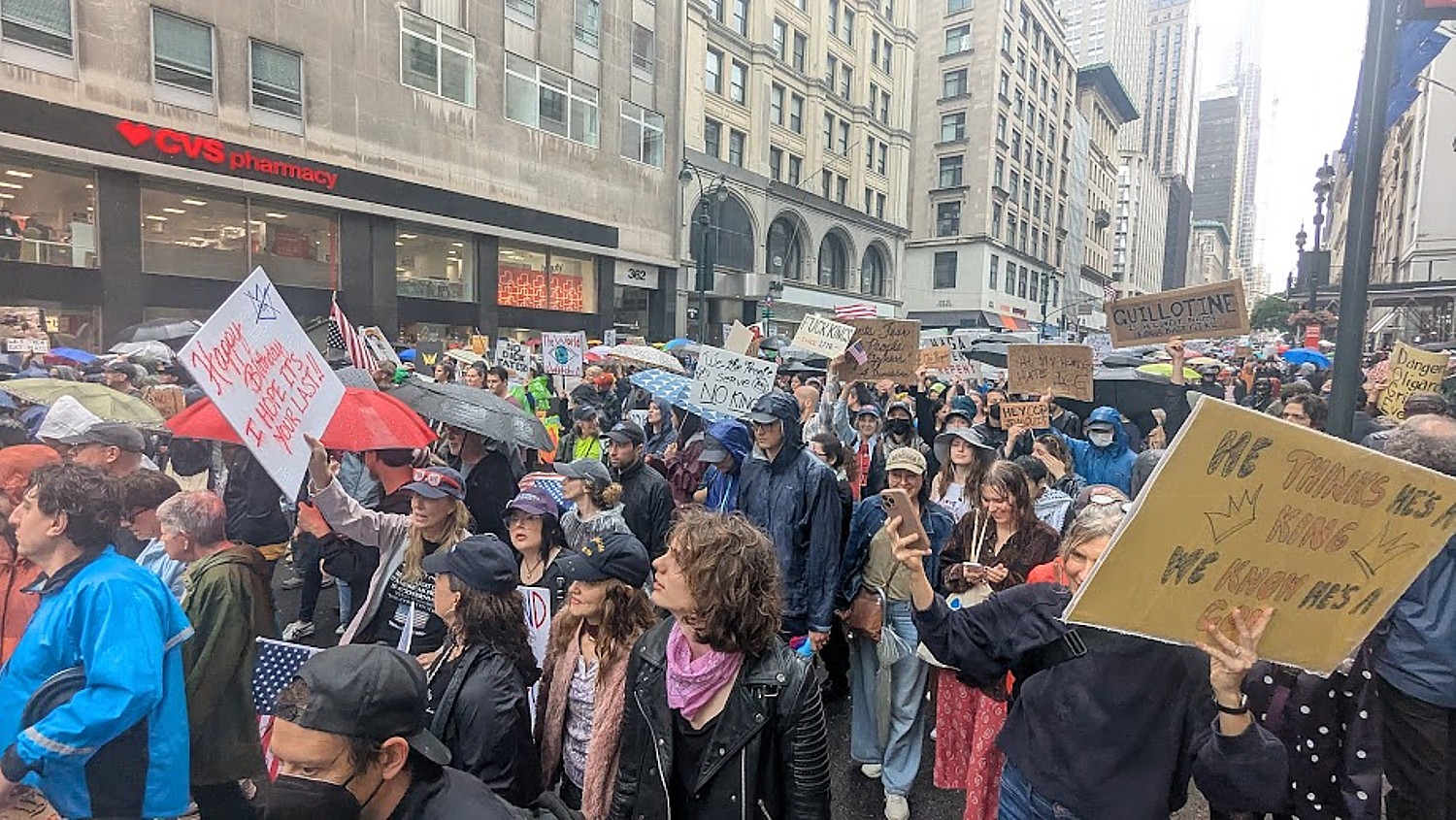
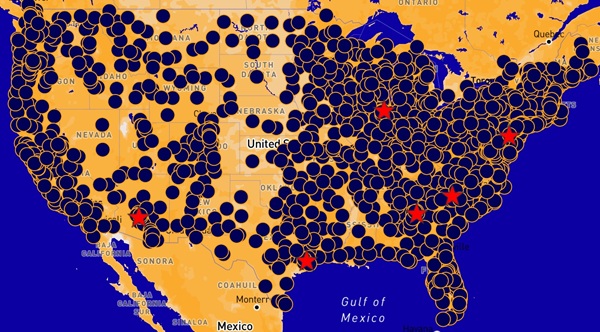
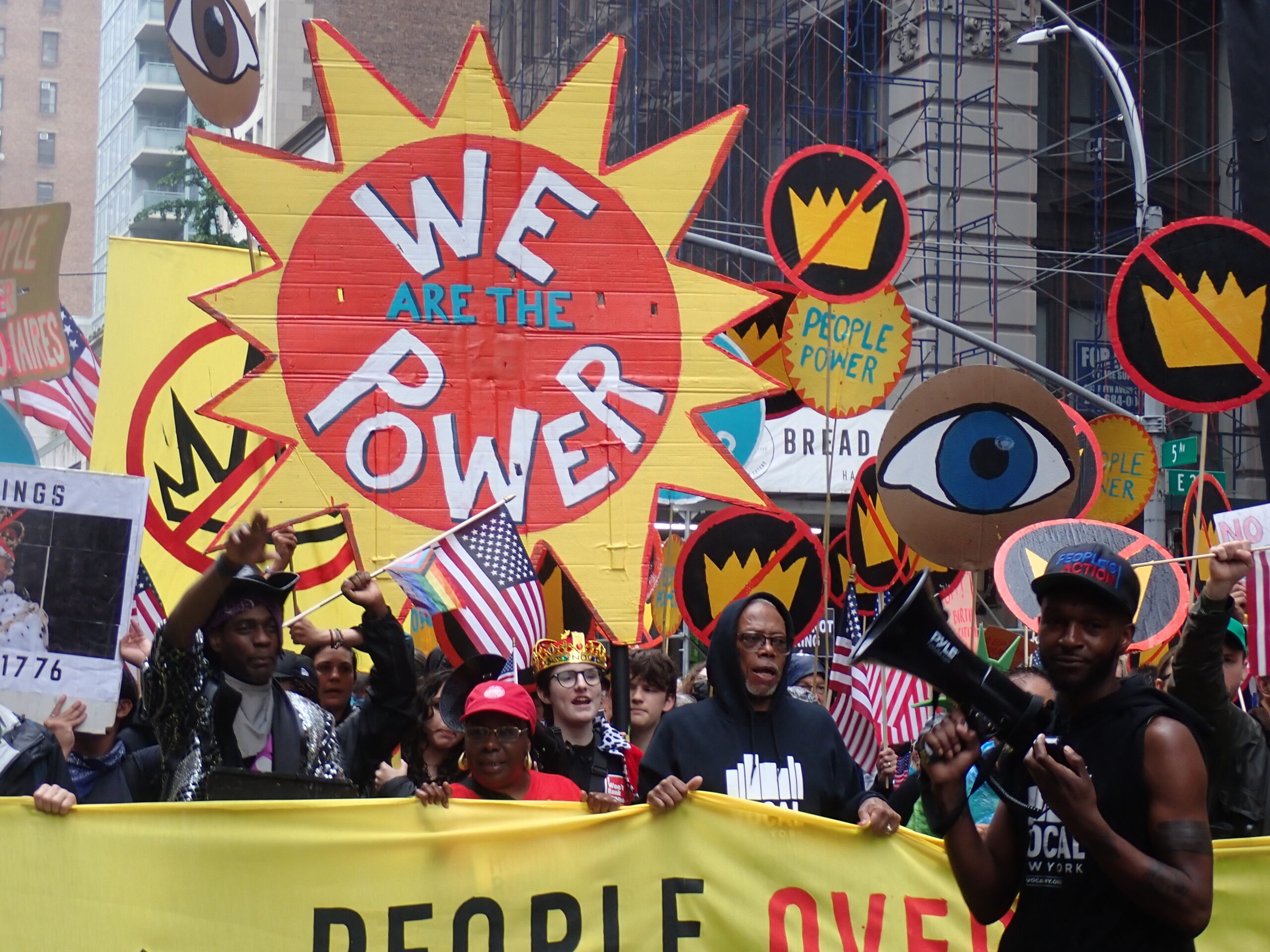
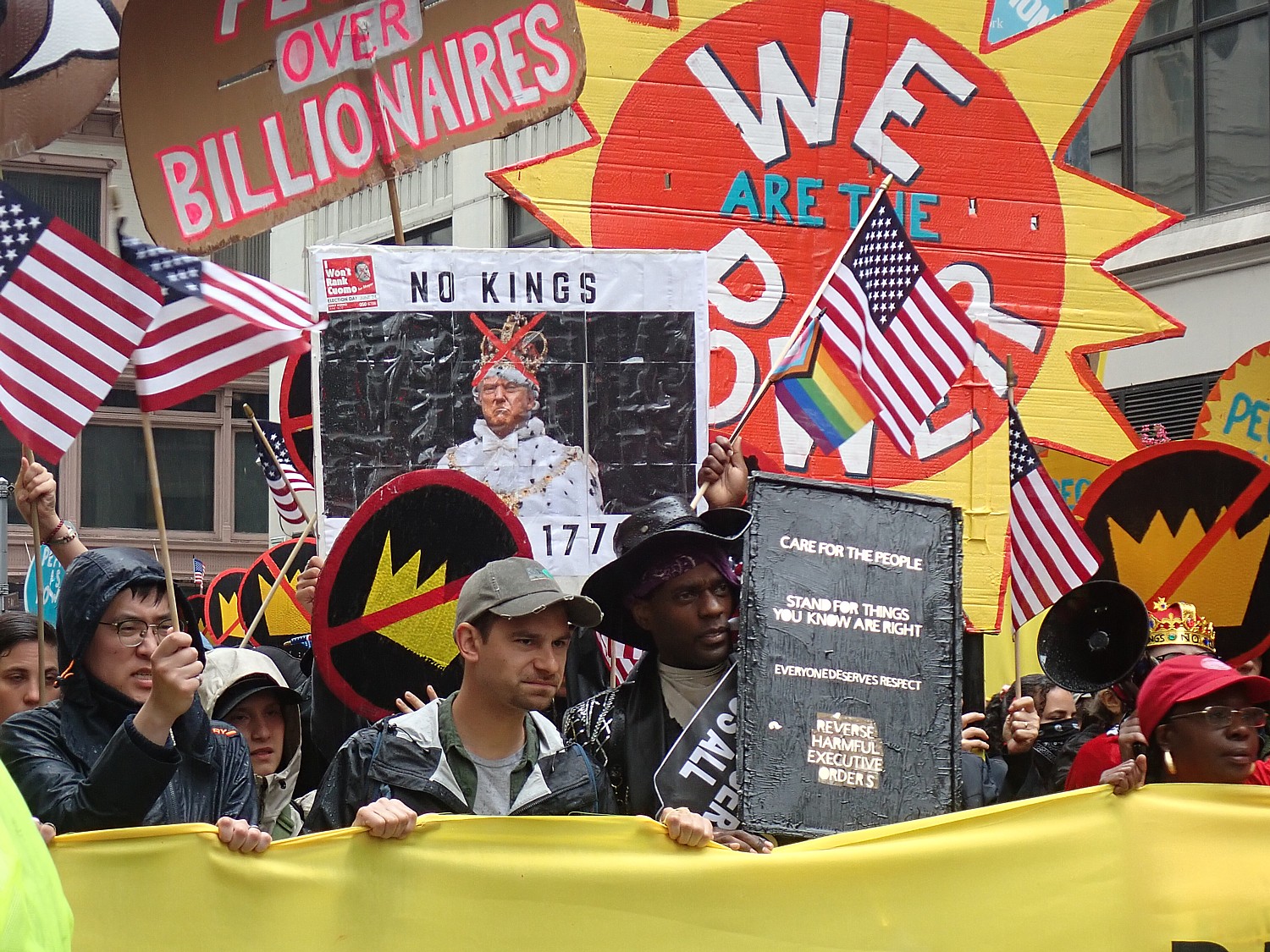
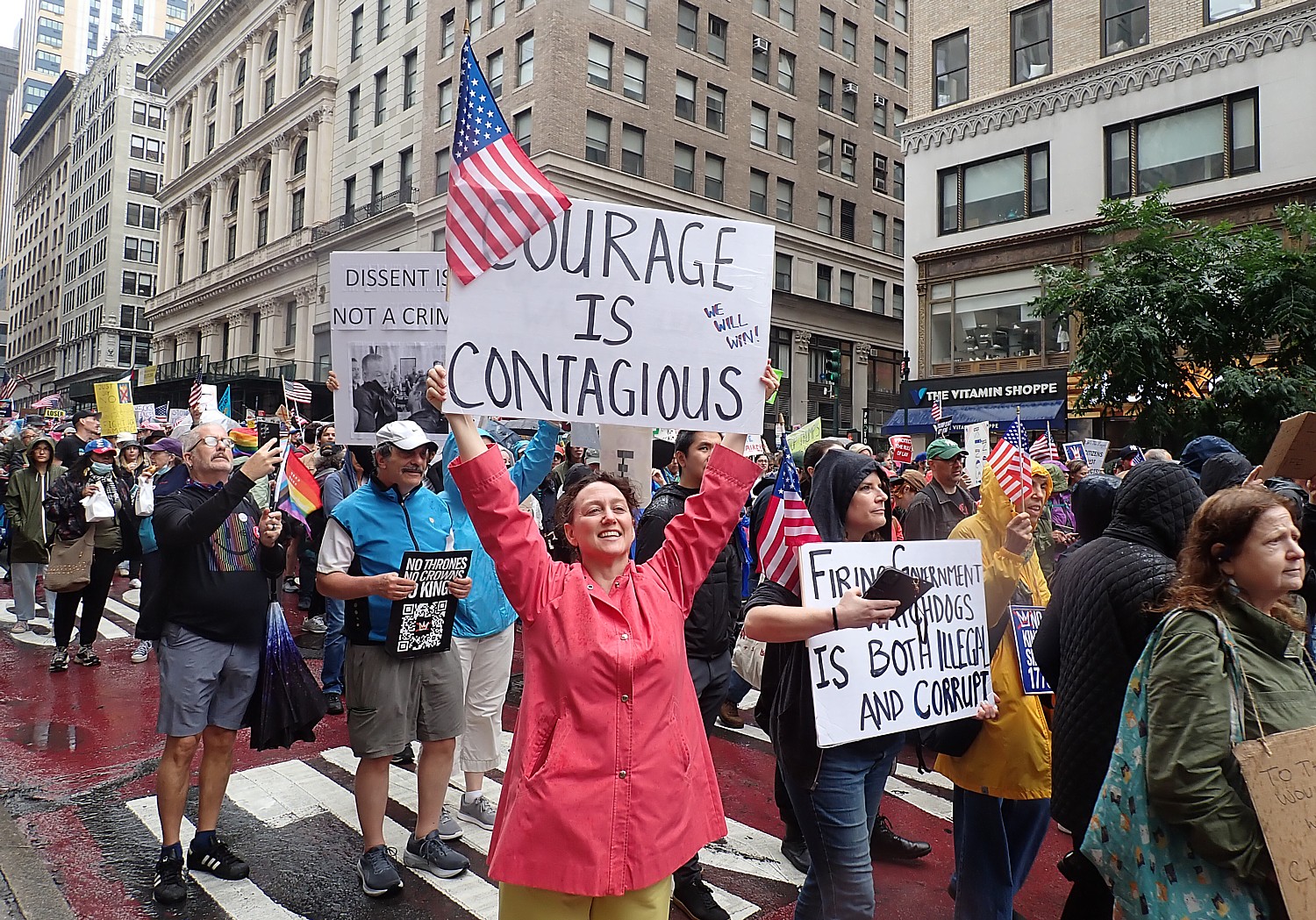
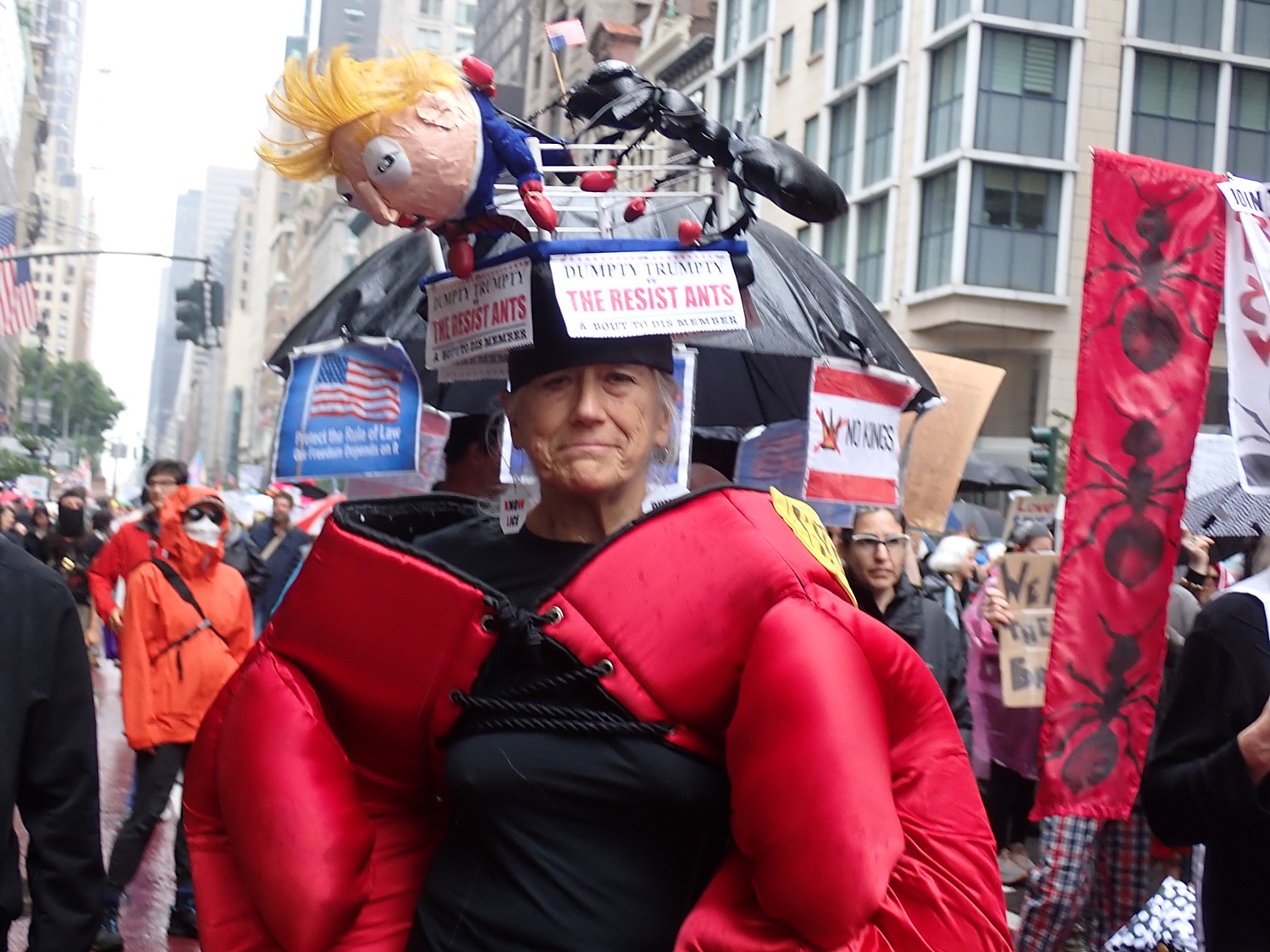
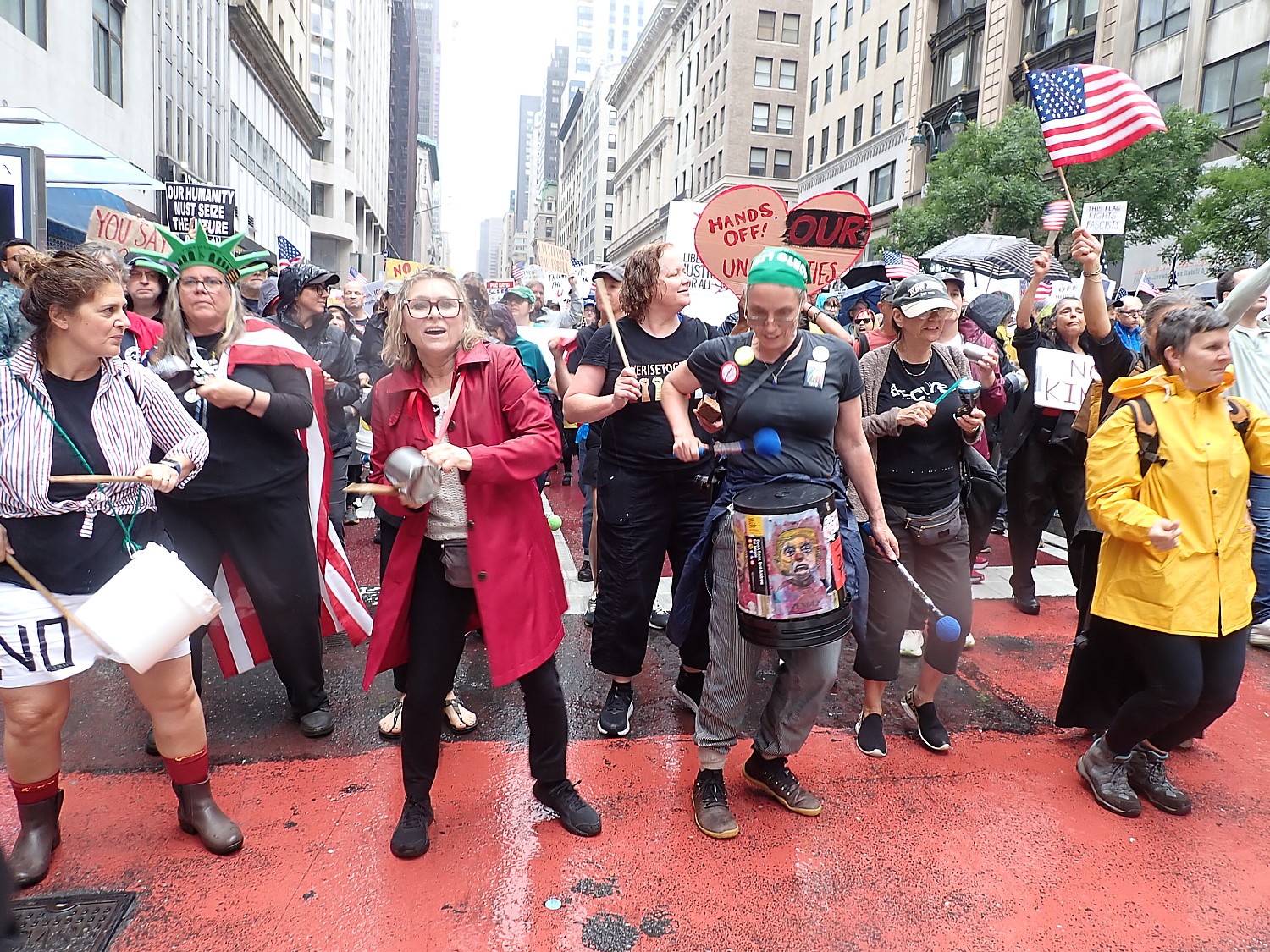
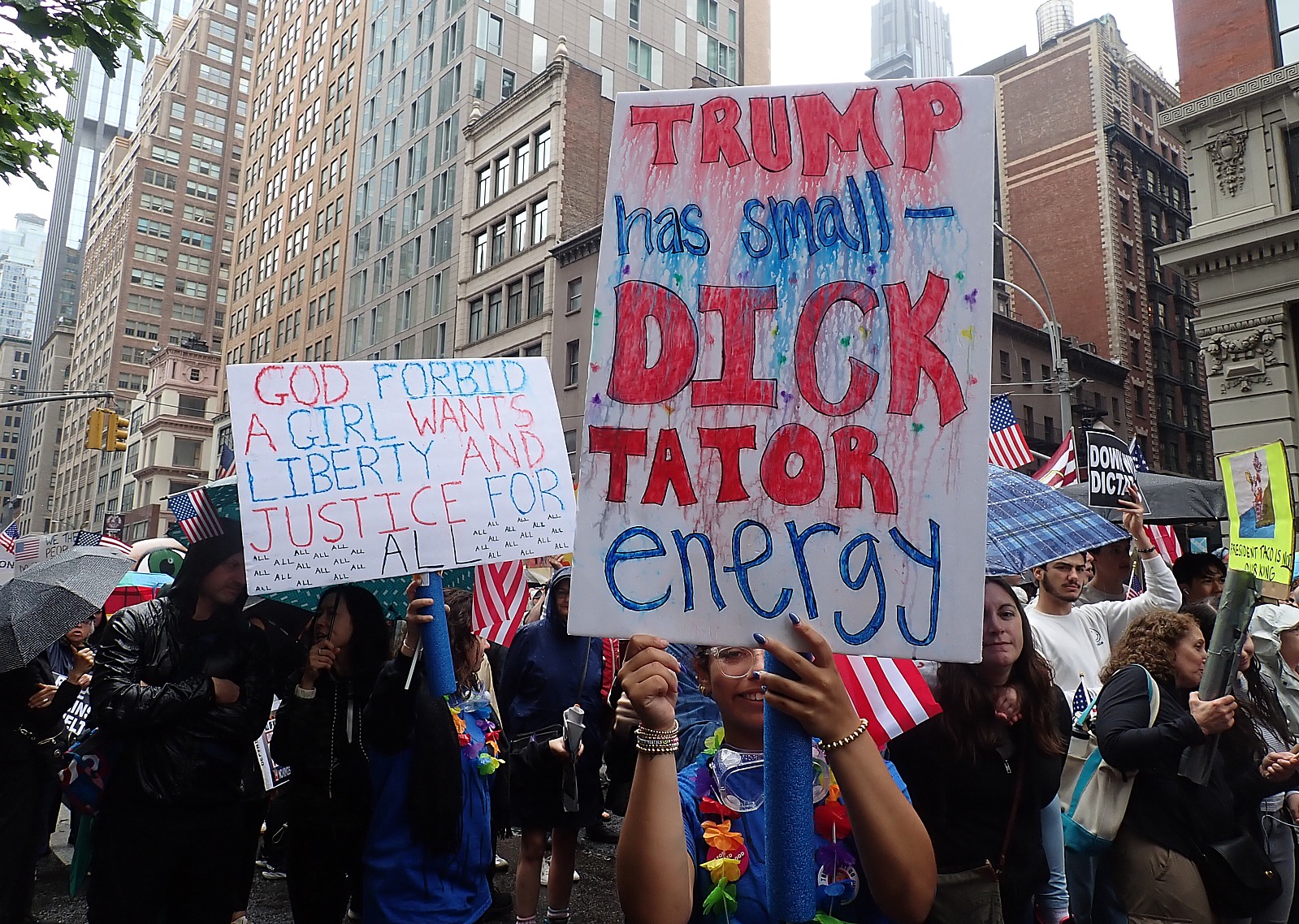
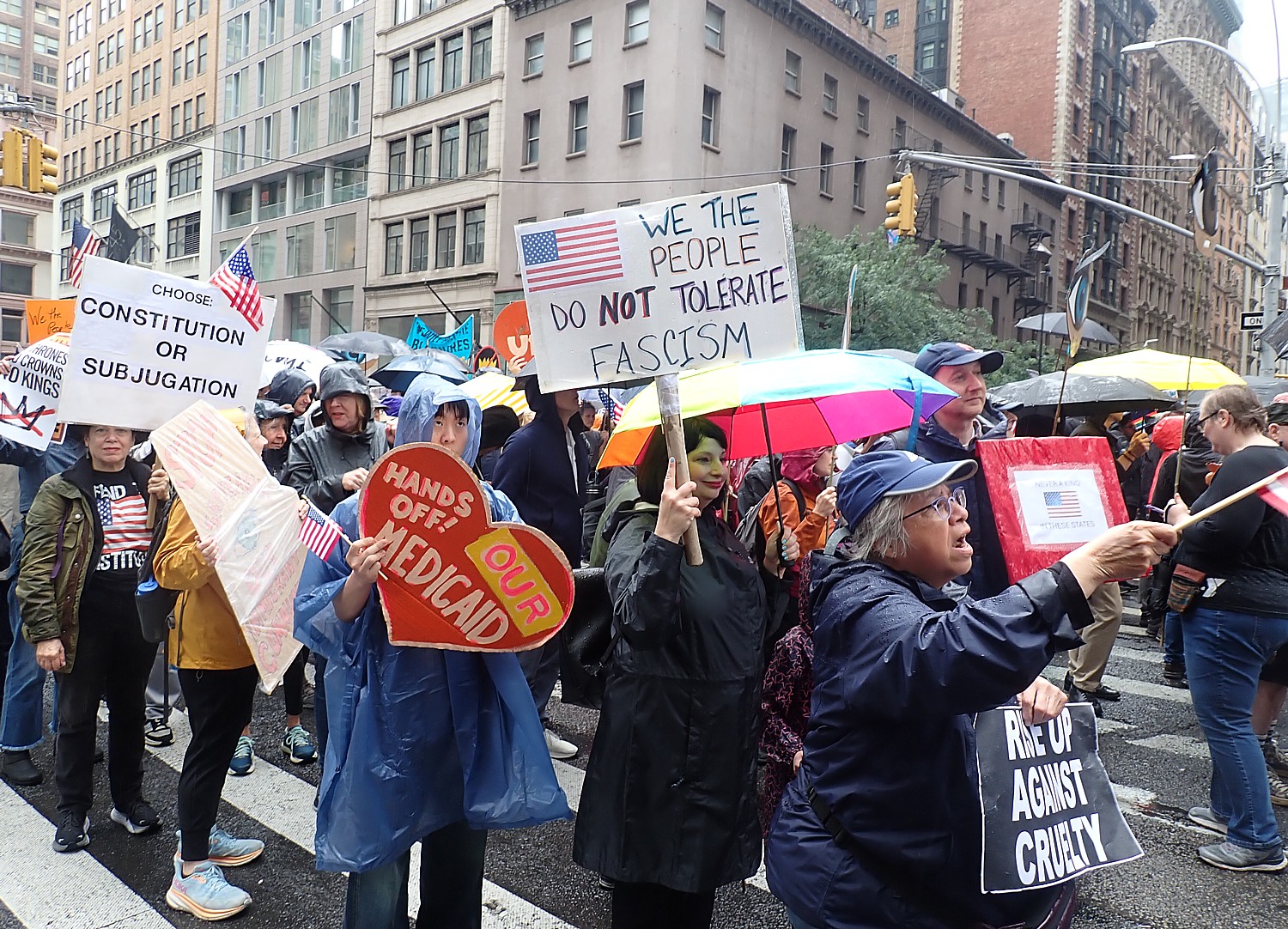
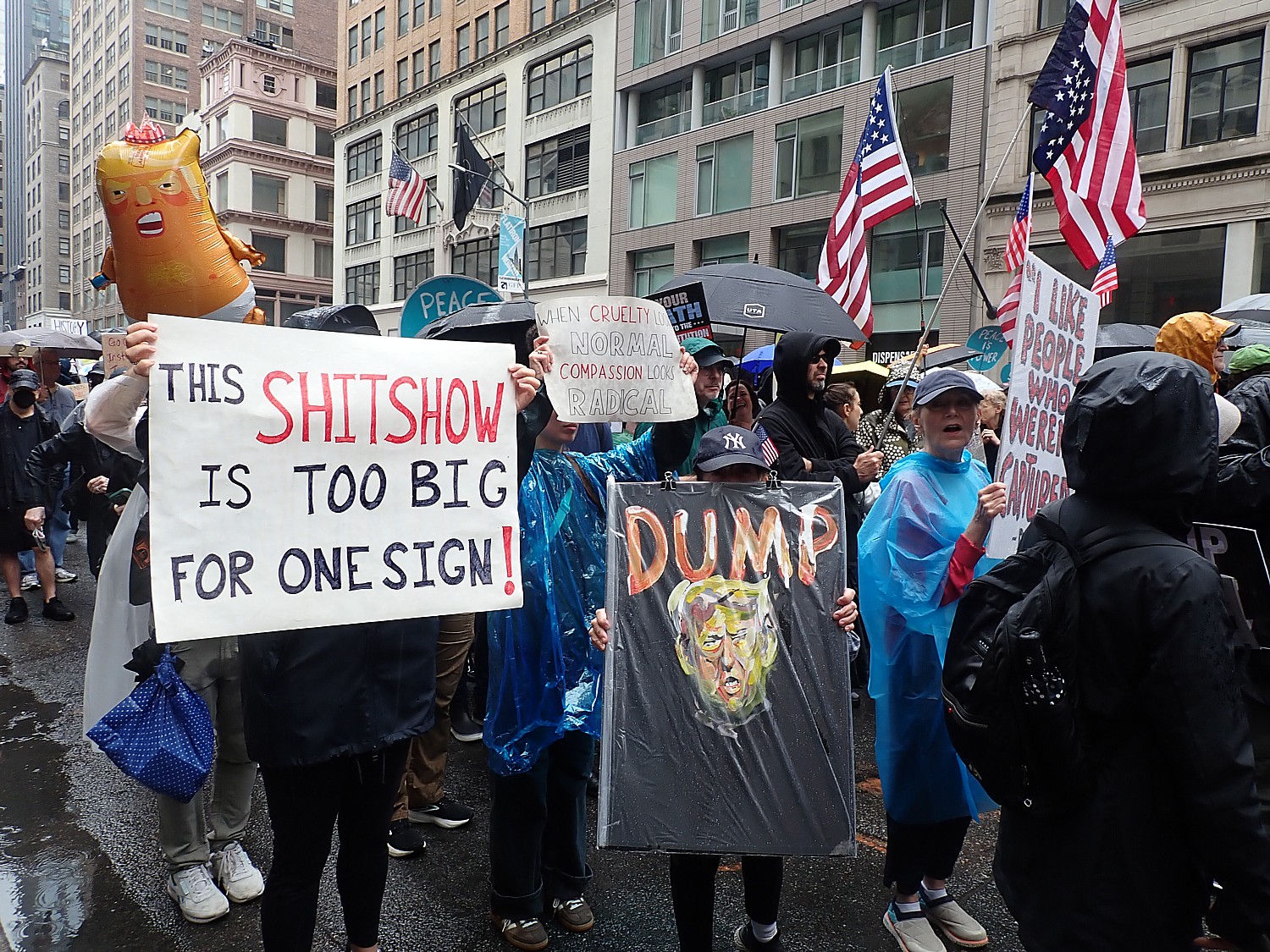
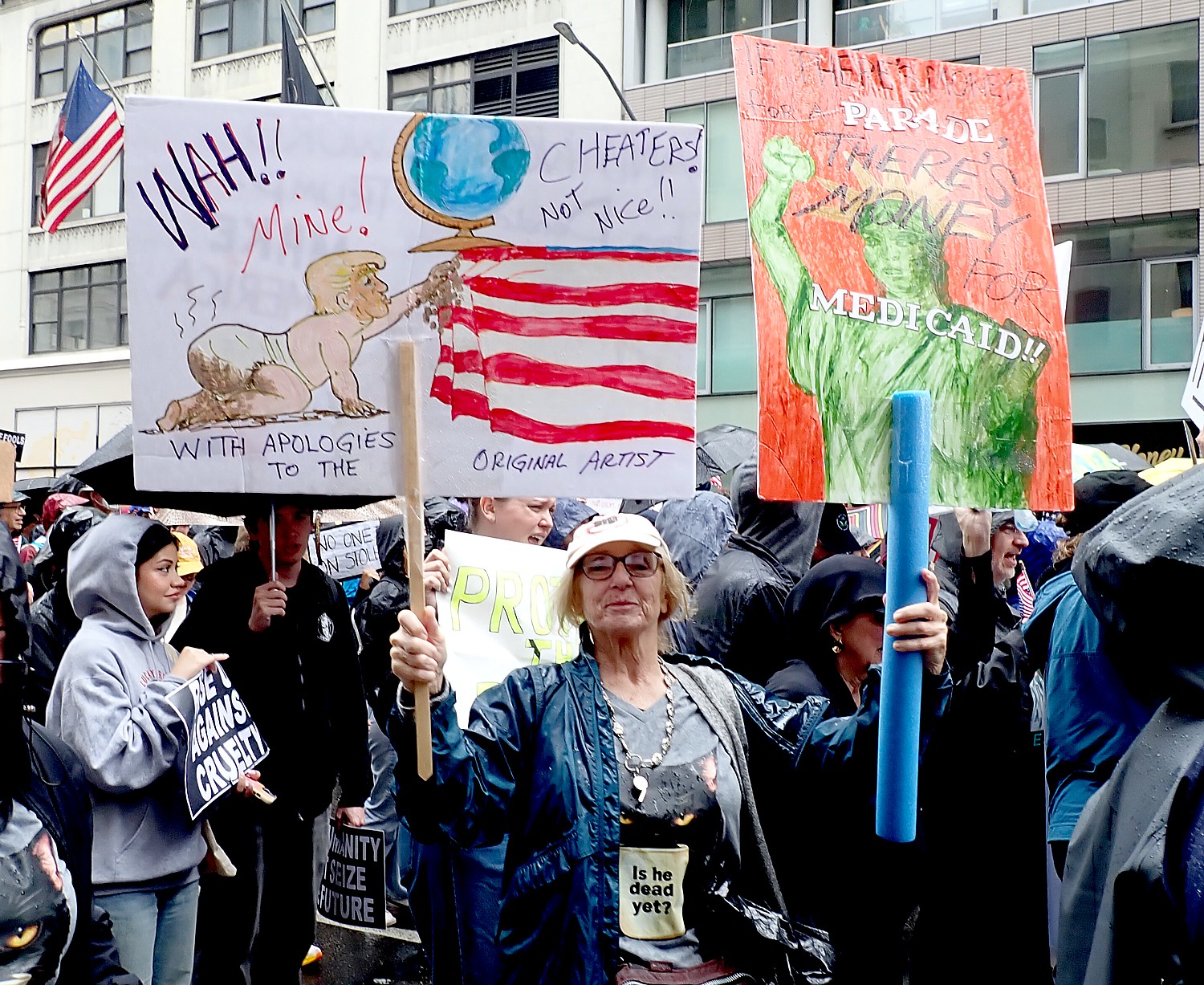
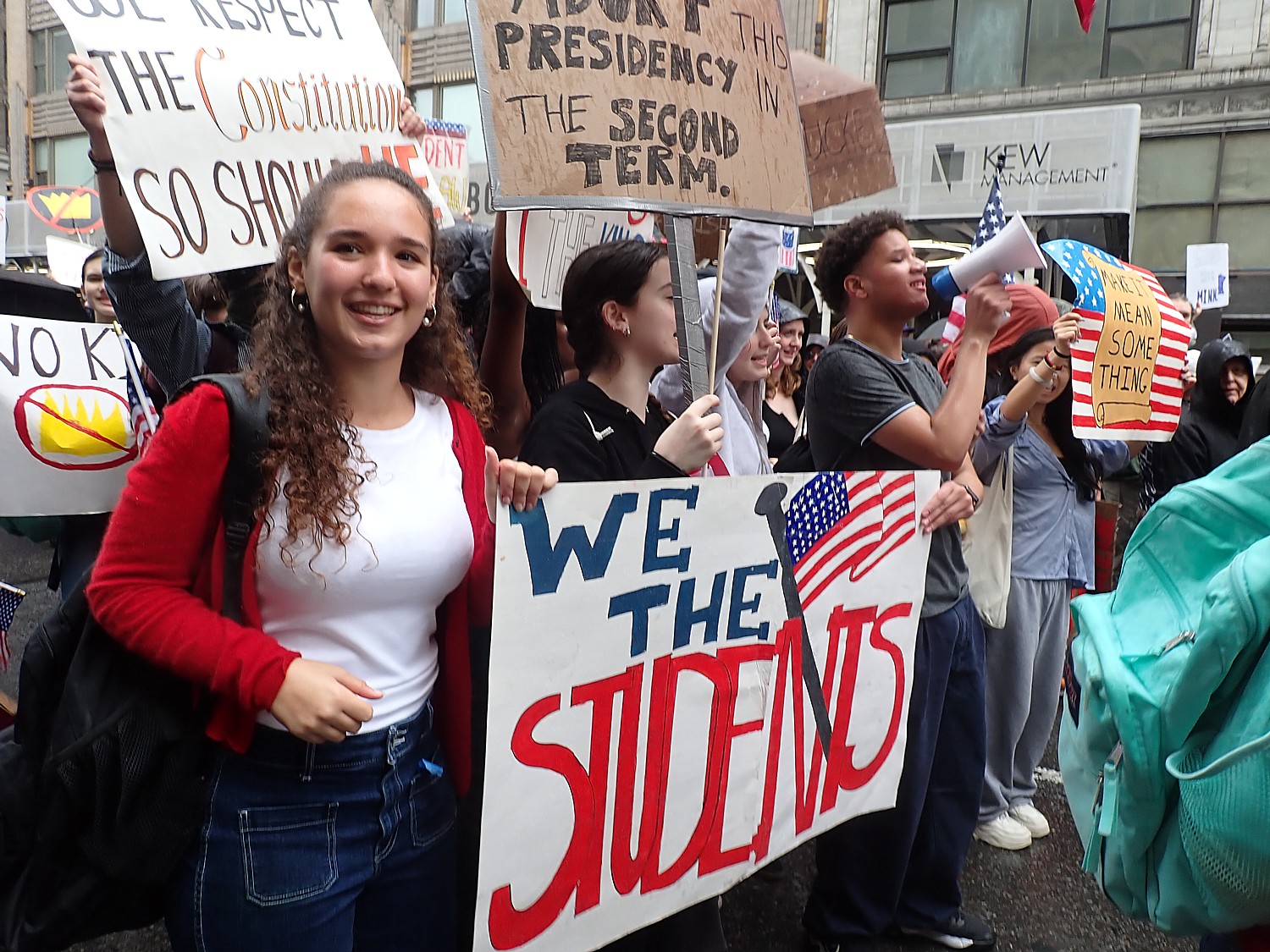
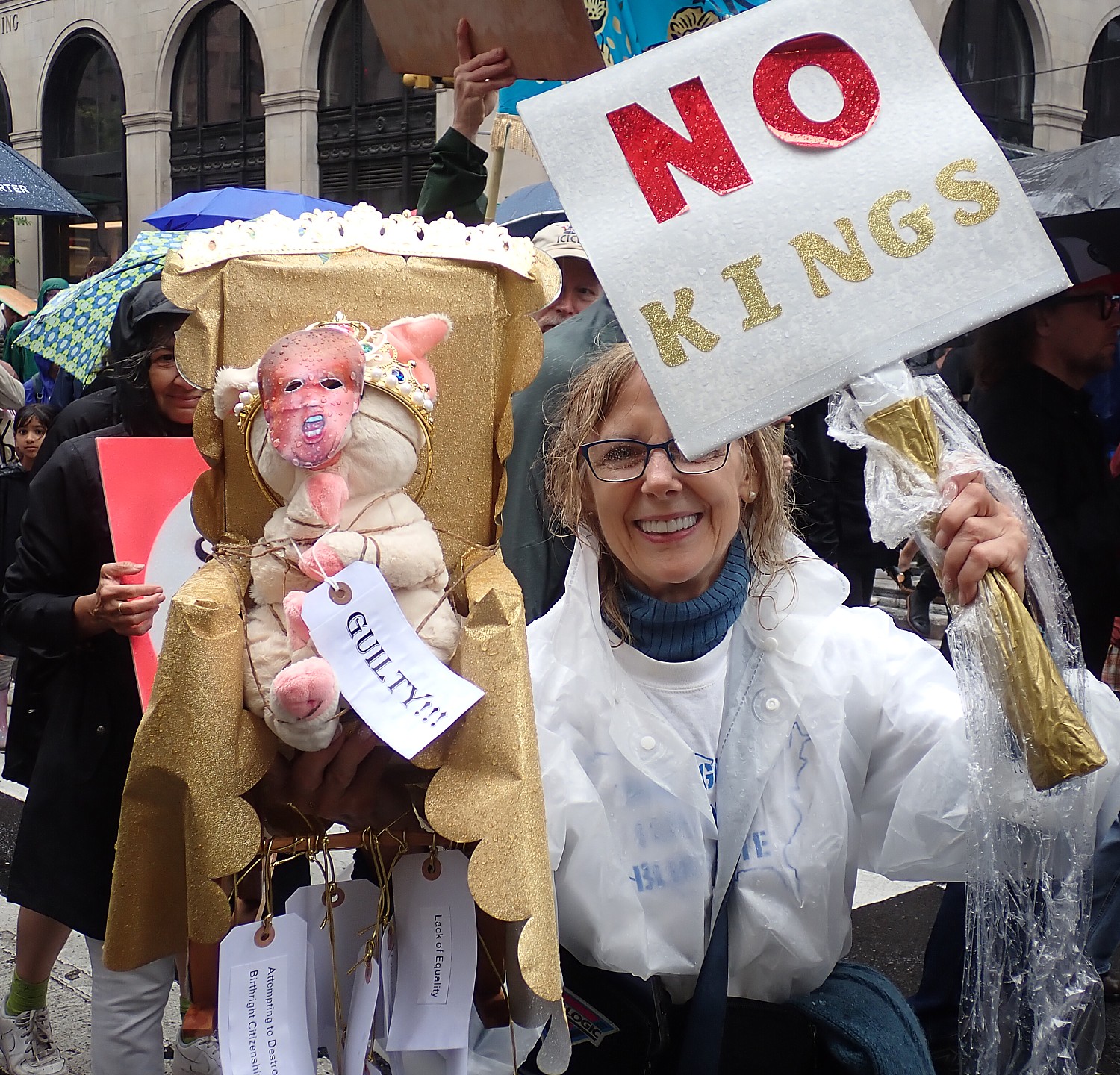
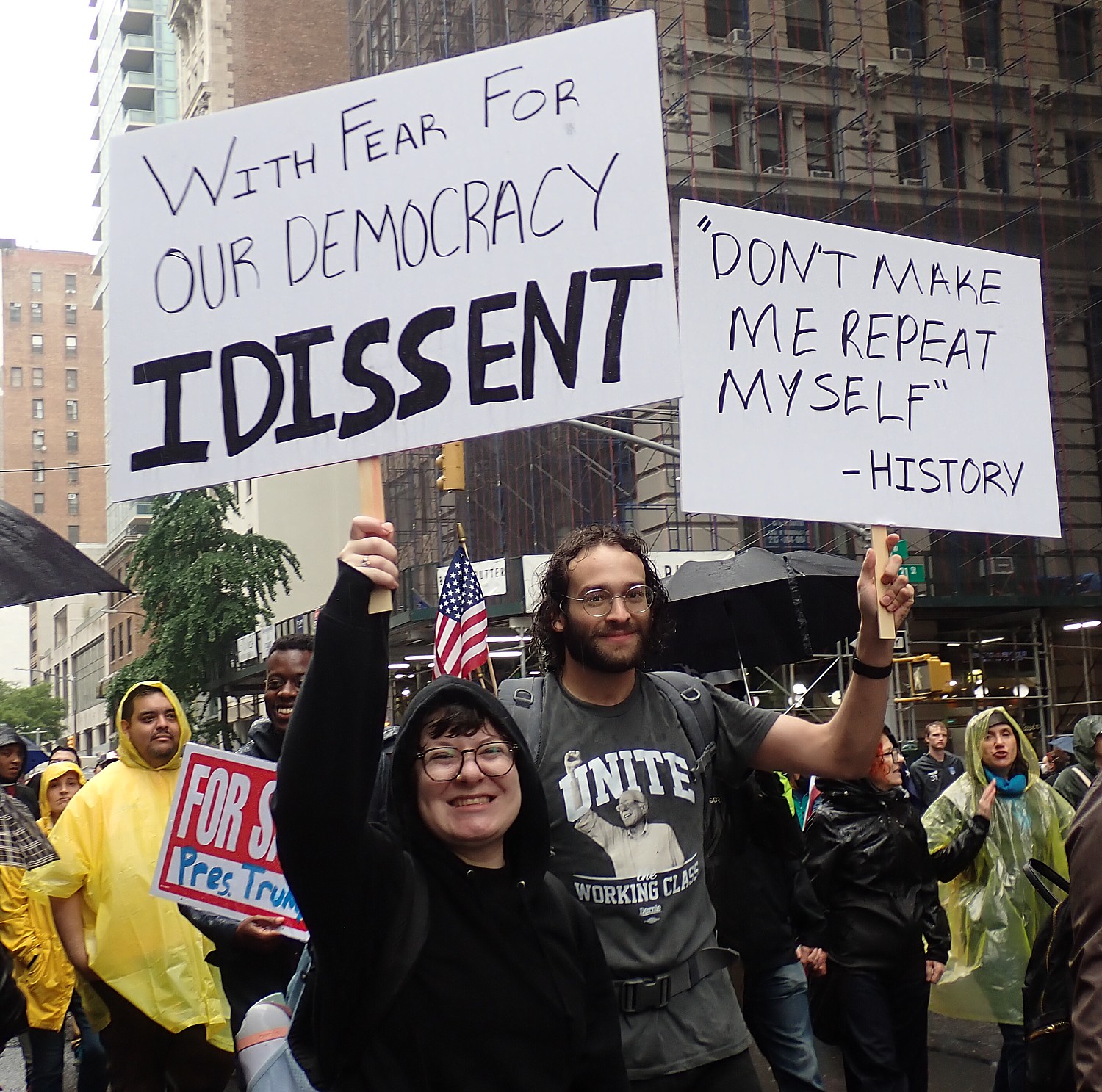
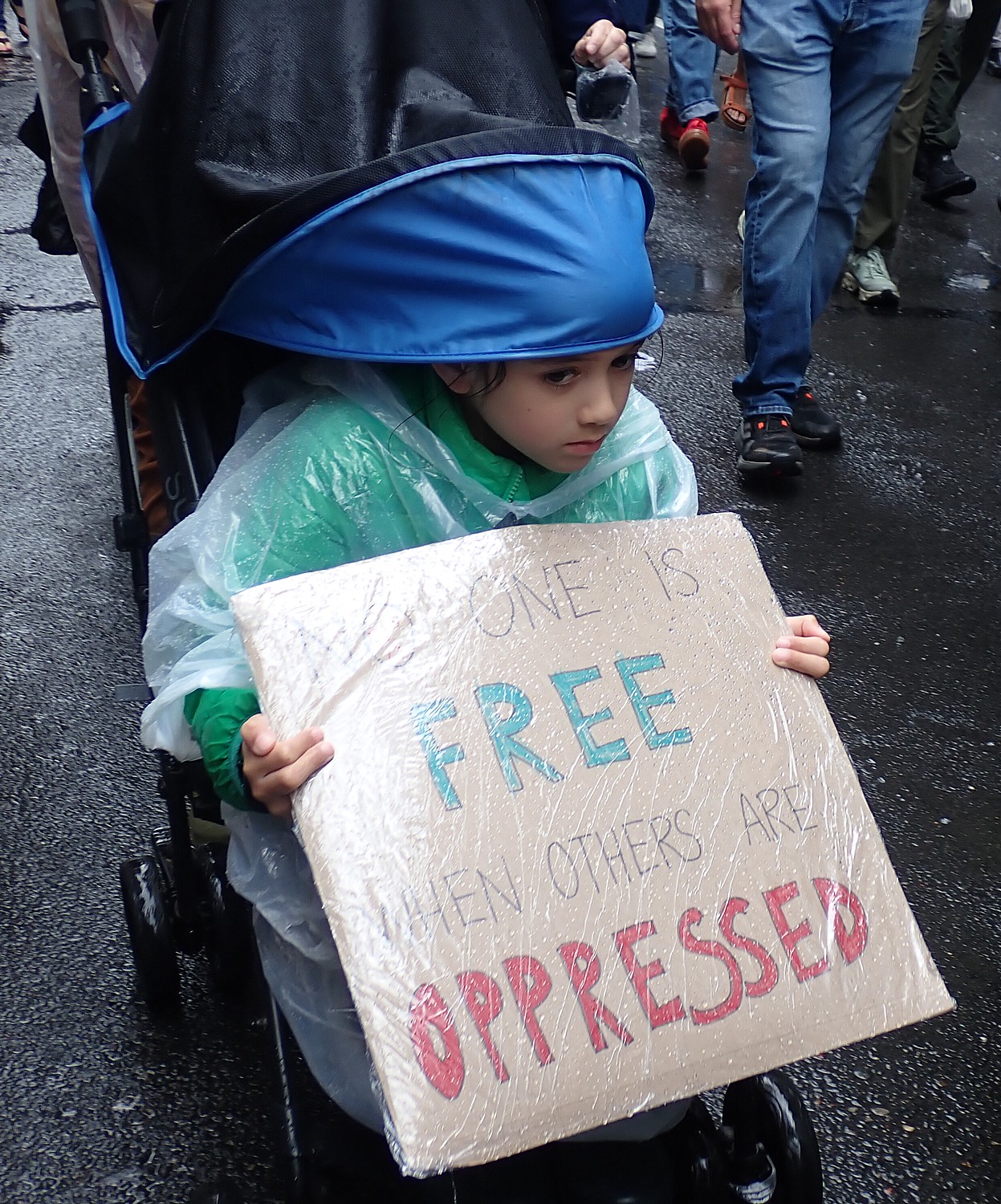
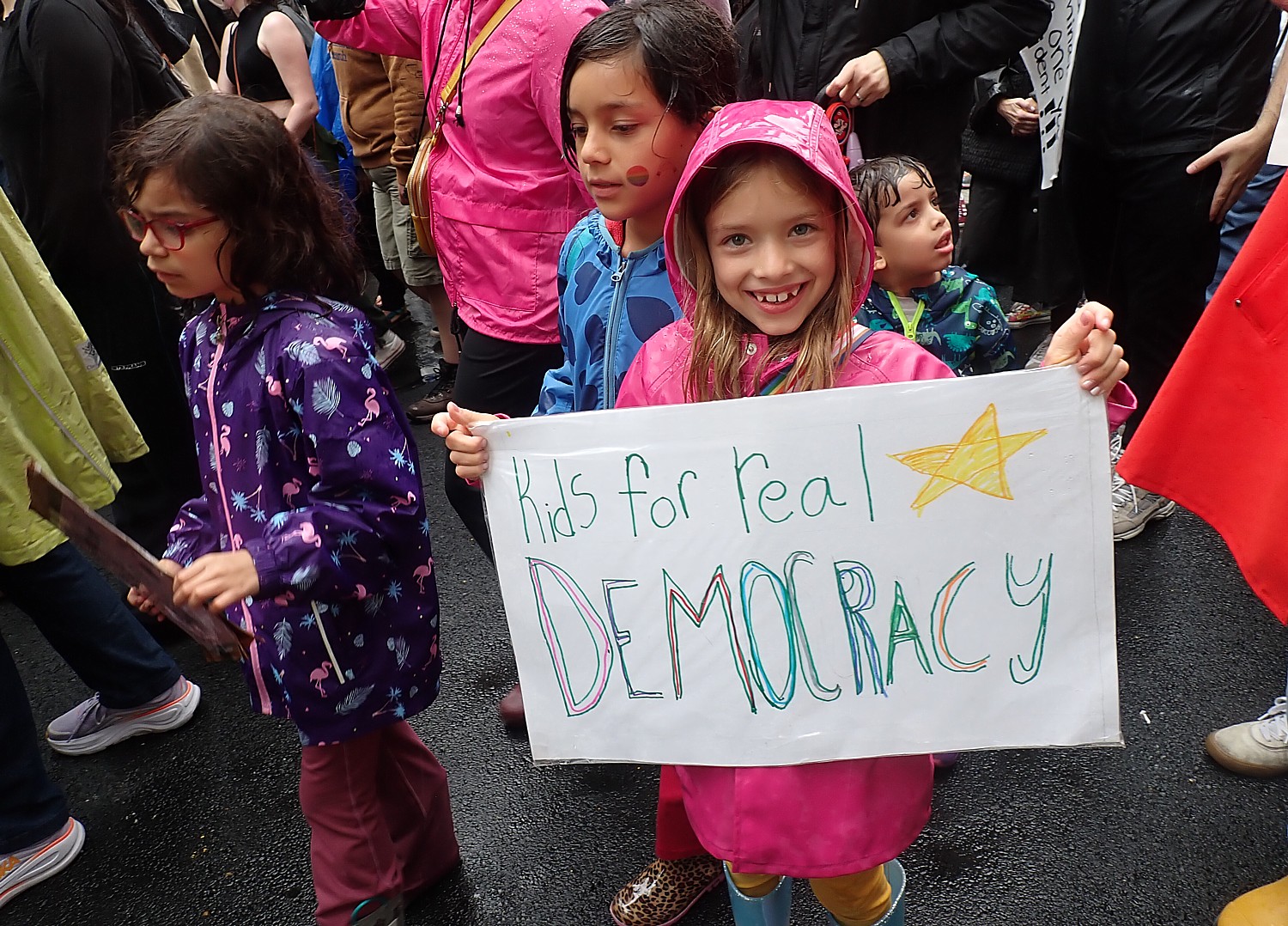
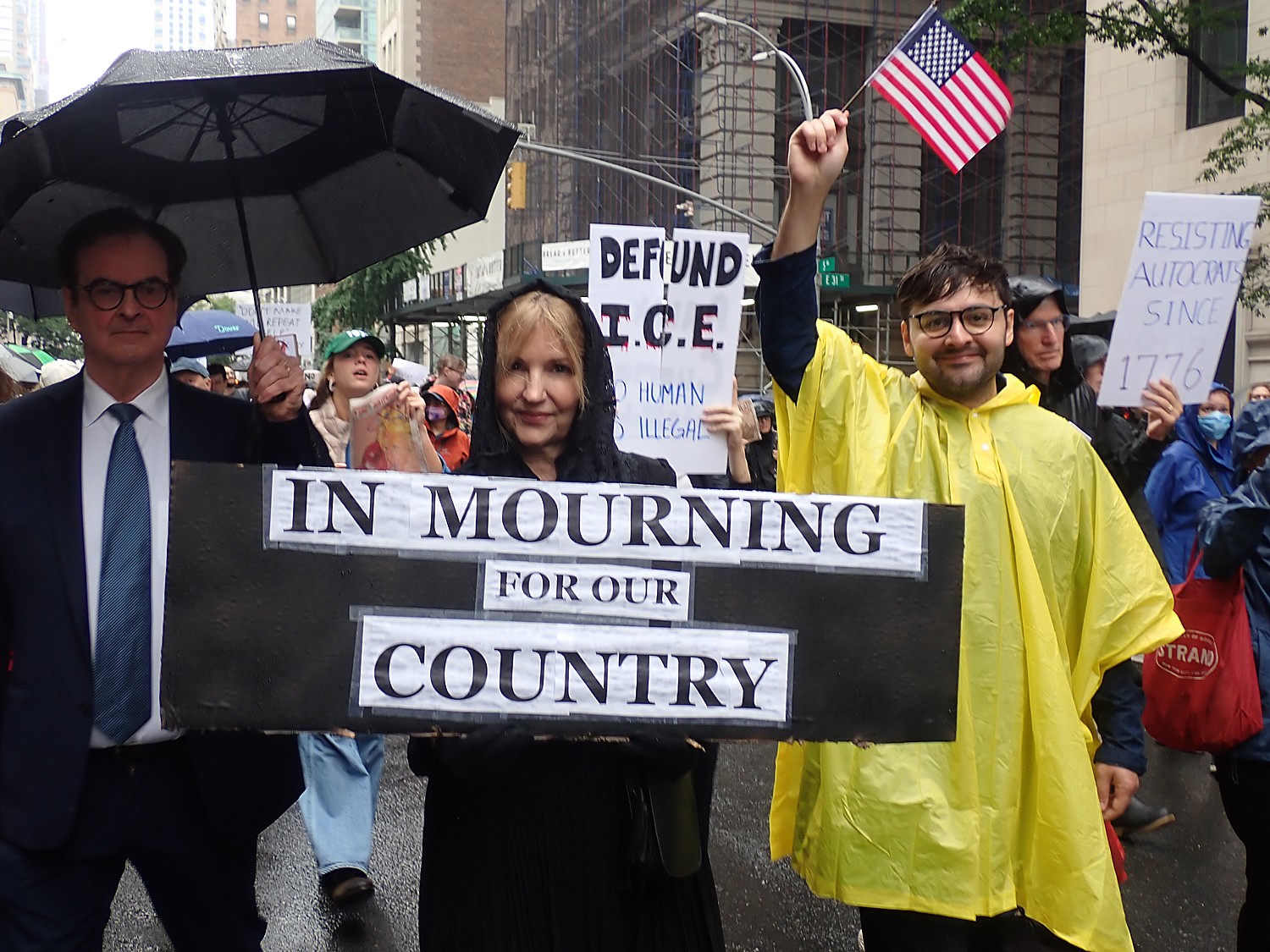
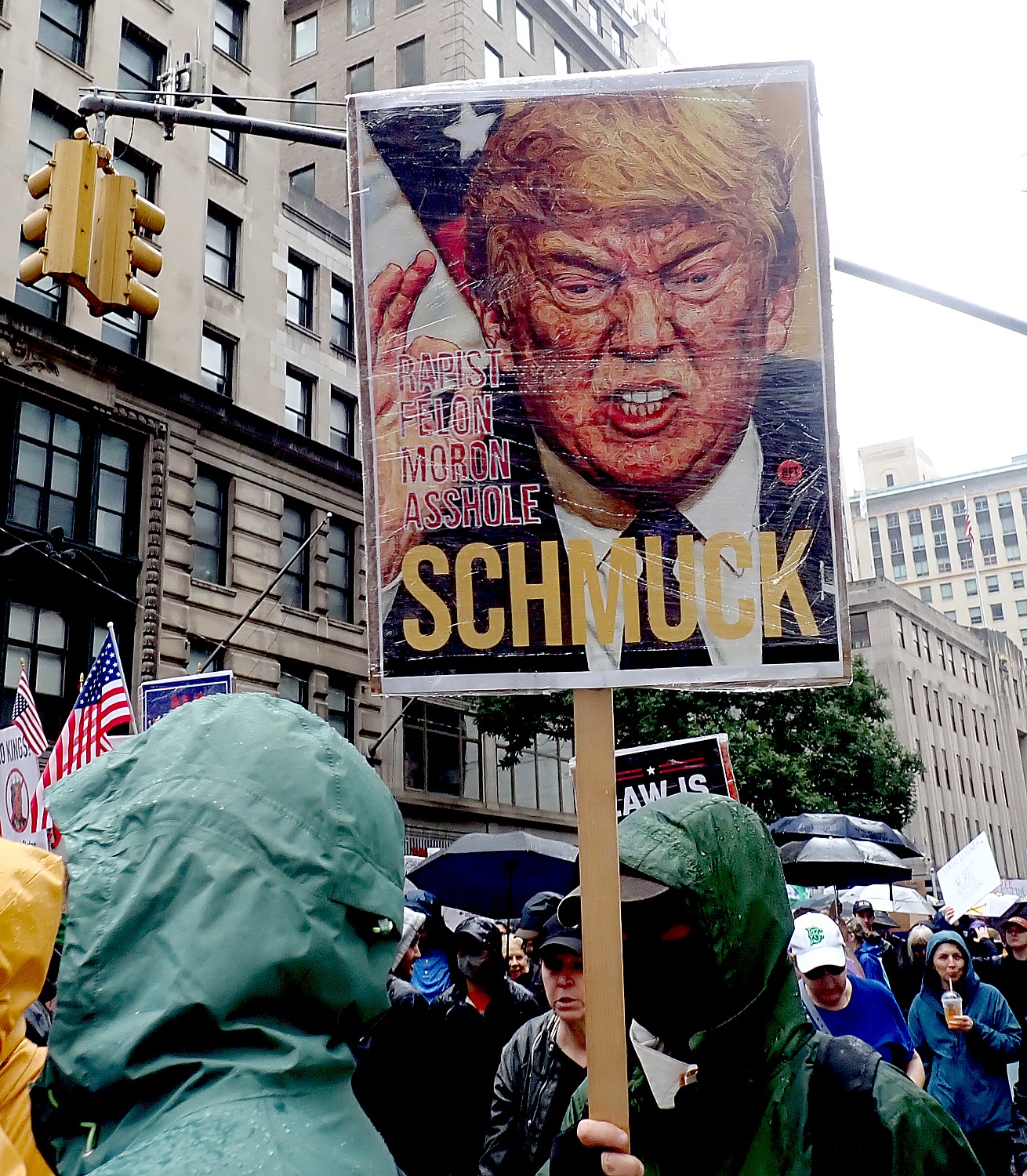
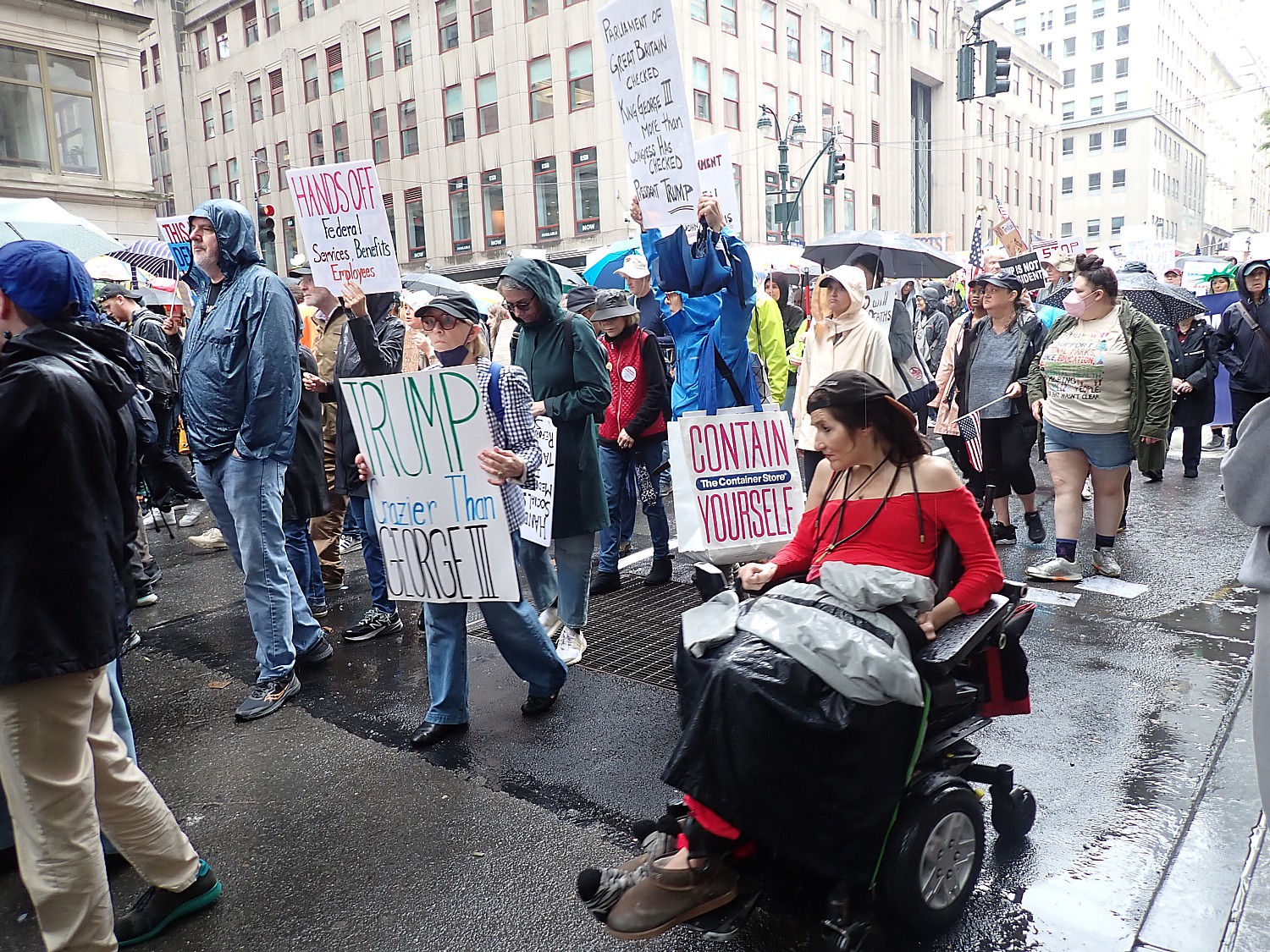
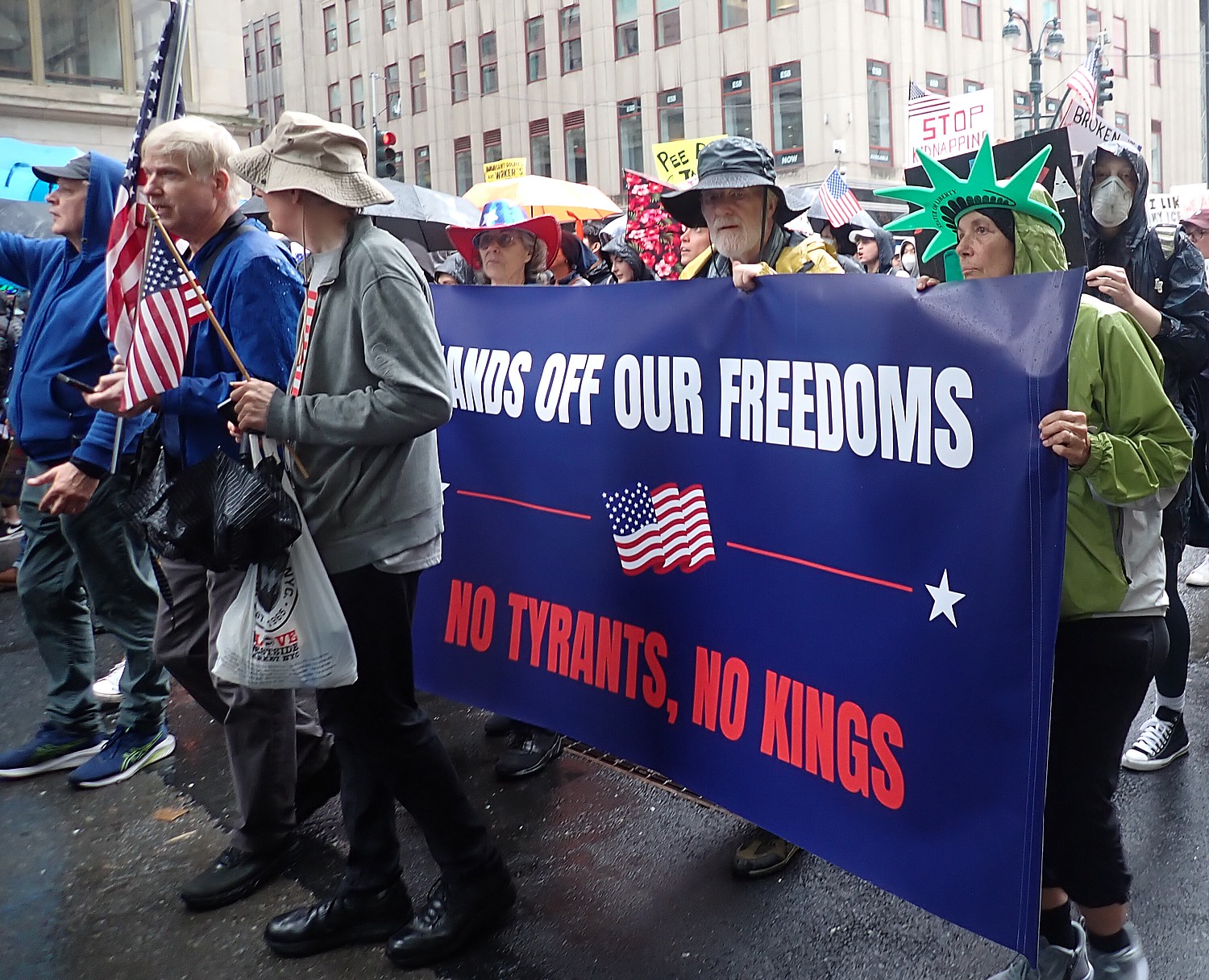
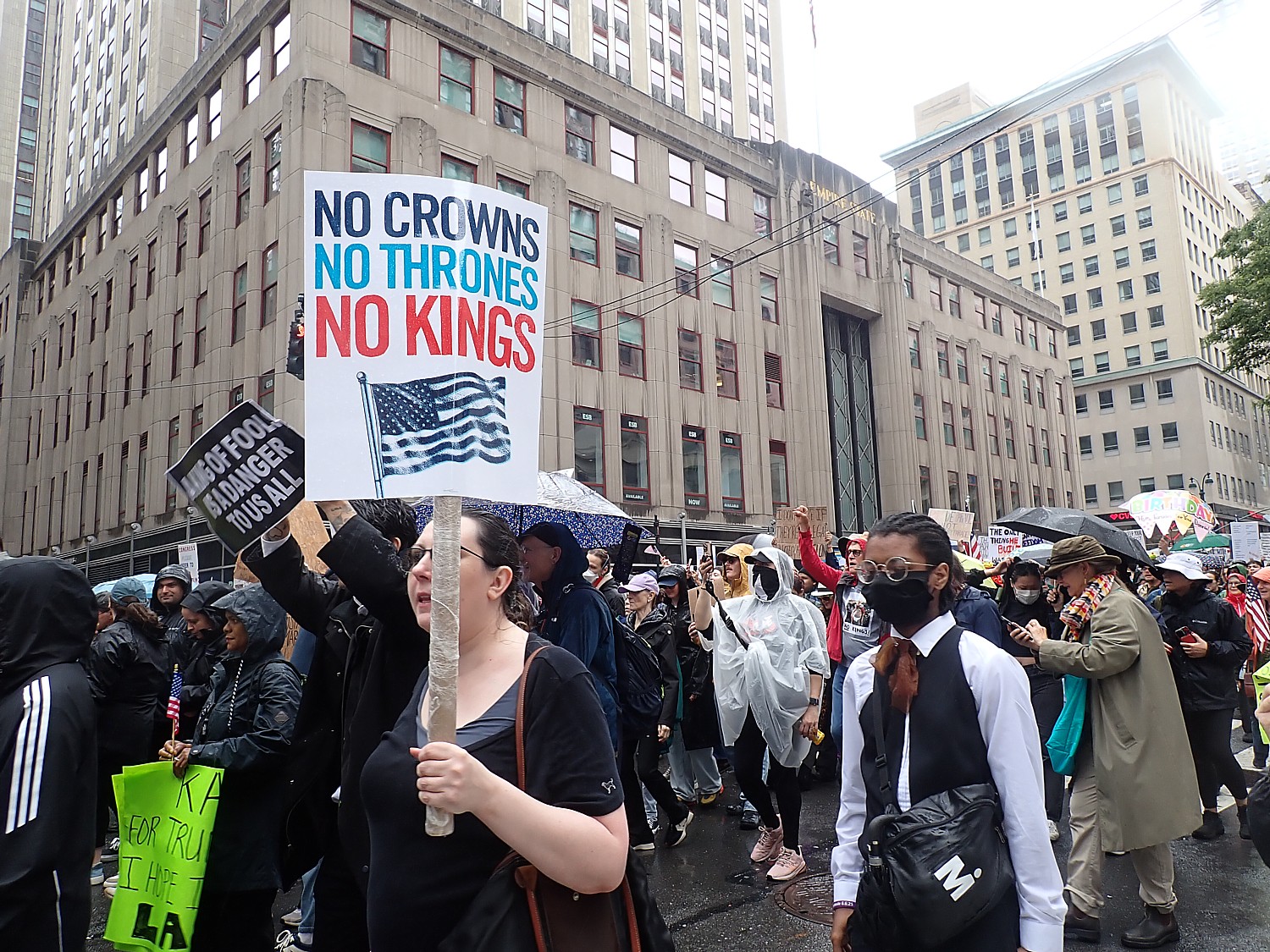
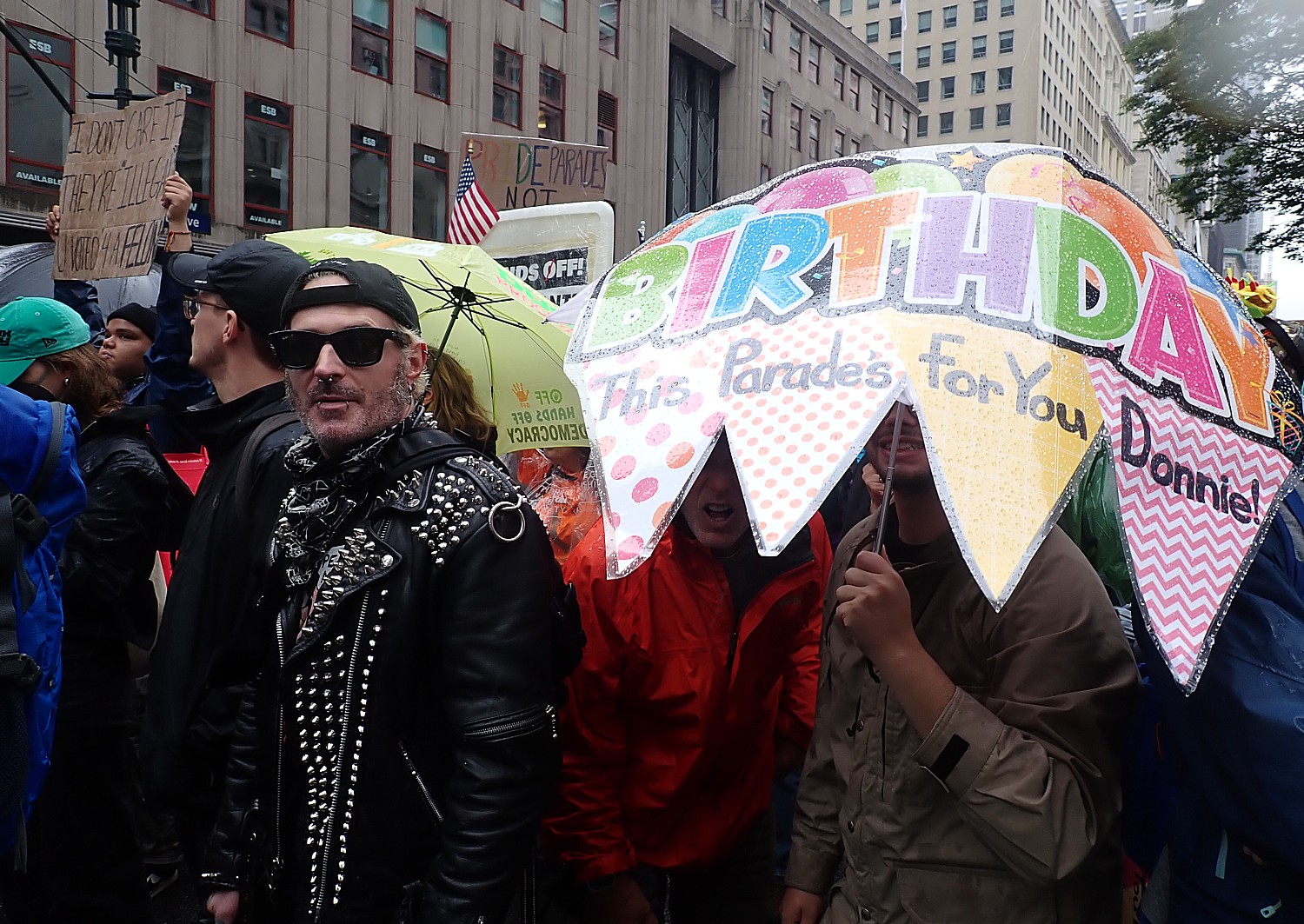
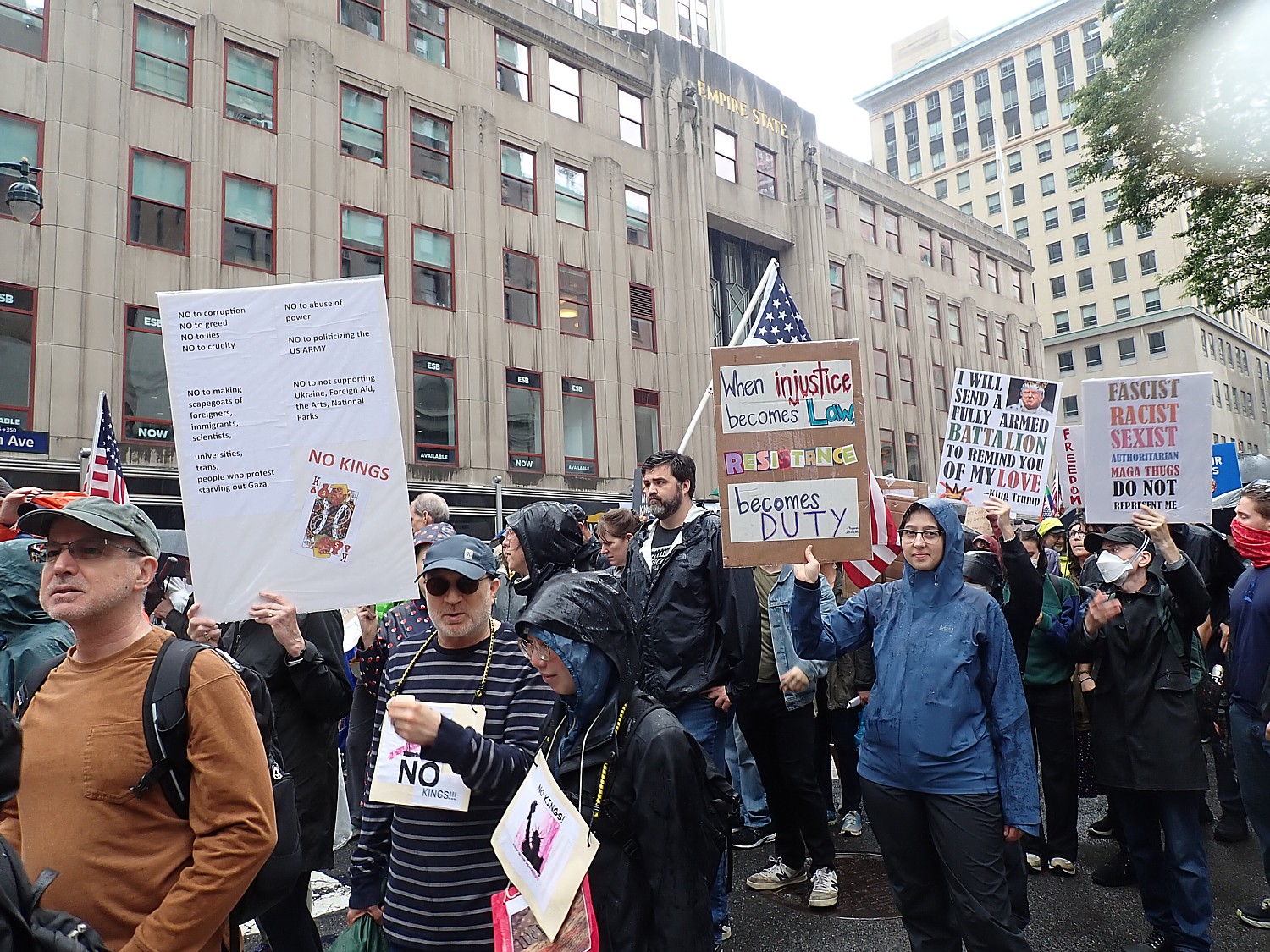
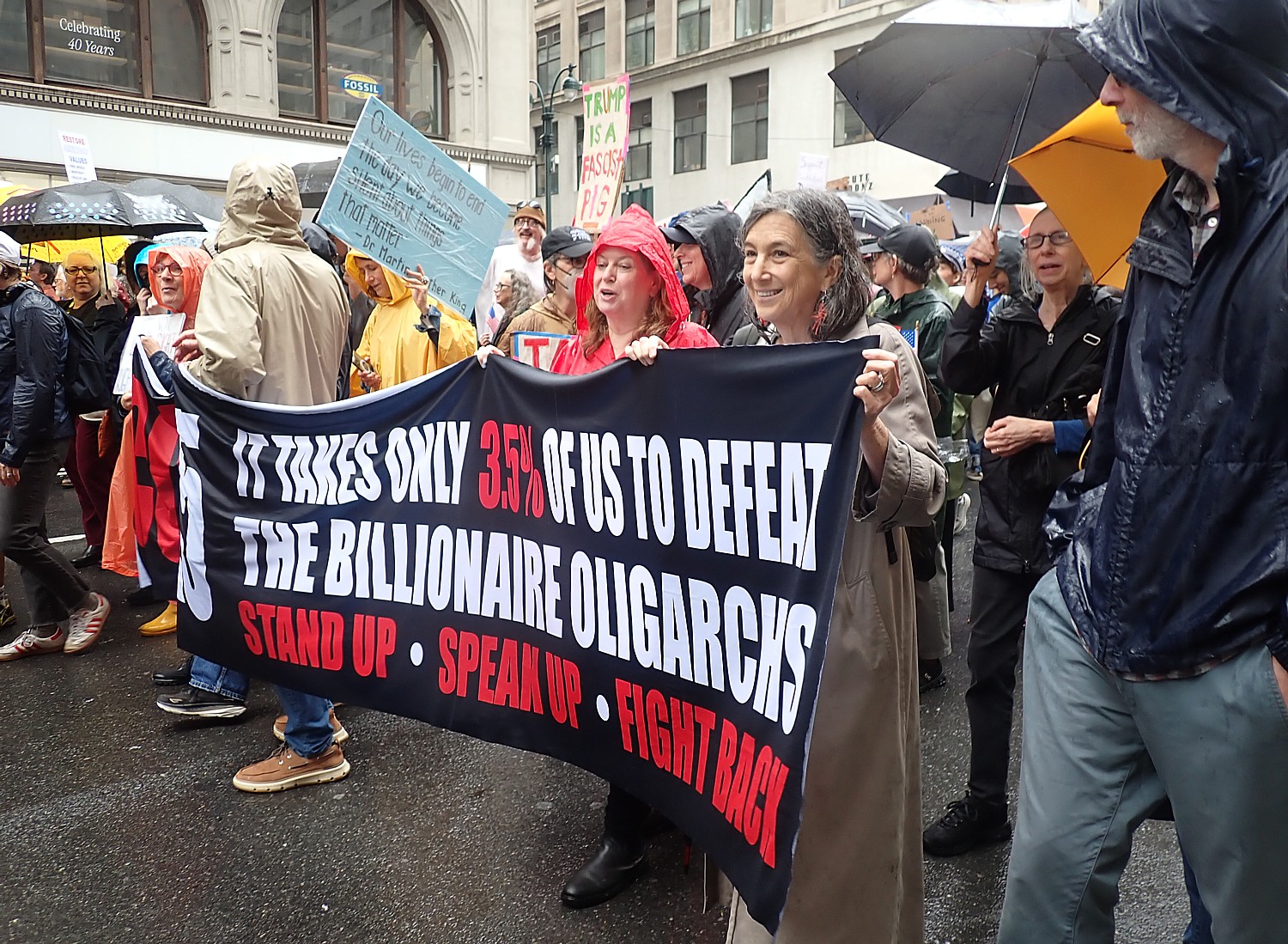
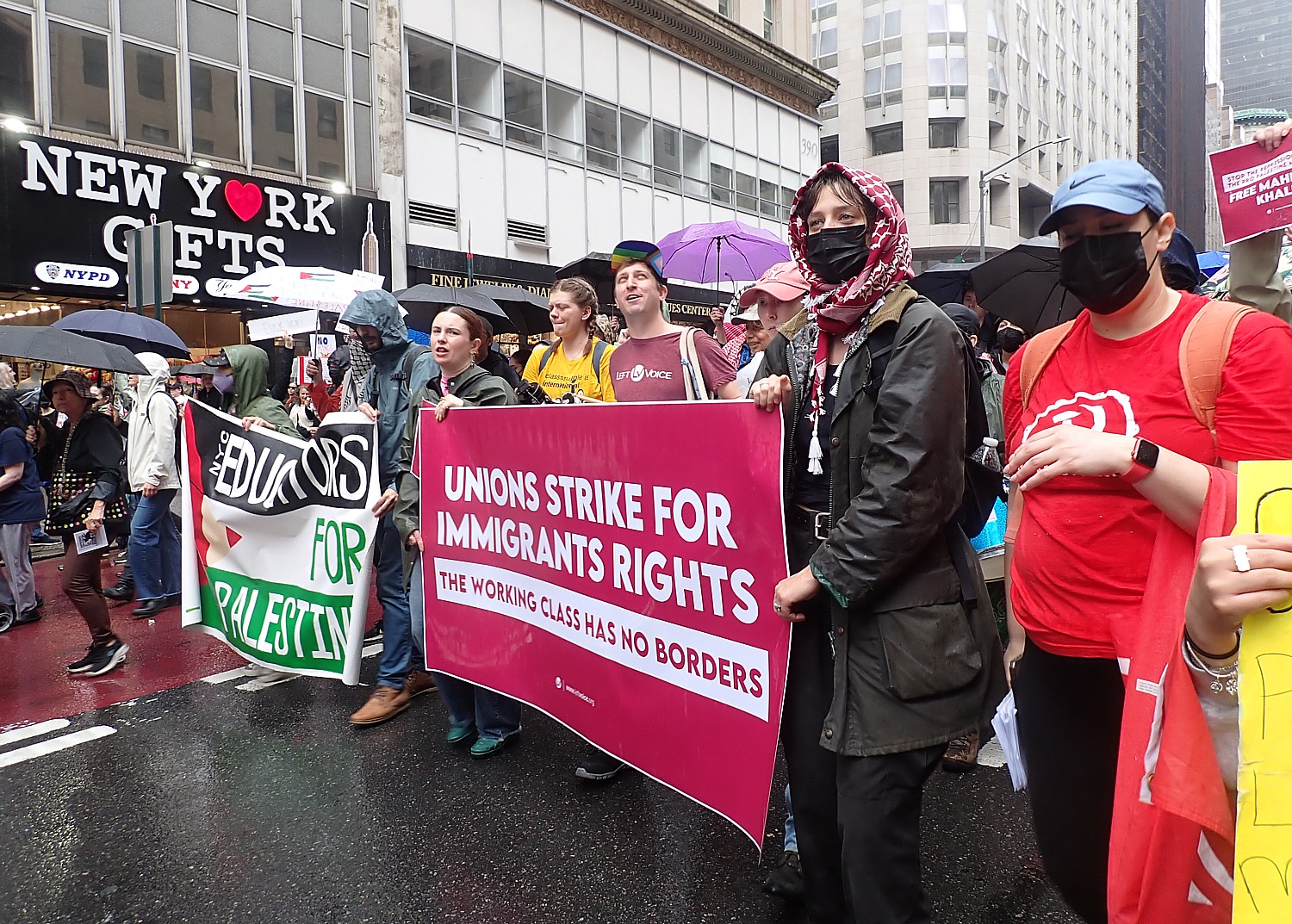
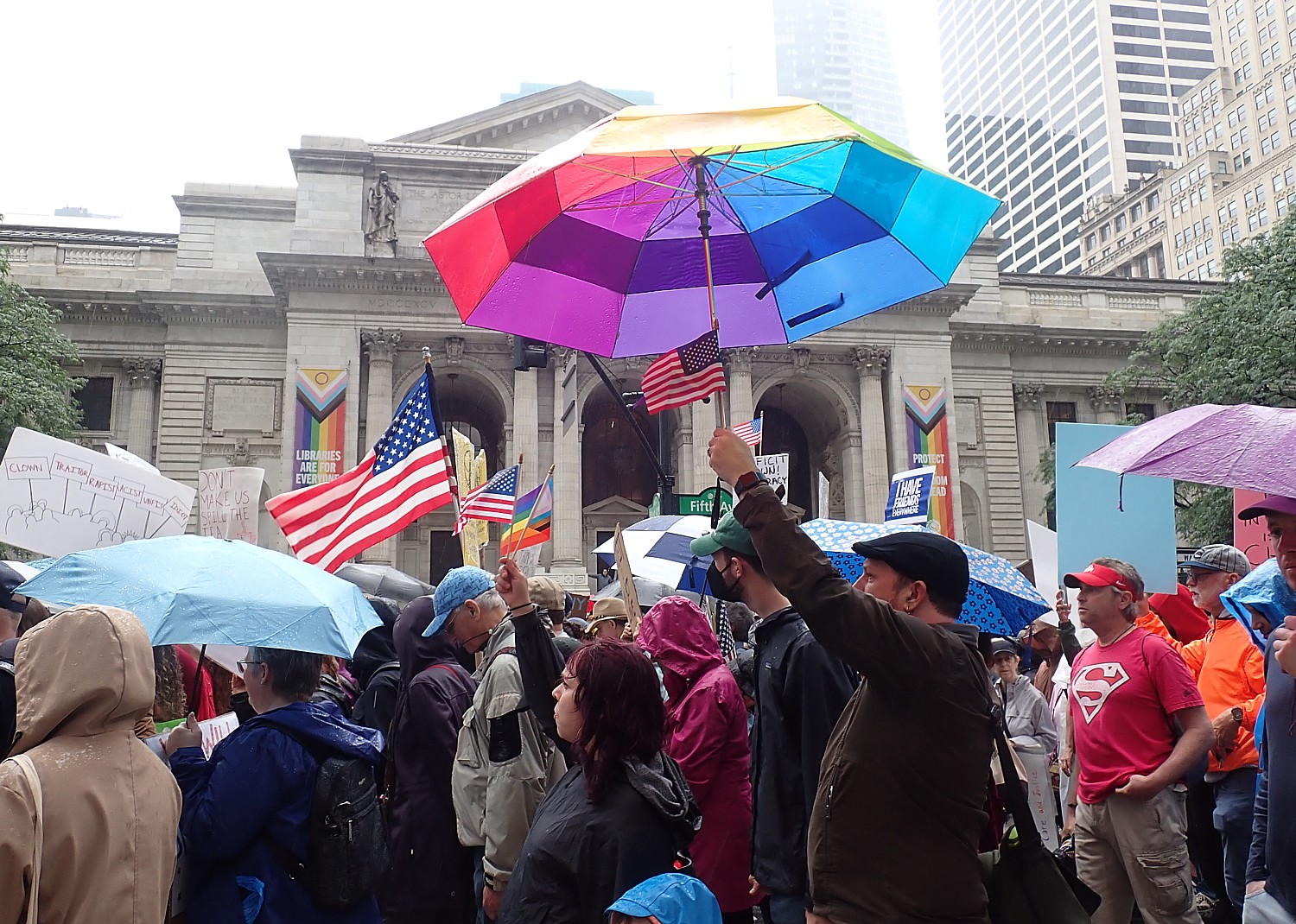
Rain did not deter the well over 50,000 New Yorkers from coming out for the “No Kings Protest” – just one of the more than 2100 protests taking place in all 50 states and around the world that drew an estimated 5 million, in one of the largest single day protests since 2017’s Women’s March against Trump and Trumpism.
They gathered as the target of their ire, the man who would be king, Donald Trump, watched his long-dreamed military parade march passed his viewing stand in Washington DC, a $45 million vanity show ostensibly to honor the 250th anniversary of the U.S. Army that coincided with his 79th birthday.
June 14th is also Flag Day, and the protesters felt it appropriate to assert their rights and freedoms the flag is supposed to represent and that so many died defending.
Among the coordinators of the New York City No Kings Protest were Indivisible, Moveon, 50501, NYCLU, and Womens March.
“They’ve defied our courts, deported Americans, disappeared people off the streets, attacked our civil rights, and slashed our services. The corruption has gone too. far. No thrones. No crowns. No kings.” Wrote Indivisible
Womens March chose to adopt the theme of Trump as a Clown: “When authoritarianism shows its face, we don’t cower. We shine light—and sometimes that light is a spotlight on smeared-on orange makeup. Ridicule isn’t trivial; it’s courageous. And right now, that courage might be the best weapon we have.”
There was music. There was a bit of dancing. There were humorous digs at the wannabe dictator (a theme advocated by Womens March). And most of all, a sense of unity, camaraderie, and community in the shared desire to reclaim democracy, decency, governance by Rule of Law, and the values of equality that this country was founded upon and still striving toward.
Notable to me were the number of people in wheelchairs who nonetheless marched in the rain, but also the extraordinary kindness shown by New Yorkers crammed together on the city streets.
Though planned weeks ago, the protests that swept the nation took on an added commitment and determination after the actions of the Trump administration in defying court orders and Constitution’s due process protections in violently rounding up migrants, even those with legal status and US citizen spouses and children, for deportation, branding them all as worst of the worst criminals and gangmembers, the DOGE cuts to public services, the attacks on academic freedom, the politicization of the military, the political assault on Democrats, judges and anyone else who Trump doesn’t like, as he pardons actual criminals and terrorists and dismisses investigations and prosecutions against his friends, allies and donors, the weaponization of his law enforcement, the breaking of alliances, the derailment of the economy with his unhinged tariff policies, and general descent into fascism, oligarchy and kleptocracy.
Add to the list the attacks on free speech, free press, taking money from foreign interests and felons for pardons and policies, overt violations of laws including using the active military for domestic law enforcement, instituting tariffs and rescinding funding which are powers of Congress, not the president, attempting to overturn voting rights and birthright citizenship prescribed by the Constitution with the stroke of a Sharpie.
All of these issues were manifest in the banners, posters, hand-drawn signs that got soaked in the rain. But no one seemed to care.
The gathering on June 14th took on even more significance as Trump and his administration’s violent rhetoric (Kristy Noem stating “We are staying here to liberate this city from the socialist & burdensome leadership that this governor & this mayor have placed into this city”) was followed by the political assassination of a Minnesota Democratic state representative Melissa Hortman and her husband, and the critical wounding of Rep. John Hoffman and his wife (effectively changing a tied legislature with shared control into a Republican majority) while in Los Angeles, law enforcement continued to provoke encounters with otherwise peaceful protesters, and just a couple of days before, U.S. Senator Padilla was thrown to the ground and handcuffed merely for trying to ask Homeland Security Sec Kristy Noem a question at a press conference.
No Kings Day proved to be one of the largest days of protest in American history, with some 5 million taking part in some 2,100 cities and towns across all 50 states and several foreign countries (Indivisible.org)
No Kings Day proved to be one of the largest days of protest in American history, with some 5 million taking part in some 2,100 cities and towns across all 50 states and several foreign countries. “From deep red small towns to our largest cities, millions of people turned out to make clear that the American people will not bow to fascism,” Indivisible stated. “It is a frightening time in our history. But in spite of that reality — or rather, in response to that reality — over five million people here in the US, along with allies in cities from London to Tokyo, stood united today in the belief that democracy is worth fighting for.”
While the protesters were all peaceful, even joyful, Minnesota Governor Tim Walz pleaded that the planned No Kings protests not be held in light of the gunman, who had a kill list and “No Kings” flyers in his car, still being on the loose, and there was an incident of shots causing a panic in Salt Lake City. And Indivisible discouraged an official “No Kings” protest in Washington DC, amid Trump’s threats to stamp out dissent with force, though some smaller ones did take place.
“Trump has made no secret of his willingness to use force to crush dissent. He’s got tanks rolling through DC and marines in Los Angeles where we’ve all seen (and continue to see) police respond aggressively to peaceful protests.”
Also, Trump has made no secret he is salivating over the prospect of invoking the Insurrection Act, declaring martial law, to unleash military force throughout the country (that is, in cities, towns and states run by Democrats). In his first term, he wondered why his soldiers couldn’t just shoot protesters, but while his Defense Secretary and generals at the time discouraged him, this Defense Secretary Pete Hegseth, equally violent and fascist, would likely greenlight whatever he was told.
But, as Indivisible wrote, “a massive, nationwide mobilization like today can change the narrative, grow our movement, build our organizing muscles, and deliver a jolt of courage — something much needed after Trump’s recent attempts to quash dissent with violence. But a single day of protest — even historically large protests like today — will not alone defeat the fascist takeover of our government. We need to ensure that the incredible organizing and inspiring courage of today’s protests continue to spread. We need to do the hard work of organizing those who turned out today and those who were watching into a sustained, broad-based movement that’s prepared for the hard work that comes ahead.”
Womens March is already planning the next action, most likely July 4th Free America action—rallies, BBQs, marches, art builds, community block parties, and more to celebrate real freedom.
Here are highlights from New York City’s No Kings Protest:
President Biden has correctly assessed the 2024 election as a battle to save democracy against an emergent autocracy. He launched the historic Summit for Democracy in 2021 to strengthen democratic institutions, protect human rights, and accelerate the fight against corruption, both at home and abroad and recently convened the Third Summit.
Can you imagine Trump or any Republican advocating for democracy, strengthening democratic institutions, protecting human rights and accelerating the fight against corruption domestically and abroad? This fact sheet from the White House lists the ways the Biden-Harris Administration is delivering on its commitment to democratic renewal, at its Third Summit for Democracy—Karen Rubin, editor@news-photos-features.com
At the first Summit, approximately 100 participating governments made over 750 commitments on a wide array of deliverables, including in the areas of advancing technology for democracy, media freedom, countering the misuse of technology, and improving financial transparency, gender equity and equality, and rule of law. The second Summit built on these efforts, convening government stakeholders, youth voices, civil society, and the private sector to demonstrate the power of cross-sectoral collaboration and amplify the importance of including diverse voices in these spaces. This year, the Republic of Korea hosted the third Summit for Democracy in Seoul under the theme “Democracy for Future Generations.”
The U.S. delegation in the ROK, led by Secretary of State Antony Blinken, highlighted U.S. efforts to strengthen democratic resilience, respect for human rights, and good governance globally. The Biden-Harris Administration has requested $11.8 billion in Democracy, Human Rights and Governance (DRG) foreign assistance, of which $5.8 billion has already been appropriated for Fiscal Years 2022 and 2023. The Administration intends to provide the remaining $6 billion over the next two years, subject to the availability of appropriations. During the Summit, the United States held a high-level, multi-stakeholder event on combatting the proliferation and misuse of commercial spyware, which not only threatens democratic institutions but also poses risks to global security.
Under President Biden’s leadership, the United States has taken concrete steps to advance previous commitments and initiatives launched over the past three years, which include:
In February 2024, the State Department announced a new visa restriction policy for individuals involved in or financially benefiting from the misuse of commercial spyware.
In February 2024, the Department of Commerce imposed export controls on a company that has enabled foreign governments to conduct mass web-monitoring, censorship, and surveillance of perceived political opponents and human rights defenders.
In February 2024, the United States joined the United Kingdom and France-led Pall-Mall Declaration, which brought together international partners and stakeholders to address the proliferation and irresponsible use of commercial cyber intrusion tools and services.
In March 2024, the Treasury Department imposed unprecedented financial sanctions targeting five commercial spyware entities and their leadership that have enabled the misuse of commercial spyware. This was the first time that the U.S. Government sanctioned actors involved in the misuse of commercial spyware.
In March 2024, the U.S. Government convened members of the investor community – during which the investors revealed voluntary principles and commitments – to discuss the role of trusted capital in advancing technology while promoting the values of free and open societies, including guarding against the misuse of commercial spyware and encouraging safe AI development.
Since its launch at the first Summit for Democracy, the U.S. Government has contributed more than $46 million to the Surge and Sustain Fund for Anti-Censorship Technology, including $31 million in 2023 alone, to support 30 million users of circumvention tools such as virtual private networks (VPNs) each month.
Supporting Free and Independent Media
USAID’s International Fund for Public Interest Media – announced at the second Summit for Democracy – has committed nearly $9 million in 32 grants across 16 countries to independent media outlets in urgent need of support and to strengthen their long-term sustainability. The U.S. Government’s initial seed funding of $20 million has leveraged an additional $32 million from 15 governments, philanthropies, and corporate entities.
The State Department launched two programs under its Journalism Protection Platform to combat impunity for violence against journalists and strengthen holistic security for journalists and independent media outlets, including those operating in exile.
Fighting Corruption
In December 2023, the United States assumed the presidency of the UN Convention against Corruption (UNCAC) Conference of the States Parties (COSP). At COSP, the United States secured consensus to adopt the U.S.-led Atlanta Declaration, which holds governments accountable to their UNCAC obligations and announced a new Presidential Proclamation restricting entry into the United States for those who enable corruption.
In 2023, the Department of the Treasury imposed sanctions on more than 130 individuals and entities engaged in corruption, spanning 17 countries, while the State Department issued public visa restrictions on more than 90 individuals from around the world for their involvement in significant corruption.
USAID kickstarted implementation of the Countering Transnational Corruption Grand Challenge for Development, with an initial focus on reducing corruption in the supply of green minerals. USAID also initiated new activities to seed a new investigative journalism network in Southeast Asia, strengthen public accountability in Zambia, and address Kremlin-backed strategic corruption in Eastern and Central Europe.
In September 2023, the State Department expanded its Transnational Anticorruption Partnership with the Federal Bureau of Investigations’ International Corruption Unit, which places regional anticorruption advisors in the field to build partners’ capacities to investigate and prosecute transnational corruption cases. This program, part of the U.S. Democracies against Safe Havens initiative to tackle kleptocracy, has upskilled law enforcement agencies in over 30 countries, resulting in dozens of new actionable leads, cases initiated, and instances of cross-border cooperation to hold kleptocrats and money launderers accountable.
In the past year, the United States has made historic strides in preventing corrupt and other illicit actors from laundering funds through anonymous companies and advancing rulemaking processes to guard against dirty money in the residential real estate sector and investment advising industry.
Bolstering Human Rights and Democratic Reformers
Since the first Summit, USAID’s Partnership’s for Democratic Development (PDD) has allocated $53 million to deepen relationships with democratic reformers and accelerate democratic development in nine countries. PDD will provide up to $52 million in additional funding in the coming year, subject to availability of funds, to expand democratic reform and ensure PDD partner countries are given the support they need to make their democratic transformation a reality.
Since announcing the Advancing Women’s and Girls’ Civic and Political Leadership Initiative at the first Summit, USAID has allocated over $15 million in nine focus countries to build and sustain women’s participation in political and civic engagement. USAID will provide up to $10 million in additional funding this year, subject to availability of funds.
The Community of Democracies (CoD) is working towards the 2024 launch of the global Youth Democracy Network, announced by the United States at the second Summit for Democracy. Ahead of the launch, the CoD YouthLeads, who will serve as the inaugural advisory board for the Network, are driving discussion on youth engagement in elections, including a new series of articles, “A Blueprint for Youth Electoral Engagement,” to showcase effective strategies and policies from around the globe that enhance youth participation in electoral processes.
Defending Free and Fair Elections
Following a commitment made at the first Summit for Democracy, USAID has worked with more than 30 leading international organizations and elections networks to launch the Global Network for Securing Election Integrity (GNSEI) to promote electoral integrity in the face of critical threats to democracy. In 2024, GNSEI intends to develop and promote two electoral integrity priorities: one on principles to support democratic electoral reform processes and the other on safeguarding election management bodies’ independence in their interactions with other domestic agencies.
In 2023, USAID launched the Defending Democratic Elections Fund, which is helping to pilot and scale up approaches to addressing critical long-standing and emerging electoral integrity issues — including on strengthening information integrity and resilience – particularly during the period in between elections, when resources have often been scarce. This past year, USAID provided nearly $16 million in additional support across 17 countries to tackle issues like campaign finance reform, and barriers to women’s political participation.
The State Department contributed $25 million in new funding under the Political Accountability, Inclusivity, and Resiliency Support mechanism to promote political competition by building stronger connections between political parties and citizens.
At the third Summit for Democracy, the United States reiterated and expanded upon its commitment to bolstering democratic resilience and advancing human rights at home and abroad. Specifically, the U.S. delegation announced several new commitments and initiatives to further progress in the years ahead:
On March 18, Finland, Germany, Ireland, Japan, the Republic of Korea, and Poland signed the Joint Statement on Efforts to Counter the Proliferation and Misuse of Commercial Spyware, which was launched by an initial group of 11 like-minded countries at the second Summit for Democracy, expanding the coalition of countries committed to implementing robust guardrails against misuse of commercial spyware. The Joint Statement affirms the threat posed by the misuse of commercial spyware and countries commit to working within their domestic systems to establish robust guardrails to counter the proliferation and misuse of this sophisticated surveillance technology.
The Biden-Harris Administration aims to provide financial support, working with Congress and subject to appropriated funds, to committed partners like the Platform for the Engagement of Civil Society, to coordinate the ongoing work of the Summit, including future convenings, and to build networks among the existing democratic renewal architecture.
The United States, led by USAID, will convene a meeting to galvanize momentum for the next Summit gathering and to show our continued commitment to democratic renewal around the world on the margins of the United Nations General Assembly session in September 2024.
On March 17, USAID launched the Advancing Digital Democracy (ADD) Academy, building upon the ADD initiative announced at the second Summit for Democracy. In partnership with multinational technology firms, the ADD Academy will offer essential skills training in cybersecurity, data privacy, cloud computing, and responsible AI, among other topics. In the initial phase, ADD Academy intends to work with technology partners Cloudflare, Google, and Microsoft.
On March 18, the State Department released U.S. Guidance for Online Platforms on Protecting Human Rights Defenders (HRDs) Online, which highlights best practices online platforms can take to prevent, mitigate, and provide remedy for actions targeting HRDs online, building on joint guidance recently released by the U.S. and the EU through the U.S.-EU Trade and Technology Council.
Through the Global Partnership for Action on Gender-Based Online Harassment and Abuse, which was announced during the first Summit, the United States and UK are developing a response framework for coordinated, evidence-informed action to prevent, disrupt, and reduce the spread of targeted online campaigns against women political and public figures and human rights defenders, which will be informed through a first-of-its-kind global conference on countering gendered disinformation held in Kenya on March 25-27, 2024. Complementing the goals of this framework, in January 2024 the State Department announced a new Global Technology-Facilitated Gender-Based Violence (TFGBV) Rapid Response Fund for women politicians, political candidates, and civil society leaders who have experienced extreme forms and/or threats of TFGBV and need urgent access to flexible resources to meet their immediate needs.
On March 20, the United States released its second National Action Plan on Responsible Business Conduct, which outlines efforts to expand U.S. government guidance to and coordination with external stakeholders on responsible business conduct, strengthen federal procurement processes related to human rights, and promote access to remedy for those harmed by irresponsible business conduct.
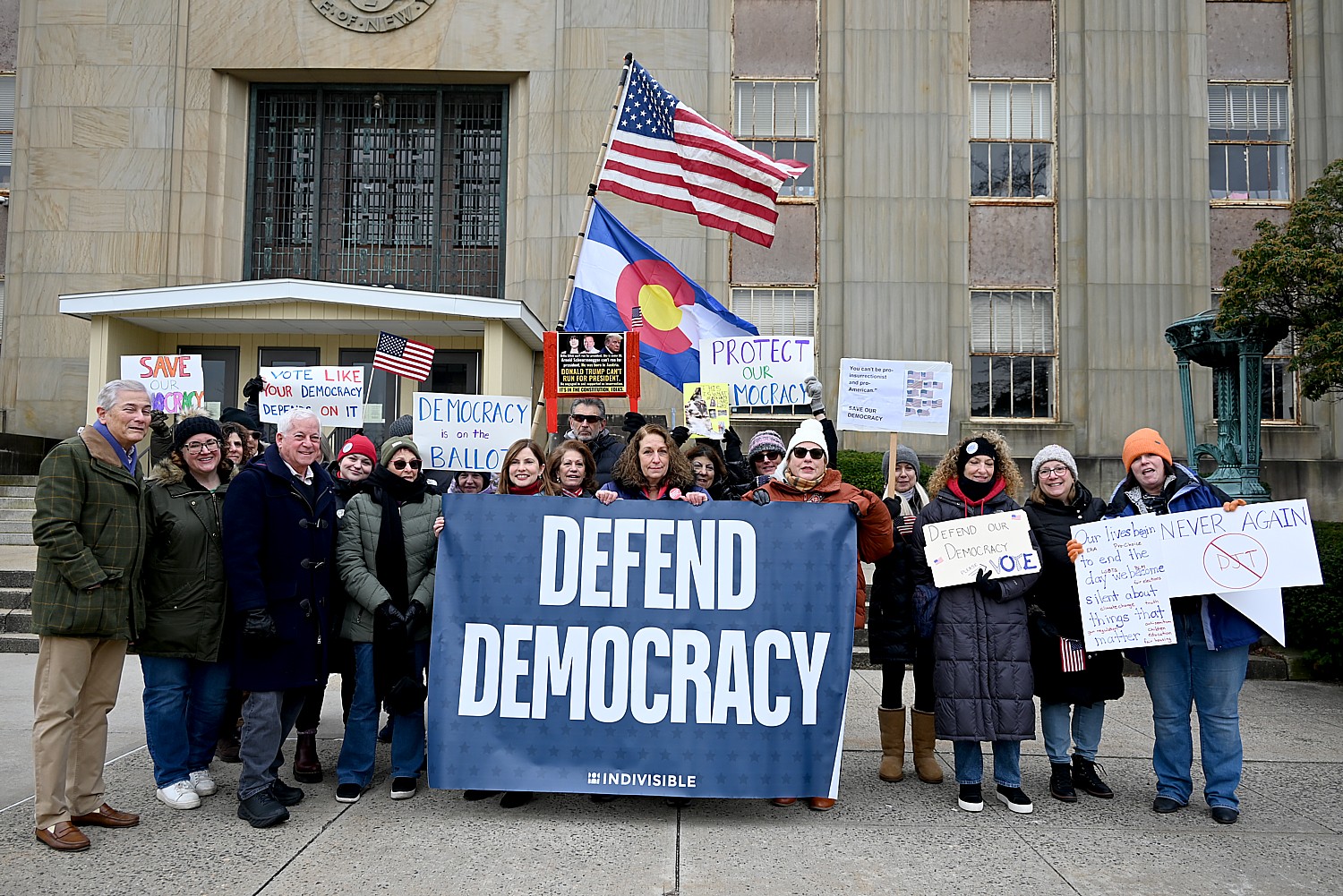
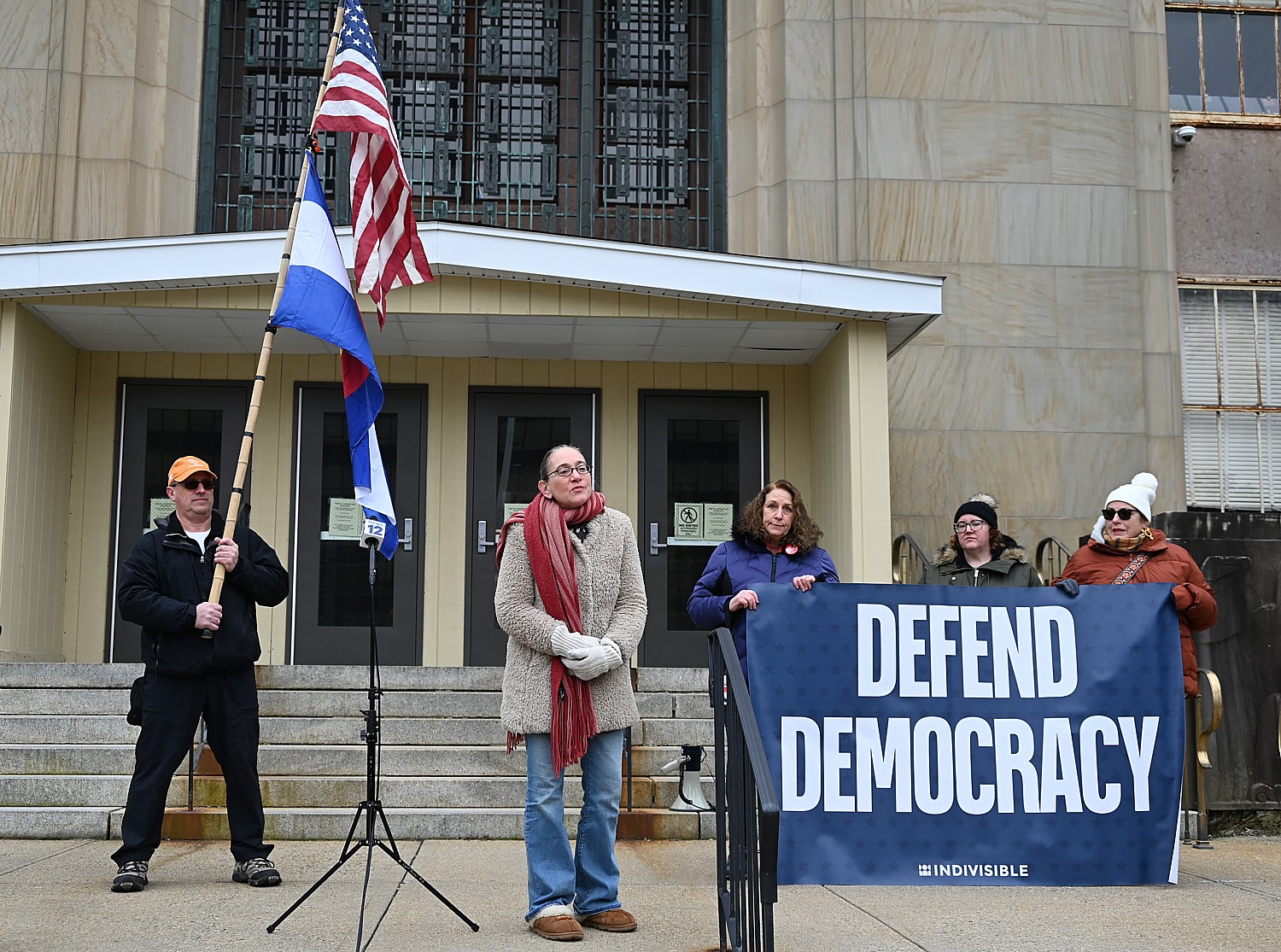
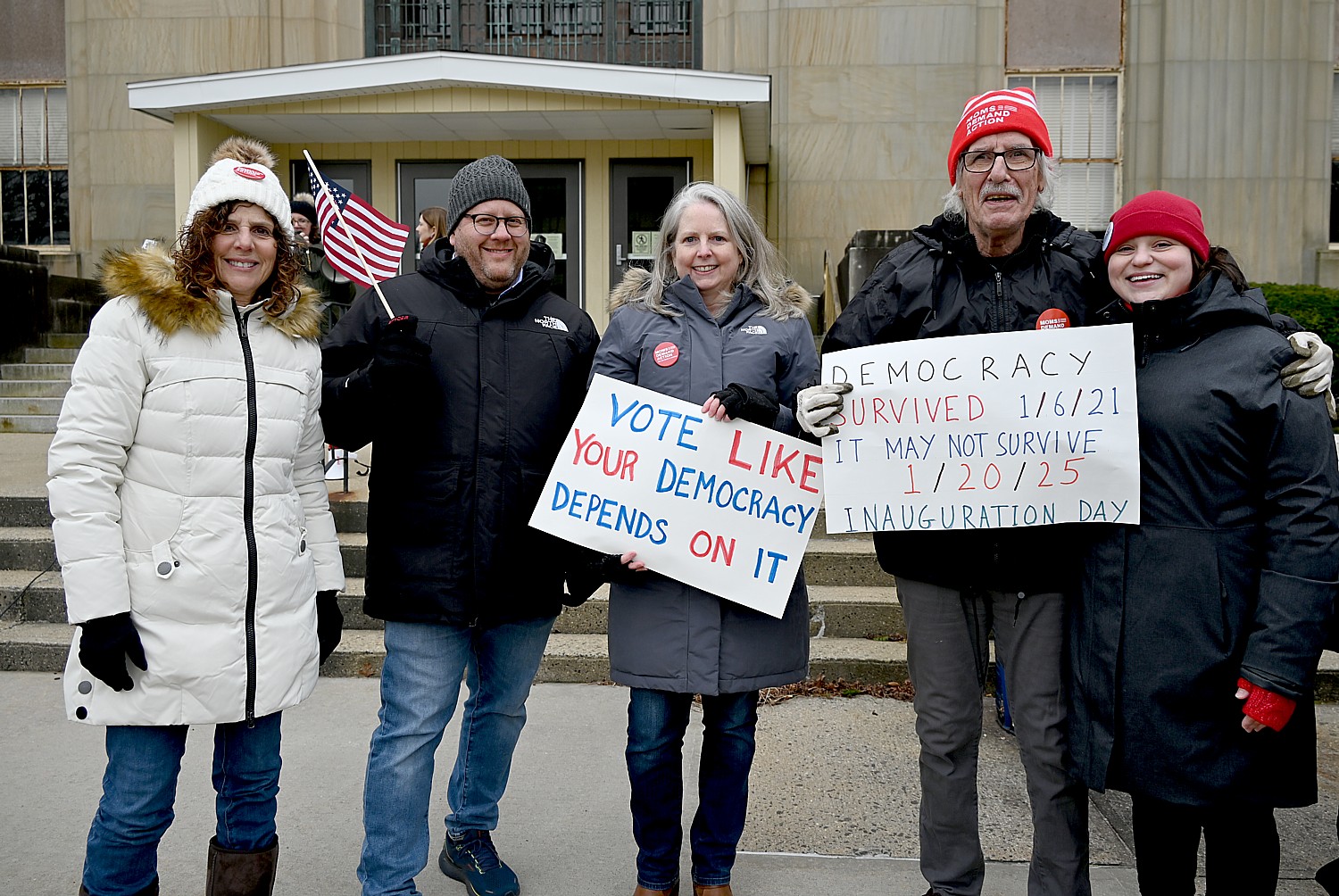
Long Island activists marked the third anniversary of the January 6 Insurrection – the first time in US history where a sitting president attempted to overturn an election by sending a violent mob to disrupt the peaceful transfer of power – with declarations to stand up to preserve democracy against those who would install an autocrat, to be engaged in the political process and most of all, vote.
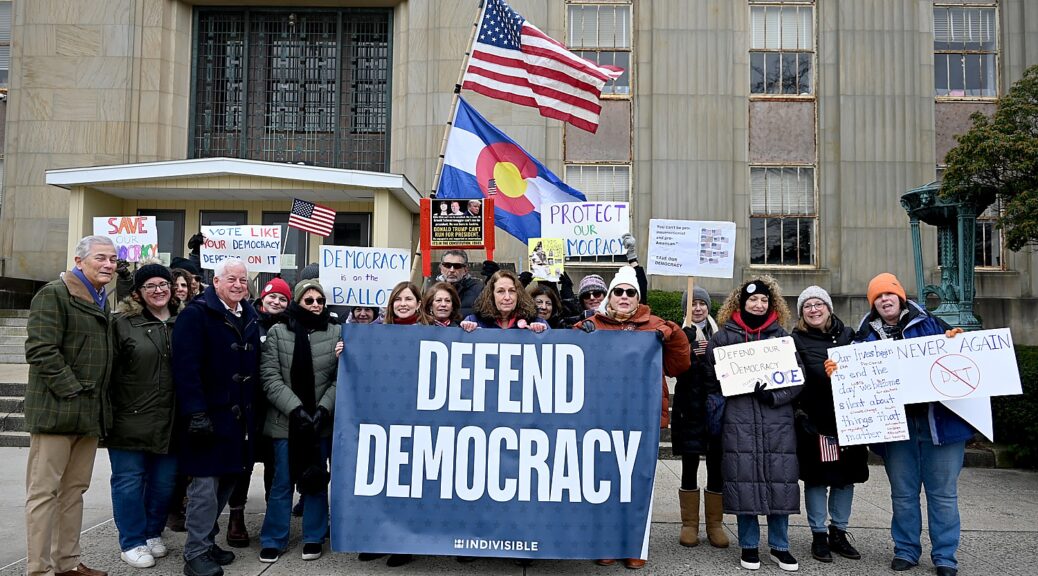
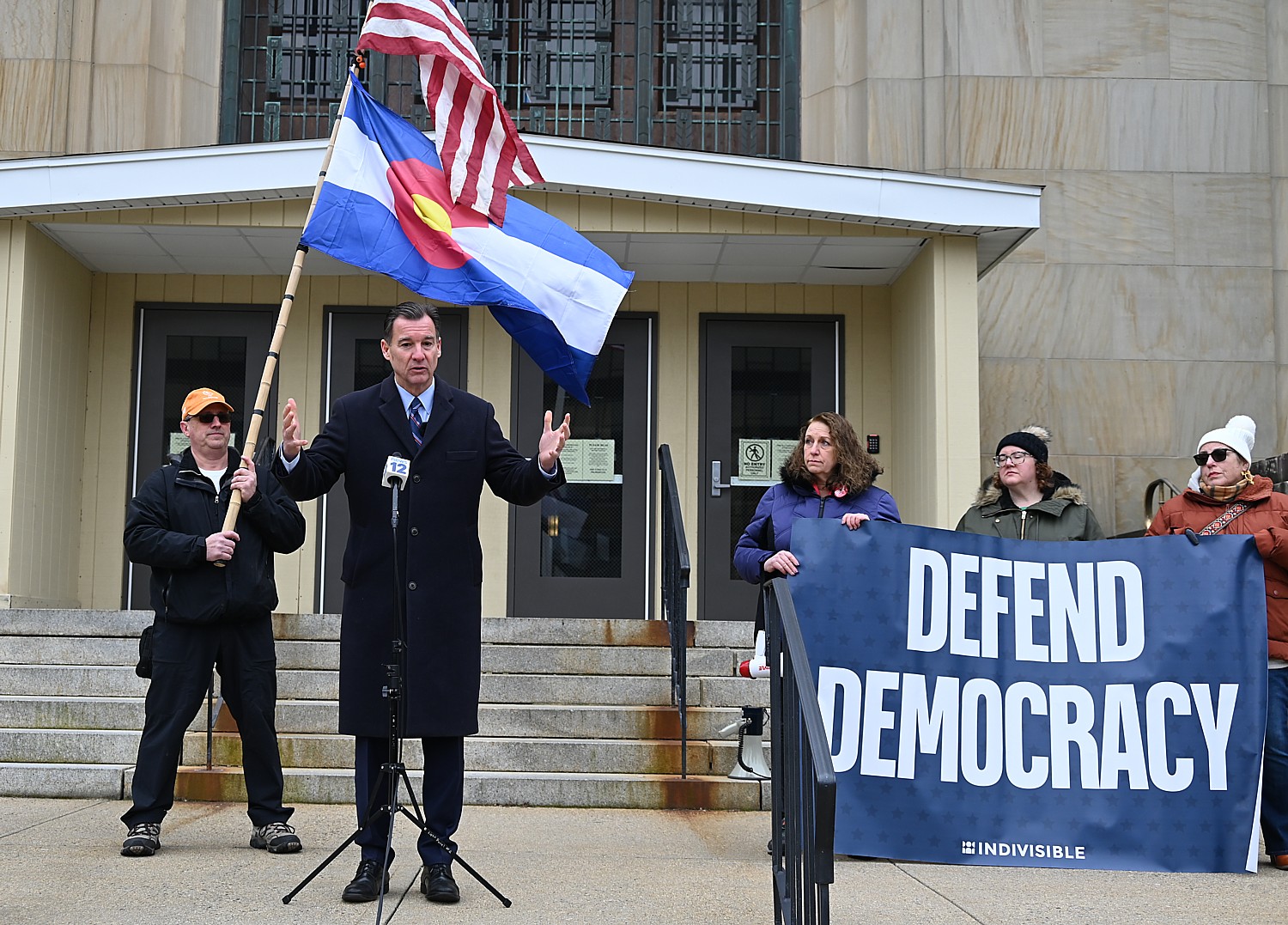
“January 6 was a wake up call how fragile democracy is. We didn’t want the day to go by without showing up in nonviolent support of democracy,” said Rachel Klein of Engage Long Island that organized a Rally to Defend Democracy on the steps of the Nassau County Supreme Court in Mineola.
The headliner was Tom Suozzi, who is running in NY-03’s special election on February 13 to return to Congress where he served for 6 years, filling the vacancy left by the disgraced, expelled fraudster George Santos, and take back the seat from Republicans.
Suozzi, who was in Congress during the January 6th insurrection, described in vivid detail what it was like for him during the attack, the terror of hearing the mob attempting to smash through the doors, hearing shots fired, how he was one of the last to leave the gallery where fellow Congressmembers were instructed to duck under seats and take out gas masks secured there.
Suozzi quoted former California Congressman Tom Lantos, a Holocaust survivor, from a speech he wrote for the United Nations on World Holocaust Day, in 2008, “We must remember that the veneer of civilization is paper thin. We are its guardians, and we can never rest.”
“As President Biden said, you can’t be pro-political violence and pro-democracy – those things don’t go together,” Suozzi said. “You don’t understand how powerful you are, how important being here today is. Keep fighting for what we know is right, so the greatest country in the world, the best hope for the world, is saved.”
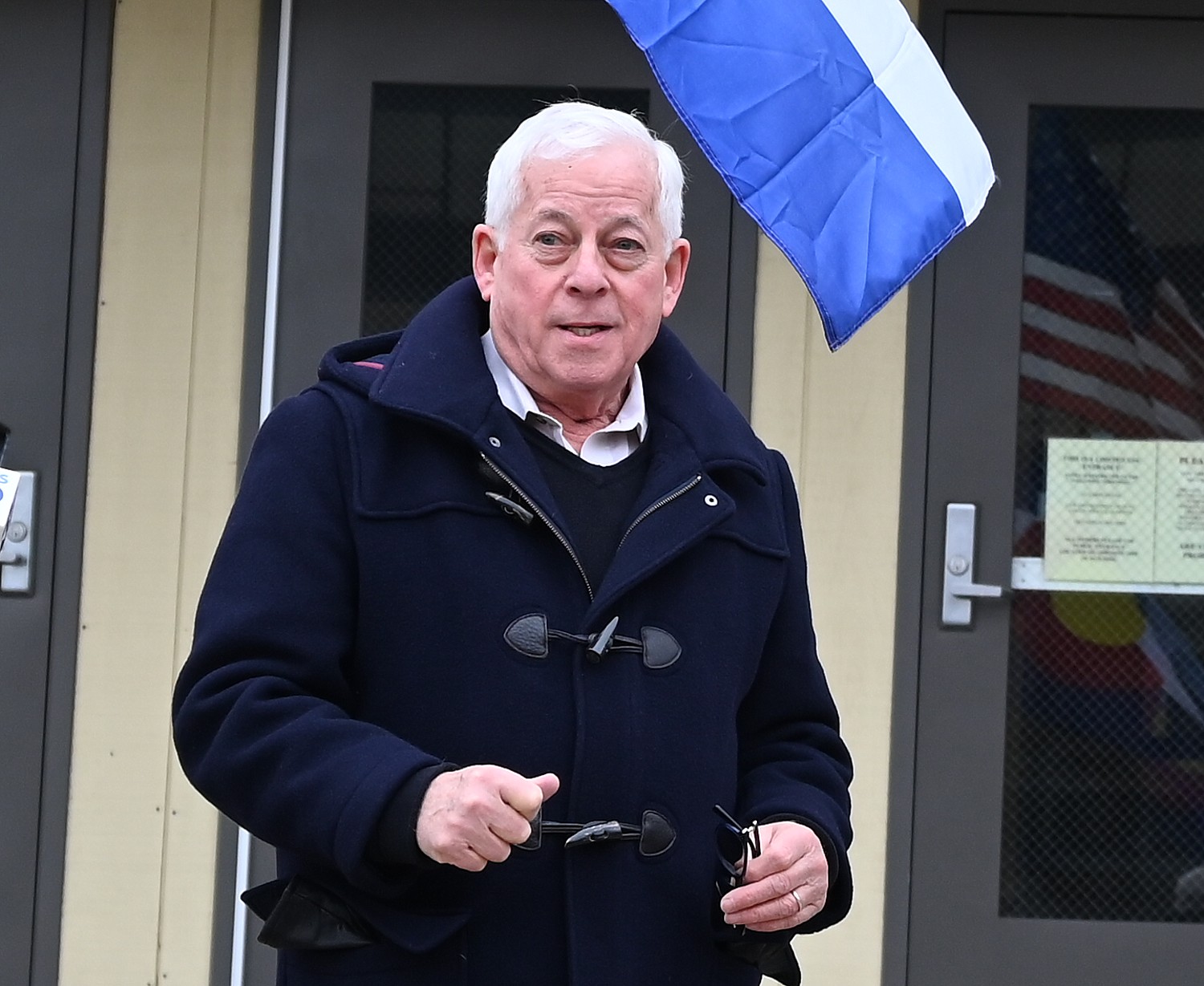
State Assemblyman Charles Lavine (D-AD 13) recalled how where the Supreme Court stands was once the Plains of Hempstead, and the site where British troops gathered to attack Washington and the rebels for the Battle of Brooklyn.
“History was made here. History is being made – standing up to tyranny. We saw the primitive brutality on January 6 – don’t want to see that again…In democracy, we accept election result, win, lose or draw. We don’t put together armed troops to contest an orderly transfer of power,” Lavine said.
“We have come out in cold weather but our blood is boiling – the idea this could happen again, that an American president would be dictator, tyrant, despot,” Lavine said. “Will we let that happen? Not on our watch. There are days that live in infamy –Sept 11th, Dec 7th. Jan 6 is one. Remember January 6th this November – in orderly fashion, go to polls, stand in line and vote.”
January 6th has inspired political activism, including people running for office.
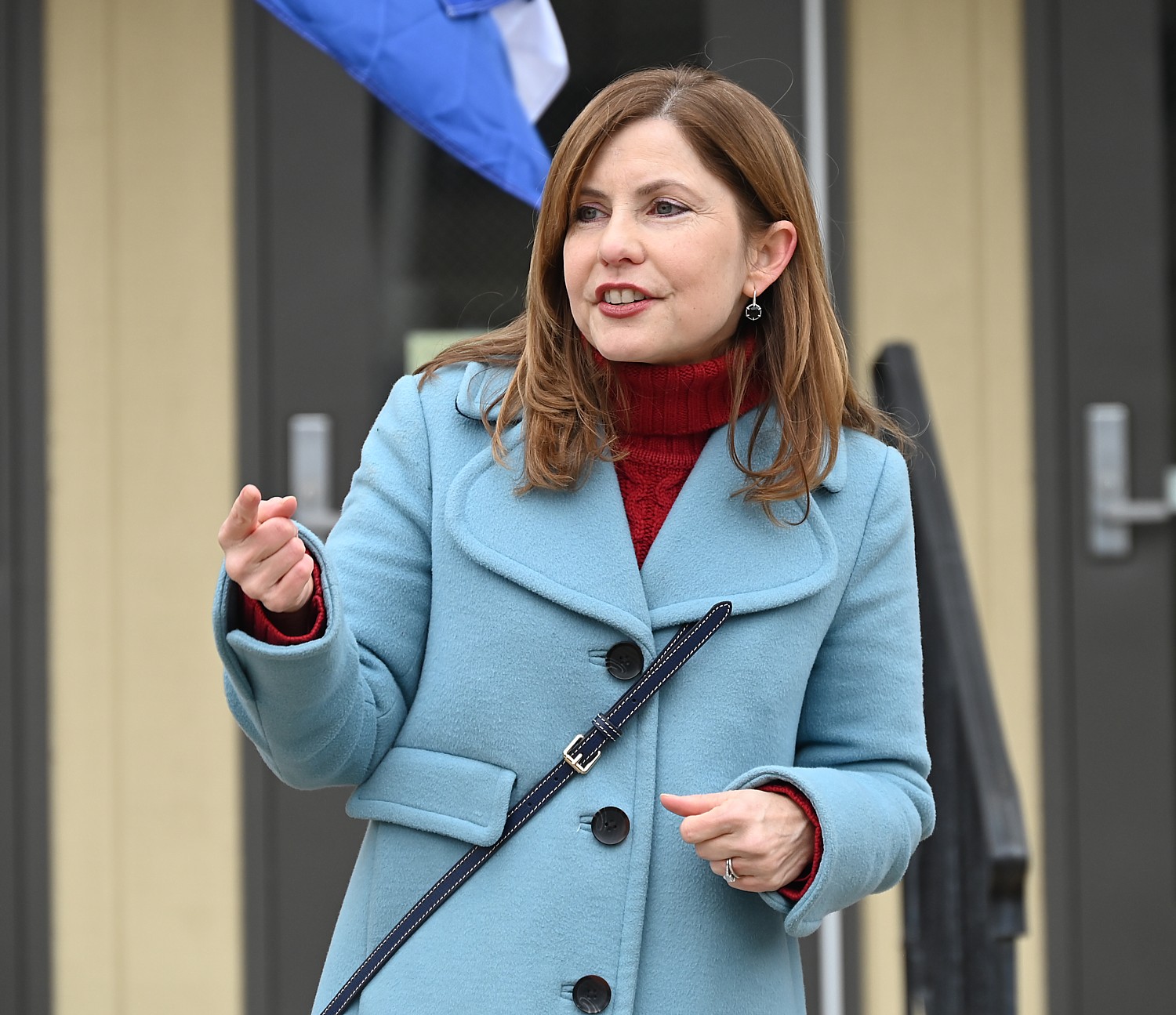
Community leader Kim Keiserman, president of Port Washington’s Democratic Club, a member of the steering committee of Concerned Citizens of NY-03 that played a key role in getting George Santos expelled from Congress, is now running for State Senate’s 7th district, taking on Republican Jack Martins.
She recalled Election night 2016 when Trump was declared the winner, how she tossed all night, replaying his lies, his attacks on women, immigrants, people of color, Muslims, disabled, press, NATO, allies. “I worried he would escalate attacks, pursue Muslim Ban, appoint Supreme Court justices to overturn Roe, cozying up to Putin, undermine democracy and our standing in world and worried what four years of Trump would do to democracy.” All of which came to pass.
“We are still in tremendous trouble –the stakes in the next election higher than ever. The biggest mistake we can make is falling into despair or believing that nobody else cares as much as we do. We need to organize and get out the vote.”
Dr. Eve Meltzer-Krief also was motivated to run for the Suffolk County Legislature. She recalled joining the Women’s March on Washington seven years ago, less than 24 hours after Trump took the oath of office and gave his “American carnage” speech.
“I understood the danger Trump posed to our democracy. We marched against his fascist tendencies, his attacks of fake news, the seeds of hate he planted – the two most powerful weapons a Fascist has in his arsenal. We know where hate, when politicized, can lead, especially when it comes from the mouth of the most powerful, loudest voice in the world: ‘Mexicans are rapists, Muslim ban, Jews will not replace us, he dehumanized immigrants, made it okay to rip young children from their parent’s arms, fomented hate against Asians, targeted public health officials – Dr. Fauci still needs body guards,” Dr. Krief said.
“During his presidency, every day, we had to think about what construct he shattered, what lie told, who he attacked, how democracy was weakened each day. Our democracy can’t survive another 4 years – Trump is existential threat to country. At this moment, we must stand up, dig deep, defend democracy. The world is an overwhelming place – divided in conflict – in the Mideast. Gun violence epidemic – yet another school shooting. A 12 year old rape victim forced to deliver. The hottest temperature the planet has ever experienced.
“It’s overwhelming – but none of these issues will matter if we don’t have democracy with which to raise our voices. We have to focus, dig deep. It can feel like the weight of world is on our shoulders. But if our democracy fails, democracies around the world will crumble. We are doing this for ourselves, our children’s futures and the world. We have to defend democracy. We can’t let democracy die on our watch,” Dr. Krief said.
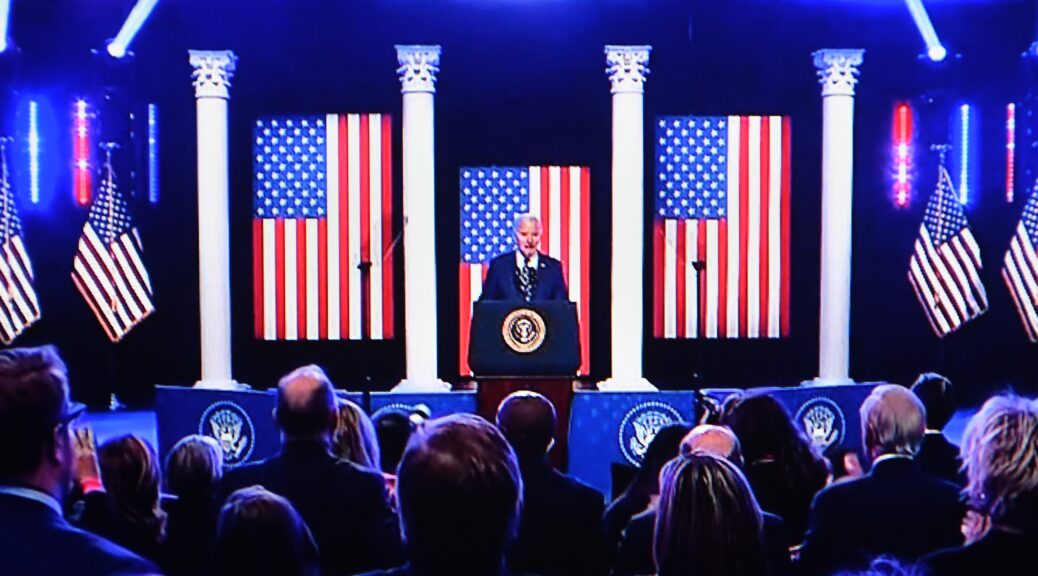
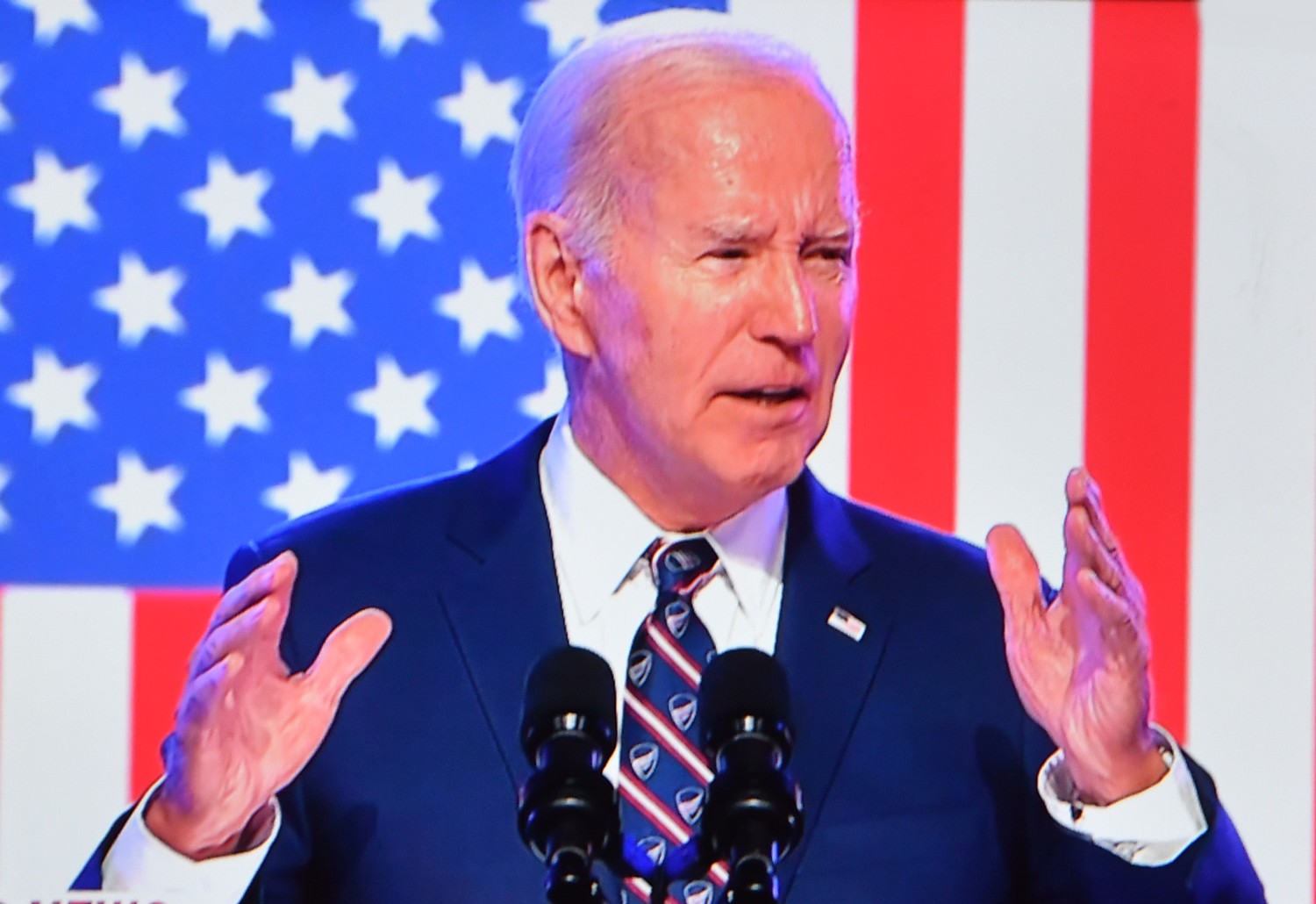
In this, President Joe Biden’s first major speech of 2024, on January 5 marking the third anniversary of the January 6 insurrection which he delivered at Valley Forge, he highlights what is at stake in the upcoming 2024 election: nothing short of whether the United States will be ruled by democracy or a despot. “Is democracy still America’s sacred cause” he askedin what may well be considered Biden’s “Gettysburg Address.”
In this, President Joe Biden’s first major speech of 2024, which he delivered at Valley Forge on January 5, marking the third anniversary of the January 6th Insurrection, he highlights what is at stake in the upcoming 2024 election: nothing short of whether the United States will be ruled by democracy or a despot. “Is democracy still America’s sacred cause” he askedin what may well be considered Biden’s “Gettysburg Address.”
In contrast, Donald Trump’s first campaign speech committed himself to “retribution, revenge,” weaponizing the Department of Justice to persecute anyone who looks like they are doing well against him, literally tearing up the Constitution, enacting the Insurrection Act, pardoning the January 6 insurrectionists (he calls “hostages”) and being dictator (for the first day). And by suggesting that his own top military general be executed (for showing loyalty to the Constitution instead of him), he has laid down the gauntlet of weaponizing and routinizing political intimidation to insure his power.
As President Biden has said so many times, “this is not hyperbole” but a real call out to the existential crisis Americans must confront.
“Whether democracy is still America’s sacred cause is the most urgent question of our time, and it’s what the 2024 election is all about.” “Democracy is on the ballot. Your freedom is on the ballot.”
“Without democracy, no progress is possible. Think about it. The alternative to democracy is dictatorship — the rule of one, not the rule of ‘We the People.’”
“Democracy means having the freedom to speak your mind, to be who you are, to be who you want to be. Democracy is about being able to bring about peaceful change. Democracy — democracy is how we’ve opened the doors of opportunity wider and wider with each successive generation, notwithstanding our mistakes.”
“But if democracy falls, we’ll lose that freedom. We’ll lose the power of “We the People” to shape our destiny. If you doubt me, look around the world. Travel with me as I meet with other heads of state throughout the world.”
Here is a slightly edited, highlighted transcript of President Biden’s remarks at Valley Forge, Blue Bell, Pennsylvania, on January 5 –Karen Rubin/news-photos-features.com
In this, President Joe Biden’s first major speech of 2024, on January 5 marking the third anniversary of the January 6 insurrection which he delivered at Valley Forge, he highlights what is at stake in the upcoming 2024 election: nothing short of whether the United States will be ruled by democracy or a despot. “Is democracy still America’s sacred cause” he askedin what may well be considered Biden’s “Gettysburg Address.”
AUDIENCE: Four more years! Four more years! Four more years!
THE PRESIDENT: Thank you. Please. Thank you. Please. Thank you very, very much.
Today — the topic of my speech today is deadly serious, and I think it needs to be made at the outset of this campaign.
In the winter of 1777, it was harsh and cold as the Continental Army marched to Valley Forge. General George Washington knew he faced the most daunting of tasks: to fight and win a war against the most powerful empire that existed in the world at the time.
His mission was clear. Liberty, not conquest. Freedom, not domination. National independence, not individual glory.
America made a vow. Never again would we bow down to a king.
The months ahead would be incredibly difficult. But General Washington knew something in his bones, something about the spirit of the troops he was leading, something — something about the soul of the nation he [that] was struggling to be born.
In his general order, he predicted, and I quote, “with one heart and one mind,” “with fortitude and with patience,” they would overcome every difficulty — the troops he was leading.
And they did. They did.
This army that lacked blankets and food, clothes and shoes. This army whose march left bloody, bare footprints in the snow. This ragtag army made up of ordinary people. Their mission, George Washington declared, was nothing less than “a sacred cause.” That was the phrase used: “a sacred cause.”
Freedom, liberty, democracy. American democracy.
I just visited the grounds of Valley Forge. I’ve been there a number of times from the time I was a Boy Scout years ago. You know, it’s the very site that I think every American should visit because it tells the story of the pain and the suffering and the true patriotism it took to make America.
Today, we gather in a new year, some 246 years later, just one day before January 6th, a day forever shared in our memory because it was on that day that we nearly lost America — lost it all.
Today, we’re here to answer the most important of questions. Is democracy still America’s sacred cause? I mean it. (Applause.)
This is not rhetorical, academic, or hypothetical. Whether democracy is still America’s sacred cause is the most urgent question of our time, and it’s what the 2024 election is all about.
The choice is clear. Donald Trump’s campaign is about him, not America, not you. Donald Trump’s campaign is obsessed with the past, not the future. He’s willing to sacrifice our democracy, put himself in power.
Our campaign is different. For me and Kamala, our campaign is about America. It’s about you. It’s about every age and background that occupy this country. It’s about the future we’re going to continue to build together.
And our campaign is about preserving and strengthening our American democracy. Three years ago tomorrow, we saw with our own eyes the violent mob storm the United States Capitol. It was almost in disbelief as you first turned on the television.
For the first time on our history, insurrectionists had come to stop the peaceful transfer — transfer of power in America — first time — smashing windows, shattering doors, attacking the police.
Outside, gallows were erected as the MAGA crowd chanted, “Hang Mike Pence.”
Inside, they hunted for Speaker Pelosi [of] the House, was chanting, as they marched through and smashed windows, “Where’s Nancy?”
Over 140 police officers were injured. Jill and I attended the funeral of police officers who died as a result of the events of that day.
And because Donald — because of Donald Trump’s lies, they died because these lies brought a mob to Washington.
He promised it would be “wild,” and it was. He told the crowd to “fight like hell,” and all hell was unleashed.
He promised he would right them — right them. Everything they did, he would be side by side with them. Then, as usual, he left the dirty work to others. He retreated to the White House.
As America was attacked from within, Donald Trump watched on TV in the private small dining room off my Oval — off the Oval Office.
The entire nation watched in horror. The whole world watched in disbelief. And Trump did nothing.
Members of his staff, members of his family, Republican leaders who were under attack for the — at that very moment pled with him: “Act. Call off the mob.”
Imagine had he gone out and said, “Stop.”
And still, Trump did nothing. It was among the worst derelictions of duty by a president in American history: an attempt to overturn a free and fair election by force and violence.
A record 81 million people voted for my candidacy and to end his presidency. Trump lost the popular vote by 7 million.
Trump’s claims about the 2020 election never could stand up in court. Trump lost 60 court cases — 60. Trump lost the Republican-controlled states. Trump lost before a Trump-appointed judge — and then judges. And Trump lost before the United States Supreme Court. (Applause.) All of it, he lost.
Trump lost recount after recount after recount in state after state. But in desperation and weakness, Trump and his MAGA followers went after election officials who ensured your power as a citizen would be heard. These public servants had their lives forever upended by attacks and death threats for simply doing their jobs.
In Atlanta, Georgia, a brave Black mother and her daughter, Ruby Freeman and Shaye Moss, were doing their jobs as elected workers until Donald Trump and his MAGA followers targeted and threatened them, forcing them from their homes and unleashing racist vitriol on them. Trump’s personal lawyer, Rudy Giuliani, was just hit with $148 million judgment for cruelty and defamation that he inflicted against them.
Other state and local elected officials across the country faced similar personal attacks. In addition, Fox News agreed to pay a record $787 million for the lies they told about voter fraud.
Let’s be clear about the 2020 election. Trump exhausted every legal avenue available to him to overturn the election — every one. But the legal path just took Trump back to the truth that I had won the election and he was a loser. (Applause.)
Well, knowing how his mind works now, he had one — he had one act left — one desperate act available to him: the violence of January the 6th.
And since that day, more than 1,200 people have been charged for their assault on the Capitol. Nearly 900 of them have been convicted or pled guilty. Collectively, to date, they have been sentenced to more than 840 years in prison. (Applause.)
And what has Trump done? Instead of calling them “criminals,” he’s called these insurrectionists “patriots.” They’re “patriots.” And he promised to pardon them if he returns to office.
Trump said that there was “a lot of love” on January the 6th. The rest of the nation, including law enforcement, saw a lot of hate and violence. One Capitol police officer called it a “medieval battle.” That same officer called vile — was called vile, racist names. He said he was more afraid in the Capitol of the United States of America, in the chambers, than when he was fighting as a soldier in the war in Iraq. He said he was more afraid inside the halls of Congress than fighting in the war in Iraq.
In trying to rewrite the facts of January 6th, Trump is trying to steal history the same way he tried to steal the election. But we knew the truth because we saw it with our own eyes. It wasn’t like something — a story being told. It was on television repeatedly. We saw it with our own eyes.
Trump’s mob wasn’t a peaceful protest. It was a violent assault. They were insurrectionists, not patriots. They weren’t there to uphold the Constitution; they were there to destroy the Constitution.
Trump won’t do what an American president must do. He refuses to denounce political violence.
So, hear me clearly. I’ll say what Donald Trump won’t. Political violence is never, ever acceptable in the United States political system — never, never, never. It has no place in a democracy. None. (Applause.)
You can’t be pro-insurrectionist and pro-American.
You know, Trump and his MAGA supporters not only embrace political violence, but they laugh about it. At his rally, he jokes about an intruder, whipped up by the Big Trump Lie, taking a hammer to Paul Pelosi’s skull and echoing the very same words used on January 6th: “Where’s Nancy?”
And he thinks that’s funny. He laughed about it. What a sick — (laughter and applause). My God.
I think it’s despicable, seriously — not just for a president, for any person to say that. But to say it to the whole world listening.
When I was overseas — anyway. (Laughter.)
Trump’s assault on democracy isn’t just part of his past. It’s what he’s promising for the future. He’s being straightforward. He’s not hiding the ball.
His first rally for the 2024 campaign opened with a choir of January 6th insurrectionists singing from prison on a cell phone while images of the January 6th riot played on a big screen behind him at his rally.
Can you believe that? This is like something out of a fairy tale — a bad fairy tale.
Trump began his 2024 campaign by glorifying the failed violent insurrectionist — insurrection at our — on our Capitol.
The guy who claims law and order sows lawlessness and disorder.
Trump’s not concerned about your future, I promise you. Trump is now promising a full-scale campaign of “revenge” and “retribution” — his words — for some years to come. They were his words, not mine. He went on to say he would be a dictator on day one.
I mean, if I were writing a book of fiction and I said an American president said that, and not in jest —
He called it, and I quote, the “termination of all the rules, regulation, and articles, even those found in the U.S. Constitution,” should be terminated, if it’s his will.
It’s really kind of hard to believe. Even found in the Constitution, he could terminate?
He’s threatened the former Chairman of the Joint Chiefs of Staff with the death penalty. Says he should be put to death because the Chairman put his oath to the Constitution ahead of his personal loyalty to Trump.
This coming from a president who called — when he visited a cemetery, called dead soldiers “suckers” and “losers.” Remember that?
Sometimes, I’m really happy the Irish in me can’t be seen. (Laughter.)
It was right around the time I was at Beau’s grave, Tommy.
How dare he? Who in God’s name does he think he is?
With former aides, Trump plans to invoke the Insurrectionist Act — the Insurrection Act, which would allow him to deploy — which he’s not allowed to do in ordinary circumstances — allow him to deploy U.S. military forces on the streets of America. He said it.
He calls those who oppose him “vermin.” He talks about the blood of Americans being poisoned, echoing the same exact language used in Nazi Germany.
He proudly posts on social media the words that best describe his 2024 campaign, quote, “revenge”; quote, “power”; and, quote, “dictatorship.”
There’s no confusion about who Trump is and what he intends to do.
I placed my hand on our family Bible, and I swore an oath on the very same steps of the Capitol just 14 days after the attack on January the 6th.
As I looked out over the capital city, whose streets were lined with National Guard to prevent another attack, I saw an American that had been pushed to the brink — an America that had been pushed to the brink.
But I felt enormous pride — not in winning. I felt enormous pride in America because American democracy had been tested and American democracy had held together. And when Trump had seen weakness in our democracy and continues to talk about it, I saw strength — your strength. It’s not hyperbole. Your strength. Your integrity. American strength and integrity.
Ordinary citizens, state election officials, the American judicial system had put the Constitution first and sometimes at their peril — at their peril.
Because of them, because of you, the will of the people prevailed, not the anger of the mob or the appetites of one man.
When the attack on January 6th happened, there was no doubt about the truth. At the time, even Republican members of Congress and Fox News commentators publicly and privately condemned the attack.
As one Republican senator said, “Trump’s behavior was embarrassing and humiliating for the country.” But now, that same senator and those same people have changed their tune.
As time has gone on, politics, fear, money, all have intervened. And now these MAGA voices who know the truth about Trump on January 6th have abandoned the truth and abandoned democracy.
They made their choice. Now the rest of us — Democrats, independents, mainstream Republicans — we have to make our choice.
I know mine. And I believe I know America’s.
We will defend the truth, not give in to the Big Lie. We’ll embrace the Constitution and the Declaration, not abandon it. We’ll honor the sacred cause of democracy, not walk away from it.
Today, I make this sacred pledge to you. The defense, protection, and preservation of American democracy will remain, as it has been, the central cause of my presidency. (Applause.)
America, as we begin this election year, we must be clear: Democracy is on the ballot. Your freedom is on the ballot. (Applause.)
Yes, we’ll be voting on many issues: on the freedom to vote and have your vote counted, on the freedom of choice, the freedom to have a fair shot, the freedom from fear. And we’ll debate and disagree.
Without democracy, no progress is possible. Think about it. The alternative to democracy is dictatorship — the rule of one, not the rule of “We the People.”
That’s what the soldiers of Valley Forge understood. And so was me — was what we have to understand it as well. We’ve been blessed so long with a strong, stable democracy. It’s easy to forget why so many before us risked their lives and strengthened democracy, what our lives would be without it.
Democracy means having the freedom to speak your mind, to be who you are, to be who you want to be. Democracy is about being able to bring about peaceful change. Democracy — democracy is how we’ve opened the doors of opportunity wider and wider with each successive generation, notwithstanding our mistakes.
But if democracy falls, we’ll lose that freedom. We’ll lose the power of “We the People” to shape our destiny. If you doubt me, look around the world. Travel with me as I meet with other heads of state throughout the world.
Look at the authoritarian leaders and dictators Trump says he admires — he, out loud, says he admires. I won’t go through them all. It would take too long.
Look, remember when he refers to what he calls the “love letter” exchanges between he and the dictator of North Korea? Those women and men out there in the audience who ever fought for the American military, would you ever believe you’d hear a president say something like that?
His admiration for Putin — I can go on.
And look at what these autocrats are doing to limit freedom in their countries. They’re limiting freedom of speech, freedom of press, freedom to assemble, women’s rights, LGB[T]Q rights, people are going to jail, so much more.
It’s true: The push and pull of American history is not a fairy tale. Every stride forward in America is met with a ferocious backlash, many times from those who fear progress and those who exploit that fear for their own personal gain; from those who traffic in lies told for power and profit; from those who are driven by grievance and grift, consumed by conspiracy and victimhood; from those who seek to bury history and ban books.
Did you ever think you’d be at a political event talking about book banning for in a presidential election?
The choice and contest between those forces — those competing forces, between solidarity and division — is perennial. But this time, it’s so different.
You can’t have a contest — you can’t have a contest if you see politics as an all-out war instead of a peaceful way to resolve our differences. All-out war is what Trump wants.
That’s why he doesn’t understand the most fundamental truth about this country. Unlike other nations on Earth, America is not built on ethnicity, religion, geography. We’re the only nation in the history of the world built on an idea — not hyperbole — built on an idea: “We hold these truths to be self-evident, that all men and women are created equal.”
It’s an idea declared in the Declaration, created in a way that we viewed everybody as equal and be — should be treated equally throughout their lives.
We’ve never fully lived up to that. We have a long way to go. But we’ve never walked away from the idea. We’ve never walked away from it before. But I promise you, I will not let Donald Trump and the MAGA Republicans — (applause) — force us to walk away now.
We’re living in an era where a determined minority is doing everything in its power to try to destroy our democracy for their own agenda. The American people know it, and they’re standing bravely in the breach.
Remember, after 2020, January 6th insurrection to undo the election in which more Americans had voted than any other in American history? America saw the threat posed to the country, and they voted him out. In 2022, historic midterm election, in state after state, election after election, the election deniers were defeated.
Now, in 2024, Trump in running as the “denier-in-chief” — the election denier-in-chief. Once again, he’s saying he won’t honor the results of the election if he loses.
Trump says he doesn’t understand. Well, he still doesn’t understand the basic truth, and that is you can’t love your country only when you win. (Applause.) You can’t love your country only when you win.
So, I’ll keep my commitment to be president for all of America, whether you voted for me or not. I’ve done it for the last three years, and I’ll continue to do it.
Together, we can keep proving that America is still a country that believes in decency, dignity, honesty, honor, truth. We still believe that no one, not even the President, is above the law. We still believe — (applause) — the vast majority of us still believe that everyone deserves a fair shot at making it. We’re still a nation that gives hate no safe harbor.
I tell you from my experience working with leaders around the world — and I mean this sincerely, not a joke — that America is still viewed as the beacon of democracy for the world.
I can’t tell you how many — how many world leaders — and I know all of them, virtually all of them — grab my arm in private and say, “He can’t win. Tell me. No, my country will be at risk.”
Think of how many countries, Tommy, you know that are on the on the edge. Imagine.
We still believe in “We the People,” and that includes all of us, not some of us.
Let me close with this. On that cold winter of 1777, George Washington and his American troops at Valley Forge waged a battle on behalf of a revolutionary idea that everyday people — like where I come from and the vast majority of you — not a king or a dictator — that everyday people can govern themselves without a king or a dictator.
In fact, in the rotunda of the Capitol, there’s a giant painting of General George Washington — not President Washington — and he is resigning his commission as Commander-in-Chief of the Continental Army.
A European king at this — at the time said, after he won the revolution, “Now is the time for him to declare his kingship.”
But instead, the mob that attacked the Capitol, waving Trump flags and Confederate flags, stormed right past that portrait. That image of George Washington gave them no pause, but it should have.
The artist that painted that portrait memorialized that moment because he said it was, quote, “one of the highest moral lessons ever given to the world.” End of quote.
George Washington was at the height of his power. Having just defeated the most powerful empire on Earth, could have held onto the power as long as he wanted. He could have made himself not a future president but a future monarch, in effect.
And, by the way, when he got elected president, he could have stayed for two, three, four, five terms, until he died. But that wasn’t the America he and the American troops at Valley Forge had fought for.
In America, genuine leaders — democratic leaders, with a small “d” — don’t hold on to power relentlessly. Our leaders return power to the people. And they do it willingly, because that’s the deal. You do your duty. You serve your country.
And ours is a country worthy of service, as many Republican presidents and Democratic presidents have shown over the years.
We’re not perfect. But at our best, we face on — we face head on the good, the bad, the truth of who we are. We look in the mirror and ultimately never pretend we’re something we’re not. That’s what great nations do. And we’re a great nation. We’re the greatest nation on the face of the Earth. We really are. (Applause.)
That’s the America I see in our future. We get up. We carry on. We never bow. We never bend. We speak of possibilities, not carnage. We’re not weighed down by grievances. We don’t foster fear. We don’t walk around as victims.
We take charge of our destiny. We get our job done with the help of the people we find in America, who find their place in the changing world and dream and build a future that not only they but all people deserve a shot at.
We don’t believe — none of you believe America is failing. We know America is winning. That’s American patriotism. (Applause.)
And it’s not winning because of Joe Biden. It’s winning.
This is the first national election since January 6th insurrection placed a dagger at the throat of American democracy — since that moment. We all know who Donald Trump is. The question we have to answer is: Who are we? That’s what’s at stake. (Applause.) Who are we?
In the year ahead, as you talk to your family and friends, cast your ballots, the power is in your hands. After all we’ve been through in our history, from independence to Civil War to two world wars to a pandemic to insurrection, I refuse to believe that, in 2024, we Americans will choose to walk away from what’s made us the greatest nation in the history of the world: freedom, liberty. (Applause.)
Democracy is still a sacred cause. And there’s no country in the world better positioned to lead the world than America.
That’s why — (applause) — I’ve said it many times. That’s why I’ve never been more optimistic about our future. And I’ve been doing this a hell of a long time. (Laughter.)
Just have to remember who we are — with patience and fortitude, with one heart. We are the United States of America, for God’s sake. (Applause.)
I mean it. There is nothing — I believe with every fiber that there is nothing beyond our capacity if we act together and decently with one another. Nothing, nothing, nothing. (Applause.) I mean it.
We’re the only nation in the world that’s come out of every crisis stronger than we went into that crisis. That was true yesterday and it’s true today, and I guarantee you will be true tomorrow.
God bless you all. And may God protect our troops. (Applause.)
Thank you. Thank you.
(The First Lady joins the President onstage.) I understand power. (Laughter.)
Thank you all so very much. (Inaudible.) Thank you, thank you, thank you. (Applause.)