The Long Island Railroad Strike has stranded some 300,000 riders a day, cost millions of dollars of economic activity daily, exacerbated traffic and pollution when air quality is already bad. The Teamsters’ demands would cause fares to increase 8%, and trigger wage and cost increases across the state’s workforce at a time when commuters can scarcely afford it.
Governor Hochul, while showing respect for unions and workers, has noted that Long Island Railroad workers are already the highest paid in the country, and if the MTA accedes to their fairly outrageous demands, it not only will force a further increase in fares for already hard-pressed Long Islanders, but will trigger similar, unsustainable increases throughout the workforce.
Here are Governor Kathy Hochul’s remarks about the Long Island Railroad strike – Karen Rubin, editor@news-photos-features.com
“The Long Island Rail Road is essential. Every day it carries nearly 300,000 commuters and without this service, life on Long Island as we know it is not possible.
“As Governor, I have been proud to make historic investments in the LIRR. Working with the MTA, we increased service by 40%, improved safety for riders and workers, secured the railroad’s fiscal future after the pandemic, and delivered transformative projects like the Main Line Third Track and Grand Central Madison.
“The LIRR is more stable now than it has been for generations. The decision by some unions to strike over demands that would threaten that progress is reckless. These unions represent the highest paid workers of any railroad in the nation, yet they are demanding contracts that could raise fares as much as 8%, pit workers against one another, and risk tax hikes for Long Islanders. This is unacceptable. My priority is protecting affordability for riders and ensuring fairness across the workforce.
“The disruption that Long Islanders face starting tonight is the direct result of reckless actions by the Trump Administration to cut mediation short and push these negotiations toward a strike. For weeks, the MTA has attempted to negotiate in good faith and put multiple fair offers on the table that included meaningful wage increases, but you cannot make a deal if one side refuses to engage in good faith.
“Commuters are dealing with unnecessary dysfunction and thousands of union LIRR workers are being forced to go without a paycheck because of decisions made by a small group of union leaders. I stand with LIRR riders and will fight to preserve the long term stability of the MTA. I believe a deal can be done and I urge both the MTA and these unions to return to the table and bargain non-stop until a deal is reached.”
After the strike was underway, Governor Hochul gave a briefing and discussed what was being done to mitigate the disruption in transportation:
I want to give Long Island Rail Road riders the latest updates on the strike. Let me be clear, I did not want a strike. The MTA did not want a strike. The MTA has put fair offers on the table, in fact, many of them. And so despite that, for the first time in 30 years, the hundreds of thousands of people who rely on the LIRR are without service because of a strike. We all know that the railroad is the lifeblood of Long Island. Without it, life as we know it is simply not possible. The bottom line is: No one wins in a strike. Everyone is hurt — the hundreds of thousands of people who rely on the railroad, and the thousands of unionized workers who are losing out on wages.
I want to speak directly to the men and women of labor at the LIRR: The work you do is absolutely vital. Absolutely. I value your labor, and I believe that you deserve fair wages and benefits. But this strike has put all that at risk. Just three days of a strike would erase every dollar of additional salary that workers would receive under a new contract. We don’t need to be here. Workers deserve better, but also New Yorkers deserve better. That’s why today I’m urging all parties once again to bargain at the table, and to get a deal done.
I also want to give an update to the Long Island Rail Road riders who are wondering about work tomorrow. Now, I’ve been in close communication, I’ve been touring the sites. I’m here at the Operations Control Center to talk to the individuals overseeing the lines that we anticipate the highest volume on tomorrow — you’ll hear more about that from our MTA leadership team — and we have a plan to ensure that essential workers can get into the city during the workday commute.
Now, starting at 4:00 a.m. tomorrow, the MTA will deploy shuttle buses to bring essential workers from across Long Island to subway stations in Queens, and those shuttle buses will be standing by to bring those essential workers back home to Long Island at the end of the day, to Long Island and Queens.
For those in Nassau County who absolutely cannot work from home, there continues to be the option of taking a Nassau Inter-County Express bus directly to the subway connections in Queens. They’ll run extra bus service weekdays during the strike, and we’ve encouraged the county to add additional capacity.
Another option is Citi Field. With the Mets hitting the road tomorrow, you can park there and transfer to the 7 train.
So right here, as I said, in the nerve center of the subway, every day four million New Yorkers rely on this system to get around. This subway system is absolutely vital, even more so tomorrow. And the MTA, as I’ve listened and asked questions, they’re ready to meet the challenge. Extra trains are on standby, and the MTA stands ready to run additional New York City subway service to meet the demand. And for the residents of Eastern Queens, who typically rely on the speed and convenience of the LIRR, the E and A trains are there for you as a great option to get to and from the city at this time.
But let’s face the facts. It’s impossible to fully replace LIRR service. So effective Monday, I’m asking that regular commuters who can work from home should. Please do so. And employers should make every accommodation necessary to allow for remote work. Now, I’ve already directed all state agencies affected to implement telecommuting plans for the state employees who typically commute in from Long Island. But also, we have to maintain essential government services. Now, everyone knows these alternatives are not business as usual. But unfortunately, they’re the direct result of this strike.
Let me be clear: This strike would not have been possible if the Trump Administration had not taken the highly unusual step last fall of releasing labor unions from mediation. Unfortunately for our commuters, the direct consequence of this action is the strike we have today.
Now, New York, everyone knows, is a pro-labor state. We believe in working men and women receiving a fair wage and benefits. But the MTA cannot agree to a contract that would raise fares as much as eight percent and risk hiking taxes for Long Islanders. I have worked too long and hard to reduce costs for our residents, and I will not allow that to be undone. As Governor, my priority is to fight for affordability for all New Yorkers, and this strike puts that affordability at risk.
Long Islanders deserve a break, as do all the residents who commute on our lines from Queens and elsewhere. They face tariff prices, price hikes on everything from food to school supplies, and skyrocketing gas prices after Trump’s war in Iran. I will not let this dispute lead to higher prices and less money in the pockets of our residents.
So we’re looking at ways to defray the costs caused by this strike, costs that fly in the face of affordability, and I’ll have more to say about that in the coming days if necessary.
Now, remember this — not long ago when I became Governor, the MTA was barreling off a fiscal cliff. Rider post-pandemic was down, and there were calls to reduce service and slash costs. I took a different approach. I said, “Let’s invest more. Let’s create more reliability. Let’s have a higher level of service.” And those results have borne out. We’ve invested billions of dollars, and I need those investments to hold and not be diminished. And as a result, ridership has surged back, nearly all the way back to the pre-pandemic levels, which is an extraordinary result, and I want to thank all the workers across the lines and at the MTA who’ve been responsible for that success.
Like I said, I put the MTA on stable financial grounds. I worked hard to do that, and I don’t want that undone. I will not let that be undone. But I believe, I know a deal can be reached to end this strike and end it soon. But to reach the deal, as I’ve said before, the MTA needs a partner. The MTA has made multiple generous offers with real wage increases.
I urge both sides to come together as soon as possible and resolve this to avoid a prolonged strike that’ll disrupt the lives of hardworking New Yorkers and affect the pocketbooks of the union members that their leaders are representing. So getting everyone back to the table is the surest way to resolve this strike, also achieving all of our goals, and getting the trains running once again.
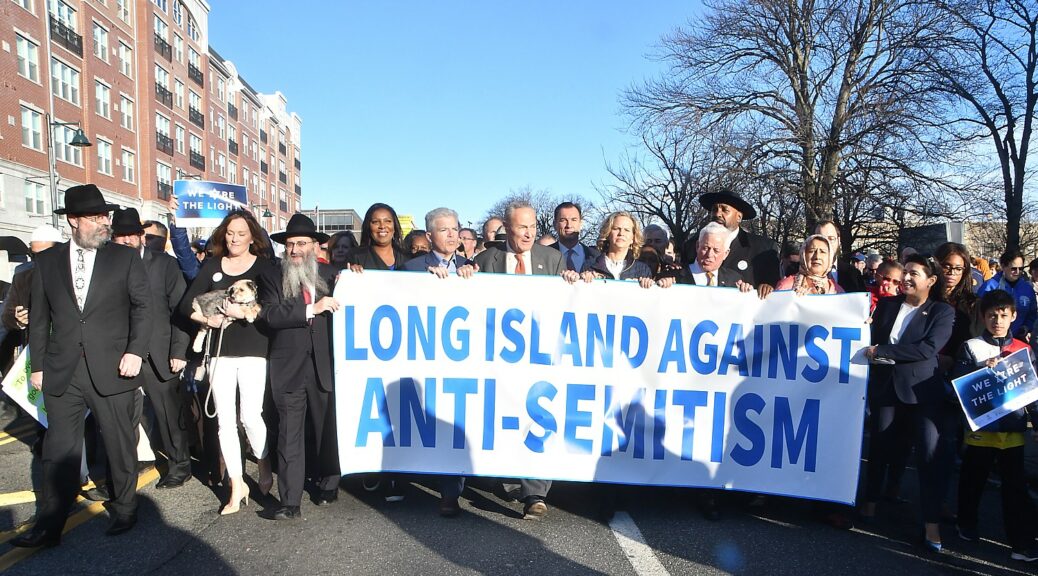
Senator Schumer, County Executives Laura Curran and Steve Bellone, Congressmen Tom Suozzi, Kathleen Rice and Peter King, Attorney General Letitia James, Comptroller Tom DiNapoli, State Senators Anna Kaplan and Todd Kaminsky, Assemblyman Charles Lavine, Dr. Isma Chaudhry of Islamic Center of Long Island among elected officials and faith leaders joining together with 2,500 Long Islanders marching to stand against anti-Semitism.
I thought it was impressive when a couple of dozen elected officials from state, county and local government came to a Shabbat service at Temple Beth-el of Great Neck to show support for the Jewish community after horrific attacks at a Rabbi’s home in Monsey and a massacre at Jersey City kosher grocery. I was moved by the outpouring of 25,000 mostly Jewish (surprisingly few Orthodox) who marched as a demonstration of Jewish pride and resolution over the Brooklyn Bridge, led by Senators Schumer and Gillibrand, Governor Cuomo and Lt. Governor Kathy Hochul, and faith leaders. But what was truly awesome were the 2500 Long Islanders who marched in a show of solidarity to fight anti-Semitism and hate crimes at the county seat in Mineola, representing just about every aspect, community and culture across the length and breadth of Long Island. Marchers came from across the Island, representing more than 125 religious and community groups.
Nassau County Executive
Laura Curran organized the march and rally in solidarity with the Jewish
community and against Anti-Semitism in response to horrific attacks in Brookyn,
Monsey, and Jersey City, as well as incidents of Anti-Semitic graffiti at the Holocaust Memorial and
Tolerance Center of Nassau County in Glen Cove. In December, Nassau and Suffolk Counties formed a bi-county coalition that
will identify and develop a plan of action to combat and report acts of hate
and bias incidents on Long Island. In conjunction with a number of
organizations, today’s march marked one of the task force’s inaugural
initiatives.
“We organized this march
to send a clear message in one voice: Long Islanders of all faiths and
backgrounds stand united with our Jewish community and against Anti-Semitism,”
said Nassau County Executive Laura
Curran.
As Assemblyman Charles Lavine read off
the names of participating groups, closing out nearly two hours of speeches
(notably very short speeches, that’s how many speakers there were) included on
the list: Turkish, Chinese, Indian…
Many of the speakers spoke of bigotry
and anti-Semitism as being anathema to American values. But of course,
Americans have a Pollyannish notion of this country’s “tolerance,”
“acceptance.” The strain of bigotry, hatred and particularly anti-Semitism has
always been here, even during World War II. It was muted after the Holocaust,
after the US soldiers penetrated the concentration camps and saw, for the first
time, that it was not “propaganda” that millions and millions were caged for
extermination, that the Final Solution was real. But it was anti-Semitism that
kept America from accepting refugees before, during and after the Holocaust,
and no coincidence that the Palmer raids of the 1920s targeted Jewish labor
leaders and the McCarthy blacklist consisted mainly of Jewish writers and
officials.
The “popular” view is that anti-Semitism
is back on the rise because working people feel somehow disadvantaged, though
the connection eludes me. But here’s what I don’t get: in Nazi Germany, Jews
were a convenient scapegoat for the genuine suffering of Germans caught in a
Great Depression. That is not the case here in the United States. In fact, we
are constantly told that the economy is the strongest in history, unemployment
is at a 50-year low.
The rise in anti-Semitism – not just
vandalism and nasty remarks but physical violence like the massacres at the
Tree of Life Synagogue in Pittsburg, a synagogue in Poway, California, in
Jersey City and the attack at a rabbi’s home in Monsey during a Chanukah
celebration, has been quite astonishing. Over 2,000 hate crimes against Jews in
2019. In New York City, according to the New York Police Department, hate
crimes against all other groups (Asian, Catholic, Hispanic, Black, Arab, Muslim,
LBGTQ) totaled 206; the number directed against Jews, just in the five
boroughs? 229.
Speakers referred to the fear that Jews now
feel in their own neighborhood, community, college campus. Many
Holocaust survivors are being wracked with renewed PTSD, their terrors
re-awakened.
Indeed, a study by the American Jewish
Committee in October found that 31% of Jews hide the fact they are Jewish; 25
percent avoid certain places, events, situations out of concern for their
safety. In America? “We must be proud
and not shy away,” said Eric Post, AJC NY Associate Director.
“Anti-Semitism is not solely a Jewish problem. It’s an American problem. If not
eradicated, it will corrode our fabric.”
There is a difference in today’s
anti-Semitism, in that individuals armed with social media or semi-automatic
weapons can do horrific damage that before would have required some
organization or government sanction. And even if the defense is some sort of
mental illness, as in the Monsey case, the question is why the voices compel them to strike out
against Jews, what is it in the culture that directs hatred in that way?
But such hate turns out not even to be
solely “organic” or a representation of “grassroots” disaffection. Foreign
governments, particularly Russia, as well as domestic political factions that
are using anti-Semitism, racism and fomenting hate in order to sow division,
disrupt and destabilize our society to tilt elections and take power – after
all, it worked so well during the 2016 campaign.
Indeed,
five of our region’s Congressional representatives – Suozzi, King, Rice, Meeks and Zeldin – are requesting FBI
Director Christopher Wray, CIA Director Gina Haspel, Homeland Security acting
Secretary Chad Wolf and Secretary of Defense Mark Esper conduct an investigation into
potential campaigns sponsored by foreign adversaries to cause civil unrest on
domestic soil.
“Whether anti-Semitic, anti-immigrant, race
based or some other form of hate, internal divisions provide an opportunity for
our adversaries to exploit and further divide our nation,” the letter states.
“We must work together to combat those that exploit ignorance to sow division for
their strategic interest.”
The letter also cites a recent FBI study
that found the rate of hate crimes increased by 17 percent from 2016 to 2017
but the rate of anti-Semitic crimes increased by 37 percent in 2017 and attacks
motivated by racial or ethnical prejudice doubled. The timing since Trump’s
ascendancy is not coincidence; Trump has curried the support of racists and
bigots and basically green-lighted their activities. No longer is racism and
bigotry kept under wraps or in shadow; with Trump it is out in the open.
But to the extent America is a melting
pot, that melting pot is the New York metropolitan region – the city and suburbs,
especially Long Island. Which is why the dramatic escalation in anti-Semitic
hate crimes our area is all the more shocking and terrifying.
Rabbi Meir Feldman, who gave the sermon
at Temple Beth-el on that Friday night, had only 72 hours before been at Yad
Vashem, the Holocaust Memorial in Jerusalem.
State, county, town, and local elected officials stand against anti-Semitism at Temple Beth-el of Great Neck (c) Karen Rubin/news-photos-features.com
“Our question tonight is not why there
is anti-Semitism. It is simpler: what is this crazy evil thing, this abnormal
force of anti-Semitism?” He shows a cartoon that is displayed at the memorial,
an image of a parasite, an insect meant to be walked on but sits on top of the
world, in its right eye, a symbol of money, in its left eye a hammer and
sickle, the symbols of Capitalist and the communist seemingly
contradictory. That is anti-Semitism –
hated by both ends, a convenient scapegoat for anybody’s discontent and any
politician’s demagoguery.
“Anti-Semitism is an impossible series
of contradictions,” he says. “What’s our response? How do we confront and fight
this scourge of contradictions?” He says with honesty, unity, solidarity and
hope.
“We must call out Anti-Semitism
wherever, whenever, reveal it for what it is: insane contradictions. Identify
the ideological source – right, left, White Nationalist, Black Nationalist.”
But this is the most
significant difference between Germany in the 1930s (where Jews had been living
for 1000 years) and now: the vast majority of elected officials are standing up
and calling out anti-Semitism, initiating new laws and calling for police enforcement,
as they did on Friday night at Temple Beth-el, in the March Against Hate in New
York last week, and in this weekend’s extraordinary march and rally on the
steps of the Theodore Roosevelt County Building.
And
it isn’t just speeches and marches, but actions. Senator Charles Schumer is
advocating $360 million more in spending to secure houses of worship and
federal assistance to localities to prosecute hate crimes; 298 Representatives
have signed on to sponsor the Never Again Education Act to authorize the Secretary of Education
to award grants to eligible entities to carry out educational programs about
the Holocaust. (It was introduced in the House in January 2019.)
Congressman Tom Suozzi attributed the
rise in anti-Semitism to social media which makes it easy to spread and magnify
hate, some of it promulgated by foreign adversaries trying to stir up civil
unrest. It works because “there is too much ignorance. How many deny the
Holocaust or don’t know about it? That is a recipe for disaster.” The US
soldiers, he said, who were just two or three months away from liberating the
concentration camps were still debating if the Holocaust was real or propaganda.
“We must educate.”
The state and county are stepping up
prosecution of hate crimes, as well. Governor Cuomo is proposing a domestic terrorism law that encompasses
hate crimes, and is seeking resources and security funding for law enforcement
and faith based institutions.
State Senator Anna
Kaplan has introduced four bills aimed at combating the rising tide of
anti-Semitism and hate in New York State, through education, awareness, and a
stronger hate crimes statute to ensure prosecutors have the tools necessary to
hold accountable those committing anti-Semitic and hate motivated crimes.
“As a Jewish
refugee who came to this country fleeing anti-Semitic violence in my homeland,
my heart aches over the out-of-control spree of anti-Semitic violence taking
place here in New York. I’ve been proud to stand shoulder to shoulder with New
Yorkers of all faiths and backgrounds as we have marched in the streets and
loudly proclaimed that we will not allow anti-Semitism and hatred to take hold
in New York, and today, I’m proud to announce that I am taking concrete steps
to address this crisis from every direction.”
Kaplan,
the first Persian-American elected State Senator: “We speak with one voice. We
are never going to accept anti-Semitism in our community or anywhere. Anti-Semitism
has been a plague on society for thousands of years. We have to be the
generation that stands up and takes decisive action.”
Nassau County District Attorney Madeline
Singas said, “We see thousands of you shoulder to shoulder, different colors,
creeds, faiths, standing with neighbors, community to say ‘Enough.’ Hate is
offensive to a nation born of tolerance, and it is criminal. We will work hard
to arrest, prosecute, hold offenders accountable. “ She has created a hate
crimes bureau. ‘We hope one day soon we won’t need it. We say no to
anti-Semitism, racism, misogyny, homophobia, bigotry.”
Nassau County Executive Laura Curran,
who organized the massive display, said, “Hate has no place on our beautiful
island. We have got your back,” and introduced five Holocaust survivors.
Suffolk County Executive Steve Bellone:
“this is the one nation on earth where every form of humanity is a citizen…
January 27 is the 75th anniversary of the liberation of Auschwitz.
That date is a reminder, we must stand up, any time we see bias or hate in
words or actions.”
Senator Schumer, relating how his great
grandmother, along with 30 other
relatives aged 3 months to 85 years old, were machine gunned by Nazis in
Ukraine, said, “Unfortunately people there didn’t speak up.”
New York State Attorney General Letitia James said, “As an African American, I know hate, know discrimination. An attack against one of us is an attack against all of us… During the civil rights movement, it was Jews who referred to blacks by their last name, not their first; who let Blacks enter the front door, not the back door, Jewish people who died for my people. Not just black blood but Jewish blood [was shed for civil rights]. Hate won’t be tolerated on Long Island or anywhere in the State.”
New York State Comptroller Tom DiNapoli
said it is hard to believe how the numbers of anti-Semitic incidents, of hate,
violence are going up in the New York metro area. “You being here show that we
will not accept this as the new normal. What we take from today, in our homes,
workplaces, houses of worship, neighborhoods, that’s where we must fight hate.”
Everyone, he said, should see the “Auschwitz: Not Long Ago, Not Far Away”
exhibit at the Museum of Jewish Heritage (extended until August 30, 2020). “Eli
Wiesel warned of the great peril of indifference in the face of hate.”
Dr. Isma Chaudhry, president of the Islamic Center of Long Island, which turned out in force for the march, said, ‘What I see today is a strong Long Island. As a Muslim, our moral obligation to stand by humanity suffering in pain, prosecution of hatred, discrimination. We stand with our Jewish brothers and sisters in solidarity… Nassau is making history by this strong statement of solidarity of diverse communities.”
Kevin Thomas, the first Indian-American
elected State Senator, holding his 13-month old daughter: “My community stands
with the Jewish community” adding, we need to teach our children when they are
young.
Assemblyman Tony D’Urso’s family is a
model of the courage that it takes. When he was just a boy, Nazis took over his
village in Italy. His father protected the only two Jewish families who lived
in the village, hiding them in the mountains when others would have happily
given them up for a little money or food.
Probably most touching was Linda Beigel
Schulman, whose son Scott was a teacher-coach when he was murdered in
the massacre at Parkland school in 2018. She noted that the target of his
killer was a history class teaching about the Holocaust.
“We held a celebration of his life at
the temple where Scott was bar mitzvahed. The rabbi asked if I wanted any
security. I said ‘Why?’ Six days later, a gunman massacred Jews at the Tree of
Life synagogue, simply because they were Jewish.”
Schulman’s father was a Holocaust
survivor and when she taught in Germany 1977-9, “I feared telling people I was
a Jew. But living in Louisiana, a woman asked me, ‘where do you hide your
horns.’ Her husband attended NYU; his roommate moved out when he discovered he
was Jewish.
“I know why I am here today, why we all
must be here, to have our voices heard. Over 2,000 anti-Semitic incidents in
2019 – gestures, name-calling, painting swastikas, toppling headstones,
physical attacks and murder, merely because a person is Jewish or believed to
be. Anti-Semitism is like a virus infecting, sometimes killing its host. The
body tries to fight it off, but it lies dormant, and rears up again. If we
allow anti-Semtiism to take hold in the United States, it will destroy the
fiber that holds us together. E Plubus Unum – out of many, one. Without that
motto is tribalism and ‘me first’.
“We need to become the best society we
can. We the people are the antidote. It
doesn’t matter if Jew, Christian, Muslim, Hindu, Sikh or no religion, Asian
American, Hispanic, Italian, African American, whether citizen or immigrant, if
you came by airplane, ship or on foot. We are the antidote to wipe out
anti-Semitism once and for all. Our voices must be heard. Silence only brings
acceptance and gives anti-Semitism the fuel it needs to spread.”
Assemblyman Charles Lavine, who served
as the emcee for the event, said, “For generations, tragedy after tragedy, Jews
have been saying “Am Yisrael Chai” – the people of Israel live. It is time for
us all Americans to stand together, united to say, Am America Chai. These are
the stakes.”