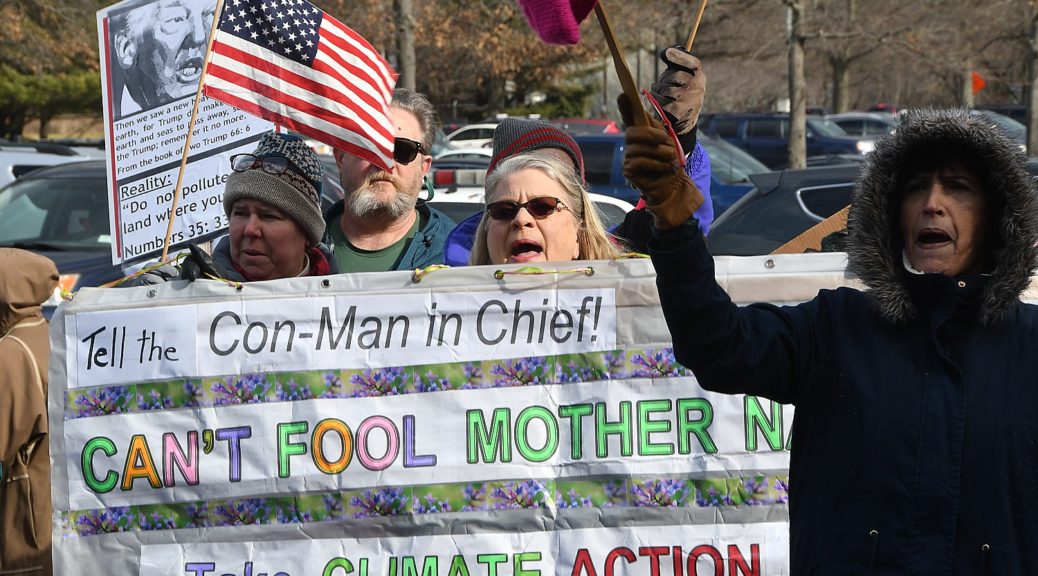
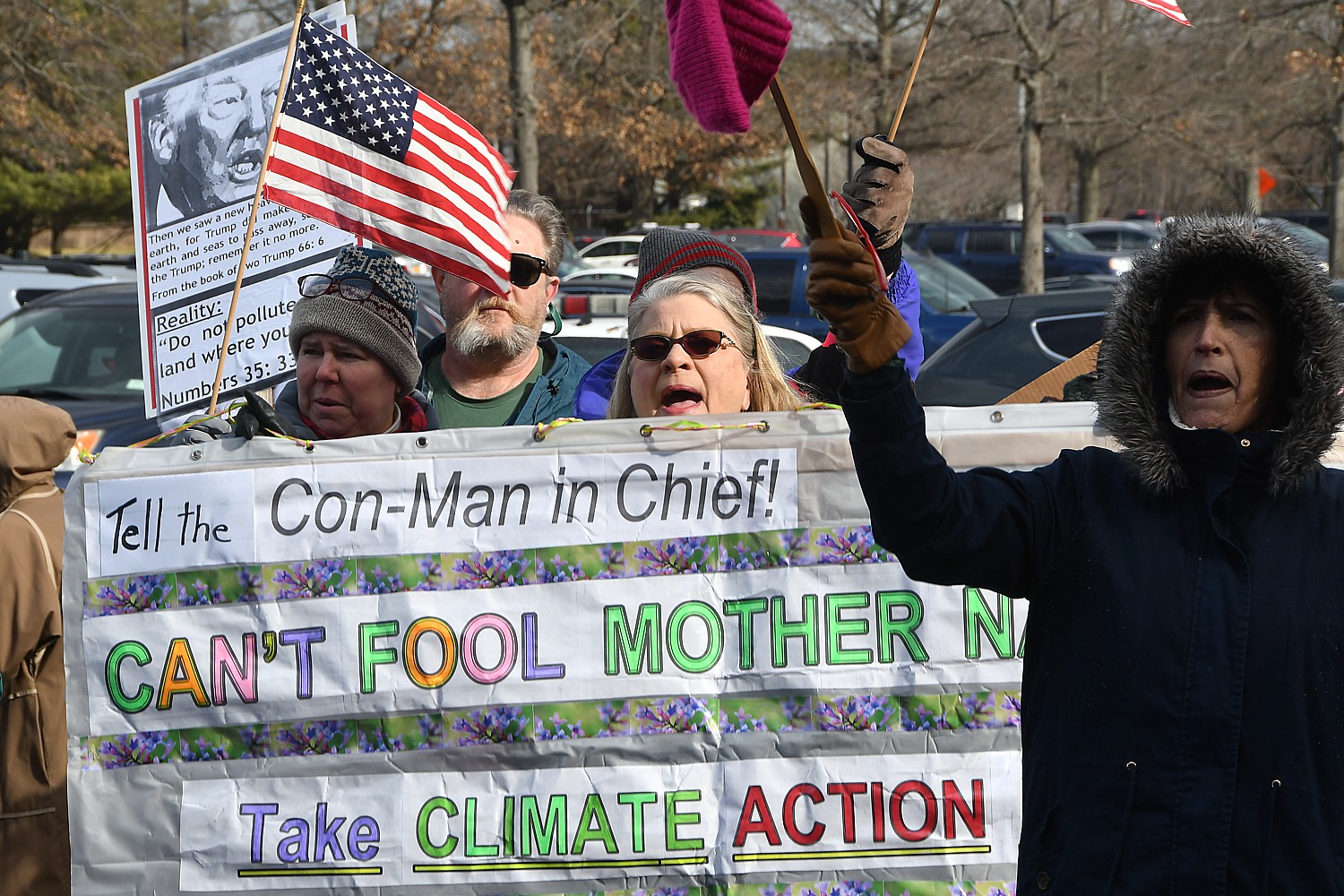
The U.S. Climate Alliance – formed by the governors of California, New York and Washington State – announced that Connecticut, Delaware, Hawaii, Massachusetts, Minnesota, Oregon, Puerto Rico, Rhode Island, Vermont and Virginia have all joined the coalition, which is committed to upholding the Paris Accord and taking aggressive action on climate change.
In response to President Trump’s decision to withdraw from the Paris Accord, New York Governor Andrew M. Cuomo, California Governor Edmund G. Brown Jr., and Washington State Governor Jay Inslee formed the Alliance to convene U.S. states committed to achieving the U.S. goal of reducing emissions 26-28 percent from 2005 levels and meeting or exceeding the targets of the federal Clean Power Plan.
With input from all participants, the U.S. Climate Alliance will also act as a forum to sustain and strengthen existing climate programs, promote the sharing of information and best practices, and implement new programs to reduce carbon emissions from all sectors of the economy.
“As the federal government turns its back on the environment, New York and states across the country are picking up the mantle of climate leadership and showing the world it’s possible to address climate change while also creating good-paying careers,” said Governor Cuomo. “The U.S. Climate Alliance is committed to meeting the standards set forth in the Paris Accord regardless of Washington’s irresponsible actions. We welcome these 10 new members and look forward to collaborating and maintaining the momentum in the global effort to protect our planet, while jumpstarting the clean energy economy.”
“The President has already said climate change is a hoax, which is the exact opposite of virtually all scientific and worldwide opinion,” said Governor Brown. “I don’t believe fighting reality is a good strategy – not for America, not for anybody. If the President is going to be AWOL in this profoundly important human endeavor, then California and other states will step up.”
“Those of us who understand science and feel the urgency of protecting our children’s air and water are as united as ever in confronting one of the greatest challenges of our lifetime,” said Governor Inslee. “Our collective efforts to act on climate will ensure we maintain the U.S.’s commitment to curb carbon pollution while advancing a clean energy economy that will bring good-paying jobs to America’s workers.”
“Connecticut has been a national leader in combating climate change and we have no plans of slowing down our efforts,” said Connecticut Governor Dannel P. Malloy. “In the absence of leadership from the White House in addressing climate change, it is incumbent upon the states to take action in order to protect their residents. We remain committed to meeting the standards set forth in the Paris Climate Agreement because it is the right thing to do for not only the future of our state, but for the future of our planet. I am proud to stand with my fellow governors in support of efforts to reverse the harmful effects of global warming and to send a message to the rest of the world that we accept the science of climate change and we will not let the misguided beliefs of a few ruin our planet.”
“Delaware is the country’s lowest-lying state and with 381 miles of coastline, climate change is a very real threat to our future,” said Delaware Governor John Carney. “As sea levels rise, more than 17,000 Delaware homes, nearly 500 miles of roadway and thousands of acres of wildlife habitat including our critical wetlands are at risk of permanent inundation. Rising average temperatures and an increase in extreme weather events also pose health risks to Delawareans, and threaten our economy. The U.S. should lead in the global fight against climate change. Delaware is proud to join this coalition of states providing that necessary leadership.”
“As the Commonwealth reiterates its commitment to exceed the emission reduction targets of the Paris Climate Agreement, today we join the U.S. Climate Alliance to expand on our efforts while partnering with other states to combat climate change,” Massachusetts Governor Charlie Baker said. “After speaking with Governors Cuomo and Scott, our administration looks forward to continued, bipartisan collaboration with other states to protect the environment, grow the economy and deliver a brighter future to the next generation.”
“I am very pleased to announce that Minnesota will join the U.S. Climate Alliance, to uphold the tenets of the Paris Climate Change Agreement in our state,” said Minnesota Governor Mark Dayton. “President Trump’s withdrawal will cause serious damage to our environment and our economy. Nevertheless, Minnesota and other states will show the world what we can achieve by working together to conserve energy, to use cleaner and renewable energy, and to leave a livable planet to our children and grandchildren.”
“The ‘America First’ doctrine should put our children first too,” said Oregon Governor Kate Brown.“Future generations deserve to inherit a world they can thrive in, not one that plays politics and ignores the fact our climate is changing. Despite the decision by the White House to retreat, it is our moral obligation to fulfill the goals of the Paris Agreement. Oregon will continue to make meaningful strides, with the rest of the world, to ensure our communities and economies adapt to meet the challenge of climate change.”
“Climate change is a real problem for all and requires immediate action to ensure future generations are left with a sustainable planet,” Puerto Rico Governor Ricardo Rosselló said.“Our administration is committed to protecting the environment. As a Governor, who is also a scientist, I value science and data as primary tools in the decision making process. As such, I strongly oppose the withdrawal from the Paris Agreement. Our administration understands that all policy decisions even those perceived to being small can have big, lasting effects on our planet. Puerto Rico, an Island that 3.4 million American Citizens call home, would suffer greatly from the devastating effects of rising sea levels. But we all stand to lose if we don’t take meaningful action right now.
“We call upon all public officials across our nation to continue to support rules and regulations that protect our environment. As most of the world move forwards, our nation cannot sit idle and lag behind.”
“President Trump’s decision to withdraw from the Paris Agreement was a tremendous mistake. Rhode Island may be a small state, but climate change can have a big impact on our communities,” said Rhode Island Governor Gina M. Raimondo. “We are determined to fight climate change from the front lines so that we can preserve our environment – including our Narragansett Bay – for future generations and create good-paying, future-proof jobs in the process. I’m proud to join Governors Cuomo, Brown and Inslee in this effort and hope other governors – from both parties – join as well.”
“Growing our economy and protecting our environment by supporting cleaner and more affordable energy and transportation choices can go together,” said Vermont Governor Phil Scott. “If our national government isn’t willing to lead in this area, the states are prepared to step up and lead. I look forward to supporting continued bipartisan cooperation on these matters and thank Governor Baker, Governor Inslee, Governor Cuomo and Governor Brown for working collaboratively on this important issue.”
“As the first state in the Trump era to take executive action to limit carbon emissions and create clean energy jobs, Virginia is proud to join the Climate Alliance,” said Virginia Governor Terry McAuliffe. “President Trump’s announcement to withdraw the United States from the Paris Climate Agreement does not speak for the states and cities that are committed to fighting climate change and paving the way for a new energy economy. If the federal government insists on abdicating leadership on this issue, it will be up to the American people to step forward — and in Virginia we are doing just that.”
In response to President Trump’s decision to withdraw from the Paris Climate Agreement, New York Governor Andrew M. Cuomo joined California Governor Edmund G. Brown Jr., and Washington State Governor Jay R. Inslee in forming the United States Climate Alliance, a coalition that will convene U.S. states committed to upholding the Paris Climate Agreement and taking aggressive action on climate change.
“The White House’s reckless decision to withdraw from the Paris Climate Agreement has devastating repercussions not only for the United States, but for our planet. This administration is abdicating its leadership and taking a backseat to other countries in the global fight against climate change,” said Governor Cuomo. “New York State is committed to meeting the standards set forth in the Paris Accord regardless of Washington’s irresponsible actions. We will not ignore the science and reality of climate change which is why I am also signing an Executive Order confirming New York’s leadership role in protecting our citizens, our environment, and our planet.”
New York, California, and Washington, representing over one-fifth of U.S. Gross Domestic Product, are committed to achieving the U.S. goal of reducing emissions 26-28 percent from 2005 levels and meeting or exceeding the targets of the federal Clean Power Plan.
“The President has already said climate change is a hoax, which is the exact opposite of virtually all scientific and worldwide opinion,” said Governor Brown. “I don’t believe fighting reality is a good strategy – not for America, not for anybody. If the President is going to be AWOL in this profoundly important human endeavor, then California and other states will step up.”
“I am proud to stand with other governors as we make sure that the inaction in D.C. is met by an equal force of action from the states,” said Governor Inslee. “Today’s announcement by the president leaves the full responsibility of climate action on states and cities throughout our nation. While the president’s actions are a shameful rebuke to the work needed to protect our planet for our children and grandchildren, states have been and will continue to step up.”
Together, New York, California, and Washington represent approximately 68 million people – nearly one-in-five Americans – and the states account for at least 10 percent of greenhouse gas emissions in the United States. California will continue to work closely together with other states to help fill the void left by the federal government.
With input from all participants, the U.S. Climate Alliance will also act as a forum to sustain and strengthen existing climate programs, promote the sharing of information and best practices, and implement new programs to reduce carbon emissions from all sectors of the economy.
New York’s Climate Leadership
Greenhouse Gas Emission Reductions: Established ambitious greenhouse gas emission reduction targets to reduce emissions 40 percent below 1990 levels by 2030 and 80 percent by 2050. These targets have made New York a leader across the country in fighting climate change.
Regional Greenhouse Gas Initiative (RGGI): Spearheaded the formation of the successful RGGI cap-and-trade program between northeast and mid-Atlantic states, led effort to reduce RGGI’s carbon emission cap by 45 percent in 2014, and recently called for an additional cap reduction of at least 30 percent between 2020 and 2030.
Reforming the Energy Vision: Established a comprehensive energy strategy to make the vision for a clean, resilient, and affordable energy system a reality, while actively spurring energy innovation, attracting new jobs, and improving consumer choice.
Clean Energy Standard: Established the most comprehensive and ambitious clean energy mandate in the state’s history, requiring that 50 percent of electricity in New York come from renewable energy sources like wind and solar by 2030.
Clean Energy Fund: Established a $5 billion fund that is jump-starting clean-tech innovation, mobilizing private investment, capitalizing the nation’s largest Green Bank, and helping eliminate market barriers to make clean energy scalable and affordable for all New Yorkers.
Coal-Free New York: Committed to close or repower all coal-burning power plants in New York to cleaner fuel sources by 2020.
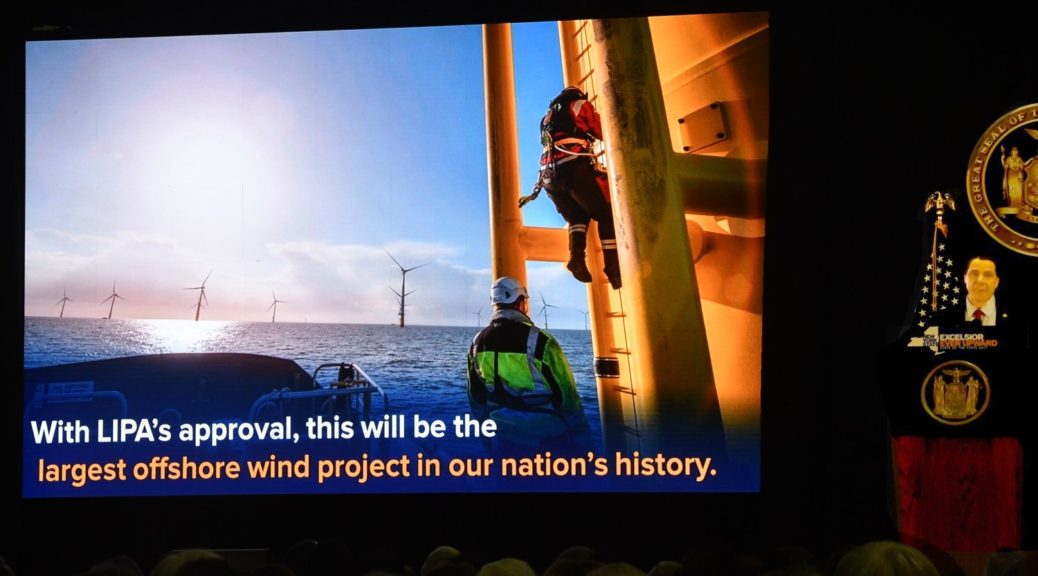
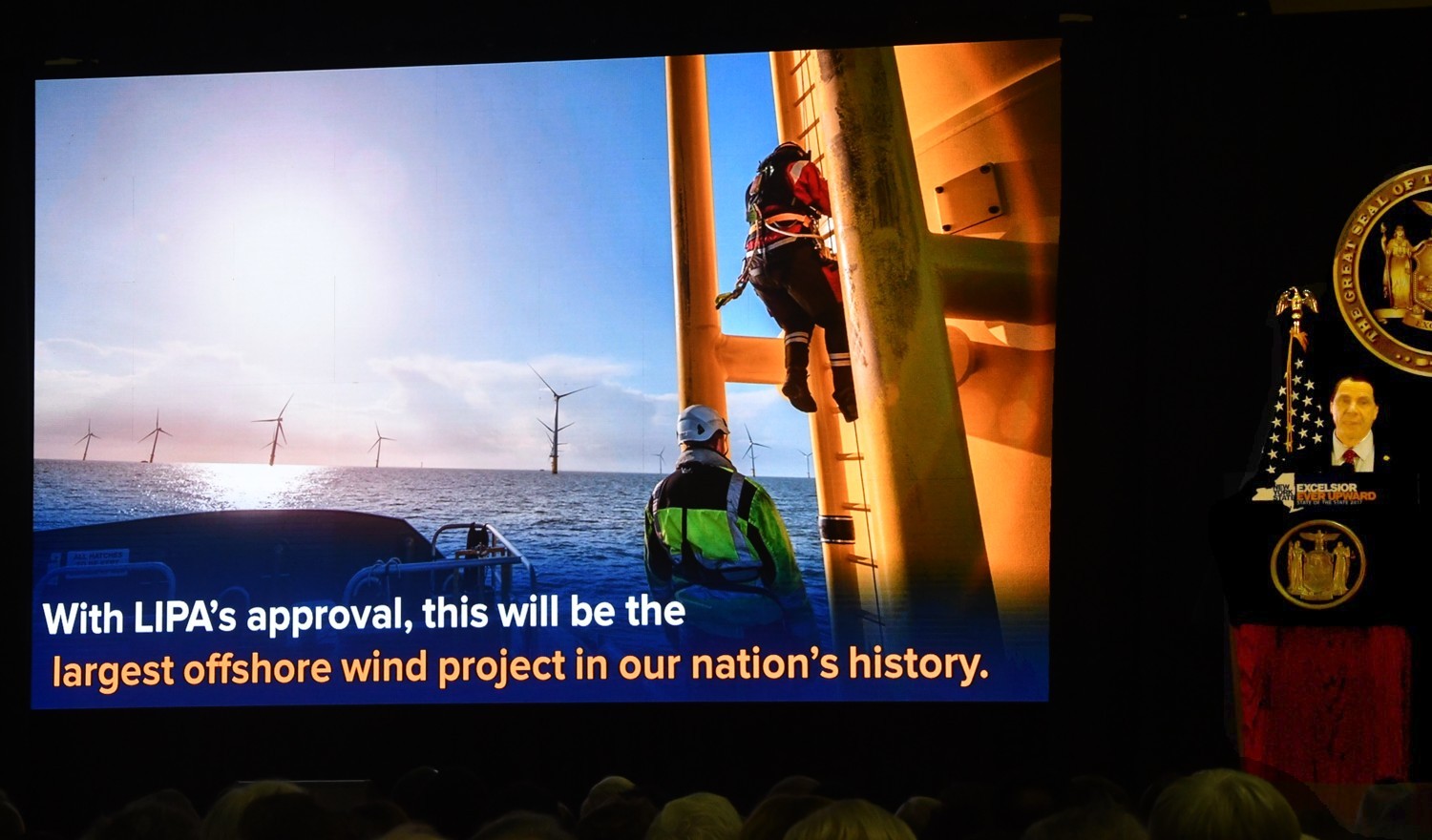
Offshore Wind: Approved the nation’s largest wind energy project off the Long Island coast in 2017 and made an unprecedented commitment to develop up to 2.4 gigawatts of offshore wind power by 2030.
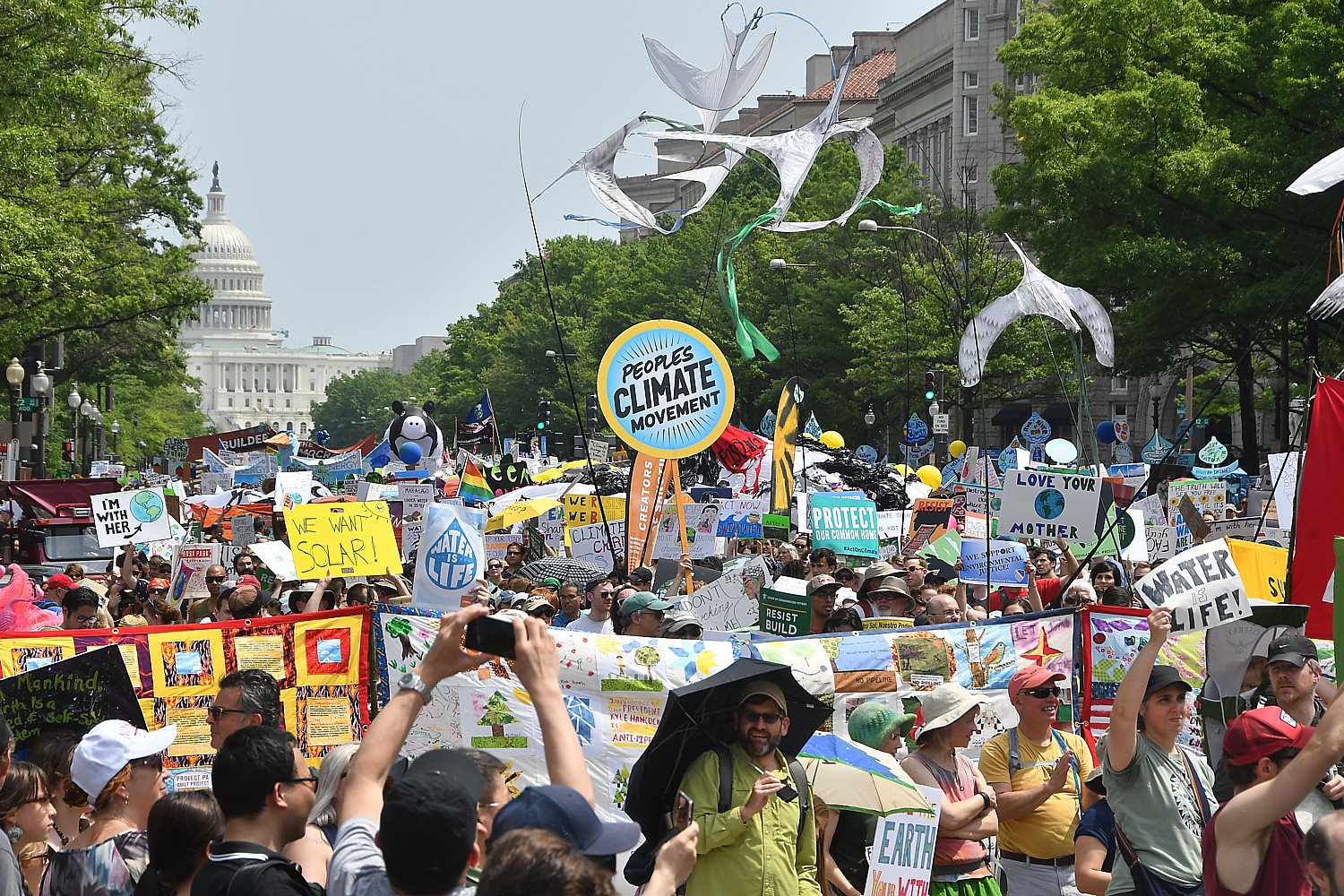
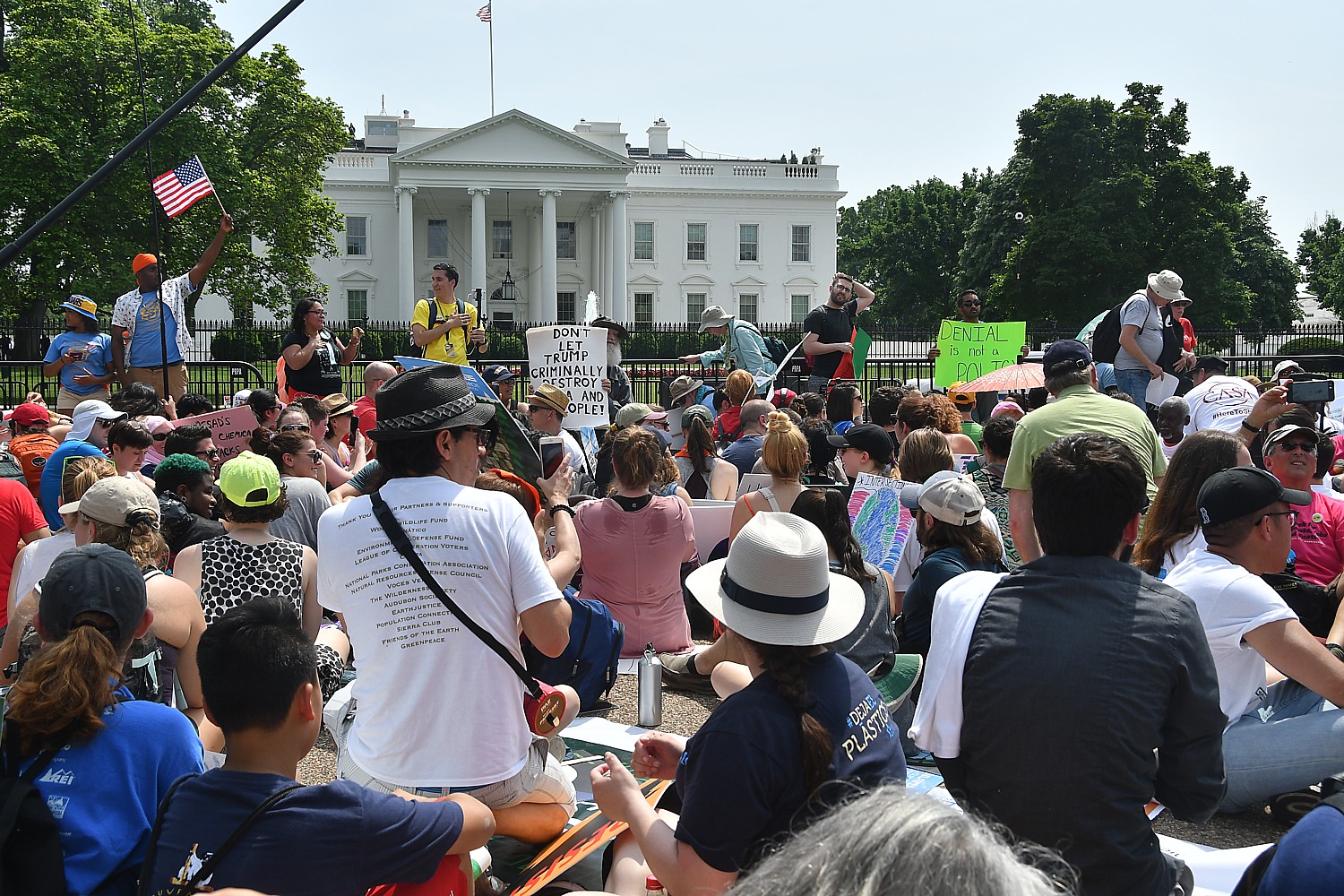
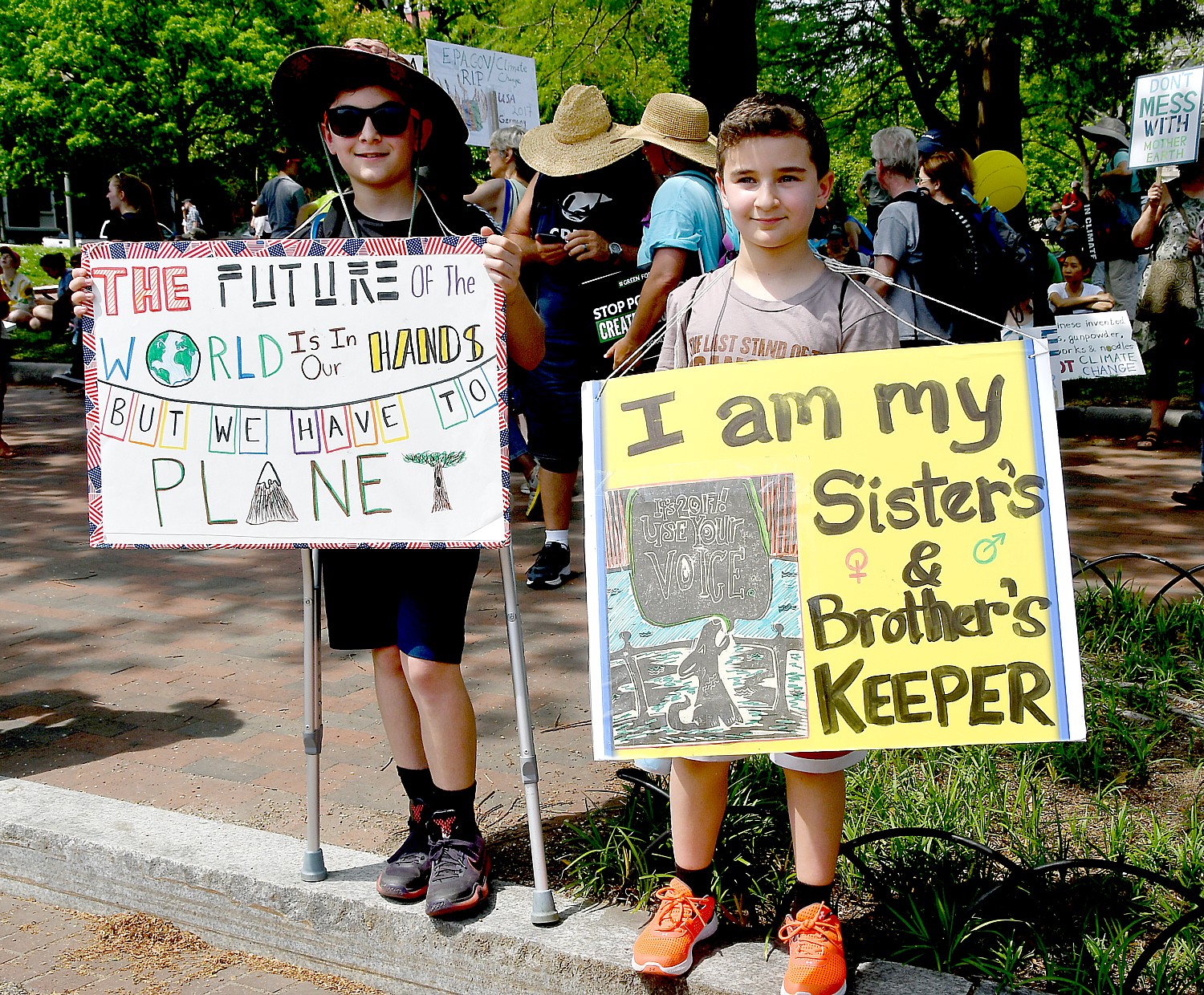
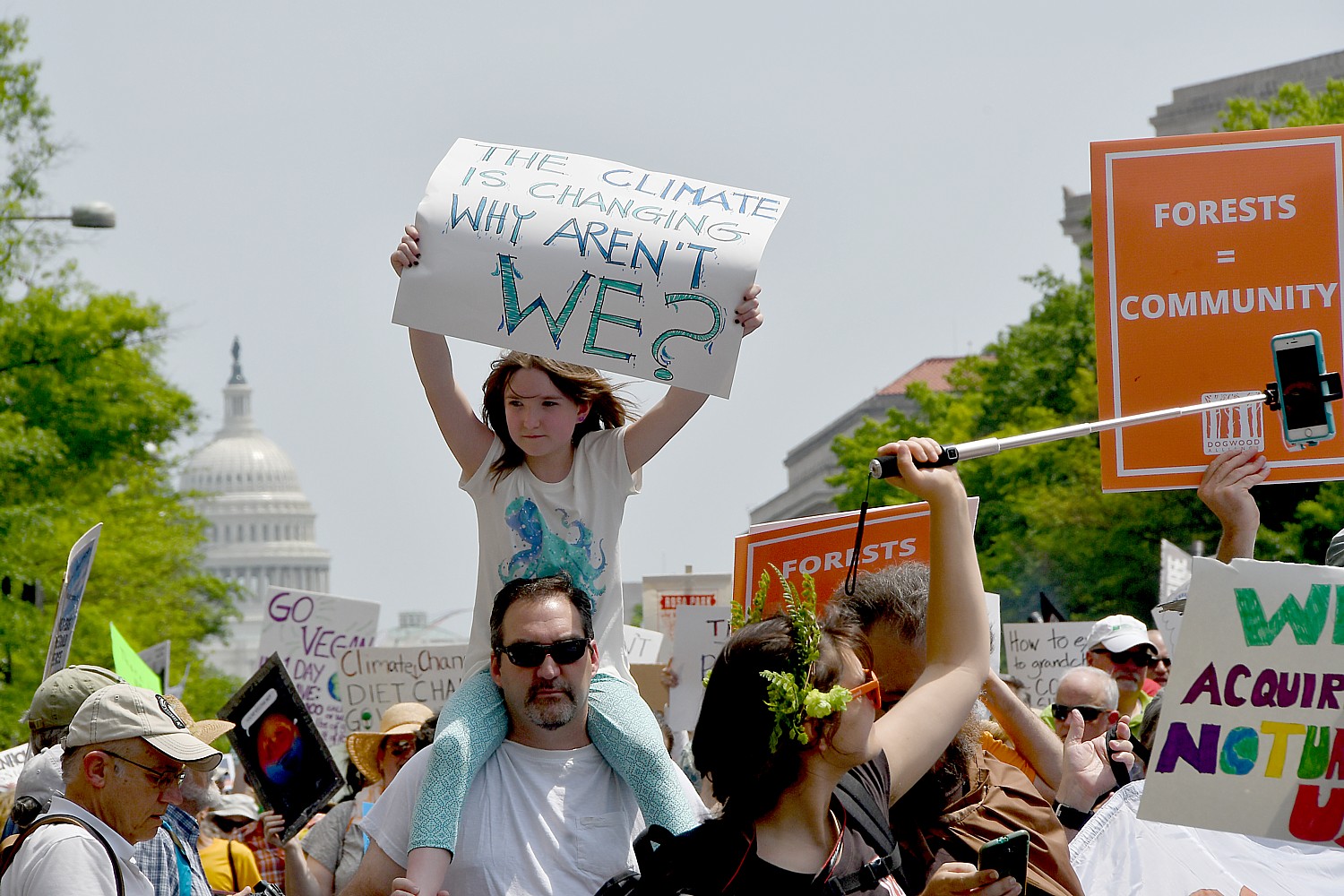
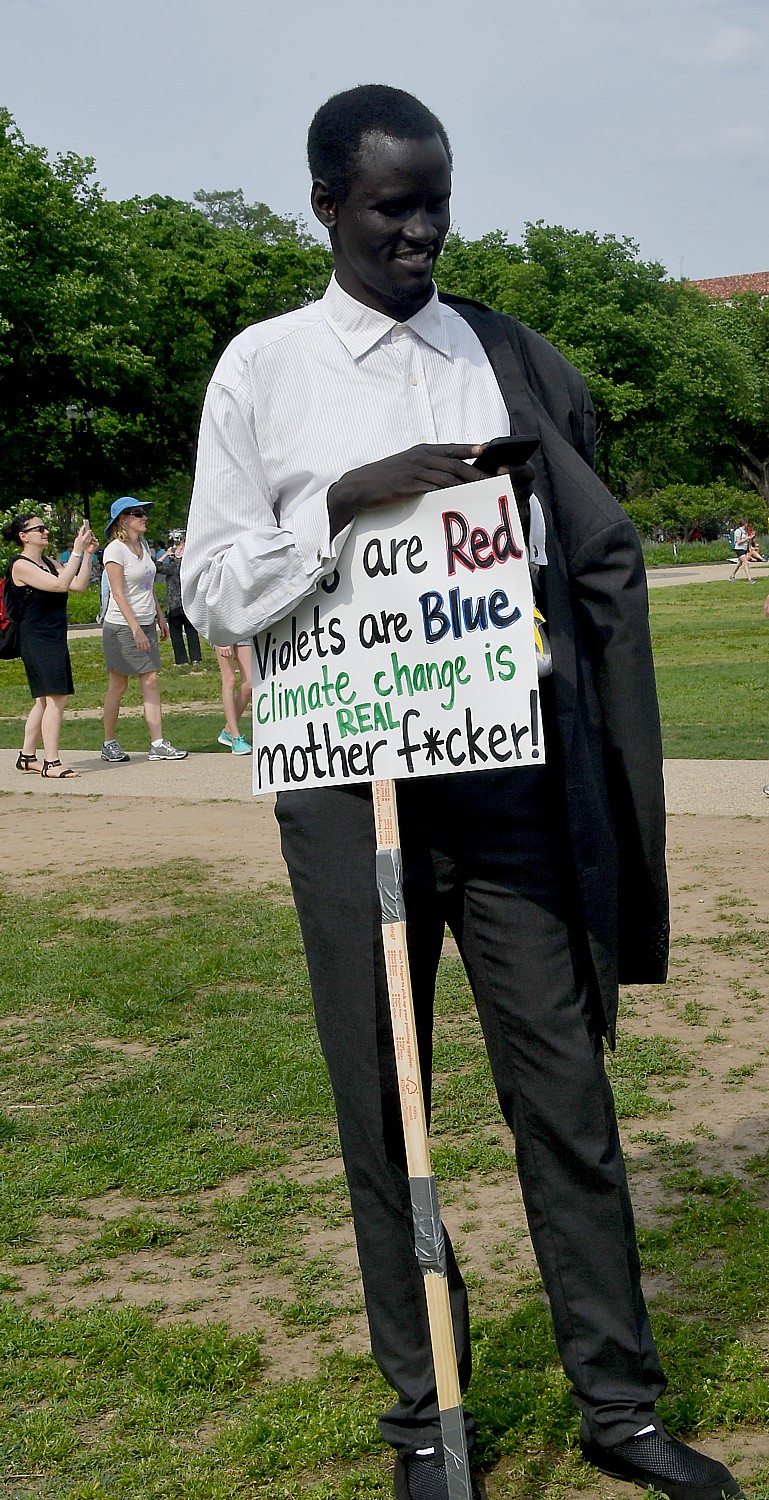
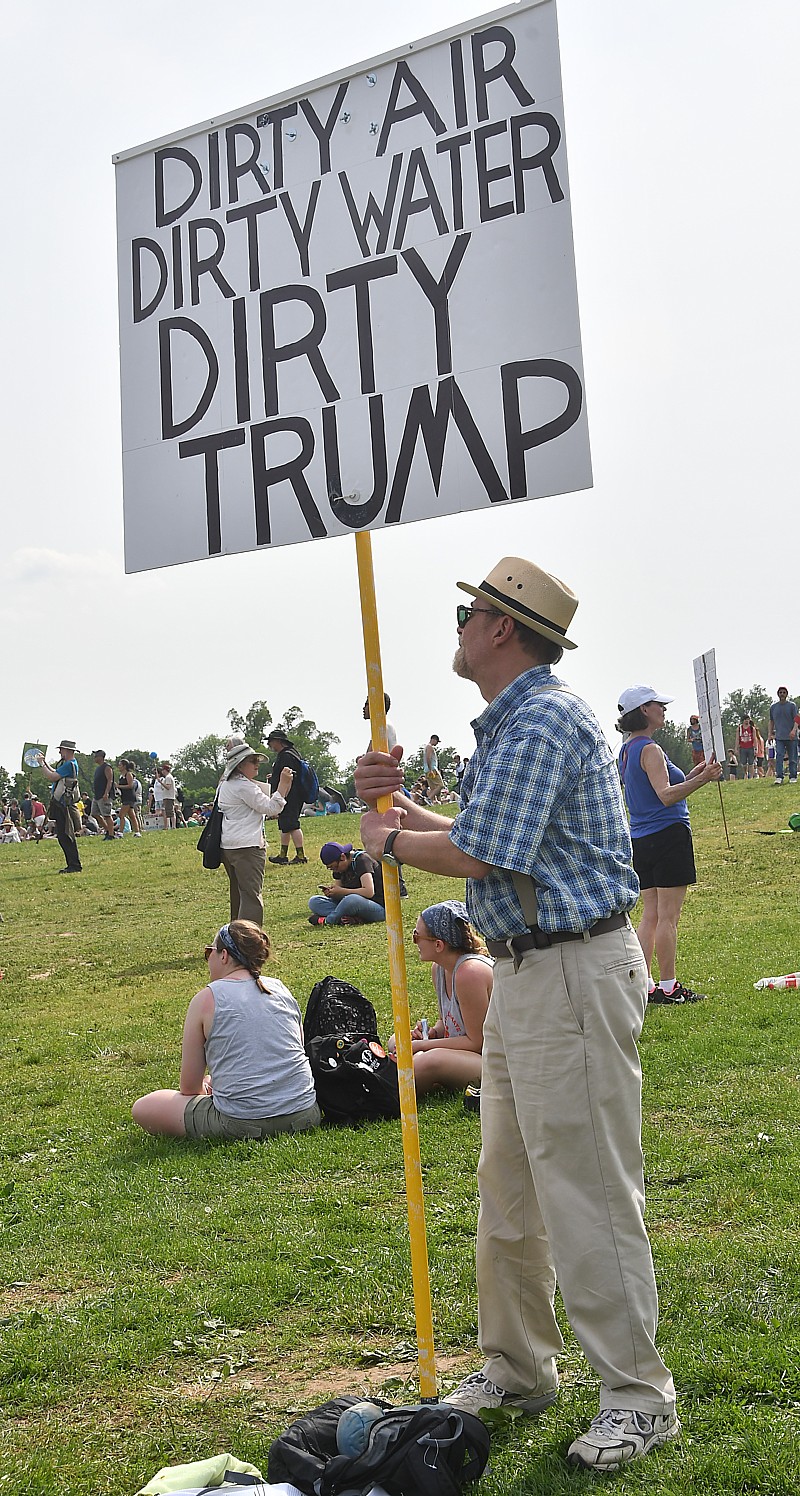
More than 200,000 gathered in Washington DC in sweltering heat for the Peoples Climate March in Washington, D.C. on Saturday, April 29 – twice the number anticipated – to register opposition to Trump Administration’s actions that will set the United States back in its effort to mitigate against the dire impacts of climate change. They formed a line extending more a mile down Pennsylvania Avenue, eventually encircling the White House for a two-minute “heartbeat”.
In the United States, tens of thousands more took to the streets 370 sister marches taking place in nearly all 50 states, from the town of Dutch Harbor in Alaska’s Aleutian Islands to the streets of Miami, Denver, Los Angeles, Chicago and other major American cities. Early counts estimated that more than 50,000 people took place nationwide.
Sister marches took place on Saturday across the world including in Japan, the Philippines, New Zealand, Uganda, Kenya, Germany, Greece, United Kingdom, Brazil, Mexico, Costa Rica, and more.
“The solidarity that exists between all of us is the key to having a strong, fair economy and a clean, safe environment,” said Kim Glas, Executive Director, BlueGreen Alliance, one of dozens of organizations that partnered in the Peoples Climate March. “We can tackle climate change in a way that will ensure all Americans have the opportunity to prosper with quality jobs and live in neighborhoods where they can breathe their air and drink their water. Together we will build a clean economy that leaves no one behind.”
“This march grew out of the relationship building among some of the country’s most important progressive organizations and movements,” said Paul Getsos, National Coordinator for the Peoples Climate Movement. “In 2014, the march was planned as a singular moment to pressure global leaders to act on climate change. There was a simple demand – act. This march was planned before the election as a strategic moment to continue to build power to move our leaders to act on climate while creating family-sustaining jobs, investing in frontline and indigenous communities and protecting workers who will be impacted by the transition to a new clean and renewable energy economy.”
As it happened, the march coincided with the 100th day of Donald Trump’s occupation of the Oval Office.
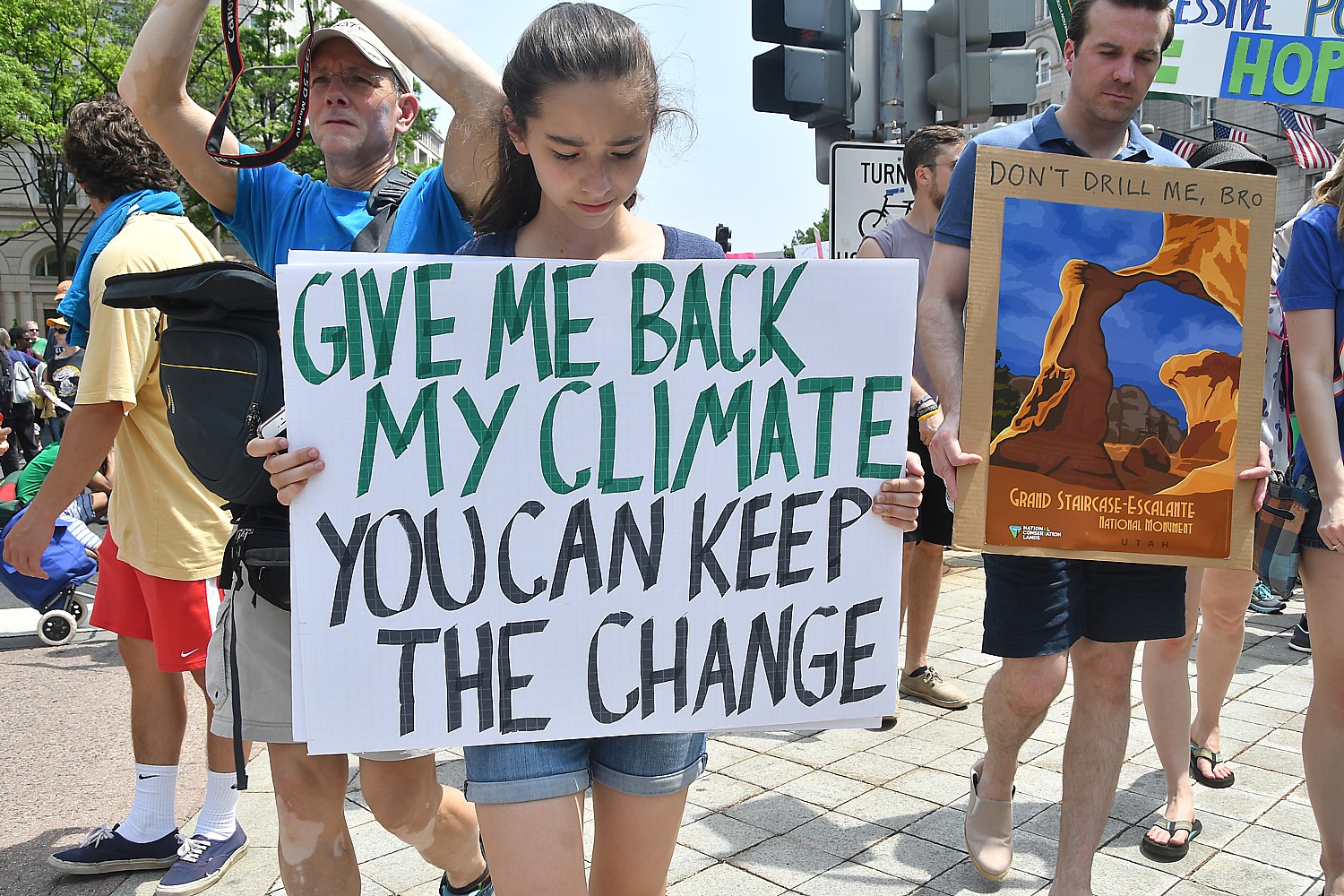
In Washington, the march topped 200,000 people at its peak, , representing a huge cross-section of geography and demographics and far outpacing the National Park Service’s permitted space for 100,000 people. The march extended for over 20 blocks down Pennsylvania and all along the south side of the National Mall, with tens of thousands more surging along the mall to push back on the Trump administration’s policies and stand up for “climate, jobs and justice.”
The day’s activities in D.C. began at sunrise with a water ceremony led by Indigenous peoples at the Capitol Reflecting Pool. Participants included Cheyenne River Sioux tribal members who traveled 1,536 miles by bus from Eagle Bend, SD to attend the ceremonies.
At an opening press conference, representatives from front line communities spoke about the impact that climate change and pollution were already having on their lives and called out the Trump administration for worsening the crisis. They called for a new renewable energy economy that created good paying, union jobs, and prioritized low-income and people of color communities.
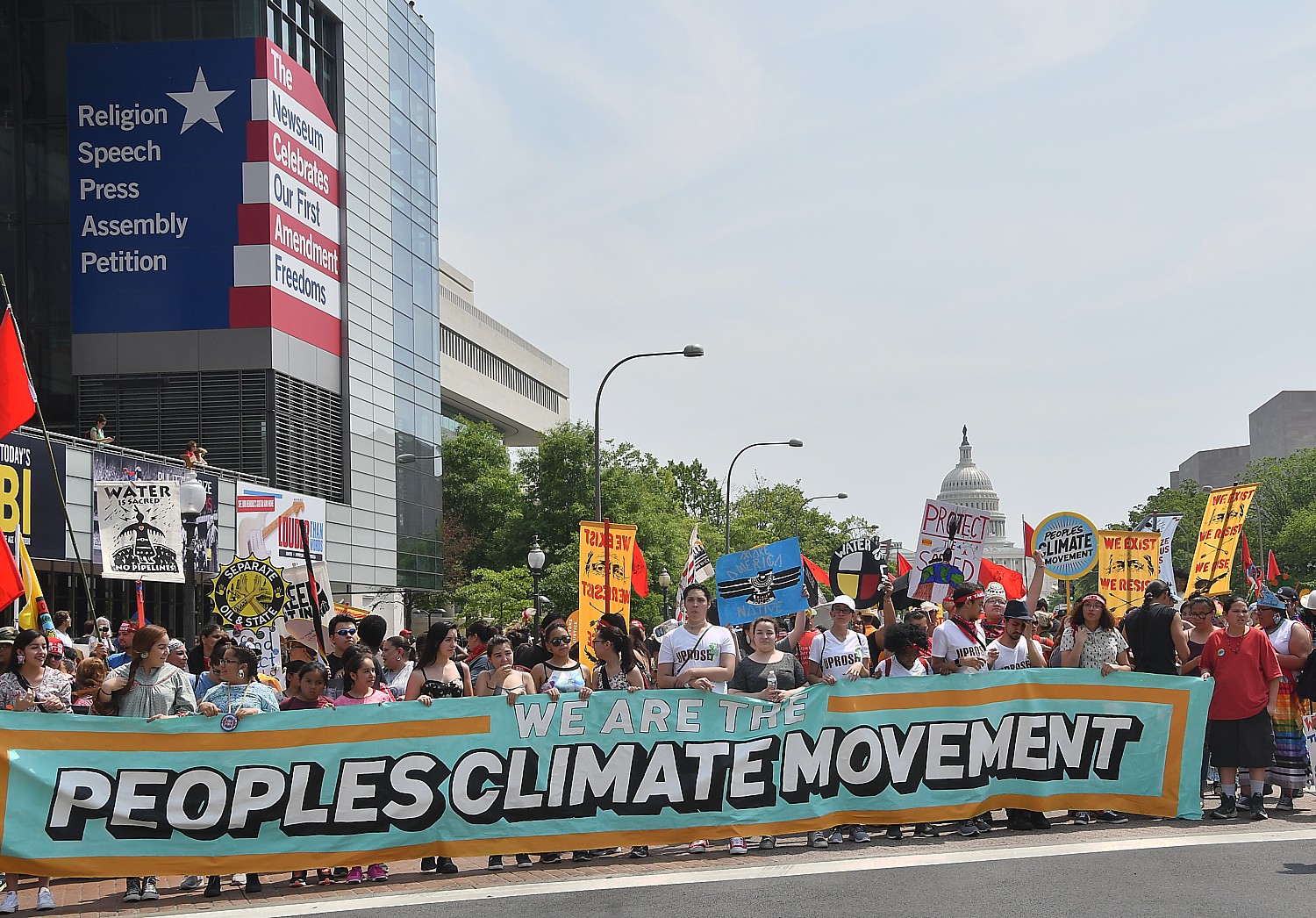
The march kicked off at 12:30 pm in front of the Newseum, which heralds the First Amendment freedoms of religion, free press, free speech, assembly and protest, and was led by young people of color from Washington, D.C. and Indigenous leaders from across the country. Tens of thousands of marchers headed up Pennsylvania Avenue in creatively named contingents, like “Protectors of Justice,” “Reshapers of Power,” and “Many Struggles, One Home.”
(The day coincided not only with Trump’s 100th day, but the White House Correspondents Association Dinner, which Trump snubbed, the first sitting president to do so; Reagan missed one after he was recovering from an assassination attempt but still sent respects.)
“When our communities are most threatened by climate; the solutions we build must allow us to have control of our resources and the energy we produce in an equitable and truly democratic way,” said Angela Adrar, Executive Director, Climate Justice Alliance. “They must create meaningful work that allows people to grow and develop to their fullest capacity. They must allow us to retain culture and traditions from our ancestors and give us the freedom of self-determination we so deserve so that we can thrive. This does not come easy and it must come with resistance and visionary opposition. Our existence depends on it.”
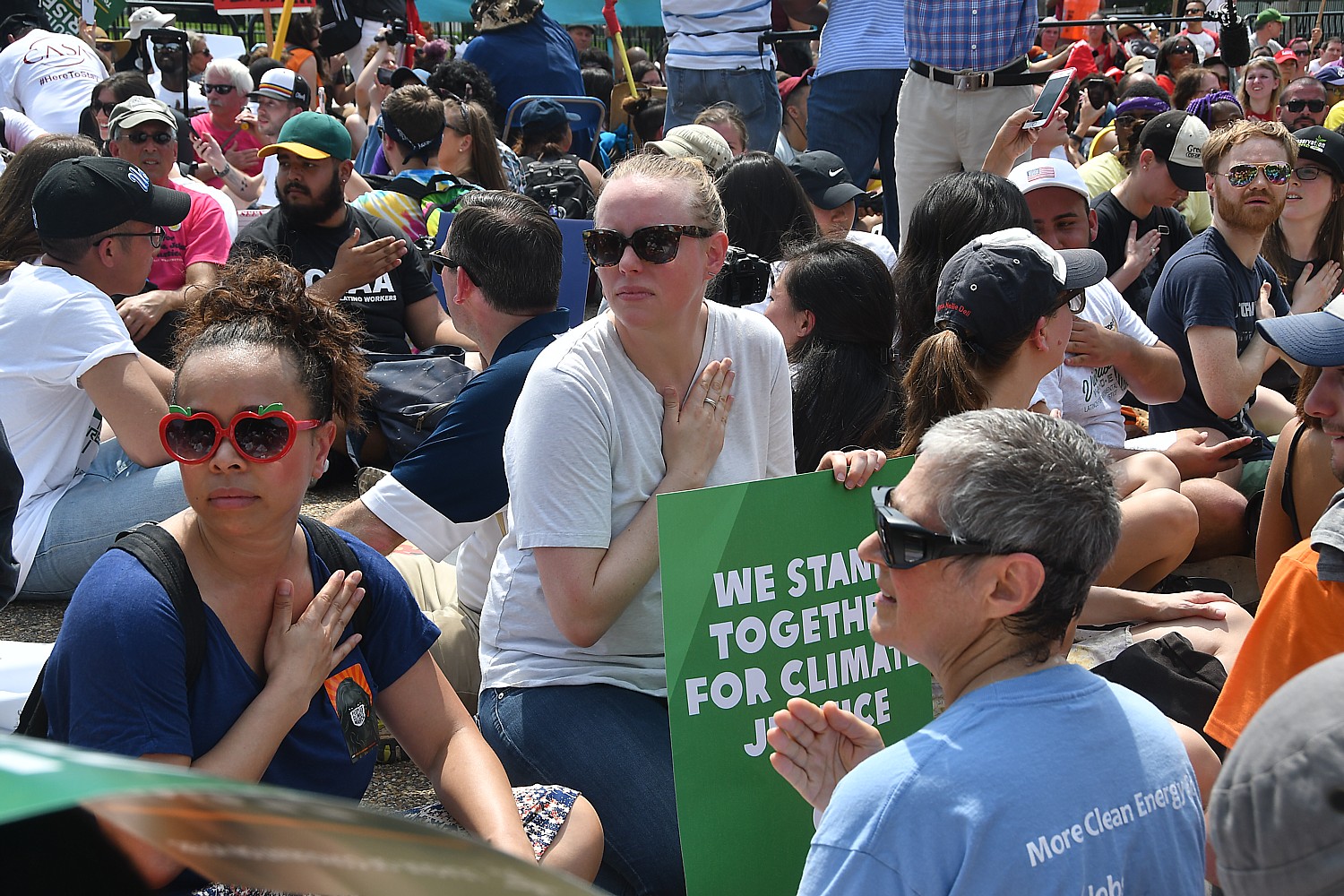
By 2 pm, in sweltering heat for an April day (nearing 90 compared to average of 79) that seemed to validate Global Warming, organizers had succeeded in their goal of completely surrounding the White House. Marchers sat down in the streets in a silent sit-in to recognize the damage caused by the Trump administration over the last 100 days and those who are losing their lives to the climate crisis.
At the appointed time, everyone created a heartbeat, tapping out a rhythm on their chests or clapping while drummers kept the time, lasting 2 minutes.
“The heartbeat was meant to show that while march participants came from many different backgrounds and communities, their hearts beat as one. It was a heartbeat of resistance, one that began with the Women’s March and will continue through the Peoples Climate March to May Day and beyond,” the organizers said.
“Six months ago, my kids woke up to half a foot of water in our living room,” said Cherri Foytlin, director of BOLD Louisiana and spokesperson for the Indigenous Environmental Network. “Now, Trump wants to open up the Gulf Coast to even more offshore drilling. But we have a message for him: we are not afraid, and we will not stop fighting. With 100 and 500 year storms now coming every year, we are fighting for our lives.”
After the heartbeat, marchers rose up with a collective roar and continued down to the Washington Monument for a closing rally. Speakers at the rally celebrated the success of the day, while many marchers gathered in “Circles of Resistance,” some set up around their parachute banners, to talk about how to continue to build their movement.
As of 3:30 pm, crowds of people still remained at the Monument while marches continued to take place across the country. The Peoples Climate Movement, a coalition of over 900 organizations representing many of the major social justice, labor and environmental groups in the country, has pledged to keep the momentum going after Saturday, from supporting the May Day marches on Monday to organizing at the local level.
“Today’s actions are not for one day or one week or one year,” said Getsos. “We are a movement that is getting stronger everyday for our families, our communities and our planet. To change everything, we need everyone.”
Promising Ongoing Resistance
The march took place on the 100th day of Trump occupying the Oval Office and the irony was not lost on the marchers, who chanted, “We won’t go away. Welcome to your 100th day.”
Indeed, Trump seemed to go out of his way to stick it to those who believe climate change is an existential threat to communities, the nation and the planet.
On the eve of the climate march, the EPA announced it was scrubbing its website of any mention of climate change.
Trump has shown utter contempt for climate change, and specifically the hard-fought initiatives Obama put through to transition the economy away from global-warming exacerbating carbon emissions and put the creation of clean, renewable energy industries on a level playing field with the subsidized Fossil Fuel industry.
Trump has shown contempt for local communities, particularly targeting Native American communities, in swiftly (and proudly) restarting the Keystone XL pipeline (his banker to which he owns millions of dollars is a leading investor) and Dakota Access Pipeline (DAPL) which threatens the water supply to native community at Standing Rock.
Just before the People’s Climate March, as if to add insult to injury, his administration backed away from challenging the lawsuit – brought by EPA Scott Pruitt when he was Oklahoma Attorney General – to Obama’s Clean Power Plan, which put new restrictions on coal-fired utility plants. That was the key mechanism that Obama put forward to meet the US commitment to reduce carbon emissions under the Paris Climate Agreement.
And he instructed Interior Secretary Zinke to open up oil and gas drilling on the continental shelf – which would require reversing Obama and Bush’s creation of marine sanctuaries that protected – under the pretext of an “American First Energy Independence Policy,” which Zinke admitted would also open the way for US Oil & Gas extractors to export US supplies. Trump is literally salivating over the 1.7 billion acres protected, where Zinke said, there are “90 billion barrels of undiscovered oil, 327 trillion cubic ft of undiscovered recoverable natural gas.”
Through high-handed executive orders, he has reversed regulations or ended implementation or enforcement that now will allow extraction companies to dump toxic waste into streams; he opened the way for a chemical to be used, for lead ammunition that kills birds that feed on the carcasses of animals brought down by those bullets. He doesn’t care.
And his budget promises to gut the EPA, shutting down entirely climate change research, eliminating 3000 positions.
And on the eve of the march, Pruitt’s EPA scrubbed its website of any findings connected to climate change.
“As EPA renews its commitment to human health and clean air, land, and water, our website needs to reflect the views of the leadership of the agency,” J.P. Freire, the agency’s associate administrator for public affairs, said in a statement. “We want to eliminate confusion by removing outdated language first and making room to discuss how we’re protecting the environment and human health by partnering with states and working within the law.”
The first page to be updated is a page reflecting President Trump’s Executive Order on Energy Independence, which calls for a review of the so-called Clean Power Plan. Language associated with the Clean Power Plan, written by the last administration, is out of date. Similarly, content related to climate and regulation is also being reviewed, according to the statement from Scott Pruitt’s EPA.
According to the Washington Post, an EPA staffer stated “we can’t have information which contradicts the actions we have taken in the last two months,” adding that Pruitt’s aides had “found a number of instances of that so far” while surveying the site.
At the rally beneath the Washington Monument that followed the march, an EPA employee – who had spent two decades in the Marines before working for 17 years at the EPA, said, “What this Administration is doing to us would be considered an act of war.” Indeed, the very chemical in sarin gas, which Trump used to justify bombing Syria, was just okayed by the Trump Administration.
Trump, he said, is vilifying federal workers like the EPA who work to protect the American people. “We are federal servants. We take the same oath as I took when I joined the Marine Corps. We’ve been made scapegoats.
“America is not for sale,” he said. “We will fight back.”
This past week, President Trump signed an executive order to “review” the last 21 years of large national monument designations — including Bears Ears National Monument – a huge affront to every American whose birthright Trump would sell off to satisfy corporate greed, but especially, yet another attack and violation of treaties made with Native Americans.
“Not only are national monuments an inherent part of Western culture, they hold historical significance to local Tribes and contribute to a $887 billion dollar recreation industry that employs millions of people around the country,” writes Senator Tom Udall (D-NM).
“We need to come together and fight on this. One of the most consistent marks of Trump’s presidency so far has been an outright assault on environmental protections. He could do more damage by rescinding national monument designations and selling off public lands to the highest bidder.”
Climate activists are looking to sustain momentum and are focusing on local actions to counter the federal dismantling of climate action initiatives.
“Across America, DFA members are mobilizing in their own communities to fight for environmental justice and resist Trump and his oil industry friends. Even after today’s marches, we still have a lot of work to do,” Robert Cruickshank, Democracy for America stated.
“Tomorrow, DFA Electoral Director Annie Weinberg will be leading a training in D.C. hosted by our friends at Climate Hawks Vote.She’ll be training climate activists on how to win elections and build a more reflective democracy.
“In fights to stop coal and oil exports, to block pipelines, and resist oil companies, it’s become clear that elections at every level of government matter. City and county governments grant crucial permits. State governments regulate emissions and help develop renewable energy sources. And the federal government plays the biggest role of all.
“Humanity was already failing to stop climate change before Trump took office. But now our climate is poised to get much, much worse. If we don’t act now, we may lose our final chance at averting a catastrophe.”
Food & Water Watch and Food & Water Action is launching a new organizing strategy aimed at winning local elections.
“Our plan is simple but incredibly ambitious: lay siege to fossil fuels at the local level. Everywhere. All at once. We’ll push local lawmakers to do everything in their power to obstruct the fossil fuel industry. With Trump opening a new wave of oil and gas drilling, we know we need to stand strong locally to create the clean energy future that we need.,” writes Katy Kiefer, Director of Distributed Organizing, Food & Water Watch. “Onward to the Clean Energy Revolution.”
Other organizations, like Earth Justice, are mounting lawsuits based on the public health and environmental destruction of rolling back environmental initiatives and violating the spirit and letter of the Clean Air and Clear Water acts, as well as the Antiquities Act.
Here’s the backdrop for the People’s Climate March, which took place April 29, on the 100th day of Trump’s occupation of the Oval Office: the administration withdrew its challenge in the court paving the way for Obama’s signature Clean Power Plan, regulating coal-powered plants and the essence for how the US would meet its commitment under the Paris Climate Agreement, to be overturned by EPA Administrator Scott Pruitt, who as Oklahoma AG, was one of the states challenging the plan in court.
And, two days before the climate march, Trump signed an Executive Order, effectively opening up all the protected marine sanctuaries through to the Continental shelf to new oil and gas drilling and exploitation. What is more, Trump’s goal is not just under the banner of American First Energy Independence, he sees the US as the major new supplier of fossil fuel energy to “allies”, which would necessitate building and converting infrastructure designed for import to export.
Most of the so-called “accomplishments” Trump has touted for his first 100 days have been reflexively overturning and reversing President Obama’s climate actions and environmental protections (with anti-women’s health and reproductive rights thrown in). It’s now okay for mining companies to throw their toxic waste into streams.
At the signing “ceremony” for the “Executive Order on an America-First Offshore Energy Strategy,” Trump declared, “This is a great day for American workers and families, and today we’re unleashing American energy and clearing the way for thousands and thousands of high-paying American energy jobs. Our country is blessed with incredible natural resources, including abundant offshore oil and natural gas reserves. But the federal government has kept 94 percent of these offshore areas closed for exploration and production. And when they say closed, they mean closed.
“This deprives our country of potentially thousands and thousands of jobs and billions of dollars in wealth. I pledged to take action, and today I am keeping that promise.
“This executive order starts the process of opening offshore areas to job-creating energy exploration. It reverses the previous administration’s Arctic leasing ban. So hear that: It reverses the previous administration’s Arctic leasing ban, and directs Secretary Zinke to allow responsible development of offshore areas that will bring revenue to our Treasury and jobs to our workers. (Applause.) In addition, Secretary Zinke will be reconsidering burdensome regulations that slow job creation.
“Finally, this order will enable better scientific study of our offshore resources and research that has blocked everything from happening for far too long. You notice it doesn’t get blocked for other nations. It only gets blocked for our nation.
“Renewed offshore energy production will reduce the cost of energy, create countless good jobs, and make America more secure and far more energy independent. This action is another historic step toward future development and future — with a future — a real future. And I have to say that’s a real future with greater prosperity and security for all Americans, which is what we want,” Trump said during the signing ceremony.”
The day before, at a press availability, Interior Secretary Ryan Zinke said, “94% of outer continental shelf is off limits for possible development – as of Mar 1 2007, only 16 million acres on the outer continental shelf out of 1.7 billion acres were under lease for oil & gas development; more than 97% of current leases are in Gulf of Mexico.”
In 2008, revenues of $18 billion came from offshore; in 2016, that amount dropped $15 billion to $2.8 billion, he noted.
Zinke added, “We like export to other countries – energy security is not only to provide for ourselves but supply allies – oil and gas exports to Asian basin is all part of it. A lot requires infrastructure – this country set up for importing energy, looking at ways to reverse that – a lot is infrastructure, we are behind. We want to supply our allies with affordable energy.”
Asked whether melting ice caps in the Arctic Circle has made for new opportunities (and have any companies specifically asked for leases), he said he had not thought about climate change shifting geographical requirements.
EarthJustice greeted the EO with promises of a lawsuit: “We won’t let this administration destroy these essential protections at a time when they’re so critically needed. In response, we’re preparing to file a lawsuit immediately to challenge this order,” writes Trip Van Noppen, President.
“Tomorrow, people from Washington, D.C., to Oakland, CA, will march in the streets to show this new administration that if the next four years are anything like the first 100 days, we’ll be here, fighting back every step of the way.”
The Peoples Climate March on Saturday, April 29 will begin near the Capitol, travel up Pennsylvania Avenue, and then surround the entire White House Grounds from 15th Street in the East to 17th Street in the West, and Pennsylvania Avenue in the North to Constitution Avenue in the South. The march will close with a post march rally, concert and gathering at the Washington Monument.
Events also are being held in hundreds of communities around the country.
For more information on the April 29th Peoples Climate Mobilization, visit peoplesclimate.org
Follow us on Twitter @Peoples_Climate and
Facebook http://www.facebook.com/peoplesclimate
Here is the White House Fact Sheet touting their America First Energy Independence Plan:
President Donald J. Trump to Open Up America’s Energy Potential
“I am going to lift the restrictions on American energy, and allow this wealth to pour into our communities.” – Donald J. Trump
AMERICA’S ENERGY RESOURCES ARE LOCKED AWAY: Under the previous administrations, America’s offshore resources were blocked from responsible development.
Ninety-four percent of the U.S. Outer Continental Shelf’s (OCS’s) 1.7 billion acres are either off-limits to or not considered for oil and gas exploration and development under the current (2017-2022) leasing program.
o Days before leaving office on January 17, 2017, the Obama Administration approved the latest schedule for oil and gas lease sales that would last for five years until 2022.
o There are hundreds of millions of acres of federal waters in the Arctic Ocean, Atlantic Ocean, and Gulf of Mexico.
The OCS is expected to contain 90 billion barrels of undiscovered technically recoverable oil and 327 trillion cubic feet of undiscovered technically recoverable natural gas.
In FY 2016, Federal revenues from the OCS were $2.8 billion; the actual sales value of the oil and gas resources was $26 billion and generated $55 billion in total spending in the economy. These expenditures supported approximately 315,000 American jobs.
Alaska has seen a number of nearby OCS areas closed off to development and now has the second highest unemployment in the country, as its resource sectors, particularly oil and gas, have lost thousands of jobs.
o At least one energy company has announced it would withdraw from all but one of its OCS leases in Alaska because of uncertain federal regulations.
Revenue to the Federal Government from leasing the OCS has fallen by over 80 percent, from $18 billion in 2008 to $2.8 billion in 2016. On average, OCS energy development generates $10-12 billion annually.
FREEING AMERICA’S ENERGY POTENTIAL: President Donald J. Trump is removing restrictions on the OCS that locked away America’s energy potential.
President Trump signed an Executive Order today to direct the Secretary of Interior and Secretary of Commerce to take action on OCS restrictions.
The Secretary of the Interior will review areas closed off by the current five-year plan for sale of oil and gas leases in the OCS, without disrupting scheduled lease sales. These planning areas include:
o Western and Central Gulf of Mexico
o Chukchi Sea
o Beaufort Sea
o Cook Inlet
o Mid and South Atlantic
The Secretary of the Interior will review four rules and regulations put in place last year that could reduce exploration and development in the OCS. These include:
o Notice to Lessees and Operators of Federal Oil and Gas, and Sulfur Leases, and Holders of Pipeline Right-of-Way and Right-of-Use and Easement Grants in the Outer Continental Shelf
o Oil and Gas and Sulfur Operations in the Outer Continental Shelf-Blowout Preventer Systems and Well Control
o Air Quality Control, Reporting, and Compliance
o Oil and Gas and Sulfur Operations on the Outer Continental Shelf—Requirements for Exploratory Drilling on the Arctic Outer Continental Shelf
The Secretary of Commerce is directed to refrain from designating or expanding National Marine Sanctuaries unless the proposal includes “a timely, full accounting from the Department of the Interior of any energy or mineral resource potential”—including offshore energy from wind, oil, natural gas, and other sources—within the designated area and the potential impact the proposed designation or expansion will have on the development of those resources.
The Secretary of Commerce and the Secretary of the Interior will work together to develop a streamlined permitting approach for privately funded seismic data research and collection to expeditiously determine the offshore resource potential of the United States.
FOLLOWING THROUGH ON HIS PROMISE TO THE AMERICAN PEOPLE: President Trump is following through on the energy development policies he promised to the American people.
Then-Candidate Trump:
o “We need an America-First energy plan. This means opening Federal lands for oil and gas production; opening offshore areas; and revoking policies that are imposing unnecessary restrictions on innovative new exploration technologies.”
Washington, DC — Ahead of the Peoples Climate March in Washington DC and in hundreds of cities around the country on Saturday, April 29 (Trump’s 100th day occupying the Oval Office), the Trump administration issued an executive order directing the Department of the Interior, led by Ryan Zinke, to review previous monument designations allowed under the 1906 Antiquities Act. According to White House officials, the review could bring “changes or modifications” that could open more public lands to fossil fuel extraction.
Indigenous leaders and climate activists have fought to gain monument designations for lands across the country to protect them from the fossil fuel industry. Areas like the Bears Ears National Monument, a 1.35-million acre area in Utah including sacred Native American lands, could be at risk for losing their protected status. National parks like the Grand Canyon exist because of the Antiquities Act, and any move by the Trump administration to revoke protections of designated monuments will likely face challenges in court.
The public overwhelmingly supports protecting our national parks and monuments and on Saturday, April 29, thousands of people across the country and in Washington, D.C. are expected to join the Peoples Climate March to Trump administration policies like this one and stand up for climate, jobs and justice.
Rhea Suh, President, Natural Resources Defense Council, said, “This is another unjust assault on our climate, environment and national heritage, a hallmark of the president’s first 100 days. These precious lands belong to all Americans. Our country holds them in trust for the benefit of all Americans, now and in the future. These monuments—and the resources and wildlife they protect—are worthy of ironclad protection because they are unique, and vulnerable to encroachment and destruction. President Trump should not try to strip away their protection. The tens of thousands gathering Saturday to march for climate action will fight his attempted sellout, and to preserve these iconic public places and the American values they represent.”
Michael Brune, Sierra Club Executive Director, said, “We should not be asking which parts of our history and heritage we can eliminate, but instead how we can make our outdoors reflect the full American story. There is no need for a review to demonstrate what families across the country already know first-hand — national monuments provide tangible health, climate, and economic benefits. Indigenous leaders and climate activists have fought to gain monument designations for lands across the country to preserve sacred sites and protect wild places from the fossil fuel industry. Areas like the Bears Ears National Monument, a 1.35-million acre area in Utah including sacred Native American lands, could be at risk for losing their protected status. National parks like the Grand Canyon exist because of the Antiquities Act, and any move by the Trump administration to revoke protections of designated monuments will likely face challenges in court.”
“Donald Trump’s executive action paves the way for the elimination of protections for America’s majestic national parks and places that tell the story of all people in this country at an unprecedented scale,” Gene Karpinski, President, League of Conservation Voters, said. “We will fight back. America’s parks and natural and cultural heritage should be protected and celebrated, not sold off to special interests. From the Statue of Liberty to the Grand Canyon, our monuments and parks honor our nation’s deep history, recognize our dedication to human and civil rights, and protect our precious lands and waters that fuel America’s thriving outdoor recreation industry. Our nation will hold Trump accountable for putting corporate polluter interests ahead of people.”
Elizabeth Yeampierre, Executive Director, UPROSE, said, “The federal administration’s move to undermine the Antiquities Act is a direct attack on everything that the environmental justice movement stands for. From the Grand Canyon to Stonewall Inn, this act preserves those monuments that symbolize our collective natural heritage and houses of culture and struggle. Justice rests at the intersection of these legacies. This move demonstrates yet again that nothing in this administration’s eyes is beyond the reach of fossil fuel interests and destructive market forces. However, this order will do nothing to undermine our commitment to defending the sacredness of our land, protecting the dignity of our people, and fighting for environmental and social justice.”
“The Antiquities Act serves a dual purpose: to preserve our beautiful land for current and future generations to enjoy, but most importantly, to protect land from pollution-creating activities–and ultimately protect vulnerable communities and their health,” stated Adrienne L. Hollis, PhD, JD, Director of Federal Policy, WE ACT for Environmental Justice. “We cannot fully measure the importance this act has on protecting the planet and its inhabitants. To alter this powerful act is another form of desecration and a continuation of efforts to ignore the plight of frontline communities and the environments in which they live, work, play, learn, and pray.”
May Boeve, Executive Director, 350.org, said, “So much for being Teddy Roosevelt. Zinke and the Trump administration want to gut the power of the Antiquities Act to shore up the fossil fuel industry. On top of all the attacks on our climate, now we’ll have to defend our parks and monuments from Big Oil as well. On Saturday, thousands of people across the country will be joining the Peoples Climate March to push back on this and other Trump climate assaults. We won’t let this presidency stop us from building toward a renewable energy future that works for all.”
Annie Leonard, Executive Director of Greenpeace USA, said “Leave it to Trump to take aim at an American tradition and principle that is beloved across political affiliations — our public lands, waters, and monuments. Trump wants to carve up this country into as many giveaways to the oil and gas industry as possible. But people who cannot afford the membership fee at Mar-a-Lago still want water they can drink, air they can breathe, and beautiful places to go for refuge. Trump is on the verge of jeopardizing true national treasures. We who cherish and rely on public lands and waters will ensure that he will not succeed.”
“Nothing, nothing at all is sacred for this administration except policies that destroy life and wellbeing for people and the planet in order to enrich the wealthy. This Executive Order is intended to promote desecration of some of the most unique and significant places in our country,” said Rev. Fletcher Harper, Executive Director of GreenFaith.
Tens of thousands of people in Washington DC and 600 cities around the world on Earth Day, April 22, joined in the first-ever global March for Science, co-organized by the Earth Day Network.
“We’ve just lived through the three hottest years on record, and yet, we continue to see policymakers politicize climate change, roll it back, and ignore it,” stated Kishore Hari, one of the March for Science organizers. “We need to show policymakers that we will not be complacent as they make cuts to life-saving scientific research. That’s why it’s important for us to show up in big numbers and prove that we will not let science be ignored.
“Scientific discovery and innovation are a critical part of our nation and our future — science extends our lives, protects our planet, puts food on our table, contributes to the economy, and allows us to communicate and collaborate with people around the world,” said Caroline Weinberg, National Co-Chair, March for Science. “Despite this fact, science and scientists, and evidence based policies are under attack. Policymakers threaten our present and future by ignoring scientific evidence when crafting policy, threatening scientific advancement through budget cuts, and limiting the public’s knowledge by silencing scientists. On April 22, scientists and science supporters will unite worldwide to protest these actions. Thousands of people in almost 500 cities around the world will march together in support of science’s role in society and policy and to ensure our future.”
“The March for Science is an unprecedented call to action for everyone who knows that science is essential to public health, global and economic security, and the livelihood of communities around the world,” said Christine McEntee, Executive Director & CEO, American Geophysical Union. “This moment is bigger than the scientific community. It is truly an important moment for all people, not just scientists, to make a strong statement in support of policy that is informed by evidence-based science, and to promote the free and open exchange of ideas, innovation and discovery, diversity and inclusion, and to stand up for the people and programs who make it possible.”
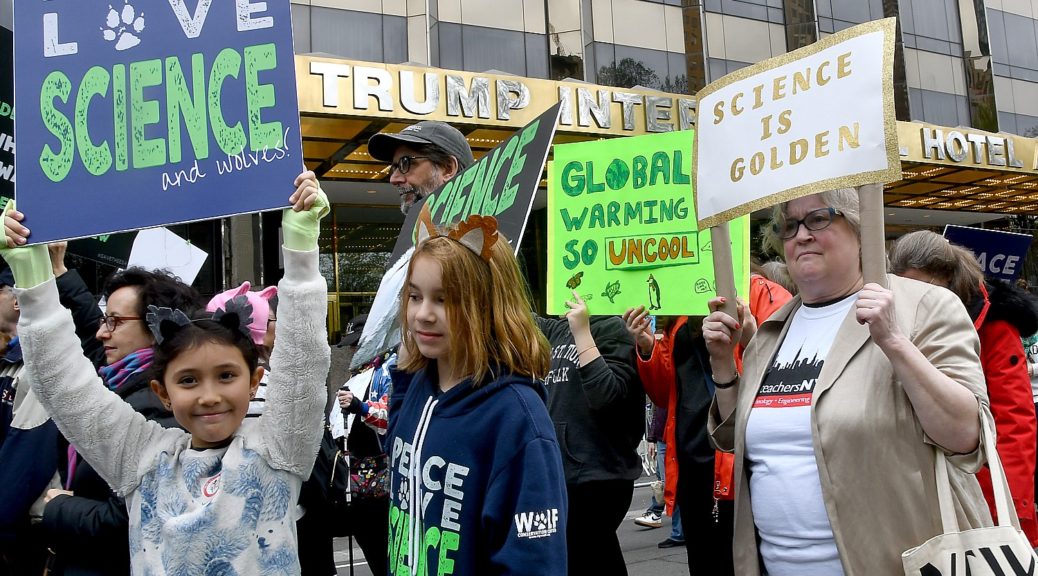
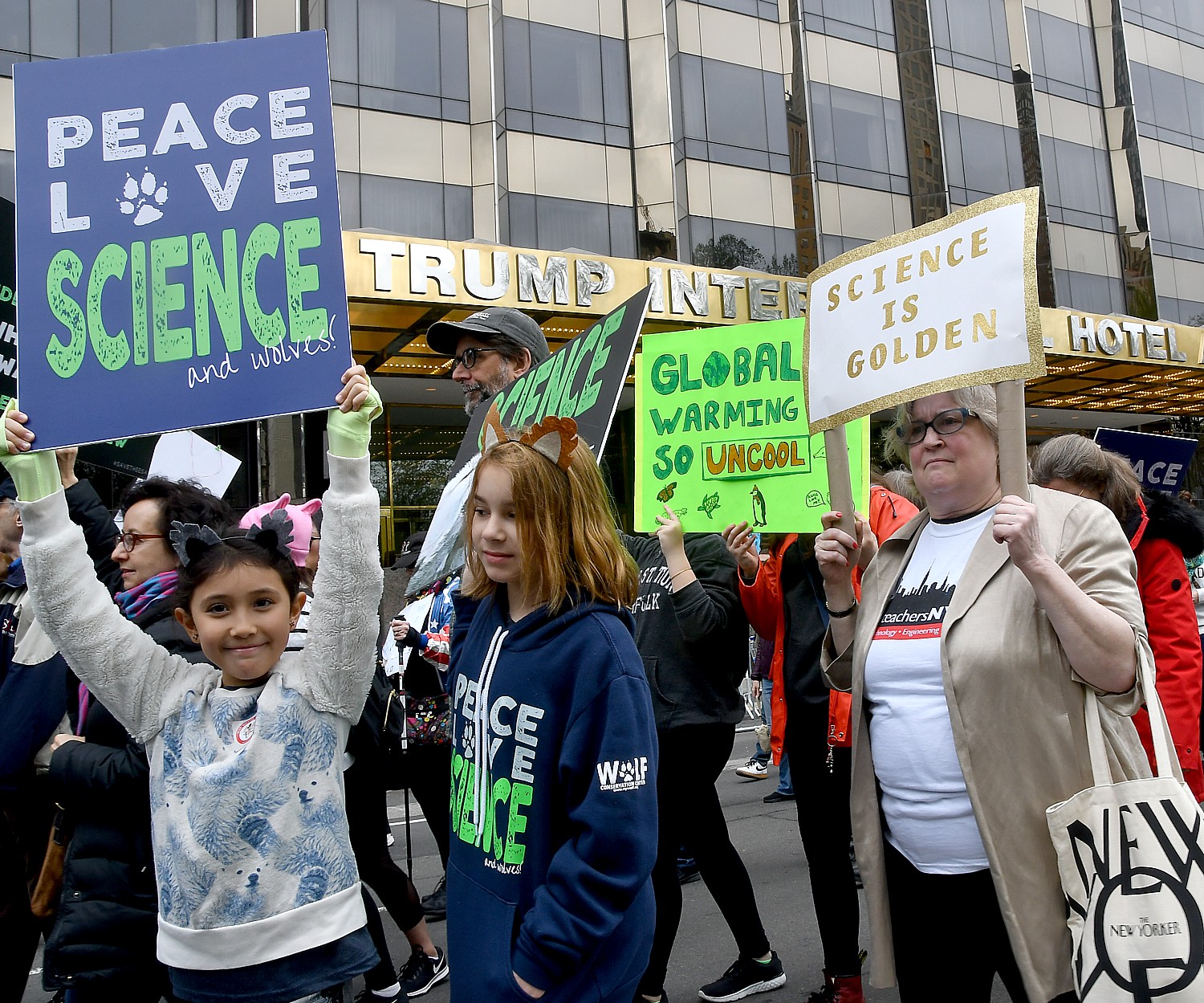
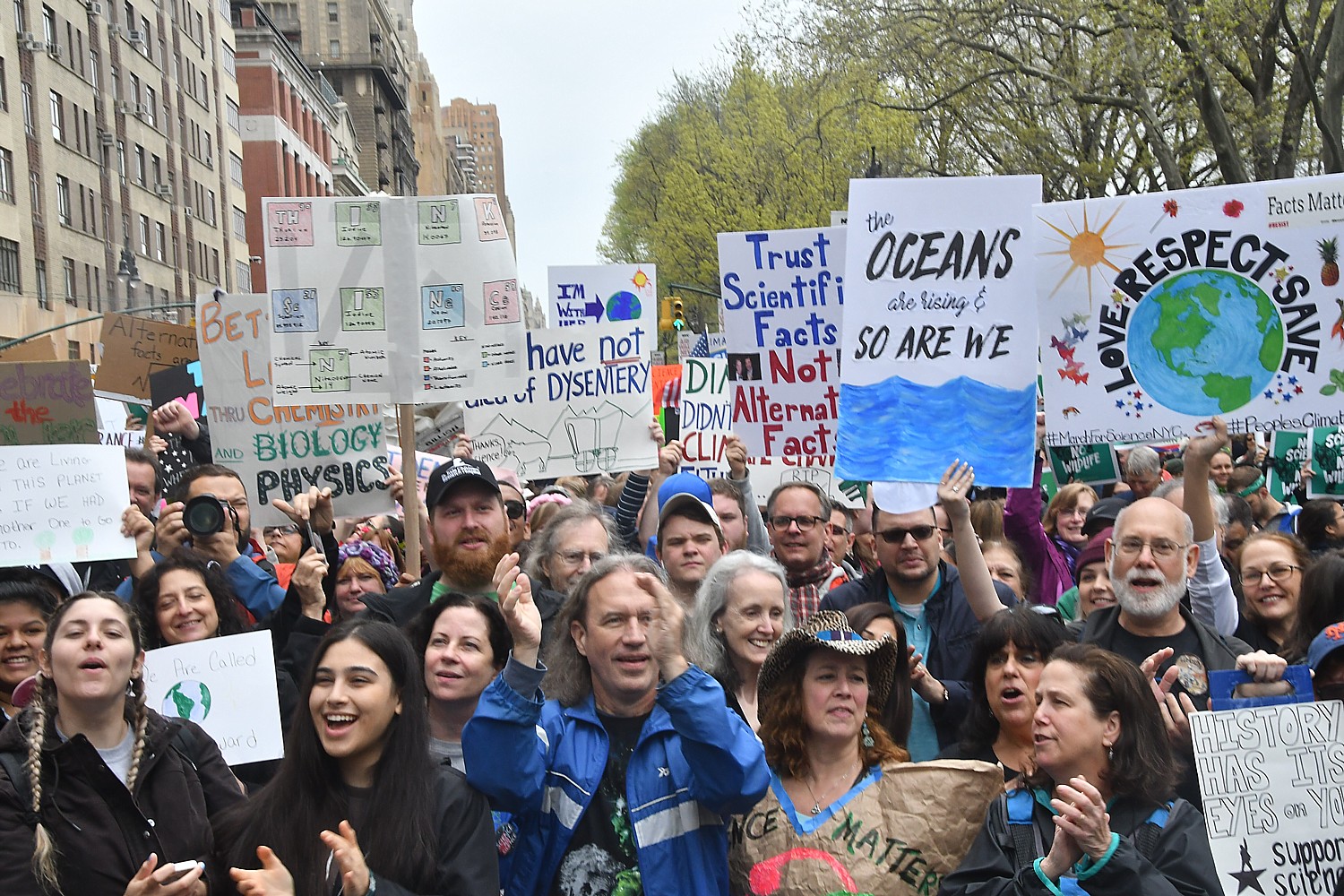
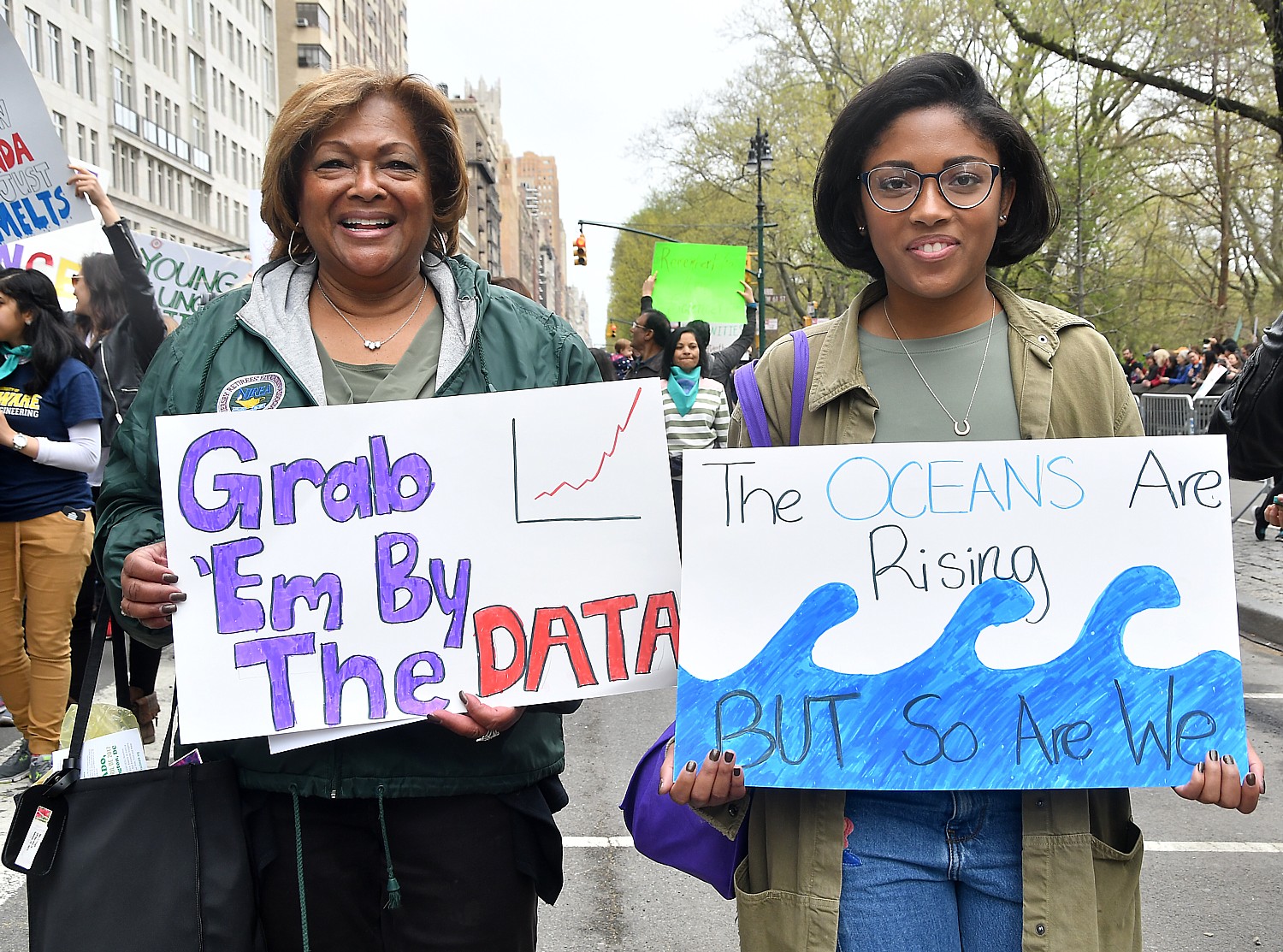
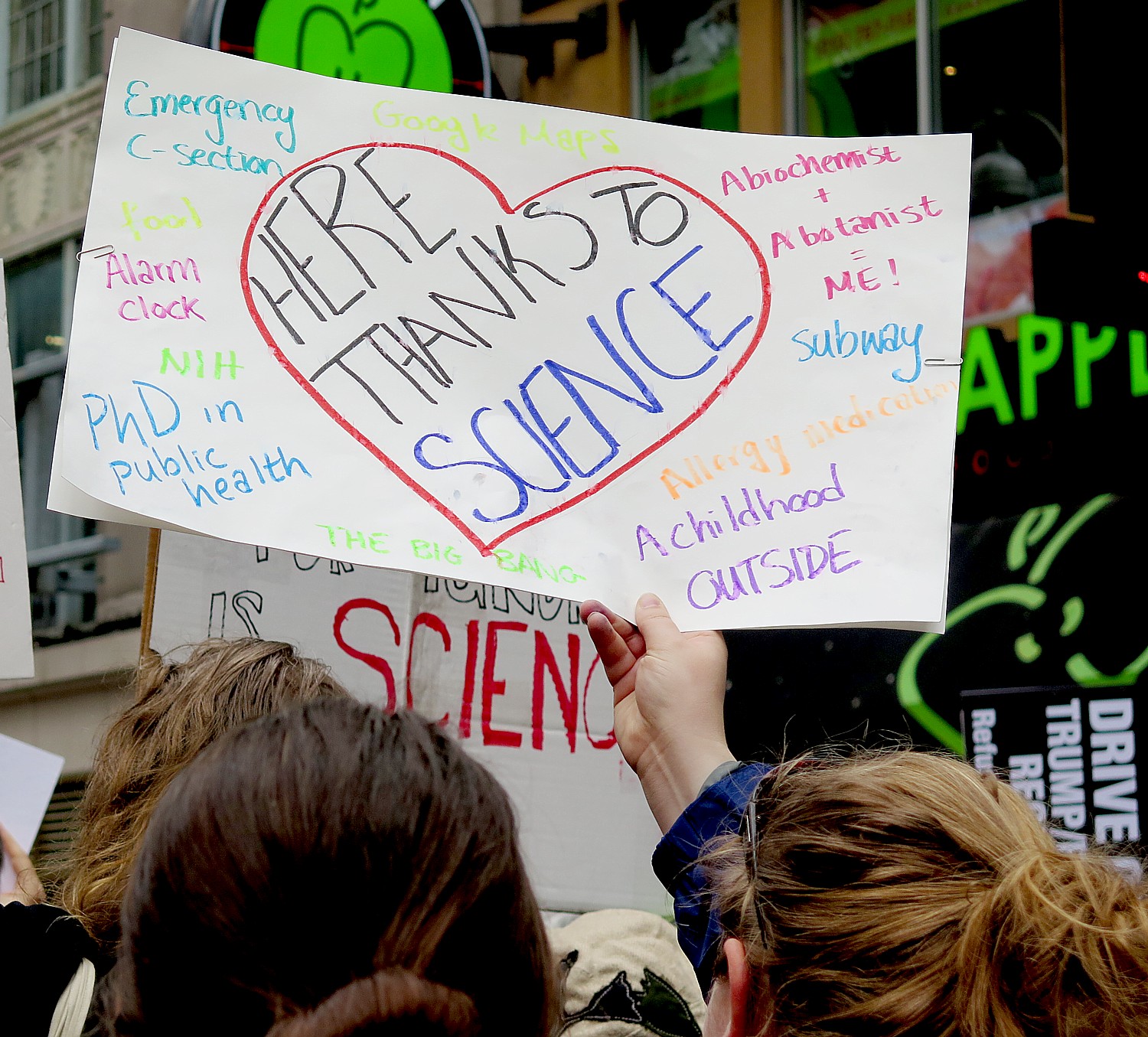
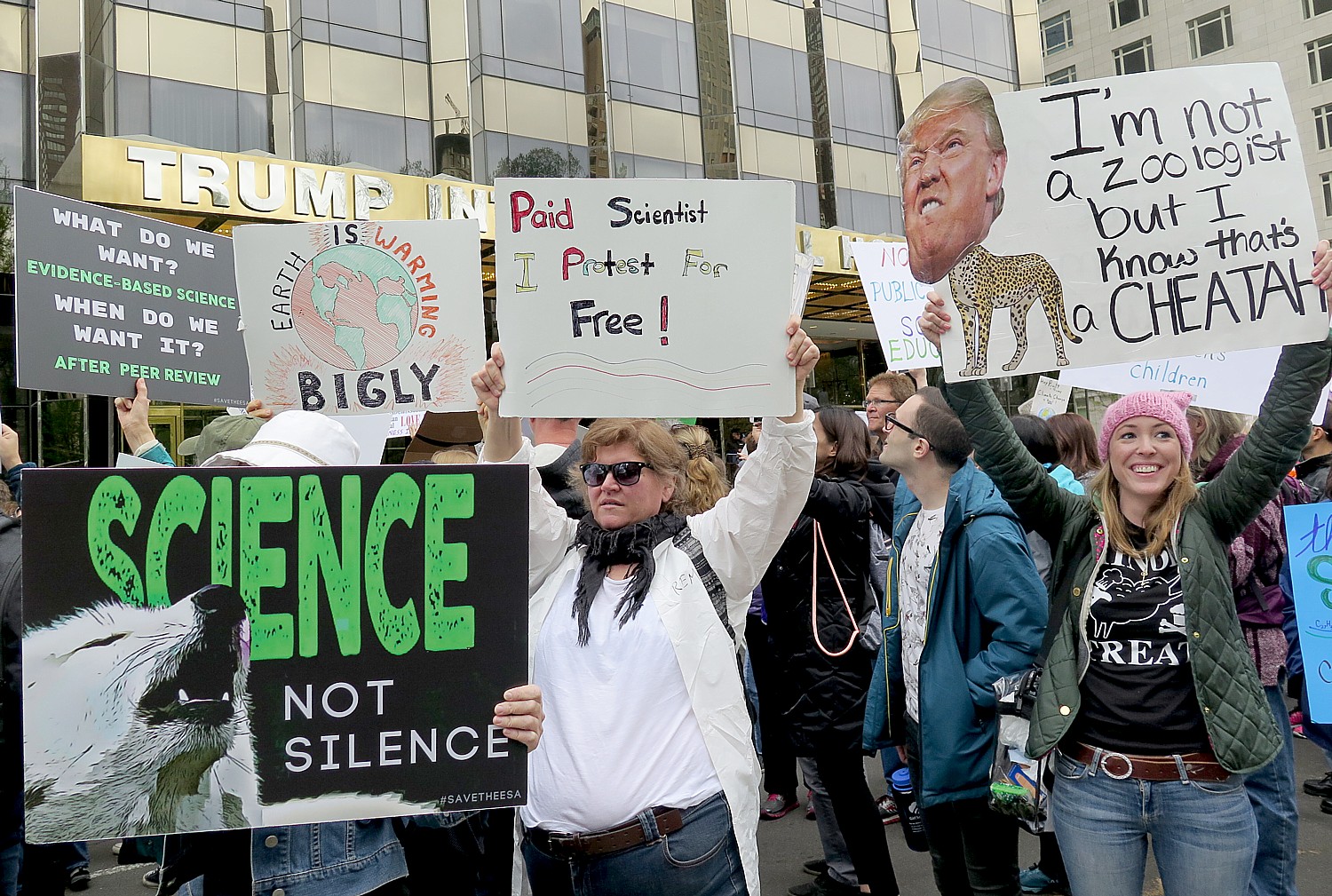
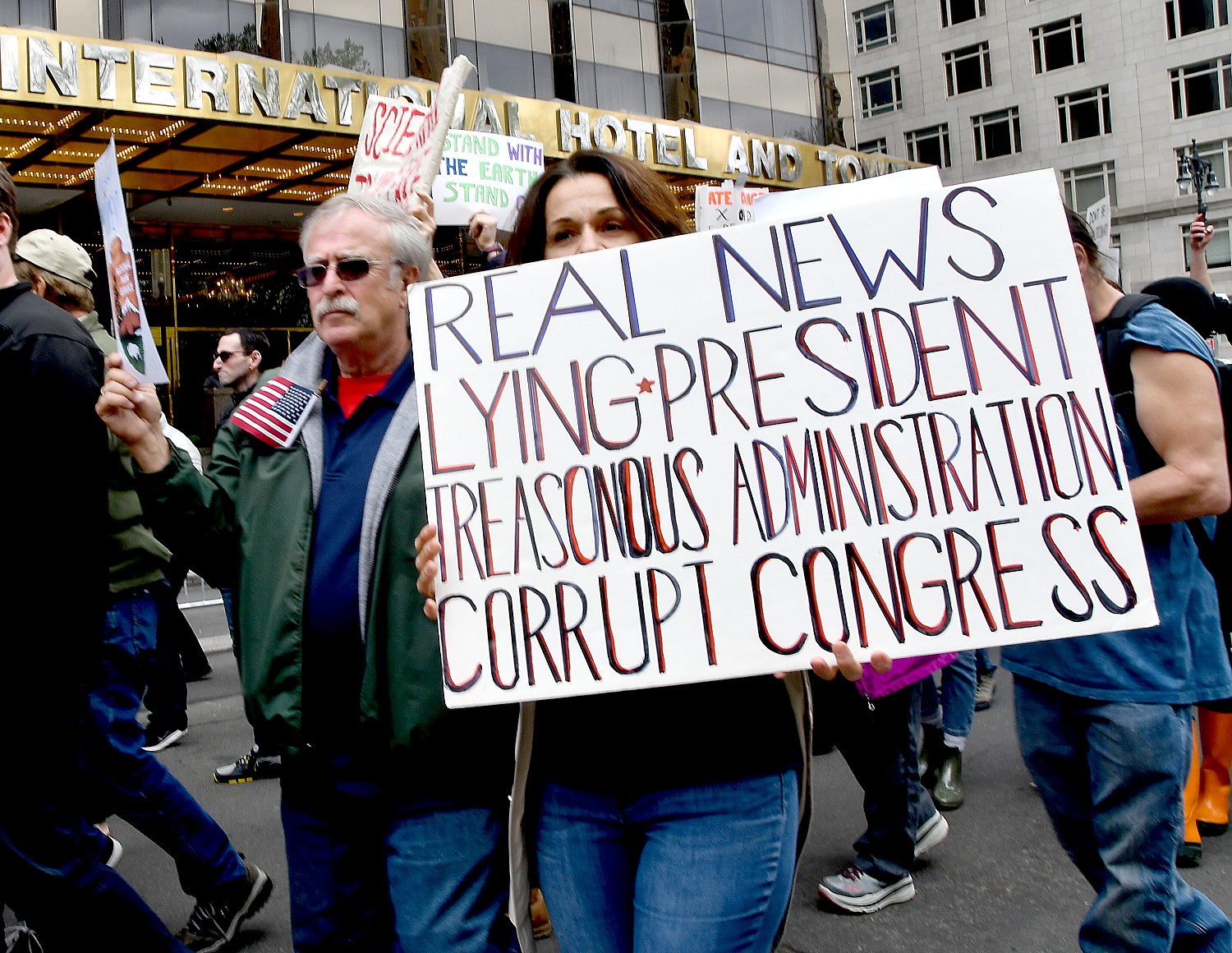
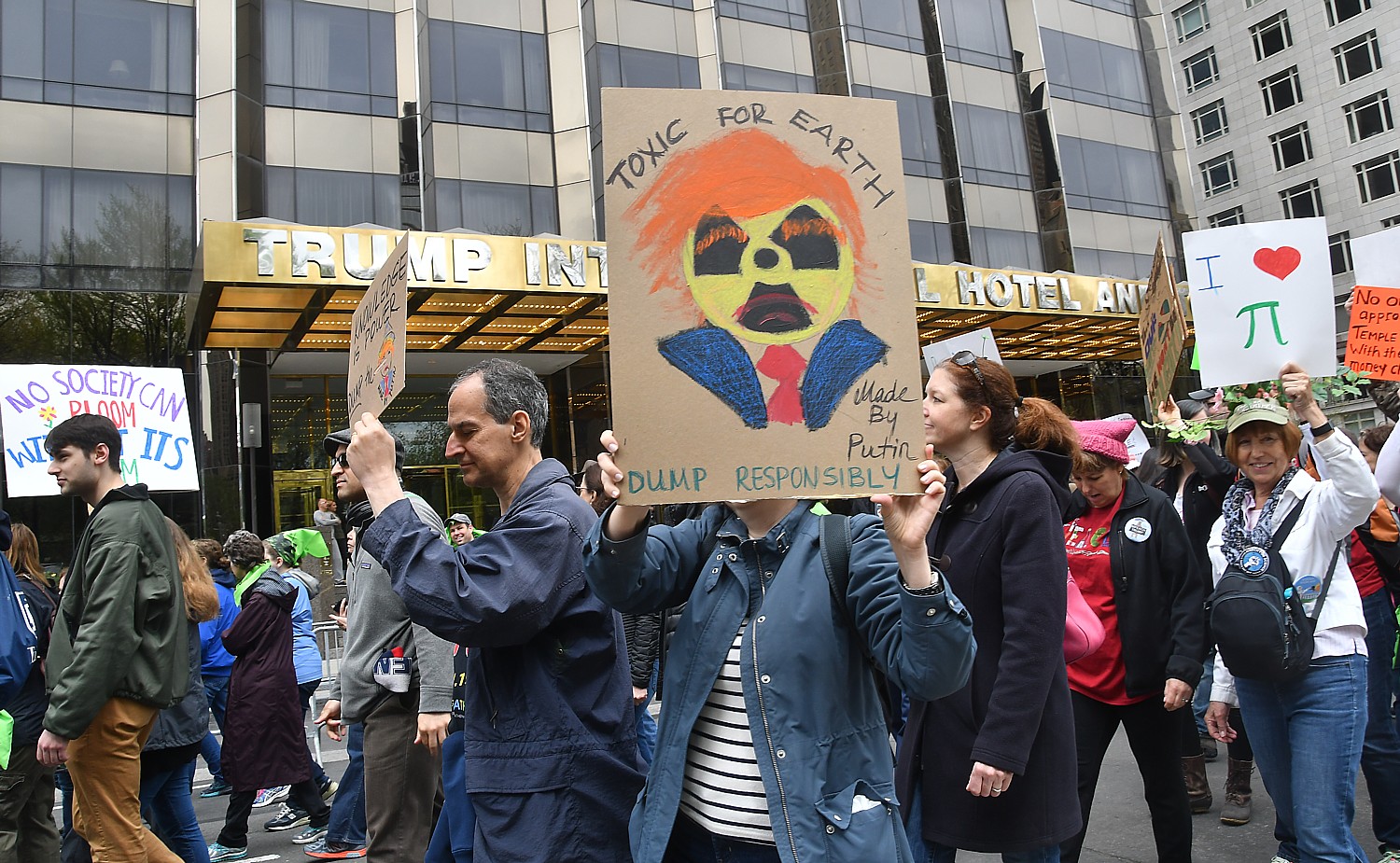
Here in New York City, some 20,000 joined the march which extended from Central Park West down to Times Square, with the loudest cheers and jeers recorded as the marchers passed by the Trump International Hotel across from the entrance to Central Park.
“This is what intelligence looks like.” They chanted.
“Hey hey what do you say, let’s all save the EPA.”
Signs were hand-drawn but heart-felt: “Data, Not Deceit.” “Make America Smart Again.” “Science, Saving Humanity Since 1612.” “Science, not Silence” “Science is like Magic but Real.”
“You Can’t Spell Existence Without Science.” “A Planet is a Terrible Thing to Waste.”
“Don’t Acid Rain on My Parade.” “More Science. Less Fear.”
Indeed, at the rally that preceded the march, several speakers – including scientists and science teachers – thanked the science community for saving their life.
Several pre-teen girls and boys from the city’s public schools extolled the value of science education, of science that has made America the great innovator in the world, responsible for the Internet, driverless cars and manned spaceflight, and lectured the government officials on the importance of funding education and innovation.
“The progress we have made would not have happened without science,” one said. “Einstein. Tesla. Anything created came from science. Our parents, our doctors use science. Medicine was created by science. Everything is Science.”
Lily Beshell, a young girl straining on a crate to reach the microphone, who proudly declared herself to be one of the “black girls who code,” said, “Science is everything that happens in this world – even when you drop a pencil. That may not be so exciting, but if you think how the pencil drops – by gravity. “
Ferdinand, representing the STEM Teachers of NYC and one of 150 marching today, said he is a prostate cancer survivor whose life was saved by science. “Learning how to do science is important for all kids – they gain knowledge and power over their lives. They use evidence, not opinion or heresay or authority, to decide how to think about the world.”
An 18-year old, working in stem cell research at the Centers for Excellence in Youth Education program at the Icahn School of Medicine at Mount Sinai, said he had developed a passion for mitigating the effect of global climate change, “the greatest threat, and I hope to be part of the solution.
“Hundreds of years ago, it was believed that evil spirits and bad air caused sickness. Today we now know disease is caused by microbes and we have developed cures.”
Debbie Lee Cohen of Cafeteria Culture – also a cancer survivor – teaches scientific principles through creating things, like the massive puppets built out of toxic, polluting Styrofoam plates that were used to convince the City Council to ban them from school lunches.
“We need science to show how environmental protection is linked to public health. We need the US EPA to protect our health, NOAA, NASA, we need publicly funded science for basic survival. Climate crises are affecting us, especially kids. Science is fundamental to a healthy democracy, a healthy planet for all.”
Ross Cagen, a professor at Mount Sinai working on next-gen cancer therapies, said, “We are part of the greatest scientific community the world has ever seen. We value knowledge, discovery, facts [rolling cheers through the crowd for “facts”]; use evidence to make basic decisions, we value diversity.
“In a world where standing up for scientific evidence is suddenly a political act, curing disease is losing its standing as a priority…. Let’s march.”
“These are scary times. I feel your anxiety, concerns. As scientists, we never wanted to merge science and politics. But that is happening to us.
“For parents with cancer scared for themselves and their children, science offers hope. The American population lives 30 years longer than years ago because of science…. We need courage to stand against those who would destroy our freedoms.
“In a world where standing up for scientific evidence is suddenly a political act, curing disease is losing its standing as a priority…. Let’s march.”
And to the strains of Star Wars, and an invocation, “May the force be with you,” they set off down Broadway.
The New York City march was one of several hundred around the world in a global effort to push back against a political climate that has become increasingly hostile toward sound, evidence-based science and its value to society. The flagship event took place on the National Mall in Washington, DC.
Organizers have partnered with over 170 organizations to make an impact throughout the world, including Earth Day Network, American Geophysical Union, National Science Teachers Association, and Carnegie Science. (A full list of partner organizations can be found here.)
“We are thrilled by the outpouring of support from museums, aquaria, scientific societies, NGOs, universities, religious groups and citizen science organizations,” said Ayana Elizabeth Johnson, Co-Director of Partnerships, March for Science. “This grassroots movement — with 198 partner organizations (and counting!) — represents a broad, diverse, and inclusive coalition in support of science and evidence-based policy making.”
“An ethical science is meaningful to us all and its role in our communities, our homes and policy making should be protected and celebrated,” said Kristian Aloma, Director, March for Science Chicago. “Chicago is a science city, and we look forward to joining communities throughout the world marching in support of science that can help answer the important questions that affect us all.”
“Defending science, innovation, and discovery is an absolute must in every community throughout the world,” said Claudio Paganini, Organizer, March for Science Berlin. “We are proud to join each of the marches on April 22 to say in one, unified, global voice that science is essential to our futures.”
As if to confirm the protesters’ worst fears, Trump released a statement for Earth Day which did not mention Climate Change, but did emphasize prioritizing the economy over environment.
“Our Nation is blessed with abundant natural resources and awe-inspiring beauty. Americans are rightly grateful for these God-given gifts and have an obligation to safeguard them for future generations. My Administration is committed to keeping our air and water clean, to preserving our forests, lakes, and open spaces, and to protecting endangered species.
“Economic growth enhances environmental protection. We can and must protect our environment without harming America’s working families. That is why my Administration is reducing unnecessary burdens on American workers and American companies, while being mindful that our actions must also protect the environment.
“Rigorous science is critical to my Administration’s efforts to achieve the twin goals of economic growth and environmental protection. My Administration is committed to advancing scientific research that leads to a better understanding of our environment and of environmental risks. As we do so, we should remember that rigorous science depends not on ideology, but on a spirit of honest inquiry and robust debate.
“This April 22nd, as we observe Earth Day, I hope that our Nation can come together to give thanks for the land we all love and call home,” Trump’s statement read.
Today, Donald Trump took steps to dismantle President Obama’s Clean Power Plan, aimed at reducing climate-changing carbon emissions that are warming the planet, resulting in melting icecaps at the Arctic and Antarctic, rising sea levels that are making island nations and coastal communities uninhabitable, contributing to catastrophic weather events that are producing floods and famine and triggering millions of climate refugees, and was incentivizing a transition to a clean, renewable energy economy and away from a society run on fossil fuel. Trump claimed it would save money and reinvigorate the coal industry, restoring jobs to coal miners. But you pay now or later in terms of repairing infrastructure, not to mention the public health impacts of air and water pollution, wildfires, heat exhaustion, and so forth. Trump is pitching it as “energy independence policy” but the US already is becoming energy independent and there are far more people permanently employed in an emerging clean energy industry than there are coal miners.
In the announcement, the White House made sure to emphasize how Trump is fulfilling a campaign promise, giving the beleaguered Donald a “win.” But instead of it being an American Energy Independence Policy, it is an American Dependence on Fossil Fuel Energy Policy. It will be up to states like California and New York, whose governors’ announced a commitment to continuing to meet or exceed the Clean Power Plan targets.
Here are the details from the White House on Trump’s “Energy Independence Policy.” – Karen Rubin, News & Photo Features
“I am going to lift the restrictions on American energy, and allow this wealth to pour into our communities.” – Donald J. Trump
MUCH NEEDED REFORM: The past Administration burdened Americans with costly regulations that harmed American jobs and energy production.
The previous Administration’s Clean Power Plan could cost up to $39 billion a year and increase electricity prices in 41 States by at least ten percent, according to NERA Economic Consulting.
The Clean Power Plan would cause coal production to fall by 242 million tons, according to the National Mining Association.
27 states, 24 trade associations, 37 rural electric co-ops, and 3 labor unions are challenging the Clean Power Plan in Federal court.
AMERICAN ENERGY INDEPENDENCE: President Donald J. Trump’s Energy Independence Policy Executive Order reverses the regulations on American jobs and energy production.
President Trump’s Executive Order directs the Environmental Protection Agency to suspend, revise, or rescind four actions related to the Clean Power Plan that would stifle the American energy industry.
o President Trump’s Executive Order directs the Attorney General to seek appropriate relief from the courts over pending litigation related to the Clean Power Plan.
President Trump’s Executive Order rescinds Executive and Agency actions centered on the previous administration’s climate change agenda that have acted as a road block to energy independence.
o President Trump’s Executive Order lifts the ban on Federal leasing for coal production.
o President Trump’s Executive Order lifts job-killing restrictions on the production of oil, natural gas, and shale energy.
President Trump’s Executive Order directs all agencies to conduct a review of existing actions that harm domestic energy production and suspend, revise, or rescind actions that are not mandated by law.
o Within 180 days, agencies must finalize their plans.
President Trump’ Executive Order directs agencies to use the best available science and economics in regulatory analysis, which was not utilized by the previous administration.
o It disbands the Interagency Working Group (IWG) on the Social Cost of Greenhouse Gases.
By revisiting the federal overreach on energy regulation, President Trump is returning power to the states – where it belongs.
FREEING AMERICA’S POTENTIAL: President Trump has worked tirelessly to free American industry and ingenuity from the constraints of Government overreach.
President Trump has signed four pieces of legislation to clear burdensome and costly regulations on energy production from the previous Administration.
President Trump has required that for every new Federal regulation, two existing regulations be eliminated.
President Trump has directed each agency to establish a Regulatory Reform Task Force to identify costly and unnecessary regulations in need of modification or repeal.
President Trump has directed the Department of Commerce to streamline Federal permitting processes for domestic manufacturing and to reduce regulatory burdens on domestic manufacturers.
President Trump signed legislation, House Joint Resolution 38, to prevent the burdensome “Stream Protection Rule” from causing further harm to the coal industry.
President Trump ordered the review of the “Clean Water Rule: Definition of Waters of the United States,” known as the WOTUS rule, to evaluate whether it is stifling economic growth or job creation.
President Trump signed a Presidential Memorandum and gave a Presidential permit to clear roadblocks to construct the Keystone XL Pipeline.
President Trump signed a Presidential Memorandum declaring that the Dakota Access Pipeline serves the national interest and initiating the process to complete its construction.
FULFILLING HIS PROMISE:By taking action on the Clean Power Plan, President Trump is fulfilling his promise to the American people.
As a candidate, Mr. Trump promised “we will eliminate… the Clean Power Plan—these unilateral plans will increase monthly electric bills by double-digits without any measurable improvement in the climate.”
With the announcement that the United States will begin to dismantle the Clean Power Plan, New York Governor Andrew M. Cuomo and California Governor Edmund G. Brown Jr. today issued the following statement reaffirming their ongoing commitment to exceed the targets of the Clean Power Plan and curb carbon pollution:
“Dismantling the Clean Power Plan and other critical climate programs is profoundly misguided and shockingly ignores basic science. With this move, the Administration will endanger public health, our environment and our economic prosperity. “Climate change is real and will not be wished away by rhetoric or denial. We stand together with a majority of the American people in supporting bold actions to protect our communities from the dire consequences of climate change. “Together, California and New York represent approximately 60 million people – nearly one-in-five Americans – and 20 percent of the nation’s gross domestic product. With or without Washington, we will work with our partners throughout the world to aggressively fight climate change and protect our future.”
New York and California lead the nation in ground-breaking policies to combat climate change. Both states – which account for roughly 10 percent of greenhouse gas emissions in the United States – have adopted advanced energy efficiency and renewable energy programs to meet and exceed the requirements of the Clean Power Plan and have set some of the most aggressive greenhouse gas emission reduction targets in North America – 40 percent below 1990 levels by 2030 and 80 percent below 1990 levels by 2050. New York and California will continue to work closely together – and with other states – to help fill the void left by the federal government.
New York’s Climate Leadership
Greenhouse Gas Emission Reductions: Established ambitious greenhouse gas emission reduction targets to reduce emissions 40 percent below 1990 levels by 2030 and 80 percent by 2050. These targets have made New York a leader across the country in fighting climate change.
Regional Greenhouse Gas Initiative (RGGI): Spearheaded the formation of the successful RGGI cap-and-trade program between northeast and mid-Atlantic states, led effort to reduce RGGI’s carbon emission cap by 45 percent in 2014, and recently called for an additional cap reduction of at least 30 percent between 2020 and 2030.
Reforming the Energy Vision: Established a comprehensive energy strategy to make the vision for a clean, resilient, and affordable energy system a reality, while actively spurring energy innovation, attracting new jobs, and improving consumer choice.
Clean Energy Standard: Established the most comprehensive and ambitious clean energy mandate in the state’s history, requiring that 50 percent of electricity in New York come from renewable energy sources like wind and solar by 2030.
Clean Energy Fund: Established a $5 billion fund that is jump-starting clean-tech innovation, mobilizing private investment, capitalizing the nation’s largest Green Bank, and helping eliminate market barriers to make clean energy scalable and affordable for all New Yorkers.
Coal-Free New York: Committed to close or repower all coal-burning power plants in New York to cleaner fuel sources by 2020.
Offshore Wind: Approved the nation’s largest wind energy project off the Long Island coast in 2017 and made an unprecedented commitment to develop up to 2.4 gigawatts of offshore wind power by 2030.
Greenhouse Gas Emission Reductions: Established ambitious greenhouse gas emission reduction targets to reduce emissions 40 percent below 1990 levels by 2030 and 80 percent by 2050. These targets have made California a leader across the country in fighting climate change.
Cap-and-Trade: Established the most comprehensive carbon market in North America, investing more than $2.6 billion from the Cap-and-Trade program in programs and projects that reduce emissions and support communities disadvantaged by pollution.
Renewable Energy: Established landmark targets that require at least 33 percent of California’s electricity comes from renewable energy sources by 2020, and 50 percent by 2030.
Energy Efficiency: Established targets that double the rate of energy efficiency savings in California buildings and require residential buildings to be Zero Net Energy by 2020, and all commercial buildings to be Zero Net Energy by 2030.
Super Pollutant Reduction: Established the nation’s toughest restrictions on destructive super pollutants, such as methane, black carbon, and hydrofluorocarbon gases.
Low Carbon Fuel Standard: Established requirements for producers of petroleum-based fuels to reduce the carbon intensity of their products, helping drive the replacement of fossil fuels with renewable natural gas and diesel, low-carbon ethanol, and clean electricity, giving consumers more clean fuel choices while driving significant clean fuel investment and creating new economic opportunities.
Zero Emission Vehicles: Established a program requiring increased sales of zero emission vehicles – a policy adopted by 10 states – resulting in more than 30 new models of clean and affordable vehicles that are reducing consumer gasoline and diesel costs. California also adopted North America’s first greenhouse gas emission car standards – later adopted as a national program – and adopted the nation’s first heavy-duty vehicle and trailer greenhouse gas emission reduction requirements, which led to similar national requirements.
These efforts complement New York and California’s ongoing efforts to broaden collaboration among subnational leaders on climate change, including through the Under2 Coalition – a pact among cities, states and countries around the world to limit the increase in global average temperature to below 2 degrees Celsius in order to avoid potentially catastrophic consequences. New York and California are among the Under2 Coalition’s 167 jurisdictions representing more than one billion people and $25.9 trillion in combined GDP – more than one-third of the global economy.
With great zeal, Donald Trump is dismantling environmental protections, regulations designed to mitigate climate change, and consumer financial protections intended to prevent another Great Recession that caused millions to lose their jobs, homes, retirement and college savings. With all the hullabaloo over Russian hacking of the election and Trump aides colluding with Russian operatives during the campaign, the firing of top National Security Adviser Michael Flynn who not only lied to VP Pence but also to federal authorities about his contact with Russia prior to the inauguration, the Trump Muslim/Travel Ban, and Trump’s attack on a free press, arguing that contrary to what is being reported, his new administration is a “fine tuned machine,” you likely have not heard about how Trump intends to make sure the machine is powered by dirty fuel and financed by deregulated banksters.
This from the White House pool press report by Adrian Carrasquillo, White House correspondent for BuzzFeed, at the signing of H.J. Res. 38:
The bill overturns the Department of Interior’s Stream Protection Rule, which was signed during the final month of the Obama administration, “addresses the impacts of surface coal mining operations on surface water, groundwater, and the productivity of mining operation sites,” according to the Congress.gov summary of the resolution.
“By eliminating this rule I am continuing to keep my promise to get rid of wasteful regulations that do nothing, absolutely nothing, but slow down the economy, hamstring companies, push jobs to other countries, which is happening all over, although I must say we’ve stopped it,” Trump said. “You’ve seen all the factories, all the plants, they’re moving back, they’re going back to a lot of places. So you know that right, fellas? They’re moving back fast — Ford, General Motors, Fiat, so many, very happy. Compliance costs for this rule would be over $50 million a year for the coal industry alone, it’s unnecessary.”
in the Roosevelt room and flanked by House Republicans on his left and miners from West Virginia in hard hats on his right, POTUS signed the resolution that he said would “eliminate another terrible job-killing rule saving many thousands of American jobs especially in the mines, which I’ve been promising you. The miners are a big deal, I’ve had support from some of these folks right from the very beginning and I won’t forget it. We went to West Virginia and we had 17, 18,000 people and they couldn’t get into that big arena.”
Trump thanked House Republican leadership including Senate Majority Leader Mitch McConnell, House Speaker Paul Ryan, House Majority Leader Kevin McCarthy, House Natural Resources Committee Chairman Rob Bishop and Rep. Bill Johnson.
McConnell, McCarthy, and Democratic Sen. Joe Manchin were behind the president as he spoke. White House Chief of Staff Reince Priebus stood off to the side watching the president’s remarks. Pool has asked for a full list of who was in attendance.
Trump told the miners the rule was a major threat to their jobs and said there was “a spirit of optimism rising across the country.”
“How about one of the miners saying a few words. I hear Rand all the time,” Trump joked of Kentucky Sen. Rand Paul who was in the room.
Coal miner Michael Nelson, General Superintendent, of the Marion County Coal Company stepped to the microphone: “President Trump we thank you for everything you’ve done for us. Everything you’re doing for our industry is very much needed. I’ve been in this industry for 40 years and this is a very exciting time in our industry.”
Nelson said he worked for Marion County Coal Company in West Virginia and POTUS asked “How did I do in the area?” referencing the election. “Oh, you did great,” Nelson said to laughs in the room.
Sen. Shelley Moore Capito said “this is a lifeline to us, these miners they mine in West Virginia, it’s a source of pride for us as a state that we’ve been able to power this country, that we’ve had the opportunity to provide the energy to this country.”
Sen. Rand Paul said this is a big day for Kentucky and thanked Trump for getting rid of job-killing regulations. “I can promise you Eastern Kentucky voted 75% for Donald J. Trump,” he said.
Senate Majority Leader Mitch McConnell said the last eight years brought a “depression” to Eastern Kentucky. “Our folks are so excited to have a pro-coal president and we thank you so much for being on our side.”
A funny moment happened before the event concluded, Carrasquillo reported. POTUS got excited and invited the miners to the Oval Office and began to leave before having to be reminded that he had to actually sign the resolution first.
FULL LIST OF ATTENDEES:
Senate Majority Leader Mitch McConnell
Sen. Heidi Heitkamp
Sen. Shelley Moore Capito
Sen. Rand Paul
Sen. Joe Manchin
Rep. Bill Johnson,
Rep. David McKinley
Rep. Evan Jenkins
Rep. Jim Jordan
Rep. Morgan Griffith
Rep. Rob Bishop
Rep. Alex Mooney
Rep. Jim Renacci
Rep. Doug Lamborn
Hal Quinn, President and CEO, National Mining Association
Matt Evans, Vice President, Boich Companies
Robert Murray, Chairman, President and CEO, Murray Energy Corporation
Ryan Murray, Vice President, Murray Energy Corporation
Casey Crooks, Superintendent, American Energy Corporation
Kevin Hughes, General Manager, Murray Energy Corporation
Scott Martin, General Superintendent, The Harrison County Coal Company
Robert Moore, Executive Vice President, Chief Operating Officer, and Chief Financial Officer, Murray Energy Corporation
John Hardison, General Manager, Anchor Longwall & Rebuld, Inc.
Eric Grimm, General Manager, The Marshall County Coal Company
Michael Carey, Vice President of Governmental Affairs, Murray Energy Corporation
Gary Broadbent, Senior Corporate Counsel and Director of Investor and Media Relations, Murray Energy Corporation
Michael Nelson, General Superintendent, The Marion County Coal Company
Here is the notice from the White House.
PRESIDENT TRUMP: PUTTING COAL COUNTRY BACK TO WORK
LETTING COAL COUNTRY WORK AGAIN: Today, President Donald J. Trump signed legislation (House Joint Resolution 38) to stop the costly “Stream Protection Rule” from further harming coal workers and the communities that depend on them.
H.J. Res. 38 blocks an overly burdensome regulation from harming the coal industry.
o The regulation was expected to reduce coal production, leading to fewer coal jobs across the country.
o The blocked regulation threatened the coal industry with millions of dollars in compliance costs.
o Complying with the regulation would have put an unsustainable financial burden on small mines, most of which are in the Appalachian Basin.
The blocked regulation would have duplicated existing regulations already in place to protect Americans.
GIVING COAL COUNTRY RELIEF: Since 2009, the coal industry has declined, leaving workers and communities without a lifeline.
Since January 2009, the coal mining industry has lost over 36,000 jobs without any relief in sight.
From 2009 to 2015, coal production declined by over 177,000,000 tons across the country.
From 2009 to 2015, over 600 coal mines closed.
A PROMISE TO COAL WORKERS: Before President Trump’s inauguration, he promised coal workers he would support them and reverse the harmful actions of the past administration.
November 21, 2016, the Trump-Pence Transition Team pledged to “end the war on coal” and review harmful regulations created under the Obama Administration.
September 22, 2016, then-candidate Donald Trump called out harmful coal regulations: “I will rescind the coal mining lease moratorium, the excessive Interior Department stream rule, and conduct a top-down review of all anti-coal regulations issued by the Obama Administration.”
August 8, 2016, then-candidate Donald Trump pledged to the American people: “We will put our coal miners and steel workers back to work.”
GETTING GOVERNMENT OUT OF THE WAY: President Trump has been steadfast in his commitment to reducing the regulatory burden on all Americans, their pocketbooks, and their businesses.
President Trump has required that for every new Federal regulation, two existing regulations be eliminated.
President Trump has placed a moratorium on all new regulations by executive departments and agencies that are not compelled by Congress or public safety.
President Trump directed the Commerce Department to streamline Federal permitting processes for domestic manufacturing and to reduce regulatory burdens on domestic manufacturers.
President Trump signed an Executive Order expediting the environmental review and approval processes for domestic infrastructure projects.
President Trump signed legislation to eliminate a costly regulation that threatened to put domestic extraction companies and their employees at an unfair disadvantage.
President Trump directed the Secretary of the Treasury to conduct a full review of the Dodd-Frank Wall Street Reform and Consumer Protection Act to ensure associated, burdensome regulations receive proper scrutiny.
President Trump ordered re-examination of the Department of Labor’s fiduciary rule, to make certain that it does not harm Americans as they save for retirement.
WASHINGTON – President Obama has taken action to ban future mineral extraction from huge sways of offshore areas in the Atlantic and Arctic Oceans to protect these ecologically sensitive marine environments from the impacts of any future oil and gas exploration and development.
Obama used a little-known law called the Outer Continental Shelf Lands Act to protect large portions of the Chukchi and Beaufort seas in the Arctic and a string of canyons in the Atlantic stretching from Massachusetts to Virginia. In addition to a five-year moratorium already in place in the Atlantic, removing the canyons from drilling puts much of the eastern seaboard off limits to oil exploration even if companies develop plans to operate around them.
The announcement by the White House was coordinated with similar steps being taken by Canadian Prime Minister Justin Trudeau to shield large areas of that nation’s Arctic waters from drilling.
The withdrawal does not restrict other uses of these federal waters on the Outer Continental Shelf, and will help to sustain commercial and recreational fisheries in the Atlantic to support fishing-dependent communities, as well as the harvest of marine resources on which many Alaska Native communities rely for subsistence use and cultural traditions.
U.S. Secretary of the Interior Sally Jewell applauded President Obama’s announcement saying, “The President’s bold action recognizes the vulnerable marine environments in the Arctic and Atlantic oceans, their critical and irreplaceable ecological value, as well as the unique role that commercial fishing and subsistence use plays in the regions’ economies and cultures,” Secretary Jewell said. “The withdrawal will help build the resilience of these vital ecosystems, provide refuges for at-risk species, sustain commercial fisheries and subsistence traditions, and create natural laboratories for scientists to monitor and explore the impacts of climate change.”
The withdrawal areas announced encompass 3.8 million acres in the north and mid-Atlantic Ocean off the East Coast and 115 million acres in the U.S. Arctic Ocean. Including previous presidential withdrawals, the {resident’s action protects nearly 125 million acres in the offshore Arctic from future oil and gas activity.
In the Atlantic, the withdrawal decision protects 31 canyons, extending from Heezen Canyon offshore New England to Norfolk Canyon offshore of the Chesapeake Bay. The largest, Hudson Canyon, reaches depths greater than 10,000 feet, comparable in scale to the Grand Canyon, which is 6,093 feet at its deepest. The canyons are regions of enhanced biodiversity, home to numerous species including deep-water corals, deep-diving beaked whales, commercially valuable fish, and significant numbers of habitat-forming soft and hard corals, sponges and crabs.
The canyon region is home to several fish stocks managed as Highly Migratory Species, including commercially valuable marlin, sailfish, swordfish, tuna and sharks. These geologic features also provide important habitat for a number of protected species including beaked, sperm and sei whales, many of which show an affinity to canyon ecosystems as compared to other Atlantic waters.
The President’s action will preserve critical ecological hot spots, helping to protect habitats important to Atlantic fisheries. The designation also affords long-term opportunity for research and exploration, and helps ensure that species dependent on the canyon habitats are protected. It also builds on protections established by the recent creation of the Frank R. Lautenberg Deep Sea Coral Protection Area. This protected region, created by the Mid-Atlantic Regional Fishery Management Council and approved by NOAA, prohibits bottom trawling in all the canyons in the region.
In addition to numerous requests from local and regional officials to protect these offshore resources, 145 prominent marine scientists issued a public letter in September 2015, voicing their conclusion that the threats to the unique marine environment in this region warranted permanent protection to preserve intact ecosystems. These concerns are informed by a number of research findings, including a National Oceanic and Atmospheric Administration study that found ocean temperatures in the Northeast U.S. Shelf are projected to warm three times faster than the global average and a climate vulnerability assessment on fish and invertebrate species in the region that concluded warming oceans due to climate change threaten the majority of fish species in the area, including salmon, lobster, and scallops. The President’s action builds on his establishment of the Northeast Canyons and Seamounts Marine National Monument, which protects 4,913 square miles of marine ecosystems located 130 miles southeast of Cape Cod. The withdrawal protects major Atlantic canyons that are not in the National Monument.
The President’s Arctic withdrawal, which encompasses the entire U.S. Chukchi Sea and significant portions of the U.S. Beaufort Sea, will provide critical protection for these vibrant and fragile offshore ecosystems, which are home to marine mammals and other important ecological resources and marine species on which many Alaska Native communities rely for subsistence and cultural traditions. These include several species of seals; Pacific walrus; polar bears; more than 98 fish species; a number of whale species, such as the bowhead, gray and beluga; many bird species, including waterfowl such as eiders, long-tailed duck and geese; and shorebirds such as the red-necked phalarope.
“Risks associated with oil and gas activity in the remote, harsh and undeveloped Arctic are not worth taking when the nation has ample energy sources near existing infrastructure,” said Abigail Ross Hopper, the Director of Interior’s Bureau of Ocean Energy Management. “Oil spill response and clean-up raises unique challenges in the Arctic and a spill could have substantial impacts on the region, particularly given the ecosystem fragility and limited available resources to respond to a spill.”
The withdrawal does not affect existing leases in these federal offshore waters and would not affect a nearshore area of the Beaufort Sea, totaling about 2.8 million acres, that has high oil and gas potential and is adjacent to existing state oil and gas activity and infrastructure. While there are significant concerns about oil and gas activity occurring in this area, it will be subject to additional evaluation and study to determine if new leasing could be appropriate at some point in the future. Interior’s five year offshore leasing program for 2017-2022 does not include lease sales in this area or in the withdrawn areas.
The U.S. Arctic Ocean is characterized by harsh environmental conditions, geographic remoteness, and a relative lack of fixed infrastructure and existing oil and gas operations. Despite the substantial steps this Administration has taken to improve the safety of potential Arctic exploration, there would still be significant risks associated with offshore drilling operations and the consequences of an oil spill in this region could be substantially detrimental to the ecosystem.
Climate change-induced temperature increases are occurring fastest in Polar Regions, including the U. S. Arctic, resulting in a disproportionate amount of changes to the Arctic environments, including reduction in seasonal ice cover. Loss of sea ice coverage reduces the available habitat for ice-dependent species such as seals, polar bears, and Pacific walrus. Such conditions and stressors may increase the vulnerability of these species and habitat and reduce their resilience to impacts of oil and gas activities.