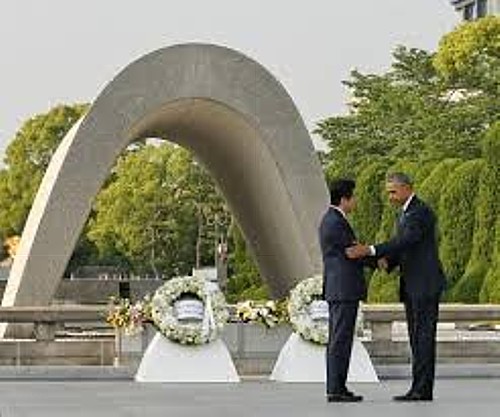
President Obama with President Abe of Japan at the Peace Memorial, Hiroshima (White House pool)
President Obama, the first sitting American President to visit Hiroshima, japan, the site of the world’s only use of an atomic weapon, struck just the right tone in a speech thoughtfully, and carefully constructed to inspire reconciliation, rather than apologize for a decision made in a different time and context. And he made it about the future, the task and the challenge ahead in face of mankind’s scientific and technological know-how to destroy all humanity. The man who won a Nobel Prize for Peace in 2009, who struggled to extract the US from two wars, who worked to secure loose nukes and negotiated a nuclear agreement with Iran has nonetheless been stymied in his goal to reduce the nuclear menace. Here is the text of his remarks, highlighted, strangely idealistic and realistic at the same time:
Hiroshima Peace Memorial
Hiroshima, Japan
5:45 P.M. JST
PRESIDENT OBAMA: Seventy-one years ago, on a bright, cloudless morning, death fell from the sky and the world was changed. A flash of light and a wall of fire destroyed a city and demonstrated that mankind possessed the means to destroy itself.
Why do we come to this place, to Hiroshima? We come to ponder a terrible force unleashed in a not so distant past. We come to mourn the dead, including over 100,000 in Japanese men, women and children; thousands of Koreans; a dozen Americans held prisoner. Their souls speak to us. They ask us to look inward, to take stock of who we are and what we might become.
It is not the fact of war that sets Hiroshima apart. Artifacts tell us that violent conflict appeared with the very first man. Our early ancestors, having learned to make blades from flint and spears from wood, used these tools not just for hunting, but against their own kind. On every continent, the history of civilization is filled with war, whether driven by scarcity of grain or hunger for gold; compelled by nationalist fervor or religious zeal. Empires have risen and fallen. Peoples have been subjugated and liberated. And at each juncture, innocents have suffered, a countless toll, their names forgotten by time.
The World War that reached its brutal end in Hiroshima and Nagasaki was fought among the wealthiest and most powerful of nations. Their civilizations had given the world great cities and magnificent art. Their thinkers had advanced ideas of justice and harmony and truth. And yet, the war grew out of the same base instinct for domination or conquest that had caused conflicts among the simplest tribes; an old pattern amplified by new capabilities and without new constraints. In the span of a few years, some 60 million people would die — men, women, children no different than us, shot, beaten, marched, bombed, jailed, starved, gassed to death.
There are many sites around the world that chronicle this war — memorials that tell stories of courage and heroism; graves and empty camps that echo of unspeakable depravity. Yet in the image of a mushroom cloud that rose into these skies, we are most starkly reminded of humanity’s core contradiction; how the very spark that marks us as a species — our thoughts, our imagination, our language, our tool-making, our ability to set ourselves apart from nature and bend it to our will — those very things also give us the capacity for unmatched destruction.
How often does material advancement or social innovation blind us to this truth. How easily we learn to justify violence in the name of some higher cause. Every great religion promises a pathway to love and peace and righteousness, and yet no religion has been spared from believers who have claimed their faith as a license to kill. Nations arise, telling a story that binds people together in sacrifice and cooperation, allowing for remarkable feats, but those same stories have so often been used to oppress and dehumanize those who are different.
Science allows us to communicate across the seas and fly above the clouds; to cure disease and understand the cosmos. But those same discoveries can be turned into ever-more efficient killing machines.
The wars of the modern age teach this truth. Hiroshima teaches this truth. Technological progress without an equivalent progress in human institutions can doom us. The scientific revolution that led to the splitting of an atom requires a moral revolution, as well.
That is why we come to this place. We stand here, in the middle of this city, and force ourselves to imagine the moment the bomb fell. We force ourselves to feel the dread of children confused by what they see. We listen to a silent cry. We remember all the innocents killed across the arc of that terrible war, and the wars that came before, and the wars that would follow.
Mere words cannot give voice to such suffering, but we have a shared responsibility to look directly into the eye of history and ask what we must do differently to curb such suffering again. Someday the voices of the hibakusha will no longer be with us to bear witness. But the memory of the morning of August 6th, 1945 must never fade. That memory allows us to fight complacency. It fuels our moral imagination. It allows us to change.
And since that fateful day, we have made choices that give us hope. The United States and Japan forged not only an alliance, but a friendship that has won far more for our people than we could ever claim through war. The nations of Europe built a Union that replaced battlefields with bonds of commerce and democracy. Oppressed peoples and nations won liberation. An international community established institutions and treaties that worked to avoid war and aspire to restrict and roll back, and ultimately eliminate the existence of nuclear weapons.
Still, every act of aggression between nations; every act of terror and corruption and cruelty and oppression that we see around the world shows our work is never done. We may not be able to eliminate man’s capacity to do evil, so nations –- and the alliances that we’ve formed -– must possess the means to defend ourselves. But among those nations like my own that hold nuclear stockpiles, we must have the courage to escape the logic of fear, and pursue a world without them.
We may not realize this goal in my lifetime. But persistent effort can roll back the possibility of catastrophe. We can chart a course that leads to the destruction of these stockpiles. We can stop the spread to new nations, and secure deadly materials from fanatics.
And yet that is not enough. For we see around the world today how even the crudest rifles and barrel bombs can serve up violence on a terrible scale. We must change our mindset about war itself –- to prevent conflict through diplomacy, and strive to end conflicts after they’ve begun; to see our growing interdependence as a cause for peaceful cooperation and not violent competition; to define our nations not by our capacity to destroy, but by what we build.
And perhaps above all, we must reimagine our connection to one another as members of one human race. For this, too, is what makes our species unique. We’re not bound by genetic code to repeat the mistakes of the past. We can learn. We can choose. We can tell our children a different story –- one that describes a common humanity; one that makes war less likely and cruelty less easily accepted.
We see these stories in the hibakusha –- the woman who forgave a pilot who flew the plane that dropped the atomic bomb, because she recognized that what she really hated was war itself; the man who sought out families of Americans killed here, because he believed their loss was equal to his own.
My own nation’s story began with simple words: All men are created equal, and endowed by our Creator with certain unalienable rights, including life, liberty and the pursuit of happiness. Realizing that ideal has never been easy, even within our own borders, even among our own citizens.
But staying true to that story is worth the effort. It is an ideal to be strived for; an ideal that extends across continents, and across oceans. The irreducible worth of every person, the insistence that every life is precious; the radical and necessary notion that we are part of a single human family -– that is the story that we all must tell.
That is why we come to Hiroshima. So that we might think of people we love — the first smile from our children in the morning; the gentle touch from a spouse over the kitchen table; the comforting embrace of a parent –- we can think of those things and know that those same precious moments took place here seventy-one years ago. Those who died -– they are like us. Ordinary people understand this, I think. They do not want more war. They would rather that the wonders of science be focused on improving life, and not eliminating it.
When the choices made by nations, when the choices made by leaders reflect this simple wisdom, then the lesson of Hiroshima is done.
The world was forever changed here. But today, the children of this city will go through their day in peace. What a precious thing that is. It is worth protecting, and then extending to every child. That is the future we can choose -– a future in which Hiroshima and Nagasaki are known not as the dawn of atomic warfare, but as the start of our own moral awakening. (Applause.)
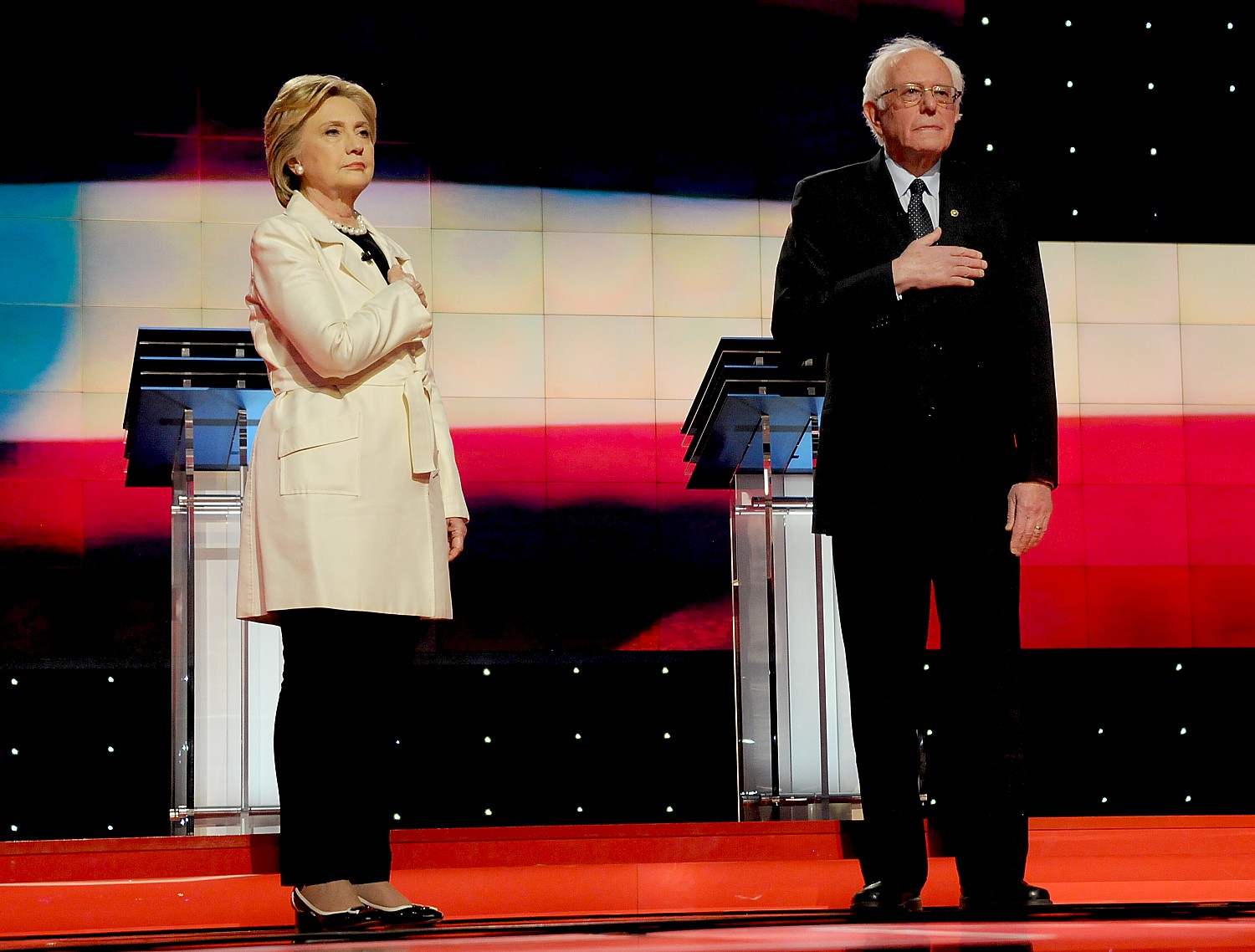
Ahead of the April 19 New York State Primary, the gloves came off between the two contenders for the Democratic presidential nomination, former Secretary of State and New York Senator Hillary Clinton and Vermont Senator Bernie Sanders, at what is being called “The Brooklyn Brawl” – the Democratic Debate at the Brooklyn Navy Yard.
The confrontation was the most contentious to date, but still substantive with both candidates making strong arguments on major issues.
Here are annotated highlights from the “Brooklyn Brawl” – the debate between Democratic contenders for the nomination for president, former Secretary of State and New York State Senator Hillary Clinton and Vermont Senator Bernie Sanders, based on a transcript provided by CNN, the news organization that hosted the debate, April 14.
In this section, the candidates debate national security and foreign policy:
National Security & Foreign Policy
Secretary Clinton, President Obama says the worst mistake in office that he made over these past seven and a half years was not preparing for Libya after Moammar Qadafi was removed. You were his secretary of State. Aren’t you also responsible for that?
CLINTON: Well, let me say I think we did a great deal to help the Libyan people after Qadafi’s demise. And here’s what we did.
“We helped them hold two successful elections, something that is not easy, which they did very well because they had a pent up desire to try to chart their own future after 42 years of dictatorship. I was very proud of that.
“We got rid of the chemical weapons stockpile that Qadafi had, getting it out of Libya, getting it away from militias or terrorist groups.
“We also worked to help them set up their government. We sent a lot of American experts there. We offered to help them secure their borders, to train a new military.
“They, at the end, when it came to security issues, Wolf, did not want troops from any other country, not just us, European or other countries, in Libya.
“And so we were caught in a very difficult position. They could not provide security on their own, which we could see and we told them that, but they didn’t want to have others helping to provide that security.
“And the result has been a clash between different parts of the country, terrorists taking up some locations in the country.
“And we can’t walk away from that. We need to be working with European and Arab partnerswith the United Nations in order to continue to try to support them.
“The Libyan people deserve a chance at democracy and self- government. And I, as president, will keep trying to give that to them.”
SANDERS: …For President Obama, this was a pretty tough call, like a 51-49 call, do you overthrow Qadafi, who, of course, was a horrific dictator?
“The New York Times told us it was Secretary Clinton who led the effect for that regime change. And this is the same type of mentality that supported the war in Iraq. Qadafi, Saddam Hussein are brutal, brutal murdering thugs. No debate about that.
“But what we have got to do and what the president was saying is we didn’t think thoroughly about what happens the day after you get rid of these dictators.
“Regime change often has unintended consequences in Iraq and in Libya right now, where ISIS has a very dangerous foothold. And I think if you studied the whole history of American involvement in regime change, you see that quite often.”
CLINTON: — I would just point out that there was a vote in the Senate as to whether or not the United States should support the efforts by the Libyan people to protect themselves against the threats, the genocidal threats coming from Gadhafi, and whether we should go to the United Nations to seek Security Council support.
“Senator Sanders voted for that, and that’s exactly what we did.”
SANDERS: No. (CROSSTALK)
CLINTON: We went to the United Nations — yes, he did. We went to the United Nations Security Council. We got support from the Security Council. And we then supported the efforts of our European and Arab allies and partners.
“This was a request made to our government by the Europeans and by the Arabs because of their great fear of what chaos in Syria would do to them. And if you want to know what chaos does, not just to the people inside but the people on the borders, look at Syria.
“Nobody stood up to Assad and removed him, and we have had a far greater disaster in Syria than we are currently dealing with right now in Libya.” (APPLAUSE) (CROSSTALK)
SANDERS: What you are talking about is what I think was what they call the unanimous consent, you know what that is, where basically, do we support Libya moving to democracy?
“Well, you know what, I surely have always supported Libya moving to democracy. But please do not confuse that with your active effort for regime change without contemplating what happened the day after. Totally different issue.”
CLINTON: There was also in that a reference to the Security Council, and I know you’re not shy when you oppose something, Senator. So, yes, it was unanimous. That’s exactly right, including you.
“And what we did was to try to provide support for our European and Arab allies and partners. The decision was the president’s. Did I do the due diligence? Did I talk to everybody I could talk to? Did I visit every capital and then report back to the president? Yes, I did. That’s what a secretary of state does.
“But at the end of the day, those are the decisions that are made by the president to in any way use American military power. And the president made that decision. And, yes, we did try without success because of the Libyans’ obstruction to our efforts, but we did try and we will continue to try to help the Libyan people.”
SANDERS: If you listen, you know — two points. Number one, yes, 100-0 in the Senate voted for democracy in Libya and I would vote for that again. But that is very different from getting actively involved to overthrow and bring about regime change without fully understanding what the consequence of that regime change would be.
“Second of all, I know you keep referring to Barack Obama all night here, but you in Syria, you in Syria talked about a no-fly zone, which the president certainly does not support, nor do I support because, A, it will cost an enormous sum of money, second of all, it runs the risk of getting us sucked into perpetual warfare in that region.
“Thirdly, when we talk about Syria right now, no debate, like Gadhafi, like Saddam Hussein, Assad is another brutal murdering dictator, but right now our fight is to destroy ISIS first, and to get rid of Assad second.”
CLINTON: Well, I think Senator Sanders has just reinforced my point. Yes, when I was secretary of state I did urge, along with the Department of Defense and the CIA that we seek out, vet, and train, and arm Syrian opposition figures so that they could defend themselves against Assad.
“The president said no. Now, that’s how it works. People who work for the president make recommendations and then the president makes the decision. So I think it’s only fair to look at where we are in Syria today.
“And, yes, I do still support a no-fly zone because I think we need to put in safe havens for those poor Syrians who are fleeing both Assad and ISIS and have some place that they can be safe.”
BASH: Senator Sanders, in 1997, you said this about NATO, you said, quote: “It is not the time to continue wasting tens of billions of dollars helping to defend Europe, let alone assuming more than our share of any cost associated with expanding NATO.”Do you still feel that way?
SANDERS: Well, what I believe, if my memory is correct here, we spend about 75 percent of the entire cost of the military aspect of NATO. Given the fact that France has a very good health care system and free public education, college education for their people, the U.K. has a good National Health Service and they also provide fairly reasonable higher education, you know what, yeah, I do believe that the countries of Europe should pick up more of the burden for their defense. Yes, I do. (APPLAUSE)
BASH: And just following up, Senator Sanders, Donald Trump also argues that NATO is unfair economically to the U.S. because America pays a disproportionate share. So how is what you say about NATO and your proposal different than his?
SANDERS: Well, you got to ask — you got to ask Trump. All I can tell you is, with a huge deficit, with 47 million people living in poverty, with our inner cities collapsing, yeah, I do think countries like Germany and U.K. and France and European countries whose economy, or at least its standard of living and health care and education, they’re doing pretty well.
“So I would not be embarrassed as president of the United States to stay to our European allies, you know what, the United States of America cannot just support your economies. You’ve got to put up your own fair share of the defense burden. Nothing wrong with that.” (APPLAUSE)
CLINTON: I support our continuing involvement in NATO. And it is important to ask for our NATO allies to pay more of the cost. There is a requirement that they should be doing so, and I believe that needs to be enforced.
“But there’s a larger question here. NATO has been the most successful military alliance in probably human history. It has bound together across the Atlantic countries that are democracies, that have many of the same values and interests, and now we need to modernize it and move it into the 21st century to serve as that head of our defense operations in Europe when it comes to terrorism and other threats that we face. So yes, of course they should be paying more, but that doesn’t mean if they don’t we leave, because I don’t think that’s in America’s interests.”
BASH: To that point, there are 28 countries in the alliance, and the United States gives more money to NATO’s budget than 21 of those countries combined. If they don’t agree to pay more, as you suggested, then what would you do as commander-in-chief?
CLINTON: I will stay in NATO. I will stay in NATO, and we will continue to look for missions and other kinds of programs that they will support. Remember, NATO was with us in Afghanistan. Most of the member countries also lost soldiers and civilians in Afghanistan. They came to our rallying defense after 9/11. That meant a lot.
“And, yes, we have to work out the financial aspects of it, but let’s not forget what’s really happening. With Russia being more aggressive, making all kinds of intimidating moves toward the Baltic countries, we’ve seen what they’ve done in Eastern Ukraine, we know how they want to rewrite the map of Europe, it is not in our interests. Think of how much it would cost if Russia’s aggression were not deterred because NATO was there on the front lines making it clear they could not move forward.” (APPLAUSE)
Taking bold actions to protect Americans in today’s digital world
The next War to End All Wars will likely be fought in cyberspace, rather than by invading armies. Cybersecurity is critical line of defense, but also raises issues of privacy – from government as well as criminals. The Obama Administration has just issued a Cybersecurity National Action Plan which, among other things, creates a Commission on Enhancing National Cybersecurity as well as a permanent Federal Privacy Council. It includes expanding upon the President’s 2014 BuySecure Initiative to strengthen the security of consumer data. Here is a fact sheet from the White House detailing the Cybersecurity National Action Plan:
From the beginning of his Administration, the President has made it clear that cybersecurity is one of the most important challenges we face as a Nation, and for more than seven years he has acted comprehensively to confront that challenge. Working together with Congress, we took another step forward in this effort in December with the passage of the Cybersecurity Act of 2015, which provides important tools necessary to strengthen the Nation’s cybersecurity, particularly by making it easier for private companies to share cyber threat information with each other and the Government.
But the President believes that more must be done – so that citizens have the tools they need to protect themselves, companies can defend their operations and information, and the Government does its part to protect the American people and the information they entrust to us. That is why, today, the President is directing his Administration to implement a Cybersecurity National Action Plan (CNAP) that takes near-term actions and puts in place a long-term strategy to enhance cybersecurity awareness and protections, protect privacy, maintain public safety as well as economic and national security, and empower Americans to take better control of their digital security.
The Challenge
From buying products to running businesses to finding directions to communicating with the people we love, an online world has fundamentally reshaped our daily lives. But just as the continually evolving digital age presents boundless opportunities for our economy, our businesses, and our people, it also presents a new generation of threats that we must adapt to meet. Criminals, terrorists, and countries who wish to do us harm have all realized that attacking us online is often easier than attacking us in person. As more and more sensitive data is stored online, the consequences of those attacks grow more significant each year. Identity theft is now the fastest growing crime in America. Our innovators and entrepreneurs have reinforced our global leadership and grown our economy, but with each new story of a high-profile company hacked or a neighbor defrauded, more Americans are left to wonder whether technology’s benefits could risk being outpaced by its costs.
The President believes that meeting these new threats is necessary and within our grasp. But it requires a bold reassessment of the way we approach security in the digital age. If we’re going to be connected, we need to be protected. We need to join together—Government, businesses, and individuals—to sustain the spirit that has always made America great.
Our Approach
That is why, today, the Administration is announcing a series of near-term actions to enhance cybersecurity capabilities within the Federal Government and across the country. But given the complexity and seriousness of the issue, the President is also asking some of our Nation’s top strategic, business, and technical thinkers from outside of government to study and report on what more we can do to enhance cybersecurity awareness and protections, protect privacy, maintain public safety as well as economic and national security, and empower Americans to take better control of their digital security. Bold action is required to secure our digital society and keep America competitive in the global digital economy.
The President’s Cybersecurity National Action Plan (CNAP) is the capstone of more than seven years of determined effort by this Administration, building upon lessons learned from cybersecurity trends, threats, and intrusions. This plan directs the Federal Government to take new action now and fosters the conditions required for long-term improvements in our approach to cybersecurity across the Federal Government, the private sector, and our personal lives. Highlights of the CNAP include actions to:
Establish the “Commission on Enhancing National Cybersecurity.” This Commission will be comprised of top strategic, business, and technical thinkers from outside of Government – including members to be designated by the bi-partisan Congressional leadership. The Commission will make recommendations on actions that can be taken over the next decade to strengthen cybersecurity in both the public and private sectors while protecting privacy; maintaining public safety and economic and national security; fostering discovery and development of new technical solutions; and bolstering partnerships between Federal, State, and local government and the private sector in the development, promotion and use of cybersecurity technologies, policies, and best practices.
Modernize Government IT and transform how the Government manages cybersecurity through the proposal of a $3.1 billion Information Technology Modernization Fund, which will enable the retirement, replacement, and modernization of legacy IT that is difficult to secure and expensive to maintain, as well as the formation of a new position – the Federal Chief Information Security Officer – to drive these changes across the Government.
Empower Americans to secure their online accounts by moving beyond just passwords and adding an extra layer of security. By judiciously combining a strong password with additional factors, such as a fingerprint or a single use code delivered in a text message, Americans can make their accounts even more secure. This focus on multi-factor authentication will be central to a newNational Cybersecurity Awareness Campaign launched by theNational Cyber Security Alliance designed to arm consumers with simple and actionable information to protect themselves in an increasingly digital world. The National Cyber Security Alliance will partner with leading technology firms like Google, Facebook, DropBox, and Microsoft to make it easier for millions of users to secure their online accounts, and financial services companies such as MasterCard,Visa, PayPal, and Venmo thatare making transactions more secure. In addition, the Federal Government will take steps to safeguard personal data in online transactions between citizens and the government, including through a new action plan to drive the Federal Government’s adoption and use of effective identity proofing and strong multi-factor authentication methods and a systematic review of where the Federal Government can reduce reliance on Social Security Numbers as an identifier of citizens.
Invest over$19 billion for cybersecurity as part of the President’s Fiscal Year (FY) 2017 Budget. This represents a more than 35 percent increase from FY 2016 in overall Federal resources for cybersecurity, a necessary investment to secure our Nation in the future.
Through these actions, additional new steps outlined below, and other policy efforts spread across the Federal Government, the Administration has charted a course to enhance our long-term security and reinforce American leadership in developing the technologies that power the digital world.
Commission on Enhancing National Cybersecurity
For over four decades, computer technology and the Internet have provided a strategic advantage to the United States, its citizens, and its allies. But if fundamental cybersecurity and identity issues are not addressed, America’s reliance on digital infrastructure risks becoming a source of strategic liability. To address these issues, we must diagnose and address the causes of cyber-vulnerabilities, and not just treat the symptoms. Meeting this challenge will require a long-term, national commitment.
To conduct this review, the President is establishing the Commission on Enhancing National Cybersecurity, comprised of top strategic, business, and technical thinkers from outside of Government – including members to be designated by the bi-partisan Congressional leadership.The Commission is tasked with making detailed recommendations on actions that can be taken over the next decade to enhance cybersecurity awareness and protections throughout the private sector and at all levels of Government, to protect privacy, to maintain public safety and economic and national security, and to empower Americans to take better control of their digital security. The National Institute of Standards and Technology will provide the Commission with support to allow it to carry out its mission. The Commission will report to the President with its specific findings and recommendations before the end of 2016, providing the country a roadmap for future actions that will build on the CNAP and protect our long-term security online.
Raise the Level of Cybersecurity across the Country
While the Commission conducts this forward looking review, we will continue to raise the level of cybersecurity across the Nation.
Strengthen Federal Cybersecurity
The Federal Government has made significant progress in improving its cybersecurity capabilities, but more work remains. To expand on that progress and address the longstanding, systemic challenges in Federal cybersecurity, we must re-examine our Government’s legacy approach to cybersecurity and information technology, which requires each agency to build and defend its own networks. These actions build upon the foundation laid by the Cybersecurity Cross-Agency Priority Goalsand the 2015 Cybersecurity Strategy and Implementation Plan.
Ø The President’s 2017 Budget proposes a $3.1 billionInformation Technology Modernization Fund, as a down payment on the comprehensive overhaul that must be undertaken in the coming years. This revolving fund will enable agencies to invest money up front and realize the return over time by retiring, replacing, or modernizing antiquated IT infrastructure, networks, and systems that are expensive to maintain, provide poor functionality, and are difficult to secure.
Ø The Administration has created the position of Federal Chief Information Security Officer to drive cybersecurity policy, planning, and implementation across the Federal Government. This is the first time that there will be a dedicated senior official who is solely focused on developing, managing, and coordinating cybersecurity strategy, policy, and operations across the entire Federal domain.
Ø The Administration is requiring agencies to identify and prioritize their highest value and most at-risk IT assets and then take additional concrete steps to improve their security.
Ø The Department of Homeland Security, the General Services Administration, and other Federal agencies will increase the availability of government-wide shared services for IT and cybersecurity, with the goal of taking each individual agency out of the business of building, owning, and operating their own IT when more efficient, effective, and secure options are available, as well as ensuring that individual agencies are not left on their own to defend themselves against the most sophisticated threats.
Ø The Department of Homeland Security is enhancing Federal cybersecurity by expanding the EINSTEIN and Continuous Diagnostics and Mitigation programs. The President’s 2017 Budget supports all Federal civilian agencies adopting these capabilities.
Ø The Department of Homeland Security is dramatically increasing the number ofFederal civilian cyber defense teams to a total of 48, by recruiting the best cybersecurity talent from across the Federal Government and private sector. These standing teams will protect networks, systems, and data across the entire Federal Civilian Government by conducting penetration testing and proactively hunting for intruders, as well as providing incident response and security engineering expertise.
Ø The Federal Government, through efforts such as the National Initiative for Cybersecurity Education, will enhance cybersecurity education and training nationwide and hire more cybersecurity experts to secure Federal agencies. As part of the CNAP, the President’s Budget invests $62 million in cybersecurity personnel to:
o Expand the Scholarship for Service programby establishing a CyberCorps Reserve program, which will offer scholarships for Americans who wish to obtain cybersecurity education and serve their country in the civilian Federal government;
o Develop a Cybersecurity Core Curriculum that will ensure cybersecurity graduates who wish to join the Federal Government have the requisite knowledge and skills; and,
o Strengthen the National Centers for Academic Excellence in Cybersecurity Program to increase the number of participating academic institutions and students, better support those institutions currently participating, increase the number of students studying cybersecurity at those institutions, and enhance student knowledge through program and curriculum evolution.
Ø The President’s Budget takes additional steps to expand the cybersecurity workforce by:
o Enhancing student loan forgiveness programs for cybersecurity experts joining the Federal workforce;
The privacy and security of all Americans online in their daily lives is increasingly integral to our national security and our economy. The following new actions build on the President’s 2014 BuySecure Initiative to strengthen the security of consumer data.
Ø The President is calling on Americans to move beyond just the password to leverage multiple factors of authentication when logging-in to online accounts. Private companies, non-profits, and the Federal Government are working together to help more Americans stay safe online through a new public awareness campaign that focuses on broad adoption of multi-factor authentication. Building off the Stop.Think.Connect. campaign and efforts stemming from the National Strategy for Trusted Identities in Cyberspace, the National Cyber Security Alliance will partner with leading technology companies and civil society to promote this effort and make it easier for millions of users to secure their accounts online. This will support a broader effort to increase public awareness of the individual’s role in cybersecurity.
Ø The Federal Government is accelerating adoption of strong multi-factor authentication and identity proofing for citizen-facing Federal Government digital services. The General Services Administration will establish a new program that will better protect and secure the data and personal information of Americans as they interact with Federal Government services, including tax data and benefit information.
Ø The Administration is conducting a systematic review of where the Federal Government can reduce its use of Social Security Numbers as an identifier of citizens.
Ø The Federal Trade Commission recently relaunchedIdentityTheft.Gov, to serve as a one-stop resource for victims to report identity theft, create a personal recovery plan, and print pre-filled letters and forms to send to credit bureaus, businesses, and debt collectors.
Ø The Small Business Administration (SBA), partnering with the Federal Trade Commission, the National Institute of Standards and Technology (NIST), and the Department of Energy, will offercybersecurity training to reach over 1.4 million small businesses and small business stakeholders through 68 SBA District Offices, 9 NIST Manufacturing Extension Partnership Centers, and other regional networks across the country.
Ø The Administration is announcing new milestones in the President’s BuySecure Initiative to secure financial transactions. As of today the Federal Government has supplied over 2.5 million more secure Chip-and-PIN payment cards, and transitioned to this new technology the entire fleet of card readers managed by the Department of the Treasury. Through government and private-sector leadership, more secure chip cards have been issued in the United States than any other country in the world.
Enhance Critical Infrastructure Security and Resilience
The national and economic security of the United States depends on the reliable functioning of the Nation’s critical infrastructure. A continued partnership with the owners and operators of critical infrastructure will improve cybersecurity and enhance the Nation’s resiliency. This work builds off the President’s previous cybersecurity focused Executive Orders on Critical Infrastructure (2013) and Information Sharing (2015).
Ø The Department of Homeland Security, the Department of Commerce, and the Department of Energy are contributing resources and capabilities to establish a National Center for Cybersecurity Resilience where companies and sector-wide organizations can test the security of systems in a contained environment, such as by subjecting a replica electric grid to cyber-attack.
Ø The Department of Homeland Security will double the number of cybersecurity advisors available to assist private sector organizations with in-person, customized cybersecurity assessments and implementation of best practices.
Ø The Department of Homeland Security is collaborating with UL and other industry partners to develop a Cybersecurity Assurance Program to test and certify networked devices within the “Internet of Things,” whether they be refrigerators or medical infusion pumps, so that when you buy a new product, you can be sure that it has been certified to meet security standards.
Ø The National Institute of Standards and Technology is soliciting feedback in order to inform further development of itsCybersecurity Framework for improving critical infrastructure cybersecurity. This follows two years of adoption by organizations across the country and around the world.
Ø Commerce Secretary Pritzker cut the ribbon on the new National Cybersecurity Center of Excellence, a public-private research and development partnership that will allow industry and government to work together to develop and deploy technical solutions for high-priority cybersecurity challenges and share those findings for the benefit of the broader community.
Ø The Administration is calling on major health insurers and healthcare stakeholders to help them take new and significant steps to enhance their data stewardship practices and ensure that consumers can trust that their sensitive health data will be safe, secure, and available to guide clinical decision-making.
Secure Technology
Even as we work to improve our defenses today, we know the Nation must aggressively invest in the science, technology, tools, and infrastructure of the future to ensure that they are engineered with sustainable security in mind.
Ø Today the Administration is releasing its 2016Federal Cybersecurity Research and Development Strategic Plan. This plan, which was called for in the 2014 Cybersecurity Enhancement Act, lays out strategic research and development goals for the Nation to advance cybersecurity technologies driven by the scientific evidence of efficacy and efficiency.
Ø In addition, the Government will work with organizations such as the Linux Foundation’s Core Infrastructure Initiative to fund and secure commonly used internet “utilities” such as open-source software, protocols, and standards. Just as our roads and bridges need regular repair and upkeep, so do the technical linkages that allow the information superhighway to flow.
Deter, Discourage, and Disrupt Malicious Activity in Cyberspace
Better securing our own digital infrastructure is only part of the solution. We must lead the international effort in adopting principles of responsible state behavior, even while we take steps to deter and disrupt malicious activity. We cannot pursue these goals alone – we must pursue them in concert with our allies and partners around the world.
Ø In 2015, members of the G20 joined with the United States in affirming important norms, including the applicability of international law to cyberspace, the idea that states should not conduct the cyber-enabled theft of intellectual property for commercial gain, and in welcoming the report of a United Nations Group of Governmental Experts, which included a number of additional norms to promote international cooperation, prevent attacks on civilian critical infrastructure, and support computer emergency response teams providing reconstitution and mitigation services. The Administration intends to institutionalize and implement these norms through further bilateral and multilateral commitments and confidence building measures.
Ø The Department of Justice, including the Federal Bureau of Investigation, is increasing funding for cybersecurity-related activities by more than 23 percent to improve their capabilities to identify, disrupt, and apprehend malicious cyber actors.
Ø U.S. Cyber Command is building a Cyber Mission Force of 133 teams assembled from 6,200 military, civilian, and contractor support personnel from across the military departments and defense components. The Cyber Mission Force, which will be fully operational in 2018, is already employing capabilities in support of U.S. Government objectives across the spectrum of cyber operations.
Improve Cyber Incident Response
Even as we focus on preventing and deterring malicious cyber activity, we must also maintain resilience as events occur. Over the past year, the country faced a wide array of intrusions, ranging from criminal activity to cyber espionage. By applying lessons learned from past incidents we can improve management of future cyber incidents and enhance the country’s cyber-resilience.
Ø By this spring, the Administration will publically release a policy for national cyber incident coordination and an accompanyingseverity methodology for evaluating cyber incidents so that government agencies and the private sector can communicate effectively and provide an appropriate and consistent level of response.
Protect the Privacy of Individuals
In coordination with the information technology and cybersecurity efforts above, the Administration has launched a groundbreaking effort to enhance how agencies across the Federal Government protect the privacy of individuals and their information. Privacy has been core to our Nation from its inception, and in today’s digital age safeguarding privacy is more critical than ever.
Ø Today, the President signed an Executive Order that created a permanent Federal Privacy Council, which will bring together the privacy officials from across the Government to help ensure the implementation of more strategic and comprehensive Federal privacy guidelines. Like cyber security, privacy must be effectively and continuously addressed as our nation embraces new technologies, promotes innovation, reaps the benefits of big data and defends against evolving threats.
Fund Cybersecurity
In order to implement these sweeping changes, the Federal Government will need to invest additional resources in its cybersecurity. That is why the 2017 Budget allocates more than $19 billion for cybersecurity – a more than 35 percent increase over the 2016 enacted level. These resources will enable agencies to raise their level of cybersecurity, help private sector organizations and individuals better protect themselves, disrupt and deter adversary activity, and respond more effectively to incidents.