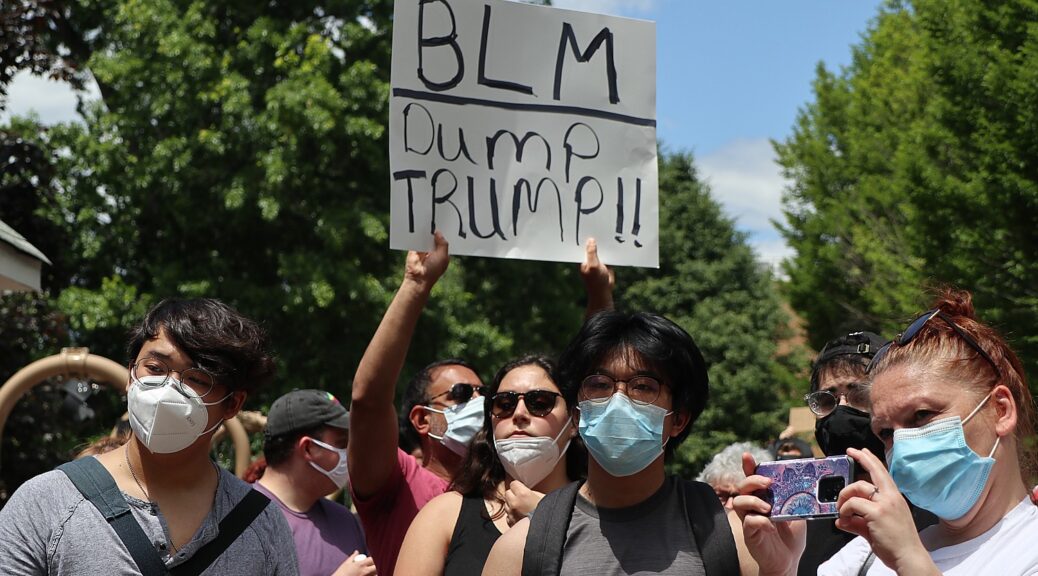
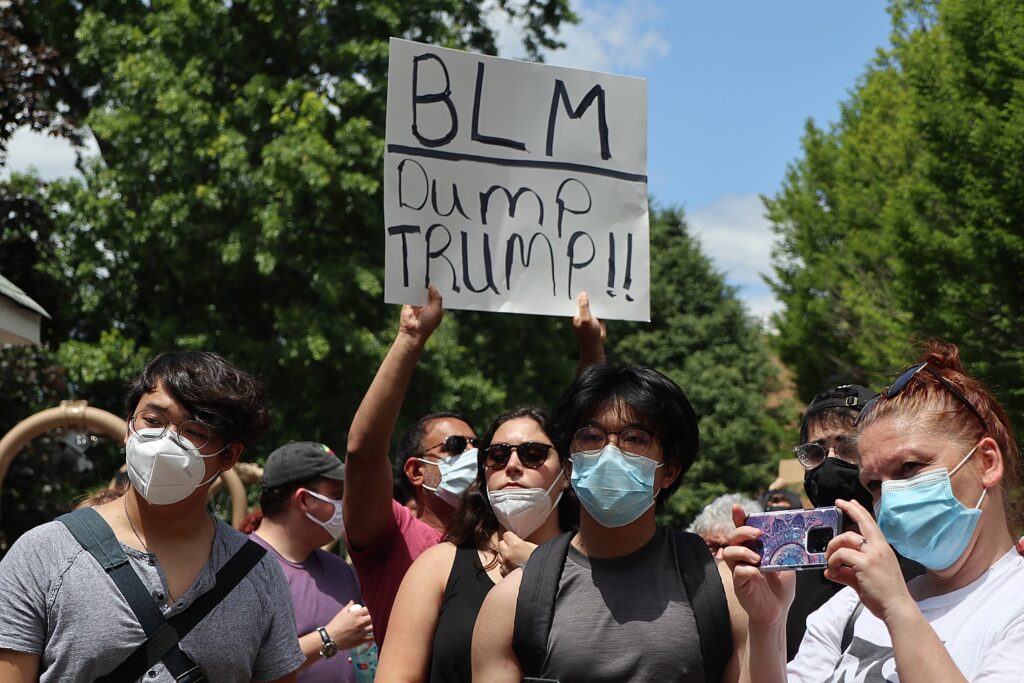
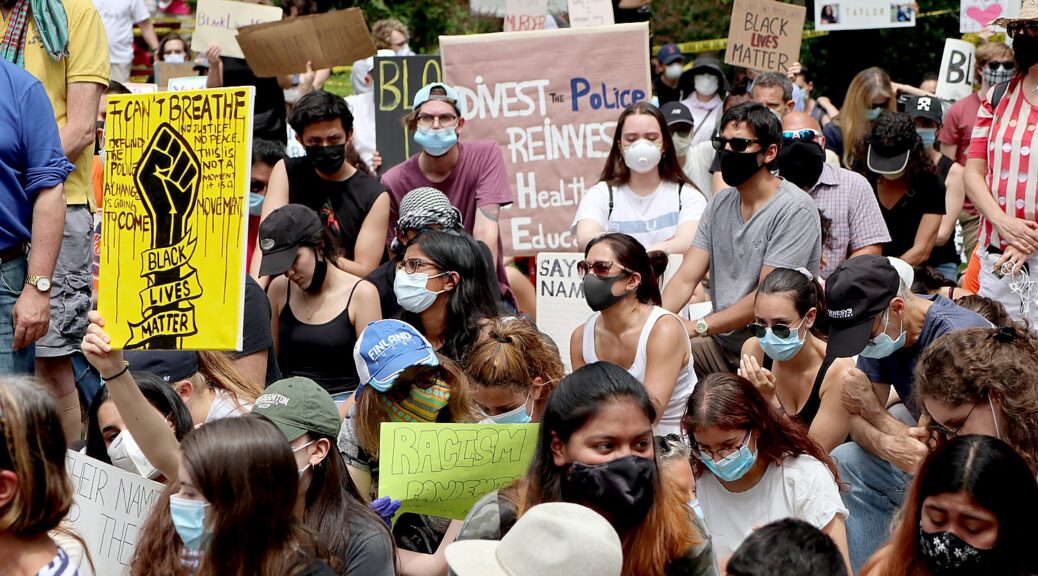
Black Lives Matter protest in suburban Long Island, NY, following George Floyd’s murder at the hands of police . The Biden Campaign issued an indictment of how Trump has failed Black Americans and what a Biden administration would do to empower Black Americans (c) Karen Rubin/news-photos-features.com
In the 2016 campaign, Trump, whose real estate business was sanctioned by the Department of Justice for discriminating against Blacks, absurdly told Black Americans, “What have you got to lose?” Well, in 2020, it is clear: your lives and your livelihoods. Blacks are disproportionately sickened and dying of COVID-19 and climate crises and are the victims of police brutality, killed by police and self-appointed vigilantes, in accelerated numbers.
While the Trump campaign parade Black Americans and people of color at the Republican National Convention and thousands assemble for a new March o n Washington in person and virtually, the Biden Campaign issued an indictment of how Trump has failed Black Americans and what a Biden administration would do to empower Black Americans.
Vice President Joe Biden and Senator Kamala Harris issued a statement on the 57th Anniversary of the March on Washington for Jobs and Freedom:
“The murder and violence toward Black Americans of the 1960s is happening today in broad daylight for the world to witness,” . A pandemic and economic crisis lays bare the systemic racism that still plagues our way of life. And instead of seeking to heal and unite, too many in our nation seek to inflame and divide.
“We’re in an ongoing battle for the soul of our nation. We condemn the violence. We cannot afford our cities and the bonds between us to be burned, broken, and scarred any further. We have to root out the racism, hate, and the vengeance.
“As our late friend John Lewis said with his final words, we must lay ‘down the heavy burdens of hate at last.’ We need to treat one another with the respect and dignity that each one of us deserves.
“And we must channel the spirit of this day 57 years ago as we’ve seen so many people of every age, race, and station do across the country over the last few months, and again this morning on the National Mall.
“With wisdom, courage, and faith, we must not turn away.
“We must choose the light and overcome.”
FACT SHEET: Trump Has Failed Black Americans
Trump has failed to deliver results for Black communities since Day One of his Administration. His failure to control COVID-19 has hurt Black Americans even more, leaving the community bearing the disproportionate brunt of COVID infections, deaths, and job loss. And, Trump’s failure to get the virus under control has worsened the economic crisis. It didn’t have to be this bad, and Black families are paying the price with their lives and livelihoods. Trump has:
Failed to address the racial disparities in the coronavirus pandemic and overseen a corrupt recovery that passed over Black small business owners. Trump didn’t have a plan to address COVID-19 and still doesn’t today. It didn’t have to be this bad — particularly for Black Americans and other people of color, who are disproportionately getting sick. Black unemployment hit 14.6%, and the unemployment gap between Black and White Americans widened further last month. And, Trump botched the delivery of assistance to small businesses, cutting out Black-and other minority-owned businesses in particular.
Sabotage Black Americans’ health care. Obamacare has saved the lives of countless Black Americans, increasing the number of insured by millions and prohibiting insurers from denying coverage due to pre-existing conditions like asthma, cancer, and diabetes. Now, Trump is asking the U.S. Supreme Court to strike down that landmark law, leaving millions without coverage in the middle of a deadly pandemic.
Put the wealthy and well-connected ahead of Black workers and communities. Trump has watered down key wage and workplace protections. He promised to veto a $15 minimum wage, and proposed a tip-pooling rule that would’ve let employers pay many non-tipped workers even less than today. He let federal contractors break laws requiring them to give workers of color a fair shot, and tried to let companies hide the truth when they don’t pay Black workers equal wages. And, Trump has done just as badly by Black entrepreneurs: he tried to slash funding for and even eliminate the federal agency that’s wholly dedicated to developing minority-owned businesses. Wealthy investors and Trump associates have reaped the benefits of Trump’s Opportunity Zones, while communities of color they’re supposed to help have been left behind.
Undercut the path to homeownership and affordable housing for Black Americans. Trump is trying to make it harder to fight housing discrimination and easier for lenders to exclude communities of color. He rolled back the Obama-era Affirmatively Furthering Fair Housing rule, which fought racial bias in housing. He repeatedly called for cuts to affordable housing programs, slamming Black families, which have lower homeownership rates and are more likely to be low-income renters. And, Trump called for drasticcuts to subsidized housing and voucher programs, and for changes that would raise rents for low-income families.
Reversed work for racial equity in education. Trump and Betsy DeVos revoked rules designed to protect students of color from racial bias in school discipline. They did away with measures meant to help schools to diversify or implement inclusive affirmative action plans. And, Trump abandoned his promise to help students manage crippling college loans, leaving Black Americans three times more likely to default on that debt.
Highlights: How Joe Will Empower Black Americans
For too long, Black Americans have lived with a knee on their neck. Joe Biden knows they’ll never have a fair shot at the American Dream, so long as entrenched disparities are allowed to quietly chip away at opportunity. With Senator Kamala Harris, he will rebuild our economy in a way that finally brings everyone along—and that starts by rooting out systemic racism from our laws, policies, institutions, and hearts. Highlights of Joe’s plans include:
Create wealth in the Black community. The typical white family holds approximately ten times more wealth than the typical Black family. Joe’s plan to Build Back Better will close the racial wealth gap, opportunity gap, and jobs gap. He will create millions of good-paying jobs, increase the minimum wage to $15 an hour, end paycheck discrimination, provide affordable child care for families, and leverage more than $150 billion in new capital and opportunities in economically disadvantaged areas, especially for Black owned small businesses and other small businesses that have been structurally excluded for generations. Because homeownership is key to building wealth, he’ll create a $15,000 down-payment tax credit for first-time home buyers. And Joe will set a goal that disadvantaged communities – including many Black communities – receive 40% of the overall benefits of his spending on infrastructure and clean energy.
Tackle health inequities. Black Americans are dying from COVID-19 at a higher rate than whites, shedding light on the long-standing, pervasive disparities across our health care system. Joe will protect and build on Obamacare to ensure access to high-quality, affordable care beyond the crisis, including by providing Black Americans with a new health insurance option – a public option. He’ll also ensure Black communities have clean air to breathe and water to drink, and healthy foods to eat.
Address racial inequity in our education system. Joe will eliminate the funding gap between white and non-white districts, improve teacher diversity, and provide high-quality, universal preschool for all three and four-year-olds. He will invest over $70 billion in Historically Black Colleges and Universities and Minority Serving Institutions to lower students’ costs, establish research centers, build high-tech labs, and more. Joe will also ensure Black Americans can attend community college without debt and make public colleges and universities tuition-free for families earning under $125,000 (including 90% of Black families). And he’ll relieve student debt, especially key for Black students who hold more debt and are three times more likely to default on loans than white borrowers. He’ll forgive undergraduate tuition-related federal student debt from public colleges and private HBCUs and MSIs for Americans earning up to $125,000.
Root out systemic racism in our police departments and justice system. Joe will outlaw choke holds, create a model use of force standard and a national police oversight commission, and push police departments to review their hiring, training, and de-escalation practices. He’ll expand and use the authority of the Justice Department, created by legislation he authored, to address systemic misconduct in police departments and prosecutors’ offices. He’ll also invest in public defenders’ offices, eliminate the death penalty and mandatory minimums, and end cash bail and private prisons. He’ll decriminalize the use of cannabis and automatically expunge all cannabis use convictions, and end incarceration for drug use alone.
In the midst of economic, unemployment, and climate crises, Vice President Joe Biden, the presumptive Democratic candidate for president, rolled out the second plank of his Build Back Better economic recovery plan for working families: building a modern, sustainable infrastructure and an equitable clean energy future. In a sharp contrast to Donald Trump’s disregard for working Americans and the consequential climate emergency at hand, Vice President Biden’s plan will create millions of good paying, union jobs for Americans while building sustainable infrastructure and creating an equitable clean energy future.
Here’s what leaders from across the country are saying about Vice President Biden’s plans:
“The plan put forward today by former Vice President Biden will create and sustain the kinds of good-paying, union jobs that provide a ladder to the middle class and make America a leader in manufacturing clean technology, put our nation on a path to doing our part to tackle the climate crisis, rebuild America’s crumbling infrastructure, and lift up all workers and communities by prioritizing investments in communities of color that have borne the brunt of environmental injustice,” Jason Walsh, the Executive Director BlueGreen Alliance, said in a statement.
“As president of the IBEW, the largest union of electrical workers in the nation, I’m pleased that it will create so many jobs in nearly every sector of the workforce we represent, including construction, utility, telecommunications, manufacturing, and railroad. Joe Biden has made it clear that any new federal investments must support American jobs and American made products,” Lonnie R. Stephenson, president of the International Brotherhood of Electrical Workers (IBEW), said in a statement. “These are vital jobs that our nation needs more than ever… The men and women of the IBEW have been part of American’s clean-energy revolution for years now. We look forward to working with a Biden administration in building a clean and sustainable economy that can both save our planet and help rebuild the American middle class.”
“This ambitious plan is a win-win for American manufacturing, auto industry jobs, new technology and a cleaner environment. By focusing on investments in new technology, increasing demand for American-made and sourced clean vehicles; investing in our plants and our auto manufacturing facilities and creating 1 million new jobs, this all-American plan will ensure that the industry will thrive for decades to come with good paying union jobs,” the United Auto Workers (UAW) said in a statement. “This comprehensive plan will also increase investment in batteries and charging infrastructure and set fuel economy standards that involve all stakeholders. And this plan will save consumers money and cut air pollution. UAW members are looking to Washington, D.C. to invest in future jobs; new technologies; a world race to cleaner air; and to save consumers their hard-earned money. This plan checks all those boxes.”
“Joe Biden’s climate plan—by a long shot—is the most ambitious we have ever seen from any president in our nation’s history,” Gina McCarthy, president and CEO of the NRDC Action Fund, said in a statement. “It will get our economy humming again, and give our children a healthier, more just and more hopeful future. And he has committed to getting started on day one.”
“Vice President Joe Biden’s ambitious new commitments to a clean energy economy, environmental justice, and equitable climate solutions are more important than ever as our nation grapples with the realities of systemic racism, a global pandemic, and the ever growing climate crisis. Biden’s strong climate leadership stands in stark contrast with the Trump administration, which is continuing this week with its full scale assault on environmental and public health protections,” Tiernan Sittenfeld, Senior Vice President of Government Affairs of LCV Action Fund, wrote in a statement. “We applaud Vice President Biden for again making clear with these plans that combatting the climate crisis, fighting for environmental justice and creating millions of good-paying, high-quality jobs in a clean energy economy will be a very top priority on day one as president and every single day.”
“Vice President Biden is right ‘that environmental policy decisions of the past have failed communities of color,’ and his emphasis on addressing those injustices is a critical part of this plan. For too long Black, Latino, as well as low-income neighborhoods have suffered far more than their fair share of pollution and other environmental impacts, with devastating results on the health of the people living there,” said Elizabeth Gore, Senior Vice President, Political Affairs, EDF Action Fund in a statement. “The Biden Plan couldn’t be more of a stark contrast to four years of failure by the Trump administration. They have weakened limits on climate pollution, undermined scientists, and surrendered international leadership. America can’t afford another four years of a president who claims climate change is a hoax instead of providing leadership. We look forward to working with the Congress and a new administration to finally take real action on climate change.”
“While Donald Trump spreads lies about windmills, tries to block legislative efforts to advance electric vehicles, and ignores the millions of Americans working in clean energy, Joe Biden is presenting a vision to invest in and grow an equitable clean energy economy,” Sierra Club Political Director Ariel Hayes said in a statement. “The Sierra Club is encouraged by Biden’s proposal, which shows he is listening to the continued calls from activists and organizations across the country demanding a bold and ambitious plan that meets the size and scale of the crisis and completes the transition to a clean energy economy.”
“Today I heard from many in the environmental justice movement across the country who were overwhelmed by the Historic Ambitious speech addressing environmental, climate, social, and economic injustice by the Vice President,” said former South Carolina State Representative Harold Mitchell and Founder of The ReGenesis Project. “We thank you for listening, and announcing one of the boldest climate and environmental justice plans ever presented by a nominee for President.”
“Joe Biden shares DSCEJ’s commitment to build the power of Black communities, harmed by toxic pollution and vulnerable to the climate crisis, to shape the national agenda for achieving environmental justice and climate justice,” said Beverly L. Wright, Ph.D., Executive Director, Deep South Center for Environmental Justice.
“The Biden Environmental Justice Plan is the most targeted and comprehensive plan to address the legacy of environmental racism and the continuing ambivalence regarding environmental quality in communities of color that has been proposed by a potential presidential nominee,” said Peggy Shepard, co-founder and executive director of WE ACT for Environmental Justice based in Harlem, New York,” said Peggy M. Shepard, Executive Director, WE ACT for Environmental Justice. “When I was chair of the National Environmental Justice Advisory Council to the EPA I witnessed the total disregard of Title 6 administrative complaints by the EPA’s Civil Rights division, and the lack of accountability or reporting on environmental justice progress by the EJ Interagency Council which was mandated to develop plans to address environmental degradation in EJ communities. The Biden plans’ initiative to mandate a report card on progress to the White House is another important proposal to establish accountability which has been absent.”
“It’s encouraging to see former Vice President Biden release an environment, climate , economic and energy plan that places justice and health at the center,” said Dr. Robert. D. Bullard, Distinguished Professor of Urban Planning and Environmental Policy, Texas Southern University, widely regarded as the father of the environmental justice movement. “Given the converging and multiple threats faced by low-income, people of color, and vulnerable communities today, I like the fact the plan calls for an inclusive and All-of-Government approach in setting policy and legislative priorities and a framework for targeting resources to address underlying systemic conditions that create and perpetuate racial and economic inequality and unequal protection.”
“This is a truly historic moment in Presidential candidate history. Environmental Justice elders are being heard and together we can, and we will forge a new pathway for this country to live up to its ideals of justice for all!” said Dr. Cecilia Martinez, Executive Director, Center for Earth, Energy & Democracy; Inaugural Signer of the Equitable and Just National Climate Platform; and Co-Chair, Biden for President Climate Engagement Advisory Council.
“We strongly applaud the Biden campaign for taking an ambitious, comprehensive approach to climate change policy that recognizes the renewable energy industry’s ability to grow America’s economy towards a cleaner environment and a more prosperous and equitable future,” said Tom Kiernan, CEO of the American Wind Energy Association in a statement. “As our country strives to recover from the global pandemic, racial injustices, and economic recession, this is the right moment to grow the investments and good-paying American jobs associated with renewable energy development, including the significant economic benefits, lower cost electricity bills, and diverse community support that wind energy brings to rural parts of the country.”
“I think this plan out of Joe Biden is really visionary. It’s about investing in the technologies of the future and it certainly does deploy a lot of the work that the big three are already doing here in Detroit — and expands upon that and builds that out even further,” Michigan Governor Gretchen Whitmer said. “Autonomous vehicles, vehicles of the future, electric vehicles — these are the industries we’ve got to make investments in, that we’ve got to grow, and that will make our environment cleaner and be a much longer-term type of investment for the people of this country. I was excited to hear Joe Biden’s plan today.”
”This is exactly the bold vision for the future that we need in our country,” said Michigan Senator Debbie Stabenow. “What I love about what Joe Biden is proposing is that it’s about making it here, it’s about using it here, it’s about tackling the climate crisis in a way that creates new, clean energy jobs and does it in a way that provides opportunity for everyone and addresses parts of our communities that have been hardest hit by that pollution and the inequalities involved. “
“I’ve spent my time in public service fighting for environmental justice and for workers‘ rights so people who work hard can forge a better life for themselves. I know these two issues go hand in hand. So does my friend, Joe Biden. His clean energy jobs plan, with a strong environmental justice focus, proves it,” said Los Angeles County Supervisor and former U.S. Secretary of Labor Hilda Solis.
“VP Biden has chosen a bold path to get America to energy and environmental security and confront the existential challenge of climate change with bold and realistic solutions,” said former Senator and former U.S. Secretary of the Interior Ken Salazar.
Here is the plan:
The Biden Plan to Secure Environmental Justice and Equitable Economic Opportunity in a Clean Energy Future
The current COVID-19 pandemic reminds us how profoundly the energy and environmental policy decisions of the past have failed communities of color – allowing systemic shocks, persistent stressors, and pandemics to disproportionately impact communities of color and low-income communities.
Joe Biden is running for President to ensure that all Americans have a fair shot at getting ahead. That means rooting out the systemic racism in our laws, policies, institutions, and hearts. Any sound energy and environmental policy must advance public health and economic opportunity for all Americans, in rural, urban, and suburban communities, and recognize that communities of color and low-income communities have faced disproportionate harm from climate change and environmental contaminants for decades. It must also hold corporate polluters responsible for rampant pollution that creates the types of underlying conditions that are contributing to the disproportionate rates of illness, hospitalization, and death from COVID-19 among Black, Latino, and Native Americans. That means officials setting policy must be accountable to the people and communities they serve, not to polluters and corporations.
Addressing environmental and climate justice is a core tenet of Biden’s climate plan. Biden will:
Use an inclusive and empowering All-of-Government approach;
Make decisions that are driven by data and science;
Target resources in a way that is consistent with prioritization of environmental and climate justice; and
Assess and address risks to communities from the next public health emergency.
USE AN INCLUSIVE AND EMPOWERING, ALL-OF-GOVERNMENT APPROACH
Our nation’s environmental justice policy was developed more than twenty years ago and no longer addresses the needs of the present or future. In order to clean up our communities and provide new opportunities to those that have been disproportionately burdened by pollution and economic and racial inequality, Biden will revise and reinvigorate the 1994 Executive Order 12898 (EO 12898) on Federal Actions to Address Environmental Justice in Minority Populations and Low-Income Populations. Specifically, Biden will:
Establish an Environmental and Climate Justice Division within the U.S. Department of Justice. Under the Trump Administration, the U.S. Environmental Protection Agency (EPA) has referred the fewest number of criminal anti-pollution cases to the Justice Department (DOJ) in 30 years. Allowing corporations to continue to pollute – affecting the health and safety of both their workers and surrounding communities – without consequences, perpetuates an egregious abuse of power. Biden will direct his EPA and DOJ to pursue these cases to the fullest extent permitted by law and, when needed, seek additional legislation to hold corporate executives personally accountable – including jail time where merited. Going beyond the ambitious proposals that the Biden plan for a clean energy revolution already includes, the Biden Administration will establish a new Environmental and Climate Justice Division within the DOJ, as proposed by Governor Inslee, to complement the work of the Environment and Natural Resources Division. In line with the new Division’s mandate, Biden will instruct the Attorney General to: (i) implement, to the extent possible by executive action, Senator Booker’s Environmental Justice Act of 2019; (ii) increase enforcement, in line with the commitments already detailed in the Biden Plan; (iii) strategically support ongoing plaintiff-driven climate litigation against polluters; (iv) address legacy pollution that includes real remedies to make communities safe, healthy, and whole; and (v) work hand-in-hand with EPA’s Office of Civil Rights.
Elevate environmental justice in the federal government and modernize the all-of-government approach. Currently, the federal government has two key environmental justice groups. Biden will elevate and reestablish the groups as the White House Environmental Justice Advisory Council and White House Environmental Justice Interagency Council, both reporting directly to the Chair of the White House Council on Environmental Quality (CEQ), who reports directly to the President. To support this work, Biden’s CEQ will also have senior and dedicated environmental justice staff. These two councils will be charged with revising EO 12898 in order to address current and historic environmental injustice, in collaboration with local environmental justice leaders. And, they will be tasked with developing clear performance metrics to ensure accountability in the implementation of the Executive Order. Once the revised EO is finalized, the White House Environmental Justice Advisory Council and White House Environmental Justice Interagency Council will publish an annual public performance score-card on its implementation.
Overhaul the EPA External Civil Rights Compliance Office. For too long, the EPA External Civil Rights Compliance Office has ignored its requirements under Title VI of the 1964 Civil Rights Act. That will end in the Biden Administration. Biden will overhaul that office and ensure that it brings justice to frontline communities that experience the worst impacts of climate change and fenceline communities that are located adjacent to pollution sources, beginning with the following actions: (i) revisit and rescind EPA’s decision in Select Steel and its Angelita C. settlement, which allowed state environmental agencies to issue dangerous permits, and to conduct its business in a way that harmed communities; (ii) conduct a rulemaking and open a public comment process to seek Americans’ input on agency guidance for investigating Title VI Administrative complaints; and (iii) work with Congress to empower communities to bring these cases themselves, by reinstituting a private right of action to sue Title VI, which was written out in the Supreme Court’s 2001 decision in Alexander v. Sandoval.
MAKE DECISIONS DRIVEN BY DATA AND SCIENCE
President Trump denies science and disempowers experts in the federal government. Biden will choose science over fiction, ensuring we make data-driven decisions when it comes to environmental justice.
Building on EPA’s EJSCREEN tool, developed in the Obama-Biden Administration, and lessons learned at the state level, Biden will charge the newly elevated White House Environmental Justice Interagency Council, in close consultation with the White House Environmental Justice Advisory Council, to create a data-driven Climate and Economic Justice Screening Tool to identify communities threatened by the cumulative impacts of the multiple stresses of climate change, economic and racial inequality, and multi-source environmental pollution. To ensure that information is accessible and transparent, the Screening Tool will be used to publish annual maps in multiple languages that identify disadvantaged communities; including disproportionately burdened tribal areas. In addition, since too often low-income and communities of color lack air quality monitors and are, as a result, unaware of unsafe pollution levels that threaten their health, Biden will:
Mandate new monitoring in frontline and fenceline communities. Biden will ensure that the federal government recommends that each state adequately monitors environmental pollution, including emissions, criteria pollutants, and toxics, in frontline and fenceline communities. This will include installing new monitors where they are lacking to provide accurate and publically-available real-time data. Biden will also create a new environmental public health corps that boosts communities’ capacity to use this data meaningfully.
Establish interagency teams to address targeted issues and partner directly with communities. Biden will also establish an Interagency Climate Equity Task Force to directly work to resolve the most challenging and persistent existing pockets of climate inequity in frontline vulnerable communities and tribal nations. This work includes addressing the challenge of lack of access to credit and capital for many local governments and small businesses owned by and located in environmental justice communities. Biden will rely on the leadership of these communities to identify what they need most. The Biden Administration will let community leaders lead by investing in community self-determination, marshalling federal resources to support local leaders and organizations, and directly funding capacity building — from critical tools to talent — to arm the creativity of local leaders and help them build back better.
Biden will also:
Tackle water pollution in a science-based manner. Biden will focus on improving water quality in a comprehensive way. For example, it is estimated that up to 110 million American’s drinking water could be contaminated with PFAS (per- and polyfluoroalkyl substances), a suite of chemicals that cause a host of health issues, including cancer, and are found in states from Michigan and Wisconsin to Colorado and New Hampshire. Instead of making empty promises with no follow-through, Biden will tackle PFAS pollution by designating PFAS as a hazardous substance, setting enforceable limits for PFAS in the Safe Drinking Water Act, prioritizing substitutes through procurement, and accelerating toxicity studies and research on PFAS. In addition, Biden will accelerate the process to test for and address the presence of lead in drinking water and housing, in line with the CDC’s determination and in partnership with labor, and state, local, and tribal governments. Biden will also help protect rural communities from water and air pollution and make water bills affordable for low-income communities, rural Americans, and tribes through targeted state revolving funds and Rural Utility Service funding for disadvantaged communities.
Prioritize strategies and technologies that reduce traditional air pollution in disadvantaged communities. Biden will direct his Cabinet to prioritize the climate strategies and technologies that most improve public health. He will also direct his Office of Science and Technology Policy to publish a report within 100 days identifying the climate strategies and technologies that will result in the most air and water quality improvements and update analytical tools to ensure that they accurately account for health risk and benefits. Finally, Biden will recommend that every state prioritize emission reductions within the disadvantaged communities identified by the Climate and Economic Justice Screening Tool in their state-level air quality plans.
TARGET RESOURCES CONSISTENT WITH THE PRIORITY THAT ENVIRONMENTAL AND CLIMATE JUSTICE REPRESENTS
The Biden plan already commits to providing low-income and communities of color preference in competitive grant programs. Today, Biden commits to go even further and target 40% of his historic investment in a clean energy revolution to disadvantaged communities. Building on the ambitious New York State climate law, Biden will:
Target relevant investments with the goal of delivering 40% of the overall benefits from those investments to disadvantaged communities, specifically:
Targeting investments made through programs related to clean energy and energy efficiency deployment; clean transit and transportation; affordable and sustainable housing; training and workforce development; remediation and reduction of legacy pollution; and development of critical clean water infrastructure; and
Utilizing the results of the Climate and Economic Justice Screening Tool to help identify these disadvantaged communities, which are threatened by the cumulative impacts of the multiple stresses of climate change, economic and racial inequality, and multi-source environmental pollution.
In addition, Biden will directly fund historic investments across federal agencies aimed at eliminating legacy pollution – especially in communities of color, rural and urban low-income communities, and indigenous communities. Biden will also address common challenges faced by disadvantaged communities, such as funds for replacing and remediating lead service lines and lead paint in households, daycares, and schools in order to ensure all communities have access to safe drinking water and wastewater infrastructure. These investments will create good-paying union jobs and help to build infrastructure that is resilient to the impacts of climate change in frontline and fenceline communities.
ASSESS AND ADDRESS RISKS TO COMMUNITIES FROM THE NEXT PUBLIC HEALTH EMERGENCY
As a country, we must do a better job to prepare for and prevent public health emergencies, particularly in communities that have been disproportionately impacted by environmental stressors. The link between climate change and health security is well-documented – climate change creates a growing threat to Americans and hits low-income and communities of color the hardest. We must heed the warning signs from the current pandemic and prepare all communities. Building on The Biden Plan to Combat Coronavirus (COVID-19) and Prepare For Future Global Health Threats, Biden will take the following actions to minimize the impacts of climate change that cannot be avoided:
Create a National Crisis Strategy to address climate disasters that prioritizes equitable disaster risk reduction and response. The Trump Administration’s lack of preparedness and failed response to the COVID-19 pandemic has reinforced that the next President must develop a science-based, national climate crisis strategy to support states, tribes, and territories. The next President must ensure the efficient and equitable allocation of disaster risk reduction-related resources and that we build back better after climate-related disasters. Building on Senator Markey’s Climate Change Health Protection and Promotion Act, Biden will use a whole-of-government approach to develop a national climate crisis strategy for each type of climate disaster that the National Climate Assessment warns will put Americans at risk (e.g., heat waves, sea level rise, wildfire, air pollution, infectious disease, hurricane, and floods). And, in line with recommendations from the American Lung Association, Biden will provide additional CDC grants to every state and territory to work with their local health departments to develop climate disaster mitigation plans.
Establish a Task Force to Decrease Risk of Climate Change to Children, the Elderly, People with Disabilities, and the Vulnerable. The Biden Department of Health and Human Services will lead a Task Force to Decrease Risk of Climate Change to Children, the Elderly, People with Disabilities, and the Vulnerable including disadvantaged and frontline communities identified by the Climate and Economic Justice Screening Tool. The Task Force will identify the health impacts of climate change that will pose the largest risk to the most vulnerable populations and work across the Department and with other agencies to use a whole-of-government approach to decrease those risks, including baseline health inequities. In addition, this Task Force will be charged with developing a ready-to-deploy recovery strategy that ensures adequate housing for individuals displaced by climate disasters.
Establish an Office of Climate Change and Health Equity at HHS and Launch an Infectious Disease Defense Initiative. In order to fully prepare for and minimize the impacts of climate change that cannot be avoided, Biden will establish an Office of Climate Change and Health Equity in the Office of the Secretary of HHS, modeled after the Office of AIDS Research that was created in 1983, and invest in surveillance, early-warning systems, and research to decrease climate change and health equity risks. This new HHS Office, in collaboration with the CDC, will partner with the Department of Defense to predict the infectious diseases with the highest probability of being exacerbated by climate change, evaluate their population risk, and work with additional federal agencies to accelerate the development of vaccines or other mitigation measures that reduce the risk to Americans.
Improve the resilience of the nation’s health care system and workers in the face of natural disasters. Building on guidelines published in the Obama-Biden Administration, Biden will establish a biennial Health Care System Readiness Task Force, a public-private task force to assess the current state of the nation’s health care system resilience to natural disasters and recommend strategies and investments to improve it, which will include participation from the Occupational Safety and Health Administration (OSHA). The evaluation will include an assessment of both physical health care infrastructure and the frontline health care workforce, including opportunities to provide workforce development opportunities in disadvantaged communities. In order to inform the Readiness Task Force, beginning in 2021, the Office of Science and Technology Policy, in coordination with the U.S. Global Change Research Program and the National Security Council will publish a declassified, annual report identifying the type, likelihood of occurrence, and locations at the highest risk, and potential impacts of natural disasters in the United States.
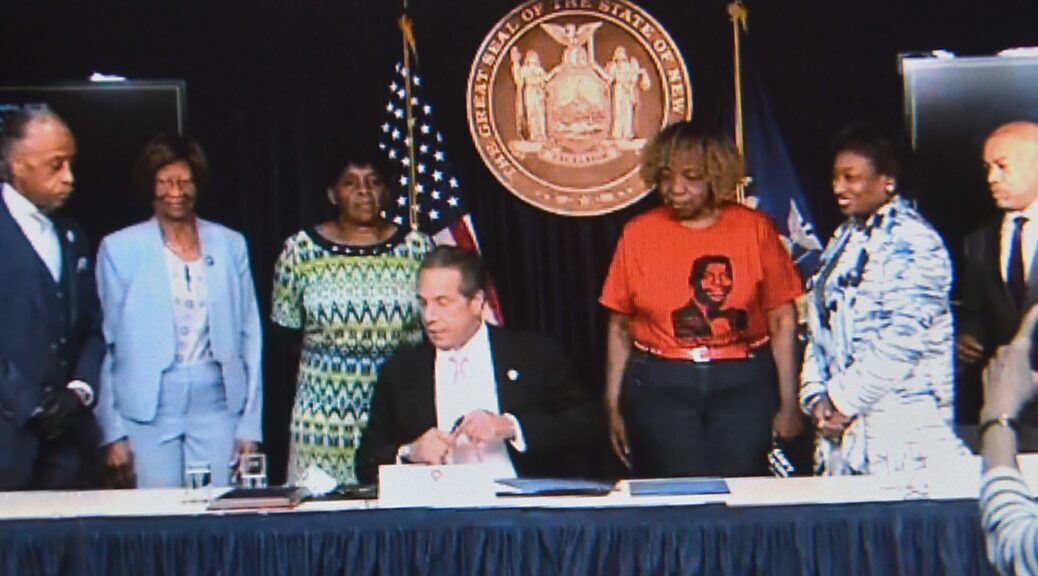
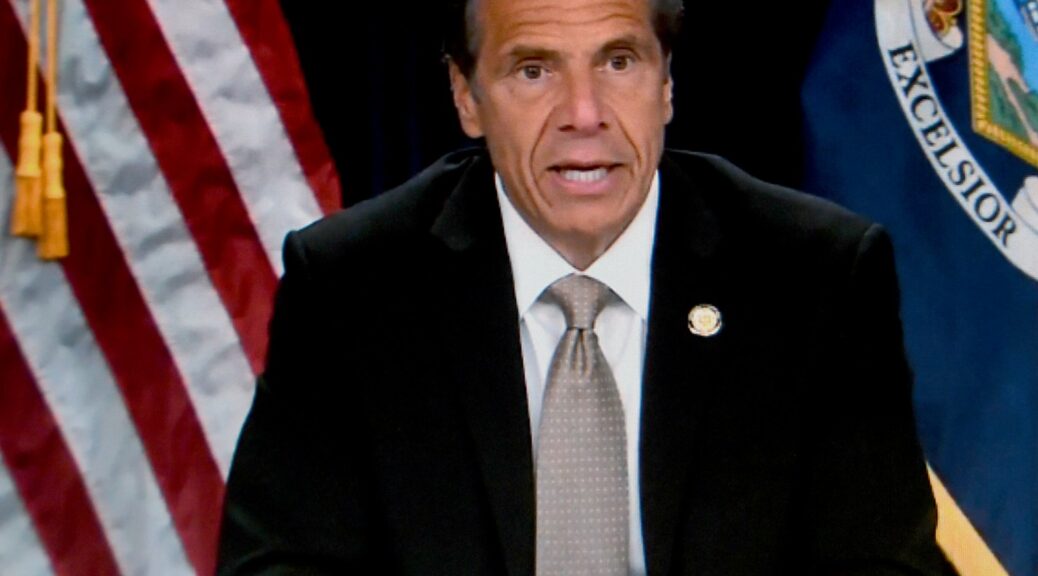
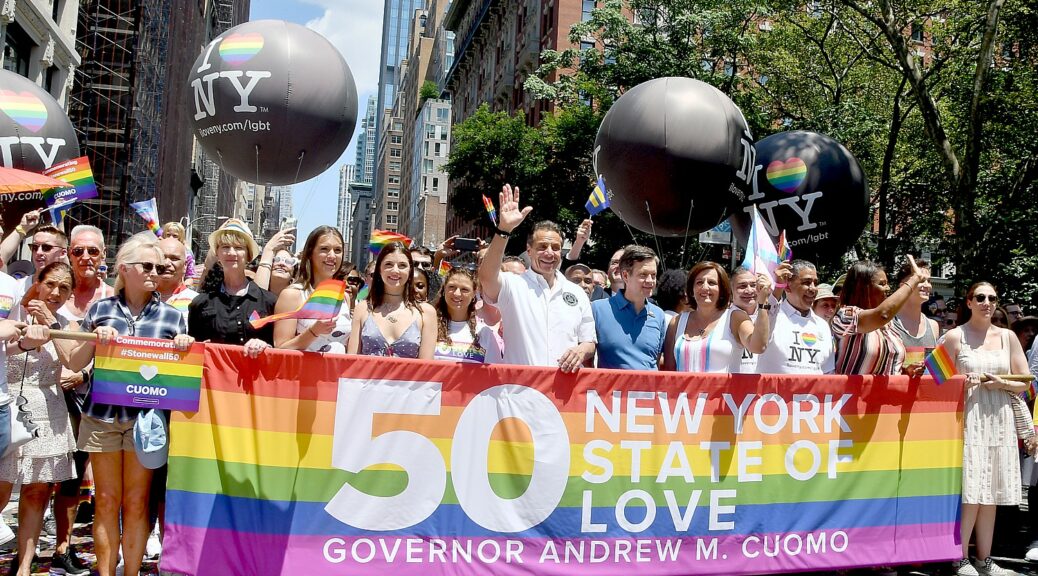
Governor Andrew M. Cuomo today signed an Executive Order — the ‘New York State Police Reform and Reinvention Collaborative’ — requiring local police agencies, including the NYPD, to develop a plan that reinvents and modernizes police strategies and programs in their community based on community input. Each police agency’s reform plan must address policies, procedures, practices and deployment, including, but not limited to use of force.
During the same event, attended by Gwen Carr, mother of Eric Garner; Valerie Bell, mother of Sean Bell; NAACP President Hazel Dukes; Reverend Al Sharpton , New York State Assembly Speaker Carl Heastie and Senate Leader Andrea Stewart-Cousins, Cuomo also signed the ‘Say Their Name’ Reform Agenda package following the killing of George Floyd and an ongoing pattern of police brutality against minority communities across the nation. These landmark policing reforms will help reduce inequality in policing and reimagine the state’s criminal justice system. The reforms include:
Allowing for transparency of prior disciplinary records of law enforcement officers by repealing 50-a of the civil rights law;
Banning chokeholds by law enforcement officers;
Prohibiting false race-based 911 reports; and
Designating the Attorney General as an independent prosecutor for matters relating to the civilian deaths.
“The murder of George Floyd was just the tipping point of the systemic injustice and discrimination that has been going on in our nation for decades, if not centuries,” Governor Cuomo said.”These are issues that the country has been talking about for a long time, and these nation-leading reforms will make long overdue changes to our policing and criminal justice systems while helping to restore community confidence in law enforcement.
Under Cuomo’s Police Reform and Reinvention Collaborative executive order, police forces throughout the state, in cities, towns and counties- some 500 of them – must adopt a plan by April 1, 2021 to be eligible for future state funding and certify that they have:
Engaged stakeholders in a public and open process on policing strategies and tools;
Presented a plan, by chief executive and head of the local police force, to the public for comment;
After consideration of any comments, presented such plan to the local legislative body (council or legislature as appropriate) which has approved such plan (by either local law or resolution); and
If such local government does not certify the plan, the police force may not be eligible to receive future state funding.
“The protests taking place throughout the nation and in communities across New York in response to the murder of George Floyd illustrate the loss of community confidence in our local police agencies — a reality that has been fueled by our country’s history of police-involved deaths of black and brown people,” Governor Cuomo said. “Our law enforcement officers are essential to ensuring public safety — they literally put themselves in harm’s way every day to protect us. This emergency regulation will help rebuild that confidence and restore trust between police and the communities they serve by requiring localities to develop a new plan for policing in the community based on fact-finding and meaningful community input.”
Immediately following the death of George Floyd, Governor Cuomo laid out a series of reform policy items – called the “Say Their Name” agenda – including allowing for transparency of prior disciplinary records of law enforcement officers by reforming 50-a of the civil rights law; banning chokeholds by law enforcement officers; prohibiting false race-based 911 reports and making them a crime; and designating the Attorney General as an independent prosecutor for matters relating to the deaths of unarmed civilians caused by law enforcement.
This builds on prior executive actions the Governor has taken including appointing the Attorney General as a special prosecutor in matters relating to the deaths of unarmed civilians caused by law enforcement.
“The horrific murder of George Floyd, the most recent in a long list of innocent people like Breonna Taylor, Ahmaud Arbery, Sean Reed, Tony McDade, and so many more, has led to a rightful outpouring of grief and anger,” Senate Majority Leader Andrea Stewart-Cousins said, who recalled when her own son, at 18 years old, was taken into custody and left with a broken nose. “Black New Yorkers, like all residents of this state, deserve to know that their rights, and lives, are valued and protected by our justice system. The legislation that will be signed today will help stop bad actors and send a clear message that brutality, racism, and unjustified killings will not be tolerated.”
Assembly Speaker Carl Heastie said,”The tragic deaths of George Floyd, Breonna Taylor, Eric Garner, Ramarley Graham and so many others shake us to the core. This week, my colleagues and I in the Assembly Majority answered the call of New Yorkers by passing historic reforms to our law enforcement system. These reforms have been championed by our members for years, and I want to thank my colleagues for their tireless commitment to seeing them through to the finish line. I would also like to thank the families of the victims and the passionate advocates who never tired in this fight for justice. They have courageously channeled their grief into a positive force for change and inspired us to deliver meaningful reforms here in New York.”
Cuomo stressed that actions need to be taken at the federal level to create national standards that root out systemic racism in criminal justice and law enforcement, but that New York State, as the “progressive capital” of the nation, would serve as a model for other states and ultimately the federal government.
“Criminal justice reform should be done on a national level,” he said. “And the House has been very aggressive on reform, the Congress, and I applaud them for it. But New York State is the progressive capital. We never sit back and say just what the nation should do, we show the nation what it should do. We lead by example and we lead by getting it done. We are a state of action and that’s us at our best…”
“There is no quick fix to this,” Cuomo said. “There is no, ’”Well, stop tear gas. Well, change the uniforms.’ That’s not what this is about, my friends. And it would be a mistake if we went down that path. This is systemic reform of police departments. This is sitting down and taking a look at exactly what they do and have been doing and looking at it through a new lens of reform and reinvention, because this has been 40, 50 years in the making. Providing police with military equipment, increasing the number of police, it goes back to the ’90s in the crime bills. Looking at the population explosion in our prisons, this was a long time in coming, and this is not about a press release that’s going to solve it. The way we really solve this is we say to every police agency in this state, I believe it should happen in the nation, sit down at the table with the local community, address these issues, get to the root of these issues, get a plan, pass that plan by your local government, and if you don’t, you’re not going to get any additional state funds, period. We’re not going to fund police agencies in this state that do not look at what has been happening, come to terms with it and reform themselves. We’re not going to be as a state government subsidizing improper police tactics, we’re not doing it. And this is how we’re going to do it.”
Senate Leader Stewart-Cousins spoke personally: “But every parent, every mother who looks like me understood that scary notion with our kids, with our husbands, with our brothers. I got that call when my son, my youngest son was only 18 years old and he was quote unquote on the wrong side of the town, he was stopped, he was frisked. The next thing I know after we’re out of the police station, we’re in the emergency room because he has a fractured nose. Thank god I was able to bring him home. I ache for Gwen, Valerie. I understood that.”
She noted that her brother, Bobby, a Marine vet, a Vietnam War vet, served as a transit police officer for six years, before he left “because he was convinced that the department, that the system was designed so that every young black man would have a record. He knew. He was a good cop, he worked with good cops, but he couldn’t change that. And you knew the system couldn’t change itself.
“And so here we are. We know this isn’t a cure, as the governor said. We know that this is the beginning, but it’s a move to bring justice to a system that has long been unjust. And, again, I thank you for being a partner for making sure that we take to heart this moment that has taken too long to come to. And I thank all of the people in the streets and the leadership of the families to make this happen. So, thank you, Governor.”
Assembly Speaker Heastie reflected, “There are still many other issues of systemic injustice and systemic racism that people of color have to deal with. It’s education and health disparities and these are all things that we have to continue as Government to be a part of. Government is supposed to be problem solvers. When society can’t fix things that’s what government is supposed to come in and chart that costs so this is just a very it’s an emotional day.”
Many reflected on the long list of victims over the past 40-50 years, and sporadic flare-ups of outrage but nothing concrete to change the system. What was different now?
Cuomo opined, “But I think it wasn’t just about Mr. Floyd’s death. I think it was the cumulative impact and I think all the names on that list did not die in vain. I think it took that repeated articulation to get the country to this point. Reverend Sharpton— on every one of those situations— was out there making this point all over the country. All over the country. And finally, finally, the country heard! But the reason we’re here today, make no mistake, is because Rev. Sharpton and good people across the country, were out there making the point every time over and over and over again.
“So, Eric Garner did not die in vain. Shawn Bell did not die in vain. It took— it took a number of lives, unfortunately. it took a number of injustices, unfortunately. But each one was a part in getting to today and it was Rev. Sharpton standing up and making sure the people of this nation heard every time, every injustice happened. And that— that Reverend— is a special ability, a special contribution, and it happened year after year after year and we all respect your effort. We thank you for what you’ve done. We thank you for your voice, which the nation has heard. This state has heard. And not only did we hear you— we’re going to make a difference and this state is going to make a difference and I believe it’s going to be a difference that will resonate across the nation. Because what we’re doing here, making every police agency come to the table with the community— that should be done in every police agency in this country. Together we’ll make it happen. Reverend Sharpton.”
Sharpton replied, ”let us be very clear. There is no governor in this country that has said what he said this morning. He and I are debating sometimes, but he has, in many ways, done things that even I did not expect. To say that every mayor must come up with a plan along these areas or they will withhold state money, is a model for where we ought to be dealing with 21st century civil rights in this country. Make no mistake: this is a new level that all other 49 governors ought to look at, because to say, “I want to see mayors deal with this” and “I want to see city councils deal with this,” is one thing. But to say, “we’re going to hold funds— means that he means it.”
He noted that 20 years ago, when Sharpton organized a March on Washington, Cuomo, then Secretary of Housing & Urban Development, was the only member of Clinton’s cabinet to attend.
“Andrew Cuomo has raised the bar, and I hope every governor in this country will be asked today whether or not they’re going to do what he just did. Somebody has to raise the bar. Then we can say to the Floyd family and others that you really have seen a new day, and we’ve turned a new way in this country. And I think that he has done that and Andrew Cuomo knows that when I don’t think he did whatever, I will tell him. He has gone beyond even my expectations. So enjoy these few minutes. But I think this is a great day.”
Here are more details of the legislation Cuomo signed:
Repealing 50-a (S.8496/A.10611)
Section 50-a of the New York State Civil Rights Law creates a special right of privacy for the personnel records of police officers, correction officers, and firefighters and paramedics employed by the State or political subdivisions. The current law prevents access to both records of the disciplinary proceedings themselves and the recommendations or outcomes of those proceedings, leading to records of complaints or findings of law enforcement misconduct that did not result in criminal charges against an officer almost entirely inaccessible to the public.
Repealing 50-a will allow for the disclosure of law enforcement disciplinary records, increasing transparency and helping the public regain trust that law enforcement officers and agencies may be held accountable for misconduct.
Banning Chokeholds (S.6670-B/A.6144)
In 1993, the New York City Police Department completely banned its officers from using chokeholds, but the ban has not prevented police officers from using this method to restrain individuals whom they are trying to arrest and the continued use of chokeholds has resulted in too many deaths. This new law creates criminal penalties when a police officer or peace officer uses a chokehold or similar restraint and causes serious physical injury or death.
Senator Brian Benjamin said, “Criminalizing the use of the chokehold by police or peace officers punishable up to 15 years in prison is an important step that will bringing sorely needed police accountability reform to New York State. It is time that we make it abundantly clear that no one is above the law. This is the first law that I am aware of that establishes an enhanced offense specifically on police officers and that is primarily because those who we hire to protect and serve must be held to a higher standard. I would like to thank the Senate and Assembly for passing the ‘Eric Garner Anti-Chokehold Act,’ and Governor Cuomo for signing this legislation that will help to save the lives of unarmed black men and women who encounter the police and hopefully begin the process of establishing trust and reducing tensions with law enforcement and communities of color.”
Assembly Member Walter T. Mosley said, “George Floyd and Eric Garner yelled out the same words as they were brutally killed by police officers. We need real change to protect black Americans, and part of that is ensuring there are consequences for misconduct on the part of police officers. This legislation is one of many steps in that direction. I thank Governor Cuomo for signing this bill into law and hope to continue working with his administration to make our state a fairer and more equal place to call home.”
Prohibiting Race-Based 911 Calls (S.8492/A.1531)
Recent years have shown a number of frivolous and false calls to 911 based on the callers’ personal discomfort with other people and not for any particular threat. This new law makes it a civil rights violation to call 911 to report a non-emergency incident involving a member of a protected class without reason to suspect a crime or an imminent threat.
Senator Kevin Parker said, “Social media is rampant with videos of people weaponizing the 911 emergency system against African-Americans hoping to see them falsely arrested or worse. This legislation is by no means a solution to the systemic injustices and prejudices that fuel these types of calls to the police. However, this law gives victims of this despicable behavior the beginnings of some recourse. I am glad that it was passed, together with other important police reform bills, and I thank Governor Cuomo for signing it into law.”
Appointing Attorney General as Independent Prosecutor for Police Involved Deaths (S.2574-C/A.1601)
This new law establishes an Office of Special Investigation within the Office of the Attorney General to investigate and, where appropriate, prosecute cases where the death of a person follows an encounter with a law enforcement officer. The law also requires the new Office of Special Investigation to produce a report explaining the reasons for its decision regardless of whether it chooses to pursue charges. This will help improve public confidence in the criminal justice system by removing a potential conflict of interest in these types of investigations. This law builds on the Governor’s Executive Order No. 147 from 2015 which established the Attorney General as an independent prosecutor in instances of police-involved deaths.
Assembly Member Nick Perry said, “Over twenty years since police unloaded 41 shots killing Amadou Diallo, nearly six years after the merciless choking of Eric Garner, it took the videos of the heartrending death of George Floyd to finally help us break through the blue wall of silence and resistance to the public cry for criminal justice reform and changes in the prosecution of cases involving death at the hands of the police, who are supposed to protect us. We know that this new law will not end our quest for an assurance for fairness in the process for prosecuting crimes by bad police officers, but it is a big step in the right direction. Millions of New Yorkers and I are delighted that the Governor has signed this bill into law.”
The murder of George Floyd at the hands of Minneapolis police officer has galvanized the nation and the world. His murder was only one of a long, long list of murders and lynchings over decades. But this was a perfect storm that made its heinousness obvious to all: this was not the instant firing of a gun in a moment of fear, but a tortuously long, drawn out 8 minutes, 46 seconds, during which three other police stood around, onlookers pleaded for mercy, and the whole thing captured on video shared over social media. So while there were other unprovoked killings – Breonna Taylor, shot in her own apartment in the dead of night after police invaded with a no-knock warrant – this one was undeniable in demonstrating the ingrained culture that dehumanizes in order for such violence to occur, and the smug security of police, given unparalleled power of a gun and a badge, that they would not be held accountable.
Enough is enough, protesters by the tens of thousands in hundreds of cities throughout the country and the world, chant, even putting their own lives at risk, not just from the baton-wielding, tear-gas throwing, flashbang grenade hurling, rubber-bullet firing police dressed as an invading army, but from the ongoing coronavirus pandemic.
The protests have come to suburbia and our home town as well – most affectingly, one this weekend organized by Great Neck high school students which drew well over 500 people to Firefighters Park in Great Neck Plaza. (They withstood accusations on Facebook they were terrorists who had collected stones to throw at police. Meanwhile, county police closed off the main street to traffic so they could march a mile to the Village Green, and walked along side.)
They decried the structural racism at the heart of a police culture that has its origins in catching slaves, then, morphed into an enforcement mechanism for White Supremacy, along with so many other structural inequities that, by design, have kept African Americans, Hispanics and other minorities unequal in society.
While the elements of police brutality and criminal injustice are well known, they are kept in force year after year, decade after decade, generation after generation by supremely politically powerful police unions.
Indeed, the most dramatic “reform” is to completely rebuild police departments – there are 16,000 of them. Some police departments have actually done this – Camden, NJ, for example – and it may be the only way to really root out the structural inequities, bias. Now Minneapolis’ city council has voted to disband its $193 million police department. What that actually means is that, like Camden, it intends to rebuild it, in order to make it functional and appropriate in a country that supposedly is based on principles of “equal justice for all.”
They will likely scrutinize how police officers are recruited, hired, know if there is a record of police brutality (like Timothy Loehmann who murdered 12-year old Tamir Rice). How are officers trained and what they understand their “mission” to be? One trendy training program (as John Oliver disclosed on “Last Week Tonight”) is in the “art” of “Killology” where officers are instructed that if they are not predators prepared to kill, they have no business being police.
Not only are the problems well known, but the solutions have been methodically investigated, analyzed, quantified and put in the form of recommendations – by the Obama Administration after the Ferguson, Missouri, riots that followed Michael Brown’s unprovoked murder by police. The task force developed a template for 21st Century Policing, including ending militarizing police. His Department of Justice under Eric Holder obtained consent decrees from the most vile police forces. But, like the template to address a global pandemic handed to the Trump Administration, it was immediately discarded, and the consent decrees withdrawn.
But George Floyd has created the rarest opportunity for reform. With breathtaking speed for New York or any state government, major measures for a “Say Their Name” police reform agenda have already passed the Legislature: Allow for transparency of prior disciplinary records by reforming 50-a; ban chokeholds; prosecute for making a false race-based 911 report; and designating the Attorney General as an independent prosecutor in cases involving death of unarmed civilian by law enforcement.
Cuomo wants to go further to “seize the momentum,” correctly seeing this time as transformational to “reinvent” policing..
“This is a long time coming,” Cuomo said. “It is time to reimagine and reinvent policing for 2020…Police are public servants for that community – if the community doesn’t trust, doesn’t respect police, police can’t do their job.”
Democrats in Congress have also seized on this transformational moment as well, introducing “Justice in Policing Act” which at the federal level would ban chokeholds; challenge “qualified immunity”; prohibit no-knock warrants; counter the trend toward militarization of police; require body and dashboard cameras; require independent prosecutors in cases of police brutality; establish a national database to track police misconduct; and (finally) make lynching a federal hate crime.
Others want more. There are calls to “defund police” – which like “They’re coming for your guns” and “Open Borders!” is a catchy slogan that fits on a sign that has been deliberately distorted by Trump and the Republicans and used to incite fear among (white suburban) voters who are being told their neighborhoods will be overrun by criminals, gangs and rapists.
What “defund police” means is reassessing what functions the police do. Do we want protectors or warriors? Are police the best ones to address situations involving mental health, drug overdoses, domestic violence or school discipline? More accurately, people are calling for “divest-reinvest”: take that money and invest in social workers, mental health professionals, and guidance counselors that police, themselves, have said they are not equipped to deal with.
And it means investing in community programs that in themselves reduce crime. That’s what Cuomo is proposing in a Justice Agenda to root out the causes of criminal injustice, all on view in conjunction with the coronavirus epidemic and its disproportionate impact on communities of color: it goes to addressing the disparities in education, housing, health care, poverty.
“This is not just a moment for political protest,” Governor Cuomo said. “It’s not just a moment to express outrage. It’s a moment to do something about it, and to make real reform and real change. That’s the goal of the moment. I understand the emotion. I want people to know how upset I am. Good. Second step, what do we do about it? And let’s get it done here in the State of New York.
“When we talk about a Justice Agenda, we want to fight the systemic racism, inequality and injustice in our society. That is what the protesters are saying and I stand with the protesters in saying that because it’s very true. But in this moment of change, let’s make it real change and let’s get to the root of the issue. You want to talk about injustice and inequality in America. Well then it has to start with our education system. We do not educate all children the same. ‘Opportunity for all.’ No, opportunity for some, opportunity for people who grow up in a rich school district and a rich family with high property taxes and they go to great schools, but not for the children who grow up in poorer communities, who go to inferior schools. That is the reality today. That is the truth. I’m saying that as Governor of New York not as a protester on a street corner. It is a fact. Even in this state, we spent $36,000 per year, per student, in a wealthy school district, $13,000 per year in a poorer school district. How do you rationalize that? You can’t and say this is a system that provides equal opportunity for all.
“How do you still have children living in poverty? With all this wealth, with all this abundance, how do you tolerate a situation where some children to no fault of their own, you can’t blame them, they were born into one circumstance and they are living in poverty? You can’t justify it. The number of homeless, lack of affordable housing, you have a federal government that just went out of the housing business. I was the former housing secretary, worked in housing all my life. Housing was a federal responsibility, not state, not local. 1949 Housing Act, “for this nation, safe, clean, decent housing for all Americans.” 1949, it’s 2020, what are we doing? There’s no section eight, no section eight project base, no more public housing, and then we wonder why there is an affordable housing shortage.
“And yes, criminal justice reform, why do we lock up more people than any industrialized nation on the globe? That is a sign of success? …Why do we have racial disparity in the criminal justice system? How do you rationalize it? Unless it goes back to the other systemic injustices and inequality, if a person grows up in poverty, if a person doesn’t have education, if a person doesn’t have access to opportunity, then you see the result in the criminal justice system. This is how you get at injustice and inequality, and you can’t do it piecemeal, either attack it fully or you will never defeat it. That is the justice agenda. And this has to be done on the federal level and it should be done on the federal level because this is not a New York or California or Florida issue. It is an American issue. And you are in the middle of election season, stand up and say, ‘Here is my election reform agenda. You want my support and my vote? Here is my agenda. You are running for Congress, you’re running for Senate, or whatever you’re running for, you want my support? Here is my agenda.’ That is my opinion,” Cuomo said.
But none of this will happen as long as Trump and the Republicans are in power.
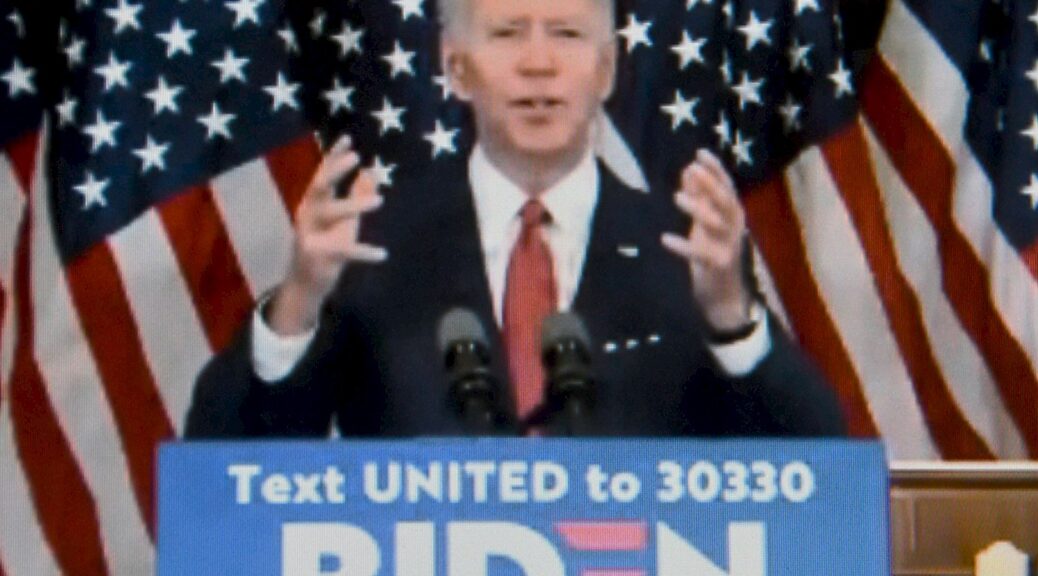
VP Joe Biden declares, “The moment has come for our nation to deal with systemic racism. To deal with the growing economic inequality in our nation. And to deal with the denial of the promise of this nation — to so many.” (c) Karen Rubin/news-photos-features.com
Amid national protests over police brutality and the murder of George Floyd in Minneapolis, and Donald Trump calling out the military against peaceful protesters outside the White House, VP Joe Biden, the presumptive Democratic candidate for president, declares, “The moment has come for our nation to deal with systemic racism. To deal with the growing economic inequality in our nation. And to deal with the denial of the promise of this nation — to so many.“
“We are a nation in pain,” Biden declared. “but we must not allow this pain to destroy us. We are a nation enraged, but we cannot allow our rage to consume us. We are a nation exhausted, but we will not allow our exhaustion to defeat us.
“As President, it is my commitment to all of you to lead on these issues — to listen. Because I truly believe in my heart of hearts, that we can overcome. And when we stand together, finally, as One America, we will rise stronger than before.”
Here is a transcript of Vice President Joe Biden’s speech delivered from the Mayor’s Reception Room in Philadelphia City Hall in front of an audience that included Mayor Jim Kenney, Congressman Brendan Boyle, and state and local elected officials.:
“I can’t breathe.” “I can’t breathe.”
George Floyd’s last words. But they didn’t die with him. They’re still being heard. They’re echoing across this nation.
They speak to a nation where too often just the color of your skin puts your life at risk.
They speak to a nation where more than 100,000 people have lost their lives to a virus – and 40 million Americans have filed for unemployment – with a disproportionate number of these deaths and job losses concentrated in black and brown communities.
And they speak to a nation where every day millions of people – not at the moment of losing their life – but in the course of living their life – are saying to themselves, “I can’t breathe.”
It’s a wake-up call for our nation. For all of us.
And I mean all of us. It’s not the first time we’ve heard these words – they’re the same words we heard from Eric Garner when his life was taken six years ago.
But it’s time to listen to these words. Understand them. And respond to them – with real action.
The country is crying out for leadership. Leadership that can unite us. Leadership that can bring us together. Leadership that can recognize the pain and deep grief of communities that have had a knee on their neck for too long.
But there is no place for violence.
No place for looting or destroying property or burning churches, or destroying businesses — many of them built by people of color who for the first time were beginning to realize their dreams and build wealth for their families.
Nor is it acceptable for our police — sworn to protect and serve all people — to escalate tensions or resort to excessive violence.
We need to distinguish between legitimate peaceful protest — and opportunistic violent destruction.
And we must be vigilant about the violence that’s being done by the incumbent president to our democracy and to the pursuit of justice.
When peaceful protestors are dispersed by the order of the President from the doorstep of the people’s house, the White House — using tear gas and flash grenades — in order to stage a photo op at a noble church, we can be forgiven for believing that the president is more interested in power than in principle.
More interested in serving the passions of his base than the needs of the people in his care.
For that’s what the presidency is: a duty of care — to all of us, not just our voters, not just our donors, but all of us.
The President held up a bible at St. John’s church yesterday.
If he opened it instead of brandishing it, he could have learned something: That we are all called to love one another as we love ourselves.
That’s hard work. But it’s the work of America.
Donald Trump isn’t interested in doing that work.
Instead he’s preening and sweeping away all the guardrails that have long protected our democracy.
Guardrails that have helped make possible this nation’s path to a more perfect union.
A union that constantly requires reform and rededication – and yes the protests from voices of those mistreated, ignored, left out and left behind.
But it’s a union worth fighting for and that’s why I’m running for President.
In addition to the Bible, he might also want to open the U.S. Constitution.
If he did, he’d find the First Amendment. It protects “the right of the people peaceably to assemble, and to petition the government for a redress of grievances.”
Mr. President: That is America.
Not horses rising up on their hind legs to push back a peaceful protest. Not using the American military to move against the American people. This nation is a nation of values. Our freedom to speak is the cherished knowledge that lives inside every American.
We will not allow any President to quiet our voice.
We won’t let those who see this as an opportunity to sow chaos throw up a smokescreen to distract us from the very real and legitimate grievances at the heart of these protests.
And we can’t leave this moment thinking we can once again turn away and do nothing. We can’t.
The moment has come for our nation to deal with systemic racism. To deal with the growing economic inequality in our nation. And to deal with the denial of the promise of this nation — to so many.
I’ve said from the outset of this election that we are in a battle for the soul of this nation. Who we are. What we believe. And maybe most important — who we want to be.
It’s all at stake. That is truer today than ever. And it’s in this urgency we can find the path forward.
The history of this nation teaches us that it’s in some of our darkest moments of despair that we’ve made some of our greatest progress.
The 13th and 14th and 15th Amendments followed the Civil War. The greatest economy in the history of the world grew out of the Great Depression. The Civil Rights Act of 1964 and Voting Rights Act of 1965 came in the tracks of Bull Connor’s vicious dogs.
To paraphrase Reverend Barber — it’s in the mourning we find hope.
It will take more than talk. We’ve had talk before. We’ve had protests before.
Let us vow to make this, at last, an era of action to reverse systemic racism with long overdue and concrete changes.
That action will not be completed in the first 100 days of my Presidency — or even an entire term.
It is the work of a generation.
But if this agenda will take time to complete, it should not wait for the first 100 days of my Presidency to get started.
A down payment on what is long overdue should come now. Immediately.
I call on Congress to act this month on measures that would be a first step in this direction. Starting with real police reform.
Congressman Jeffries has a bill to outlaw choke holds. Congress should put it on President Trump’s desk in the next few days.
There are other measures: to stop transferring weapons of war to police forces, to improve oversight and accountability, to create a model use of force standard — that also should be made law this month.
No more excuses. No more delays.
If the Senate has time to confirm Trump’s unqualified judicial nominees who will run roughshod over our Constitution, it has time to pass legislation that will give true meaning to our Constitution’s promise of “equal protection of the laws.”
Looking ahead, in the first 100 days of my presidency, I have committed to creating a national police oversight commission.
I’ve long believed we need real community policing.
And we need each and every police department in the country to undertake a comprehensive review of their hiring, their training, and their de-escalation practices.
And the federal government should give them the tools and resources they need to implement reforms.
Most cops meet the highest standards of their profession. All the more reason that bad cops should be dealt with severely and swiftly. We all need to take a hard look at the culture that allows for these senseless tragedies to keep happening.
And we need to learn from the cities and precincts that are getting it right.
We know, though, that to have true justice in America, we need economic justice, too.
Here, too, there is much to be done.
As an immediate step, Congress should act to rectify racial inequities in the allocation of COVID-19 recovery funds.
I will be setting forth more of my agenda on economic justice and opportunity in the weeks and months ahead.
But it begins with health care. It should be a right not a privilege. The quickest route to universal coverage in this country is to expand Obamacare.
We could do it. We should do it.
But this president — even now — in the midst of a public health crisis with massive unemployment wants to destroy it.
He doesn’t care how many millions of Americans will be hurt— because he is consumed with his blinding ego when it comes to President Obama.
The President should withdraw his lawsuit to strike down Obamacare, and the Congress should prepare to act on my proposal to expand Obamacare to millions more.
These last few months we have seen America’s true heroes. The health care workers, the nurses, delivery truck drivers, grocery store workers.
We have a new phrase for them: Essential workers.
But we need to do more than praise them. We need to pay them.
Because if it wasn’t clear before, it’s clear now. This country wasn’t built by Wall Street bankers and CEOs. It was built by America’s great middle class — by our essential workers.
I know there is enormous fear and uncertainty and anger in the country. I understand.
And I know so many Americans are suffering. Suffering the loss of a loved one. Suffering economic hardships. Suffering under the weight of generation after generation after generation of hurt inflicted on people of color — and on black and Native communities in particular.
I know what it means to grieve. My losses are not the same as the losses felt by so many. But I know what it is to feel like you cannot go on.
I know what it means to have a black hole of grief sucking at your chest.
Just a few days ago marked the fifth anniversary of my son Beau’s passing from cancer. There are still moments when the pain is so great it feels no different from the day he died. But I also know that the best way to bear loss and pain is to turn all that anger and anguish to purpose.
And, Americans know what our purpose is as a nation. It has guided us from the very beginning.
It’s been reported. That on the day John F. Kennedy was assassinated, little Yolanda King came home from school in Atlanta and jumped in her father’s arms.
“Oh, Daddy,” she said, “now we will never get our freedom.”
Her daddy was reassuring, strong, and brave.
“Now don’t you worry, baby,” said Martin Luther King, Jr. “It’s going to be all right.”
Amid violence and fear, Dr. King persevered.
He was driven by his dream of a nation where “justice runs down like water and righteousness like a mighty stream.”
Then, in 1968 hate would cut him down in Memphis.
A few days before Dr. King was murdered, he gave a final Sunday sermon in Washington.
He told us that though the arc of a moral universe is long, it bends toward justice.
And we know we can bend it — because we have. We have to believe that still. That is our purpose. It’s been our purpose from the beginning.
To become the nation where all men and women are not only created equal — but treated equally.
To become the nation defined — in Dr. King’s words — not only by the absence of tension, but by the presence of justice.
Today in America it’s hard to keep faith that justice is at hand. I know that. You know that.
The pain is raw. The pain is real.
A president of the United States must be part of the solution, not the problem. But our president today is part of the problem.
When he tweeted the words “When the looting starts, the shooting starts” – those weren’t the words of a president. They were the words of a racist Miami police chief from the 1960s.
When he tweeted that protesters “would have been greeted with the most vicious dogs … that’s when people would have been really badly hurt.” Those weren’t the words of a president — those were the kind of words a Bull Connor would have used unleashing his dogs.
The American story is about action and reaction. That’s the way history works. We can’t be naïve about that.
I wish I could say this hate began with Donald Trump and will end with him. It didn’t and it won’t. American history isn’t a fairytale with a guaranteed happy ending.
The battle for the soul of this nation has been a constant push-and-pull for more than 240 years.
A tug of war between the American ideal that we are all created equal and the harsh reality that racism has long torn us apart. The honest truth is both elements are part of the American character.
At our best, the American ideal wins out.
It’s never a rout. It’s always a fight. And the battle is never finally won.
But we can’t ignore the truth that we are at our best when we open our hearts, not when we clench our fists. Donald Trump has turned our country into a battlefield riven by old resentments and fresh fears.
He thinks division helps him.
His narcissism has become more important than the nation’s well-being he leads.
I ask every American to look at where we are now, and think anew: Is this who we are? Is this who we want to be? Is this what we pass on to our kids’ and grandkids’ lives? Fear and finger-pointing rather than hope and the pursuit of happiness? Incompetence and anxiety? Self-absorption and selfishness?
Or do we want to be the America we know we can be. The America we know in our hearts we could be and should be.
Look, the presidency is a big job. Nobody will get everything right. And I won’t either.
But I promise you this. I won’t traffic in fear and division. I won’t fan the flames of hate.
I will seek to heal the racial wounds that have long plagued this country – not use them for political gain.
I’ll do my job and take responsibility. I won’t blame others. I’ll never forget that the job isn’t about me.
It’s about you.
And I’ll work to not only rebuild this nation. But to build it better than it was.
To build a better future. That’s what America does.
We build the future. It may in fact be the most American thing to do.
We hunger for liberty the way Harriet Tubman and Frederick Douglass did.
We thirst for the vote the way Susan B. Anthony and Ella Baker and John Lewis did. We strive to explore the stars, to cure disease, to make this imperfect Union as perfect as we can.
We may come up short — but at our best we try.
We are facing formidable enemies.
They include not only the coronavirus and its terrible impact on our lives and livelihoods, but also the selfishness and fear that have loomed over our national life for the last three years.
Defeating those enemies requires us to do our duty — and that duty includes remembering who we should be.
We should be the America of FDR and Eisenhower, of Rosa Parks and Martin Luther King Jr., of Jonas Salk and Neil Armstrong.
We should be the America that cherishes life and liberty and courage.
Above all, we should be the America that cherishes each other – each and every one.
We are a nation in pain, but we must not allow this pain to destroy us. We are a nation enraged, but we cannot allow our rage to consume us. We are a nation exhausted, but we will not allow our exhaustion to defeat us.
As President, it is my commitment to all of you to lead on these issues — to listen. Because I truly believe in my heart of hearts, that we can overcome. And when we stand together, finally, as One America, we will rise stronger than before.
So reach out to one another. Speak out for one another. And please, please take care of each other.
This is the United States of America. And there is nothing we can’t do. If we do it together.
Governor Andrew M. Cuomo proposed a positive reform agenda to address systemic racism and police brutality amidst the ongoing protests across the state and nation in response to the killing of George Floyd. The reform agenda includes a national ban on excessive force and chokeholds by law enforcement officers; independent investigations of police brutality conducted by independent, outside agencies – not by local prosecutors; and disclosure of disciplinary records of police officers being investigated.
While standing firmly in support of the protests against police brutality, the Governor said that protest for its own sake would only work against the cause, but that there needs to be a clearly defined list of actions that need to be articulated.
“You want to make that moment work,” he declared. “Yes, you express the outrage. But then you say, ‘Here’s my agenda. Here’s what I want.’ That’s what we have to be doing in this moment. And the protesters are making a point. And most of them are making a smart, sensible point. But you have to add the positive reform agenda that every voice calls for so the government, the politicians know what to do. And there is a positive reform agenda here. There should be a national ban on excessive force by police officers. There should be a national ban on chokeholds. Period. There should be independent investigations of police abuse.”
And Cuomo also differentiated between the those who are exercising their Constitutional First Amendment right to protest against those who are taking advantage to loot and vandalize, giving Trump the opportunity to deflect and discount, and shift focus to himself as the “law-and-order” strongman. Indeed, there are reports that White Nationalist group is posing as Antifa on Twitter, calling for violence. Trump is proposing to designate Antifa a terrorist group, and is using them to justify calling out military against protesters – which would be a violation of the Posse Comitatus Act.
“There’s no doubt that what the President’s trying to do here is turn the attention to the looters rather than the point of the protest, which is genuine outrage,” Cuomo said in an interview with Nicolle Wallace on MSNBC. “”You look at what happened with Mr. Floyd, you have to be outraged. It’s not just Mr. Floyd in an isolated situation, it’s been years and years of the same situation. You can go back to Rodney King, Amadou Diallo and Eric Garner – it’s a long list.
“They want to make this about looting and criminals rather than the killing. That’s what they’re trying to do. In New York, we did have large protests and we do have people who are, I think, exploiting the protest. There’s no doubt that there’s some people who came out and did looting and criminal activity. You have some disrupting organizations that are seizing upon the moment. We want to make sure that order is maintained and we’re putting in place a curfew.”
“Use this moment. You look in history, Nicolle, when did change come? Change came when the people insisted on change. Let’s talk about investigation of police abuse. No chokeholds, nation-wide standard for undue force. Let’s talk about funding of education and equal funding in education. Let’s talk about affordable housing. Let’s talk about a child poverty agenda. Let’s use the moment constructively.”
Cuomo ordered a curfew of 11 pm in New York City, and doubled the number of police, from 4,000 to 8,000. However, that was not enough to stop a spate of acts of looting and vandalism.
The protests come just as New York City was hitting the milestones in the fight against COVID-19, which has taken more lives – and more disproportionately in communities of color – in the city and state than anywhere in the country or world. The Governor said that if there was any “silver” lining in the timing, the protests are happening when the infection rate has been cut from 20 percent to 2 percent but still raised concerns of reigniting the spread of the pandemic.
Here is a transcript of Governor Cuomo’s remarks:
We’re talking about reopening in one week in New York City. Now we’re seeing these mass gatherings over the past several nights that could, in fact, exacerbate the COVID-19 spread. We spent all this time closed down, locked down, masked, socially distanced and then you turn on the TV and you see there’s mass gatherings that could potentially be infecting hundreds and hundreds of people. After everything that we have done. We have to talk a minute and ask ourselves what are we doing here? What are we trying to accomplish?
We have protests across the state that continued last night, they continued across the nation. Upstate we worked with the cities very closely. The State Police did a great job. We had, basically, a few scattered arrests, upstate New York. But the local governments did a great job, the people did a great job, law enforcement did a great job. The protestors were responsible. It wasn’t great, but it wasn’t bad, either, upstate.
I said from day one, I share the outrage and I stand with the protestors. You look at that video of the killing of an unarmed man, Mr. Floyd, it is horrendous. Horrendous. It’s frightening. It perverts everything you believe about this country. It does and there’s no excuse for it. No right minded American would make an excuse for it. So, protest yes. Be frustrated, yes. Outraged, yes of course. Is there a larger problem? Of course. It’s not just Mr. Floyd, it goes back – there are 50 cases that are just like Mr. Floyd. We’ve them here in New York City. What’s the difference between Mr. Floyd and Amadou Diallo? Or Abner Louima? Or Eric Garner? What is the difference? What have we learned? Nothing?
So, yes, we should be outraged. And yes, there’s a bigger point to make. It is abuse by police. But it’s something worse. It is racism. It is discrimination. It is fundamental inequality and injustice. My father spoke about it in 1984. The speech called “The Tale of Two Cities.” People still talk about it. The point of the tale of two cities is there’s two Americas. Two sets of rules. Two sets of outcomes. Two sets of expectations. It’s true. It was true then, it’s true now. Look at our prisons and tell me there’s not inherit injustice in society. Look at public housing, tell me there’s not inherent injustice.
Look at what happened with this COVID infection rate nationwide. More African Americans infected, more African Americans dead proportionally than white Americans. Of course, there’s chronic institutionalized discrimination. There is no doubt. There is no doubt. And there’s no doubt that it’s been going on for a long time and people are frustrated, and it has to be corrected and it has to be corrected now. And there’s no doubt, that this nation as great as it is has had the continuing sin of discrimination. From before the nation was formed and it started with slavery. And it has had different faces over the decades, but it’s still the same sin. That is true. That is true. So let’s use this moment as a moment of change? Yes.
When does change come? When the stars align and society focuses and the people focus, and they focus to such an extent that the politicians follow the people. That’s when change comes. “Well, the leaders lead!” Baloney. The people lead. And then the politicians see the people moving, and the politicians run to catch up with the people. How did we pass marriage equality in this State, giving a new civil right to the LGBTQ community? Because the people said, “enough is enough. How can you say only heterosexual people can marry, but the LGBTQ people— they can’t marry? How is that constitutional? How is that legal?” You have your own preference— God bless you. But how in the law, do you discriminate between two classes of people. We passed marriage equality.
After the Sandy Hook massacre, after all those years we tried to pass common sense gun safety. Do you really need an assault weapon to kill a deer? But then the Sandy Hook massacre happened, and the people said, “enough. You’re killing children? Young children in schools with an assault weapon? In the Sandy Hook massacre. Enough.”
And in that moment, we passed common sense gun safety in the State of New York. Record income inequality? People said, “enough” and passed a real minimum wage in this State that went all across the nation. There’s a moment for change, and is there a moment here? Yes. If we’re constructive and if we’re smart, and if we know what were asking for! It’s not enough to come out and say, “I’m angry, I’m frustrated.” OK. And what? “Well, I don’t know, but I’m angry and frustrated.”
And you want what done? You need the answer. “Well, I want common sense gun reform.” OK, what does it look like? Here it is— three points. “Well I want to address income inequality.” Well, what do you want? “Here’s what I want. Minimum wage at $15. Free college tuition.” What do you want?
You want to make that moment work. Yes, you express the outrage! But then you say, “here’s my agenda. Here’s what I want.” That’s what we have to be doing in this moment. And the protestors are making a point. And most of them are making a smart, sensible point. But you have to add the positive reform agenda that every voice calls for so the government, the politicians know what to do. And there is a positive reform agenda here. There should be a national ban on excessive force by police officers. There should be a national ban on chokeholds. Period. There should be independent investigations of police abuse. When you have the local District Attorney doing the investigations— I don’t care how good they are— there is the suggestion of a conflict of interest. Why? Because that DA works with that police department every day and now that prosecutor is going to do the investigation of that police department that they work with every day? Conflict of interests can be real or perceived. How can people believe that the local prosecutor who works with that police department is going to be fair in the investigation? It shouldn’t be state by state. Minnesota Governor Walz put the attorney general in charge. Good. In this state, I put attorney general in charge of investigations where police kill an unarmed person. Good. But it shouldn’t be the exception. It should be the rule. There is no self-policing. There’s an allegation, independent investigation. Give people comfort that the investigation is real.
If a police officer is being investigated, how is there disciplinary records not relevant? Once a police officer is being investigated, if they have disciplinary records that show this was a repeat pattern, how is that not relevant? By the way, the disciplinary records can also be used to exonerate. If they have disciplinary records that say he never, she never did anything like this before, fine. That’s relevant too.
We still have two education systems in this country. Everybody knows it. Your education is decided by your zip code. Poorer schools in poorer communities have a different level of funding than richer schools in this state. $36,000 per year we spend in a rich district. $13,000 in a poor district. How do you justify that? If anything, the children in a poorer community need more services in a school, not less. How do you justify that? You can’t. Do something about it. You still have children living in poverty in this nation? Well, when we had to, we found a trillion dollars to handle the COVID virus, but you can’t find funding to help children who live in poverty? No, you can find it, United States. You just don’t want to. It’s political will. When you need to find the money, you can find it. Let’s be honest, the federal government has a printing press in their basement. When they have the political will, they find the money.
The federal government went out of the housing business and never re-entered it. We have a national affordable housing crisis. Of course you do. You don’t fund affordable housing. I’m the former HUD secretary. I know better than anyone what the federal government used to do in terms of affordable housing with Section 8 and building new public housing. And we just stopped, and we left it to the market. Now you have an affordable housing plan. That’s what we should be addressing in this moment. And we should be saying to our federal officials, “There’s an election this year, a few months away. Here’s my agenda. Where do you stand?” Say to the congress, the House and Senate, “Where’s your bill on this?”
I heard some congressional people talking saying well maybe they’ll do a resolution. Yeah, resolutions are nice. Resolutions say in theory I support this. Pass a law, that’s what we want. A law that actually changes the reality, where something actually happens. That’s government’s job is to actually make change. Make change. You’re in a position to make change. Make change. Use this moment to galvanize public support. Use that outrage to actually make the change. And have the intelligence to say what changes you actually want. Otherwise, it’s just screaming into the wind if you don’t know exactly what changes we need to make.
And we have to be smart in this moment. The violence in these protests obscures the righteousness of the message. The people who are exploiting the situation, the looting, that’s not protesting. That’s not righteous indignation. That’s criminality and it plays into the hands of the people and the forces that don’t want to make the changes in the first place because then they get to dismiss the entire effort. I will tell you what they’re going to say. They’re going to say the first thing the President said when this happened. They’re going to say “These are looters.” Remember when the President put out that incendiary tweet? “We start shooting when they start looting or they start looting, we start shooting?” That’s an old ’60s call. The violence, the looting, the criminality plays right into those people who don’t want progressive change. And you mark my words, they’re going to say today, “Oh you see, they’re criminals. They’re looters. Did you see what they did breaking the store windows and going in and stealing?” And they’re going to try to paint this whole protest movement that they’re all criminals, they’re all looters. That’s what they’re going to do. Why? They don’t want to talk about Mr. Floyd’s death. They don’t want people seeing that video. They want people seeing the video of the looting. And when people see the video of the looting they say “Oh yeah, that’s scary. They’re criminals.” No, look at the video of the police officer killing Mr. Floyd. That’s the video we want people watching.
Now, I don’t even believe it’s the protesters. I believe there are people who are using this moment and using the protest for their own purpose. There are people who want to sow the seeds of anarchy, who want to disrupt. By the way, there are people who want to steal. And here’s a moment that you can use this moment to steal. You can use this moment to spread chaos. I hear the same thing from all the local officials. They have people in their communities who are there to quote unquote protest. They’re not from their community. They don’t know where they’re from, extremist groups, some people are going to blame the left, some people will blame the right. It will become politicized. But there is no doubt there are outside groups that come in to disrupt. There is no doubt that there are people who just use this moment to steal. What, it’s a coincidence they broke into a Rolex watch company? That was a coincidence? High end stores, Chanel. That was a coincidence? That was random? That was not random. So, can you have a legitimate protest movement hijacked? Yes, you can. Yes, you can. And there are people and forces who will exploit that moment and I believe that’s happening.
But we still have to be smart. And at the same time, we have a fundamental issue which is we just spent 93 days limiting behavior, closing down, no school, no business, thousands of small businesses destroyed. People will have lost their jobs. People wiped out their savings. And now mass gatherings with thousands of people in close proximity one week before we’re going to reopen New York City? What sense does this make? Control the spread, control the spread, control the spread. We don’t even know the consequence for the COVID virus of those mass gatherings. We don’t even know. We won’t know possibly for weeks. It’s the nature of the virus. How many super-spreaders were in that crowd? “Well, they were mostly young people.” How many young people went home and kissed their mother hello or shook hands with their father or hugged their father or their grandfather or their brother or their mother or their sister and spread a virus?
New York City opens next week. Took us 93 days to get here. Is this smart? New York tough. We went from the worst situation to reopening. From the worst situation to 54 deaths in 50 days. We went from the worst situation to reopening in 93 days. We did that because we were New York tough. New York tough was smart. We were smart. We were smart for 93 days. We were united, we were respectful of each other. We were disciplined. Wearing the mask is just discipline, it’s just discipline. Remember to put it on, remember to pick it up, remembering to put it on when see someone, it’s just discipline.
It was also about love. We did it because we love one another. That’s what a community is. We love one another. And yes, you can be loving even in New York. Even with the New York toughness, even with a New York accent, even with a New York swagger. We’re loving. That’s what we’ve done for 93 days in a way we’ve never done it before. Never in my lifetime. Never in my lifetime has this city and this state come together in the way we have. I don’t think it ever will again, in my lifetime. Now you can say maybe it takes a global pandemic for it to happen. I don’t know if that’s true and I don’t know that the power of what it was like when it came together might not be so beautiful that people want to do it again.
Remember when we all acted together during coronavirus and we rallied and we knocked coronavirus on its rear end. Remember when we all wore masks and we had to have hand sanitizer? Remember what we did? Wow. When we come together, we can do anything and it’s true. It’s true for the state, it’s true for a nation. When you come together and you have one agenda you can do anything. You want to change society, you want to end the tale of two cities, you want to make it one America? You can do that, just the way you knocked coronavirus on its rear end.
People united can do anything. We showed that, we just showed that the past 93 days. We can end the injustice and the discrimination and the intolerance and the police abuse. We have to be smart. We have to be smart right now. Right now in this state. We have to be smart tonight in this city because this is not advancing a reform agenda. This is not persuading government officials to change. This is not helping end coronavirus. We have to be smart.
The vigorous contest of Democrats running for president has produced excellent policy proposals to address major issues. Senator Elizabeth Warren released her plan for Justice for Border Communities – a stark contrast to what Trump has done to punish asylum seekers, separating children from their parents, and most recently, using the coronavirus pandemic to raise the prospect of shutting the border to Mexico entirely.
“Our border region is made up of multinational, multicultural, economically vibrant communities that reflect the best of what our country can be. From affordable housing to investing in small businesses to stopping Trump’s monument to hate, we can make big, structural change to promote accountability, opportunity, and prosperity at the border,” Senator Warren stated.
This is from the Warren campaign:
Charlestown, MA – Senator Elizabeth Warren, running for president, released her plan to ensure accountability in our border communities by rolling back the Trump administration’s incessant militarization, immediately stopping the construction of Trump’s wall on the border between Mexico and the United States, creating a fair and welcoming immigration system, and respecting the rights of people and our fragile border ecosystem.
She will also work to build a 21st century border economy by boosting small businesses, growing access to financial services, closing the digital divide, uplifting labor and environmental protections through trade, and developing the green workforce of the future.
Some new proposals in her plan include:
In her first 100 days, she will convene a borderlands
summit, bringing together federal, state, and local representatives, Tribal
Nations, members of the business community, community organizations and
stakeholders to undo the harm of the Trump administration and create more
prosperity in the region.
She will create a new position in the White House that
serves as an advisor to the president on border communities. This person will
direct an Interagency Task Force on Border Community Prosperity and coordinate
the entire federal government’s investment in our border communities.
She will end Trump’s deployment of military forces to the
border.
Despite the immediate public health threat, the Trump
administration is demanding that we cut spending elsewhere to pay for emergency
funding we need to prepare for and respond to coronavirus — so she is
introducing a bill in the Senate to redirect funding diverted to the wall
toward coronavirus instead.
She will end Constitution-Free Zones: She will hold
immigration enforcement to the same due process and standards as other law
enforcement agencies — no more warrantless property searches, no more
arbitrary stops, no more violations of basic Constitutional rights.
She will reverse the Trump administration’s policy giving
Border Patrol agents the power to make “credible fear” determinations for
asylum-seekers rather than asylum officers.
She will invest resources in more culturally competent asylum
officers and immigration judges and better coordinate a full federal government
response to the humanitarian crisis at the border, just like we would with FEMA
under a natural disaster.
She will pardon those convicted of providing food and water
to migrants — because no one should go to jail simply for providing
humanitarian aid to another person in need.
She will create a Border Health Initiative within the
Federal Office of Rural Health Policy to focus on strengthening these health
institutions in ways that serve the unique needs of this region and its people.
She will build a 21st century border economy by investing in
our ports of entry.
The campaign recently did a Texas Latino Engagement tour —
and listened and learned from hundreds of Latino, Latina, and Latinx people in
San Antonio, Laredo, McAllen, Corpus Christi, and Houston.
Elizabeth will be in San
Antonio with former Secretary of HUD Julián Castro today.
But the challenges at the border did not start with Donald Trump’s ignorance
and bigotry. For decades, decisions made in Washington have divided and
disrupted communities, cities, Tribal Nations, and families — many of whom
have lived along what is now the border for longer than the United States has
even existed.
The 15 million residents living
in our Southern borderlands — from Brownsville, Texas to San Diego, California
— deserve a champion and a partner in the White House. Building an
America that reflects our values means elevating the voices of those who have
traditionally been overlooked and underserved. We’ve got to make sure everyone
has a seat at the table, and that includes border communities and immigrant
advocacy groups. In my first 100 days, I will convene a borderlands summit,
bringing together federal, state, and local representatives, Tribal Nations,
members of the business community, community organizations, and stakeholders to
undo the harm of the Trump administration and create more prosperity in the
region. I will also create a new position in the White House that serves as an
advisor to the president on border communities. This person will direct an
Interagency Task Force on Border Community Prosperity and coordinate the entire
federal government’s investment in our border communities.
A Warren administration will ensure accountability in our border
communities by rolling back the Trump administration’s incessant
militarization of the border, creating a fair and welcoming immigration system,
and respecting the rights of people and our fragile border ecosystem. I’ll
fight for healthy and safe border communities with affordable housing,
high-quality education, health care, and economic opportunities. And together,
we’ll build a 21st century border economy by boosting small
businesses, growing access to financial services, closing the digital divide,
uplifting labor and environmental protections through trade, and developing the
green workforce of the future.
Accountability in Border Communities
We need a federal government that’s accountable to our border
communities. That means an immigration system that keeps families
together, preserves our security, grows our economy, honors our Constitution,
and reflects our values. That also means an approach to national security that
respects the rights of people and our fragile border ecosystems. As president,
my administration will:
Welcome those in need and protect rights and due process. My immigration plan commits
to decriminalizing migration, significantly reducing detention and ending
private detention facilities, providing rights and due process for all
immigrants, reaffirming asylum protections for those fleeing violence, and
ending policies like metering and the “Remain in Mexico” policy. As president,
I’ll also reverse the Trump administration’s policy giving Border Patrol agents
the power to make “credible fear” determinations for asylum-seekers rather than
asylum officers. A Warren administration will invest resources in more
culturally competent asylum officers and immigration judges and better
coordinate a full federal government response to the humanitarian crisis at the
border, just like we would with FEMA during a natural disaster. And I’ll pardon
those convicted of providing food and water to migrants — because no
one should go to jail simply for providing humanitarian aid to another person
in need.
Remake CBP and ICE in a way that reflects our values. We
spend billions of dollars each year on a
massive and cruel immigration detention and enforcement system that
breaks up families and keeps thousands locked up — with little evidence that it makes
our nation safer.A Warren
administration will reshape CBP and ICE from top to bottom, reducing
funding for detention and instead focusing their efforts on ports of entry and
homeland security efforts like screening cargo, identifying counterfeit goods,
and preventing smuggling and trafficking. And to change the culture, I’ll
insist on transparency and strengthen the authorities of independent internal
watchdogs to prevent future abuses. I’ll designate a Justice Department task
force to investigate accusations of serious violations, and give it independent
authority to pursue any substantiated criminal allegations.
The Supreme Court ruling that a family can’t seek damages after
their son was killed by a border patrol agent because he was on
the Mexican side of the border when the agent shot him shows us that our system
of accountability is broken. In spite of the Supreme Court’s decision, a few
steps to one side of the border or another should not serve to forfeit basic
rights. As president, I’ll work to reverse the decision legislatively in order
to ensure accountability for victims of border patrol violence — regardless of
the side of the border. Furthermore, I support requiring Customs and Border
Patrol (CBP) agents to wear body cameras, a best practice in local law
enforcement that reduces use-of-force incidents and increases transparency.
And as new technology is deployed, a Warren administration will monitor
violations of privacy and limit the use of facial-recognition software. Let
there be no ambiguity on this: if you are violating the basic rights of
immigrants, now or in the future, a Warren administration will hold you
accountable.
Stop Trump’s Militarization of the Border. Despite Trump’s
rhetoric, the people seeking asylum at the southern border are not a threat to
our national security. And Trump’s wall is a monument to hate — and only the
latest attempt to treat the southern border as a war zone rather than as a
vibrant community. Many of the apprehensions at the border are families and
children who commonly turn themselves in to
Border Patrol to apply for asylum. This is a humanitarian
crisis in need of medical doctors, immigration lawyers, and social workers —
not military troops. As president, I will end Trump’s deployment of
military forces to the border. I’ve listened to communities at the border when
they say we do not need Trump’s failed wall, and I will immediately stop the
construction of Trump’s wall on the border between Mexico and the United
States. I will also work to repeal the sections of law that allow the federal government to
waive federal procurement rules or environmental impact reviews.
Despite the immediate public health threat, the Trump administration is demanding
that we cut spending elsewhere to pay for emergency funding we need to prepare
for and respond to coronavirus — so I am introducing a bill in the Senate to
redirect funding diverted to the wall toward coronavirus instead. We need to
get our priorities straight and focus on keeping the American people safe,
rather than funding some useless vanity project. Let’s be clear: our border
communities are not a war zone.
End Constitution-Free Zones. CBP has the authority to
operate within 100 miles of any “external boundary” — an area deep into
the interior of the country that covers about 200 million people, including
9 of the 10 largest U.S. cities. The Border Patrol operates numerous
immigration checkpoints and regularly stops people to check their immigration
status, raising concerns about racial profiling and violations of the
Constitution’s Fourth Amendment protections. During natural disasters and daily
life, immigrant families are afraid to travel freely in their own communities.
Citizens of Tribal Nations such as the Tohono O’odham Nation who have tribal ID cards face
unnecessary hurdles with border patrol checkpoints. Agents also have the authority to enter private property
(except dwellings) 25 miles from the border, which includes almost
all of El Paso. There is no reason Border Patrol agents should have special
access to private property without receiving a warrant from a judge just like
the rest of law enforcement. As president, I will hold immigration enforcement
to the same due process and standards as other law enforcement agencies — no
more warrantless property searches, no more arbitrary stops, no more violations
of basic Constitutional rights. It’s time to rein in CBP, and ensure everyone’s
rights are respected.
Root Out White Nationalism. We need to call out white
nationalism for what it is—domestic terrorism. It is a threat to
American safety and security. In a Warren administration, we will use every
tool we have to defeat it, and that includes from within our military, our law
enforcement, and our immigration enforcement agencies. To start, I will
instruct these federal agencies to tighten their background check processes and
to better track incidents of bias crimes and reports of affiliation with white
nationalist or neo-Nazi groups in their ranks. Extremist ideology is a threat
to our values, and it has no place inside our government. As part of my plan to
reshape ICE and CBP, I’ve said that I will strengthen the authorities of
independent internal watchdogs to prevent future abuses. This includes tasking
the Inspectors General at both agencies to focus explicitly on reports of bias
crimes or racism on the job. A Warren administration will have zero tolerance
for these types of infractions.
From the 1918 Porvenir massacre through
today, we must also recognize the long history of racist violence along
the U.S.-Mexico border. Tragically, we have seen how this horrific
history repeated itself just last August, when a white nationalist, directly
echoing the rhetoric of President Trump, drove hundreds of miles to commit an
act of terror against the people of El Paso. As I laid out in my plan to combat white nationalism,
combatting white nationalist crime will be a top priority for the Departments
of Justice and Homeland Security in a Warren administration. My administration
will also work with federal and local law enforcement to crack down on
dangerous anti-immigrant vigilante militias at the border, which often include members of hate groups or
individuals with a history of violence,
including against U.S. citizens.
Respect Tribal Sovereignty. My plan for public lands
includes aggressive steps to
stop private interests from pillaging sacred lands. I will use all legal
authorities, including the Native American Graves
Protection and Repatriation Act, to protect sacred sites like Organ
Pipe. And absent extraordinary circumstances, respect for tribal sovereignty
means that no project, development or federal decision that will have a
significant impact on a tribal community, their lands, resources, members or
religious practices, should proceed without the free, prior, and informed
consent of the Tribal Nation concerned. I have also called for a new Sacred Lands Religious
Freedom Restoration Act to dramatically improve the
ability of Tribal Nations to block the imposition of development, extraction,
and land use decisions with respect to tribal lands.
Fighting for Safe, Healthy, High-Quality Living on the Border
A generation of barely budging wages and rising costs for basics like housing,
health care, child care, and education have squeezed family budgets. Many
families living in communities at our borders are hanging on by their
fingernails.
A lack of affordable housing and decades of systemic discrimination has
driven hundreds of thousands of people,
predominantly U.S. citizens of Mexican-descent, in Texas, Arizona, New Mexico,
and California to live in neighborhoods, called colonias, without basic
necessities like potable water, electricity, and safe housing. Border
communities have uninsured rates that are much higher than the national average
and have some of the highest rates of chronic diseases like diabetes in the
country. In the colonias in Texas, over 50% of adults do not have a
high school diploma.
A Warren administration will:
Invest in safe and affordable housing for all. My Housing Plan for America invests
$500 billion over the next ten years to build, preserve, and rehab more than
three million units that will be affordable to lower-income families —
including $523 million to create 380,000 affordable rental homes in rural
communities and $2.5 billion to build or rehabilitate 200,000 homes on
tribal lands, where overcrowding, homelessness, and substandard
housing have reached crisis levels. My plan will lower rents by 10%, reform
land-use rules that restrict affordable housing construction and further racial
segregation, and take a critical first step towards closing the racial wealth gap.
My plan to protect and empower renters tackles the growing cost of rent,
strengthens fair housing law and enforcement, fights for a nationwide right to
counsel for low-income tenants in eviction proceedings, and creates a national
small dollar grant program to help make sure families aren’t evicted because of
financial emergencies.
My administration will also take on “land contracts”
agreements, predatory loans that arefrequently targeted at
communities of color and areprevalent in border communities. In
these contracts, tenant-buyers can be subject to unjust eviction
proceedings, homes can be in such bad condition they’re basically
uninhabitable, interest rates exorbitantly high, and in the case of some
colonias, developers have failed to provide basic infrastructure
like a sewer system or paved roads. And because of the “forfeiture clause”
embedded in these kinds of agreements, if tenants fall behind on these
high-interest payments, lenders can seize the property — and keep the payments
that have been made as “liquidated damages.”
Texas is one state that has moved toward increasing protections after
a certain amount has been paid, but there’s more we can do. I’ll choose a CFPB
Director committed to reining in land contracts, work with states to require
that these contracts be recorded to collect better data and formalize land
titling, and strengthen protections and rights of these residents to ensure
their property isn’t lost to exploitative practices and can be passed onto
future generations.
Protect Clean Water.Clean water is
vital to our health and welfare and to our economy. But decades of
environmental racism have allowed corporate polluters to
pump dangerous amounts of pollution into our border communities and unaccountable developers to
leave these communities without the resources and infrastructure to take it
on. 30% of people living in colonias
don’t have safe drinking water. Meanwhile, border communities have
been battling toxic waste dumping in
their neighborhoods. And yet, Trump’s 2021 budget proposal eliminates much of
the federal money allocated for water and wastewater projects that could have
been used to work towards clean drinking water in border regions.
A Warren administration will invest in our nation’s water systems. I have
committed to fully capitalize the Drinking Water State Revolving Fund and the
Clean Water State Revolving Fund to refurbish old water infrastructure and
support ongoing water treatment operations and maintenance, prioritizing the
communities most heavily impacted by inadequate water infrastructure. I will
also fully enforce Safe Drinking Water Act standards for all public water
systems and aggressively regulate chemicals that make their way into our water
supply, including from agricultural runoff. I’ll restore all funding to water
and wastewater projects the Trump administration has proposed to eliminate.
And, for the thousands of people who rely on private
sources for drinking water, a Warren administration will fight for
adequate funding so that everyone can have access to safe water. I’ll also make
giant agribusinesses pay the full costs of the environmental damage they wreak
on the border communities that surround them by closing the loopholes that they
use to get away with polluting and by beefing up enforcement of the Clean Air
and Clean Water Acts against them.
Health care is a human right and that’s why we need
Medicare for All. Under Medicare for All, every single person in this
country will be able to see the doctor they need and get their recommended
treatments. As president, I will immediately act to lower the cost of
prescription drugs, using every available tool to bring pressure on the big
drug companies and bring down the high costs of many common prescription drugs,
including Insulin. And within 100 days, I’ll work with Congress to expand
coverage to every American by expanding Medicare and creating a Medicare for
All option that is free for all kids and families at or below 200 percent of
poverty.
While we work to deliver Medicare for All, a Warren
administration will roll back the Trump administration’s efforts to rip health
coverage away from people. The Trump administration’s reinterpretation of
Section 1557 would undermine critical nondiscrimination protections, weakening
requirements to make health information language-accessible. As president, I will
direct HHS to reinstate the Obama administration’s 2016 guidance that fully
upholds civil rights and nondiscrimination protections. I’ll roll back the
Trump administration’s Public Charge rule change, which is harming immigrants
with disabilities and forcing immigrant families to choose between staying
together and ensuring their children can get critical services. And I’ll
reverse the Trump administration’s harmful Medicaid policies, like work
requirements and block grants, that take coverage away from low-income
individuals and families.
Strengthen the Health System. While coverage is critical,
it’s only part of ensuring access to high-quality care. We also have a
responsibility to make sure that places that have experienced a loss in
services or are otherwise medically underserved get support to improve their
health systems and meet the needs of their communities.
That’s why I’ve committed to protecting health care in rural communities by
creating a new designation under Medicare for rural hospitals, ending the
harmful effects of consolidation, and dramatically increasing funding for
Community Health Centers. I will also establish a $25 billion dollar capital
fund to support a menu of options for improving care in health professional
shortage areas, including: constructing a new facility like a
Community Health Center, Rural Health Clinic, School-Based Health Center, or
birthing center; expanding capacity or services at an existing clinic;
establishing pharmacy services or a telemedicine program; supporting a diabetes
self-management education program; improving transportation to the nearest
hospital; or piloting models like mobile clinics and community paramedicine
programs. A Warren administration will also expand our health care workforce by
investing more resources in building the pipeline of culturally-competent and
language-inclusive medical professionals in rural areas and other areas with
shortages, from physicians to promotoras.
But we also need to support robust public health efforts to keep these
communities healthy and prepared to handle potential outbreaks — and to work
in partnership with the international community, including Mexico, in our
global health response. That’s why I’ve committed to fully fund the critical
agencies that support our public health infrastructure. To
double down on this commitment in the border region, I will also create a
Border Health Initiative within the Federal Office of Rural Health Policy to
focus on strengthening these institutions in ways that serve the unique needs
of this region and its people.
Fight for high-quality education from the earliest years through college. 33 of the 44 counties along the
Southern border are non-metropolitan counties. Today, a majority of rural communities lack
sufficient access to child care. My plan for Universal Child Care will
provide high-quality child care free for millions and affordable for everyone.
My administration will also work closely with local providers and tribal
governments to make sure there are high-quality child care options available in
every community — including home-based child care services. And as part of a
comprehensive early childhood education system, I will ensure all children can
attend free high-quality universal pre-K.
I’m also committed to protecting English Language Learners by enforcing their
rights to meaningful access to rigorous coursework, teachers, special education
services, and integration with the rest of the student body, while fostering
their home language. And I will protect the rights of immigrant students,
ensuring that all immigrant children have access to a quality education, no
matter their native language, national origin, or immigration status.
Border states are
facing an acute teacher shortage.
My administration will treat teachers and staff like the professionals they are
by strengthening the ability of educators to organize and bargain for just
compensation and ensure that educators aren’t drowning in debt. I’ll also build
a more diverse teacher and school leadership pipeline by investing in Grow Your
Own and teacher residency programs. And I will push to fully fund the Teacher
Quality Partnership program to support teacher residency programs in high-need
areas, like rural communities, and in areas of expertise like Special Education
and Bilingual Education.
My student debt cancellation and
universal public college plan will cancel up to $50,000 in
student loan debt for more than 95% of Americans who carry it and make two-year
or four-year public college or technical school free. My plan also makes a
minimum $50 billion investment in HBCUs, Hispanic Serving Institutions, Tribal
Colleges and Universities, and other Minority-Serving Institutions.
Prevent Gun Violence in Border Communities and in Mexico. After
Trump, we’ll have work to do to restore our relationship with our Mexican
neighbors. One area where we can begin to make improvements immediately is
in stopping the flow of American guns
to Mexico. As Mexico struggles with record violence, Americans must
face the fact that our weak gun laws have not only fed an epidemic of gun
violence at home, but are also a leading driver of instability among our
neighbors. This instability in turn is displacing people across Mexico and
elsewhere in Latin America, feeding the humanitarian crisis that border
communities in both the U.S. and Mexico are facing today. I will fight to end gun violence,
recognizing that this is part of addressing the root causes of migration and improving
our relationship with Mexico. And as president, I will pass a new federal
anti-trafficking law making clear “straw purchases” are a federal crime and
prosecute gun traffickers by instructing my Attorney General to go after the
transnational gun trade with all the resources of the federal government.
Building a 21st Century Border Economy
A thriving border economy is crucial to the economic wellbeing of the rest of
our country. And when Trump has threatened to shut it down, the ramifications
have been felt quickly and acutely. In 2018, a 5 hour border crossing closure
at San Ysidro in California — the busiest land border crossing in
the world — cost local businesses $5.3 million. We
need a strong border economy that works for everyone. That means investments in
local small businesses, growing access to financial services, closing the
digital divide, trade that uplifts labor and environmental protections, and
developing the green workforce of the future.
Boosting Small Businesses. Small businesses are
essential to the prosperity of border communities, but these businesses have
been harmed by increased border militarization and Trump’s reckless tariff by tweet approach
to trade. People along the U.S.-Mexico border also confront barriers to
accessing the capital and financial services necessary to start and grow their
businesses — barriers that disproportionately affect Latino,
Native American, and Black entrepreneurs. My comprehensive agenda to boost
America’s small businesses will level the playing field for
small business owners on the border by providing access to credit, helping
small businesses deal with regulatory requirements, and unleashing the full
purchasing power of the federal government to support small businesses.
Protecting and Expanding Financial Services. The number of
rural counties without a locally owned community bank has doubled since 1994, and
border communities are increasingly becoming banking
deserts. I’ve proposed allowing the U.S. Postal Service to partner with
local community banks and credit unions to provide access to
low-cost, basic banking services online and at post offices. A Warren
Administration will also strengthen lending to small businesses in underserved
areas by expanding support for Community Development Financial Institutions,
which provide an important source of funding for
women, people of color, and rural communities. As president, my
administration will also protect immigrant families sending remittances by
enacting stronger rules at the Consumer Financial Protection Bureau around
remittances to ensure fees are transparent, and I will oppose President Trump’s
proposed tax on remittances that targets wire transfers to Mexico, Latin
America, and the Caribbean to pay for his wall.
Extend Broadband to Border Communities. The communities
along the U.S.-Mexico border have some of the lowest levels of internet
connectivity in the nation. This digital divide is a
major barrier for people to find jobs, students to complete homework, small
business to connect to new markets, and it holds back the entire community.
That’s why as president, I will make it clear in federal statute that
municipalities have the right to build their own broadband networks and
establish a new $85 billion federal grant program to
massively expand broadband access across the country. I will also require all
telecommunications services to contribute fairly into the Universal Service
Fund to shore up essential universal service programs that provide subsidies to
low-income individuals, schools, and libraries to increase broadband adoption –
because every home in America deserves a fiber broadband connection at a price
families can afford.
Decreasing Wait Times. Under the Trump Administration, wait times
at ports of entry are dramatically increasing, reducing trade and commerce
and even impacting air quality for
surrounding communities. Every day almost $2 billion worth of products crosses
the U.S.-Mexico border, but delays in Texas can exceed 10 hours — this is
unacceptable. In places like Deming, New Mexico, students pushed across the
border because of unaffordable housing or to be with deported family
members get up at dawn to wait hours
through highly-militarized security checks to make it to school on
the U.S.-side on time. An estimated 40,000 children cross the
U.S.-Mexico border for school every day. First, we will
invest in dedicated pedestrian lanes for both U.S. citizens and students, and
the “All Lanes Open Initiative” so that there is better traffic flow
during the morning rush and expand the program to include evenings. We also
need to completely repeal the “hardening measures,” such as concrete
barriers topped with razor wire, and limit “tactical exercises” that create
choke points and slow down traffic. With the passage of the USMCA, we will
increase the number of custom officials and invest in modern technology to more
efficiently and effectively inspect and verify goods.
Leveling the Playing Field with Trade. As a Senator, I voted
for the USMCA — the revised NAFTA agreement. I supported the agreement because
it made some improvements for American workers, farmers, and consumers, and
Mexican workers too. It guarantees the right to organize for Mexican workers,
provides for new investments in combating pollution such as $300 million
to stop cross-border sewage flows,
and strengthens diplomatic ties with our neighbors at a time that President
Trump seeks to divide us.
But we will do much better for border communities in a Warren administration.
We need a new approach to trade that works for Americans who have been left
behind, including the communities on the U.S.-Mexico border. Instead of pursuing
a race to the bottom when it comes to worker’s rights and environmental
protection, it is time to use our leverage of the American market to encourage
other countries, including Mexico, to elevate their policies. When we raise
labor and environmental standards worldwide, we help millions of people living
abroad and let American workers compete on a more level playing field.
Building the Green Workforce of the Future. Border states
are emerging as leaders of the new green economy.Texas is the leading producer of
wind energy in the country, California is the leading producer
of solar energy, and clean energy investments in New Mexico and Arizona are on the
rise. To really bend the curve on climate, we’ll need sustained big, structural
change across a range of industries and sectors. My administration will commit
to investments in retraining, joint labor management apprenticeships, and
creating strong career pipelines to ensure a continuous supply of skilled,
available workers. And, we will look for every opportunity to partner with high
schools and vocational schools to build pathways to the middle class for kids
who opt not to go to college. Outside experts that have looked at my ideas for
a Green New Deal to analyze how they will drive job creation have estimated
that they will create 10.6 million new green jobs.
That means millions of new clean energy jobs in border states and honoring our
commitments and a just transition for fossil fuel workers, so that no one is
left behind.
Honoring our Border Servicemembers and Veterans. Military
bases and military families are key drivers of local border economies, from the
Marine Corps Air Station in Yuma to Laughlin Air Force Base in Del Rio. Rather
than defunding military projects — like military base child care
facilities — to build Trump’s “wall”, we should be investing
in military readiness, infrastructure, and veterans and their families. From
military housing and child care to a 21st century VA system, I will keep our
promise to care for our nation’s veterans, service members, and military
families.
They
came in incontrovertible triumph, a study in strength, talent, perseverance,
grit, discipline – celebrated role models for girls and women everywhere. True
champions, the US Women’s National Team battled on the to become four-time
World Cup Champions, winning two consecutive titles, pitch as well as off,
their fight for equal pay elevated to national politics.
Just before stepping off for their ticker-tape parade through the Canyon of Heroes through New York’s financial district to City Hall where they would receive the Keys to the City from Mayor Bill De Blasio, New York State Governor Andrew Cuomo signed a law prohibiting unequal pay on the basis of a protected class for all substantially similar work and forbidding employers from asking prospective employees about their salary history. He also called on U.S. Soccer to pay the women’s national team the same as the men’s national team
“There is no
rationale why women should not get paid what men get paid. These are
women’s soccer players, they play the same game as the men’s soccer players,
and they play it better – so if there is any economic rationale, the men should
get paid less than the women,” Governor Cuomo said. “New York will continue to lead the way
forward and stand in solidarity with women and girls in every corner of this
state. By signing this legislation, we are not only doing the right thing, we
are also doing the moral thing and equal pay for equal work is now the law in
the State of New York.”
There
were signs calling for “Equal Pay,” but few chants could be heard over the squeals
of delight when the 2019 World Cup Champions came into view.
During
the parade, US Soccer Federation President Carlos Cordeiro was all smiles, and when it was his
turn to come to the stage – greeted by chants of “Equal Pay, Equal Pay” – was
conciliatory, suggesting that prayers – or rather, the court case – would be
answered to the women’s satisfaction.
“To our Women’s National Team and the
millions who support them, in recent months, you’ve raised your voices for
equality. Today, on behalf of all of us at U.S. Soccer, I want to say, we
hear you, we believe in you and we’re committed to doing right by you.
“That’s why, over the years—from our
development programs to our youth national teams to our professional leagues to
our women’s national team—U.S. Soccer has invested more in women’s soccer than
any other country in the world. We will continue to invest more in
women’s soccer than any country in the world. And we will continue to
encourage others, including FIFA, to do the same.
“We believe that all female athletes
deserve fair and equitable pay. Together, we can get this done.
“Because as this team has taught us
all, being the greatest isn’t just about how you play on the field, it’s about
what you stand for off the field. It’s about who we are—as a sport and as
a country. The 2019 Women’s World Cup Champions! The United States
of America! One Nation, One Team! Go USA!”
Then
Megan Rapinoe came to the stage, a glittering star among stars not just for
winning the Golden Boot for most goals and the Golden Ball as the tournament’s
most valuable player and co-captaining the team to their victory, but for her
bold stand for equal pay, for social justice (she was one of the few athletes
who knelt in solidarity with Colin Kaepernick), and her rejection of any
invitation by Donald Trump to visit the White House, prompting his twitter ire.
She
went out of her way to express appreciation to Cordeiro. “Thank you, you were incredible
during the World Cup….. everyone gets booed in a position of power. I will
stick my neck out, endorse Carlos. I think he’s on the right side of things. I
think he will make things right…”
Her
speech, delivered on the City Hall steps extemporaneously and without notes,
was a call to action, and a call to come together.
“This
is my charge to everyone. We have to be better, we have to love more, hate
less, listen more, talk less, we got to know that this is everybody’s
responsibility – every single person here, every single person who’s not here, every
single person who doesn’t want to be here, who agrees and doesn’t agree, it’s
our responsibility to make this world a better place.
“I
think this team does an incredible job of taking that on our shoulders, and
understanding the position we have and the platform we have in this world. Yes we play sports, yes we play soccer, yes
we’re female athletes, but we’re so much more than that. You’re so much more
than that. You’re more than a fan who supports sports, who tunes in every four
years. You’re someone who works these streets every single day, you interact with your community every day. How do
you make your community better, how do you make the people around you better,
your family, your closest friends, the 10 closets people, the hundred closest
people to you. It’s every single person’s responsibility
“There’s
been so much contention in these last years. I’ve been a victim of that. I’ve
been a perpetrator of that. If I’ve (hurt) the Federation sorry for some of the things I’ve said – not
all the things. But it’s time to come together. This conversation is at the
next step. We have to collaborate. It takes everybody.
“This is my charge to everybody: Do what you can. Do what you have to do. Step outside yourself. Be more, be better, be bigger, be better than you ever have been before. If this team is a representation of what you can be when you do that, please take that as an example. This group is incredible. We took so much on our shoulders to be here with you today, to celebrate with you today. And we did it with a smile. So do the same for us.”
Then
she ended with classic, mischievous outrageousness: “New York City! You the mother-[expletive] best!!!”
They came together in celebration, not anger or fear. The common thread among the 150,000 who marched, coming from around the world and across the country, and the estimated 2.5 million who watched along the WorldPride NYC 2019 parade route: Free to be me.
The parade, which took eight hours to complete and was
estimated to be the largest Pride event in history, was particularly poignant,
honoring the 50th anniversary since the Stonewall Uprising, which
are considered the trigger to the modern LGBTQ movement.
Jim Foray, among the Grand Marshals at the parade, was there
that night. He was living just a block away and recalled the Stonewall as a
“sleazy bar where we were grateful and exploited.” The bar, reputedly owned by
the Mafia, was regularly raided by the police.
What a difference 50 years has made, noted Julian Sanjivan,
NYC Pride March Director. “They had no way of knowing what the next 50 years
would bring, no way to know they were starting a global movement, changing
hearts and minds everywhere.” And who could have expected an openly gay and
married man, a mayor from South Bend, Indiana, Peter Buttigieg, running for
President.
Five Grand Marshals lead both the 50th NYC Pride March: the cast of POSE, represented by Dominique Jackson (Elektra), Indya Moore (Angel), and MJ Rodriguez (Blanca); Phyll Opoku-Gyimah; Gay Liberation Front; The Trevor Project and Monica Helms.
Phyll Opoku-Gyimah is the nucleus of the award-winning
celebration and protest that is UK Black Pride. Widely known as Lady Phyll –
partly due to her decision to reject an MBE in the New Year’s Honours’ list, to
protest Britain’s role in formulating anti-LGBTQ+ penal codes across its empire
– she is a senior official at the Public and Commercial Services (PCS) trade
union as the Head of Equality and Learning. She’s a community builder and
organizer; a Kaleidoscope Trust Trustee; an Albert Kennedy Trust patron; Diva
Magazine columnist, and public speaker focusing on race, gender, sexuality and
class.
Gay Liberation Front was the very first LGBTQ activist
organization formed after the Stonewall Rebellion. The courageous members of
GLF fought to give political shape and direction to a whole new generation of
LGBTQ militancy that spread with unprecedented vigor and impact across the
nation and the world.
The Trevor Project is the world’s largest suicide prevention
and crisis intervention organization for lesbian, gay, bisexual, transgender,
queer, and questioning (LGBTQ) young people. The organization works to save
young lives by providing support through free and confidential programs,
including TrevorLifeline, TrevorText, and TrevorChat. They also run
TrevorSpace, the world’s largest safe space social networking site for LGBTQ
youth, and operate innovative education, research, and advocacy programs.
Monica Helms is a transgender activist, author, and veteran
of the United States Navy, having served on two submarines. She is also the
creator of the Transgender Pride Flag, in 1999, and subsequently donated the
original flag to the Smithsonian Institution in 2014.
It was indeed a demonstration of world pride – there were
marchers from Copenhagen, Germany, Sweden, Switzerland, United Kingdom, Portugal,
Australia, Holland, and so many other places.
American cities and states were represented as well, from
coast to coast and in between – from Palm Beach and Orlando to Palm Springs,
San Francisco and Venice (California), Austin to Washington DC, Brooklyn,
Boston, even Native American tribes.
A clear sign of the changing times was the outpouring of
elected and government officials who joined the march. New York State Governor
Andrew Cuomo used the occasion to sign into law legislation banning the gay
and trans panic legal defense, a key component of his 2019 Justice
Agenda,.
New York State Governor Andrew Cuomo did
not come empty-handed to the WorldPride NYC 2019 parade, perhaps the largest
LGBTQIA+ Pride event in history: Cuomo used the occasion to sign into law legislation banning the gay
and trans panic legal defense (S3293/A2707), fulfilling his pledge
to ensure nobody uses this abhorrent legal defense strategy in the State
of New York. The Governor signed the measure, a key component of his 2019
Justice Agenda, on WorldPride and the 50th anniversary of the
Stonewall uprising. The Governor also vowed to double down next legislative
session on his campaign to legalize gestational surrogacy, which the Assembly
failed to take up this year.
“The gay and trans panic defense is essentially a
codification of homophobia and transphobia, and it is repugnant to our values
of equality and inclusion,” Governor Cuomo said at a press
conference on the street before joining the parade. “This
defense strategy isn’t just offensive – it also sends a dangerous message that
violence toward LGBTQ people is somehow OK. It’s not, and today we’re sending
this noxious legal tool to the dustbin of history where it belongs.”
At a press conference before joining the parade, Governor Cuomo said, “What a great, great day
this is. New York is so proud. New York is so, so, so proud to
host WorldPride.
“New Yorkers are just
New Yorkers. Look, all New Yorkers should be very proud because New York has
always been the home of the LGBTQ equality movement, always. It all started
here. It started at Stonewall, it started when we hosted the first Pride Day
ever. And we’ve kept that legacy alive. This is the leading State in the United
States of America for LGBTQ equality. And we don’t just say it, we do it. We
prove it here in New York.
“What was the first
state to address AIDS and announce the goal of ending AIDS as an epidemic? New
York. What was the first state to end discrimination against transgender
people? New York. What was the first big state to pass marriage equality
and send a message across the nation? New York. What was the first state
to pass GENDA and end discrimination against transgender people? New York.
What was the first state to ban conversion therapy? New York.
“And today, we’re going
to sign a bill that ends the codification of homophobia. Because we have now as
a law in this state, something called the gay and trans panic
defense. That a person can argue – they were so emotionally disturbed when they
found out a person was gay or trans that that is actually a
justification or an excuse for murder. Not in this state. We are going to – not
in this state. Not in this state. Not in this state. Not in this state. Not in
this state. And we are going to end the gay and transpanic defense and we
are going to do it right now. I will sign this now and end this law. It is now
over.
“Congratulations, New
York. Let’s lead once again.”
The gay and trans panic defenses allow those accused of violent
crimes against LGBTQ people to receive a lesser sentence, and in some cases,
avoid conviction, by placing the blame on a victim’s sexual orientation or
gender identity. The passage of this bill would close a loophole in state law
that currently allows individuals to use the gay and trans panic
defenses after attacking another person based upon a perception, or discovery
of, that victim’s gender, gender identity, or sexual orientation.
Senator
Brad Hoylman said,”By banning the so-called gay and trans
panic defense, New York is sending a message to prosecutors, defense attorneys,
juries and judges that a victim’s LGBTQ identity shouldn’t be weaponized
against them. I’m proud to be a member of a legislature that protects the
rights of LGBTQ New Yorkers and thank Senate Majority Leader Stewart-Cousins
and Assemblymember O’Donnell for their leadership on this critical
issue. As we commemorate the 50th anniversary of Stonewall, I am extremely
grateful to Governor Cuomo for signing this critical piece of legislation into
law and look forward to continuing to work with him to make New York a more
inclusive, equitable home for the LGBTQ community.”
Delores
Nettles said,
“In 2013, my daughter Islan was killed in Harlem for being who she was.
Her attacker used the discriminatory ‘trans panic’ defense. I am so grateful
that New York is banning this legislation so that no mother has to go through
this again. We must keep fighting so that all trans people
can live free from violence and discrimination. Thank you to Governor
Cuomo for advocating tirelessly for this bill and for signing it into law
today.”
“Banning the “gay
and trans panic” defense in New York is an important and long
overdue step toward treating the LGBTQ community equitably,” Ethan Rice, Senior Attorney,
Fair Courts Project at Lambda Legal. “LGBTQ people in New York should never have to experience
violence. When it happens, LGBTQ people certainly should not be faced with
blame for this violence. These “defenses” have no place in our
justice system. Lambda Legal commends the Governor for signing this bill
today and for his ongoing advocacy on behalf of the LGBTQ community.”
Glennda Testone,
Executive Director of NYC’s LGBT Community Center said, “New York State government has
taken another great step in the right direction, legally halting some enduring
elements of homophobia and transphobia ingrained in our society. After
establishing marriage equality, passing GENDA and ending conversion therapy in
our state, Governor Cuomo showed that he is not done fighting for LGBTQ
equality, and neither are we. We thank him for taking the gay
and trans panic defense out of New York’s court system and for his
commitment to equal rights for all people.”
“Using an
individual’s actual or perceived sexual orientation or gender as a defense for
violent behavior is abhorrent and will not stand in the State of New York,” Harlem Pride and The NYC Black and Latino
LGBTQ Coalition said. “We applaud Governor Cuomo for his leadership and
dedication to protecting the LGBTQ community and closing the legal loophole
keeping this archaic practice in place.”
Guillermo
Chacon, president of the Latino Commission on AIDS and founder of Hispanic
Health Network said,”As we celebrate LGBT Pride and the
50th Anniversary of the Stonewall uprising we recognize that outlawing the
gay and trans panic defense is long overdue in New York. We
appreciate that this legislation will be signed to ensure this can never happen
again and that people impacted by homophobia and transphobia are no longer
taking the blame for this antiquated loophole. We thank Governor Cuomo for
advancing this important issue and I look forward to him signing this law to
increase protections for the LGBTQ community.”
Rod Townsend, Community Leader said, “A person’s gender identity or sexual orientation is never a justifiable reason for violent attack, and Governor Cuomo closes the loophole in state law that allowed for it in cases of first degree murder today. We look forward to seeing justice for individuals impacted by these crime and will fight to further limit the use of this appalling “blame the victim” strategy in cases of violence against LGBTQ people everywhere.”
Amanda
Babine, Director of Policy & Programs at the New York Transgender
Advocacy Group said,”Banning the ‘gay
and trans panic’ defense was a huge win for the LGBTQI community,
especially for our Transgender, Gender-Non-Conforming, & Non-Binary
siblings. This year alone, ten Transgender women of color have been found
dead, one right here in New York. The New York Transgender Advocacy Group
stands with pride next to Governor Cuomo as he continues to be a champion for
the LGBTQI community here in New York State.”
Brooke
Malloy, Executive Director, Rockland County Pride Center said, “New Yorkers do not tolerate hate. We are
a state of love and inclusion, and hold firm to our belief in equality for
every person. The fact that there ever was a legal defense for crimes committed
against the LGBTQ community, specifically based on their actual or perceived
gender identity or sexual orientation is disgusting. Thank you to Governor
Cuomo for his leadership in ending this abhorrent law, and for always speaking
up and protecting LGBTQ New Yorkers.”
Kelly Metzgar,
Executive Director, Adirondack North Country Gender Alliance said,”New York State prides itself on being an inclusive,
progressive state, where every person can feel safe and welcome. With
his work to end the gay and trans panic defense, Governor Cuomo
continues to ensure that everyone, regardless of their sexual orientation or
gender identity, receives equal protection under New York
State law. I wish to personally thank Governor Cuomo, on behalf
of residents in the Adirondack North Country for
his relentless work to defend the rights of all who call this
beautiful state our home.”
Christopher Goodwin, Supervisor of The MOCHA Center Rochester said, “We at The MOCHA Center and Trillium Health applaud Governor Cuomo for taking swift, progressive action to protect and uphold the rights of LGBTQ New Yorkers. Thanks to his efforts, a dangerous loophole rooted in hate has been erased from our criminal justice system. The gay and trans panic defense should never have been allowed. LGBTQ New Yorkers are grateful that we can now feel safer knowing that we are one step closer to having our lives equally valued and represented under the law.”
Jeff Rindler, Executive Director, Hudson Valley LGBTQ Community Center said, “This revision to our legal system has been long overdue. The human rights of LGBTQ New Yorkers are non-negotiable, and now this hateful excuse will no longer be a permissible defense for homophobic and transphobic hate crimes, which are on the rise. For transgender women of color who experience higher rates of violence, this law is the next step in solidifying protections for our community. I applaud and thankGovernor Cuomo and all the advocates and legislators who worked tirelessly to pass this legislation.”
Kelsey Louie,
CEO, GMHC said, “The beginning of the Stonewall rebellion was in New York
City and it was in reaction to hate-fueled actions. Fifty years have passed
since the beginning of our LGBT rights movement and New York has been a model
for LGBT equality, setting a national standard that the rest of the country
must follow. We thank Governor Cuomo for closing a loophole which permitted the
murder of gay and trans New Yorkers due to their perceived sexual
orientation or gender identity. This ensures that justice will be served for LGBTQ
New Yorkers who are the victims of homophobia and transphobia.”
Kristen Prata Browde,
Board President, LGBT Bar Association of Greater New York and
Co-Chair Board of Directors, National Trans Bar Association said,”This shows the kind of change that good government can and
should bring. Banning the trans and gay panic defense is a huge step
towards equality for LGBTQ New Yorkers. Governor Cuomo not only recognized the
absurdity of giving someone a lesser sentence or even a pass after murdering
someone based on their sexual orientation or gender identity, he fought hard
for the ban. As the Governor signs the bill he is once again showing that New
York truly is a beacon to the world and to every LGBTQ person.”
The Governor also released a new video for social media featuring
Delores Nettles, the mother of Islan Nettles, a transgender woman who
was brutally murdered in Harlem in 2013 and whose assailant used the gay
and trans panic legal defense in court. Watch the video here.