Category Archives: News & Photo Features

Governor Hochul Unveils Budget for Bold Agenda to ‘Embrace This Moment of Possibility, Redefine New York’s Destiny’

NYS Governor Kathy Hochul: “This is a moment of a great possibility, a once-in-a-generation chance to reconsider what is possible for our state. And this really is the beginning of New York’s next great comeback. I declared a New Era for New York, and it continues today.” © Karen Rubin/news-photos-features.com

NYS Governor Kathy Hochul: “This is a moment of a great possibility, a once-in-a-generation chance to reconsider what is possible for our state. And this really is the beginning of New York’s next great comeback. I declared a New Era for New York, and it continues today.”

This is a highlighted transcript of New York State Governor Kathy Hochul’s budget message:

Two weeks ago in my State of the State speech, I proposed a whole new era for New York. One in which my administration, my fellow statewide elected officials and the legislature will finally work together to deliver for New Yorkers. But before I deliver our positive budget trends, let’s look at another trend, which is increasingly positive.

Today, positive COVID cases are at 22,312 down 75% from our peak of 90,132 on January 7th, less than two weeks ago and that’s incredible. And cases dropped 34% in the last seven days while cases across the rest of the United States went down only by five percent. Our positivity rate is down to 12.48%, nearly an 11% drop from the peak on January 2nd and hospitalizations continue to trend downward as well.

So we hope to close the books on this winter surge soon. So we can turn the page and open the book on our 2023 budget outlook and focus on the post pandemic future. As I said, since I took office 147 days ago, my top priority is to confront this pandemic head-on and to save lives, protect the health of New Yorkers and protect the health of our economy.

But we also must pass a bold agenda that’ll do more than just help us recover from this crisis. We need to embrace this moment of possibility and use it to redefine New York’s destiny. How? First by rebuilding our healthcare and teacher workforces, providing tax relief to those who need it the most, speeding up economic growth and creating good paying middle-class jobs, strengthening our infrastructure and confronting climate change, securing public safety and protecting our communities, making housing more affordable and ensuring every New Yorker has a roof over their head, enacting bold reforms that will restore trust in state and we’re changing the culture and creating workplaces that are free of harassment.

This is an extraordinary time and it will be met with extraordinary solutions. The policies I laid out two weeks ago are ambitious, but as I said, just as importantly, they’re realistic and achievable. And we’re in a position to fully fund them by making historic investment,  like record aid to education, the biggest capital plan for infrastructure that our state has ever seen, and a groundbreaking program to rebuild the healthcare industry. But we’re also being smart and responsible recognizing that we need to fund our reserves to historic levels as well. So I’m proud to say that today we are submitting a balanced executive budget for fiscal year 2023 to the legislature.

Our state is in a strong financial position due to a combination of factors, increased tax receipts, a thriving stock market, and an influx of federal aid through the American rescue plan and the infrastructure act, some of which have already been received, some with more still to come. Looking forward, our base level forecasts are equally optimistic.

We predict we’ll be able to continue to balance the budget and be able to make these types of bold but necessary investments all the way through fiscal year 2027. And this is a big change from where we were just this time last year. When the division of budget projected deficits totaling $17 billion during that same timeframe.

So this is a once in a generation opportunity to make thoughtful, purpose-driven investments in our state and in our people that will pay dividends for decades. And that’s exactly what my budget will do.

But this is also about meeting New Yorkers where they are now, frustrated by a persistent pandemic, anxious about rising prices for everything from milk to gas to housing, worried about whether or not their paycheck will be enough to make ends meet and stressed, most of all, about their kids, the quality of their education, affordability of childcare, and even thoughts about what their future will be in a world beset by climate change.

So New Yorkers, this budget is for you and about you. And how I propose to use the entirety of our $216 billion budget to directly address the immediate needs of New Yorkers and at the same time positively impact people’s lives and livelihoods for decades to come first. First, we’ll respond to this pandemic head-on by following the science and the data, and doing whatever it takes to ensure that our recovery is swift and far-reaching.

That’s why we’ve set aside $2 billion for pandemic recovery initiatives. I’ll work with the legislature to identify the most impactful use of these funds in the short term, whether that’s held for struggling, small landlords and their tenants, or the hardest hurt industries and workers, or for other purposes.

Now let’s talk about putting more money back into people’s pockets. Rather than raise taxes, this is about tax relief. Accelerating a $1.2 billion tax cut originally scheduled to take effect between 2023 and 2025. This [means] way more than 6 million middle-class taxpayers getting their much-needed money a lot sooner.

At a time when inflation is robbing families of long awaited gains and income, and recognizing that property taxes are still too high, we will provide a $2 billion property tax rebate to more than 2 million middle-class homeowners. And we’re delivering $250 million in tax credits for small businesses to help them pay for COVID related expenses.

In addition to that, we’re having new support for farms and other small businesses, hit so hard by this pandemic. We need to help them not just survive, but to thrive. And using the unprecedented fusion of money from our leaders in Washington, starting with President Joe Biden, New York will see the largest investment in our state infrastructure ever through a $32.8 billion capital plan.

The boldness I outlined in my State of the State address will be realized. I’m putting the dollars behind making long-term overdo repairs to our roads, and our bridges, building new transit options, modernizing existing transit and hubs and revitalizing communities. I’ve also declared war on potholes. So here’s the first shot across the bow: a $1 billion plan called Operation POP: Pave Our Potholes, and this strategy takes us from potholes to not-holes. For me, infrastructure is a quality of life issue. It’s about creating connections, connecting neighborhoods, connecting people to jobs, connecting people to their family members and loved ones. And we’ll finally be able to strengthen those bonds across our state, using cash rather than borrowing money. So future generations are not hamstrung by the commitments we make today.

One way we’ll do that is by reconnecting neighborhoods that were severed by asphalt highways, and these all disproportionally impacted communities of color, like the Kensington Expressway in Buffalo, I-81 in Syracuse, the Inner Loop in Rochester, and the Cross Bronx Expressway. 

And one hard lesson we learned about what happens when there’s a lack of investment is how our healthcare system crumbled under the stress of the pandemic.

And that’s why we’re making up for lost time and positioning the state to have better footing going forward with the largest investment in healthcare in State history, $10 billion. One of our shared values as New Yorkers is that everyone deserves the dignity of access to quality health care, especially during a public health crisis. In my State of the State speech, I promise to start by rebuilding our healthcare workforce. They’re the heroes of this pandemic, so let’s stop talking about the debt we owe them, and actually pay them what they deserve. And that includes more than $1 billion in bonuses. We’ll also work to rebuild our medical facilities, nursing homes, and hospitals, which have been crushed by this pandemic, through a $1.6 billion capital program to help them make much needed upgrades.

We’re also going to invest in education, strengthening our teacher workforce and supporting students’ mental health. We’ll provide more than $31 billion in aid for our schools. Continuing our commitment to fully fund education and foundation aid. And that brings us to the highest level the State has invested in education ever. And this should be used to continue expanding our pre-K program to school districts all across the state, and for much needed after school programs. Because working parents need all the support they can get. We’re also increasing our investments in childcare, to more than $1.4 billion. This will make 400,000 more families eligible for childcare subsidies, and we’ll invest more in childcare workers as well.

To boost our economy, we’ll make significant investments in our workforce development programs, support for small businesses, and the revitalization of downtowns across the state. So we can be the most worker friendly and business friendly state in the nation, with all the different engines of our economy firing in all cylinders. And we’ll ensure that the new businesses we’re going to draw to New York will have access to a well-trained and educated workforce. And how we do that is by making our statewide higher education system, the very best in the entire nation.

We’re going to increase operational support for SUNY and CUNY, the engines of social mobility, and we’re adding $1.5 billion over the next five years. And we’re investing $150 million into the expansion of the tuition assistance program, so it’s available to part-time students giving them a chance, which means more students won’t have to choose between work and getting their degree. We’ll also make that assistance available to people in prison as part of our jails-to-jobs initiative.

And we’re going to confront that climate crisis with the urgency that is required. That’s why my budget includes $4 billion for the landmark Clean Water Clean Air and Green Jobs Environmental Bond act, in the largest ever investment in the Environmental Protection Fund. We must speed up our transition to clean energy and you are we’ll lead the way by making a nation-leading $500 million investment in offshore wind energy.

And we have to confront the housing affordability crisis. And one way we’ll do that is by advancing a new $25 billion five-year housing plan to create and preserve 100,000 affordable homes, including 10,000 homes with supportive services for vulnerable populations. And everyone deserves to feel safe on the streets, in schools, in their homes, and in their communities, and during their commutes, and in too many communities, they just don’t. So we’re going to prioritize public safety. Starting with $224 million investment into programs that will reduced gun violence and other programs to help children in our streets, and will confront the other public health crisis that is taking far too many New Yorkers lives and will take it on head-on because that is something that has destroyed the lives of too many of our loved ones.

So we’re going to make a $400 million dollar multi-year investment in opioid and substance abuse addiction service. Of course, this is just a small sampling of everything that’s included in the 2023 budget. But the bottom line is that we’ll make smart investments to ensure we not only recover from this pandemic, but emerge from it stronger than ever before.

And I want to be very clear. We’re going to do it by taking a fiscally responsible approach because we know that the federal funds will eventually run out. And that’s why we’re not banking on them for the future. We’re not creating recurring expenses or new programs we can’t pay for. So for the first time ever, with smart planning, New York will have no out year gaps.

All these commitments are either one-time expenditures or are supported by the expectation of a reasonable growth in revenue as projected by our division of budget. So we have the means to respond to this historic moment with a historic level of funding. And what we have achieved with the blueprint I’m printing today is both a plan that is socially responsible and fiscally prudent. And as I learned working on 14 balanced municipal budgets with much smaller numbers, but with the same philosophy, you have to prepare for the rainy days, even when there’s not a cloud in the sky, because of the rain – or where I come from, the snow, eventually does fall.

So we’re prepared for the downturns as well. Just remember where we were two years ago today, and suddenly how our world changed forever. As we assess the risks, we do have concerns about long-term economic erosion caused by the pandemic and the impact of inflation and even – hate to say it but possible resurgence of COVID. We just can’t predict the future. But I want to share New Yorkers that we are prepared.

And that’s why we’re making these investments with those worst case scenario calculations built in. And committing resources every year until the state has reserves of at least 15% of operating spending. That’s what the experts recommend, and it’s what we’re going to do. For the future leaders, for future generations, and for the future health of our state. But we’re not letting this once in a generation moment pass us by. It’s not simply enough to return to our pre pandemic world in way of life. That would be timid and unimaginative, and it would fail to honor our history and the legacy of the daring, visionary New Yorkers who came before us.

Leaders like FDR, who weathered some of the most intense storms the world has ever seen, always while keeping one eye fixed on the horizon, planning for the day when the clouds would part. And it wasn’t through sheer luck that the policies he passed during those crises made an immediate difference in the short-term and a generational impact in the long-term. Through careful and strategic planning. And he embraced those times of crisis for what they were, a chance to re-imagine the future while correcting the mistakes of the past. And we must now have the same foresight and resolve to do the same because this pandemic did not create all the problems we’re facing today.

It simply forced us to hold up a mirror and see the cracks in our society that have been too easy to ignore before. We cannot allow this virus to grip us so tightly that it constrains us from looking to the future or prevents us from mending those cracks. Since its founding, our state has been the home of the dreamers and the doers from all over the world who came here in pursuit of opportunity and a better life. But today for too many New Yorkers, the American dream is just that, a dream. And that has been even more true as a result of this pandemic.

As I said in my State of the State speech, it’s time for a better, fairer, and more inclusive version. And I’m calling it the New York dream. And by implementing the agenda I proposed two weeks ago, we can make it a reality. And this is with smart, strategic and a forward thinking plan, we will. This is a moment of great possibility. A once in a generation chance to reconsider what is possible for our state. And this really is the beginning of New York’s next great comeback.

I declared a new era for New York and it continues today. So New Yorkers, this budget’s for you. 

FACT SHEET: BIDEN ADMINISTRATION HITS THE GROUND RUNNING 60 DAYS INTO IMPLEMENTING INFRASTRUCTURE LAW FUNDING

George Washington Bridge, NY-NJ. The historic Bipartisan Infrastructure Law will rebuild crumbling road and bridges, replace lead pipes, help provide high-speed internet to every family in America, and produce concrete results that change people’s lives for the better. These results will create good-paying, union jobs, support domestic manufacturing and supply chains, and position the United States to win the 21st century. New York State, for one, has 1,702 bridges considered “in poor condition.” The state is scheduled to receive $378.4 million in FY 2022 bridge formula program funding, and $1.9 billion in the 5-year bridge formula program funding © Karen Rubin/news-photos-features.com

The White House issued a Fact Sheet reviewing results 60 days after President Joe Biden signed the Bipartisan Infrastructure Law.

Since President Biden signed the Bipartisan Infrastructure Law 60 day ago, the Biden-Harris Administration has hit the ground running to deliver results. The Administration has made key progress towards implementing the largest long-term investment in America’s infrastructure and competitiveness in nearly a century.
 
The historic Bipartisan Infrastructure Law will rebuild crumbling road and bridges, replace lead pipes, help provide high-speed internet to every family in America, and produce concrete results that change people’s lives for the better. These results will create good-paying, union jobs, support domestic manufacturing and supply chains, and position the United States to win the 21st century. As the Administration implements the law, it is following through on President Biden’s commitment to ensure investments advance equity and racial justice, reach communities all across the country – including rural communities, communities of color, and disability communities – and strengthen the nation’s resilience to climate change.

On the day President Biden signed the bill into law, he appointed Mitch Landrieu as Senior Adviser and Infrastructure Implementation Coordinator and signed an Executive Order establishing an Infrastructure Implementation Task Force to ensure the Administration achieves results for the American people. The Administration launched Build.gov to serve as a growing hub of implementation resources, and it kicked off a nationwide tour to highlight the benefits of the law for people across the country.
 
President Biden surveyed a bridge needing repairs in New Hampshire, toured an electric vehicle plant in Michigan, visited a public transit authority in Missouri. Vice President Harris joined Transportation Secretary Buttigieg in North Carolina to tour an electric bus facility. EPA Administrator traveled across the South during an environmental justice tour. Interior Secretary Deb Haaland toured the West to discuss resilience projects while Energy Secretary Jen Granholm touted clean energy projects from Illinois to Tennessee to Rhode Island. Throughout the tour, the Administration demonstrated how we will work as one team with one mission: to deliver results to the American people while advancing racial equity, combatting climate change, and creating job opportunities for American workers.
 
Roads, Bridges, and Transportation Infrastructure
 

  • The U.S. Department of Transportation (USDOT) and Federal Highway Administration (FHWA) announced $27 billion in funding to replace, repair, and rehabilitate bridges across the country to all 50 states, D.C., Puerto Rico, and Tribal governments over the next five years. 
  • Vice President Harris announced an EV Charging Action Plan to achieve the President’s goal of building a national network of 500,000 electric vehicle chargers. 
  • Transportation Secretary Pete Buttigieg and Energy Secretary Jennifer Granholm formed a Joint Office of Energy & Transportation  focused on building out the national network of EV chargers. 
  • FHWA at USDOT announced $52.5 billion in Federal Highway Apportionment for fiscal year 2022 the largest in decades for all 50 states and DC. 
  • The Federal Aviation Administration (FAA) at USDOT announced $3 billion for 3,075 airports across the country that can use investments to upgrade critical infrastructure. 
  • The National Highway Traffic Safety Administration (NHTSA) at USDOT announced $260 million for highway safety programs to reduce traffic crashes. 
  • USDOT awarded $1 billion in Rebuilding American Infrastructure with Sustainability and Equity (RAISE) grants to invest in 90 major projects across 47 states funding that will be boosted by an additional $7.5 billion in the Bipartisan Infrastructure Law.
     
  • The Maritime Administration (MARAD) at USDOT announced $230 million in Port Infrastructure Development grants to improve ports, strengthen the nation’s supply chains to meet demand resulting from the rapid economic recovery over the past year, and help ease inflationary pressures. Funding for this program will be boosted by an additional $2.25 billion through the Bipartisan Infrastructure Law.


Water Infrastructure
 

  • Environmental Protection Agency (EPA) Administrator Michael Regan issued a letter to Governors outlining the key priorities for water investments, including targeting resources to disadvantaged communities, making rapid progress on lead-free water for all, and tackling dangerous chemicals such as PFAS. 
  • EPA announced $7.4 billion in funding allocations for states to upgrade America’s aging water infrastructure, sewerage systems, pipes and service lines, and more. 
  • Vice President Harris announced a Lead Pipe and Paint Action Plan to replace all of the nation’s lead pipes in the next decade and expand access to clean drinking water.

 
High-Speed Internet
 

  • The Federal Communications Commission launched the Affordable Connectivity Program providing broadband subsidies of up to $30/month for low-income households (up to $75/month for households on Tribal Lands) and up to $100 towards the purchase of a desktop, laptop or tablet computer. 
  • The U.S. Department of Agriculture (USDA) began accepting applications for the $1.15 billion ReConnect rural broadband program for loans and grants to state, local or territory governments, corporations, Native American Tribes and limited liability companies and cooperative organizations to help people in rural areas get access to high-speed internet, which will be boosted by the infrastructure law.
  • Vice President Harris and the Department of Commerce (DOC) announced the first and second sets of grants for the Tribal Broadband Connectivity Program, totaling $2.4 million, which is receiving additional funding through the Bipartisan Infrastructure Law.
  • The National Telecommunications and Information Administration (NTIA) at the DOC hosted the first two in a series of  broadband listening sessions with more than 1,400 participants to inform how the Administration implements several of the historic broadband program funded by the infrastructure law. 
  • The NTIA also published a request for comment seeking public input on the design and implementation of the Broadband Equity, Access and Deployment Program, the Middle-Mile Broadband Infrastructure Program, and the Digital Equity Planning Grant Program which together will distribute more than $25 billion in broadband funding.

 
Clean Energy and Environmental Remediation
 

  • EPA announced $1 billion in funding to clean up 49 Superfund sites across 24 states to accelerate cleanup at dozens of other sites across the country, stop toxic waste from harming communities, and create good-paying jobs. 
  • DOE established the new Office of Clean Energy Demonstrations, which will oversee $20 billion of infrastructure funding to scale up clean energy, create new, good-paying jobs for American families and workers, and reduce pollution while benefiting underserved communities. 
  • DOE launched a new Building a Better Grid initiative to accelerate the deployment of new transition lines, enabled by the Bipartisan Infrastructure Law. As part of this initiative, Office of Electricity at DOE released a notice of intent to inform the design and implementation of this historic investment.  
  • DOI released initial guidance for the states interested in applying for funding to cap and plug orphaned oil and gas wells that reduce methane emissions and create jobs, with 26 states expressing interest in a portion of the $4.7 billion in funding for well plugging, remediation and restoration available in infrastructure programs.  
  • DOI announced the Office of Surface Mining Reclamation and Enforcement (OSMRE) is extending the Abandoned Mine Reclamation Fund program through 2034. This extension will provide for continued funding to states and Tribes for reclaiming hazardous abandoned mines, replacing polluted water supplies, and reducing legacy pollution in coalfield communities.  
  • DOE released a request for information on deployment and demonstration opportunities for carbon reduction and removal technologies, representing $10 billion in infrastructure programs.

Historic Bridge Replacement, Rehabilitation, Preservation, Protection and Construction Program

The U.S. Department of Transportation today launched the historic Bridge Replacement, Rehabilitation, Preservation, Protection, and Construction Program (Bridge Formula Program), made possible by President Biden’s Bipartisan Infrastructure Law. The program, to be administered by the Federal Highway Administration, represents the single largest dedicated bridge investment since the construction of the interstate highway system – providing $26.5 billion to states, the District of Columbia and Puerto Rico over five years and $825 million for Tribal transportation facilities. The total amount that will be available to states, D.C. and Puerto Rico in Fiscal Year 2022 is $5.3 billion along with $165 million for tribes. The FHWA also published initial guidance on the new program.    
   
“The Biden-Harris Administration is thrilled to launch this program to fix thousands of bridges across the country – the single largest dedicated bridge investment since the construction of the Interstate highway system,” said U.S. Transportation Secretary Pete Buttigieg. “Modernizing America’s bridges will help improve safety, support economic growth, and make people’s lives better in every part of the country – across rural, suburban, urban, and tribal communities.” 
 
“This record amount of funding, made possible by the Bipartisan Infrastructure Law, will allow states and Tribal governments to fix the bridges most in need of repair,” Deputy Federal Highway Administrator Stephanie Pollack said. “It will also modernize bridges to withstand the effects of climate change and to make them safer for all users, including cyclists and pedestrians. Every state has bridges in poor condition and in need of repair, including bridges with weight restrictions that may force lengthy detours for travelers, school buses, first responders or trucks carrying freight,” she added.  
  
Nationwide, the Bridge Formula Program is expected to help repair approximately 15,000 highway bridges. In addition to providing funds to states to replace, rehabilitate, preserve, protect, and construct highway bridges, the Bridge Formula Program has dedicated funding for Tribal transportation facility bridges as well as “off-system” bridges, which are generally locally- owned facilities not on the federal-aid highway system.   
The Bipartisan Infrastructure Law includes an incentive for states to direct the new Bridge Formula Program funds to off-system bridges owned by a county, city, town or other local agency. While states generally must match federal funding with up to 20 percent state or local funding, the guidance issued today notes that federal funds can be used for 100 percent of the cost of repairing or rehabilitating such locally owned off-system bridges.  
  
The Bipartisan Infrastructure Law is a once-in-a-generation investment in infrastructure, which will grow the economy, enhance U.S. competitiveness in the world, create good jobs, and make our transportation system more sustainable and equitable. Specific to the FHWA, the Bipartisan Infrastructure Law provides more than $350 billion over five fiscal years for surface transportation programs.   
  
FHWA released the first tranche of Bridge Formula Program funding to states for Fiscal Year 2022  in addition to the program guidance.

For a map of bridges, see https://infobridge.fhwa.dot.gov and USDOT Bridge Formula Program Funding and Condition by State.  

Here is State-by-state BFP funding Fiscal Years 2022-2026.

New York State, for one, has 1,702 bridges considered “in poor condition.” The state is scheduled to receive $378.4 million in FY 2022 bridge formula program funding, and $1.9 billion in the 5-year bridge formula program funding.

The program is set up so that localities – towns and cities – can get 100 percent funding for their bridge repair projects.

NYS Finalizes First Two Contracts for Offshore Wind Energy Projects

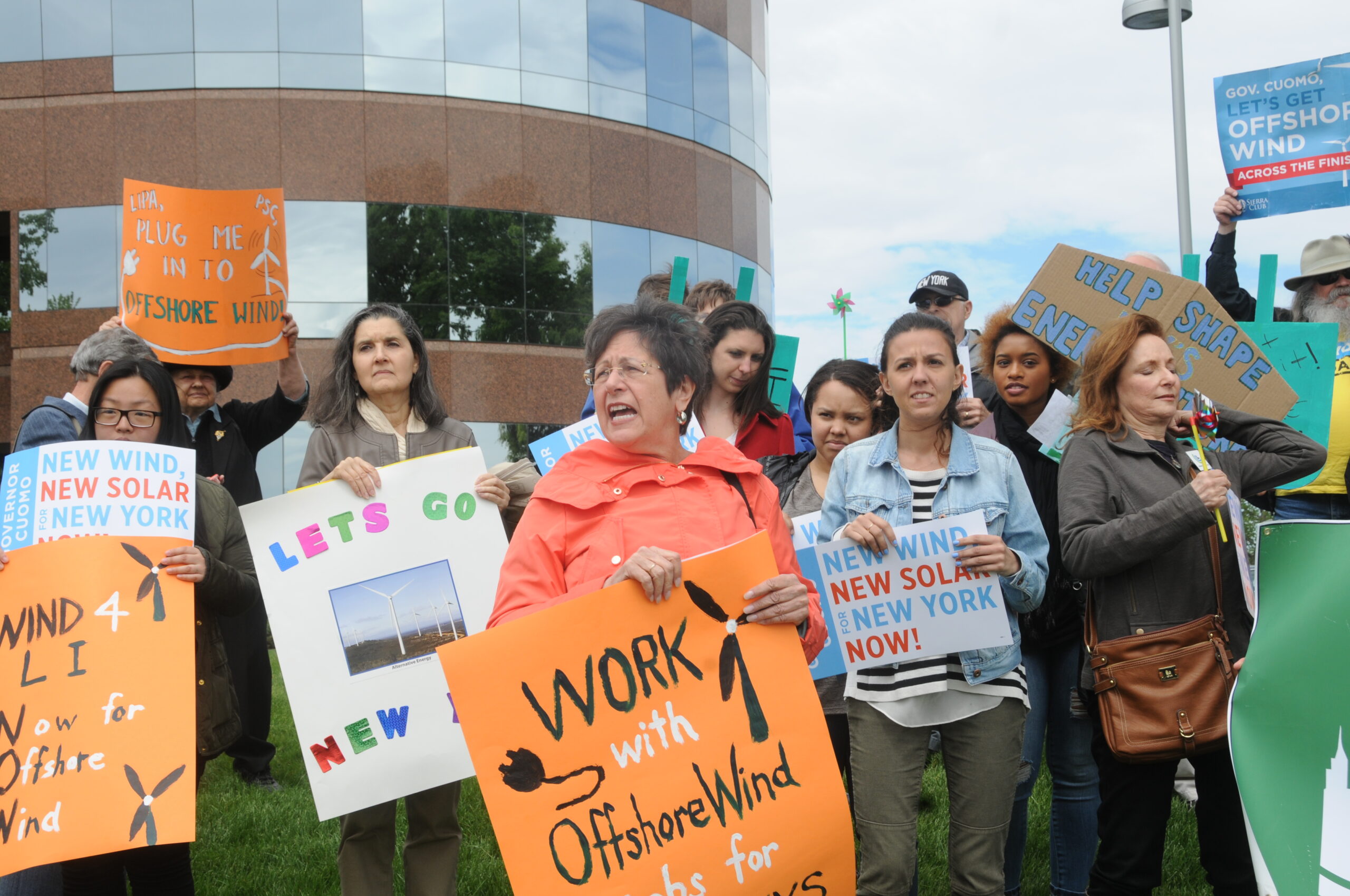
Adrienne Esposito, Executive Director, Citizens Campaign for the Environment, pops cork in 2017 after Long Island Power Authority pledged to move forward with offshore wind. Today, Governor Hochul signed contracts for the state’s first two offshore wind projects. “This announcement is one step forward for wind power, and a giant leap for a cleaner energy future. It is thrilling to see significant progress that guides our transition from fossil fuels to renewable energy. The public strongly supports this transition and New York is delivering! As we build a green economy and advanced offshore wind, we are fulfilling the commitment to make New York a leader in the battle to fight climate change. Thank you to Governor Hochul and NYSERDA for continuing to forge a pathway of progress.” © Karen Rubin/news-photos-features.com

New York State Governor Kathy Hochul today at the Port of Albany, alongside U.S. Secretary of Energy Jennifer M. Granholm, Congressman Paul Tonko and other elected officials, announced the finalization of contracts between the New York State Energy Research and Development Authority (NYSERDA) and Empire Wind Offshore LLC and Beacon Wind LLC, each a 50-50 partnership between Equinor and bp, for the Empire Wind 2 and Beacon Wind offshore wind projects, representing a key milestone in the advancement of offshore wind development in New York State.

“We know what it takes to build and sustain for the future, it’s in our DNA as New Yorkers,” Governor Hochul said. “By advancing these significant offshore wind projects, we can maintain our cadence for developing projects that will spur much-needed green job creation and investment. No state has felt the impacts of climate change more than New York State, and now more than ever, we can continue to lead the way with our ambitious, nation-leading vision to transition to a renewable energy and a cleaner, greener future.”

Today’s announcement formally closes the State’s second offshore wind competitive solicitation and also includes the first awards for the State’s Offshore Wind Training Institute. Coupled with this week’s issuance of the Bureau of Ocean Energy Management’s (BOEM) Final Sale Notice for the New York Bight and the State of the State announcement of a nation-leading $500 million investment in offshore wind ports, manufacturing, and supply chain to be integrated within NYSERDA’s 2022 solicitation, these events represent a significant step forward in advancing the Climate Leadership and Community Protection Act goal to develop 9,000 megawatts of offshore wind by 2035.  

“Hats off to Governor Hochul for taking a huge step towards lowering energy bills for New York households, creating thousands of good-paying jobs, and advancing President Biden’s goal of a robust offshore wind industry in America,” U.S. Secretary of Energy Jennifer M. Granholm said. “We can and will overcome the challenge of climate change, and we’ll do it one clean energy worker at a time.”

Senator Gillibrand said,”As we celebrate New York’s innovation in clean energy this week in Albany, I’m thrilled to announce this key partnership between the New York State Energy Research and Development Authority and Empire Wind Offshore LLC and Beacon Wind LLC. This marks another milestone in our state’s leadership and innovation in clean energy and offshore wind development. I look forward to continuing our great work to bring clean energy jobs and technology to New York.”

“We know New York’s potential for offshore wind development is tremendous,” Congressman Paul Tonko said. “Today’s exciting news will play a pivotal role in expanding this industry, creating good-paying jobs, training the energy workforce of the future, and helping address our most pressing climate challenges. Thanks to all involved in this forward-thinking announcement that invests in our region and pushes New York further down the path to becoming a powerhouse of wind manufacturing.”

NYSERDA President and CEO Doreen M. Harris said, “New York State has been steadfast in its commitment to establish itself as the leading offshore wind market in the nation and a global wind energy manufacturing powerhouse. These contracts with Equinor further solidify our progress and will create new economic opportunities while building a new electric grid powered by clean, renewable energy that paves our way to a healthier and more sustainable future.”  

The 1,260-megawatt Empire Wind 2 and 1,230-megawatt Beacon Wind projects were provisionally awarded in January 2021 as a result of NYSERDA’s second offshore wind competitive solicitation. Expected to enter into commercial operation in 2027 and 2028, respectively, the projects will strengthen New York’s economy and further drive investments in ports to directly support offshore wind projects while establishing New York as the hub of the offshore wind supply chain. NYSERDA payments to the projects will commence once they obtain all required permits and approvals, complete construction, and begin delivering power to New York.  

The final project contracts are available on NYSERDA’s website and include commitments to the following key benefits: 

  • Unprecedented public and private funding commitments of $644 million in port infrastructure, including: 
  • $357 million in the nation’s first offshore wind tower manufacturing facility to be built at the Port of Albany 
  • More than $287 million in an offshore wind staging and assembly facility at the South Brooklyn Marine Terminal (SBMT), owned by the City of New York and managed by New York City Economic Development Corporation (NYCEDC)
  • More than $8.9 billion in anticipated in-state spending and the creation of more than 5,200 jobs backed by prevailing wage and project labor agreement commitments. 
  • The average bill impact for customers will be approximately 0.8 percent, or about $0.95 per month. Total project costs, including a cost-effective average all-in development cost of $80.40 per megawatt hour, are approximately seven percent lower than those of NYSERDA’s 2018 awards, signaling offshore wind is a competitively priced renewable energy resource with tremendous benefits. 

Equinor Wind US President Siri Espedal Kindem said, “Today’s announcement sets Equinor and bp on the path to provide over 3.3 GWs of offshore wind power for New York. It also offers a large-scale, tangible demonstration of the incredible economic activity and carbon reduction potential being driven by New York’s green energy transition. We are proud to help lead the growth of this exciting industry in New York.” 

“These are world class assets and we are moving quickly and safely to get them producing the energy people need in the way that they want it – all the while creating positive ripple effects for the surrounding communities and industry,” bp Senior Vice President for Zero Carbon Energy Felipe Arbelaez said. “Today’s milestone is a critical step forward and we will continue to work hard to deliver the Empire Wind and Beacon Wind projects, providing clean energy and stable returns for decades to come.” 

Director of the New York Offshore Wind Alliance Fred Zalcman said, “Today’s suite of announcements moves the state inexorably closer to realization of its’ nation-leading goal of 9,000 MW by 2035 and secures New York as the undisputed economic epicenter for the emerging offshore wind industry. We congratulate NYSERDA and the Equinor-bp joint venture on achieving this major commercial milestone, as well as the recipients of the first training grants to support the first generation of skilled workers to be deployed on these New York’s groundbreaking projects.”

“This is another important step toward reducing emissions, securing New York’s place in the offshore wind industry, and creating good union jobs and careers in communities across the state,” Executive Director of Climate Jobs NY Jeff Vockrodt said. “We look forward to working with the Hochul administration to ensure that these projects move forward expeditiously, that the jobs created are good family-sustaining union jobs, and that New Yorkers see the economic benefits of these investments. We are also encouraged to see that NYSERDA plans to issue the next solicitation for offshore wind power soon, which together with Governor Hochul’s recent announcement of $500 million in new supply chain investments will help build out ports and other essential offshore wind infrastructure.”

This week, Governor Hochul joined United States Secretary of the Interior Deb Haaland, and New Jersey Governor Phil Murphy to announce BOEM’s Final Sale Notice of six new leases, comprised of 488,000 total acres for offshore wind development in the New York Bight, and the release of the document “A Shared Vision on the Development of an Offshore Wind Supply Chain,” which describes a coordinated offshore wind supply chain effort between New York, New Jersey and BOEM. These additional lease areas are needed for New York and New Jersey to achieve their respective offshore wind goals and support the federal government’s offshore wind goal of 30,000 megawatts by 2030. 

Keeping pace to be the U.S. leader in the offshore wind industry, New York will launch its third statewide solicitation round in early 2022. As announced in Governor Hochul’s 2022 State of the State address, NYSERDA’s next solicitation is expected to result in at least 2 gigawatts of new projects — enough to power 1.5 million homes, bringing the state’s combined total to more than 4.5 million homes powered by offshore wind. NYSERDA will couple this procurement with a $500 million offshore wind infrastructure investment to catalyze private investments to build the critical infrastructure needed to assure New York’s prominence as the hub for this burgeoning industry. The solicitation will include improvements to the approach for offshore transmission based on recommendations from the New York State Power Grid Study, increased emphasis on in-state manufacturing, inclusive economic development and climate equity, an emphasis on close relations with New York’s labor force including construction backed by prevailing wage and project labor agreements, and additional scoring credit for projects that propose to repurpose existing downstate fossil-based electric generation infrastructure and utilize energy storage to enhance future system reliability. 

New York State Department of Labor Commissioner Roberta Reardon said, “Offshore wind is breathing fresh air into New York’s economy. With the support of a well-trained workforce, this emerging sector will bring economic prosperity for years to come. I thank Governor Hochul for continuing to strategically invest in our economy, our environment, and New York’s workforce.”

“Offshore wind ports will fuel both a green economy and economic opportunities,” Empire State Development Acting Commissioner and President & CEO-designate Hope Knight said. “Empire Wind 2 and Beacon Wind will make New York State greener and create green jobs, which advances Empire State Development’s mission to prepare our economy for the future. With today’s announcement, New York will continue to be leaders in the fight against climate change and production of green energy and green jobs – bringing us closer to the State’s ambitious climate goals.” 

President and CEO of the Center for Economic Growth Mark Eagan said,”We are witnessing the birth of a sector that is not only new to New York State, but the entire country. It’s real and it’s concentrating here – in the Capital Region. New York State is a pioneer in the offshore wind industry, and we are deeply thankful for the vision and commitment of Governor Hochul and NYSERDA. We congratulate  Equinor, bp, and the Port of Albany on this contract, which will help transform our economy and provide good-paying jobs. CEG started globally marketing the region’s offshore wind potential three years ago, and that has helped yield this nation-leading investment with more on the way. CEG will continue to work with its partners to leverage state and federal dollars to further build out the Capital Region as the location-of-choice for offshore wind component manufacturing.”

Adrienne Esposito, Executive Director, Citizens Campaign for the Environment said, “This announcement is one step forward for wind power, and a giant leap for a cleaner energy future. It is thrilling to see significant progress that guides our transition from fossil fuels to renewable energy. The public strongly supports this transition and New York is delivering! As we build a green economy and advanced offshore wind, we are fulfilling the commitment to make New York a leader in the battle to fight climate change. Thank you to Governor Hochul and NYSERDA for continuing to forge a pathway of progress.” 

These advancements build on New York’s continued responsible and cost-effective approach to developing offshore wind, including NYSERDA’s recently published Guiding Principles for Offshore Wind Stakeholder Engagement, and Request for Information seeking feedback from the public and interested stakeholders to identify topics to consider in the analysis of offshore and onshore cable corridors. NYSERDA will also initiate a new Offshore Wind Master Plan 2.0: Deep Water to unlock the next frontier of offshore wind development this year. 

New York State has five offshore wind projects in active development, the largest portfolio in the nation. This initial portfolio totals more than 4,300 megawatts and will power more than 2.4 million New York homes and is expected to bring a combined economic impact of $12.1 billion to the state. The projects are also expected to create more than 6,800 jobs in project development, component manufacturing, installation, and operations and maintenance. Achieving the State’s 9,000 megawatt by 2035 goal will generate enough offshore wind energy to power approximately 30 percent of New York State’s electricity needs, equivalent to nearly 6 million New York State homes, and spur approximately 10,000 jobs. 

Offshore Wind Training Institute 

Also announced today were the first round of competitive awards under the State’s $20 million Offshore Wind Training Institute, the largest public investment in offshore wind workforce development by any state in the U.S. Through a partnership between the State University of New York’s Farmingdale State College and Stony Brook University on Long Island, the training institute aims to advance offshore wind training programs and the educational infrastructure needed to establish a skilled workforce that can support the emerging national offshore wind industry. The Institute will certify and train 2,500 New York workers beginning this year to support both offshore and onshore renewable energy projects.

The first two winning proposals will receive a combined $569,618 to support early training and skills development for disadvantaged communities and priority populations – including veterans, individuals with disabilities, low-income individuals, homeless individuals, and single parents – in both the Capital Region and New York City. Awardees include: 

  • Hudson Valley Community College in Troy, NY (HVCC)  
  • LaGuardia Community College in Queens, NY (LAGCC)  

To help build a strong pipeline for the Capital Region’s offshore wind initiative, HVCC recently began offering a two-year associate degree in welding and fabrication and will focus student recruitment efforts on priority populations in urban and rural disadvantaged communities, providing full or partial scholarships to participants. Foundational welding skills training will be provided by the Capital Region Educational Opportunity Center, a division of HVCC with additional non-credit training and certifications be provided at the college’s main campus. The college will also partner with regional manufacturers building turbine components to provide a skilled workforce pipeline of welders and fabricators, aiming to train 75 individuals, including 65 from priority populations and disadvantaged communities.

LAGCC is partnering with Siemens Gamesa to build an inclusive offshore wind workforce that ensures a robust local talent pipeline for the construction, repair, and maintenance of offshore wind facilities in the New York City metro area. The college will convene employers to detail the skill gaps for both new entrants to the workforce and incumbent workers in the construction trades to help inform and develop a best-in-class custom curriculum. A total of fifty low-income individuals from the Brooklyn-Queens waterfront will be trained to work as offshore wind technicians. 

Penny Hill, Dean of Economic Development and Workforce Initiatives for HVCC, said, “Hudson Valley Community College is committed to helping supply the workforce for New York State’s clean energy future. In addition to those trained in welding and fabrication, the college is ready to provide other educational opportunities to support the offshore wind industry. We look forward to partnering with manufacturers to provide job training and build stronger, more resilient communities.” 

“Building an inclusive offshore wind workforce will allow us to ensure that low-income communities of color and other communities that have been left behind in the past have a chance to lead the green economy of the future,” Hannah Weinstock, Senior Director of Workforce Development for LAGCC, said.

NYS’s Nation-Leading Climate Plan 

New York State’s nation-leading climate agenda is the most aggressive climate and clean energy initiative in the nation, calling for an orderly and just transition to clean energy that creates jobs and continues fostering a green economy as New York State recovers from the COVID-19 pandemic. Enshrined into law through the Climate Leadership and Community Protection Act, New York is on a path to achieve its mandated goal of a zero-emission electricity sector by 2040, including 70 percent renewable energy generation by 2030, and to reach economy wide carbon neutrality. It builds on New York’s unprecedented investments to ramp-up clean energy including over $33 billion in 102 large-scale renewable and transmission projects across the state, $6.8 billion to reduce buildings emissions, $1.8 billion to scale up solar, more than $1 billion for clean transportation initiatives, and over $1.6 billion in NY Green Bank commitments. Combined, these investments are supporting nearly 158,000 jobs in New York’s clean energy sector in 2020, a 2,100 percent growth in the distributed solar sector since 2011 and a commitment to develop 9,000 megawatts of offshore wind by 2035. Under the Climate Act, New York will build on this progress and reduce greenhouse gas emissions by 85 percent from 1990 levels by 2050, while ensuring that at least 35 percent with a goal of 40 percent of the benefits of clean energy investments are directed to disadvantaged communities, and advance progress towards the state’s 2025 energy efficiency target of reducing on-site energy consumption by 185 trillion BTUs of end-use energy savings. 

Historic Wind Energy Auction Offshore NY, NJ Has Potential to Power 2 Million Homes With Clean, Renewable Energy

New York Bight lease sale has potential to generate up to seven gigawatts of clean energy, power nearly two million homes

Long Island activists, in 2017, cheer an agreement by Long Island Power Authority to move forward with offshore wind power. Then the Trump administration stalled progress. Now the Biden Administration announced that the Bureau of Ocean Energy Management (BOEM) will hold a wind auction in February for more than 480,000 acres offshore New York and New Jersey, in the area known as the New York Bight, that is projected to produce 5.6 to 7 gigawatts of offshore wind energy, enough to power nearly 2 million homes © Karen Rubin/news-photos-features.com


WASHINGTON — Secretary of the Interior Deb Haaland announced today that the Bureau of Ocean Energy Management (BOEM) will hold a wind auction next month for more than 480,000 acres offshore New York and New Jersey, in the area known as the New York Bight. Secretary Haaland was joined by New Jersey Governor Phil Murphy, New York Governor Kathy Hochul, and Liz Shuler, President of the American Federation of Labor and Congress of Industrial Organizations, to highlight what will be the first offshore wind lease sale under the Biden-Harris administration.
 
The Feb. 23 auction will allow offshore wind developers to bid on six lease areas – the most areas ever offered in a single auction – as described in BOEM’s Final Sale Notice. Leases offered in this sale could result in 5.6 to 7 gigawatts of offshore wind energy, enough to power nearly 2 million homes. As offshore wind technology continues to advance, these areas may have the potential to produce even more clean energy.
 
“The Biden-Harris administration has made tackling the climate crisis a centerpiece of our agenda, and offshore wind opportunities like the New York Bight present a once-in-a-generation opportunity to fight climate change and create good-paying, union jobs in the United States,” said Secretary of the Interior Deb Haaland. “We are at an inflection point for domestic offshore wind energy development. We must seize this moment – and we must do it together.”
 
On today’s call, the leaders outlined a shared vision for developing a robust offshore wind domestic supply chain that will deliver benefits to residents of New York and New Jersey and the surrounding region, including underserved communities. This collaboration will serve as a model for future engagement and establish the U.S. as a major player in the global offshore wind market.
 
The Biden-Harris administration’s goal to install 30 GW of offshore wind by 2030 is complemented by state offshore wind policies and actions throughout the Northeast and Mid-Atlantic. Collectively, New York and New Jersey have set the nation’s largest regional offshore wind target of installing over 16 GW of offshore wind by 2035.
 
“Offshore wind holds the tremendous promise for our future in terms of climate change, economic growth, strengthening our work force, and job creation,” said Governor Phil Murphy. “New Jersey is already committed to creating nearly one-quarter of the nation’s offshore wind-generation market and these transformative projects are proof that climate action can drive investments in infrastructure and manufacturing, while creating good-paying, union jobs. By acting on this this shared vision, we can promote our joint offshore wind goals, and deliver benefits to residents of both states, particularly those in overburdened communities. Together, with this critical cooperation with the Biden-Harris administration and our state partners, we will turn this vision of becoming a leader in the global offshore wind market into a reality.”
 
“Here in New York, we are already living with the disastrous effects of climate change through extreme weather that pose a direct threat to our way of life,” said Governor Hochul. “We must chart an ambitious path toward a cleaner energy economy now more than ever, and today’s milestone further highlights New York’s commitment creating a greener tomorrow. This effort will require collaboration at all levels, and I applaud the Biden Administration for their action and thank Secretary Haaland and BOEM, as well as New Jersey Governor Murphy, for their partnership as we confront the climate crisis.”
 
A recent report indicates that the United States’ growing offshore wind industry presents a $109 billion opportunity in revenue to businesses in the supply chain over the next decade.   
 
The New York Bight offshore wind auction will include several innovative lease stipulations designed to promote the development of a robust domestic U.S. supply chain for offshore wind and enhance engagement with Tribes, the commercial fishing industry, other ocean users, and underserved communities. The stipulations will also advance flexibility in transmission planning and make use of project labor agreements throughout the construction of offshore wind projects. Stipulations include incentives to source major components domestically – such as blades, turbines, and foundations – and to enter into project labor agreements to ensure projects are union-built.
 
To advance the Department’s environmental justice and economic empowerment goals, the Sale Notice also requires lessees to identify Tribes, underserved communities and other ocean users who could be affected by offshore wind development. The Interior Department will hold companies accountable for improving their engagement, communication and transparency with these communities.
 
These additions are intended to promote offshore wind development in a way that coexists with other ocean uses and protects the ocean environment, while also facilitating our nation’s energy future for generations to come. 
 
BOEM initially asked for information and nominations of commercial interest for 1,735,154 acres in the Bight. Based on the bureau’s review of scientific data, and extensive input from the commercial fishing industry, Tribes, partnering agencies, key stakeholders, and the public, BOEM reduced the acreage by 72% to avoid conflicts with ocean users and minimize environmental impacts. BOEM will continue to engage with stakeholders as the process unfolds.
 
More information about the auction, lease stipulations, list of qualified bidders for the auction and Interior’s collaboration with New York and New Jersey can be found on BOEM’s website.
 
The Biden-Harris administration catalyzed the offshore wind industry by announcing the first-ever national offshore wind energy goal, creating a clear vision for the future of this innovative industry. This goal is reinforced by the Bipartisan Infrastructure Law, which will make robust investments in sustainable economies, clean energy, and climate resilience.
 
The Administration has already made significant progress toward creating a pipeline of projects. It has approved the nation’s first two commercial-scale offshore wind projects in federal waters: the 800-megawatt Vineyard Wind project (approved on May 11, 2021) and the 130-megawatt South Fork Wind project (approved on November 24, 2021). BOEM expects to review at least 16 plans to construct and operate commercial offshore wind energy facilities by 2025, which would represent more than 22 GW of clean energy for the nation.
 
This past fall Secretary Haaland announced a new leasing path forward, which identified up to seven potential lease sales by 2025, including the New York Bight and offshore the Carolinas and California later this year, to be followed by lease sales for the Central Atlantic, Gulf of Maine, the Gulf of Mexico, and offshore Oregon.

In addition, Governor Hochul announced plans to invest in offshore wind infrastructure, procure enough wind energy to power at least 1.5 million homes, initiate planning for an offshore wind transmission network, and launch the offshore wind Master Plan 2.0 Deep Water in her 2022 State of the State address. This will ensure that the state has the strongest offshore wind energy market along the Eastern Seaboard. The Governor’s plan for offshore wind will support more than 6,800 jobs, a combined economic impact of $12.1 billion statewide, and more than 4.3 gigawatts of energy, enough to power nearly 3 million homes in New York.

Biden-Harris Administration Races to Deploy Clean Energy that Creates Jobs, Lowers Costs for Consumers, Industry

New Actions Advance Offshore Wind, Leverage Public Lands for Clean Energy, and Build the Bipartisan Infrastructure Law’s Transmission Lines
 

Long Island activists in 2016 protesting for offshore wind, solar energy projects at Long Island Power Authority headquarters. Projects put on hold during Trump administration, have now gotten back on the fast track by the Biden Administration, bringing a whole-of-government approach. The Department of the Interior is holding a record-breaking offshore wind lease sale, with the most lease areas ever offered, in the New York Bight off the coasts of New York and New Jersey. The upcoming lease sale is projected to generate up to 7 gigawatts (GW) of clean energy, power two million homes, and create thousands of jobs in manufacturing, construction, operations, maintenance, and service industries in nearby communities © Karen Rubin/news-photos-features.com

When President Biden came into office nearly a year ago, he pulled every lever to position America to scale up clean energy that creates good-paying, union jobs and lowers energy bills for consumers. Since then, the Biden-Harris Administration has readied offshore areas to harness power from wind, approved new solar projects on public lands, and passed the Bipartisan Infrastructure Law to build thousands of miles of transmission lines that deliver clean energy.
 
Today, the Biden-Harris Administration is making major leaps forward on wind, solar, transmission, and other clean energy projects to create high-quality jobs and deliver affordable, carbon pollution-free electricity across the country. Seven federal agencies are announcing clean energy projects and plans that demonstrate the Administration’s unwavering commitment to creating cleaner and cheaper energy, and the actions showcase President Biden’s unprecedented coordination activating the entire government to fight climate change, produce good-paying, union jobs, and accelerate America’s clean energy economy.
 
These actions include:

  • The Department of the Interior is holding a record-breaking offshore wind lease sale, with the most lease areas ever offered, in the New York Bight off the coasts of New York and New Jersey. The upcoming lease sale is projected to generate up to 7 gigawatts (GW) of clean energy, power two million homes, and create thousands of jobs in manufacturing, construction, operations, maintenance, and service industries in nearby communities. The sale includes innovative lease provisions that will lead to offshore wind projects being built with union labor and Made in America materials. Working together, New York, New Jersey and the federal government will build on these new lease stipulations through a new federal-state partnership that will ensure local residents—including underserved communities—benefit from new developments.
     
  • A number of agencies are working together to drive the rapid build-up of offshore wind—a brand new U.S. clean energy industry that can create nearly 80,000 good-paying jobs by 2030. For example, the Department of Transportation recently announced port investments to help develop areas that will be used to build and stage offshore wind turbine components, and efforts are underway across the Departments of Commerce, the Interior, and Energy to promote biodiversity and cooperative ocean use and support innovation across the supply chain.
     
  • The Departments of the Interior, Agriculture, Defense, Energy, and the Environmental Protection Agency are forming a new collaboration to improve the efficiency and effectiveness of reviews of clean energy projects on public lands, in order to expand solar, onshore wind, and geothermal energy, building on the Department of the Interior’s approvals over the past year of 18 onshore projects that will deliver 4.175 GW of clean energy.
     
  • The Department of Energy is launching a new Building a Better Grid initiative to accelerate the deployment of new transmission lines—as enabled by the Bipartisan Infrastructure Law—to connect more Americans to cleaner, cheaper energy. This transmission buildout will make our grid more reliable and resilient in the face of intensifying extreme weather and is critical to achieving the President’s goal of 100% carbon pollution-free electricity by 2035.
     
  • To ensure that these benefits reach all Americans, the Department of Agriculture is creating a new pilot program to support clean energy in underserved rural communities and the Department of Commerce is awarding American Rescue Plan funds to support regional coalitions to grow new industry clusters focused on clean energy deployment and job training. And the release of a new report from the National Renewable Energy Laboratory shows that the Administration’s SolarAPP+ tool is reducing permitting times for residential installations to less than one day, helping local governments fast-track rooftop solar. 

Today’s announcements build on a year of unprecedented progress on clean energy deployment. Before President Biden took office, projects were stalled and agencies were hollowed out. But during his first week, the President issued an Executive Order on Tackling the Climate Crisis at Home and Abroad, which mobilized the entire federal government to activate and deploy clean energy so that Americans can reap the immense climate and economic benefits of the clean energy future.
 
The Administration continues to use every tool available to deploy clean energy at a record pace. But to fully seize the opportunities of a clean energy economy, President Biden is pressing forward on passing the Build Back Better Act. The historic legislation will amount to the nation’s largest investment in combatting climate change, lowering energy costs for working families, and building a clean energy future. It will support domestic manufacturing of wind turbines, solar panels, and other clean technologies; invest in workforce development programs to launch careers in these growing industries; and provide a historic set of clean energy tax credits that are more powerful and accessible. With these investments, the U.S. will lead the world on innovative climate solutions and save the average American family hundreds of dollars each year in energy costs.
 
As work continues to pass the Build Back Better Act, today’s announcements further the Administration’s ongoing commitment to powering our economy with clean American energy:
 
ADVANCING OFFSHORE WIND TO CREATE JOBS
 
To deploy offshore wind at the speed and scale necessary to achieve our climate goals and create tens of thousands of jobs, the Administration is announcing:
 

  • Record-Breaking Lease Sale in the New York Bight. Last year, the Administration established a Wind Energy Area in the New York Bight off the coasts of New York and New Jersey. Today, the Department of the Interior’s Bureau of Ocean Energy Management (BOEM) is announcing the Final Sale Notice of six commercial lease areas—the most ever offered—with the potential to generate 5.6 to 7 GW of clean energy across 488,201 acres. Innovative leasing provisions will encourage winning bidders to enter into Project Labor Agreements (PLA) that support union jobs. They also will financially incentivize lessees to utilize wind turbine blades, towers, and cables made in America. To promote meaningful stakeholder engagement, lessees must identify any Tribes, ocean users, underserved communities, and others potentially affected by projects and report on engagement activities.  
     
  • New State-Federal Partnership. Today, Interior Secretary Deb Haaland joined New York Governor Kathy Hochul and New Jersey Governor Phil Murphy to celebrate progress in the New York Bight and announce a new collaboration between BOEM, New York, and New Jersey on offshore wind with a focus on job creation and environmental justice. Through a new shared vision and working group, these partners will work together on strengthening regional supply chains and delivering benefits to underserved communities.
     
  • DOT Port Investments for Manufacturing and Staging Hubs. The Department of Transportation (DOT) recently awarded Port Infrastructure Development Program Grants to two hubs that will strengthen the U.S. offshore wind supply chain. In Virginia, the Portsmouth Marine Terminal will receive $20 million to construct staging and storage areas for wind turbine components—supporting union jobs for dockworkers, crane operators, and building trades members. In New York, the Port of Albany will receive $29.5 million for the Offshore Wind Tower Manufacturing Port Project, which will develop vacant areas along the Hudson River for a first-of-its-kind U.S. facility for fabrication and assembly of offshore wind towers, creating hundreds of jobs in construction, manufacturing, and maritime activities. DOT announced in March 2021 that this discretionary port funding would be available to support offshore wind activities, and that climate and environmental justice considerations would factor into the review process. The Bipartisan Infrastructure Law significantly increases funding for the Port Infrastructure Development Program Grants to expand federal investments in ports.
     
  • Funding for Innovative Supply Chain and Maintenance Projects. The National Offshore Wind Research and Development Consortium is awarding over $3 million to six offshore wind R&D projects, bringing total investment through NOWRDC over the past year to $14 million. The competitive awards will fund three new supply chain projects to facilitate U.S. manufacturing, ensure quality component production, and simplify transportation of major wind plant components. Three additional projects will support asset monitoring and inspection to reduce operational costs for offshore wind farms. The NOWRDC was established in 2018 with a $20.5 million Department of Energy (DOE) investment and matching funds from the New York State Energy Research and Development Authority (NYSERDA), with follow-on contributions from state agencies in Maryland, Virginia, Massachusetts, Maine, and New Jersey—all resulting in approximately $48 million in committed funds.
     
  • NOAA-BOEM Memorandum of Understanding. The Commerce Department’s National Oceanic and Atmospheric Administration (NOAA) and BOEM are entering an interagency agreement to collaboratively advance offshore wind energy while protecting biodiversity and promoting cooperative ocean use. This partnership underscores NOAA and BOEM’s commitment to leverage their resources and expertise to responsibly deploy 30 GW by 2030 in a way that protects environmental quality, creates jobs, and advances environmental justice.
     
  • DOE Report Underscoring Need for Continued Offshore Wind Investment. The Department of Energy will be issuing a report on “Offshore Wind Energy Strategies: Regional and National Strategies to Maximize the Effectiveness, Reliability, and Sustainability of U.S. Offshore Wind Energy Development and Operation.” It outlines five strategic priorities for tapping into the enormous potential for growth and job creation in the offshore wind industry: expanding targeted federal incentives, reducing costs through innovation, improving siting and permitting processes, investing in supply chain development, and facilitating grid integration of offshore wind projects. The President’s Build Back Better Act would advance these priorities with expanded investment and production tax credits for offshore wind deployment, advanced manufacturing credits to incentivize Made in America wind turbine components, and investments across transmission planning, port infrastructure, and improved leasing and permitting processes.

These actions follow a year of interagency collaboration to jumpstart the U.S. offshore wind industry—in 2021, the Administration: 

  • Launched an offshore wind strategy to achieve a new national target of deploying 30 GW by 2030 and create jobs up and down the supply chain, from factories in the heartland to shipyards on the coasts.
     
  • Approved the nation’s first two commercial-scale offshore wind projects, Vineyard Wind 1 and South Fork Wind, which will be built by a highly skilled, well-paid union workforce. 
     
  • Developed a roadmap for holding seven offshore wind lease sales and completing reviews of 16 multi-billion dollar offshore wind projects—representing 22 GW of clean energy—by 2025.

Moving ahead in 2022, BOEM will conduct reviews of wind energy areas offshore northern California (Humboldt) and central California (Morro Bay); explore new potential Wind Energy Areas in the Gulf of Mexico and off the coasts of Oregon and the central Atlantic; and advance lease sales in the Carolina Long Bay and offshore California.
 
FAST-TRACKING CLEAN ENERGY ONSHORE

America’s public lands have substantial potential to support solar, wind, and geothermal energy projects. As part of ongoing efforts to advance these projects in an environmentally sound way and in close collaboration with community stakeholders, the Administration is announcing:

  • Five-Agency Collaboration to Expedite Reviews. The Departments of the Interior, Agriculture, Defense, Energy, and the Environmental Protection Agency have issued a new Memorandum of Understanding to improve federal agency coordination and prioritize reviews for renewable energy projects located on public lands managed by the Interior and Agriculture Departments. This collaboration will expedite decision-making by establishing interagency coordination teams with qualified staff to facilitate environmental reviews and other federal reviews.
     
  • Renewable Energy Coordination Offices. The Department of the Interior is developing plans for new Renewable Energy Coordination Offices (RECOs), authorized by the Energy Act of 2020. The RECOs will realign Bureau of Land Management resources to consolidate renewable energy work, and support collaboration on public lands renewable energy project permitting across Interior and other federal agencies.
     
  • Major Progress toward 25 GW by 2025. Since President Biden took office, the Administration has approved 18 onshore projects totaling 4.175 GW (including eight located on public lands and ten with interconnection lines on public lands) and initiated processing of another 54 priority projects with the potential to add at least 27.5 GW of clean energy. Most recently, the Bureau of Land Management approved the Arica and Victory Pass solar projects in California, which will provide up to 465 megawatts of electricity with up to 400 megawatts of battery storage. With today’s actions, the Administration will continue advancing toward the goal of permitting 25 GW of solar, onshore wind, and geothermal energy on public lands by 2025.

BUILDING CLEAN TRANSMISSION LINES

The President’s Bipartisan Infrastructure Law is the largest-ever investment in America’s power grid, including funding to build out thousands of miles of new transmission lines that are critical to unlocking clean energy resources and providing American homes, schools, and businesses with electricity that is more affordable and reliable in the face of extreme weather, wildfires, and other disasters. 

To harness the new funding in the Bipartisan Infrastructure Law, today the Department of Energy is announcing a coordinated transmission deployment program, which will catalyze nationwide buildout of long-distance, high-voltage transmission lines. As outlined in a new Notice of Intent, the pillars of the “Building a Better Grid” initiative are:
 

  • Financing transmission lines and other grid upgrades, including through the Bipartisan Infrastructure Law’s new $2.5 billion Transmission Facilitation Program, a revolving fund for new, replacement, or upgraded transmission lines; $3 billion expansion of the Smart Grid Investment Grant Program, focused on advanced technologies that increase capacity and enhance flexibility of the existing grid; and more than $10 billion in grants for states, Tribes, and utilities to enhance grid resilience and prevent power outages. DOE will also leverage existing financing, including the $3.25 billion Western Area Power Administration (WAPA) Transmission Infrastructure Program, which facilitates deployment of renewable energy in WAPA’s 15-state service territory, and a number of loan guarantee programs through the Loan Programs Office.  
     
  • Strengthening coordination with state and local governments, Tribal nations, and other stakeholders, including through participation in regional convenings with independent system operators (ISOs), regional transmission organizations (RTOs), state regulatory commissions, utilities, and others.
     
  • Modernizing transmission planning to drive investment to the highest-need projects, including through a new National Transmission Planning Study, National Transmission Needs Study, Offshore Wind Transmission Study, and expanded technical assistance to help states and regions with policy implementation.
     
  • Improving permitting processes, in coordination with the Infrastructure Implementation Task Force and other federal initiatives, including by helping developers provide early information to permitting agencies; using public-private partnerships to advance new transmission lines and system upgrades; and designating National Corridors in areas with transmission capacity constraints that harm consumers.
     
  • Supporting research, development, and demonstration (RD&D) of next-generation transmission technology, including through collaborations with the National Laboratories and industry partners.

Last year, the Administration laid the foundation for these efforts by revitalizing Department of Energy transmission financing assistance programs and through Department of Transportation actions to help states host transmission lines along public highways and other transportation rights-of-way.

DELIVERING BENEFITS TO COMMUNITIES ACROSS THE COUNTRY

The Administration has prioritized clean energy deployment in rural communities, providing financing for agricultural producers and rural small businesses to install solar arrays and other clean energy infrastructure and for grid upgrades across rural areas. To build on these investments, the Department of Agriculture is creating a new Rural Energy Pilot Program with $10 million in available grants for rural communities that are particularly underserved to deploy community-scale clean energy technologies, innovations, and solutions. This upcoming pilot program will also help economically distressed rural communities conduct community energy planning to advance local goals for clean, affordable, and reliable power.

Additionally, President Biden’s American Rescue Plan is driving historic economic recovery from the pandemic—including by helping communities create new jobs and industries in clean energy. The Department of Commerce’s Economic Development Administration (EDA) recently announced the finalists for Phase 1 of the Build Back Better Regional Challenge, which uses American Rescue Plan funds to support regional industry clusters that will promote equitable economic growth and workforce development. The finalists include 14 regional coalitions focused on clean energy and other climate-related industries, which will receive a combined $7 million in planning grants and compete to win awards of $25 million to $100 million for implementation. Among these finalists are projects to reuse abandoned mine lands for solar, wind, and geothermal energy generation; utilize offshore wind as a power source for hydrogen production in industrial areas; and support clean energy job training, entrepreneurship, and innovation in areas historically dependent on fossil fuel economies.

The Administration is also helping local governments speed up approvals for rooftop solar in order to unlock economic and health benefits for their communities. In July 2021, the Department of Energy launched the Solar Automated Permit Processing (SolarAPP+) tool, an online platform that enables jurisdictions to rapidly approve residential solar installation permits. Now, a new report from the National Renewable Energy Laboratory shows that in a pilot conducted in Arizona and California, the SolarAPP+ tool reduced the average permit review time to less than one day. More than 125 localities have already signed up to consider using SolarAPP+, and the Department of Energy is continuing to recruit additional communities across the country.  

President Biden Pushes for Voting Rights: ‘This is a defining moment in history. To protect democracy, change the Senate rules’

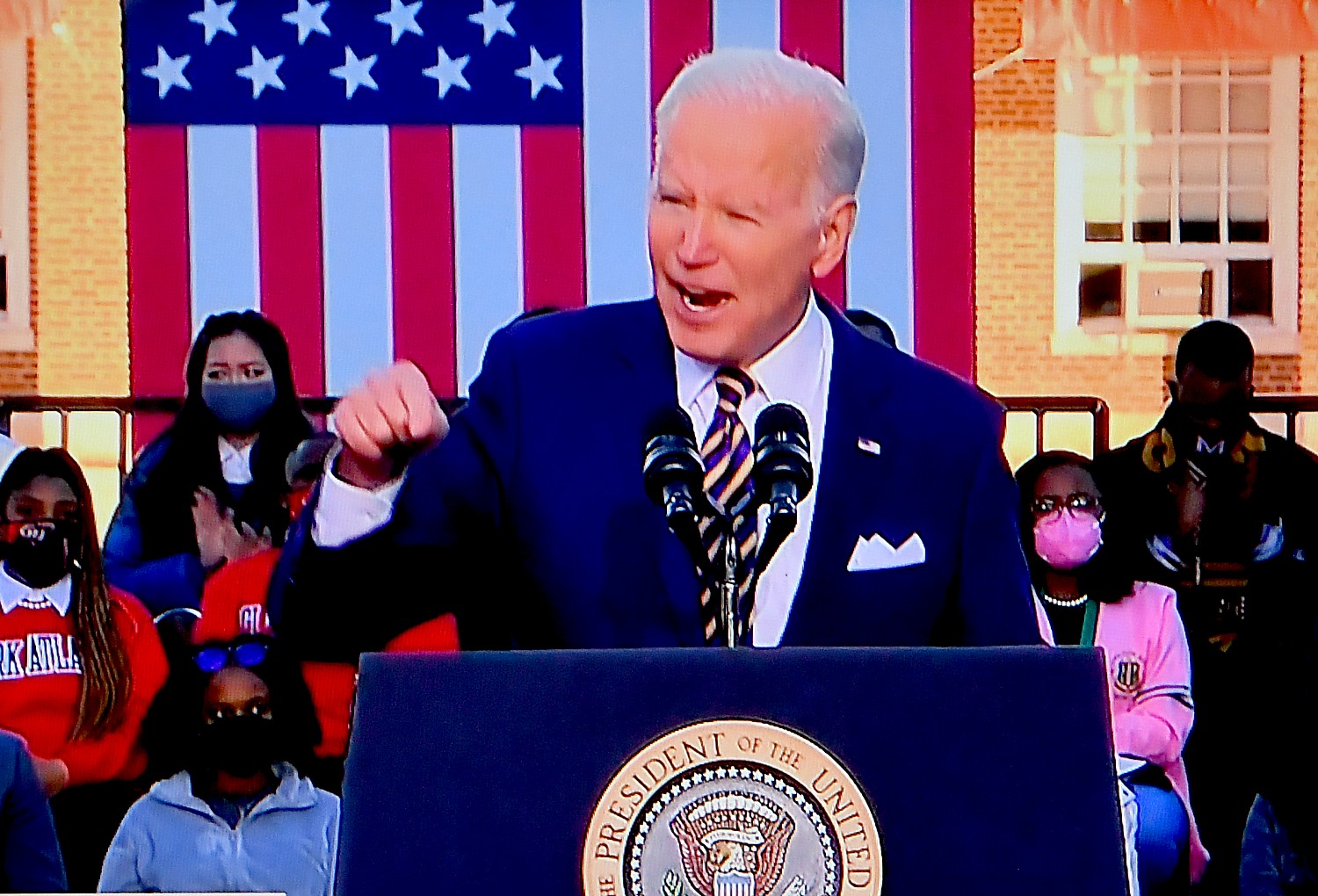
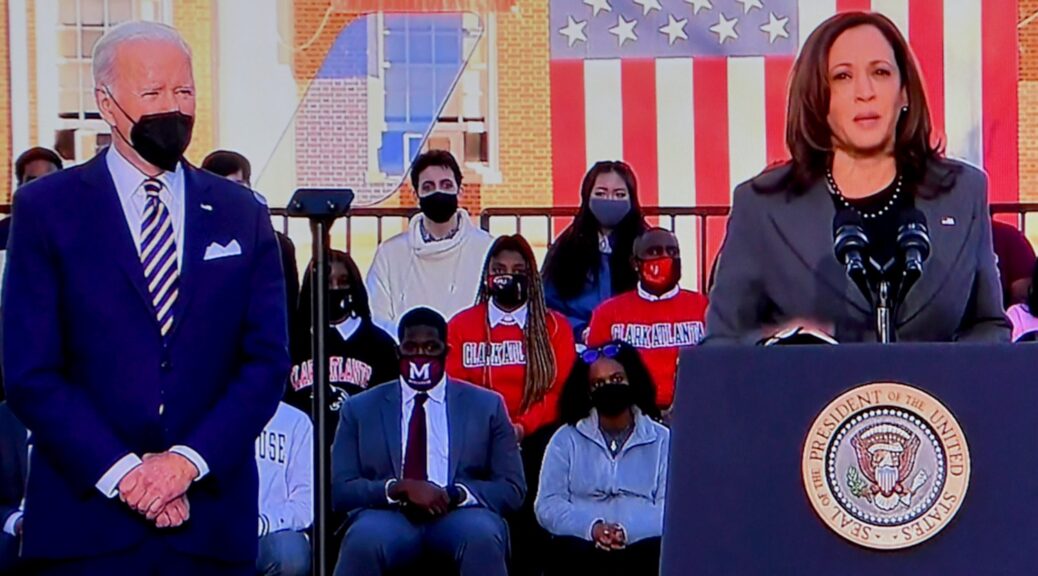
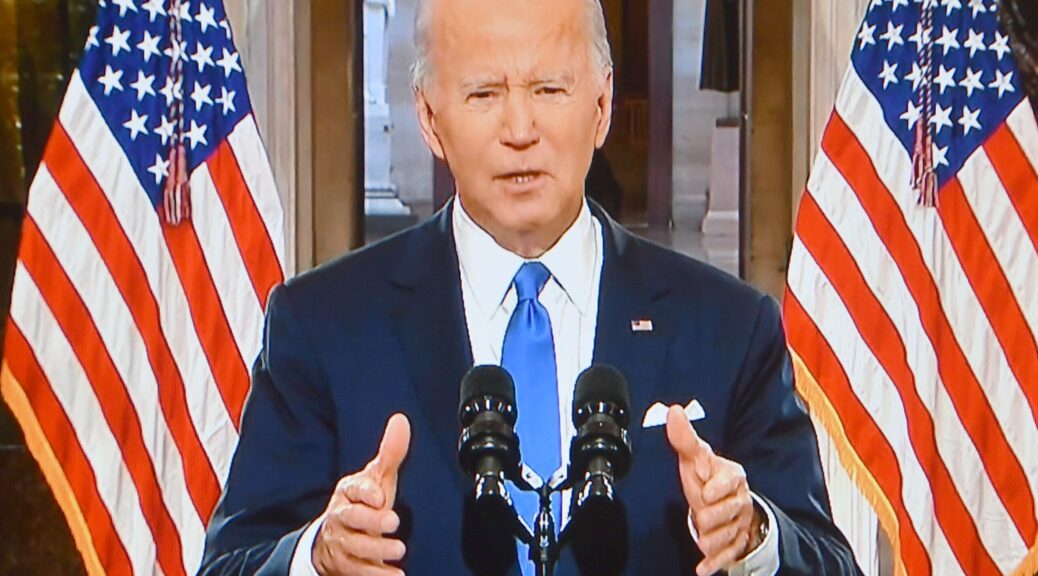
“To protect our democracy, I support changing the Senate rules..to prevent a minority of senators from blocking action on voting rights,” President Joe Biden declared in a speech in Atlanta, “cradle of civil rights,” demanding passage of laws to voting rights © Karen Rubin/news-photos-features.com via msnbc.

President Joe Biden delivered a forceful speech delivered in Atlanta, Georgia, the “cradle of civil rights,” demanding the Senate pass voting rights protections, at one point slamming his hand down on the podium. The “institutionalist” who spent decades in the Senate, he came out as supporting overturning the filibuster – a relic of segregation and Jim Crow – which has been weaponized by Republicans, giving tyrannical control of the minority over the majority.

“To protect our democracy, I support changing the Senate rules..to prevent a minority of senators from blocking action on voting rights,” he declared.

Here is a highlighted transcript of his remarks:

In our lives and the lives of our nation — the life of our nation, there are moments so stark that they divide all that came before from everything that followed.  They stop time.  They rip away the trivial from the essential.  And they force us to confront hard truths about ourselves, about our institutions, and about our democracy.
 
In the words of Scripture, they remind us to “hate evil, love good, and establish justice in the gate.”
 
Last week, [Vice] President Harris and I stood in the United States Capitol to observe one of those “before and after” moments in American history: January 6th insurrection on the citadel of our democracy.
 
Today, we come to Atlanta — the cradle of civil rights — to make clear what must come after that dreadful day when a dagger was literally held at the throat of American democracy.
 
We stand on the grounds that connect Clark Atlanta — Atlanta University, Morehouse College, and near Spellman College — the home of generations of advocates, activists, educators and preachers; young people, just like the students here, who have done so much to build a better America.  (Applause.)
 
We visited the sacred Ebenezer Baptist Church and paused to prayed at the crypt of Dr. and Mrs. King, and spent time with their family.  And here in the district — as was pointed out — represented and reflected the life of beloved friend, John Lewis.
 
In their lifetimes, time stopped when a bomb blew up the 16th Street Baptist Church in Birmingham and murdered four little girls.
 
[Time] stopped when John and many others seeking justice were beaten and bloodied while crossing the bridge at Selma named after the Grand Dragon of the Ku Klux Klan.
 
They stopped — time stopped, and they forced the country to confront the hard truths and to act — to act to keep the promise of America alive: the promise that holds that we’re all created equal but, more importantly, deserve to be treated equally.  And from those moments of darkness and despair came light and hope.
 
Democrats, Republicans, and independents worked to pass the historic Civil Rights Act and the voting rights legislation.  And each successive generation continued that ongoing work.
 
But then the violent mob of January 6th, 2021, empowered and encouraged by a defeated former president, sought to win through violence what he had lost at the ballot box, to impose the will of the mob, to overturn a free and fair election, and, for the first time — the first time in American history, they — to stop the peaceful transfer of power.
 
They failed.
  They failed.  (Applause.)  But democracy’s victory was not certain, nor is democracy’s future.
 
That’s why we’re here today to stand against the forces in America that value power over principle, forces that attempted a coup — a coup against the legally expressed will of the American people — by sowing doubt, inventing charges of fraud, and seeking to steal the 2020 election from the people.
 
They want chaos to reign.  We want the people to rule.
  (Applause.)
 
But let me be clear: This is not about me or Vice President Harris or our party; it’s about all of us.  It’s about the people.  It’s about America.
 
Hear me plainly: The battle for the soul of America is not over.  We must stand strong and stand together to make sure January 6th marks not the end of democracy but the beginning of a renaissance of our democracy.  (Applause.)
 
You know, for the right to vote and to have that vote counted is democracy’s threshold liberty.  Without it, nothing is possible, but with it, anything is possible.
 
But while the denial of fair and free elections is un-democratic, it is not unprecedented.
 
Black Americans were denied full citizenship and voting rights until 1965.  Women were denied the right to vote until just 100 years ago.  The United States Supreme Court, in recent years, has weakened the Voting Rights Act.  And now the defeated former president and his supporters use the Big Lie about the 2020 election to fuel torrent and torment and anti-voting laws — new laws designed to suppress your vote, to subvert our elections.
 
Here in Georgia, for years, you’ve done the hard work of democracy: registering voters, educating voters, getting voters to the polls.  You’ve built a broad coalition of voters: Black, white, Latino, Asian American, urban, suburban, rural, working class, and middle class. 
 
And it’s worked: You’ve changed the state by bringing more people, legally, to the polls.  (Applause.)  That’s how you won the historic elections of Senator Raphael Warnock and Senator Jon Ossoff.  (Applause.) 
 
You did it — you did it the right way, the democratic way.
 
And what’s been the reaction of Republicans in Georgia?  Choose the wrong way, the undemocratic way.  To them, too many people voting in a democracy is a problem.  So they’re putting up obstacles.
 
For example, voting by mail is a safe and convenient way to get more people to vote, so they’re making it harder for you to vote by mail. 
 
The same way, I might add, in the 2020 Election, President Trump voted from behind the desk in the White House — in Florida. 
 
Dropping your ballots off to secure drop boxes — it’s safe, it’s convenient, and you get more people to vote.  So they’re limiting the number of drop boxes and the hours you can use them. 
 
Taking away the options has a predictable effect: longer lines at the polls, lines that can last for hours.  You’ve seen it with your own eyes.  People get tired and they get hungry.
 
When the Bible teaches us to feed the hungry and give water to the thirsty, the new Georgia law actually makes it illegal — think of this — I mean, it’s 2020, and now ’22, going into that election — it makes it illegal to bring your neighbors, your fellow voters food or water while they wait in line to vote.  What in the hell — heck are we talking about?  (Laughter and applause.)
 
I mean, think about it.  (Applause.)  That’s not America.  That’s what it looks like when they suppress the right to vote. 
 
And here’s how they plan to subvert the election: The Georgia Republican Party, the state legislature has now given itself the power to make it easier for partisan actors — their cronies — to remove local election officials. 

Think about that.  What happened in the last election?  The former president and allies pursued, threatened, and intimidated state and local election officials.
 
Election workers — ordinary citizens — were subject to death threats, menacing phone calls, people stalking them in their homes.
 
Remember what the defeated former president said to the highest-ranking election official — a Republican — in this state?  He said, quote, “I just want to find 11,780 votes.” 
 
Pray God.  (Laughter.)  He didn’t say that part.  (Laughter.)
 
He didn’t say, “Count the votes.”  He said, “find votes” that he needed to win.
 
He failed because of the courageous officials — Democrats, Republicans — who did their duty and upheld the law.  (Applause.)
 
But with this new law in Georgia, his loyal- — his loyalists will be placed in charge of state elections.  (Laughs.)  What is that going to mean?  Well, the chances for chaos and subversion are even greater as partisans seek the result they want — no matter what the voters have said, no matter what the count.  The votes of nearly 5 million Georgians will be up for grabs if that law holds.
 
It’s not just here in Georgia.  Last year alone, 19 states not proposed but enacted 34 laws attacking voting rights.  There were nearly 400 additional bills Republican members of state legislatures tried to pass.  And now, Republican legislators in several states have already announced plans to escalate the onslaught this year.
 
Their endgame?  To turn the will of the voters into a mere suggestion — something states can respect or ignore.
 
Jim Crow 2.0 is about two insidious things: voter suppression and election subversion.  It’s no longer about who gets to vote; it’s about making it harder to vote.  It’s about who gets to count the vote and whether your vote counts at all.
 
It’s not hyperbole; this is a fact. 
 
Look, this matters to all of us.  The goal of the former president and his allies is to disenfranchise anyone who votes against them.  Simple as that.  The facts won’t matter; your vote won’t matter.  They’ll just decide what they want and then do it.
 
That’s the kind of power you see in totalitarian states, not in democracies. 

We must be vigilant.
 
And the world is watching.  I know the majority of the world leaders — the good and the bad ones, adversaries and allies alike.  They’re watching American democracy and seeing whether we can meet this moment.  And that’s not hyperbole.
 
When I showed up at the G7 with seven other world leaders — there were a total of nine present — Vice President Harris and I have spent our careers doing this work — I said, “America is back.”  And the response was, “For how long?”  “For how long?” 

As someone who’s worked in foreign policy my whole life, I never thought I would ever hear our allies say something like that.
 
Over the past year, we’ve directed federal agencies to promote access to voting, led by the Vice President.  We’ve appointed top civil rights advocates to help the U.S. Department of Justice, which has doubled its voting rights enforcement staff.
 
And today, we call on Congress to get done what history will judge: Pass the Freedom to Vote Act.  (Applause.)  Pass it now — (applause) — which would prevent voter suppression so that here in Georgia there’s full access to voting by mail, there are enough drop boxes during enough hours so that you can bring food and water as well to people waiting in line. 
 
The Freedom to Vote Act takes on election subversion to protect nonpartisan electors [election] officials, who are doing their job, from intimidation and interference.
 
It would get dark money out of politics, create fairer district maps and ending partisan gerrymandering.  (Applause.)
 
Look, it’s also time to pass the John Lewis Voting Rights Advancement Act.
  (Applause.) 
 
I’ve been having these quiet conversations with the members of Congress for the last two months.  I’m tired of being quiet!  (Applause.)
 
Folks, it’ll restore the strength of the Voting Rights Act of ’65 — the one President Johnson signed after John Lewis was beaten, nearly killed on Bloody Sunday, only to have the Supreme Court weaken it multiple times over the past decade.
 
Restoring the Voting Rights Act would mean the Justice Department can stop discriminatory laws before they go into effect — before they go into effect.  (Applause.) 
The Vice President and I have supported voting rights bills since day one of this administration.  But each and every time, Senate Republicans have blocked the way.  Republicans oppose even debating the issue.  You hear me?

I’ve been around the Senate a long time.  I was Vice President for eight years.  I’ve never seen a circumstance where not one single Republican has a voice that’s ready to speak for justice now.

When I was a senator, including when I headed up the Judiciary Committee, I helped reauthorize the Voting [Rights] Act three times.  We held hearings.  We debated.  We voted.  I was able to extend the Voting Rights Act for 25 years.

In 2006, the Voting Rights Act passed 390 to 33 in
the House of Representatives and 98 to 0 in the Senate with votes from 16 current sitting Republicans in this United States Senate.  Sixteen of them voted to extend it.

The last year I was chairman, as some of my friends sitting down here will tell you, Strom Thurmond voted to extend the Voting Rights Act.  Strom Thurmond.

AUDIENCE MEMBER:  Wow.

THE PRESIDENT:   You can say that again: “Wow.”  You have no idea how damn ha- — how darn hard I worked on that one.  (Laughter and applause.)

But, folks, then it was signed into law, the last time, by President George W. Bush.

You know, when we got voting rights extended in the 1980s, as I’ve said, even Thurmond supported it.  Think about that.  The man who led one of the longest filibusters in history in the United States Senate in 1957 against the Voting Rights Act [Civil Rights Act].  The man who led and sided with the old Southern Bulls in the United States Senate to perpetuate segregation in this nation.  Even Strom Thurmond came to support voting rights.

But Republicans today can’t and won’t.  Not a single Republican has displayed the courage to stand up to a defeated president to protect America’s right to vote.  Not one.  Not one.

We have 50-50 in the United States Senate.  That means we have 51 presidents.  (Laughter.)  You all think I’m kidding.  (Laughter.)

I’ve been pretty good at working with senators my whole career.  But, man, when you got 51 presidents, it gets harder.  Any one can change the outcome.

Sadly, the United States Senate — designed to be the world’s greatest deliberative body — has been rendered a shell of its former self.  It gives me no satisfaction in saying that, as an institutionalist, as a man who was honored to serve in the Senate.
 
But as an institutionalist, I believe that the threat to
our democracy is so grave that we must find a way to pass these voting rights bills, debate them, vote. 
 
Let the majority prevail.  (Applause.)  And if that bare minimum is blocked, we have no option but to change the Senate rules, including getting rid of the filibuster for this.
  (Applause.)

You know, last year, if I’m not mistaken, the filibuster was used 154 times.  The filibuster has been used to generate compromise in the past and promote some bipartisanship.  But it’s also been used to obstruct — including and especially obstruct civil rights and voting rights.

And when it was used, senators traditionally used to have to stand and speak at their desks for however long it took, and sometimes it took hours.  And when they sat down, if no one immediately stood up, anyone could call for a vote or the debate ended.

But that doesn’t happen today.  Senators no longer even have to speak one word.  The filibuster is not used by Republicans to bring the Senate together but to pull it further apart.

The filibuster has been weaponized and abused.

While the state legislatures’ assault on voting rights is simple — all you need in your House and Senate is a pure majority — in the United States Senate, it takes a supermajority: 60 votes, even to get a vote — instead of 50 — to protect the right to vote.

State legislatures can pass anti-voting laws with simple majorities.  If they can do that, then the United States Senate should be able to protect voting rights by a simple majority.  (Applause.)

Today I’m making it clear: To protect our democracy, I support changing the Senate rules, whichever way they need to be changed — (applause) — to prevent a minority of senators from blocking action on voting rights.  (Applause.)  

When it comes to protecting majority rule in America, the majority should rule in the United States Senate.  
 
I make this announcement with careful deliberation, recognizing the fundamental right to vote is the right from which all other rights flow.
 
And I make it with an appeal to my Republican colleagues, to those Republicans who believe in the rule of law: Restore the bipartisan tradition of voting rights. 

The people who restored it, who abided by it in the past were Richard Nixon, Gerald Ford, Ronald Reagan, George H.W. Bush, George W. Bush.  They all supported the Voting Rights Act.

Don’t let the Republican Party morph into something else.  Restore the institution of the Senate the way it was designed to be.

Senate rules were just changed to raise the debt ceiling so we wouldn’t renege on our debt for the first time in our history and prevent an economic crisis.  That was done by a simple majority.

As Senator Warnock said a few weeks ago in a powerful speech: If we change the rules to protect the full faith and credit of the United States, we should be able to change the rules to protect the heart and soul of our democracy.  (Applause.)  He was right.

In the days that followed John Lewis’s death, there was an outpouring of praise and support across the political spectrum.

But as we stand here today, it isn’t enough just to praise his memory.  We must translate eulogy into action.  We need to follow John Lewis’s footsteps.  We need to support the bill in his name.

Just a few days ago, we talked about — up in the Congress and in the White House — the event coming up shortly to celebrate Dr. King’s birthday.  And Americans of all stripes will praise him for the content of his character.

But as Dr. King’s family said before, it’s not enough to praise their father.  They even said: On this holiday, don’t celebrate his birthday unless you’re willing to support what he lived for and what he died for.  (Applause.)

The next few days, when these bills come to a vote, will mark a turning point in this nation’s history.

We will choose — the issue is: Will we choose democracy over autocracy, light over shadows, justice over injustice? 

I know where I stand.  I will not yield.  I will not flinch.  I will defend the right to vote, our democracy against all enemies — foreign and, yes, domestic.  (Applause.)

And the question is: Where will the institution of the United States Senate stand?  Every senator — Democrat, Republican, and independent — will have to declare where they stand, not just for the moment, but for the ages.

Will you stand against voter suppression?  Yes or no?  That’s the question they’ll answer.  Will you stand against election subversion?  Yes or no?  Will you stand for democracy?  Yes or no?

And here’s one thing every senator and every American should remember: History has never been kind to those who have sided with voter suppression over voters’ rights.  And it will be even less kind for those who side with election subversion.
 
So, I ask every elected official in America: How do you want to be remembered? 

At consequential moments in history, they present a choice: Do you want to be the side of Dr. King or George Wallace?  Do you want to be on the side of John Lewis or Bull Connor?  Do you want to be on the side of Abraham Lincoln or Jefferson Davis?

This is the moment to decide to defend our elections, to defend our democracy.  (Applause.)

And if you do that, you will not be alone.  That’s because the struggle to protect voting rights has never been borne by one group alone.

We saw Freedom Riders of every race.  Leaders of every faith marching arm in arm.  And, yes, Democrats and Republicans in Congress of the United States and in the presidency.

I did not live the struggle of Douglass, Tubman, King, Lewis, Goodman, Chaney, and Schwerner, and countless others — known and unknown.

I did not walk in the shoes of generations of students who walked these grounds.  But I walked other grounds.  Because I’m so damn old, I was there as well.  (Laughter.)

You think I’m kidding, man.  (Laughter.)  It seems like yesterday the first time I got arrested.  Anyway — (laughter).

But their struggles here — they were the ones that opened my eyes as a high school student in the late — in the late ’50s and early ’60s.  They got me more engaged in the work of my life.

And what we’re talking about today is rooted in the very idea of America — the idea that Annell Ponder, who graduated
from Clark Atlanta, captured in a single word.  She was a teacher and librarian who was also an unyielding champion of voting rights.

In 1963 — when I was just starting college at university — after registering voters in Mississippi, she was pulled off a bus, arrested, and jailed, where she was brutally beaten.

In her cell, next to her, was Fannie Lou Hamer, who described the beating this way, and I quote: “I could hear the sounds of [the] licks and [the] horrible screams…They beat her, I don’t know [for] how long.  And after a while, she began to pray, and asked God to have mercy on those people.”

Annell Ponder’s friends visited her the next day.  Her face was badly swollen.  She could hardly talk.

But she managed to whisper one word: “Freedom.”  “Freedom” — the only word she whispered.

After nearly 250 years since our founding, that singular idea still echoes.  But it’s up to all of us to make sure it never fades, especially the students here — your generation that just started voting — as there are those who are trying to take away that vi- — vote you just started to be able to exercise. 

But the giants we honor today were your age when they made clear who we must be as a nation.  Not a joke.  Think about it.  In the early ’60s, they were sitting where you’re sitting.  They were you.  And like them, you give me much hope for the future.

Before and after in our lives — and in the life of the nation — democracy is who we are, who we must be — now and forever.  So, let’s stand in this breach together.  Let’s love good, establish justice in the gate. 

And remember, as I said, there is one — this is one of those defining moments in American history: Each of those who vote will be remembered by class after class, in the ’50s and ’60s — the 2050s and ’60s.  Each one of the members of the Senate is going to be judged by history on where they stood before the vote and where they stood after the vote. 

There’s no escape.  So, let’s get back to work. 

As my grandfather Finnegan used to say every time I walked out the door in Scranton, he’d say, “Joey, keep the faith.”  Then he’d say, “No, Joey, spread it.” 

Let’s spread the faith and get this done.  (Applause.) 

May God bless you all.  And may God protect the sacred right to vote.  (Applause.)  Thank you.  I mean it.  Let’s go get this done.  Thank you.

VP Kamala Harris: ‘We will fight to secure our most fundamental freedom – the freedom to vote’

“The assault on our freedom to vote will be felt by every American, in every community, in every political party….The American people have waited long enough.  The Senate must act,” Vice President Kamala Harris declared in a speech on voting rights in Atlanta. “We will fight to secure our most fundamental freedom: the freedom to vote.” © Karen Rubin/news-photos-features.com via msnbc.

Vice President Kamala Harris and President Joe Biden came out forcefully to demand protection of voting rights and election integrity in speeches in Atlanta and called for removing the filibuster, weaponized as an obstacle to Senate action. Republicans in the Senate and House immediately twisted and attacked the Democrats’ desire to assure free and equal access to the ballot and fair counting as an attempt to hijack elections, rather than preserve the foundational element of democracy, dismissing what Republican-dominated legislatures are doing around the country to – by simple majority vote – enact voter suppression, gerrymandered maps and rules that allow them to subvert elections by overturning the will of the majority.

“The assault on our freedom to vote will be felt by every American, in every community, in every political party….The American people have waited long enough.  The Senate must act,” Harris declared. “We will fight to secure our most fundamental freedom: the freedom to vote.“ Here is a highlighted transcript of Vice President Harris’ remarks:

Last week, one year after a violent mob breached the United States Capitol, the President of the United States and I spoke from its hallowed halls and we made clear: We swore to preserve, protect, and defend the Constitution of the United States.  And we will.  We will fight.  (Applause.)  We will fight to safeguard our democracy.  We will fight to secure our most fundamental freedom: the freedom to vote. 

And that is why we have come to Atlanta today — to the cradle of the Civil Rights Movement; to the district that was represented by the great Congressman John Lewis — (applause) — on the eve of the birthday of Reverend Dr. Martin Luther King, Jr.  (Applause.)

More than 55 years ago, men, women, and children marched from Selma to Montgomery to demand the ballot.  And when they arrived at the State Capitol in Alabama, Dr. King decried what he called “normalcy” — the normalcy, the complacency that was denying people the freedom to vote.

The only normalcy anyone should accept, Dr. King said, is the “normalcy of justice.”  And his words resonate today.

Over the past few years, we have seen so many anti-voter laws that there is a danger of becoming accustomed to these laws, a danger of adjusting to these laws as though they are normal, a danger of being complacent, complicit.

Anti-voter laws are not new in our nation, but we must not be deceived into thinking they are normal.

We must not be deceived into thinking a law that makes it more difficult for students to vote is normal.

We must not be deceived into thinking a law that makes it illegal to help a voter with a disability vote by mail is normal.  (Applause.)

There is nothing normal about a law that makes it illegal to pass out water or food to people standing in long voting lines.  (Applause.)

And I have met with voters in Georgia.  I have heard your outrage about the anti-voter law here and how many voters will likely be kept from voting.

And Georgia is not alone.  Across our nation, anti-voter laws could make it more difficult for as many as 55 million Americans to vote.  That is one out of six people in our country.

And the proponents of these laws are not only putting in place obstacles to the ballot box, they are also working to interfere with our elections to get the outcomes they want and to discredit those they don’t.

That is not how a democracy should work.

My fellow Americans: Do not succumb to those who would dismiss this assault on voting rights as an unfounded threat — who would wave this off as a partisan game.

The assault on our freedom to vote will be felt by every American, in every community, in every political party.

And if we stand idly by, our entire nation will pay the price for generations to come.

As Dr. King said, “The battle is in our hands.”  And today, the battle is in the hands of the leaders of the American people, those in particular that the American people sent to the United States Senate.

Two landmark bills sit before the United States Senate: the John Lewis Voting Rights Advancement Act and the Freedom to Vote Act.  (Applause.) 

And these two bills represent the first real opportunity to secure the freedom to vote since the United States Supreme Court gutted the Voting Rights Act nearly a decade ago.

We do not know when we will have this opportunity again.  Senate Republicans have exploited arcane rules to block these bills.

And let us be clear: The Constitution of the United States gives the Congress the power to pass legislation.  And nowhere — nowhere — does the Constitution give a minority the right to unilaterally block legislation. (Applause.)

The American people have waited long enough.  The Senate must act.

And the bottom line is this: Years from now, our children and our grandchildren, they will ask us about this moment.  They will look back on this time, and they will ask us not about how we felt — they will ask us what did we do.

We cannot tell them that we let a Senate rule stand in the way of our most fundamental freedom.  Instead, let us tell them that we stood together as people of conscience and courage. 

Let us tell them we acted with the urgency that this moment demands. 

And let us tell them we secured the freedom to vote, that we ensured free and fair elections, and we safeguarded our democracy for them and their children.

Biden Marks January 6th: ‘I will defend this nation. And I will allow no one to place a dagger at the throat of our democracy’

President Joe Biden marks the one-year anniversary of the January 6th insurrection in the Capitol Rotunda: “I will defend this nation.  And I will allow no one to place a dagger at the throat of our democracy.. Here in America, the people rule through the ballot, and their will prevails.” © Karen Rubin/news-photos-features.com via msnbc

President Joe Biden spoke to the nation on the day marking the one year anniversary of the January 6 insurrection, the attack on the Capitol and Congress aimed at impeding the Constitutional requirement for Congress to certify the results of the 2020 presidential election and interfere with the peaceful transition of power. In his address, Biden placed responsibility for the violent attack – the first since the War of 1812 and the first interruption of a peaceful transition of power after a free and fair election, promoted, incited and organized by the then-sitting but defeated president, in the nation’s nearly 250 years. He spoke to the need to continually protect democracy, especially in an era marked by the rise of authoritarians. Here is a highlighted transcript of President Biden’s remarks:

THE PRESIDENT:  Madam Vice President, my fellow Americans: To state the obvious, one year ago today, in this sacred place, democracy was attacked — simply attacked.  The will of the people was under assault.  The Constitution — our Constitution — faced the gravest of threats.
 
Outnumbered and in the face of a brutal attack, the Capitol Police, the D.C. Metropolitan Police Department, the National Guard, and other brave law enforcement officials saved the rule of law.
 
Our democracy held.  We the people endured.  And we the people prevailed.
 
For the first time in our history, a president had not just lost an election, he tried to prevent the peaceful transfer of power as a violent mob breached the Capitol.
 
But they failed.  They failed.
 
And on this day of remembrance, we must make sure that such an attack never, never happens again.
 
I’m speaking to you today from Statuary Hall in the United States Capitol.  This is where the House of Representatives
met for 50 years in the decades leading up to the Civil War.  This is — on this floor is where a young congressman of Illinois, Abraham Lincoln, sat at desk 191. 
 
Above him — above us, over that door leading into the Rotunda — is a sculpture depicting Clio, the muse of history.  In her hands, an open book in which she records the events taking place in this chamber below.
 
Clio stood watch over this hall one year ago today, as she has for more than 200 years.  She recorded what took place.  The real history.  The real facts.  The real truth.  The facts
and the truth that Vice President Harris just shared and that you and I and the whole world saw with our own eyes.
 
The Bible tells us that we shall know the truth, and the truth shall make us free.  We shall know the truth.
 
Well, here is the God’s truth about January 6th, 2021:
 
Close your eyes.  Go back to that day.  What do you see? Rioters rampaging, waving for the first time inside this Capitol a Confederate flag that symbolized the cause to destroy America, to rip us apart.
 
Even during the Civil War, that never, ever happened.  But it happened here in 2021.
 
What else do you see?  A mob breaking windows, kicking in doors, breaching the Capitol.  American flags on poles being used as weapons, as spears.  Fire extinguishers being thrown at the heads of police officers. 
 
A crowd that professes their love for law enforcement assaulted those police officers, dragged them, sprayed them, stomped on them.
 
Over 140 police officers were injured.
 
We’ve all heard the police officers who were there that day testify to what happened.  One officer called it, quote, a med- — “medieval” battle, and that he was more afraid that day than he was fighting the war in Iraq.
 
They’ve repeatedly asked since that day: How dare anyone — anyone — diminish, belittle, or deny the hell they were put through?
 
We saw it with our own eyes.  Rioters menaced these halls, threatening the life of the Speaker of the House, literally erecting gallows to hang the Vice President of the United States of America.
 
But what did we not see?
 
We didn’t see a former president, who had just rallied the mob to attack — sitting in the private dining room off the Oval Office in the White House, watching it all on television and doing nothing for hours as police were assaulted, lives at risk, and the nation’s capital under siege.
 
This wasn’t a group of tourists.  This was an armed insurrection.
 
They weren’t looking to uphold the will of the people.  They were looking to deny the will of the people.
 
They were looking to uphold — they weren’t looking to uphold a free and fair election.  They were looking to overturn one.
 
They weren’t looking to save the cause of America.  They were looking to subvert the Constitution.
 
This isn’t about being bogged down in the past.  This is about making sure the past isn’t buried.
 
That’s the only way forward.  That’s what great nations do.  They don’t bury the truth, they face up to it.  Sounds like hyperbole, but that’s the truth: They face up to it.
 
We are a great nation.
 
My fellow Americans, in life, there’s truth and,tragically, there are lies — lies conceived and spread for profit and power.
 
We must be absolutely clear about what is true and what is a lie.
 
And here is the truth: The former president of the United States of America has created and spread a web of lies about the 2020 election.  He’s done so because he values power over principle, because he sees his own interests as more important than his country’s interests and America’s interests, and because his bruised ego matters more to him than our democracy or our Constitution.
 
He can’t accept he lost, even though that’s what 93 United States senators, his own Attorney General, his own Vice President, governors and state officials in every battleground state have all said: He lost.
 
That’s what 81 million of you did as you voted for a new way forward.
 
He has done what no president in American history — the history of this country — has ever, ever done: He refused to accept the results of an election and the will of the American people.
 
While some courageous men and women in the Republican Party are standing against it, trying to uphold the principles of that party, too many others are transforming that party into something else.  They seem no longer to want to be the party — the party of Lincoln, Eisenhower, Reagan, the Bushes.
 
But whatever my other disagreements are with Republicans who support the rule of law and not the rule of a single man, I will always seek to work together with them to find shared solutions where possible.  Because if we have a shared belief in democracy, then anything is possible — anything.
 
And so, at this moment, we must decide: What kind of nation are we going to be?
 
Are we going to be a nation that accepts political violence as a norm?
 
Are we going to be a nation where we allow partisan election officials to overturn the legally expressed will of the people?
 
Are we going to be a nation that lives not by the light of the truth but in the shadow of lies?
 
We cannot allow ourselves to be that kind of nation.  The way forward is to recognize the truth and to live by it.
 
The Big Lie being told by the former president and many Republicans who fear his wrath is that the insurrection in this country actually took place on Election Day — November 3rd, 2020.
 
Think about that.  Is that what you thought?  Is that what you thought when you voted that day?  Taking part in an insurrection?  Is that what you thought you were doing?  Or did you think you were carrying out your highest duty as a citizen and voting?
 
The former president and his supporters are trying to rewrite history.  They want you to see Election Day as the day of insurrection and the riot that took place here on January 6th as the true expression of the will of the people.
 
Can you think of a more twisted way to look at this country — to look at America?  I cannot.
 
Here’s the truth: The election of 2020 was the greatest demonstration of democracy in the history of this country.
 
More of you voted in that election than have ever voted in all of American history.  Over 150 million Americans went to the polls and voted that day in a pandemic — some at great risk to their lives.  They should be applauded, not attacked.
 
Right now, in state after state, new laws are being written — not to protect the vote, but to deny it; not only to suppress the vote, but to subvert it; not to strengthen or protect our democracy, but because the former president lost.
 
Instead of looking at the election results from 2020 and saying they need new ideas or better ideas to win more votes, the former president and his supporters have decided the only way for them to win is to suppress your vote and subvert our elections. 
 
It’s wrong.  It’s undemocratic.  And frankly, it’s un-American.
 
The second Big Lie being told by the former President and his supporters is that the results of the election of 2020 can’t be trusted.

The truth is that no election — no election in American history has been more closely scrutinized or more carefully counted.
 
Every legal challenge questioning the results in every court in this country that could have been made was made and was rejected — often rejected by Republican-appointed judges, including judges appointed by the former president himself, from state courts to the United States Supreme Court.
 
Recounts were undertaken in state after state.  Georgia — Georgia counted its results three times, with one recount by hand.
 
Phony partisan audits were undertaken long after the election in several states.  None changed the results.  And in some of them, the irony is the margin of victory actually grew slightly.
 
So, let’s speak plainly about what happened in 2020.  Even before the first ballot was cast, the former president was preemptively sowing doubt about the election results.  He built his lie over months.  It wasn’t based on any facts.  He was just looking for an excuse — a pretext — to cover for the truth.
 
He’s not just a former president.  He’s a defeated former president — defeated by a margin of over 7 million of your votes in a full and free and fair election.
 
There is simply zero proof the election results were inaccurate.  In fact, in every venue where evidence had to be produced and an oath to tell the truth had to be taken, the former president failed to make his case.
 
Just think about this: The former president and his supporters have never been able to explain how they accept as accurate the other election results that took place on November 3rd — the elections for governor, United States Senate, the House of Representatives — elections in which they closed the gap in the House.
 
They challenge none of that.  The President’s name was first, then we went down the line — governors, senators, House of Representatives.  Somehow, those results were accurate on the same ballot, but the presidential race was flawed?
 
And on the same ballot, the same day, cast by the same voters.
 
The only difference: The former President didn’t lose those races; he just lost the one that was his own.
 
Finally, the third Big Lie being told by a former President and his supporters is that the mob who sought to impose their will through violence are the nation’s true patriots.
 
Is that what you thought when you looked at the mob ransacking the Capitol, destroying property, literally defecating in the hallways, rifling through desks of senators and representatives, hunting down members of congress?  Patriots?  Not in my view.
 
To me, the true patriots were the more than 150 [million] Americans who peacefully expressed their vote at the ballot box, the election workers who protected the integrity of the vote, and the heroes who defended this Capitol.
 
You can’t love your country only when you win.
 
You can’t obey the law only when it’s convenient.
 
You can’t be patriotic when you embrace and enable lies.
 
Those who stormed this Capitol and those who instigated and incited and those who called on them to do so held a dagger at the throat of America — at American democracy.
 
They didn’t come here out of patriotism or principle.  They came here in rage — not in service of America, but rather in service of one man.
 
Those who incited the mob — the real plotters — who were desperate to deny the certification of the election and defy the will of the voters.
 
But their plot was foiled.  Congressmen — Democrats and Republicans — stayed.  Senators, representatives, staff — they finished their work the Constitution demanded.  They honored their oath to defend the Constitution against all enemies, foreign and domestic.
 
Look, folks, now it’s up to all of us — to “We the People” — to stand for the rule of law, to preserve the flame of democracy, to keep the promise of America alive.
 
That promise is at risk, targeted by the forces that value brute strength over the sanctity of democracy, fear over hope, personal gain over public good.
 
Make no mistake about it: We’re living at an inflection point in history.
 
Both at home and abroad, we’re engaged anew in a struggle between democracy and autocracy, between the aspirations of the many and the greed of the few, between the people’s right of self-determination and self- — the self-seeking autocrat. 
 
From China to Russia and beyond, they’re betting that democracy’s days are numbered.  They’ve actually told me democracy is too slow, too bogged down by division to succeed in today’s rapidly changing, complicated world.
 
And they’re betting — they’re betting America will become more like them and less like us.  They’re betting that America is a place for the autocrat, the dictator, the strongman.
 
I do not believe that.  That is not who we are.  That is not who we have ever been.  And that is not who we should ever, ever be.
 
Our Founding Fathers, as imperfect as they were, set in motion an experiment that changed the world — literally changed the world.
 
Here in America, the people would rule, power would be transferred peacefully — never at the tip of a spear or the barrel of a gun.
 
And they committed to paper an idea that couldn’t live up to — they couldn’t live up to but an idea that couldn’t be constrained: Yes, in America all people are created equal.
 

We reject the view that if you succeed, I fail; if you get ahead, I fall behind; if I hold you down, I somehow lift myself up.
 
The former President, who lies about this election, and the mob that attacked this Capitol could not be further away from the core American values.
 
They want to rule or they will ruin — ruin what our country fought for at Lexington and Concord; at Gettysburg; at Omaha Beach; Seneca Falls; Selma, Alabama.  What — and what we were fighting for: the right to vote, the right to govern ourselves, the right to determine our own destiny.
 
And with rights come responsibilities: the responsibility to see each other as neighbors — maybe we disagree with that neighbor, but they’re not an adversary; the responsibility to accept defeat then get back in the arena and try again the next time to make your case; the responsibility to see that America is an idea — an idea that requires vigilant stewardship.
 
As we stand here today — one year since January 6th, 2021 — the lies that drove the anger and madness we saw in this place, they have not abated.
 
So, we have to be firm, resolute, and unyielding in our defense of the right to vote and to have that vote counted.
 
Some have already made the ultimate sacrifice in this sacred effort.
 
Jill and I have mourned police officers in this Capitol Rotunda not once but twice in the wake of January 6th: once to honor Officer Brian Sicknick, who lost his life the day after the attack, and a second time to honor Officer Billy Evans, who lost his life defending this Capitol as well.
 
We think about the others who lost their lives and were injured and everyone living with the trauma of that day — from those defending this Capitol to members of Congress in both parties and their staffs, to reporters, cafeteria workers, custodial workers, and their families.
 
Don’t kid yourself: The pain and scars from that day run deep.
 
I said it many times and it’s no more true or real than when we think about the events of January 6th: We are in a battle for the soul of America.  A battle that, by the grace of God and the goodness and gracious — and greatness of this nation, we will win.
 
Believe me, I know how difficult democracy is.  And I’m crystal clear about the threats America faces.
  But I also know that our darkest days can lead to light and hope.
 
From the death and destruction, as the Vice President referenced, in Pearl Harbor came the triumph over the forces of fascism.
 
From the brutality of Bloody Sunday on the Edmund Pettus Bridge came historic voting rights legislation.
 
So, now let us step up, write the next chapter in American history where January 6th marks not the end of democracy, but the beginning of a renaissance of liberty and fair play.
 
I did not seek this fight brought to this Capitol one year ago today, but I will not shrink from it either.
 
I will stand in this breach.  I will defend this nation.  And I will allow no one to place a dagger at the throat of our democracy. 
 
We will make sure the will of the people is heard; that the ballot prevails, not violence; that authority in this nation will always be peacefully transferred.
 
I believe the power of the presidency and the purpose is to unite this nation, not divide it; to lift us up, not tear us apart; to be about us — about us, not about “me.”
 
Deep in the heart of America burns a flame lit almost 250 years ago — of liberty, freedom, and equality.
 
This is not a land of kings or dictators or autocrats.  We’re a nation of laws; of order, not chaos; of peace, not violence.
 
Here in America, the people rule through the ballot, and their will prevails.
 
So, let us remember: Together, we’re one nation, under God, indivisible; that today, tomorrow, and forever, at our best, we are the United States of America.
 
God bless you all.  May God protect our troops.  And may God bless those who stand watch over our democracy.

VP Harris Marks January 6th: ‘Our tested democracy requires voting rights in order to maintain free and fair elections’

In her remarks on the one-year anniversary of the January 6 insurrection, Vice President Kamala Harris reminded the nation that “the strength of democracy is the Rule of Law,” and that to preserve our fragile, tested democracy requires voting rights in order to maintain free and fair elections © Karen Rubin/news-photos-features.com via msnbc

In her remarks on the one-year anniversary of the January 6 insurrection, Vice President Kamala Harris reminded the nation that “the strength of democracy is the Rule of Law,” and that to preserve our fragile, tested democracy requires voting rights in order to maintain free and fair elections. Here is a highlighted transcript of her remarks, delivered in the Capitol Rotunda:

Fellow Americans, good morning.

Certain dates echo throughout history, including dates that instantly remind all who have lived through them — where they were and what they were doing when our democracy came under assault.  Dates that occupy not only a place on our calendars, but a place in our collective memory.  December 7th, 1941.  September 11th, 2001.  And January 6th, 2021.

On that day, I was not only Vice President-elect, I was also a United States senator.  And I was here at the Capitol that morning, at a classified hearing with fellow members of the Senate Intelligence Committee.  Hours later, the gates of the Capitol were breached. 

I had left.  But my thoughts immediately turned not only to my colleagues, but to my staff, who had been forced to seek refuge in our office, converting filing cabinets into barricades. 

What the extremists who roamed these halls targeted was not only the lives of elected leaders.  What they sought to degrade and destroy was not only a building, hallowed as it is.  What they were assaulting were the institutions, the values, the ideals that generations of Americans have marched, picketed, and shed blood to establish and defend.

On January 6th, we all saw what our nation would look like if the forces who seek to dismantle our democracy are successful.  The lawlessness, the violence, the chaos.
 
What was at stake then, and now, is the right to have our future decided the way the Constitution prescribes it: by we, the people — all the people.
 
We cannot let our future be decided by those bent on silencing our voices, overturning our votes, and peddling lies and misinformation; by some radical faction that may be newly resurgent but whose roots run old and deep.

When I meet with young people, they often ask about the state of our democracy, about January 6th.  And what I tell them is: January 6th reflects the dual nature of democracy — its fragility and its strength.

You see, the strength of democracy is the rule of law.  The strength of democracy is the principle that everyone should be treated equally, that elections should be free and fair, that corruption should be given no quarter.  The strength of democracy is that it empowers the people.
 
And the fragility of democracy is this: that if we are not vigilant, if we do not defend it, democracy simply will not stand; it will falter and fail.
 
The violent assault that took place here, the very fact of how close we came to an election overturned — that reflects the fragility of democracy.

Yet, the resolve I saw in our elected leaders when I returned to the Senate chamber that night — their resolve not to yield but to certify the election; their loyalty not to party or person but to the Constitution of the United States — that reflects its strength. 
 
And so, of course, does the heroism of the Capitol Police, the D.C. Metropolitan Police Department, the National Guard, and other law enforcement officers who answered the call that day, including those who later succumbed to wounds, both visible and invisible.
 
Our thoughts are with all of the families who have lost a loved one.

You know, I wonder, how will January 6th come to be remembered in the years ahead?

Will it be remembered as a moment that accelerated the unraveling of the oldest, greatest democracy in the world or a moment when we decided to secure and strengthen our democracy for generations to come?

The American spirit is being tested.

The answer to whether we will meet that test resides where it always has resided in our country — with you, the people.
 
And the work ahead will not be easy.  Here, in this very building, a decision will be made about whether we uphold the right to vote and ensure free and fair election.

Let’s be clear: We must pass the voting rights bills that are now before the Senate, and the American people must also do something more.
 
We cannot sit on the sidelines.  We must unite in defense of our democracy in order to form a more perfect union, establish justice, ensure domestic tranquility, provide for the common defense, promote the general welfare, and secure the blessings of liberty to ourselves and to our prosperity and posterity.
 
That is the preamble of the Constitution that President Biden and I swore an oath to uphold and defend.  And that is the enduring promise of the United States of America.

Justice Department Announces New Rule to Enhance Safe Storage of Firearms

The March for Our Lives protest in Washington DC after the Parkland massacre by a former student. Despite this and other protests after school shootings, Congress has refused to do anything and states including Texas have made it easier to obtain guns, while the Supreme Court is considering overturning New York State’s gun restriction © Karen Rubin/news-photos-features.com

BREAKING: A one-year-old child accidentally shoots their three-month-old sibling and mother at a Walmart in Texas after finding a gun concealed beneath the seat of the family vehicle. RT IF YOU THINK THIS MADNESS MUST BE STOPPED WITH NEW GUN LAWS! Occupy Democrats @OccupyDemocrats 7:08 PM · Jan 5, 2022

The Department of Justice is issuing a new rule to promote safe and secure storage of firearms, which would go a long way to reduce school shootings, for example, where an under-age person gets access to a gun. But the federal government should also use its purchasing power and rule making to require all guns purchased by the federal government (for military, law enforcement) be smart-guns that can only be used by the registered owner, which would make smart guns the norm.–Karen Rubin/news-photos-features.com

WASHINGTON – The Department of Justice today announced a new rule to help enable the safe and secure storage of firearms and published a Best Practices Guide for federal firearms licensees (FFLs). This new rule implements the existing Gun Control Act requirement that federal firearms licensees that sell firearms to the general public (non-licensees) must certify that they have available secure gun storage or safety devices. The Bureau of Alcohol, Tobacco, Firearms and Explosives’ (ATF) Best Practices Guide for FFLs is an important resource and reference guide about federal laws and regulations.

“Today’s announcements build on the department’s efforts to reduce the risk of firearms falling into the wrong hands,” said Attorney General Merrick B. Garland. “Gun safety is a Department of Justice priority, and we will continue to take all appropriate steps to help reduce the number of people killed and injured by the misuse of firearms.”

The Department of Justice has submitted to the Federal Register for publication a final rule, which will take effect Feb. 3, requiring FFLs to certify that they have secure gun storage devices available to their customers for purchase. Secure gun storage or safety device, as defined by statute and regulation, includes a safe, gun safe, gun case, lock box or other device that is designed to be or can be used to store a firearm and that is designed to be unlocked only by means of a key, a combination or other similar means. Not all devices are compatible with varying types of firearms. Therefore, integral to the new rule is the requirement that FFLs have available secure gun storage options that are compatible with the firearms they are selling.

The final rule, published in the electronic reading room today, can be viewed here: https://www.federalregister.gov/public-inspection/2021-28398/secure-gun-storage-and-definition-of-antique-firearm

In addition, today, the ATF published a Best Practices Guide for FFLs. The ATF’s Best Practices Guide is designed to assist FFLs in complying with all required firearm laws and regulations that are designed to ensure public safety and the traceability of firearms.

The Best Practices Guide also encourages FFLs to provide customers with ATF publications to help firearms owners better understand their legal obligations, as well as practical steps they can take to help keep firearms out of the hands of prohibited persons and facilitate the safe storage of firearms. Links to ATF publications addressing the following topics are included in the Best Practices Guide: procedures for FFLs to assist unlicensed firearms owners in conducting background checks for private party transfers; compliance with the Youth Handgun Safety Act; records firearms owners should maintain that can assist law enforcement if the owner’s firearms are ever lost or stolen; and the legal consequences and public safety dangers of straw purchasing – which involves purchasing a gun for someone who is prohibited by law from possessing one or for someone who does not want his or her name associated with the transaction. To view ATF’s Best Practices Guide, see: https://www.atf.gov/firearms/federal-firearms-licensee-quick-reference-and-best-practices-guide