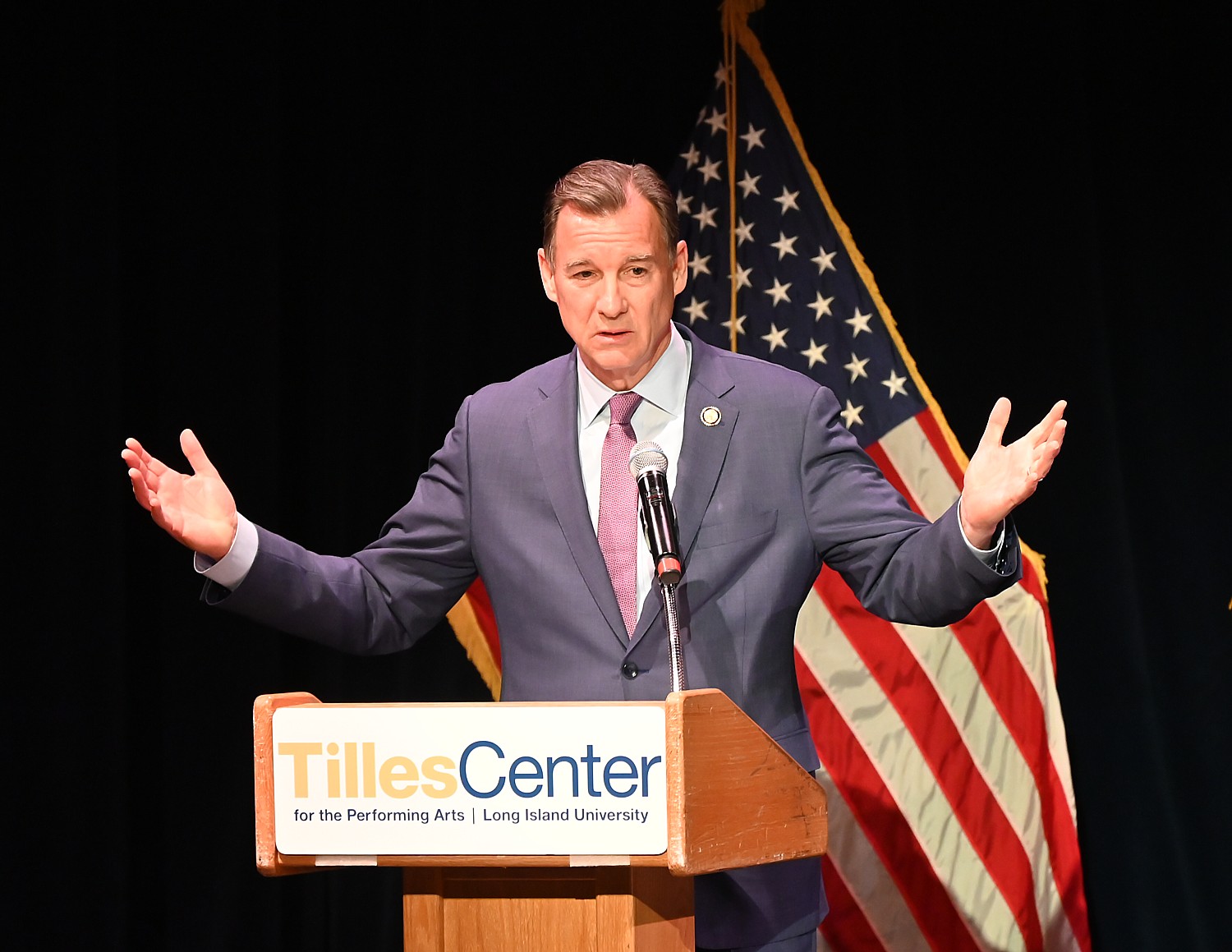
Making another stab at commonsense, reasonable governance, Congressmen Tom Suozzi (D-NY) and Brian Fitzpatrick (R-PA) have offered bipartisan legislation to break the impasse that has led to the longest government shutdown, caused extraordinary difficulty for Homeland Security federal workers, for travelers, left the country vulnerable after climate disaster and emergencies and exposed the nation to terror attacks at a time of war. House Speaker Mike Johnson, doing Trump’s bidding, refused to take up the compromise bill that was passed by the Senate by unanimous consent, prolonging the national misery, while Trump tried to make himself the White Knight by paying TSA (but not the others). The Coast Guard, FEMA, and counter-terrorism agents remain unpaid after more than 40 days – Karen Rubin, editor@news-photos-features.com
Washington, D.C.—Today, Congressmen Tom Suozzi (D-NY) and Brian Fitzpatrick (R-PA) unveiled their Reforming ICE and Protecting America Act, bipartisan legislation to fully fund the Department of Homeland Security (DHS) for Fiscal Year 2026 while enacting targeted, enforceable reforms to Immigration and Customs Enforcement (ICE).
The legislation comes after weeks of deadlock in Washington over immigration enforcement, during which no serious proposal emerged that both kept DHS fully funded and delivered real ICE reform.
The Reforming ICE and Protecting America Act meets both imperatives: fully funding DHS while bringing ICE in line with the standards of every other law enforcement agency in the United States.
“Government should never be brought to a standstill—certainly not when homeland security is on the line and the consequences are borne by TSA agents, Coast Guard servicemembers, FEMA personnel, frontline DHS employees, and the American people. This debate began with a legitimate call for real ICE reform, yet after weeks of political deadlock, no serious solution emerged. The right course was clear from the start: keep the Department of Homeland Security fully funded and confront the problem before us with real reform. That is precisely what this bill does. It is time to do what should have been done from the beginning: govern, reform, and protect,” said Fitzpatrick.
“The American people are fed up. The chaos at our airports was awful, the Department of Homeland Security has not been fully funded during these very dangerous times, and the people are demanding that ICE live up to the standards of all other federal law enforcement. They are sick and tired of the endless blame game and they are demanding that we work together to solve the very real problems we face,” said Suozzi. “This legislation cuts through the dysfunction. It’s rooted in common sense; let’s fund DHS, keep our country safe, and hammer out real reforms of ICE.”
Drawing on Fitzpatrick’s more than 15 years as an FBI Special Agent and Suozzi’s experience overseeing the nation’s 11th largest police department as Nassau County Executive, the legislation was developed with direct input from federal law enforcement officials and in consultation with Members of the Problem Solvers Caucus and Senate partners, including the Chair of the Senate Appropriations Committee.
The Reforming ICE and Protecting America Act would:
Fully fund DHS for FY26 and keep the Department operational across its core security, disaster response, and public safety missions.
Bring ICE in line with standardized law enforcement policies through body cameras, a limitation on masks, visible identification, standardized uniforms and training, and independent investigations of officer-involved shootings.
Focus enforcement where it belongs—on violent offenders and the most serious threats to public safety.
Protect due process and prevent abuse through probable-cause and warrant requirements in key enforcement contexts, including protections against the knowing detention of U.S. citizens without probable cause.
Establish clear guardrails for sensitive locations by limiting civil immigration enforcement at schools, health care facilities, places of worship, polling places on election day, childcare facilities, and private home residences absent a warrant, except in exigent circumstances.
Protect law enforcement personnel and their families by strengthening penalties for doxxing and expanding protections for sensitive personal information.
Ensures CBP remains focused on its intended mission: securing the border.
Last week, Fitzpatrick and Suozzi announced they were developing a bipartisan path to fully fund DHS while advancing real ICE reform. The bill introduced today is the product of that effort.
Watch the Congressmen talk about their efforts here and here.
Proposal Would Fix Chaos at American Airports, Mandate ICE Standards Consistent with Other Federal Agencies, Target Enforcement on “Worst of the Worst”
Senate Democrats have tried 10 times to pass legislation to fully fund TSA so the officers could get paid and relieve the abominable lines at airport security, to fully fund FEMA, the Coast Guard, and cybersecurity, more important than ever in light of heightened terror threats since Trump’s unprovoked, illegal Iran War. But each time, Republicans have blocked it.
Think of it. When Americans are most vulnerable, Trump and the Republicans are willing to let national security collapse in order to continue to allow ICE illegally detain, arrest, incarcerate in inhumane concentration camps, without any accountability.
And now, when Republicans are ready to say “uncle,” Trump has told them he does not want them to work with Democrats. Think of it – that’s more than half the country that he doesn’t care about, especially since his approval rating is now around 36%.
What is more, since he came up with the brilliant idea (like a paper clip!), which actually came from a woman calling in to a talk show, to install the ICE thugs at airports, under the pretense of relieving the burdens of the TSA agents who remain on the job despite not being paid in a month, he has actually fallen in love with the fact that the ICE agents aren’t helping relieve travelers’ misery at all (in fact, they are like SCABs in a union action), but are in place to continue extra-judicial, unconstitutional arrests, detentions, deportations.
Trump has also tied passing any new legislation to the Congress passing his SAVE Act, whose singular purpose is to suppress voting by disenfranchising potentially millions of women, Blacks, seniors, college students, and anyone else who tends to vote for Democrats. So Trump has little incentive to adopt this legislation proposed by Congressmen Tom Suozzi (D-NY) and Brian Fitzpatrick (R-PA). But good try, guys.
Meanwhile, I’m sick of people blaming Democrats or “Congress,” instead of putting the blame for the chaos, confusion, misery, suffering, and impending collapse of our economy, democracy, national security by Trump and his Republican enablers. –Karen Rubin, editor@news-photos-features.com
Washington, D.C.— Congressman Tom Suozzi (D-NY) and Congressman Brian Fitzpatrick (R-PA) announced that they are working on bipartisan legislation to immediately re-open the Department of Homeland Security (DHS) while advancing commonsense reforms to Immigration and Customs Enforcement (ICE).
At a moment when Washington remains deadlocked, the Suozzi-Fitzpatrick effort offers a serious bipartisan path to restore full DHS operations while pairing that action with targeted reforms to improve public trust and strengthen accountability within ICE.
“People are standing in long lines at our airports, TSA agents are not getting paid, FEMA is going unfunded, and Americans are becoming increasingly frustrated that instead of solving problems, politicians in Washington are pointing fingers. Congressman Fitzpatrick and I are trying to cut through the dysfunction, isolate the problem areas where negotiations have stalled, and work together to get things done,” said Congressman Suozzi.“Ultimately, ICE is a law enforcement agency that needs to be held to the same professional standards as every other law enforcement agency in the United States. Unfortunately, ICE has been operating in a fashion I believe is illegal and immoral. It’s not a radical idea to ask them to answer to the same safety and transparency requirements as every other police officer and federal agent in the country.
“Protecting the American people is among the first obligations of government, and that means ensuring the Department of Homeland Security is fully funded and fully operational. It also means ensuring that those entrusted with enforcing the law operate under clear, consistent standards that preserve public trust. I have long believed that, at its core, law enforcement is a social contract built on trust on both ends. This effort would restore DHS operations, reinforce clear and uniform standards across federal law enforcement, and keep enforcement focused on the most serious threats to public safety. That is how we restore the mission, strengthen enforcement, and renew public confidence in the institutions charged with protecting the American people,” said Congressman Fitzpatrick.
The proposed reforms are being developed to fully restore DHS operations while establishing ICE standards consistent with those of other law enforcement agencies. In shaping this effort, the Congressmen have engaged directly with federal law enforcement officials, while drawing on Congressman Fitzpatrick’s more than 15 years as an FBI Agent and Congressman Suozzi’s experience overseeing the nation’s 11th largest police department as Nassau County Executive.
The legislation would require that all federal law enforcement agencies, including ICE, are held to the same high standards and policies as it pertains to training requirements, the use of body cameras, independent investigation of use-of-force at scenes, clear outer identification of the agency engaged in the enforcement action, cooperation with local law enforcement, and a prohibition of masks during enforcement actions coupled with tougher penalties for doxxing. It would also lay out stronger warrant requirements and rules governing activity in sensitive locations to ensure enforcement resources are focused on the “worst of the worst.”
Last week, the Senate failed to advance DHS funding for the fifth time, extending a stalemate that has left the Department unfunded since February 13 and is taking a serious toll on TSA staffing, airport operations, and DHS’s ability to fully carry out its mission. At the same time, the deadlock has made clear that any durable solution must not only reopen DHS, but also address the need for credible, commonsense reforms that strengthen accountability within ICE.
Governor Kathy Hochul today declared a state of emergency and announced new actions in response to the Trump administration stripping food assistance from 3 million New Yorkers come November 1. As the GOP federal government shutdown continues, the Trump administration has refused to release billions in statutorily approved federal contingency funding that would address this crisis in states across the nation. By refusing to release this contingency funding, the federal government is leaving millions of New Yorkers without critical assistance they rely on to feed themselves and their families.
While Washington Republicans refuse to act to avert this crisis, Governor Hochul is stepping up by committing an additional $65 million in new State funds for emergency food assistance that will reinforce New York’s network of vital food bank and pantry partners and provide about 40 million meals to hungry New Yorkers. The Governor is also deploying Empire State Service Corps and SUNY Corps Members to support local food banks during this emergency period of increased need, and continuing to explore food hubs at schools.
“The Trump Administration is cutting food assistance off for three million New Yorkers, leaving our state to face an unprecedented public health crisis and hurting our grocers, bodegas and farmers along the way,” Governor Hochul said. “Unlike Washington Republicans, I won’t sit idly by as families struggle to put food on the table. Today, I’m declaring a state of emergency and am committing additional state funds for emergency food assistance to ensure New Yorkers don’t go hungry. Donald Trump and Republicans in Congress have the power to stop this crisis — millions of families depend on it.”
Since the inception of the program, SNAP benefits have been federally funded. New York administers approximately $650 million per month in federally funded SNAP benefits to nearly 3 million New Yorkers. Given the scale of the program, Governor Hochul along with governors across the country have repeatedly emphasized that no state government can replace SNAP benefits or backfill the program.
Here’s a look at what today’s announcement means for New Yorkers:
$65M in new State funds for programs that support food banks, pantries, soup kitchens and more to provide emergency food assistance to New Yorkers
$40M in new funding for the Hunger Prevention and Nutrition Assistance Program, which provides emergency food relief and nutrition services to food-insecure populations. HPNAP works in partnership with a network of about 2,700 Emergency Food Providers (EFPs), including food pantries, soup kitchens, and shelters.
$25M in new funding for Nourish NY, which supplies surplus agricultural products (e.g., milk, apples, cheese, yogurt, cabbage, squash) to populations who need them through the State’s network of food relief organizations (i.e., regional food banks, food pantries, soup kitchens, and community-based organizations that provide food for free to persons experiencing food insecurity).
Deploying Empire State Service Corps and SUNY Corps Members to support food banks
Currently, hundreds of SUNY students serve as peer navigators, helping fellow students complete SNAP applications and assisting at campus and local food pantries.
The Empire State Service Corps will allow current members to expand their paid hours, enabling them to provide greater support at food pantries statewide. In addition, new short-term crisis response positions will be created to assist food pantries and food banks facing staffing shortages.
Today’s announcement comes as New York, along with 24 other states, sued the Trump administration on Tuesday to demand the release of emergency SNAP funds. The Governor also joined a letter alongside 20 other Governors to the President, calling for the Administration to reverse course and release emergency SNAP funds. Governor Hochul also fast-tracked $41 million in state funds for emergency food assistance earlier this week — today’s announcement brings the total of allocated state funds to $106 million.
New York State Health Commissioner Dr. James McDonald said, “The federal government’s refusal to release emergency food assistance will have devastating consequences for families already struggling to make ends meet. Access to nutritious food is a fundamental public health necessity — it affects everything from childhood development to chronic disease prevention. Under Governor Hochul’s leadership, the State Health Department is working closely with food banks, local health departments and community organizations to ensure no New Yorker goes hungry during this crisis. These actions reflect our shared commitment to protecting the health and well-being of all New Yorkers.”
New York State Education Commissioner Betty A. Rosa said, “No student should have to choose between focusing on their education and worrying about their next meal. In response to the recent cuts to SNAP benefits, our agencies are coming together to make sure no student is left behind. This is a team effort, working hand in hand with our partners in government, communities, and local organizations to build a safety net that ensures that hunger never stands in the way of learning and opportunity.”
New York State Office of Temporary and Disability Assistance Commissioner Barbara C. Guinn said, “SNAP recipients, most of whom are children, older adults or individuals with a disability, count on SNAP every month to feed their families. The federal government’s callous decision to cut off federal funding for SNAP recipients for the first time in the program’s history underscores this administration’s lack of understanding of the difficult economic realities facing nearly 3 million New Yorkers and millions more of our fellow Americans. Now is a pivotal moment for our federal government to honor its long-standing social safety-net obligations. We are grateful for Governor Hochul’s leadership and commitment to fighting on behalf of New Yorkers and demanding accountability from federal officials.”
New York State Agriculture Commissioner Richard A. Ball said, “I am grateful for our Governor’s swift response to the federal government’s senseless and reckless cuts that will put millions of New Yorkers in jeopardy of not having enough food to put on the table, stress the emergency food system, and impact our farmers in the process. By providing additional, critical funding to our feeding assistance programs, such as Nourish NY, we will be able to help our food banks and food pantries purchase and make available more local farm products to our communities in need. This is one more step in New York’s efforts to fight back and ensure we do everything we can to maintain support of our families and our farmers.”
House Democratic Leader Hakeem Jeffries said, “From day one, Donald Trump and rubber-stamp Republicans have waged an all-out assault on the health, safety and well-being of the American people. Their latest attempt to rip food out of the mouths of children, seniors and veterans who have served our country honorably is a disgusting dereliction of duty and makes clear that the cruelty is the point. Instead of finding money to pay off wannabe dictators in Argentina, Donald Trump should use the money that was appropriated by Congress to make sure that 42 million Americans do not go hungry and lose their SNAP benefits. I am grateful to Governor Hochul for her strong leadership and her principled commitment to making sure that every single New Yorker can put food on the table. It’s time for Republicans in Washington to do the same.”
State Senator Cordell Cleare said, “Over 3 million New Yorkers rely on SNAP including almost 1 million of our beloved Older New Yorkers. The program is a lifeline and provides a baseline of humanity and quality of life for those seeking just to simply provide for themselves and their family. It shocks the conscience that Trump and Congressional Republicans would hold families hostage like this, bulldozing the White House and plowing under the well-being of millions. I join the Governor in not only calling out the hypocrisy but in making certain that New York steps up to the plate and funds SNAP with state resources.”
State Senator Michelle Hinchey said, “Starting Saturday, the Trump administration will cut off SNAP benefits, leaving 3 million New Yorkers without enough to eat. SNAP is one of our country’s most effective anti-hunger programs, and taking it away is a cruel abdication of the federal government’s duty. We have to take every action to protect New Yorkers from the food insecurity created by the Trump administration, and I thank Governor Hochul for this new funding and support for food pantries, which will help us fight against this crisis.”
Assemblymember Rebecca A. Seawright said, “As Chair of the Assembly Committee on Aging, I applaud Governor Hochul for taking swift action to safeguard millions of New Yorkers from losing the food assistance they rely on. Older adults are among the most vulnerable to food insecurity, and the continued refusal of the federal government to release emergency SNAP funds is unconscionable. The Governor’s investment will strengthen our food banks and pantries, ensuring seniors and families can continue to access the nutrition they need to live with dignity. I stand with Governor Hochul in calling for the immediate release of federal contingency funding and for protecting the health and well-being of every New Yorker.”
New York Common Pantry Executive Director Stephen Grimaldi said, “The Government shutdown will have serious adverse effects for SNAP recipients on November 1st, impacting the working poor, elderly, children and the disabled. We’ve got to do better. The federal government must continue to provide SNAP funds to ensure people are fed or millions will flood food pantries and soup kitchens, overwhelming the emergency feeding network. We’ve just served the largest number of households coming for Pantry services in one day, in anticipation of the cuts.”
Food Bank For NYC CEO and President Leslie Gordon said, “Amid surging food insecurity rates, the Federal shutdown has created so much uncertainty and devastating long lasting impact for so many. We are incredibly grateful for the Governor’s leadership. Her support, along with that of the State government, allows us to continue to meet the growing need and serve every neighbor with dignity.”
Sharing Excess CEO Evan Ehlers said, “While we face a growing crisis of food access, the U.S. continues to waste nearly 40% of its food supply, throwing away ten times more food than we need to feed everyone. At Sharing Excess, we’re committed to redirecting that surplus to communities in need, and we’re thrilled to partner with Governor Kathy Hochul and r4 to make a meaningful difference for families across New York during a critical time of need.”
Governor Kathy Hochul today called out Washington Republicans for cutting critical safety and security funding for New York’s mass transit system. The Metropolitan Transportation Authority (MTA) had been slated to receive $34 million in federal Transit Security Grant Program funds, which support essential counter-terror and transit security functions. Last week, lawmakers were notified that the MTA was to be the only agency of 21 applicants nationwide to not receive federal security dollars via this program.
“Keeping New Yorkers safe, from our streets to our subways, is my highest priority,” Governor Hochul said. “Since 9/11, New York has relied on federal support to ensure that our transit system has the counterterrorism resources it needs to keep millions of riders safe every single day. The shocking actions of Washington Republicans to slash these funds and defund the police put New York City at risk. We will not tolerate these cuts; New York will take every action available to us — including the courts — to ensure the MTA gets this critical funding to keep millions of riders safe.”
The Transit Security Grant Program was started after 9/11. Administered by the Federal Emergency Management Agency (FEMA), these grants support critical functions to keep mass transit systems safe from security threats. The MTA carries a significant portion of the United States’ mass transit riders, with over 6 million daily trips taken on Metro-North, the Long Island Rail Road, and New York City Transit. In addition to approximately $12 million which would go to the NYPD, the MTA had planned to utilize this year’s grant funding to support the following public safety and counter-terror investments:
Two cybersecurity projects, extending cyber visibility into MTA’s key systems, and a cyber lab to develop protections and vet operational technology systems.
The procurement and deployment of approximately 330 tactical cellular cameras to replace & expand upon current unsecure offline devices in a cost-effective manner.
The expansion of MTA weapons of mass destruction chemical detection system across 9 subway lines and a commuter rail terminal.
The TSA mandated frontline security awareness training of 16,000 MTA employees.
374 deployments of MTAPD counterterrorism teams.
The procurement of 3 MTAPD counterterrorism coordination and response vehicles.
The installation of several hundred cameras, access control points, and laser intrusion detection systems at a major subway complex.
“What the federal government is doing to us is a stark moment of hypocrisy, literally threatening our ability to keep these operations safe, our ability to protect public transit riders compromised,” Governor Hochul said during a press conference. “Homeland Security Secretary Kristi Noem is trying her very best to slash $35 million in funds for security on subway system–a person who swore an oath, as we all did, to protect Americans.
“Clearly defunding police without justification has no rational other than to punish blue states like New York. Of the 20 regions that applied for security funding, New York is the only one that has been denied.”
Governor Hochul chided the seven Republican New York members of Congress who pretend to “back the blue” and be the party of “law and order” for not standing up against these cuts.
Just this week, Attorney General Pam Bondi, deflecting from questioning from Senate Democrats on the Oversight Committee, repeated the meme that Democrats want to defund police. But it is Trump, her Department of Justice and Department of Homeland Security that are defunding police and public safety in cities and states led by Democrats.
“We are the #1 terror target in America – not just 9/11, but countless cases have thwarted. We are safer because of the invested dollars from federal, city and state together. That’s what is in jeopardy – our safety compromised.”
NYPD Commissioner Jessica Tisch said, “The NYPD’s counterterrorism operations are essential to keeping people safe both above ground and below ground on our subways. Withholding these critical funds from the busiest transit system in the country is a profound mistake, and one that will make New York City’s subways meaningfully less safe. Counterterrorism operations – and public safety in general – cannot be politicized, and I thank Governor Hochul for her efforts to ensure the NYPD has the resources it needs to protect New Yorkers.”
Tisch said that eight terror plots against the New York City subway system have been foiled since 9/11.
Following initial reporting that the MTA would not receive Transit Security Grant Program funding, the Office of the New York Attorney General filed suit in the Southern District of New York, which issued a Temporary Restraining Order barring FEMA from executing the cuts. To date, FEMA has not formally notified the MTA that their funding has been restored.
New York State and the NYPD continue to make significant investments in subway safety. These investments, which support an ongoing surge of NYPD officers in the subway system — including overnight train patrols announced by Governor Hochul in her 2025 State of the State address — have succeeded in reducing transit crime to historic lows in 2025. In 2022, Governor Hochul directed the MTA to install cameras in all 6,000 of its subway cars, which it completed last year. To further enhance safety, this year, the MTA began installing brighter, safer LED lights in all 472 subway stations as well as platform edge barriers to improve customer safety at 100 stations throughout the system.
Subway crime in September was down 31 percent from September 2024, and year-to-date, crime is down 4.3 percent compared to 2024. This summer was the safest summer in the subway since 2009, with major crimes down nearly 10 percent from 2024. Felony assaults in the transit system were down in September, and were down every month this summer when compared with the same month last year.
“Under Governor Hochul’s leadership, MTA has made huge progress on every front – safety, reliability and ridership,” MTA Chair and CEO Janno Lieber said. “It’s truly strange that Washington keeps spinning stories about subway crime, but then defunds the NYPD and MTA cops who patrol the system.”
MTA Chief Security Officer Michael Kemper said, “I can’t overstate the importance of this grant funding in reinforcing and advancing our counterterrorism initiatives. It significantly enhances our operational capabilities, all with the goal of providing a safe and secure transit environment for our riders and workforce — a responsibility we take seriously every single day.”
Last week, Governor Hochul successfully fought to restore $187 million in critical counterterrorism and homeland security funding cuts which had been planned by the Department of Homeland Security. These unprecedented cuts would have had a direct impact on public safety agencies throughout the state.
Nassau County, NY County Executive Bruce Blakeman has spent his entire time in office honing to the MAGA Trump Republican line in an attempt to curry favor – perhaps a position in the administration. He never fails to attack Democrats – cashless bail, affordable housing, gun safety – instead of working together with state and local leaders to improve lives, public health and safety of constituents. He is sitting on hundreds of millions of dollars of federal funding from the Biden administration, and blaming Biden for opioid addiction he attributes to “open borders”, rather than spend the funds from the opioid settlement on treatment. He has proved complicit with the Trump administration’s cruel and unconstitutional crackdown on undocumented migrants rather than address the real public safety threats, including historic levels of traffic fatalities and injuries and outsized incidents of violent crime, including gun and domestic violence, when the state and New York City are seeing significant drops.Instead, he has diverted funds to create a private militia and banned wearing mask in public (but not for the migrant capturers).
He actually refused to show up when Governor Kathy Hochul came to the county to announce hundreds of millions of dollars invested in a new state-of-the-art world-class gene therapy research lab, and had told the governor months before to “never set foot” in his county. He also left a ceremony announcing the completion of a $10 million Downtown Revitalization grant program before the Governor began her remarks.
Instead of seeking out state funding for climate action, infrastructure and economic development, or working collaboratively to increase the supply of affordable housing, he diverted $10 million in tourism promotion funding from Discover Long Island, a professional tourism marketing organization, to a home-based branding person with no experience or contacts in tourism marketing, and used $5 million in television commercials to market himself in places like Oklahoma.
This op-ed penned by Nassau County Legislator Olena Nicks provides an inside view of what happens when elected officials only practice politics for the sake of political power rather than governing for the benefit of constituents – that is, all constituents, not just to appease their own voters. –Karen Rubin, editor@news-photos-features.com
Olena Nicks, of Uniondale, was elected to the Nassau County Legislature in a February 2025 special election. She represents Nassau’s Second Legislative District.
By Olena Nicks
My first five months as a Nassau County Legislator have been an eye-opening lesson in the operations of government, and it has reinforced my belief in how necessary bipartisanship is for a strong government to function effectively and equitably. Unfortunately, as the old saying goes, absence makes the heart grow fonder.
Nassau County Executive Bruce A. Blakeman’s hyper-partisan approach to local government has erected unnecessary roadblocks, creating an indelible impression in my mind of the tremendous obstacles that are created by such an approach.
Since the start of this Legislative term, County Executive Blakeman has processed dozens of Community Revitalization Project (CRP) grants for districts served by Republicans, thereby allowing 50 of their requests to reach the Legislative calendar in regular order. Meanwhile, he has stonewalled every request for districts served by Democratic legislators, delaying funding for improvements to local parks, schools and libraries and impeding the delivery of resources for the firefighters, EMS, and local police that keep us all safe.
As a longtime Uniondale Fire Department member, it is mind-boggling that someone would prioritize funding for our first responders based upon political representation. Every first responder steps up to serve and protect the public without fear, favor, or consideration of the party registration of the person they’re helping.
Funding for these grants is allocated to each Legislative district through the County’s capital plan, so the money is already in place. While the County Executive’s role is strictly to process the applications onto the Legislative calendar, he has consistently refused.
This spring, I stood with my Democratic colleagues as we drew a line in the sand. We agreed that we would not release our votes for the Fiscal Year 2025 capital infrastructure plan, which requires a 13-vote supermajority to pass, until the County Executive funded first responders in all of our communities. By including guardrails such as this supermajority requirement for bonding, the drafters of the Nassau County Charter recognized the role of bipartisanship in healthy local government – and the importance of giving the Minority appropriate leverage with which to force an obstinate majority or executive branch to the negotiating table.
Limiting or politicking CRPs is just one example of how dysfunctional government becomes when even routine issues become a political showdown. Consider the following:
Nassau County is the only municipality in our region that does not recognize Juneteenth, which marks the end of slavery in America, as an official holiday. I recently filed legislation, which was introduced in 2021 by former Legislator and current Senator Siela Bynoe, to effectuate this change and require the County to begin good-faith negotiations with our unions. Democrats have filed this four times, and each time, the Republican-controlled Legislature has refused to advance it. A separate measure I co-sponsored to match Suffolk County in recognizing July 1 as Muslim American Appreciation Day has similarly not moved.
Democrats have introduced common-sense legislative proposals to put epi-pens in every police vehicle, equip every park and athletic facility with defibrillators and bundle fentanyl testing strips with every Narcan kit we distribute. The County Executive has blocked each of these with assistance from a Republican Majority that operates more as a rubber stamp than a coequal branch of government.
And, as we speak, the County is sitting on $98 million in proceeds from various settlements with opioid manufacturers, retailers and distributors. To date, County Executive Blakeman has gotten just 9 percent of those funds to agencies that provide prevention, treatment and recovery resources.
Which brings us back to where we are now – the County Executive is still refusing to process our CRPs in regular order. Now, we are fighting for the Blakeman administration to release long-stalled grant funds for local libraries, schools and parks – including $150,000 to modernize Hempstead Village’s Mirschel Park, and $162,150 for a Westbury Fire Department memorial to members who made the ultimate sacrifice while in the line of duty.
To be clear, bipartisanship does not entail sacrificing one’s core values. It calls upon us to seek areas in which we share common goals – supporting our first responders, making communities safer and stronger for our families, and ensuring effective, responsive government. Making one community more vibrant uplifts all of Nassau County, and it is essential for us to work together to achieve that outcome whenever we can.
Although these first several months have brought their share of frustrating moments, I remain optimistic and committed to doing my part to restore a spirit of collaboration to our county and our nation when it is needed the most.
Olena Nicks, of Uniondale, was elected to the Nassau County Legislature in a February 2025 special election. She represents Nassau’s Second Legislative District.
Governor Kathy Hochul today released new data showing the devastating impacts of the Republicans’ “Big Ugly Bill” on New York State – supported by all seven New York Republican congressmembers. The data show the enormous scale of the recently-enacted law, including draconian cuts to Medicaid, hospitals and SNAP benefits, and the impact of those cuts on the millions of New Yorkers who rely on these lifeline programs and services.
“I’ve been very clear: no state can fully undo the damage in this bill or backfill cuts of this scale,” Governor Hochul said. “I’m working with the Legislature to brace for the impact and protect as many New Yorkers as possible because your family is my fight. I will never turn my back on New Yorkers or the values that we share.”
“Our NY GOP Congressmembers have sold out millions of New Yorkers in fear of retribution from Donald Trump,” State Senator Toby Ann Stavisky said. “This disgraceful bill continues a non-stop assault on our nation’s universities and seeks to destroy our educational institutions. I have worked hand-in-hand with Governor Hochul to keep our colleges affordable, accessible and of high quality and will continue to do so. These actions will ultimately hurt poor and middle class families, especially those in upstate and rural areas where our universities are the top economic driver. It’s an utter and complete betrayal of the people of New York State.”
State Senator Samra Brouk said,“The federal administration’s “Big Ugly Bill” betrays Americans by depriving them of health care coverage and raising healthcare costs across the board. It also enacts the largest SNAP cuts in American history. In New York State, many residents will lose healthcare coverage, hospitals will shoulder costs of uncompensated care, and increased medical bills will place a strain on anyone seeking care. Millions of New Yorkers will also be impacted by worsening food insecurity, loss of jobs in the food industry, and decreased SNAP funding for local farmers’ markets. This bill will cause irreparable harm to hardworking families and deepen inequity between working people and the ultra wealthy. New Yorkers deserve better–I will continue to fight for investments in our state, especially for children and working families, and prioritize the welfare of my neighbors.”
Essential Plan/Medicaid Cuts
Republicans’ cuts to health care and other benefits will hurt all New Yorkers. The changes will eliminate insurance coverage for millions of New Yorkers, destabilize health insurance programs statewide, and have an overall fiscal impact on the State and the New York health care system of almost $13 billion per year. These changes will make it harder for providers statewide to keep operating, making it more difficult for all New Yorkers to find care when they need it.
More than 2 million New Yorkers will lose their current insurance coverage, including approximately 730,000 lawfully-present non-citizens who could lose Essential Plan (EP) coverage as over half of EP’s budget — $7.5 billion in federal funding — is eliminated, and a further 1.3 million New Yorkers who will lose Medicaid coverage due to new eligibility and verification hurdles.
Of these 2 million people, 1.5 million New Yorkers are anticipated to become uninsured, with uncompensated care costs to hospitals and providers estimated to rise to over $3 billion annually —which means less access to care and higher medical bills for New Yorkers.
Analysis from the Greater New York Hospital Association (GNYHA) and the Healthcare Association of New York State (HANYS) estimates a total $8 billion in annual cuts to New York’s hospitals and health systems, which could force hospitals to curtail critically needed services such as maternity care and psychiatric treatment, not to mention to downsize operations, and even close entirely. These consequences will not only affect Medicaid enrollees, but also harm everyone who requires hospital care, leading to longer wait times and less access to critical services.
The size and scope of the Rural Transformation Fund included in the law — an average of $10 billion annually for 5 years for rural hospitals nationwide — is wholly inadequate to meet the needs of our State. Adding insult to injury, none of these funds are guaranteed to reach any New York State hospital.
SNAP and Nutrition Assistance
Since the inception of SNAP, the federal government has funded these benefits 100 percent, receiving bipartisan support from presidents of both parties and in Congress.
For the first time in history, the Republicans’ enacted law requires states to contribute to the cost of benefits, or risk having to end their SNAP programs entirely — jeopardizing a program that nearly 3 million New Yorkers rely on to put food on the table. New York State will be required to fund 15 percent of all SNAP benefits starting as early as October 1, 2027, at an estimated cost to the State of $1.2 billion per year. It further cuts the federal share of SNAP administrative costs from 50 percent to 25 percent which will increase costs for the State by roughly $36 million annually, and increase costs for counties and New York City by roughly $168 million annually. Counties will have to begin incorporating this fiscal hit into their 2026 budgets due this fall. In total, New York and local governments are facing up to $1.4 billion in new costs annually.
The law also imposes more punitive administratively complex work requirements on SNAP recipients, which will make it harder to qualify for assistance. As a result, 300,000 households are projected to lose some or all of their SNAP benefits, with an average loss of $220/month, devastating low-income families’ grocery budgets.
The law also cuts funds for the SNAP-Ed New York Program, which promotes healthy eating and efficient use of already modest SNAP benefits by teaching SNAP beneficiaries how to shop for and cook wholesome, healthy meals on a limited budget. As a result, New York will lose $29 million annually that funded this work by 18 community-based organizations throughout the entire State including Cornell Cooperative Extensions in Albany, Allegany, Erie, Wayne, Oneida, Onondaga, Orange, St. Lawrence, Steuben and Suffolk counties.
Beyond worsening food insecurity and malnutrition, cuts to the program will hurt local businesses and weaken SNAP’s ability to boost local economies in every state. The U.S. Department of Agriculture’s (USDA) own research has shown that SNAP benefits have a multiplier effect, with every $1 spent on SNAP benefits generating $1.54 in economic activity as recipients spend their benefits at local businesses in their communities. For New York, where a total of approximately $7.4 billion in SNAP benefits are issued every year, that means $11.5 billion in economic activity is generated annually across urban, suburban, and rural areas alike.
Slashing families’ grocery budgets would reduce revenue for thousands of businesses, with ripple effects throughout the food supply chain. If states are forced to end their SNAP programs, in addition to increasing hunger and poverty, grocery stores in rural areas will struggle to stay open, people in agriculture and the food industry will lose jobs, and State and local economies will suffer:
Lost SNAP sales and matching dollars will have a critical impact on local economies and the more than 18,000 retailers that accept SNAP in New York State, including grocery stores, local shops and more than 400 SNAP-authorized local farmers’ markets and farm stands that can be found in every county in New York selling New York agricultural products to the people in their local community.
SNAP sales in the farming community have dramatically increased since 2019, providing New York consumers access to healthy, farm fresh foods and providing our farm communities additional economic development dollars.
As the State matches SNAP dollars spent at farm markets through the Fresh2You FreshConnect program, the hit to farms of decreased SNAP funding is doubled.
New York State Health Commissioner Dr. James McDonald said, “This bill undermines health care for millions of New Yorkers, dismantles vital services, and places our most vulnerable families in jeopardy. With the support of Governor Hochul, we remain unwavering in our commitment to safeguarding the health and well-being of all New Yorkers, ensuring they continue to receive the care and support they rightfully deserve.”
“The historic cuts and cost shifts related to SNAP enacted last week will take food off the tables of hundreds of thousands of New Yorkers and shift billions of dollars in costs onto the backs of the State and local governments in New York, while weakening the very safety net families rely on when times are hard,” New York State Office of Temporary and Disability Assistance Commissioner Barbara C. Guinn said. :As the State agency tasked with administering SNAP and other essential support programs, we are deeply concerned, not only for the immediate harm to individuals and families, but for the continued erosion of the social safety net that has helped support low-income New Yorkers across the state. At a time when so many households are struggling with the high cost of food, rent, and energy – we should not be reducing access to vital economic supports.”
State Senate Majority Leader Andrea Stewart-Cousins said,“By passing this bill, House Republicans have rubber-stamped Donald Trump’s cruel and dangerous agenda, one that rips Medicaid away from 1.5 million New Yorkers, slashes $13 billion from our healthcare system, and raises costs for working families. As we continue to assess the full scope of these devastating cuts, it’s clear that the damage will leave our state deeply vulnerable. All of the progress we’ve made is under threat. No state can fully fill the hole this bill has blown open but we are committed to doing everything in our power to protect New Yorkers and keep our communities thriving.”
“This bill will devastate the lives of countless families across our state, especially our most vulnerable neighbors,” Assembly Speaker Carl E. Heastie said. “By cutting vital programs like SNAP and Medicaid, the administration has indicated that they care more about the pockets of their billionaire friends than they do about the families, children and people with disabilities that rely on this funding to survive day to day. I am truly disgusted by the public servants – especially New York’s seven Republican members of Congress – who voted for this and continue to lie about the impact this will have on their communities. They should be honest about the fact that they stood by their billionaire donors at a cost of their neighbors’ access to food, healthcare and essential services.”
Assemblymember Amy Paulin said,“As Chair of the Assembly Health Committee, I am deeply alarmed by the catastrophic impacts of the federal bill. Slashing Medicaid and Essential Plan funding will strip health care coverage from over 1.5 million New Yorkers and devastate our hospitals and providers — all while driving up costs for everyone else. These cruel and short-sighted cuts, combined with the gutting of SNAP benefits, will worsen health outcomes, increase hunger, and punish all of us.”
“This bill is a betrayal of the people we are meant to serve. It turns its back on our most vulnerable, gutting the support they need to stay healthy, fed, and secure,” Assemblymember Jo Anne Simon said. “At its core, this bill is a giveaway to the wealthy, sacrificing the needs of hard-working families for billionaires’ gain. As a result, everyday New Yorkers are left with impossible choices and an uncertain future. New York will keep fighting to protect our communities and build a future rooted in care, dignity, and justice.”
Assemblymember Alicia L. Hyndman said, “This so-called ‘Big Ugly Bill’ is a direct assault on the most vulnerable New Yorkers—gutting essential health care, food assistance, and educational opportunity in one fell swoop. The harm is staggering: millions of people could lose health coverage, families will struggle to put food on the table, and students will face higher barriers to higher education. These are not just numbers—they’re lives. We in New York refuse to sit idle while Washington plays politics with our communities’ survival. I stand with Governor Hochul in fighting to protect every New Yorker’s basic dignity, health, and future.”
House Republicans’ are proposing appropriations bills would raise a host of costs for families, hurt students, seniors, and rural communities, slash support for law enforcement, and undermine our economy—while Congressional Republicans fight separately for multi-millionaires and big corporations to get massive tax cuts. Basically going back on the deal that was negotiated just months ago, with Biden saved the nation from its first ever credit default, they are now using extortion, threatening a government shutdown, if they don’t get these cuts, along with policy changes to undermine women’s rights. This fact sheet from the White House details the impacts on individual states.–Karen Rubin/news-photos-features.com
Earlier this year, the President and Congressional leaders reached a bipartisan budget agreement that averted a first-ever default and protected our historic economic progress. The President, House Democrats, Senate Democrats, and Senate Republicans all stand by this promise. Unfortunately, Speaker McCarthy and House Republicans are ignoring the bipartisan budget agreement they passed and instead advancing extreme, partisan appropriations bills that break their public promise and gut key investments in the American people.
House Republicans claim these cuts are about fiscal responsibility—but they aren’t. Not only would their bills add at least $100 billion to deficits over 10 years by making it easier for the wealthy and big corporations to cheat on their taxes, but House Republicans are separately pushing corporate tax giveaways that would cost over $500 billion if made permanent—including at least $30 billion in retroactive tax breaks for investments companies made last year. These retroactive tax cuts alone would erase the savings from their deep cuts to education, health, and labor programs.1
Today, the Office of Management and Budget released 51 fact sheets highlighting the devastating impacts of these extreme cuts on states and the District of Columbia. Below are some of the most harmful elements of House Republicans’ appropriations bills that they will begin to consider this week.
The cuts in the House appropriations bills would:
Slash Funding for Schools with Low-Income Students: House Republicans’ 80 percent cut to Title I funding would impact 26 million students in schools that teach low-income students by forcing a reduction of up to 226,000 teachers, aides or other key staff.
Eliminate Tens of Thousands of Preschool Slots: House Republicans’ cut to Head Start would mean as many as 82,000 children would lose access to high-quality preschool—undermining their education, leaving fewer children ready to enter kindergarten ready to learn, and making it more difficult for parents to join the workforce.
Slash Funding for Law Enforcement: The proposed cut to the FBI would eliminate up to 1,850 personnel, including up to 673 agents, and the Bureau of Alcohol, Tobacco, Firearms and Explosives would be forced to eliminate approximately 400 positions, including more than 200 agents. The House bill also cuts funding for U.S. Attorneys by roughly 12 percent, which would eliminate approximately 1,400 positions.
Raise Housing Costs for Tens of Thousands: The proposed cuts would raise housing costs by eliminating funding for Housing Choice Vouchers for 20,000 households, including approximately 6,000 households headed by seniors. In addition, a nearly 70 percent cut to the HOME Investment Partnerships Program would result in 20,000 fewer affordable homes being constructed, rehabbed, or purchased in communities across the country.
Slash Critical Job Training and Workforce Development Programs: The proposal would result in half a million fewer people receiving job training and employment services. These harmful cuts would deprive businesses of the skilled workforce they need to thrive, and would cut off workers’ pathways to good jobs.
Undermine Critical Health Research: House Republicans’ cuts would undermine critical research efforts to find treatments and cures for diseases like cancer and Alzheimer’s by cutting $3.8 billion for the National Institutes of Health. They would also eliminate funding for the Agency for Healthcare Research and Quality, which would end the Long COVID research at the agency and delay other priority health services research.
In addition to demanding these draconian cuts, House Republicans are also fighting to rescind vital funding that is helping make our tax code fairer, rebuilding America’s infrastructure, lowering costs for families, and tackling the climate crisis. Their proposals would:
Increase Risks of Lead Exposure: The proposal would rescind over $564 million in funding for programs that mitigate housing-related risks of lead poisoning and other illnesses and hazards to lower income families, especially children, resulting in 55,000 fewer homes safe of hazards and adversely impacting approximately 78,000 children.
Protect Wealthy Tax Cheats: While House Republicans separately lay the groundwork for more than $3 trillion in tax cuts skewed to the wealthy and big corporations, they are also fighting to make it easier for wealthy tax cheats to avoid paying what they owe—proposing to rescind $67 billion dollars in funding for the IRS enacted in the Inflation Reduction Act, which would increase the deficit by more than $100 billion.
Increase Energy Costs for Rural Americans: Rescinding $2 billion in funding provided by the Inflation Reduction Act for programs at USDA would undermine programs that help agricultural producers and rural small businesses convert to renewable energy systems, and that help rural Americans to build clean, affordable, and reliable energy by working with approximately 900 electric cooperatives in 47 States.
Shortchange Home Electrification Projects: Rescinding $4.5 billion in funding provided by the Inflation Reduction Act for the High-Efficiency Electric Home Rebate Program would impact at least 250,000 home electrification and appliance upgrade projects in low- and medium-income homes across all States, territories, and tribes.
Undermine Clean Technology Investments and Pollution Reduction: Rescinding $20 billion in funding provided by the Inflation Reduction Act for programs at EPA would take away funds designed to help communities access grant opportunities to reduce pollution and mobilize private capital into clean technology projects, especially in low-income and disadvantaged communities. These programs will spur investment in clean technology projects and expand economic opportunities in communities, helping to cut harmful pollution and protect people’s health while tackling the climate crisis.
Slash Support for Teachers: Rescinding $1.7 billion—or 77 percent—in the Supporting Effective Instruction State Grants (Title II) program would severely undermine the program’s ability to improve the effectiveness of teachers in the classroom.
A deal is a deal. The President and the Speaker already made a bipartisan budget agreement—one that would result in $1 trillion of deficit reduction over the next decade. Every party to that agreement except House Republicans—House Democrats, Senate Democrats, Senate Republicans, and President Biden—are honoring their word. It is a balanced deal that protects critical investments while ensuring fiscal responsibility. We urge House Republicans to follow the law they helped enact and the Senate’s bipartisan approach to funding the government according to the deal.
The White House released a fact sheet detailing President Biden’s proposed budget, aimed at investing in America, lowering costs for working class and middle class families, cutting taxes for working families, and protecting and strengthening Medicare and Social Security. It demonstrates the president’s long-held values that seeks to achieve stable, sustainable economy that grows from the bottom up and the middle out.
President Biden has long believed that we need to grow the economy from the bottom up and middle out, not the top down. Over the past two years, in the face of significant challenges, that economic strategy has produced historic progress for the American people.
Under the President’s leadership, the economy has added more than 12 million jobs—more jobs in two years than any president has created in a four-year term—including 800,000 manufacturing jobs. The unemployment rate has fallen to 3.4 percent, the lowest in 54 years. The Black and Hispanic unemployment rates are near record lows. The past two years were the best two years for new small business applications on record. The President has taken action to lower costs and give families more breathing room, including cutting prescription drug costs, health insurance premiums, and energy bills, while driving the uninsured rate to historic lows. And the President’s plan is rebuilding America’s infrastructure, making the economy more competitive, investing in American innovation and industries that will define the future, and fueling a manufacturing boom that is strengthening parts of the country that have long been left behind while creating good jobs for workers, including those without college degrees.
The President has done all of this while delivering on his commitment to fiscal responsibility. While the previous Administration passed a nearly $2 trillion unpaid-for tax cut with benefits skewed to the wealthy and big corporations while dramatically increasing the deficit, President Biden cut the deficit by more than $1.7 trillion during his first two years in office—the largest decline in American history. And the reforms he signed into law to take on Big Pharma, lower prescription drug costs, and make the wealthy and large corporations pay their fair share will reduce the deficit by hundreds of billions of dollars more over the coming decade.
The President’s Budget details a blueprint to build on this progress, deliver on the agenda he laid out in his State of the Union, and finish the job: continuing to grow the economy from the bottom up and middle out by investing in America, lowering costs for families, protecting and strengthening Medicare and Social Security, and reducing the deficit by nearly $3 trillion over the next decade by making the wealthy and big corporations pay their fair share and cutting wasteful spending on Big Pharma, Big Oil, and other special interests. No one earning less than $400,000 per year will pay a penny in new taxes.
Congressional Republicans have taken a very different approach. While they have consistently said that reducing the deficit is a top priority, Congressional Republicans have already proposed policies that would add an additional $3 trillion to the debt over the next decade—all while raising costs for working families and handing out tax giveaways to the wealthy and big corporations. As the President has made clear, they owe the American people a detailed accounting of exactly what they plan to cut in order to cover the costs of their proposals, while also achieving the kinds of fiscal targets that they claim to support. Until they produce a plan, we’re left to rely on a wide array of Republican budgets, statements, and proposals—past and present—which provide clear and consistent evidence that many critical programs the American people count on will be on the chopping block.
Lowering Costs and Giving Families More Breathing Room
As our economy transitions from a historically strong recovery to stable and steady growth, the President has remained laser-focused on continuing to lower costs for families and giving them more breathing room, without giving up the historic economic gains we’ve made. While more work remains, there are clear signs that the President’s strategy is working. Annual inflation is lower than it was seven months ago, gas prices are down $1.60 per gallon since their peak last summer, and unemployment remains at its lowest level in 54 years, while take home pay has gone up. And the Biden-Harris Administration has taken historic action to lower the costs of health care, clean energy, and prescription drugs, eliminate junk fees that make it harder for families to make ends meet, promote greater competition to lower costs, and address pandemic-driven supply chain bottlenecks. While some Congressional Republicans have proposed repealing the Inflation Reduction Act and taken other actions that would raise costs for working families, the President’s Budget takes a very different approach—proposing a package of policies to continue lowering everyday costs for the American people.
Cuts Taxes for Families with Children and American Workers. The President is calling for the restoration of the full Child Tax Credit enacted in the American Rescue Plan, which cut child poverty in half in 2021, to the lowest level in history. The Budget would expand the credit from $2,000 per child to $3,000 per child for children six years old and above, and to $3,600 per child for children under six. The Budget would also permanently reform the credit to make it fully refundable. The President also calls on the Congress to make the Earned Income Tax Credit expansion for childless workers permanent, which would help pull low-paid workers out of poverty.
Lowers Health Care Costs. The President believes that health care should be a right, not a privilege. With enrollment in affordable health coverage at an all-time high, the Budget builds on the remarkable success of the Affordable Care Act (ACA), by making permanent the average $800 per year premium cuts through expanded premium tax credits that the Inflation Reduction Act extended. It also provides Medicaid-like coverage to individuals in States that have not adopted Medicaid expansion under the ACA, paired with financial incentives to ensure States maintain their existing expansions.
Reduces Prescription Drug Costs for All Americans. The Budget builds upon the Inflation Reduction Act to continue lowering the cost of prescription drugs. For Medicare, this includes further strengthening the newly established negotiation power by extending it to more drugs and bringing drugs into negotiation sooner after they launch. The Budget also proposes to limit Medicare Part D cost-sharing for high-value generic drugs used for certain chronic conditions like hypertension and high cholesterol to no more than $2. For Medicaid, the Budget includes proposals to ensure Medicaid and CHIP programs are prudent purchasers of prescription drugs, authorizing HHS to negotiate supplemental drug rebates on behalf of interested States in order to pool purchasing power. For the commercial market, the Budget includes proposals to curb inflation in prescription drug prices and cap the prices of insulin products at $35 for a monthly prescription.
Expands Access to Quality, Affordable Health Care. The Budget invests $150 billion over 10 years to improve and expand Medicaid home and community-based services, such as personal care services, which would allow seniors and individuals with disabilities to remain in their homes and stay active in their communities as well as improve the quality of jobs for home care workers. And because community health centers—which provide comprehensive services regardless of ability to pay—serve one in three people living in poverty and one in five rural residents, the Budget puts the Health Center Program on a path to double its size and expand its reach. To bolster the health care workforce, the Budget provides a total of $966 million in 2024 to expand the National Health Service Corps, which provides loan repayment and scholarships to health care professionals in exchange for practicing in underserved areas, and a total of $350 million to expand programs that train and support the nursing workforce.
Expands Access to Affordable, High-Quality Early Child Care and Learning. Too many families across America cannot access high-quality, affordable child care—preventing parents from working and holding back our entire economy. The President’s Budget enables states to increase child care options for more than 16 million young children and lowers costs so that parents can afford to send their children to high-quality child care. The Budget also funds a Federal-State partnership that provides high-quality, universal, free preschool to support healthy child development and ensure children enter kindergarten ready to succeed.
Lowers Housing Costs by Increasing Affordable Housing Supply and Expanding Access to Homeownership and Affordable Rent. The President believes that everyone deserves a safe and affordable place to live. To address the critical shortage of affordable housing in communities throughout the country that has exacerbated inflation, the Budget includes $59 billion in mandatory funding and tax incentives aimed at increasing the affordable housing supply, including for extremely low-income households. The Budget also includes $10 billion in mandatory funding to incentivize State, local, and regional jurisdictions to make progress in removing barriers to affordable housing developments, such as restrictive zoning. By expanding the supply of housing, the Budget would help prevent the kind of rapid increases in rental and homeownership costs we have seen in recent years. The Budget also includes $10 billion in mandatory funding for a new First-Generation Down Payment Assistance program to help address racial and ethnic homeownership and wealth gaps—making homeownership more attainable for Americans who have been locked out of the generational wealth building that can come with owning a home. And the Budget expands access to affordable rent through the Housing Choice Voucher (HCV) program to well over 200,000 additional households. In addition to assisting all current voucher recipients and providing new vouchers for tens of thousands of additional families, the Budget includes mandatory funding to support two populations that are particularly vulnerable to homelessness—guaranteed assistance for all 20,000 youth who age out of foster care annually and an incremental expansion to cover the 450,000 extremely low-income (ELI) veteran families nationwide.
Improves College Affordability and Expands Free Community College. The Budget proposes to increase the discretionary maximum Pell Grant by $500—helping more than 6.8 million students pay for college, building on successful bipartisan efforts to increase the maximum Pell Grant award by $900 over the past two years, and laying out a path to double the award by 2029. The Budget also invests mandatory and discretionary funding to expand free community college, and provides mandatory funding for two years of subsidized tuition for students from families earning less than $125,000 enrolled in a participating four-year Historically Black College or University (HBCU), Tribally-Controlled College or University (TCCU), or Minority-Serving Institution (MSI).
Lowers Home Energy and Water Costs. The Budget provides $4.1 billion for the Low Income Home Energy Assistance Program (LIHEAP), building on the $13 billion provided in the Inflation Reduction Act to reduce energy bills for families, expand clean energy, transform rural power production, and create thousands of good-paying jobs for people across rural America. Since the Low Income Household Water Assistance Program (LIHWAP) expires at the end of 2023, the Budget proposes to expand LIHEAP funding and allow States the option to use a portion of their LIHEAP funds to provide water bill assistance to low-income households.
Increases Food Security. As called for in the National Strategy on Hunger, Nutrition and Health, the Budget provides over $15 billion to allow more States and schools to leverage participation in the Community Eligibility Program and provide healthy and free school meals to an additional 9 million children. The Budget also includes $6.3 billion to support the 6.5 million individuals expected to participate in the Special Supplemental Nutrition Program for Women, Infants, and Children (WIC).
Protecting and Strengthening Medicare and Social Security
The President has always believed that Medicare and Social Security are a promise—a rock-solid guarantee generations of Americans have counted on to be able to retire with dignity and security. The President will reject any efforts to cut the Medicare or Social Security benefits that seniors and people with disabilities have earned and paid into their entire working lives. The Budget honors that ironclad commitment—not only by rejecting benefit cuts, but by embracing reforms and investments that will protect and strengthen both programs. The President is committed to working with Congress to ensure Medicare and Social Security remain strong for their beneficiaries, now and in the future.
Protects and Strengthens Medicare. The Budget strengthens Medicare by extending the solvency of the Medicare Trust Fund by at least 25 years, without cutting any benefits or raising costs for beneficiaries. The Budget includes key reforms to the tax code to ensure high-income individuals pay their fair share into the Medicare HI trust fund. It also directs the revenue from the Net Investment Income Tax into the HI trust fund as was originally intended. Finally, the Budget directs the savings from the Budget’s proposed Medicare drug reforms into the HI trust fund.
Protects the Social Security Benefits that Americans Have Earned. The Administration is committed to protecting and strengthening Social Security and opposes any attempt to cut Social Security benefits for current or future recipients. The Administration looks forward to working with the Congress to responsibly strengthen Social Security by ensuring that high-income individuals pay their fair share. The Budget also invests in staff, information technology, and other improvements at the Social Security Administration, providing an increase of $1.4 billion, a 10 percent increase, over the 2023 enacted level. These funds would improve customer service at Social Security Administration field offices, State disability determination services, and teleservice centers for retirees, individuals with disabilities, and their families.
Growing the Economy from the Bottom up and Middle Out by Investing in America and Its People
The Budget proposes smart, targeted investments to grow the economy from the bottom up and middle out, not the top down, by investing in America and its people—investing in the foundations of our country’s economic strength; confronting the climate crisis while creating clean energy jobs; and advancing equity, dignity, and opportunity and strengthening our democracy.
Investing in the Foundations of Our Economic Strength
Invests in American Manufacturing. The Budget provides $375 million for the National Institutes of Standards and Technology’s (NIST) Industrial Technology Services to support the progress of NIST’s existing manufacturing institute, fund a new institute to be launched in 2023, and promote domestic production of institute-developed technologies. The Budget also includes $277 million for the Manufacturing Extension Partnership, a public-private partnership that offers advisory services to small and medium enterprises.
Makes Historic Investments in Innovation and Cutting-Edge Research. The Budget provides almost $21 billion in discretionary spending for CHIPS and Science Act-authorized activities. This funding includes $1.2 billion for the CHIPS and Science Act-authorized Directorate for Technology, Innovation, and Partnerships to help accelerate and translate scientific research into innovations, industries, and jobs, as well as $300 million for NSF’s Regional Innovation Engines program to galvanize use-inspired research, technology translation, and workforce development. Within DOE’s Office of Science, the Budget also supports cutting-edge research in artificial intelligence, quantum information sciences, microelectronics, and isotope production at the national laboratories and universities. In addition, the Budget requests $4 billion in new mandatory funding for the Regional Technology and Innovation Hub Program at the Economic Development Administration. And the Budget provides $210 billion for Federal research and development, an historic level of investment in American science, technology and innovation.
Provides National, Comprehensive Paid Family and Medical Leave and Calls for Paid Sick Leave for All Workers. Workers power our economy—and when they thrive, our economy thrives. The Budget proposes to establish a national, comprehensive paid family and medical leave program, providing up to 12 weeks of leave to allow eligible workers to take time off to care and bond with a new child; care for a seriously ill loved one; heal from their own serious illness; address circumstances arising from a loved one’s military deployment; or find safety from domestic violence, sexual assault, or stalking. The President also calls on Congress to require employers to provide seven job-protected paid sick days each year to all workers.
Expands Workforce Training that Provides Pathways to Good Jobs. The Budget invests in evidence-based training models to ensure all workers—including women, workers of color, and workers in rural areas—have the skills they need for the good jobs being created by the President’s historic legislative accomplishments. The Budget invests $335 million in Registered Apprenticeship, an earn-and-learn model, to provide debt-free pathways to careers in construction, clean energy, semiconductor manufacturing, and other in-demand industries. The Budget also provides $200 million for the new Sectoral Employment through Career Training for Occupational Readiness (SECTOR) program, which will support development and expansion of public-private partnerships to equitably deliver high-quality training in growing industries, and invests $100 million to help community colleges partner with employers and the public workforce system to design and deliver effective training models in communities across the Nation.
Invests in High-Poverty Schools. The Budget provides $20.5 billion for Title I, a $2.2 billion increase above the 2023 enacted level, delivering critical funding to 90 percent of school districts across the Nation and helping them provide students in low-income communities the academic opportunities and support they need to succeed. This increase in funding addresses chronic funding gaps between high-poverty schools—which disproportionately serve students of color—and their wealthier counterparts.
Taking Historic Action to Cut Energy Bills for Families and Confront the Climate Crisis While Creating Clean Energy Jobs Across America
Cuts Energy Bills for Families and Creates Jobs Building Clean Energy Infrastructure. The Budget invests $4.5 billion in clean energy across America, bringing jobs to rural communities and cities, leaving no one behind. The Budget supports clean energy workforce development and sustainable infrastructure projects across the country, including $1.8 billion to weatherize and retrofit low-income Americans’ homes, and $83 million to electrify Tribal homes and transition Tribal Colleges and universities to renewable energy.
Makes Historic Investments in Science & Research to Continue to Cut the Cost of Clean Energy. To boost American innovation and sustain American leadership in research and scientific discovery, the Budget also provides a historic investment of $16.5 billion in climate science and clean energy innovation. The Budget includes $3.5 billion of the $8.8 billion total for DOE’s Office of Science and $1.6 billion at NSF, and makes advancements toward the CHIPS and Science Act authorizations, including $1 billion for fusion, the largest ever investment in the promise of a clean energy power source.
Cuts Global Warming Pollution. The Budget invests in reducing global warming pollution and achieving the President’s target to cut greenhouse gas emissions 50-52 percent by 2030. These investments include an additional $64.4 million at EPA to implement the American Innovation and Manufacturing (AIM) Act and continue phasing out potent greenhouse gases known as hydrofluorocarbons (HFCs). The Budget supports $1.2 billion in DOE industrial decarbonization activities.
Helps Increase Climate Resilience and Bolsters Conservation. The Budget invests more than $24 billion to help build communities’ resilience to floods, wildfires, storms, extreme heat, and drought brought on by climate change, expand conservation and ecosystem management, strengthen America’s natural disaster response capabilities, increase the resilience of rural housing to the impacts of climate change while reducing rent burdens, and ensure the resilience of our nation’s defense to climate change.
Advances Equity and Environmental Justice. The Administration continues to prioritize efforts to deliver environmental justice in communities across the United States, including meeting the President’s Justice40 Initiative to ensure that 40 percent of the overall benefits of Federal investments in climate and clean energy reach disadvantaged communities, including rural and Tribal communities. The Budget bolsters these efforts by investing nearly $1.8 billion at EPA across numerous programs that will support securing environmental justice for communities that bear the brunt of toxic pollution and climate change. The Budget also provides EPA $219 million to help remediate lead contamination in water, an increase of $163 million over the 2023 enacted level.
Increases Global Energy Security, Infrastructure, and Resilience. The Budget supports the President’s pledges to more than quadruple international climate finance and to provide more than $3 billion for the President’s Emergency Plan for Adaptation and Resilience (PREPARE). This includes a $1.6 billion contribution to the Green Climate Fund and a $1.2 billion loan to the Clean Technology Fund. The Budget also advances new tools, such as loan guarantees, to re-assert U.S. leadership in the Indo-Pacific to finance energy security and infrastructure projects and reduce reliance on volatile energy supplies and prices.
Expanding Access to High-Quality Health Care and Improving Health Outcomes
Advances Maternal Health and Health Equity. The United States has the highest maternal mortality rate among developed nations, and rates are disproportionately high for Black and American Indian and Alaska Native women. The Budget includes $471 million to reduce maternal mortality and morbidity rates; expand maternal health initiatives in rural communities; implement implicit bias training for health care providers; create pregnancy medical home demonstration projects; and address the highest rates of perinatal health disparities, including by supporting the perinatal health workforce. In addition, the Budget requires all States to provide continuous Medicaid coverage for 12 months postpartum, eliminating gaps in health insurance at a critical time.
Advances Cancer Moonshot Goals. The Cancer Moonshot aims to reduce the cancer death rate by at least 50 percent over the next 25 years and improve the experience of people who are living with or have survived cancer, their families, and caregivers. The Budget includes $1.7 billion for dedicated Cancer Moonshot activities across the Department of Health and Human Services (HHS), in addition to targeted investments at the Departments of Veterans Affairs, Defense, Agriculture, and other Cancer Cabinet agencies, and a total investment of $7.8 billion at the National Cancer Institute (NCI) to drive progress on ways to prevent, detect, and treat cancer. The Budget also provides an increase of $1 billion for the Advanced Research Projects Agency for Health (ARPA-H), for a total of $2.5 billion, to drive innovative health research and speed the implementation of breakthroughs that would transform the treatment, prevention, and early detection of cancer and other diseases.
Transforms Behavioral Health Care. The United States is facing a mental health crisis. While recently enacted legislation takes significant steps to address this crisis, much more can be done. For people with private health insurance, the Budget expands coverage of mental health benefits and strengthens the network of behavioral health providers. For people with Medicare, the Budget lowers patients’ costs for mental health services, requires parity in coverage between behavioral health and medical benefits, and expands coverage for behavioral health providers. The Budget provides historic investments in the behavioral health workforce, youth mental health care, Certified Community Based Behavioral Health Clinics, Community Mental Health Centers, and mental health research.
Making Our Communities Safer, Advancing Equity and Opportunity, and Strengthening American Democracy
Invests in Federal Law Enforcement, Community Violence Interventions, and Prevention to Combat Gun Violence and Other Violent Crime. The Budget continues to fund the President’s comprehensive Safer America Plan, including funding to put 100,000 additional police officers on our streets for accountable, community-oriented policing; $19.4 billion over 10 years for crime prevention strategies; and $5 billion over 10 years for community violence interventions. The Budget also includes $17.8 billion for DOJ law enforcement, including a total of nearly $2 billion for the Bureau of Alcohol, Tobacco, Firearms, and Explosives (ATF) to expand multijurisdictional gun trafficking strike forces with additional personnel, increase regulation of the firearms industry, and implement the Bipartisan Safer Communities Act. The Budget also includes $1.9 billion for the U.S. Marshals Service to support personnel dedicated to fighting violent crime, as well as $51 million to the Federal Bureau of Investigation (FBI) to support the continued implementation of enhanced background checks required by the Bipartisan Safer Communities Act.
Prioritizes Efforts to End Gender-Based Violence. The Budget proposes $1 billion to support implementation of programs through the Violence Against Women Act of 1994 (VAWA), which was recently reauthorized and strengthened in 2022. The Budget supports substantial increases for longstanding VAWA programs, including key investments in legal assistance for victims, transitional housing, and sexual assault services. The Budget also includes $519 million for the Family Violence Prevention and Services (FVPSA) program and the National Domestic Violence Hotline to support domestic violence survivors—double the 2023 enacted level.
Advances Child and Family Well-Being in the Child Welfare System. The Budget proposes to expand and incentivize the use of evidence-based foster care prevention services to keep families safely together and reduce the number of children entering foster care. The Budget provides States with support to place more foster children with relatives or other adults who have an existing emotional bond with the children, while also providing additional funding to support youth who age out of care without a permanent caregiver. In addition, the Budget proposes to make the adoption tax credit refundable and to extend the credit to legal guardianships. This would reduce the financial burden on low- and moderate-income families wishing to pursue adoption, as well as for families who opt for legal guardianship.
Strengthens Our Democracy. To continue efforts to restore and strengthen American democracy, the Budget proposes $5 billion in new election assistance funding to be allocated over 10 years, $1.5 billion to support increasing the living allowance provided to AmeriCorps members so that national service is a more accessible pathway to success, and $73 million to support American history and civics education programs.
Keeping America Safe and Confronting Global Challenges
Even as he has taken decisive action to strengthen America at home, the President has worked with allies and partners to confront pressing global challenges. The Budget builds on that progress through proposals to continue addressing threats to global security and strengthening the U.S. military, addressing pressing global challenges, strengthening border security and the U.S. immigration system, and honoring America’s commitment to veterans, servicemembers, families, caregivers, and survivors.
Supports Ukraine, European Allies, and Partners. The Budget continues support for Ukraine, the United States’ strong alliance with the states of the North Atlantic Treaty Organization (NATO), and other European partner states by prioritizing funding to enhance the capabilities and readiness of U.S. forces, NATO allies, and regional partners in the face of continued Russian aggression.
Invests in New Ways to Out-Compete China and Deepens Alliances and Partnerships in the Indo-Pacific. China is the United States’ only competitor with both the intent to reshape the international order and, increasingly, the economic, diplomatic, military, and technological power to do it. During these unprecedented and extraordinary times, the Budget requests both discretionary and mandatory resources to out-compete China and advance American prosperity globally. The mandatory proposal will strengthen the U.S. role in the Indo-Pacific, and advance the U.S. economy by investing $2 billion to create a new International Infrastructure Fund to support “hard” critical infrastructure; $2 billion to create a new equity revolving fund at the U.S. International Development Finance Corporation to support equity investments; and $2 billion to make game-changing investments in the Indo-Pacific to strengthen partner economies and support their efforts in pushing back against predatory efforts. As part of this mandatory proposal, the Budget also requests a total of $7.1 billion over the next 20 years for the Compacts of Free Association with the Freely Associated States of the Marshall Islands, Micronesia, and Palau.
Promotes Integrated Deterrence in the Indo-Pacific and Globally. The Budget prioritizes China as America’s pacing challenge in line with the 2022 National Defense Strategy. The Department of Defense’s 2024 Pacific Deterrence Initiative highlights $9.1 billion of targeted investments the Department is making to U.S. force posture, infrastructure, presence, and readiness as well as efforts to bolster the capacity and capabilities of U.S. allies and partners in the Indo-Pacific region.
Strengthens Democracy and Promotes Human Rights Globally. The Budget provides more than $3.4 billion to advance democratic governance and foster democratic renewal globally. The Budget would strengthen free and independent media, fight corruption, bolster democratic institutions, advance technology for democracy, promote gender equality and women’s civic and political participation, and defend free and fair elections and political processes.
Enhances Border Security and Immigration Enforcement. Strengthening border security and providing safe, lawful pathways for migration remain top priorities for the Administration. The Budget includes nearly $25 billion for U.S. Customs and Border Protection (CBP) and Immigration and Customs Enforcement (ICE). The Budget includes funds for CBP to hire an additional 350 Border Patrol Agents, $535 million for border technology at and between ports of entry, $40 million to combat fentanyl trafficking and disrupt transnational criminal organizations, and funds to hire an additional 460 processing assistants at CBP and ICE.
Expands Health Care, Benefits, and Services for Military Environmental Exposures. The PACT Act represents the most significant expansion of VA health care and disability compensation benefits for veterans exposed to burn pits and other environmental exposures in more than 30 years. As part of the PACT Act, the Congress authorized the Cost of War Toxic Exposures Fund (TEF) to fund increased costs above 2021 funding levels for health care and benefits delivery for veterans exposed to a number of environmental hazards—and ensure there is sufficient funding available to cover these costs without shortchanging other elements of veteran medical care and benefit delivery. The Budget provides $20.3 billion for the TEF in 2024, which is $15.3 billion above the 2023 enacted level.
Reducing Deficits by Nearly $3 Trillion by Making the Wealthy and Big Corporations Pay Their Fair Share and Cutting Wasteful Spending on Big Pharma, Big Oil, and Special Interests
After inheriting historically high deficits from the previous Administration, President Biden told the American people he would reduce the deficit, pay for his proposals, and ensure that no one making less than $400,000 a year would pay a penny more in new taxes. That’s exactly what he has done—and exactly what he will continue to do.
The President’s Budget builds on the record-breaking deficit reduction he achieved during his first two years in office. It more than fully pays for its investments, reduces deficits by nearly $3 trillion over the next decade by making the wealthy and big corporations pay their fair share and cutting wasteful spending on Big Pharma, Big Oil, and other special interests, and ensures that no one making less than $400,000 per year will pay a penny more in new taxes.
The Budget reflects the President’s ironclad belief that we need a tax system that rewards work, not wealth—and that ensures the wealthiest Americans and biggest corporations don’t pay lower tax rates than teachers or firefighters. That’s in sharp contrast with Congressional Republicans, who in recent months have proposed policies that would add $3 trillion to the debt over the next decade while handing out tax giveaways to the wealthy and big corporations.
Building on the progress the President has already made to promote a fairer tax code, the Budget proposes additional reforms that would ensure the wealthy and corporations pay their fair share while cutting wasteful spending on Big Pharma, Big Oil, and other special interests.
Proposes a Minimum Tax on Billionaires. The tax code currently offers special treatment for the types of income that wealthy people enjoy. While the wages and salaries that everyday Americans earn are taxed as ordinary income, billionaires make their money in ways that are taxed at lower rates, and sometimes not taxed at all. This special treatment, combined with sophisticated tax planning and giant loopholes, allows many of the wealthiest Americans to pay lower rates on their full income than many middle-class households pay. To finally address this glaring problem, the Budget includes a 25 percent minimum tax on the wealthiest 0.01 percent.
Ensures Corporations Pay Their Fair Share. The Budget includes an increase to the rate that corporations pay in taxes on their profits. Corporations received an enormous tax break in 2017, cutting effective U.S. tax rates for U.S. corporations to a low of less than 10 percent. While their profits soared, their investment in the economy did not. Their shareholders and top executives reaped the benefits, without the promised trickle down to workers, consumers, or communities. The Budget would set the corporate tax rate at 28 percent, still well below the 35 percent rate that prevailed prior to the 2017 tax law. This tax rate change is complemented by other proposals to incentivize job creation and investment in the United States and ensure large corporations pay their fair share.
Stops the Race to the Bottom in International Corporate Tax and End Tax Breaks for Offshoring. For decades, countries have competed for multinational business by slashing tax rates, at the expense of having adequate revenues to finance core services. Thanks in part to the Administration’s leadership, more than 130 nations signed on to a global tax framework to finally address this race to the bottom. Building on that framework, the Budget proposes to reform the international tax system to reduce the incentives to book profits in low-tax jurisdictions, stop corporate inversions to tax havens, and raise the tax rate on U.S. multinationals’ foreign earnings from 10.5 percent to 21 percent. These reforms will ensure that profitable multinational corporations pay their fair share.
Quadruples the Stock Buybacks Tax. Last year, the President signed into law a surcharge on corporate stock buybacks, which reduces the differential tax treatment between buybacks and dividends and encourages businesses to invest and grow as opposed to funneling tax-preferred profits to foreign shareholders. The Budget proposes quadrupling the stock buybacks tax from one percent to four percent to address the continued tax advantage for buybacks and encourage corporations to invest in productivity and the broader economy.
Repeals Trump Tax Cuts for the Wealthy and Reform Capital Gains Tax to Ensure the Wealthy Pay Their Fair Share. The 2017 tax law lowered rates for the wealthiest Americans, delivering massive tax cuts to the top one percent. The Budget repeals the Trump tax cuts for the highest-income Americans, restoring the top tax rate of 39.6 percent for single filers making more than $400,000 a year and married couples making more than $450,000 per year. It also proposes taxing capital gains at the same rate as wage income for those with more than $1 million in income and finally closes the carried interest loophole that allows some wealthy investment fund managers to pay tax at lower rates than their secretaries.
Cuts Wasteful Spending on Big Pharma, Big Oil, and Other Special Interests, Combats Fraud, and Makes Programs More Efficient. The Budget puts forward reforms that cut wasteful spending on Big Pharma, Big Oil, and other special interests, crack down on fraud, and strengthen program integrity—saving taxpayers hundreds of billions of dollars. For example, the Budget cuts Federal spending by $160 billion—and saves billions of dollars for seniors—by increasing the number of drugs Medicare can select for negotiation and bringing more drugs into the negotiation process sooner, building on the Inflation Reduction Act’s reforms. It also includes a package of reforms to crack down on systemic fraud—combatting identity theft and other fraud in Unemployment Insurance, increasing funding for the Anti-Pandemic Fraud Strike Force, and investing in Inspectors General.
Further evidence that President Joe Biden’s economic plan – essentially building the economy from the bottom up and the middle out, and creating longterm, sustainable, stable growth – is working. Despite the manufactured hysteria over inflation and impending recession, the data shows otherwise – in terms of record 12 million jobs created, lowest unemployment in 50 years, real increase in wages.
Biden is also able to show progress in slowing inflation – which has been much more crippling throughout the world – and has been able to demonstrate that while his economic policies will address the national debt (a record reduction in the budget deficit), Republicans’ agenda would worsen the national debt (largely caused by the Trump/GOP tax plan that reduced taxes on the wealthiest individuals and corporations, and which added $7.4 trillion, or 25% of the national debt, in the four-year term). The Republican plan would actually add $3 trillion MORE to the national debt.
President Biden, commenting on the January CPI Report, said:
“Inflation in America is continuing to come down, which is good news for families and businesses across the country. Today’s data confirm that annual inflation has fallen for seven straight months. Inflation for food at the grocery store came down again last month. Gas prices are down about $1.60 from their peak last year. And real wages for working Americans are up over the last seven months, delivering welcome breathing room for American families. We are seeing this progress even as unemployment remains at its lowest level since 1969 and job growth remains resilient.”
“There is still more work to do as we make this transition to more steady, stable growth, and there could be setbacks along the way. That is why my unwavering focus is on continuing to lower costs for families, rebuild our supply chains, and invest in America. Right now, because of the Inflation Reduction Act we passed last year, we are lowering prescription drug costs, health care costs, and home energy costs for tens of millions of Americans all while lowering our deficits. My administration is eliminating junk fees which make it harder for American families to make ends meet at the end of the month. And we are creating manufacturing jobs all across the country, which will lower costs and rebuild our supply chains.”
“Unfortunately, many of my Republican friends in Congress seem intent on taking us in the opposite direction. They have proposed repealing the Inflation Reduction Act, which would make inflation worse, shower billions of dollars on Big Pharma, and increase the deficit. They are threatening to raise costs for seniors by threatening to cut Medicare and Social Security, and other critical programs that American seniors and families count on. And some are threatening to default on the full faith and credit of the U.S., which would raise costs and create economic chaos. I will stand firmly against any effort to make inflation worse and increase costs for families. Today’s data reinforces that we have made historic progress and are on the right track, and now we need to finish the job. “
The Congressional Republican Agenda to Increase the Debt by Over $3 Trillion
CongressionalRepublicanleaders insist that the national debt is among our nation’s greatest challenges, and reducing it is among their highest priorities. In fact, they claim that reducing the debt is so urgent it warrants endangering the entire U.S. economy through debt limit brinksmanship. But their legislative agenda to date points in a very different direction—with proposals that would increase the debt by over $3 trillion.
The first bill passed by the new Republican House majority increased the debt by $114 billion by allowing wealthy people and corporations to continue to cheat on their taxes.
Congressional Republicans proposed repealing—and are even running ads attacking—reforms President Biden signed to lower prescription drug costs. Repealing these policies would increase the amount of money Medicare pays Big Pharma, raise costs for seniors, and add $159 billion to the debt.
House Republicans have advocated and proposed repealing tax increases on large corporations that President Biden has signed into law, adding $296 billion to the debt.
House Republicanleaders have also committed to extend the expiring Trump tax cuts, a $2.7 trillion debt increase that would give the top 0.1% (with incomes over $4 million per year) a $175,000 annual tax cut, over 2.5 times a typical family’s annual income.
Grover Norquist, President of Americans for Tax Reform, exposed the political logic of Congressional Republicans’ fiscal hypocrisy. He told Republicans their focus should be “not the deficit” after all: it’s to shift public discussion to cutting spending, paving the way for more tax cuts for the wealthy.
That trickle-down economic theory has never worked. President Trump and President Bush’s tax cuts addedtrillions to the debt and failed to deliver their promised benefits for the economy or American workers. And taking revenues—and even savings from cutting corporate subsidies—off the table means Congressional Republicans consistently propose deep cuts to programs seniors and middle-class and working families count on.
That’s why the American people deserve to see Congressional Republicans’ full and detailed budget plan and compare it with the President’s Budget plan to invest in America, bring down costs for families, protect and strengthen Social Security and Medicare, and reduce the deficit, which he will release March 9.
Congressional Republicans’ Commitment to Debt Increases
The fiscal consequences of the debt increases Congressional Republicans have put at the top of their agenda are stark. After a decade, these policies, if enacted, would add over $3 trillion to the debt (accounting for debt service costs), increasing debt as a share of the economy by almost 10 percentage points. Congressional Republicans’ debt increases include:
The Tax Cheats Protection Act: House Republicans’ first bill in the new Congress would add $114 billion to the Federal debt by repealing President Biden’s legislation that cracks down on wealthy tax cheats. While working people pay 99% of taxes on their income from wages and salaries, the top 1% hides about 20% of their income from tax, including by funneling it through offshore accounts and tax havens that do not report earnings. President Biden passed a law to make our tax system fairer by cracking down on wealthy tax cheats, while protecting middle-class taxpayers and small businesses and improving taxpayer service. But 221 House Republicans voted to enable tax fraud by wealthy Americans and large corporations.
Increase Spending With a Handout to Big Pharma: House Republicans have introduced a bill to repeal the entire Inflation Reduction Act (IRA), including the reforms President Biden signed into law to lower prescription drug costs. Congressional Republicans and Big Pharma have launched a concertedattack on the IRA’s prescription drug reforms, advocating to increase both Federal spending and seniors’ costs to increase Big Pharma’s profits. Thanks to the new prescription drug law, Medicare will finally be able to negotiate drug prices, and drug companies will pay rebates to Medicare if they try to hike their prices faster than the rate of inflation. Congressional Republicans want to repeal these policies, giving a $159 billion handout to Big Pharma, raising costs for seniors, and driving up the Federal debt.
Enrich Multi-Billion Dollar Corporations: In 2020, 55 of the largest, most profitable corporations paid $0 in taxes. The President signed into law legislation to level the playing field for companies and small businesses that are already paying their fair share in taxes. Under his corporate minimum tax, the largest, most profitable corporations—those with over $1 billion in profits—have to pay a 15% minimum tax on the profits they report to their shareholders. But House Republicans—through their Inflation Reduction Act repeal bill and other statements—have made clear that they want to enrich large corporations that don’t pay their fair share. That would add $222 billion to the debt.
Increase the Tax Subsidy for Stock Buybacks: President Biden signed into law a surcharge on corporate stock buybacks, which reduces the differential tax treatment between buybacks and dividends and encourages businesses to invest in their growth and productivity as opposed to paying out corporate executives or funneling tax-preferred profits to foreign shareholders. The President in his State of the Union address proposed quadrupling the stock buybacks tax to 4% to address the continued tax advantage for buybacks and encourage long-term investment over giveaways to executives. House Republicans instead want to repeal the stock buybacks tax and let corporations continue to funnel tax-preferred profits to shareholders instead of investing in productivity and the broader economy. That would add $74 billion to the Federal debt.
Extend President Trump’s Unpaid-for Tax Giveaway to the Wealthy and Large Corporations: President Trump and Congressional Republicans deliberately sunset portions of their tax giveaway to the wealthy and large corporations. They did this to conceal how much their plan added to the debt as well as how large the tax breaks were for multi-millionaires and large corporations. Now, House RepublicanLeadership has made clear that extending President Trump’s tax giveaway to the wealthy and large corporations is one of their top priorities. An analysis by the Tax Policy Center found that doing so would mean an average tax cut of $175,000 for the top 0.1%—Americans making more than $4 million per year. That average tax cut is more than 2.5 times a typical family’s annual income. Meanwhile, extending the expiring Trump tax cuts would add $2.7 trillion to the Federal debt over 10 years.
The President supports a fiscally responsible approach to continuing current tax policies for people making less than $400,000 per year, and opposes any tax increase for this group. Meanwhile, Congressional Republicans—including the more than three quarters of them who are signatories to Grover Norquist’s tax pledge—have made clear they will oppose paying for middle-class tax cuts by raising taxes on the wealthy and large corporations.
Even Without a Budget, Congressional Republicans Are Already Showing Who Will Pay the Price
The proposals Congressional Republicans have put forward show that, even as they commit to massive tax cuts for the wealthy and large corporations, they are more than ready to raise taxes on middle-class and working families. The House Republican IRA repeal bill would cut premium tax credits that are helping an estimated 14.5 million people pay for health insurance. And the House Budget Committee last week doubled down on eliminating Affordable Care Act premium tax credits for middle-income people with high health insurance premiums: a tax increase of $7,600 per year for a typical 62-year old earning $55,000.
In addition, some Congressional Republicans continue to push a national retail sales tax bill that would repeal most existing taxes and impose a new 30% sales tax on American families. The legislation would increase debt by trillions—and cut taxes for a couple making a million dollars a year by more than $200,000—and at the same time would raise taxes by at least $7,000 for a retired couple with $60,000 in Social Security income and at least $6,000 for a single mom making $38,000, a recent analysis found.
The bottom line is: having committed to over $3 trillion in debt increases and also insisted they are committed to reducing the debt, Congressional Republicans owe the American public a complete and transparent accounting of who will foot the bill. Will it be middle-class and working families, seniors, students, or all of the above?
House Republican agenda amounts to a death panel for Medicare and Social Security:
The contrast in agendas for America between President Joe Biden and the Democrats and the Congressional Republicans could not be more stark.
While President Biden, in his State of the Union address, described his plans for building on the historic job creation he has achieved, making more progress against inflation, reducing the deficit by making the wealthy and big corporations pay their fair share, and protecting Medicare and Social Security benefits from cuts, in contrast, House Republicans opened the week by announcing the latest in a long succession of attempts to undermine Medicare and Social Security.
Bloomberg reports that as part of a ransom demand for not triggering a financial meltdown, top House Republicans want an agreement that both earned benefits programs are put on track for cuts.
As The Washington Post reported in late January, House Republicans have continuously pressed for slashing Medicare and Social Security benefits in exchange for not actively harming the American economy with the first debt default in our history.
Republicans have also introduced legislation to repeal the Inflation Reduction Act, which would be one of the biggest Medicare benefit cuts in history, depriving seniors of lower insulin costs, the $2,000 cap on out of pocket expenses for prescription drugs, and Medicare’s new ability to negotiate lower drug costs.
Today’s news is even more confirmation that House Republicans are taking direct aim at programs that are critical to the middle class, even as they vote for tax giveaways to the rich that would manage to increase taxes on working families while raising the deficit at the same time, the White House stated.
“With the President poised to announce new plans to keep making our economy works from the bottom up and the middle out – not the top down – House Republicans are dead-set on the opposite,” said White House spokesperson Andrew Bates. “They’re opening the week unveiling their latest in a long line of ultimatums about how they’ll act to kill jobs, businesses, and retirement accounts if they can’t cut Medicare and Social Security benefits. Meanwhile, they’re voting to worsen the deficit with tax welfare for the rich and big corporations. Think about that: they’re targeting the Medicare and Social Security benefits that middle class families pay in to earn their whole lives, then turning around and giving tax handouts to big corporations. The American people want more jobs and lower costs, not a death panel for Medicare and Social Security.”
“While President Biden shows the American people his plan to build on the unprecedented deficit reduction his leadership has already delivered, by having the richest taxpayers and big corporations pay their fair share and lowering prescription drug prices, House Republicans’ only plan is to make the deficit skyrocket by over $3 trillion with unaffordable tax giveaways to wealthy special interests,” stated White House spokesperson Andrew Bates. “They’ve even proposed raiding Medicare so that the ultra-rich can enjoy new tax welfare. Meanwhile, House Republicans are threatening to actively throw our economy into a tailspin with a default – which they have a non-negotiable, Constitutional duty to prevent – unless they can further cut Social Security, Medicare and Medicaid. It’s utterly backwards. The President is delivering on his commitment to build an economy that grows from the bottom up and the middle out – not from the top down. The House GOP seems determined to pull the American economy in the opposite direction, increasing taxes on working families while giving $3 trillion in new handouts for the rich.”
The chart below is based on the record:
Policy
10-Year Deficit Increase
Republican House-passed bill to make it easier for billionaires to cheat on their taxes
Republican Proposals to repeal Inflation Reduction Act’s prescription drug savings, which will raise costs for seniors and Medicare and increase federal spending
Deficit increases from Republican proposals to date
Over $3 trillion
Congressional Republicans keep calling for earned benefits on the one hand, but more tax giveaways for the rich on the other
After President Biden put Republicans on the defensive over their long-public intentions to slash Medicare and Social Security benefits, a continuing list of congressional Republicans ranging from Ron Johnson last week to Senator Mike Rounds yesterday, keep proving his point.
Whether it’s a large number of House Republicans and Rick Scott pushing to repeal the Inflation Reduction Act in what would be one of the worst Medicare benefit cuts of all time, or the Republican Study Committee proposing benefit cuts and the privatization of Social Security of last year, the receipts are undeniable. Formonths, congressional Republicans have indicated they would even use the threat of a catastrophic default to cut Medicare and Social Security benefits.
Republicans in Congress justify these intentions under the guise of fiscal responsibility. However, at the same time, they are advocating for enormous tax giveaways to rich special interests that, combined, would add over $3 trillion to the debt. Those two positions are irreconcilable.
The first vote the Republican-controlled House took was to help wealthy individuals and multinational corporations worsen inflation by cheating on their taxes. They broadly support renewing the Trump tax giveaways for the rich. And in addition to being a Medicare benefit cut, repealing the Inflation Reduction Act would at the same time be more tax welfare for the rich and a giant windfall for Big Pharma. And that’s just the tip of the iceberg.
“It’s irreconcilable to support Medicare and Social Security benefit cuts in the name of supposed ‘fiscal responsibility,’ while at the same time adding $3 trillion to the national debt with a seemingly endless gravy train for rich special interests,” said White House spokesperson Andrew Bates. “Prioritizing tax giveaways for the wealthy and specific handouts for Big Pharma over the Medicare and Social Security benefits that middle class families pay to earn throughout their lives is a recipe for making our economy work from the top-down. The last thing that Americans who’ve felt invisible want is cuts to lifeline programs in exchange for permanent trickle-down economics.”
This is President Joe Biden’s statement about his FY2023 budget proposal:
Budgets are statements of values, and the budget I am releasing today sends a clear message that we value fiscal responsibility, safety and security at home and around the world, and the investments needed to continue our equitable growth and build a better America.
My Administration is on track to reduce the federal deficit by more than $1.3 trillion this year, cutting in half the deficit from the last year of the previous Administration and delivering the largest one-year reduction in the deficit in U.S. history. That’s the direct result of my Administration’s strategy to get the pandemic under control and grow the economy from the bottom up and the middle out. We spent less money than the last Administration and got better results: strong economic growth, which has increased revenues and allowed us to responsibly scale back emergency spending. My budget will continue that progress, further reducing the deficit by continuing to support the economic growth that has increased revenues and ensuring that billionaires and large corporations pay their fair share.
At the same time, my budget will make investments in securing our nation and building a better America. We will secure our communities by putting more police on the street to engage in accountable community policing, hiring the agents needed to help fight gun crime, and investing in crime prevention and community violence intervention.
I’m calling for one of the largest investments in our national security in history, with the funds needed to ensure that our military remains the best-prepared, best-trained, best-equipped military in the world. In addition, I’m calling for continued investment to forcefully respond to Putin’s aggression against Ukraine with US support for Ukraine’s economic, humanitarian, and security needs.
My budget also makes the investments needed to reduce costs for families and make progress on my Unity Agenda – including investments to cut the costs of child care and health care; help families pay for other essentials; end cancer as we know it; support our veterans; and get all Americans the mental health services they need.
All told, it is a budget that includes historic deficit reduction, historic investments in our security at home and abroad, and an unprecedented commitment to building an economy where everyone has a chance to succeed.
And here’s what in the Biden budget:
FACT SHEET: The President’s Budget for Fiscal Year 2023
Under the President’s leadership, America is on the move again. We created more than 6.5 million jobs in 2021, the most our country has ever recorded in a single year. Our economy grew at 5.7 percent, the strongest growth in nearly 40 years. And the unemployment rate has fallen to 3.8 percent, the fastest decline in recorded history. At the same time, the deficit fell last year—by around $300 billion. This progress was a direct result of the President’s strategy to grow the economy from the bottom up and the middle out and his effective management of the American Rescue Plan—a strategy that was built on smart, fiscally prudent investments that helped jumpstart our economy.
As our historic economic and labor market recovery continues, the President’s Budget projects that the deficit in 2022 will be more than $1.3 trillion lower than last year’s—the largest ever one-year decline in our country’s history. The strongest economic growth in four decades, powered by the American Rescue Plan, has also contributed to a historic decline in the deficit—by fueling strong revenue growth and allowing the Administration to responsibly phase down emergency pandemic-related spending.
Today, the President released a Budget that details his vision to expand on our economic and fiscal progress—investing in our economy and our people while cutting deficits, improving our country’s long-term fiscal outlook, and keeping the economic burden of debt low.
As he made clear in his State of the Union address, the President is committed to working with Congress to enact legislation that lowers costs for American families, expands the productive capacity of the American economy, and further reduces the deficit: by reducing prescription drug costs and fixing the tax code to ensure corporations and wealthy people pay the taxes they already owe and close loopholes they exploit.
The President’s FY 2023 Budget also proposes additional smart, targeted investments designed to spur durable economic growth, create jobs, reduce cost pressures, and foster shared prosperity. These investments are more than fully paid-for through tax reforms that ensure corporations and the wealthiest Americans pay their fair share, while also fulfilling the President’s ironclad promise that no one earning less than $400,000 per year will pay an additional penny in new taxes. Overall, the Budget reduces deficits by more than $1 trillion over the next 10 years and deficits under the Budget policies would fall to less than one-third of the 2020 level the President inherited.
The Budget improves our country’s long-term fiscal outlook while also delivering on the ambitious agenda the President laid out in his State of the Union address—to build a better America, reduce costs for families, advance equity, and grow our economy from the bottom up and the middle out. It proposes significant new investments in proven strategies to reduce gun crime and keep our communities safe. It makes additional investments in the American people that will help lay a stronger foundation for shared growth and prosperity. It advances a bipartisan unity agenda through proposals to take on the mental health crisis, combat the opioid epidemic, support our veterans, and accelerate progress against cancer. And during what will be a decisive decade, it strengthens our military and leverages America’s renewed strength at home to meet pressing global challenges, deepen partnerships and alliances, and manage crises as they arise.
PUTTING THE NATION ON A SOUND FISCAL AND ECONOMIC COURSE
The Budget proposes smart, targeted, fully-offset investments while also cutting deficits, improving our country’s long-term fiscal outlook, and keeping the economic burden of debt low. The Budget’s investments are more than paid for with tax reforms focused on making sure the rich and the largest corporations pay their fair share, reducing deficits by over $1 trillion over the next 10 years.
Proposes a New Minimum Tax on Billionaires. The tax code currently offers special treatment for the types of income that wealthy people enjoy. This special treatment, combined with sophisticated tax planning and giant loopholes, allows many of the very wealthiest people in the world to end up paying a lower tax rate on their full income than many middle-class households. To finally address this glaring problem, the Budget includes a minimum tax on multi-millionaires and billionaires who so often pay indefensibly low tax rates. This minimum tax would apply only to the wealthiest 0.01 percent of households—those with more than $100 million—and over half the revenue would come from billionaires alone. It would ensure that, in any given year, they pay at least 20 percent of their total income in Federal income taxes.
Ensures Corporations Pay Their Fair Share. The Budget also includes an increase to the rate that corporations pay in taxes on their profits. Corporations received an enormous tax break in 2017. While their profits have soared, their investment in our economy did not: the tax breaks did not trickle down to workers or consumers. Instead of allowing some of the most profitable corporations in the world to avoid paying their fair share, the Budget raises the corporate tax rate to 28 percent, still the lowest tax rate faced by corporations since World War II except in the years after the 2017 tax cut. This increase is complemented by other changes to the corporate tax code that incentivize job creation and investment in the United States and ensure that large corporations pay their fair share.
Prevents Multinational Corporations from Using Tax Havens to Game the System. For decades, American workers and taxpayers have paid the price for a tax system that has rewarded multinational corporations for shipping jobs and profits overseas. Last year, the Administration rallied more than 130 countries to agree to a global minimum tax that will ensure that profitable corporations pay their fair share and will incentivize U.S. multinationals to create jobs and invest in the United States. The Budget contains additional measures to ensure that multinationals operating in the United States cannot use tax havens to undercut the global minimum tax.
Advancing Legislation to Lower Costs, Reduce the Deficit, and Expand Productive Capacity
The President is committed to working with Congress to sign legislation that lowers costs for American families, reduces the deficit, and expands the productive capacity of the American economy. That means cutting costs for prescription drugs, healthcare premiums, child care, long-term care, housing, and college; reducing energy costs by combatting climate change and accelerating the transition to a clean energy economy; supporting families by providing access to free, high-quality preschool, up to two years of free community college, nutritious food at school and resources to purchase food over the summer months, and paid family and medical leave and by continuing the enhanced Child Tax Credit and Earned Income Tax Credit; and providing health coverage to millions of uninsured Americans. The President believes these proposals must be paired with reforms that ensure corporations and the wealthiest Americans pay their fair share, including ensuring that they pay the taxes they already owe.
Because discussions with Congress continue, the President’s Budget includes a deficit neutral reserve fund to account for a future agreement, preserving the revenue from tax and prescription drug reforms the President proposed last year for this legislation for the investments needed to bring down costs for American families and expand our productive capacity.
BUILDING A BETTER AMERICA
The Budget includes smart, targeted investments in the American people that will help build a better America. It will keep our communities safe and combat violent crime; promote job creation and expand the productive capacity of our economy; improve our public health infrastructure; ensure America leads the world in combating the climate crisis; and advance equity and opportunity for all. It strengthens our military and leverages America’s renewed strength at home to meet pressing global challenges, deepen partnerships and alliances, and manage crises as they arise.
Combating Crime to Keep Our Communities Safe
Puts More Police Officers on the Beat. The Budget provides $3.2 billion in discretionary resources for State and local grants, and $30 billion in mandatory resources to support law enforcement, crime prevention, and community violence intervention, including putting more officers for community policing on the beat across the Nation.
Provides More Tools to Tackle Gun Violence. The Budget provides $1.7 billion for the Bureau of Alcohol, Tobacco, Firearms, and Explosives (ATF) to expand multijurisdictional gun trafficking strike forces with additional personnel, increase regulation of the firearms industry, enhance ATF’s National Integrated Ballistic Information Network, and modernize the National Tracing Center.
Increases Federal Law Enforcement Capacity to Combat Violent Crime. Under the President’s Budget, key Federal law enforcement agencies like the FBI and U.S. Marshals Service will have the resources they need fight violent crime, including through fugitive apprehension and enforcement operations. The Budget also ensures U.S. Attorneys have the necessary support to prosecute violent crimes.
Strengthens Civil Rights Enforcement. The Budget makes important investments to support law enforcement while addressing longstanding inequities and strengthening civil rights protections. The Budget invests $367 million, an increase of $101 million over the 2021 enacted level, at the Department of Justice to support police reform, the prosecution of hate crimes, enforcement of voting rights, and efforts to provide equitable access to justice.
Supports Criminal Justice System Reform. The Budget includes $100 million for a historic multi-agency collaboration to provide comprehensive workforce development services to people in the Federal prison system and proposes $106 million to support the deployment of body-worn cameras to DOJ’s law enforcement officers.
Promoting Job Creation, Reducing Cost Pressures, and Boosting Productive Capacity
Increases Affordable Housing Supply. In communities throughout the country, rents are skyrocketing and homeownership is becoming increasingly out of reach. This strains family budgets and holds back our economy – making it harder for workers to afford to live near good jobs and good transportation options. To address the critical shortage of affordable housing in communities throughout the Nation, the Budget proposes $50 billion for housing construction and supply – addressing existing market gaps and helping to stabilize housing prices over the long-term. This includes funding, via the Department of Housing and Urban Development, for state and local housing finance agencies and their partners to provide grants, revolving loan funds, and other streamlined financing tools to boost housing supply, with a particular focus on housing types that have traditionally been difficult to finance using existing Federal financing but have the potential to boost supply and density in supply-constrained communities. The Budget also includes grants to advance and reward state and local jurisdictions’ efforts to remove barriers to affordable housing development. It also includes modifying Low-Income Housing Tax Credits to better incentivize new unit production, and funding for the Department of the Treasury’s Community Development Financial Institutions Fund to support financing of new construction and substantial rehabilitation that creates net new units of affordable rental and for sale housing.
Accelerates Efforts to Move More Goods Faster through American Ports and Waterways. The Budget continues support for the historic levels of Federal investment to modernize America’s port and waterway infrastructure provided under the Bipartisan Infrastructure Law. It includes $230 million for the Port Infrastructure Development Program to strengthen maritime freight capacity, as well as $1.7 billion in spending for the Harbor Maintenance Trust Fund to facilitate safe, reliable, and environmentally sustainable navigation at coastal ports.
Strengthens the Nation’s Supply Chains through Domestic Manufacturing. To help ignite a resurgence of American manufacturing and strengthen domestic supply chains, the Budget provides $372 million, an increase of $206 million over the 2021 enacted level, for the National Institutes of Standards and Technology’s (NIST) manufacturing programs to launch two additional Manufacturing Innovation Institutes in 2023 and continue support for the two institutes funded in 2022. The Budget includes a $125 million increase for the Manufacturing Extension Partnership to make America’s small and medium manufacturers more competitive. The Budget also invests $200 million for a new Solar Manufacturing to build domestic capacity in solar energy supply chains while moving away from imported products.
Expands Access to Registered Apprenticeships and Equips Workers with Skills They Need to Obtain High-Quality Jobs. The Budget invests $303 million, a $118 million increase above the 2021 enacted level, to expand Registered Apprenticeship opportunities in high growth fields, such as information technology, advanced manufacturing, health care, and transportation, while increasing access for historically underrepresented groups, including people of color and women. In addition, the Budget invests $100 million to help community colleges work with the public workforce development system and employers to design and deliver high-quality workforce training programs. The Budget also provides $100 million for a new Sectoral Employment through Career Training for Occupational Readiness program, which will support training programs focused on growing industries, enabling disadvantaged workers to enter on-ramps to middle class jobs, and creating the skilled workforce the economy needs to thrive.
Fosters Competitive and Productive Markets and Targets Corporate Concentration. The Budget reflects the Administration’s commitment to vigorous marketplace competition through robust enforcement of antitrust law by including historic increases of $88 million for the Antitrust Division of the Department of Justice (ATR) and $139 million for the Federal Trade Commission (FTC).
Restoring American Leadership and Confronting Global Threats
Supports United States’ European Allies and Partners. The Budget includes $6.9 billion for the European Deterrence Initiative, the North Atlantic Treaty Organization (NATO), and countering Russian aggression to support Ukraine, the United States’ strong partnerships with NATO allies, and other European partner states by bolstering funding to enhance the capabilities and readiness of U.S. Forces, NATO allies, and regional partners in the face of Russian aggression.
Defends Freedom Globally. To support American leadership in defending democracy, freedom, and security worldwide, the Budget includes nearly $1.8 billion for the State Department and USAID to support a free and open, connected, secure, and resilient Indo-Pacific Region and the Indo-Pacific Strategy, and $400 million for the Countering the People’s Republic of China Malign Influence Fund. In addition, the Budget provides nearly $1 billion in assistance to Ukraine for State Department, USAID, and Department of Defense to counter Russian malign influence and to meet emerging needs related to security, energy, cyber security issues, disinformation, macroeconomic stabilization, and civil society resilience.
Promotes Integrated Deterrence in the Indo-Pacific and Globally. The Budget proposes $773 billion for the Department of Defense. To sustain and strengthen deterrence, the Budget prioritizes China as the Department’s pacing challenge. DOD’s 2023 Pacific Deterrence Initiative highlights some of the key investments the Department is making that are focused on strengthening deterrence in the Indo-Pacific region. DOD is building the concepts, capabilities, and posture necessary to meet these challenges, working in concert with the interagency and our allies and partners to ensure our deterrence is integrated across domains, theaters, and the spectrum of conflict.
Renews America’s Leadership in International Institutions. The Budget continues the Administration’s efforts to lead through international organizations by meeting the Nation’s commitments to fully fund U.S. contributions and to pay United Nations peacekeeping dues on time and in full. The Budget also provides $1.4 billion for the World Bank’s International Development Association (IDA). This investment restores the United States’ historical role as the largest World Bank donor to support the development of low- and middle-income countries, which benefits the American people by increasing global stability, mitigating climate and health risks, and developing new markets for U.S exports.
Advances Equity and Equality Globally. The Budget provides $2.6 billion to advance gender equity and equality across a broad range of sectors. This includes $200 million for the Gender Equity and Equality Action Fund to advance the economic security of women and girls. This total also includes funding to strengthen the participation of women in conflict prevention, resolution, and recovery through the implementation of the Women, Peace, and Security Act.
Advances American Leadership in Global Health, Including Global Health Security and Pandemic Preparedness. The Budget includes $10.6 billion to bolster U.S. leadership in addressing global health and health security challenges. Within this total, the Budget supports a $2 billion contribution to the Global Fund’s seventh replenishment, for an intended pledge of $6 billion over three years, to save lives and continue the fight against HIV/AIDS, tuberculosis, and malaria, and to support the Global Fund’s expanding response to COVID-19 and global health strengthening. This total also includes $1 billion to prevent, prepare for, and respond to future infections disease outbreaks, including the continued expansion of Global Health Security Agenda capacity-building programs and a multilateral financial intermediary fund for health security and pandemic preparedness
Strengthening America’s Public Health & Advancing Cures for Cancer and Other Diseases
Prepares for Future Pandemics and Other Biological Threats. In addition to combatting the ongoing COVID-19 pandemic, the United States must catalyze advances in science, technology, and core capabilities to prepare for future biological threats. The Budget makes transformative investments in pandemic preparedness across the Department of Health and Human Services (HHS)—$81.7 billion available over five years—to enable an agile, coordinated, and comprehensive public health response to protect American lives, families, and the economy.
Builds Advanced Public Health Systems and Capacity. The Budget includes $9.9 billion to build capacity at CDC and state and local levels to improve the core immunization program, expand public health infrastructure in States and Territories, strengthen the public health workforce, support efforts to modernize public health data collection, increase capacity for forecasting and analyzing future outbreaks, including at the Center for Forecasting and Outbreak Analytics, and conduct studies on Long COVID to inform diagnosis and treatment options.
Transforms Mental Health Care. The United States faces a mental health crisis that has been exacerbated by the COVID-19 pandemic. The Budget proposes reforms to health coverage and invests in the behavioral health workforce. It provides sustained and increased funding for community-based centers and clinics, and mental health staff in schools, makes historic investments in youth mental health and suicide prevention programs, and strengthens access to crisis services by building out the National Suicide Prevention Lifeline and crisis services infrastructure. These resources will help build system capacity, connect more Americans to care, and create a system of support to improve mental health for all.
Advances Maternal Health and Health Equity. The United States has the highest maternal mortality rate among developed nations, with an unacceptably high mortality rate for Black and American Indian and Alaska Native women. The Budget includes $470 million to reduce maternal mortality and morbidity rates, expand maternal health initiatives in rural communities, implement implicit bias training for healthcare providers, create pregnancy medical home projects, and address the highest rates of perinatal disparities. The Budget also expands maternal and other health initiatives in rural communities to improve access to high-quality care.
Accelerates Innovation through the Advanced Research Projects Agency for Health (ARPA-H). The Budget proposes a major investment of $5 billion for ARPA-H, significantly increasing direct Federal research and development (R&D) spending in health to improve the health of all Americans. With an initial focus on cancer and other diseases such as diabetes and dementia, this major investment will drive transformational innovation in health technologies and speed the application and implementation of health breakthroughs.
Taking Historic Steps to Combat the Climate Crisis and Advance Environmental Justice
Invests in Clean Energy Infrastructure and Innovation. The Budget invests $3.3 billion to support clean energy projects that will create good paying jobs, continue to cut to cost of clean energy, and drive progress toward President Biden’s climate goals. Investments include $502 million to weatherize and retrofit low-income homes, including $100 million for a new LIHEAP Advantage pilot to electrify and decarbonize low-income homes, and $260 million to support energy efficiency improvements to USDA-assisted multifamily homes. In addition, the Budget provides $150 million to electrify Tribal homes and transition Tribal colleges and universities to renewable energy, and $80 million for a new Grid Deployment Office to build the grid of the future.
Strengthens Climate Resilience. The Budget provides more than $18 billion for climate resilience and adaptation programs across the Federal Government. These critical investments will reduce the risk of damages from floods and storms, restore the Nation’s aquatic ecosystems, and make HUD-assisted multifamily homes more climate resilient. In line with President Biden’s commitment to ensure the American’s fighting wildfires earn $15 an hour, the Budget includes $1.8 billion in the Forest Service and Department of the Interior to strengthen the Federal firefighting workforce, increase capacity, and improve firefighter compensation.
Advances Equity and Environmental Justice. The Budget provides historic support for underserved communities, and advances the President’s Justice40 commitment to ensure 40 percent of the benefits of Federal investments in climate and clean energy reach disadvantaged communities. The Budget includes $1.45 billion to bolster the EPA’s environment justice efforts that will help create good-paying jobs, clean up pollution, implement Justice40, advance racial equity, and secure environmental justice for communities that too often have been left behind
Achieves the President’s Historic Climate Pledge. The Budget includes over $11 billion in international climate finance, meeting the President’s pledge to quadruple international climate finance a year early. This funding will accelerate the global energy transition to net zero emissions by 2050; help developing countries build resilience to the growing impacts of climate change, including through the President’s Emergency Plan for Adaptation and Resilience and other programs; and support the implementation of the President’s Plan to Conserve Global Forests. Among these critical investments are $1.6 billion for the Green Climate Fund, a critical multilateral tool for financing climate adaptation and mitigation projects in developing countries and support for a $3.2 billion loan to the Clean Technology Fund to finance clean energy projects in developing countries.
Expanding Economic Opportunity, Advancing Equity, and Strengthening our Democracy
Makes Historic Investments in K-12 Schools and Education Beyond High School. The Budget more than doubles funding for Title I compared to the 2021 enacted level through a combination of discretionary and mandatory funding. This substantial funding, which serves 25 million students in nearly 90 percent of school districts across America, is a major step toward fulfilling the President’s commitment to addressing long-standing funding disparities between under-resourced schools—which disproportionately serve students of color—and their wealthier counterparts. The Budget increases support for children with disabilities by providing a $3.3 billion increase for IDEA Grants to States – the largest two-year increase ever for the program. The budget also doubles funding for IDEA Grants for Infants and Families and proposes to reforms to increase equitable access to early intervention services with a proven record for improving academic and developmental outcomes. The Budget also provides $1 billion in sustainable funding to help schools increase the number of school counselors, psychologists, social workers and other health professionals. The Budget provides an additional $438 million for Full Service Community Schools, ramping up the mental health and wraparound supports in schools for students and their families. The Budget proposes to double the maximum Pell Grant by 2029, beginning with a historic $2,175 increase over the 2021-2022 school year, thereby expanding access and helping nearly 6.7 million students afford college.
Advances Child and Family Well-Being in the Child Welfare System. The Budget proposes to expand and incentivize the use of evidence-based foster care prevention services to keep families safely together and to reduce the number of children entering foster care, while also targeting resources to reduce the overrepresentation of children and families of color in the child welfare system. For children who do need to be placed into foster care, the Budget provides States with support to place more children with relatives or other adults who have an existing emotional bond with the child and fewer children in group homes and institutions while also providing additional funding to improve the educational outcomes of foster youth and support youth who age out of care without a permanent caregiver.
Guarantees Adequate and Stable Funding for the Indian Health Service (IHS). The Budget significantly increases IHS’s funding over time, and shifts it from discretionary to mandatory funding. For the first year of the proposal, the Budget includes $9.1 billion in mandatory funding, an increase of $2.9 billion above 2021. After that, IHS funding would automatically grow to keep pace with healthcare costs and population growth and gradually close longstanding service and facility shortfalls. Providing IHS stable and predictable funding will improve access to high quality healthcare, rectify historical underfunding of the Indian Health system, eliminate existing facilities backlogs, address health inequities, and modernize IHS’ electronic health record system.
Protects Our Elections and the Right to Vote. As our democracy faces threats across the country—and to provide state and local election officials with a predictable funding stream for critical capital investments and increased staffing and services—the Budget proposes $10 billion in new elections assistance funding to be allocated over ten years. The Budget also proposes to fund an expansion of U.S. Postal Service delivery capacity in underserved areas and support for vote-by-mail, including making ballots postage-free and reducing the cost of other election-related mail for jurisdictions and voters.