Trump’s Plan to End Medicare Part D Subsidies is Expected to Take Effect in 2027 and Lead to Higher Monthly Premiums for Millions of Seniors Nationwide
While Trump Continues to Raise Costs for Seniors, Governor Hochul’s Policies Deliver Savings on Healthcare For Seniors Statewide
Governor’s Expansion of the Medicare Savings Program Has Helped More Seniors Save More Than $7,000 Per Year On Healthcare Costs
Governor’s Ban on Insulin Co-Pays Saved New Yorkers Around $25 Million Since 2025
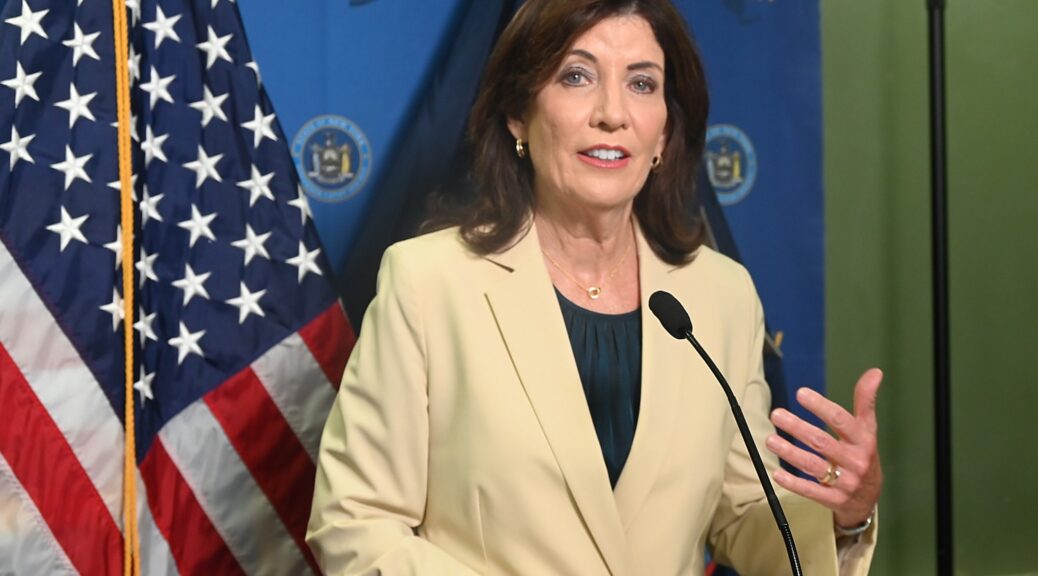
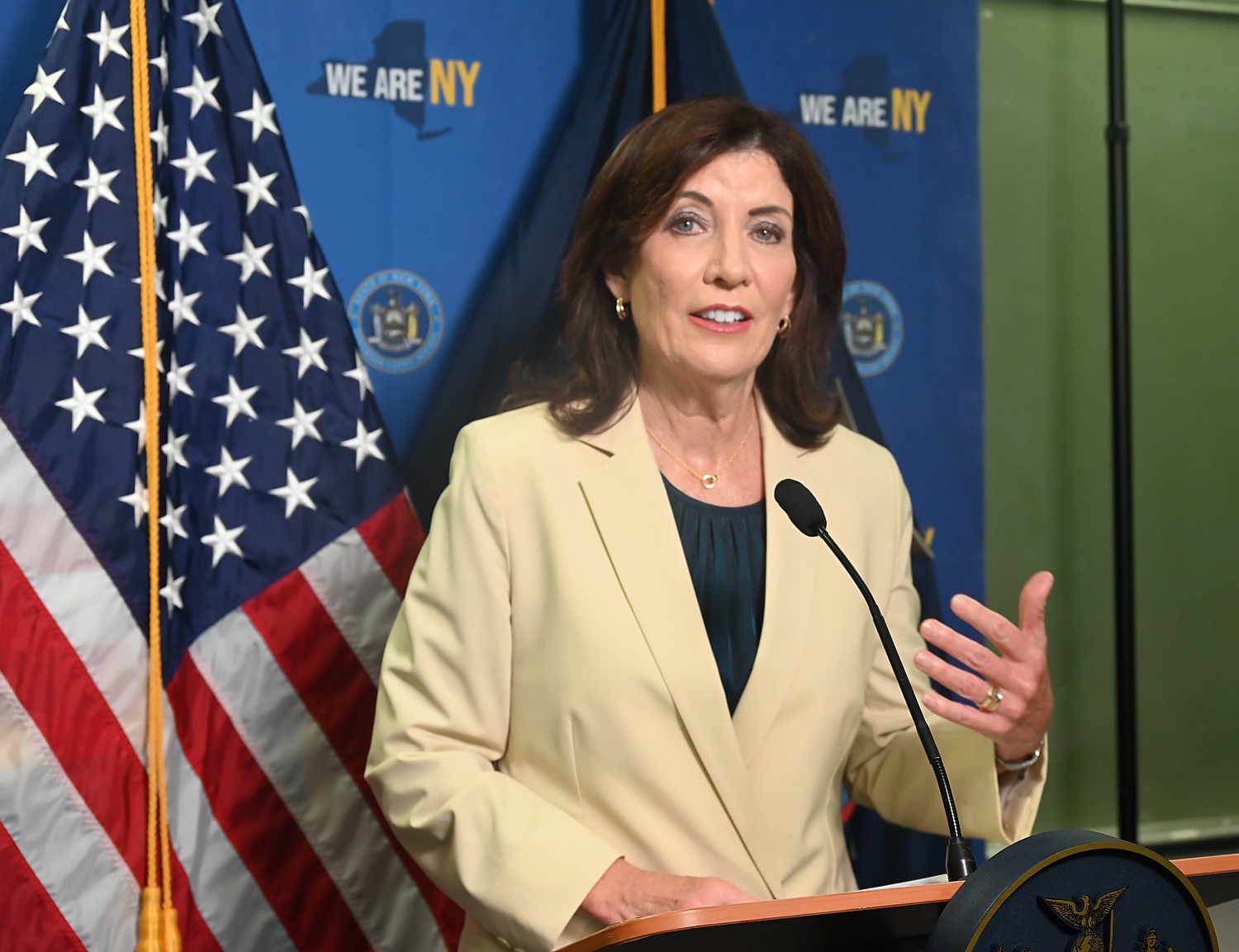
Governor Kathy Hochul today announced that the Trump Administration’s controversial plan to end Medicare Part D subsidies will raise prescription drug costs for around 1.3 million seniors across New York State, according to policy analyst estimates.
Governor Hochul joined seniors in New York City today to demand that the Trump Administration stop these planned Medicare cuts and end their crusade to raise costs for millions of seniors across the nation. If the Trump Administration proceeds with its plans to end Medicare Part D subsidies, impacted seniors could see higher monthly premiums starting in 2027.
As Governor Hochul slammed Trump’s latest plans for Medicare cuts, she also highlighted how New York has delivered healthcare savings for seniors through her major expansion of the Medicare Savings Program, banning copays for insulin, and other initiatives.
“The Trump Administration’s latest attack on Medicare will raise prescription drug costs for seniors across New York — and I’m calling on Trump to reverse these Medicare cuts now,” Governor Hochul said. “While Republicans in Washington are hellbent on making life harder and more expensive for hard-working Americans, I’m staying laser-focused on helping seniors and putting money back into New Yorkers’ pockets.”
Last week, the Trump Administration announced it would end the Medicare Part D Premium Stabilization Demonstration Program by the end of the year – a year earlier than intended. This program, initiated by the Biden Administration in 2024, was intended to stabilize stand-alone prescription drug plan premiums for enrollees, by providing subsidies to plan sponsors. Analysts estimate that these subsidies offset the average prescription drug plan premium by $16 per month in 2026.
Raising prescription drug costs that millions of older New Yorkers rely on every day risks putting additional financial pressure on seniors living on fixed incomes. Since taking office, Governor Hochul has been committed to making life more affordable for all New Yorkers, including seniors. Her initiatives include:
Expanded Medicare Savings Program: The Medicare Savings Program helps Medicare beneficiaries living on limited incomes by paying their Medicare Part B premiums. Governor Hochul’s expansion of the program increased enrollment by 20% to serve more than 1 million New Yorkers today. This program saves eligible New Yorkers $203 per month, meaning $2.4 billion in Medicare Part B premiums every year that New Yorkers do not have to pay.
Eliminating Co-Pays for Insulin:1.58 million people are living with diabetes in New York and according to the American Diabetes Association, people with diabetes have medical expenses that are 2.3 times higher than people who do not have diabetes and the impact is even larger for communities of color, which face disproportionately high diagnosis rates. Governor Hochul spearheaded the most expansive prohibition policy against insulin cost-sharing in the nation, saving residents millions of dollars. Estimates show that this proposal has saved New Yorkers $25 million over the last two years.
EpiPen Price Cap: The Governor signed legislation in 2024 that reduced the sky-high costs of epinephrine auto-injector (“EpiPen”) devices for consumers with commercial health insurance. The legislation required health insurers to cover EpiPens and capped the amount consumers would be required to pay out-of-pocket at $100, making the life-saving treatment more affordable for the New Yorkers who need it. The initiative has saved New Yorkers approximately $2.4 million in 2026.
Congressman Jerry Nadler said, “Donald Trump’s Big Ugly Bill already kicked 500,000 New Yorkers off potentially life-saving health coverage, with hundreds of thousands more expected to suffer the same loss next year. Now, his cruel attack on Medicare Part D will force millions of seniors in New York and across our country to pay more for the lifesaving medicines they rely on every day. I will continue fighting to protect our seniors from these devastating policies in Congress, and I thank Governor Hochul for her leadership to lower costs for New York’s seniors.”
Assembly Member Rebecca Seawright said, “As Chair of the New York State Assembly Committee on Aging, I know that even small increases in prescription drug costs can have devastating consequences for older adults living on fixed incomes. Seniors should never be forced to choose between filling a prescription and paying for groceries, rent, or other necessities. New York has made meaningful progress by expanding access to affordable healthcare and lowering out-of-pocket costs for older adults, and we cannot allow that progress to be undermined. I thank Governor Hochul for standing up for New York’s seniors and fighting to protect affordable access to the medications they depend on every day.”
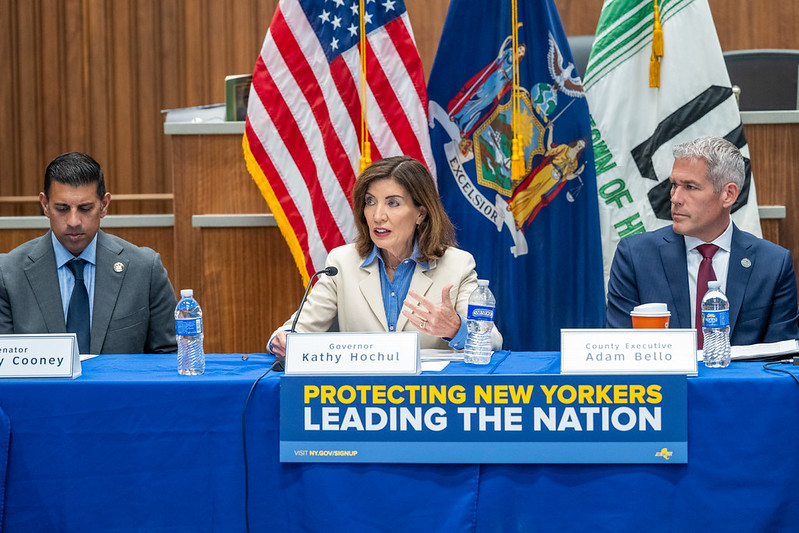
Governor Hochul hosts a roundtable meeting in the Finger Lakes with local officials and business leaders discussing year moratorium on new data centers. (Darren McGee/ Office of Governor Kathy Hochul)
Governor Kathy Hochul today held a roundtable with state, business and local leaders from the Finger Lakes Region to highlight her Executive Order that creates the nation’s first moratorium on new hyperscale data centers, establishing the strongest standards for data center development and creating a blueprint to support localities. The Governor is temporarily pausing State environmental permits for up to one year in order to build a nation-leading regulatory framework that protects ratepayers, the environment, the energy grid and communities across the state.
“New Yorkers’ well-being and convenience always comes first — that’s why we’re not letting residents foot the bill while data centers come in, plant the seeds and benefit from our localities,” Governor Hochul said. “This one year pause is centered around an action plan to protect ratepayers from rising utility costs, determine the best approach for the environment and to ensure incoming partners are paying into our already-overwhelmed energy grid. We’re developing a framework that works for our communities, not against them.”
Earlier this year, the Governor directed the Department of Public Service (DPS) to begin the Energize NY proceeding, which will require data centers to either pay more for their energy or supply their own, allowing the state to keep energy more affordable for New Yorkers. As part of that proceeding, the Governor is now also directing DPS to develop a Generic Environmental Impact Statement (GEIS) for data centers to ensure new data centers coming online are being held to consistent standards. During the development of this GEIS, which will take up to a year, a moratorium will be in place and the Department of Environmental Conservation (DEC) will not issue any discretionary permits not already deemed complete. The state will use the GEIS to assess the potential environmental impacts of the construction and operation of data centers in the state, including their effect on energy demand, water use and quality, and air quality. Once the State finalizes these standards, the moratorium will be lifted, allowing new data center projects to proceed as long as they follow state, zoning code and other local approvals.
The Governor also directed Empire State Development (ESD) to issue a Community Investment Framework (CIF) within 60 days, which will provide clear guidance to local entities to help them negotiate community benefits as part of any large-scale data center deal, including local infrastructure improvements, child care investments, and direct financial support for their community. The CIF will also establish frameworks that provide organized labor a seat at the table and prioritize prevailing wage standards and project labor agreements for data center construction, local hiring, apprenticeships and workforce development to maximize economic benefits. This framework will additionally include a formula to help communities assess where to begin investment negotiations. An outline of the CIF is currently available onESD’s website, and the public is encouraged to submit feedback.
Additionally, the Governor is directing DPS to consider creating a New York Grid Acceleration Fund to require data centers to invest in the state’s aging grid infrastructure and energy needs so all New Yorkers benefit from responsible development. The fund could support the procurement of new clean energy supply and establishment of an insurance pool to which developers may need to contribute to protect against speculative large loads that create uncertainty and increase costs. DPS will also consider approaches to require data centers to fund new clean electric generation dedicated to their operations, including but not limited to customer-sited distributed energy resources and battery storage.
Finally, Governor Hochul is pursuing legislation to repeal sales tax exemptions for massive data centers across the state.
State Senator Jeremy Cooney said, “Governor Hochul’s willingness to listen on data centers sets the precedent that New York’s communities will always come first. This timeline allows the proper framework to be laid for a safe integration of this new technology — protecting ratepayers, the environment, our energy grid, and unlocking opportunities for labor leaders. I will continue to support the Governor’s commitment to ensuring sensible policies surrounding data centers in New York.”
Monroe County Executive Adam J. Bello said, “Any economic development project, including data centers, must be a net positive for our community, and we have to protect residents from rising electrical bills. Because the pace of technological demand is moving faster than our physical infrastructure, we have to take a thoughtful, deliberate and prudent approach. Thanks to Governor Hochul for her leadership on this issue and for engaging local stakeholders in the conversation.”
Greater Rochester Chamber President and CEO Bob Duffy said, “New York State must remain an international leader in emerging technologies powering the 21st century economy — but it must do so responsibly. Thank you to Governor Kathy Hochul for her leadership in ensuring our state implements thoughtful, comprehensive policies that support all of its communal goals. By convening discussions like this and addressing implementation concerns prior to development, Governor Hochul is setting New York up to find a mutually beneficial path forward. We look forward to continued collaboration with leaders across the state to ensure that all voices are heard in this conversation and all New Yorkers benefit from these investments.”
Genesee County Legislature Chair Christian Yunker said, “I appreciate Governor Hochul taking the time to hear directly from communities that are on the front lines of economic development. This roundtable gives us an opportunity to share how data centers could impact communities. We have the opportunity to create jobs, strengthen local tax bases, and support long-term growth while addressing legitimate concerns. This is a healthy exercise.”
Since taking office, Governor Hochul has ensured New York is leading the nation in AI innovation and development. As part of her FY25 Budget, the Governor launched Empire AI, a nation-leading initiative to advance AI research for public good. This year, she launched the FutureWorks Commission to advise on policy and private sector actions to protect the security of workers while harnessing the economic benefits of AI for all New Yorkers. This blue ribbon Commission is composed of nation-leading experts, workers’ advocates, and business leaders, and will be charged with advising Governor Hochul on how to navigate the AI transition, so that the benefits of AI can be shared among New York’s families, workers and small businesses — not just large corporations.
Governor Hochul also implemented nation-leading safeguards to keep New Yorkers safe online and to ensure safe and responsible AI use in New York State. Initiatives include:
The SAFE for Kids Act and Child Data Protection Act that restrict addictive feeds for kids and prevent online operators from collecting and monetizing children’s data without informed consent.
AI Companion legislation which set first-in-the-nation safeguards, diverting user conversations about self-harm to mental health resources and interrupting unhealthy addictive behaviors. The Governor also outlawed AI-Generated Child Sexual Abuse Material.
The recently signed Warning Labels bill that will require social media companies post warnings about the platform’s potential impact on mental health.
AI Deceptive Practices Act, which enhances protections against unauthorized use of likeness/voice and the unauthorized dissemination of intimate images.
This year, the Governor’s Safe by Design Act was enacted in the FY27 State Budget. Safe by Design ensures that parental controls for kids are set at the highest protections on common social and gaming platforms, which means that non-connections above the age of 18 cannot privately communicate with kids, view their full profile, or tag them in content. Location settings will also be turned off by default, and children under 13 must receive parental approval for new connections. It also disables certain AI chatbot features on online platforms for kids and parents must be able to set limits on children’s financial transactions on online gaming platforms and view their child’s transaction history. While many of these platforms have increased their security features for kids, in New York it is now the law, and cannot be relaxed by these platforms over time.
Additionally, Governor Hochul is creating a first-of-its kind Office of Digital Innovation, Governance, Integrity, and Trust (DIGIT). DIGIT will serve as a central, authoritative body for digital safety and technological governance, devising new approaches and ensuring consistent enforcement to keep New Yorkers safe online while protecting New York’s position as a state that values and invests in cutting-edge innovation. The DIGIT Office will first focus on regulating large frontier AI developers as outlined in the RAISE Act, enabling greater transparency into their safety measures and establishing a reporting mechanism for developers to report critical safety incidents. The effective date of the law is January 1, 2027.
Participants of today’s roundtable includes:
Commissioner Hope Knight, President & CEO, Empire State Development
State Senator Jeremy Cooney
County Executive Adam Bello, Monroe County
Christian Yunker, Managing Partner, CY Farms & Chair, Genesee County Legislature
Stephen Schultz, Town Supervisor, Town of Henrietta
Joshua Banda, Student, Monroe Community College
Robert “Bob” Duffy, President & CEO, Greater Rochester Chamber of Commerce
Kevin Ellis, CEO, Upstate Niagara Dairy Co-op
Dr. Barbara Grosh, Resident, Town of Penfield
Rachel Sherman, Board Member, Rush-Henrietta Board of Education & Executive Director, Wilson Foundation
Proposals Eligible for $58 Million in Federal Low-Income Housing Tax Credits, $10 Million in State Low-Income Housing Tax Credits, and More Than $200 Million in HCR Subsidies
Governor Kathy Hochul announced proposals are now being accepted for the State’s annual 9% Low-Income Housing Tax Credit awards, which will make available up to $58 million in 9% Federal Low-Income Housing Tax Credits (LIHTC), $10 million in New York State Low-Income Housing Tax Credits (SLIHC) and more than $200 million in State Capital subsidy loan programs. The program, administered by New York State Homes and Community Renewal (HCR), will accept proposals through September 10, 2026.
“Families across New York deserve safe, sustainable, affordable housing, and my administration is committed to providing it,” Governor Hochul said. “These $270 million in targeted investments will be a critical part of our five-year Housing Plan and go hand-in-glove with our affordability agenda, allowing developers to build and preserve affordable housing faster and more efficiently in every corner of the state. The resulting projects will transform neighborhoods, lower costs for New Yorkers and strengthen our communities.”
The 9% LIHTC Request for Proposals, issued once a year, is a highly competitive process through which HCR seeks proposals for the creation and preservation of high-quality affordable housing throughout the State. It is a central component of Governor Hochul’s $25 billion comprehensive five-year Housing Plan to create or preserve more than 100,000 affordable homes across New York, including 10,000 with support services for vulnerable populations.
Eligible applicants proposing affordable multifamily housing projects can apply for the 9% LIHTC; SLIHC; and subsidy loan financing from the Low-Income Housing Trust Fund Program, Rural and Urban Community Investment Fund, Supportive Housing Opportunity Program, Public Housing Preservation Program, Middle Income Housing Program, Senior Housing Program and LGBTQ+ Affirming Senior Program, HOME Program, New Construction Program, Clean Energy Initiative Program and Multifamily Solar Fund.
New York State Homes and Community Renewal Commissioner RuthAnne Visnauskas said, “Projects funded through this year’s 9% RFP will put $270 million in tax credits and Capital subsidies to work expanding housing opportunities for families and individuals, revitalizing neighborhoods, enhancing local economic development initiatives, and making New York a place where people can live independently and affordably in the communities they choose. The Low-Income Housing Tax Credit Program and our Capital subsidies are among the most effective tools we have to create the opportunities New Yorkers need. Thanks to Governor Hochul’s laser focus on housing affordability and our development partners, these targeted investments will pave the way for about 1,800 apartments and bring us closer to the goals of the Housing Plan that is on its way to creating and preserving 100,000 affordable homes across the State.”
The agency’s RFP page includes all relevant information, including available resources, project eligibility, and submission requirements.
On or before July 16, HCR will also post an updated RFP Presentation providing detailed guidance, explaining application changes, and highlighting common errors.
All applicants are required to participate in an HCR Technical Assistance session within 12 months of the application due date.
Governor Hochul’s Housing Agenda
Governor Hochul is dedicated to addressing New York’s housing crisis and making the State more affordable and livable for all New Yorkers. Since FY23, the Governor has worked to increase housing supply to make housing more affordable by launching a $25 billion five-year comprehensive Housing Plan, enacted the most significant housing deal in decades and implemented new protections for renters and homeowners. Under Governor Hochul’s leadership, HCR has created new programs that jumpstart development of affordable and mixed-income homes for both renters and homebuyers. These include the Pro-Housing Community Program, which allows certified localities exclusive access to up to $750 million in discretionary State funding. More than 420 communities throughout the state have been certified Pro-Housing.
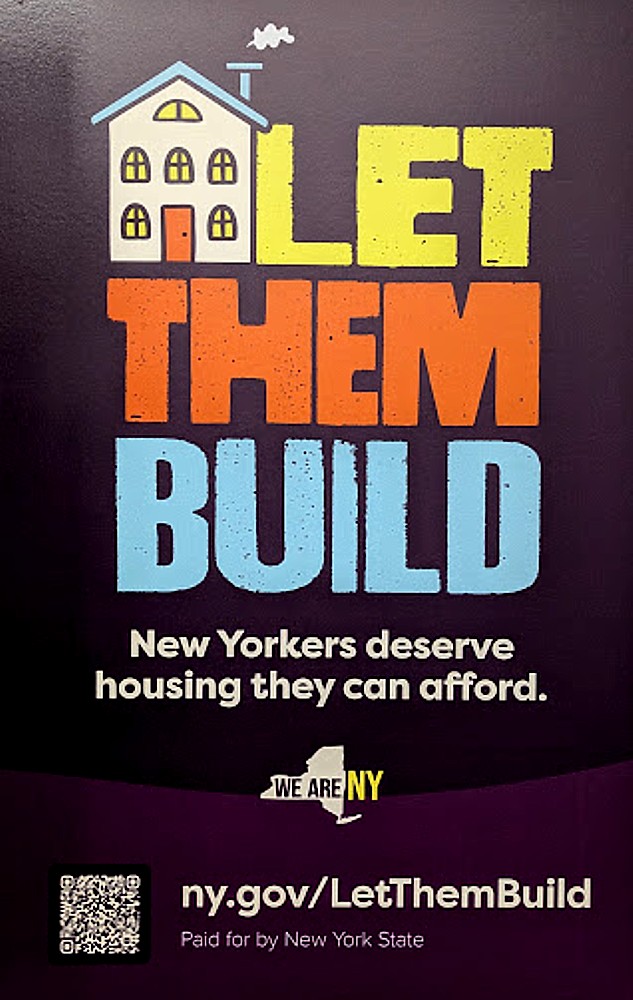
Governor Hochul’s “Let Them Build” agenda will speed up housing and infrastructure development while lowering costs through a series of landmark reforms. Common-sense changes to New York’s Environmental Quality Review Act (SEQRA) in the FY 2027 Enacted Budget as well as executive actions will expedite critical categories of projects that have been consistently found to not have significant environmental impacts, but for too long have been caught up in red tape and subject to lengthy delays.
The enacted FY27 Budget completes the Governor’s current five-year Housing Plan to create or preserve 100,000 affordable homes statewide, including 10,000 with support services for vulnerable populations plus the electrification of an additional 50,000 homes. More than 81,000 affordable homes have been created or preserved to date. The Budget also invests $250 million in capital funding to accelerate the construction of thousands of new affordable homes. The enacted FY27 budget also further reinforces critical protections for tenants and homeowners.
Governor Kathy Hochul signed her FY 2027 Budget making New York more affordable, keeping New Yorkers safe and expanding opportunity for all. The Governor delivered sweeping measures to lower costs including putting New York on a path to universal childcare, reducing utility costs and delivering energy rebate checks, and bringing auto insurance rates down for drivers. She also implemented a surcharge on luxury New York City second homes, generating much needed revenue for the City without impacting everyday New Yorkers. Additionally, the Governor continues to build on her unprecedented investments in public safety with more than $900 million in funding, measures to crack down on illegal 3D printed guns, and a nation leading package of immigration protections that keep New Yorkers safe.
“Every proposal included in this Budget was a fight for New Yorkers and their future. Working with my partners in the Legislature, we delivered an ambitious agenda that will lower costs for hardworking families, keep New Yorkers safe and create opportunity for all,” Governor Hochul said. “While Washington continues to make life more difficult for New Yorkers, I’m doing everything in my power to make real, tangible progress on the issues New Yorkers are facing and I will always fight for the people who call this great state home.”
Delivering Universal Childcare
Governor Hochul is putting New York State on a pathway toward universal childcare, beginning with committing to investments that will support the delivery of affordable childcare to up to nearly 100,000 additional children.
The Governor’s landmark investment will increase funding by $1.7 billion bringing the total FY27 investment to $4.5 billion for childcare and prekindergarten services statewide.
These investments will:
Make Pre-K truly universal statewide by making funding available to provide high-quality pre-k seats for all four-year-olds in the State by the start of the 2028-29 school year.
Partner with New York City to launch the Mayor’s signature 2-Care program and finally realize the promise of universal 3K access in New York City.
Support counties in building out New York’s First 3 Program providing high-quality affordable childcare to families across the state regardless of income.
Expand childcare subsidies to tens of thousands of additional families.
Support the workforce through early childhood educator preparation.
Launch an Office of Childcare and Early Education to steer the implementation of high-quality, universal childcare for New York families and will work to enhance awareness of the Child Tax Credit to ensure as many New Yorkers as possible benefit from the Governor’s historic expansion of the program that increased the credit from $330 per child to $1,000 annually for children under four.
Tackling Utility Costs
New Yorkers deserve reliable energy at a price they can afford, which is why Governor Hochul is proposing a sweeping set of reforms to modernize the Public Service Law, demanding strict fiscal discipline from utilities and empowering the State to fight more effectively for lower bills.
In her FY27 Budget, the Governor is putting ratepayers first by:
Issuing one-time $1 billion Protecting Our Wallets Energy Rebate (POWER) checks to help provide needed relief. The POWER program will provide $200 to joint filers with incomes under $150,000 and $150 to joint filers with incomes between $150,000 and $300,000. Tying executive pay directly to customer affordability,
Requiring utilities to present a budget constrained option when requesting a rate increase to ensure efficiency and affordability are prioritized,
Ensuring customers do not foot the bill for hidden costs like lobbying, political contributions and unnecessary executive travel.
Allowing for the installation of an “Affordability Monitor” within any utility company when the average residential bills creep too high.
Modernizing the way utility rate cases are reviewed to help keep prices manageable.
Incentivizing the use of smart thermostats to help reduce energy usage and lower bills.
Establishing the RATES commission, bringing together consumer advocates and energy experts to investigate the root causes of surging utility bills, evaluate utility profits, review energy market designs and recommend actionable, transparent reforms.
Pied-à-Terre Tax on Luxury Second Homes in New York City
Governor Hochul’s Budget includes a pied-à-terre tax, a surcharge that will apply to high-value – $5 million or more – second homes within New York City. The tax ensures that those who own luxury properties as their second homes are still fairly contributing towards the funding of essential services like policing or parks that make New York City a global destination.
Given the complexity of New York City’s property tax system, the pied-à-terre surcharge makes accommodations in the short term transition phase for the ways in which different property types are currently valued in New York City, while ensuring the surcharge is applied fairly and immediately to luxury properties. The proposal is expected to generate at least $500 million a year in recurring revenue for New York City without impacting everyday New Yorkers.
Protecting New Yorkers From ICE Overreach
Governor Hochul has enacted a sweeping set of laws to protect New Yorkers against aggressive federal immigration enforcement as part of the FY27 Enacted Budget.
These new laws will expand protections by:
Prohibiting state, local and federal officers from wearing face covering while interacting with the public.
Prohibiting local governments, state and local police and state and local corrections from entering into 287(g) Agreements or similar agreements with the federal government that allow for state and local law enforcement personnel and facilities to be used for civil immigration enforcement purposes.
Establishing a state law under which New Yorkers can bring a lawsuit against federal, state and local government officials for a violation of their constitutional rights.
Prohibiting the use of state and local civilian agencies and public school resources, including employee time, for immigration enforcement activities.
Prohibiting civilian state, local and school employees (including higher education and K-12) from permitting access to any non-public area of a state-owned or operated facility to immigration authorities without a judicial warrant, meaning any state or municipally owned, or operated facility including housing accommodations, parks, childcare facilities, preschools, hospitals, schools, dorms, healthcare facilities, community centers, libraries and shelters, cannot grant or facilitate access to any non-public areas of their facilities to immigration authorities without a warrant.
Ensuring immigrant students can access education, codifying the right to a free public education regardless of immigration status.
Record Investments in Public Safety
Since taking office, Governor Hochul has invested more than $3 billion in public safety initiatives. The funding has provided record support for local and state law enforcement that has contributed to gun violence reaching record lows, reduced subway crime and combated pandemic-era surges in motor vehicle and retail thefts.
This Budget adds more than $900 million to those record investments and strengthens public safety by:
Prioritizing New Yorkers’ safety throughout the transit system. The Governor secured an additional $77 million to support the deployment of NYPD officers across the subway system and $25 million for expanding the Subway Co-Response Outreach Teams initiative to respond more quickly to individuals in acute distress.
Establishing a pilot program for New York City requiring the installation of Intelligent Speed Assistance devices in the vehicles of so-called “super speeders,” drivers with a documented pattern of flouting speeding laws and putting New Yorkers at risk.
Advancing a comprehensive approach to both prohibit risky drone use and expand responsible use of drones as first responders by creating a crime for dangerous drone use and flying in and around restricted areas, and authorizing the use of detection and mitigation efforts by qualified law enforcement officers.
Protecting safe access to worship — creating a new crime for knowingly and intentionally interfering with a person seeking to enter or exit a place of religious worship or acting in a way that makes a person within 50 feet of a place of worship fear for their safety.
Stopping Illegal Homegrown Guns
Governor Hochul has passed the strongest gun laws in the nation and made record investments in gun violence prevention, resulting in New York having the fewest shooting incidents statewide in 2025 in recorded history.
Governor Hochul’s FY27 Enacted Budget will:
Require first-in-the-nation minimum safety standards for 3D printers sold in New York to be equipped with basic technology that prevents the unlicensed, illegal production of lethal firearms and firearm parts.
Require the New York State Division of Criminal Justice Services to lead a task force of experts to recommend regulations that will ensure New Yorkers are protected from these dangerous weapons. Following the implementation of the resulting regulations, state law will allow for recourse against any actor who sells a 3D printer in New York without equipping it with such technology.
Criminalize the unlawful possession, sale, or distribution of blueprints that allow the printing of illegal guns and gun parts, and the manufacture of 3D-printed firearms.
Prohibit gun manufacturers and firearms dealers from selling pistols that can be quickly and easily converted into machine guns using common tools.
Lowering Car Insurance Rates for New Yorkers
Fraud is a major driver of elevated auto insurance premiums. Increasingly sophisticated actors stage elaborate accidents, designed to allow for “jackpot” payouts from insurance companies or jury awards. These schemes imperil the safety of honest drivers, cause property damage, and increase rates for drivers across the state. Increasingly, scams go beyond just one bad actor at the wheel and are orchestrated by organized criminal rings.
The Governor’s plan will:
Cap payouts for drivers engaging in criminal behavior at the time of the incident, including uninsured motorists, drunk drivers, and drivers in the act of committing a felony.
Better define what actually constitutes a ‘serious injury’ so that damages for pain and suffering or emotional distress are reserved for those able to objectively demonstrate that they have suffered a serious injury.
Ensure that if a driver is found to be mostly at fault for causing an accident, they cannot claim outsized payments for damages.
Prevent insurance companies from exorbitantly raising rates by setting a legal threshold that prevents excess profits and returns savings to consumers.
Create new regulatory safeguards to prevent insurance companies from raising rates without seeking express approval from the Department of Financial Services.
Protect consumers by prohibiting insurance companies from setting rates based on extraneous, personal factors like homeownership status, occupation, education level or zip code.
Enable prosecutors to seek criminal penalties against any individual responsible for organizing a staged accident, not just the particular individual behind the wheel.
These measures come in addition to the Governor’s whole-of-government approach to combatting fraud by tasking DFS, DMV, DCJS and NYSP with a more proactive and coordinated approach to enforcement.
The Governor’s plan also includes transparency for auto insurance policyholders by requiring insurers to notify policyholders about rate changes.
Protecting Vulnerable Renters and Homeowners
High prices and unscrupulous landlords are driving too many tenants out of their homes and making it harder for vulnerable homeowners to make ends meet. Governor Hochul has secured agreements to help address these issues in the FY27 Budget including:
Protecting renters by clarifying anti-harassment laws.
Enacting stiffer criminal penalties for landlords who engage in systemic harassment of rent-regulated tenants across multiple buildings or who are repeat serious offenders of existing anti-harassment laws.
To ensure that housing remains affordable for both seniors and New Yorkers with disabilities who are living in rent-regulated housing and Mitchell-Lama affordable housing, Governor Hochul’s final FY27 Budget:
Increases income eligibility limits for New York’s Rent Freeze Program for both the Senior Citizen Rent Increase Exemption and Disability Rent Increase Exemption from $50,000 to $75,000.
Authorizes raising the eligibility for the Senior Citizen Homeowners’ Exemption and Disabled Homeowner’s Exemption from $50,000 to $75,000.
Adds notice requirements to make more elderly and disabled rent-regulated tenants aware of the SCRIE/DRIE rent freeze programs.
Consistent with current practice, New York City and other communities may opt into both the SCRIE/DRIE and SCHE/DHE programs.
Improving Transparency in the Residential Property Insurance Market
Homeowners and housing providers across the state are contending with escalating home insurance premiums and shrinking options for coverage, which threaten the affordability of New York’s single and multi-family homes. While single family home insurance rates in New York are on average lower than many other states — thanks to New York’s tightly regulated market — year over year increases in insurance rates still threaten to sap money from families’ pocketbooks and make multi-family housing less and less affordable for homeowners and renters. For years, New Yorkers have not been properly informed about the reasons for rising premiums. This year, the Governor’s reforms will increase transparency for consumers and give the Department of Financial Services (DFS) a better understanding of the multi-family market with new data from insurers.
Governor Hochul is tackling this problem head-on by:
Requiring insurers to provide detailed information to DFS on how they price policies for multifamily residential buildings.
Increasing transparency for home insurance as well as auto insurance by requiring insurers to notify policyholders about rate changes.
Protecting New York Farmers from the Disruption of Federal Tariffs
Agriculture is a cornerstone of New York’s economy, yet the federal government’s tariff policy has threatened the competitiveness of our farmers. Federal actions have driven up the cost of essential resources — like seeds, fertilizer, and necessary machinery — while creating market instability. Although the USDA recently announced a national assistance program, it is fundamentally flawed for New York since it leaves specialty crops and the dairy sector with no meaningful support.
To relieve farmers from the adverse impacts caused by federal tariffs, Governor Hochul will:
Create the Agricultural Resiliency Against Tariffs Program, which will provide $30 million in direct payments to New York specialty crop growers, livestock producers, aquaculture, and dairy farmers.
This initiative will quickly distribute much needed support to offset rising costs caused by tariffs.
This program reinforces New York’s commitment to our agricultural community, while safeguarding local jobs and ensuring our farmers have the certainty needed to compete in a volatile global marketplace.
Helping New Yorkers Put Food on the Table
The recent shutdown of the federal government reminded the nation of how precarious our nutrition safety net is and how many New Yorkers contend with food insecurity. In response to the shutdown, Governor Hochul rushed an additional $65 million toward food assistance programs that delivered meals to tens of thousands of New Yorkers in their hour of need. To build on these actions and further reinforce our emergency food system:
Governor Hochul is announcing a $51 million investment in the Department of Health (DOH)’s Hunger Prevention and Nutrition Assistance Program (HPNAP) program, which will help New York’s network of about 2,700 food banks, pantries, and soup kitchens reach more New Yorkers in need. An additional $15 million will strengthen and expand operations, allowing them to reach more people with healthier options.
The Enacted Budget also includes $55 million for the Nourish New York Program, which reroutes surplus agricultural products to those who need them most through the state’s food banks.
Theft of Supplemental Nutrition Assistance Program (SNAP) benefits is an epidemic across the United States, with hundreds of millions of dollars illegally stolen from families’ EBT cards nationwide using illegal “skimming” devices. Governor Hochul’s FY27 Budget will protect New Yorkers from this predatory behavior by:
Upgrading New York’s EBT cards to secure chip-based technology that makes cards virtually impervious to skimming. While the federal administration tries to strip SNAP benefits from as many New Yorkers as possible and turns a blind eye to criminals taking food from vulnerable families, transitioning to chip-based EBT cards will help safeguard the SNAP dollars that New Yorkers depend on.
The Governor’s plan will also:
Establish New York PLATES, a statewide competitive $10 million grant program for eligible food pantries that will fund capital projects, to increase the capacity of these critical organizations and enable food pantries to safely store, transport and distribute food to more families.
Support localities in expanding free summer meal sites.
No Taxes on Tips for Hardworking New Yorkers
Tipped workers — New York’s bartenders, servers, and deliveristas — are the backbone of the state’s service economy. In jobs that demand long hours and daily dedication, every dollar is hard-won. Governor Hochul is committed to making sure tipped workers can hold on to more of what they earn. The Governor passed legislation that eliminates state income taxes on up to $25,000 of tipped income in tax year 2026, consistent with federal tax guidance.
Governor Hochul’s FY27 Budget builds on her efforts to put more money back in New Yorkers’ pockets. To date, her administration has:
Cut middle-class taxes to their lowest rates in 70 years, ensuring families keep more of the paychecks they earn.
Raised New York’s minimum wage and tied future increases to inflation so a day’s work covers a day’s needs.
Implemented an historic expansion of New York’s Child Tax Credit, also known as the Empire State Child Credit, to provide families up to $1,000 per child under the age of four beginning in 2026, and up to $500 for school-aged children beginning in 2027, substantially increasing the previous maximum of $330.
Made school meals free for every student, saving families $1,600 per child every year and making sure no child goes hungry at school.
Sent Inflation Refund checks to 8.2 million New Yorkers — up to $200 for individuals and up to $400 for families.
Increased the maximum weekly unemployment benefit by $300 a week so people can focus on finding work, not keeping the lights on.
Established a nation-leading birth allowance — the New York State BABY Benefit (Birth Allowance for Beginning Year Benefit) — providing $1,800 to new parents receiving Public Assistance when they have a new baby.
Governor Hochul: “I also would not accept a deal that would compromise affordability for Long Islanders. At a time when everything is going up, we all know the story, I was not going to allow taxes or fares to go up. And that’s why we stood firm for a deal that would not require any additional fare increases or tax increases, period. Full stop. Got it done.”
Hochul: “Now, this contract will ensure that 3,500 Long Island Rail Road employees will be paid fairly for their labor. I want them to know this, I deeply value and respect the hard work they do. They’re out there every single day making sure the job gets done. Their work is critical for the entire region, and they deserve a fair wage.”
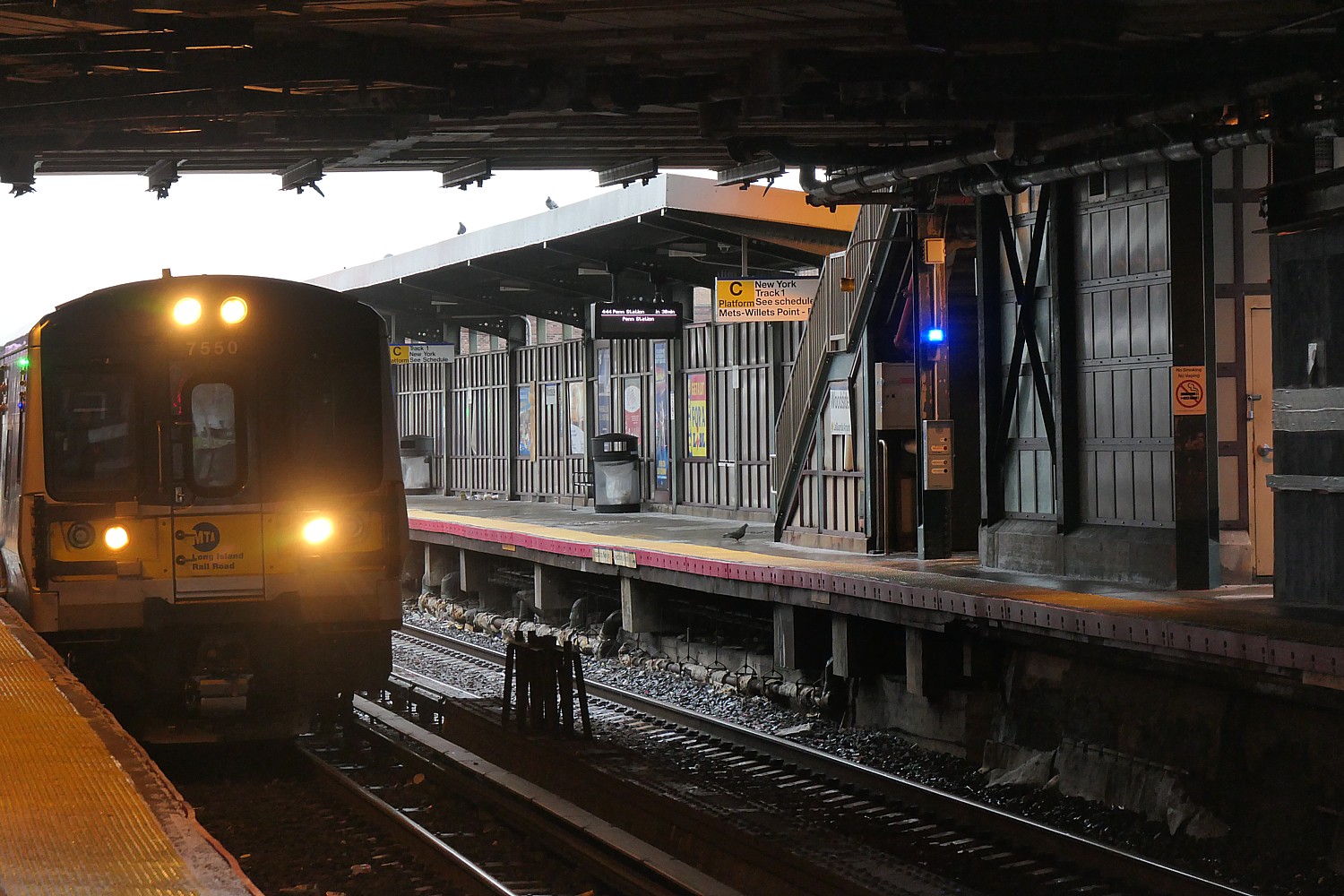
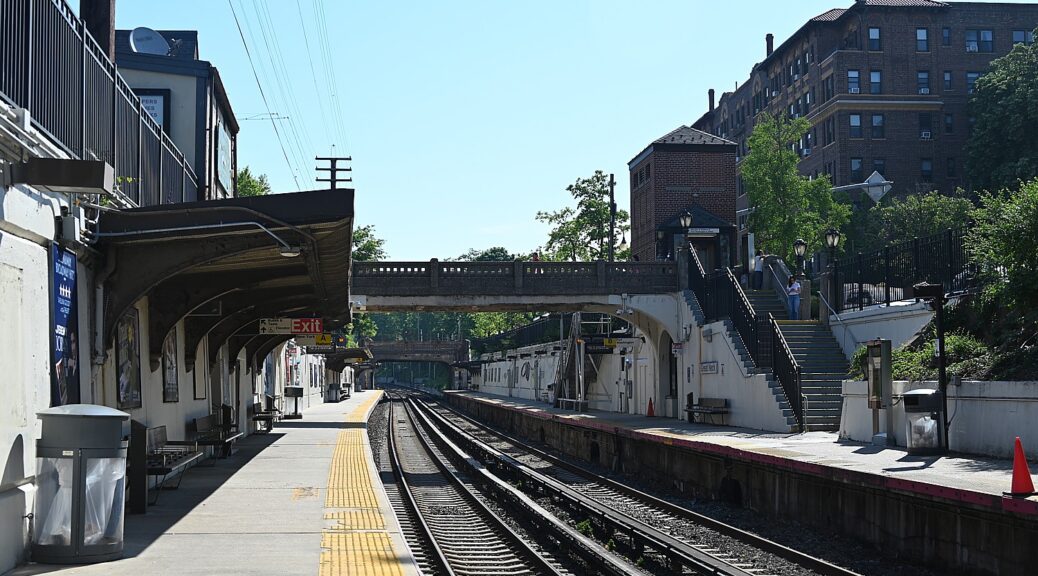
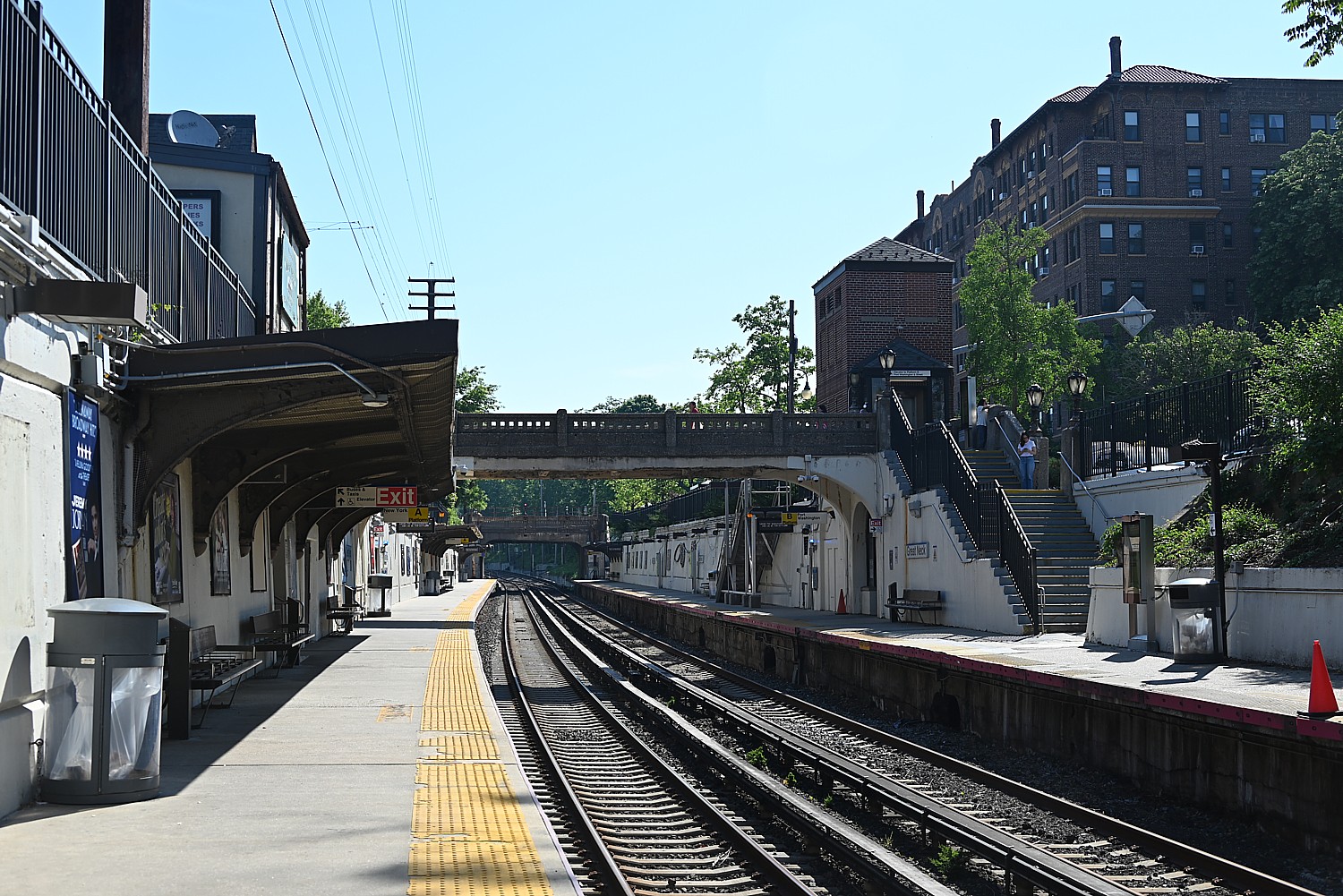
Late Monday night, after the first full work day with the Long Island Railroad, the busiest commuter railroad in the country, on strike, Governor Kathy Hochul announced a resolution ending the strike: Here are her comments:
Good evening, everyone. I’m truly pleased to share that the five Long Island Rail Road unions and the MTA were able to come together and reach a fair deal this evening.
Now, negotiations are rarely easy, but I have a lot of respect for the collective bargaining process that unfolded over the last few days. And I always believed that we could reach a good, fair compromise, a contract that achieved two principles: Number one, protecting affordability for Long Islanders and commuters while giving fair wages to the employees. And by working and negotiating together, we have reached that kind of deal.
Now, this contract will ensure that 3,500 Long Island Rail Road employees will be paid fairly for their labor. I want them to know this, I deeply value and respect the hard work they do. They’re out there every single day making sure the job gets done. Their work is critical for the entire region, and they deserve a fair wage.
I also would not accept a deal that would compromise affordability for Long Islanders. At a time when everything is going up, we all know the story, I was not going to allow taxes or fares to go up. And that’s why we stood firm for a deal that would not require any additional fare increases or tax increases, period. Full stop. Got it done.
Now, the Long Island Rail Road service will resume tomorrow at noon, with the full service time, expected in time for the evening rush hour, and yes, in time for the Knicks game. Knicks fans will be able to take the trains to MSG tomorrow in time for game one of the Eastern Conference Finals.
Finally, I want to thank so many people. I want to thank New Yorkers, Long Islanders particularly, who made all the accommodations, who had to work from home, who sacrificed, who had to put up with inconveniences. We are so grateful for their patience and understanding. And for those who helped us weather the storm over the last few days, to their employers who made the accommodations, helped get this done, the elected officials who helped get the word out.
I also want to say, the MTA negotiating team, led by Janno Lieber, did an exceptional job. I want to thank every single one of them. And also the preparations that I came down to see over many days, going to the command centers and talking to the people that were deciding how many shuttle buses, how many trains, how many workers need to be out there greeting people. The job was done like a military operation, and I was very impressed with that, Janno, so I want to thank you and your entire team for anticipating the worst and preparing all of our commuters for a better experience than they would have had otherwise.
I also want to thank our labor leaders, who fought hard for a fair deal, and I respect them for that. They’re looking out for their members. Also, Mario Cilento, the state leader of the AFL-CIO, played an integral role in this process as well. I want to thank, finally, the extra people who showed up every single day to make sure this ran smoothly. We got the deal done. It is a very good night for everyone, and I’m really proud of the work that was accomplished by an extraordinary team and our partners in labor. Thank you.
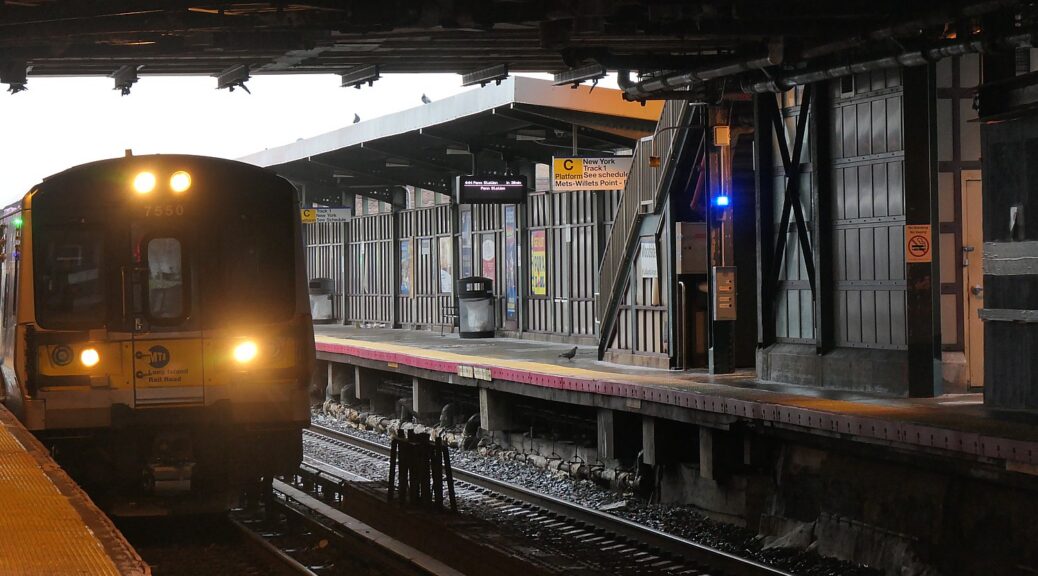
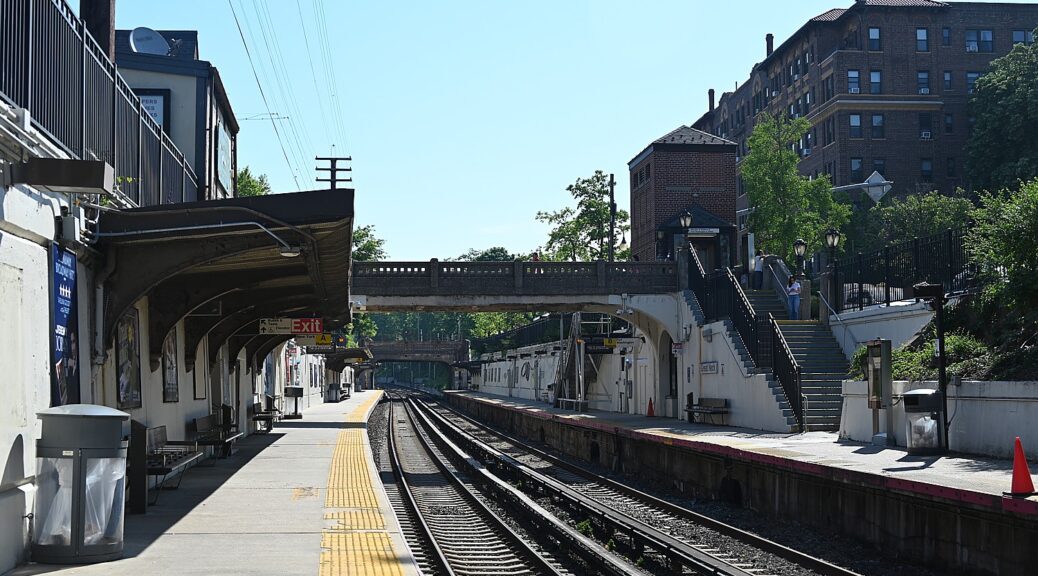
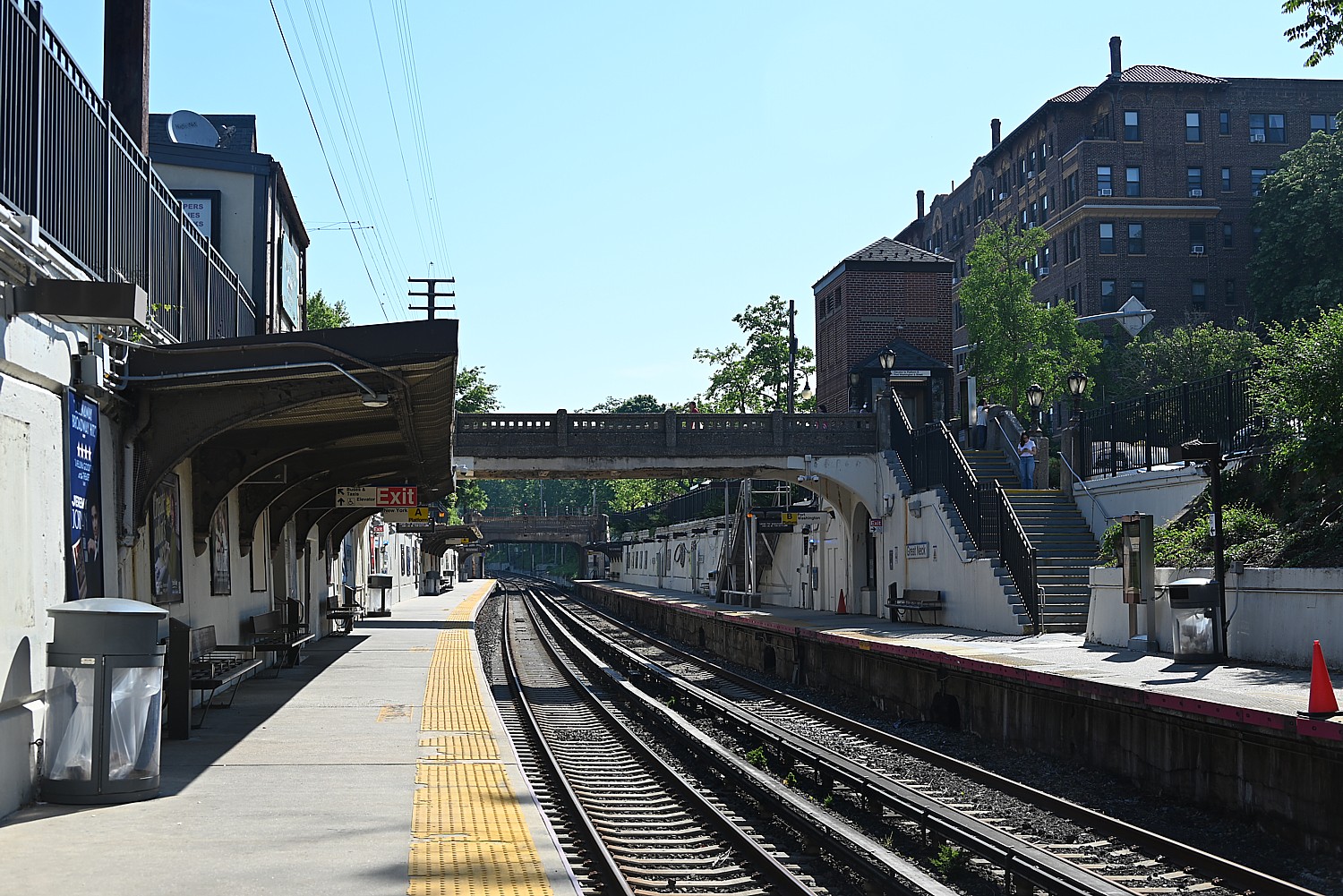
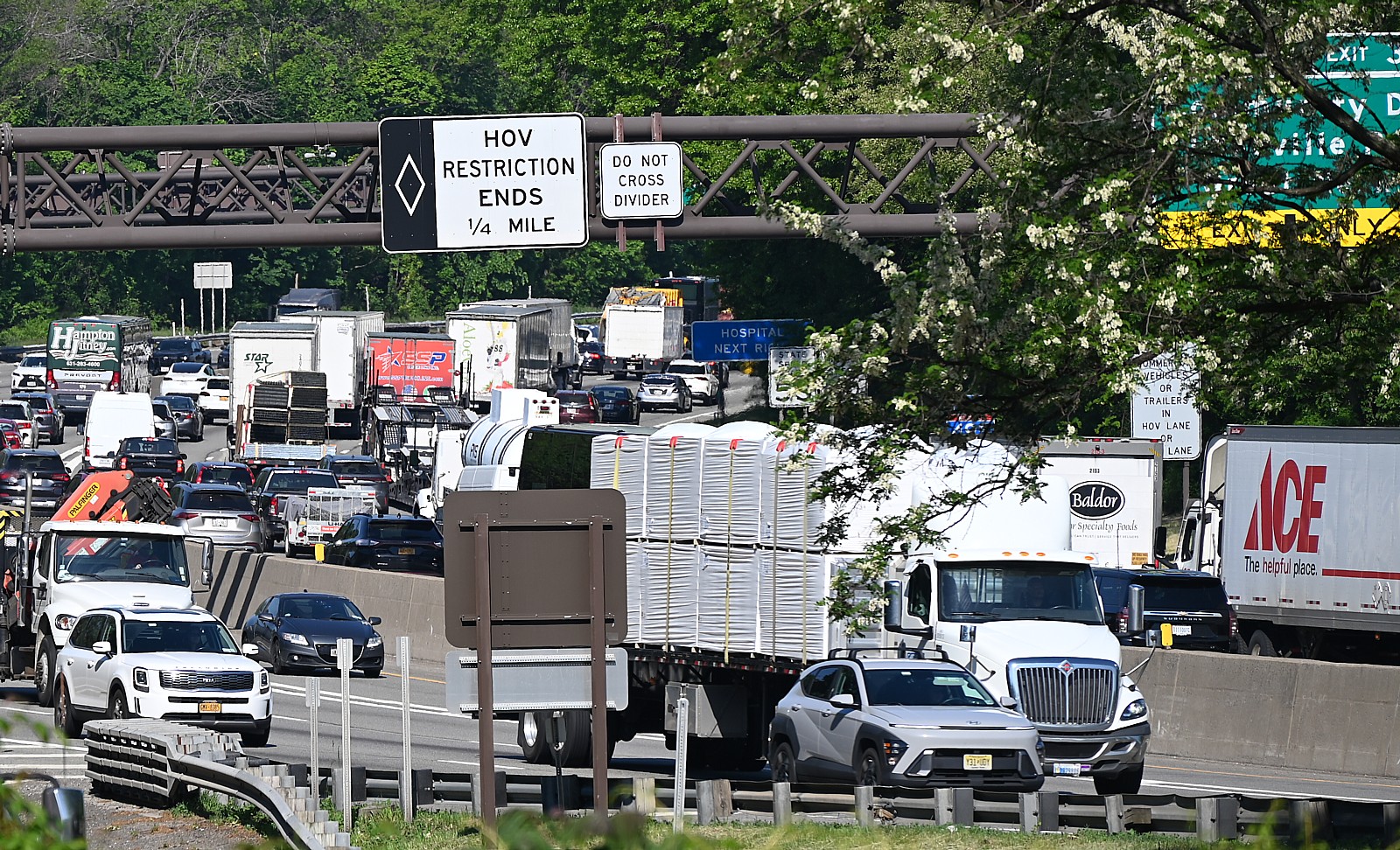
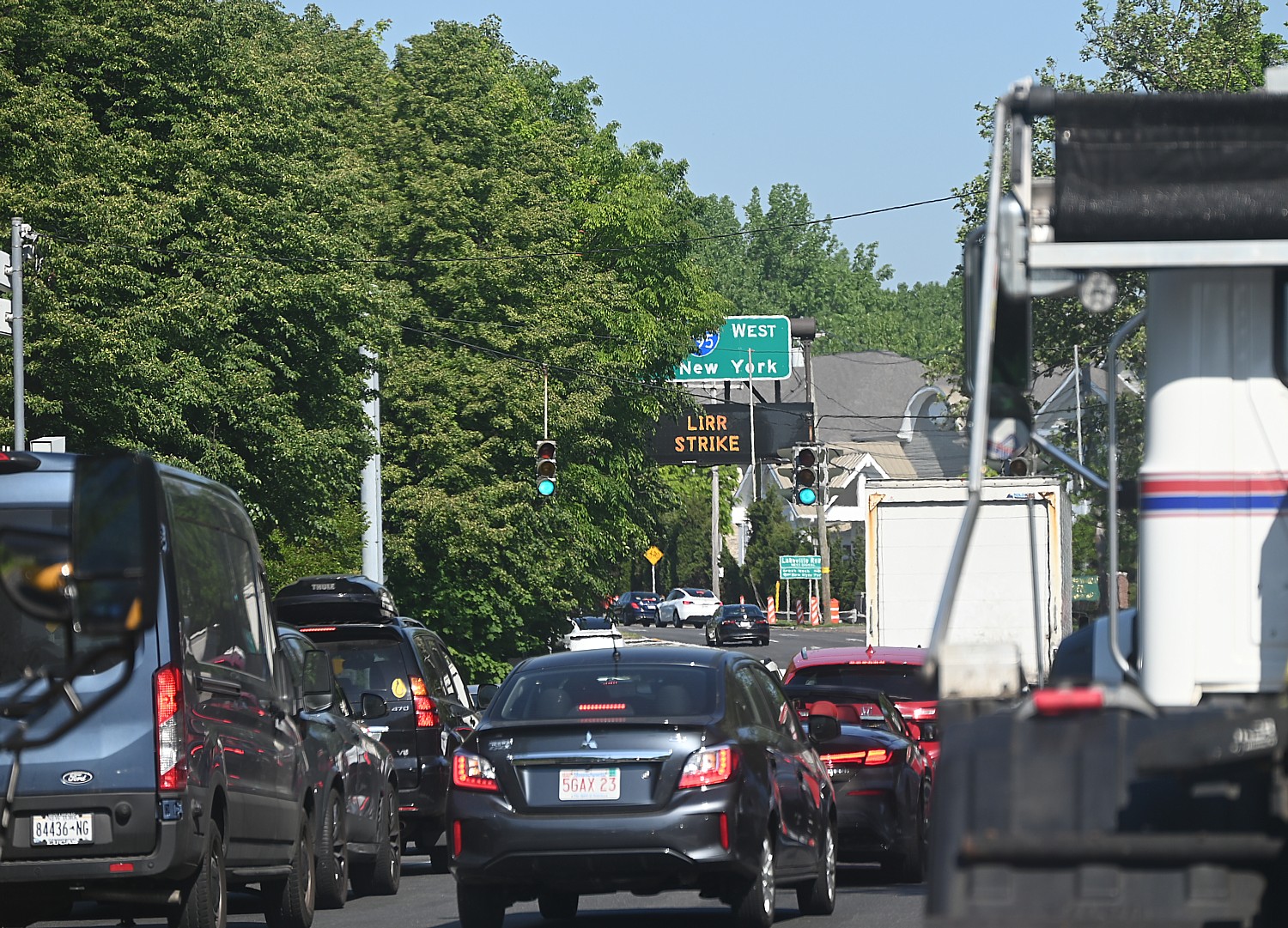
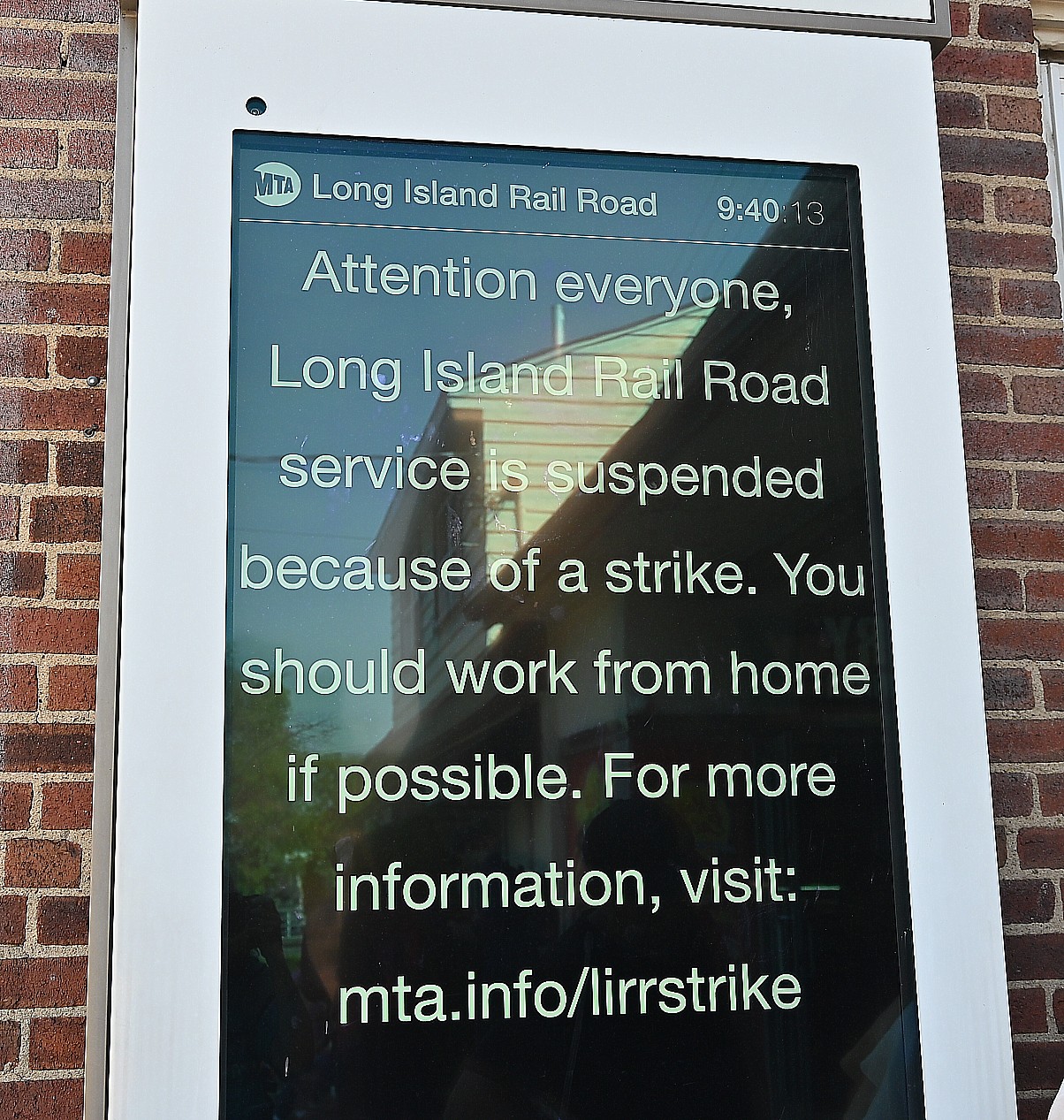
For the first time in 30 years, the Long Island Rail Road, the biggest commuter rail system in the nation, is on strike, causing havoc across the region, as some 300,000 daily riders have to find alternate ways to get to work.
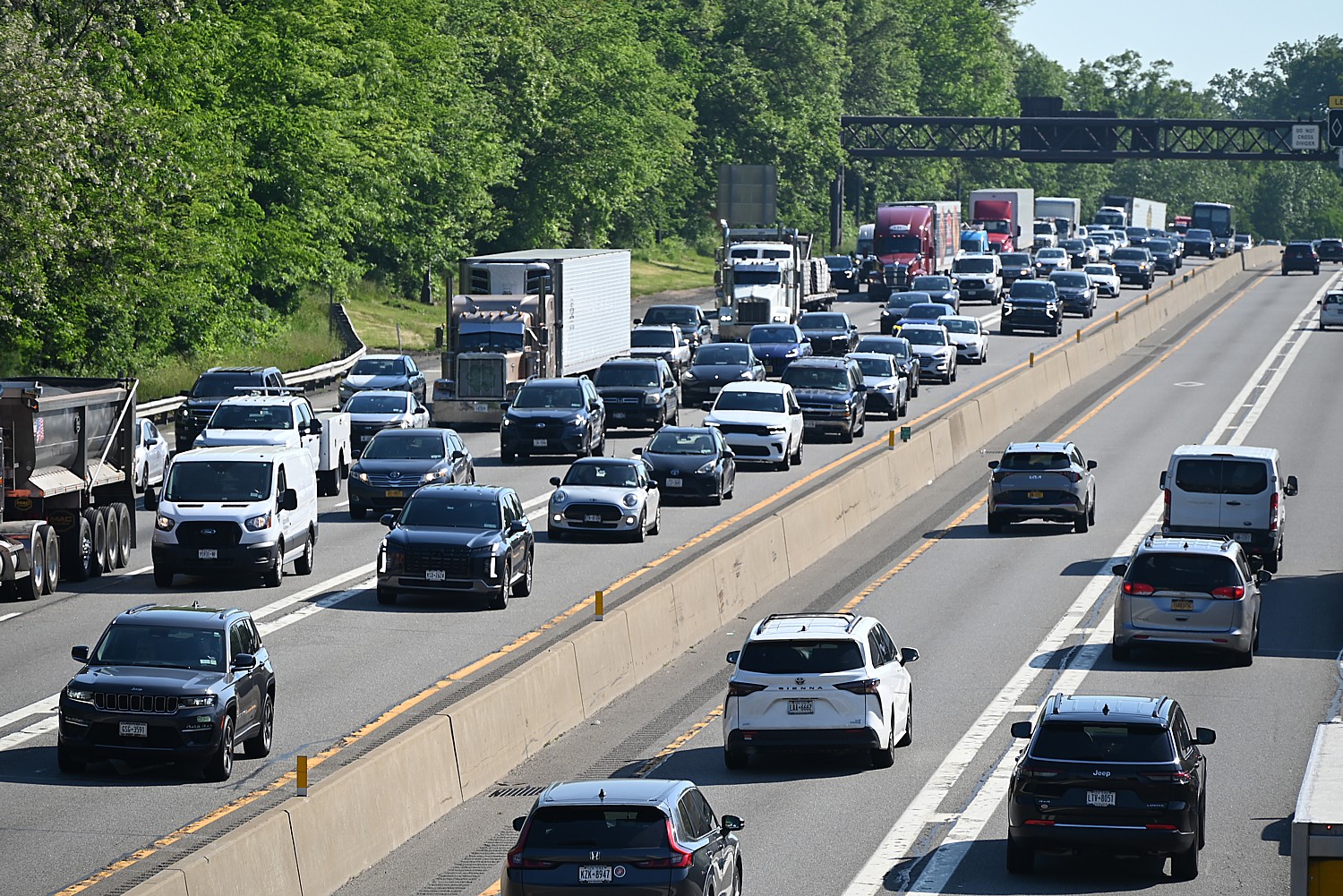
At a time when the air quality is already bad, the increased traffic and emissions will make it worse.
People who normally have to drive for work, to get to doctor, or some emergency are stuck in traffic, at a time when gas prices are reaching new heights, compounding family financial woes.
You look at the vacant cafes and shops around the train station that are normally bustling with people.
The timing is interesting, aimed at hurting Governor Kathy Hochul who is being challenged by Republican Bruce Blakeman, the Nassau County Executive.
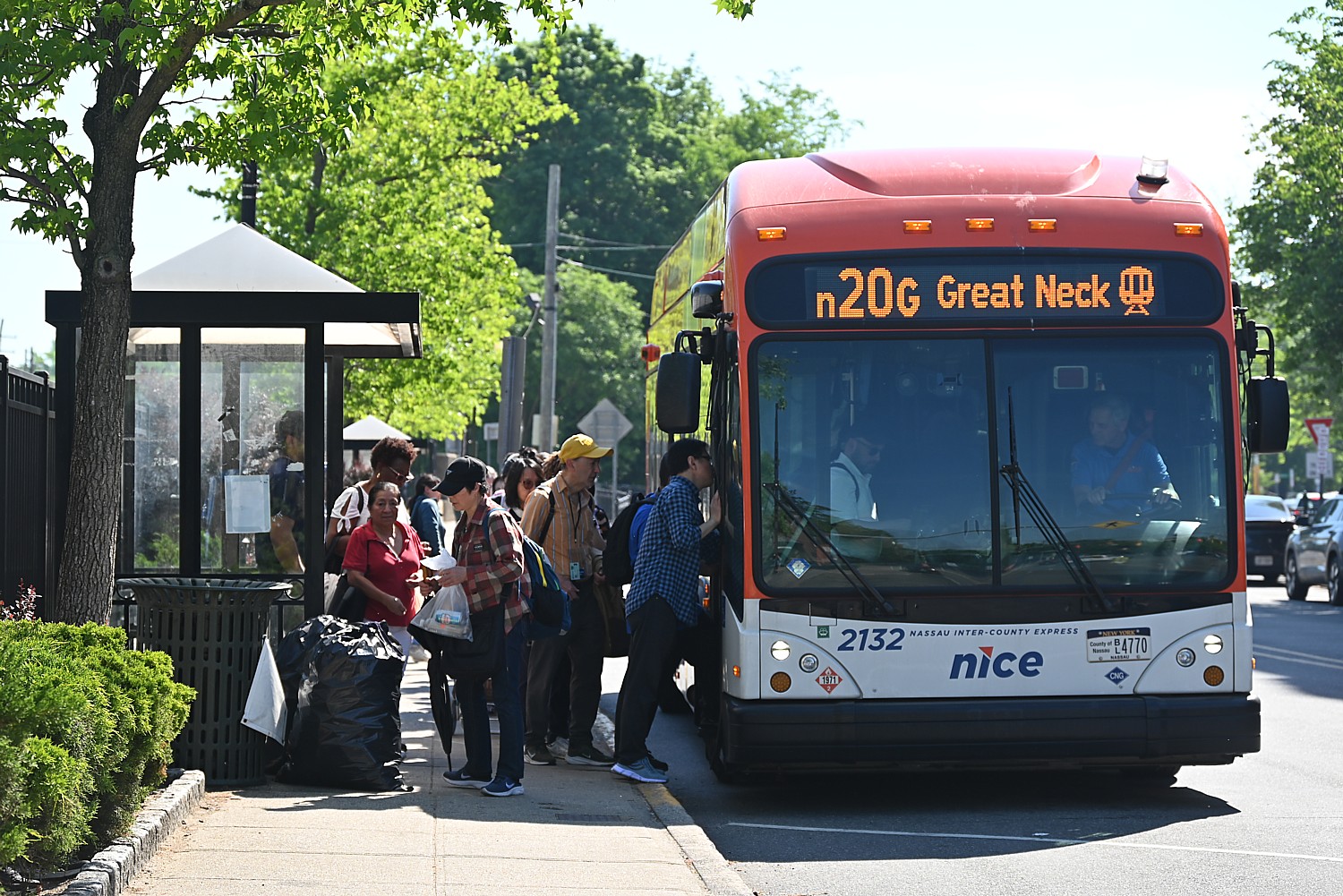
The NICE buses which are under Blakeman’s control, take only 13,000 people from Long Island train stations, depositing them at subway stations in Queens.
A commute that normally takes 40 minutes can take 2 hours.
The timing of the strike – the first in 30 years – is interesting, especially since the MTA put very favorable terms on the table, and the LIRR workers are already the highest paid in the nation.
I would bet Trump is behind the Long Island Railroad strike in order to boost Nassau County Executive Bruce Blakeman, who is the Republican challenging Governor Kathy Hochul and thinks the strike makes Governor Hochul look bad and the pain it will cause the 300,000 daily LIRR riders will result in lots of angry votes against her, because of course you blame the Democrat – except it actually makes Blakeman look impotent.
It also makes it clear that like his idol, Donald Trump, Blakeman is willing to inflict misery and suffering on his constituents in order to benefit himself. The Teamsters, who have supported trump for the unfathomable notion that trump is for workers and for unions (when he has sold workers and unions under the bus at every turn) and that waving the trump flag makes them more patriotic and better Americans than others (radical liberal lunatics who want to be able to afford food, clothing and shelter) are doing this to bolster Blakeman.
Here’s how you know that Blakeman is enjoying seeing Hochul and Long Islanders squirm: he could offer to help organize NICE buses to relieve some of the stress, but instead, uses the opportunity to try to get Hochul to cancel congestion pricing tolls (which he sued to overturn), to be told by Hochul that it is not possible under the federal contract. Instead, the pro-Blakeman NICE unions are urging bus drivers to support the LIRR strikers and not change their schedules to help. (Where were the unions defending the federal workers as they were fired by DOGE?)
But Governor Hochul, while showing respect for unions and workers, has noted that Long Island Railroad workers are already the highest paid in the country, and if the MTA accedes to their fairly outrageous demands, it not only will force a further increase in fares for already hard-pressed Long Islanders, but will trigger similar, unsustainable increases throughout the workforce.
“The LIRR is more stable now than it has been for generations,” Governor Kathy Hochul stated. “The decision by some unions to strike over demands that would threaten that progress is reckless. These unions represent the highest paid workers of any railroad in the nation, yet they are demanding contracts that could raise fares as much as 8%, pit workers against one another, and risk tax hikes for Long Islanders. This is unacceptable. My priority is protecting affordability for riders and ensuring fairness across the workforce.
“The disruption that Long Islanders face starting tonight is the direct result of reckless actions by the Trump Administration to cut mediation short and push these negotiations toward a strike. For weeks, the MTA has attempted to negotiate in good faith and put multiple fair offers on the table that included meaningful wage increases, but you cannot make a deal if one side refuses to engage in good faith.
“Commuters are dealing with unnecessary dysfunction and thousands of union LIRR workers are being forced to go without a paycheck because of decisions made by a small group of union leaders. I stand with LIRR riders and will fight to preserve the long term stability of the MTA. I believe a deal can be done and I urge both the MTA and these unions to return to the table and bargain non-stop until a deal is reached.”
The Long Island Railroad Strike has stranded some 300,000 riders a day, cost millions of dollars of economic activity daily, exacerbated traffic and pollution when air quality is already bad. The Teamsters’ demands would cause fares to increase 8%, and trigger wage and cost increases across the state’s workforce at a time when commuters can scarcely afford it.
Governor Hochul, while showing respect for unions and workers, has noted that Long Island Railroad workers are already the highest paid in the country, and if the MTA accedes to their fairly outrageous demands, it not only will force a further increase in fares for already hard-pressed Long Islanders, but will trigger similar, unsustainable increases throughout the workforce.
Here are Governor Kathy Hochul’s remarks about the Long Island Railroad strike – Karen Rubin, editor@news-photos-features.com
“The Long Island Rail Road is essential. Every day it carries nearly 300,000 commuters and without this service, life on Long Island as we know it is not possible.
“As Governor, I have been proud to make historic investments in the LIRR. Working with the MTA, we increased service by 40%, improved safety for riders and workers, secured the railroad’s fiscal future after the pandemic, and delivered transformative projects like the Main Line Third Track and Grand Central Madison.
“The LIRR is more stable now than it has been for generations. The decision by some unions to strike over demands that would threaten that progress is reckless. These unions represent the highest paid workers of any railroad in the nation, yet they are demanding contracts that could raise fares as much as 8%, pit workers against one another, and risk tax hikes for Long Islanders. This is unacceptable. My priority is protecting affordability for riders and ensuring fairness across the workforce.
“The disruption that Long Islanders face starting tonight is the direct result of reckless actions by the Trump Administration to cut mediation short and push these negotiations toward a strike. For weeks, the MTA has attempted to negotiate in good faith and put multiple fair offers on the table that included meaningful wage increases, but you cannot make a deal if one side refuses to engage in good faith.
“Commuters are dealing with unnecessary dysfunction and thousands of union LIRR workers are being forced to go without a paycheck because of decisions made by a small group of union leaders. I stand with LIRR riders and will fight to preserve the long term stability of the MTA. I believe a deal can be done and I urge both the MTA and these unions to return to the table and bargain non-stop until a deal is reached.”
After the strike was underway, Governor Hochul gave a briefing and discussed what was being done to mitigate the disruption in transportation:
I want to give Long Island Rail Road riders the latest updates on the strike. Let me be clear, I did not want a strike. The MTA did not want a strike. The MTA has put fair offers on the table, in fact, many of them. And so despite that, for the first time in 30 years, the hundreds of thousands of people who rely on the LIRR are without service because of a strike. We all know that the railroad is the lifeblood of Long Island. Without it, life as we know it is simply not possible. The bottom line is: No one wins in a strike. Everyone is hurt — the hundreds of thousands of people who rely on the railroad, and the thousands of unionized workers who are losing out on wages.
I want to speak directly to the men and women of labor at the LIRR: The work you do is absolutely vital. Absolutely. I value your labor, and I believe that you deserve fair wages and benefits. But this strike has put all that at risk. Just three days of a strike would erase every dollar of additional salary that workers would receive under a new contract. We don’t need to be here. Workers deserve better, but also New Yorkers deserve better. That’s why today I’m urging all parties once again to bargain at the table, and to get a deal done.
I also want to give an update to the Long Island Rail Road riders who are wondering about work tomorrow. Now, I’ve been in close communication, I’ve been touring the sites. I’m here at the Operations Control Center to talk to the individuals overseeing the lines that we anticipate the highest volume on tomorrow — you’ll hear more about that from our MTA leadership team — and we have a plan to ensure that essential workers can get into the city during the workday commute.
Now, starting at 4:00 a.m. tomorrow, the MTA will deploy shuttle buses to bring essential workers from across Long Island to subway stations in Queens, and those shuttle buses will be standing by to bring those essential workers back home to Long Island at the end of the day, to Long Island and Queens.
For those in Nassau County who absolutely cannot work from home, there continues to be the option of taking a Nassau Inter-County Express bus directly to the subway connections in Queens. They’ll run extra bus service weekdays during the strike, and we’ve encouraged the county to add additional capacity.
Another option is Citi Field. With the Mets hitting the road tomorrow, you can park there and transfer to the 7 train.
So right here, as I said, in the nerve center of the subway, every day four million New Yorkers rely on this system to get around. This subway system is absolutely vital, even more so tomorrow. And the MTA, as I’ve listened and asked questions, they’re ready to meet the challenge. Extra trains are on standby, and the MTA stands ready to run additional New York City subway service to meet the demand. And for the residents of Eastern Queens, who typically rely on the speed and convenience of the LIRR, the E and A trains are there for you as a great option to get to and from the city at this time.
But let’s face the facts. It’s impossible to fully replace LIRR service. So effective Monday, I’m asking that regular commuters who can work from home should. Please do so. And employers should make every accommodation necessary to allow for remote work. Now, I’ve already directed all state agencies affected to implement telecommuting plans for the state employees who typically commute in from Long Island. But also, we have to maintain essential government services. Now, everyone knows these alternatives are not business as usual. But unfortunately, they’re the direct result of this strike.
Let me be clear: This strike would not have been possible if the Trump Administration had not taken the highly unusual step last fall of releasing labor unions from mediation. Unfortunately for our commuters, the direct consequence of this action is the strike we have today.
Now, New York, everyone knows, is a pro-labor state. We believe in working men and women receiving a fair wage and benefits. But the MTA cannot agree to a contract that would raise fares as much as eight percent and risk hiking taxes for Long Islanders. I have worked too long and hard to reduce costs for our residents, and I will not allow that to be undone. As Governor, my priority is to fight for affordability for all New Yorkers, and this strike puts that affordability at risk.
Long Islanders deserve a break, as do all the residents who commute on our lines from Queens and elsewhere. They face tariff prices, price hikes on everything from food to school supplies, and skyrocketing gas prices after Trump’s war in Iran. I will not let this dispute lead to higher prices and less money in the pockets of our residents.
So we’re looking at ways to defray the costs caused by this strike, costs that fly in the face of affordability, and I’ll have more to say about that in the coming days if necessary.
Now, remember this — not long ago when I became Governor, the MTA was barreling off a fiscal cliff. Rider post-pandemic was down, and there were calls to reduce service and slash costs. I took a different approach. I said, “Let’s invest more. Let’s create more reliability. Let’s have a higher level of service.” And those results have borne out. We’ve invested billions of dollars, and I need those investments to hold and not be diminished. And as a result, ridership has surged back, nearly all the way back to the pre-pandemic levels, which is an extraordinary result, and I want to thank all the workers across the lines and at the MTA who’ve been responsible for that success.
Like I said, I put the MTA on stable financial grounds. I worked hard to do that, and I don’t want that undone. I will not let that be undone. But I believe, I know a deal can be reached to end this strike and end it soon. But to reach the deal, as I’ve said before, the MTA needs a partner. The MTA has made multiple generous offers with real wage increases.
I urge both sides to come together as soon as possible and resolve this to avoid a prolonged strike that’ll disrupt the lives of hardworking New Yorkers and affect the pocketbooks of the union members that their leaders are representing. So getting everyone back to the table is the surest way to resolve this strike, also achieving all of our goals, and getting the trains running once again.
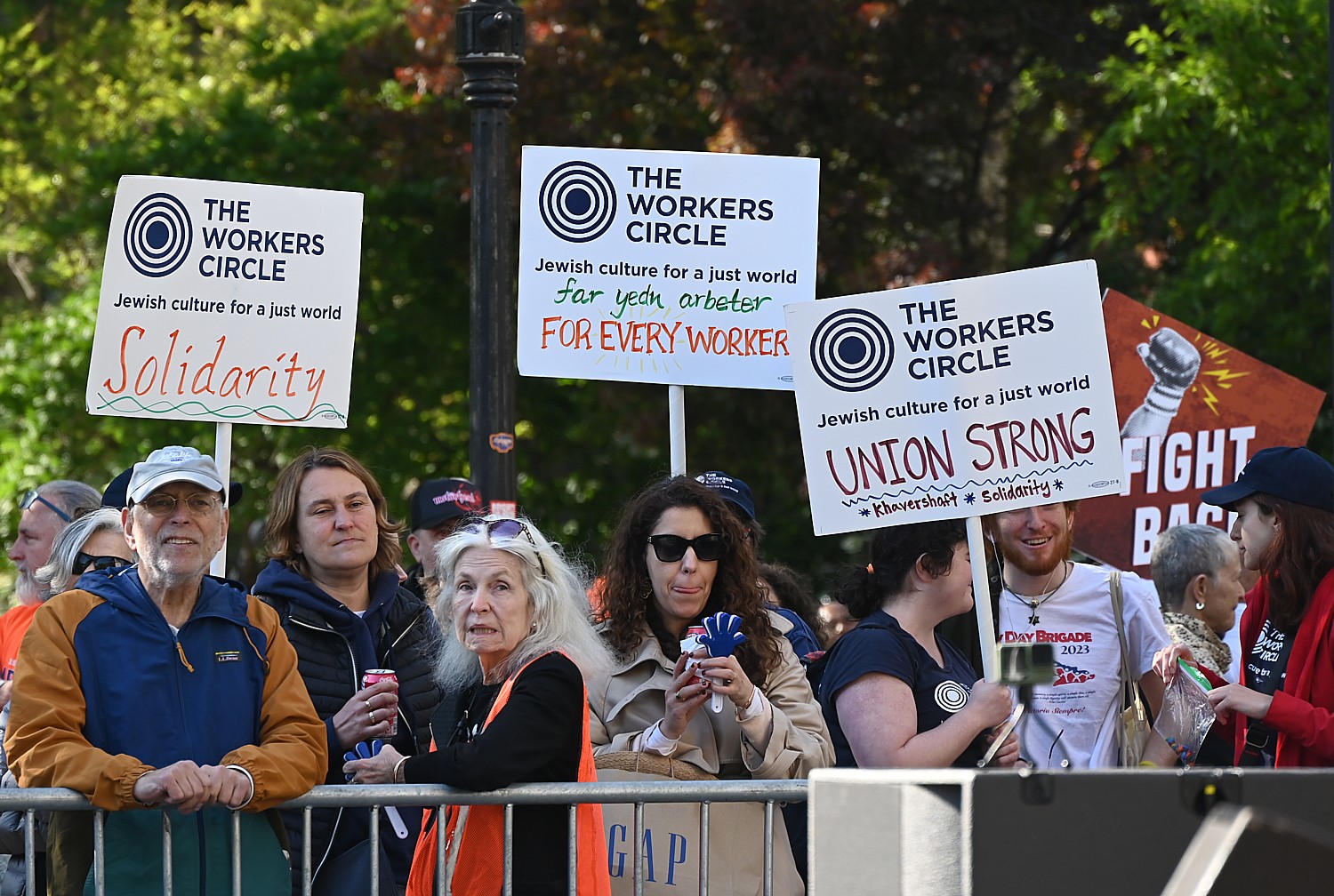
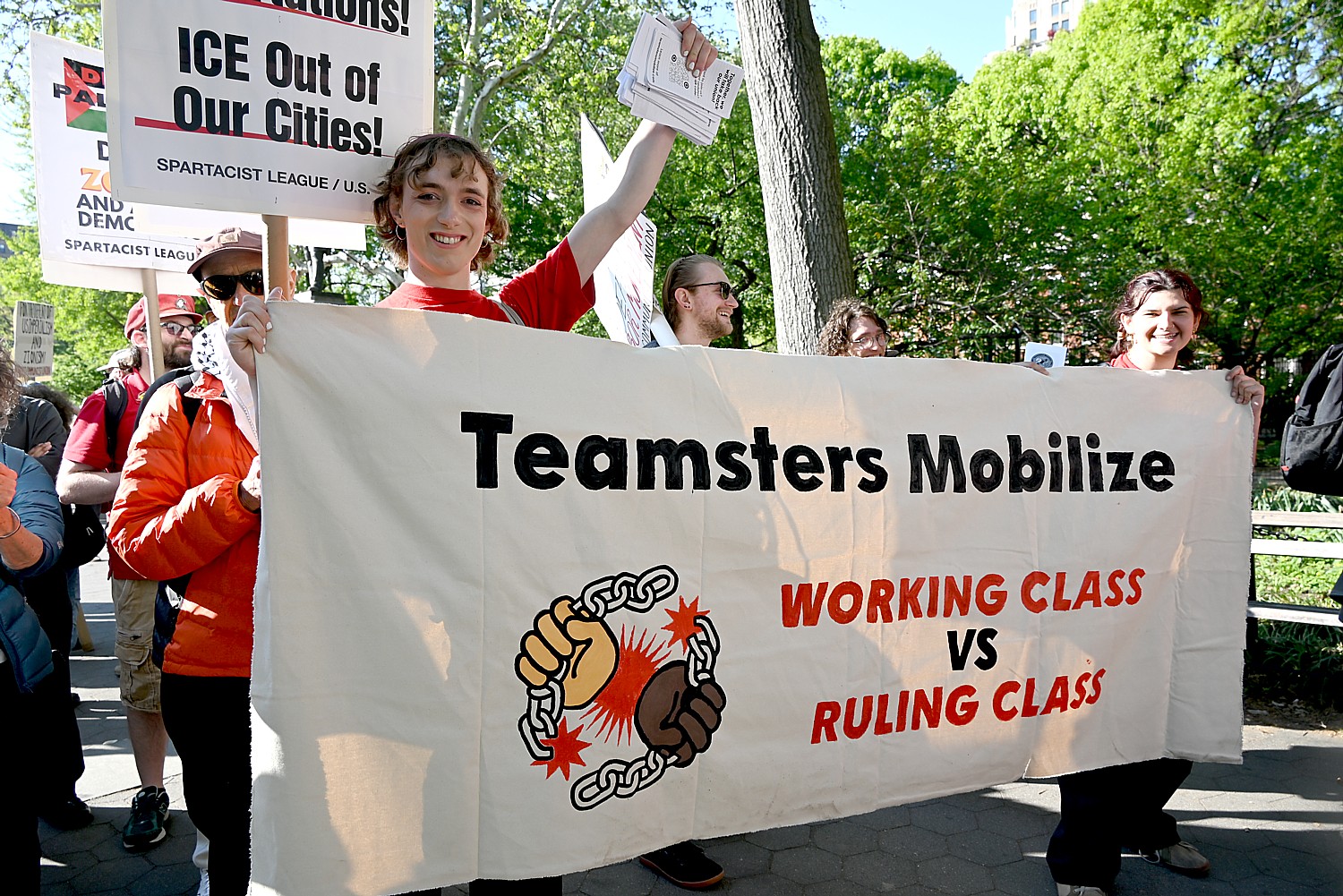
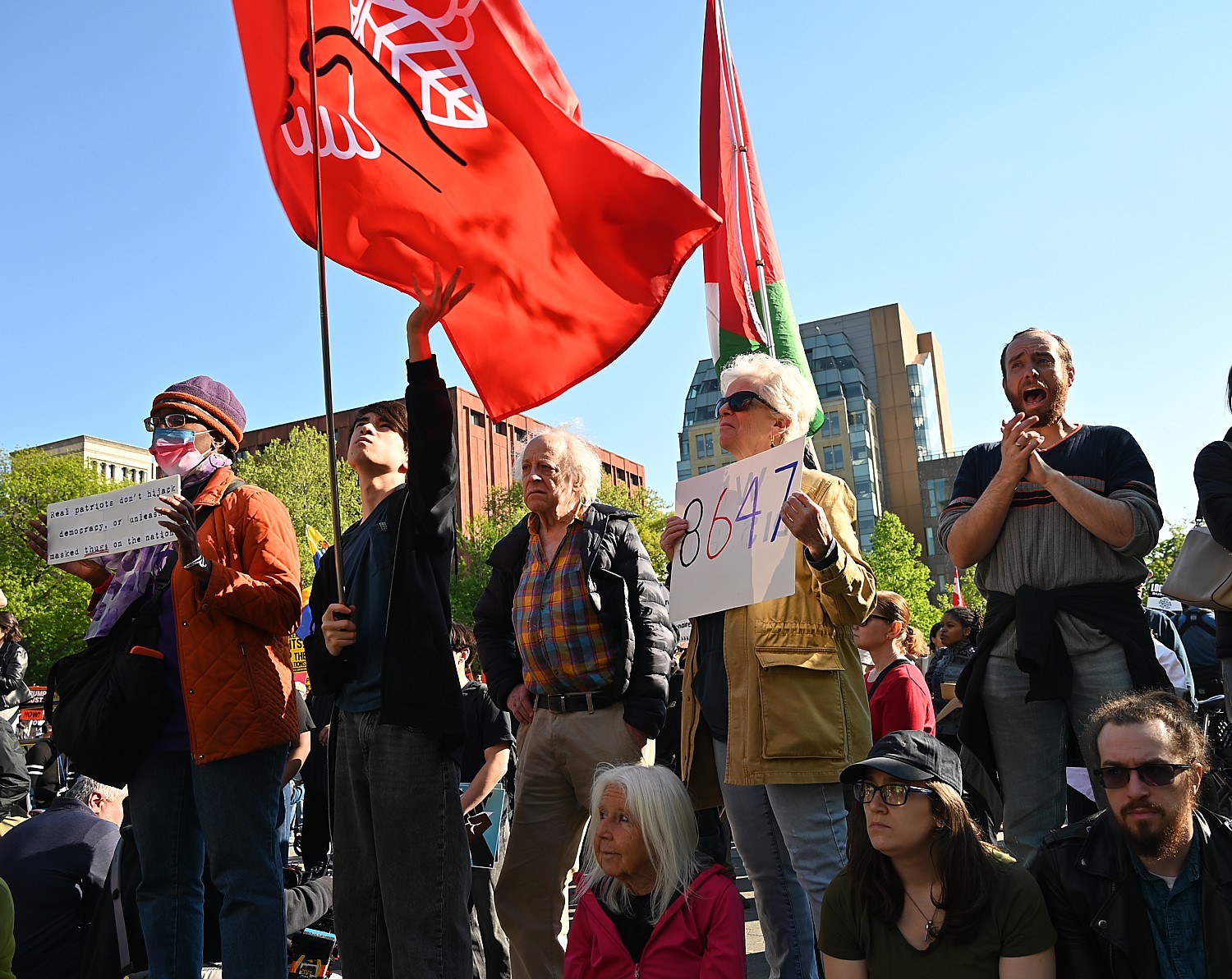
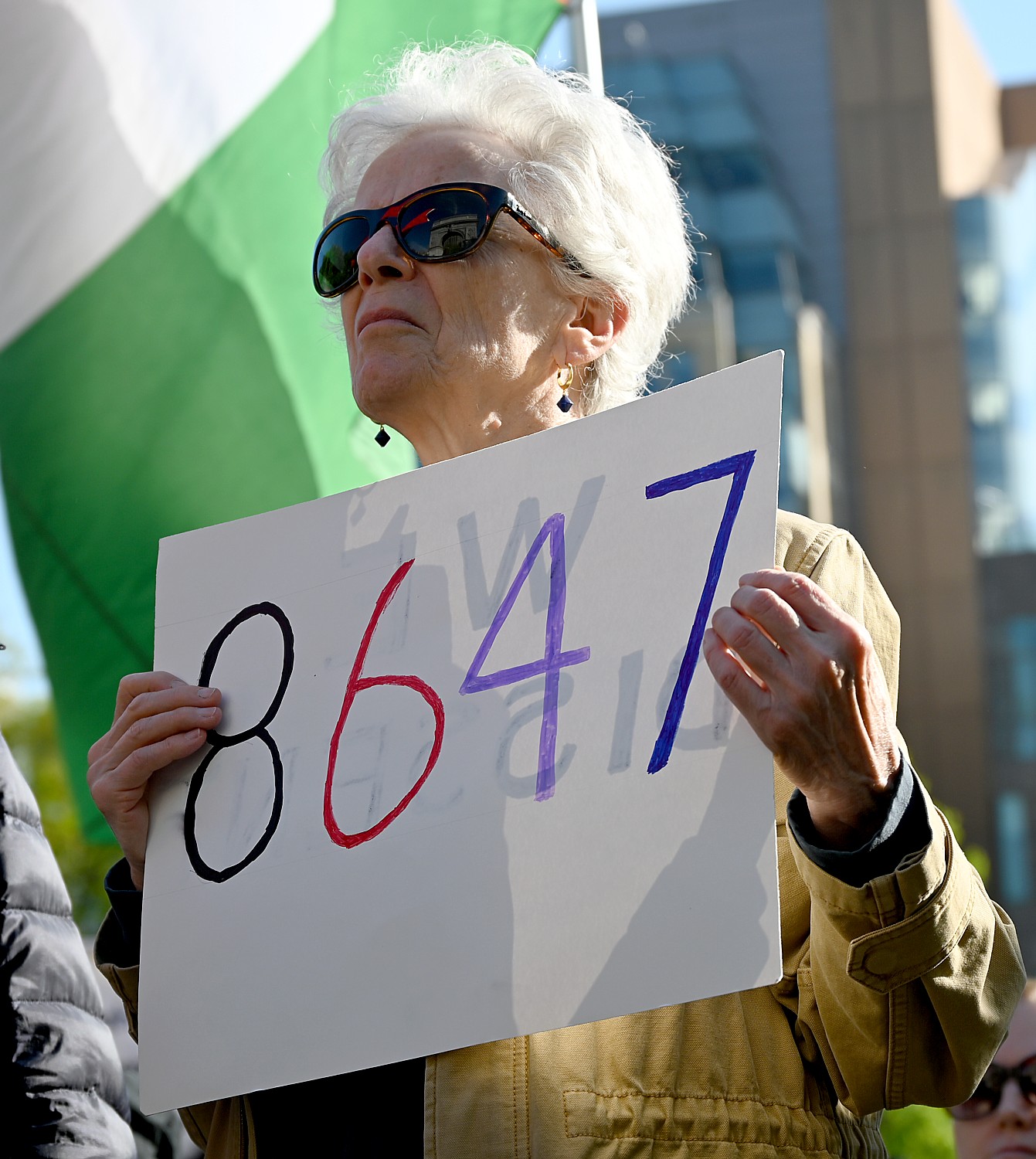
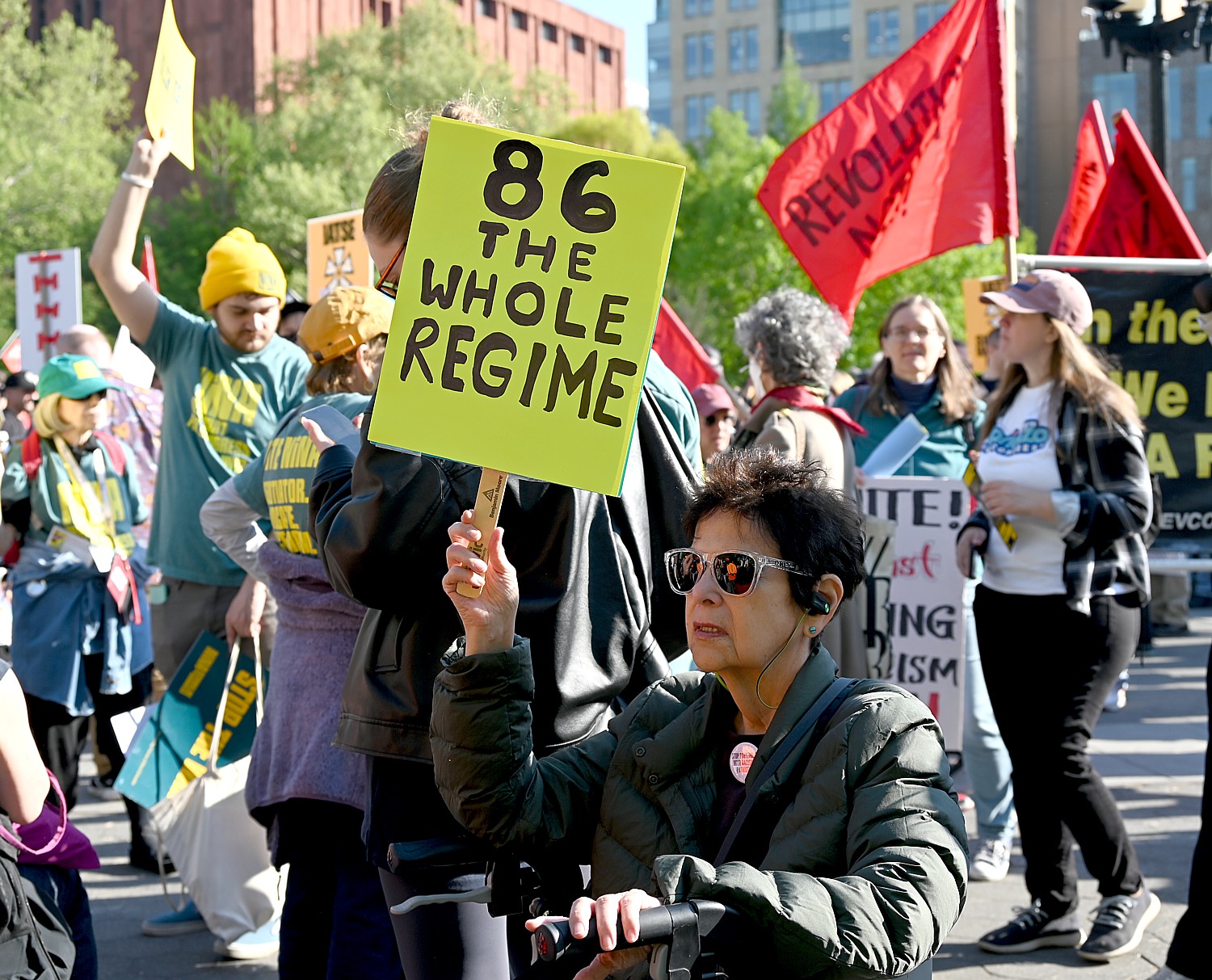
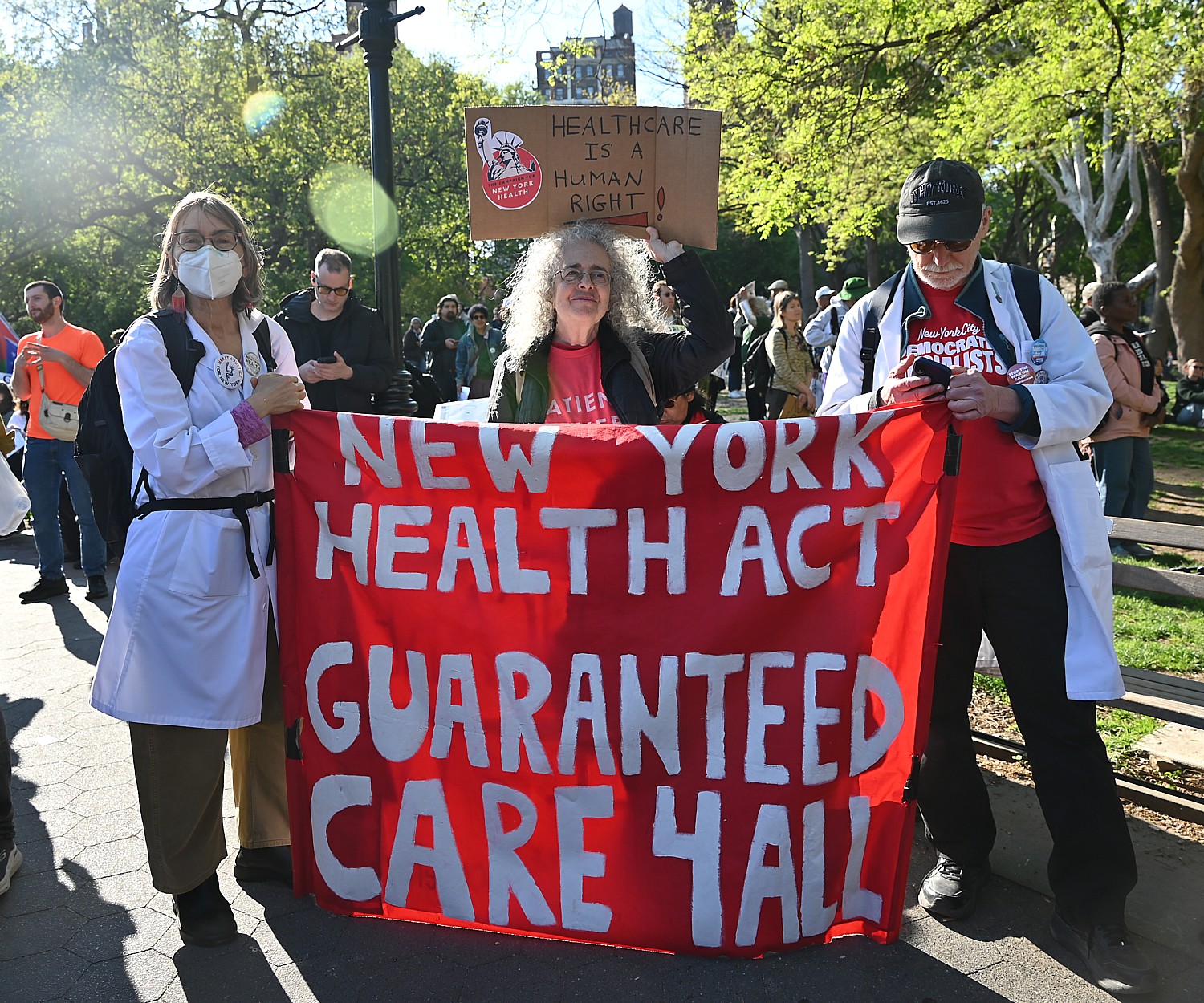
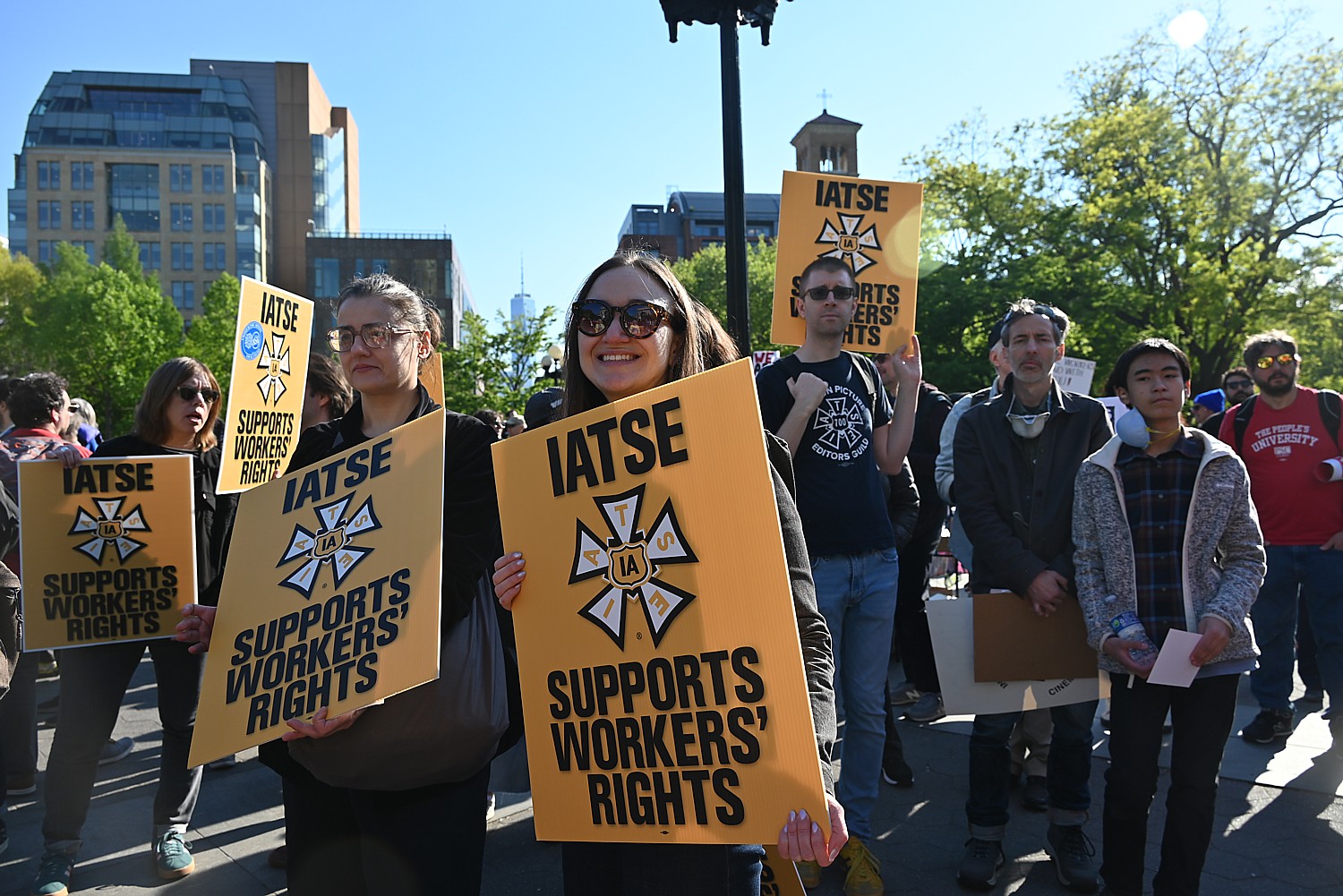
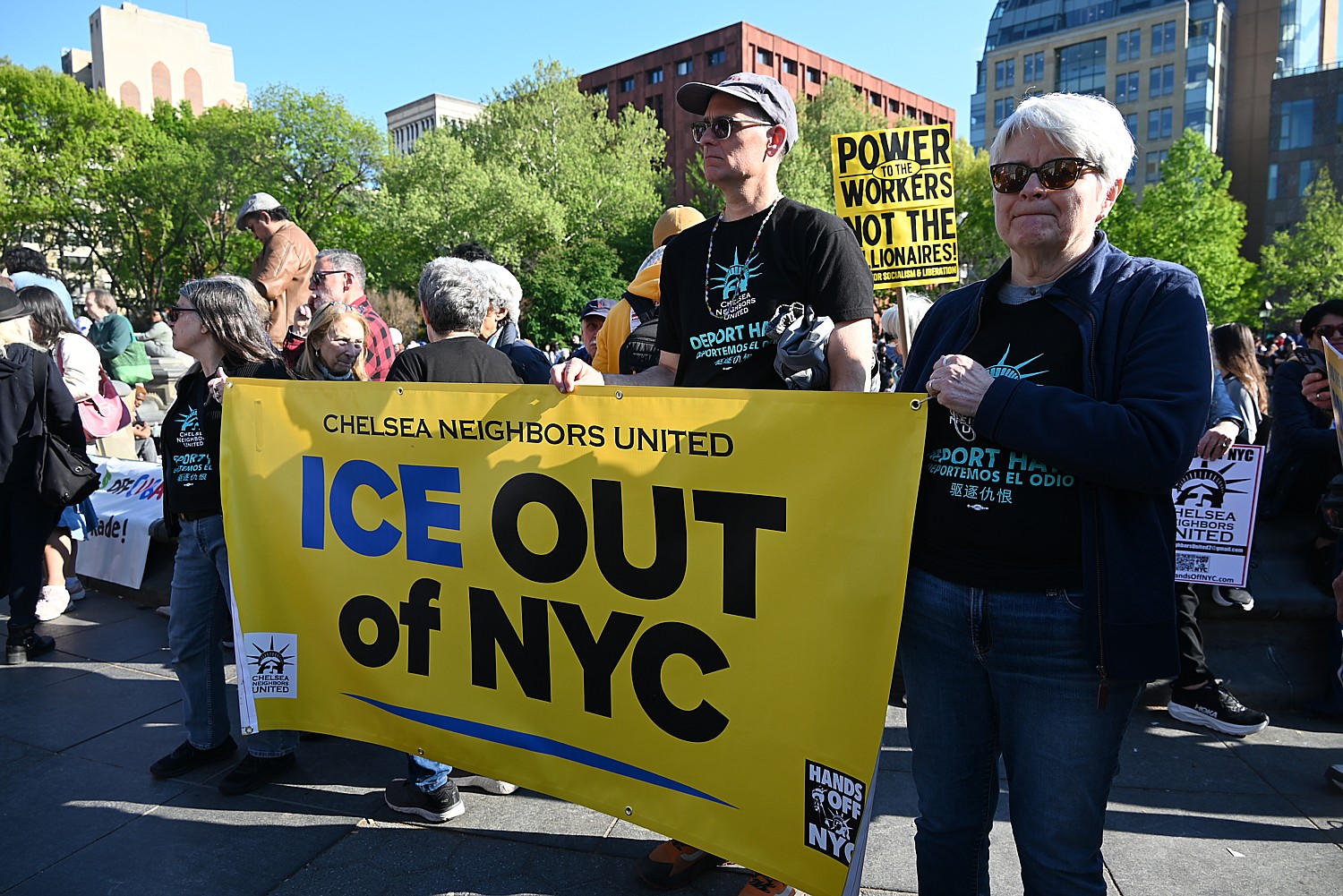
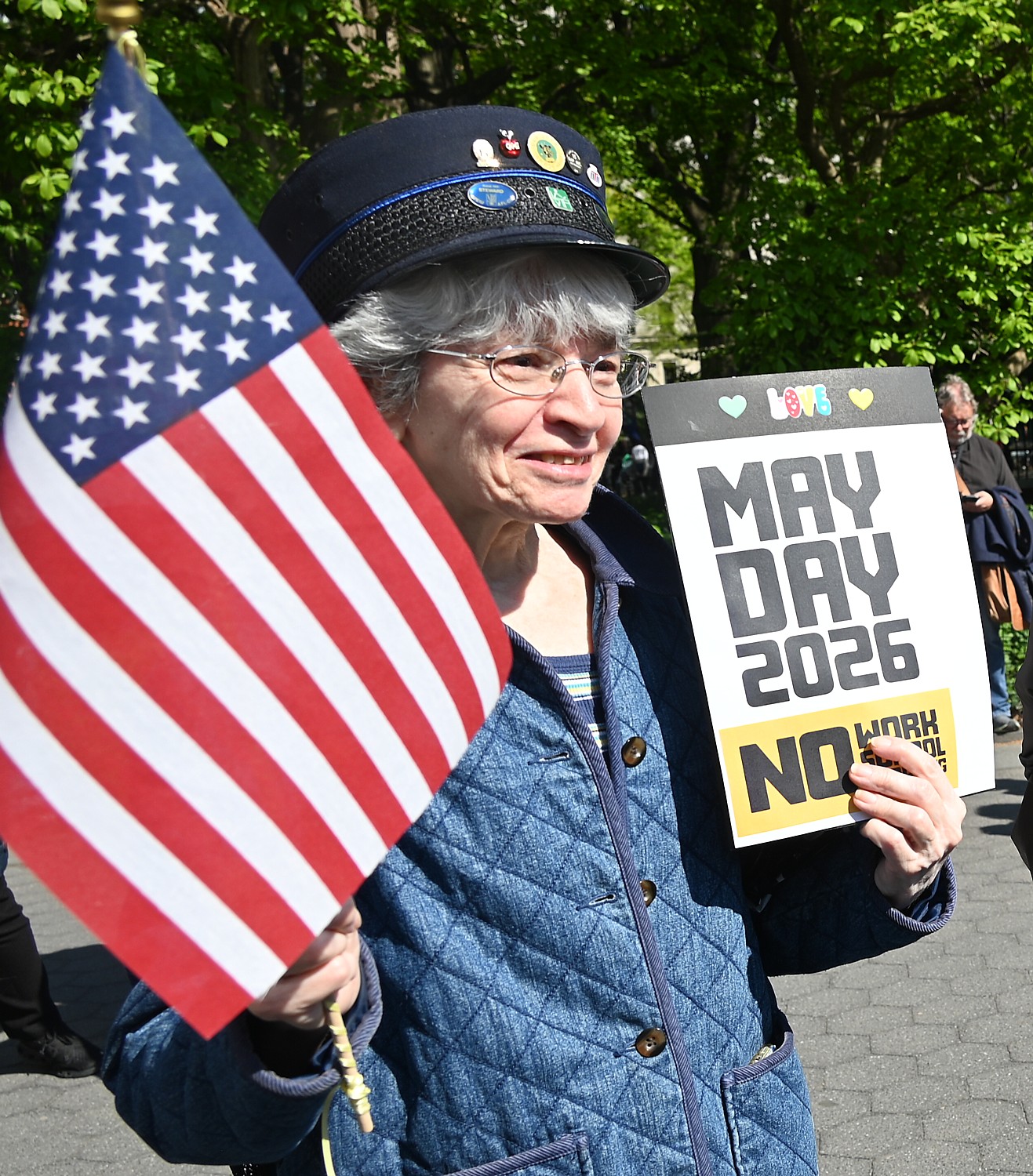
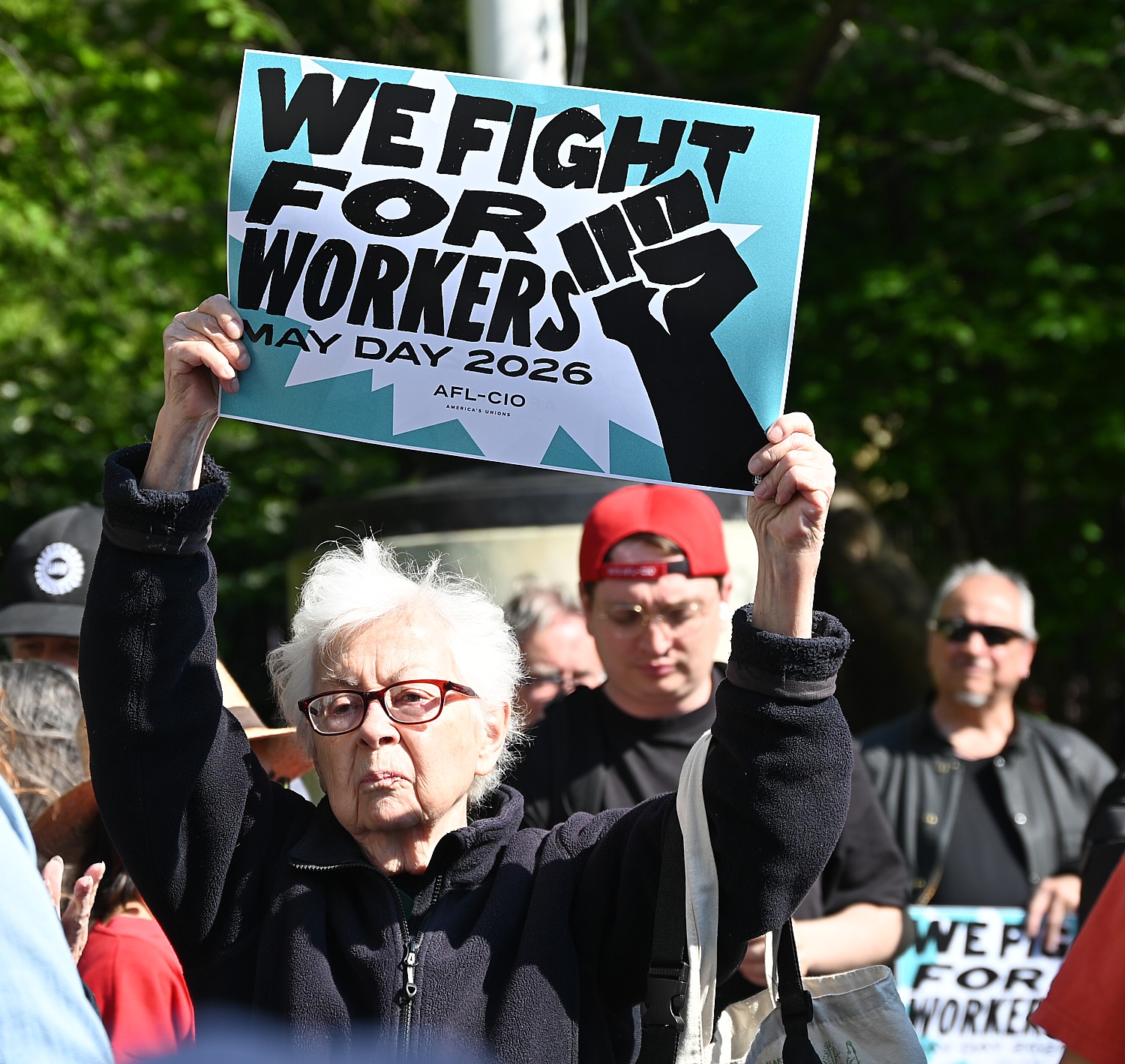
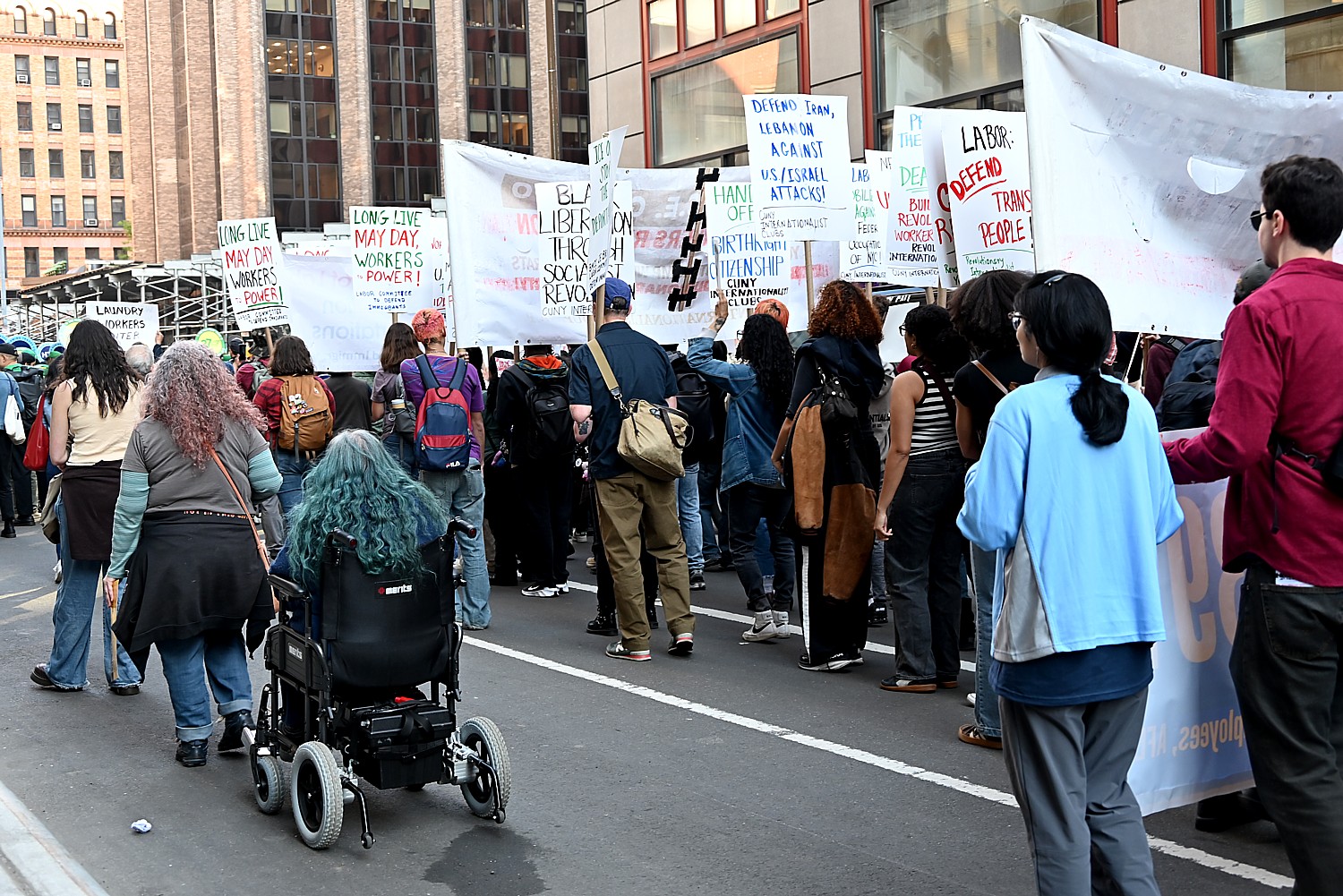
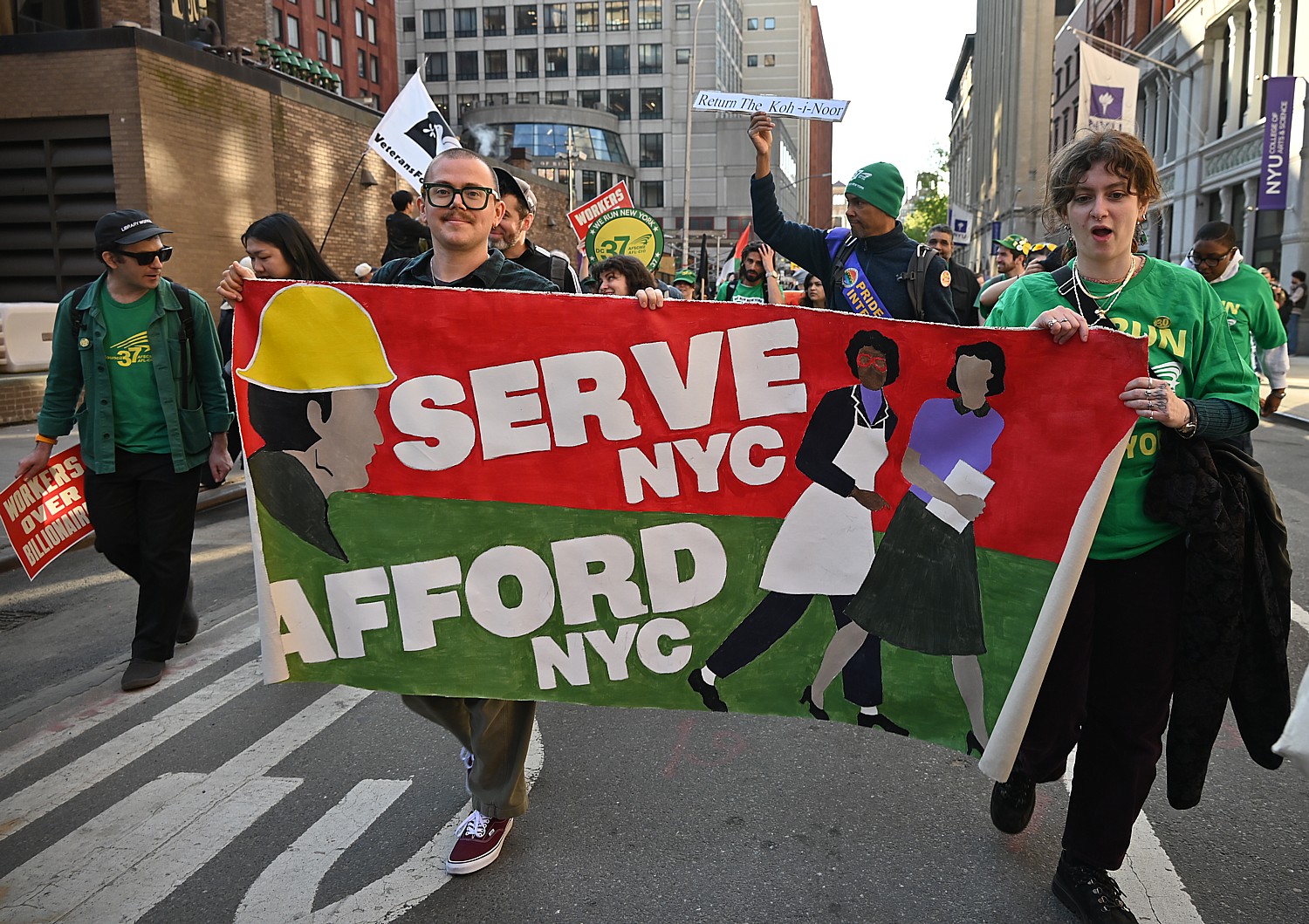
Thousands strong came out for a rally in Washington Square Park, Manhattan, and march support unions, workers and the ideals of a pluralistic, diverse society – one of 3,000 May Day actions nationwide, a continuation of the anti-Trump resistance movements. More than an annual demonstration for union, workers’ rights and economic justice, the protests manifested ire against the Iran War and ICE, the attacks on civil and voting rights, protecting immigrants, making the rich pay their fair share of taxes and themes of the No Kings/Hands Off! Movements.
No War. No ICE. No Billionaires, read the banners behind the speakers.
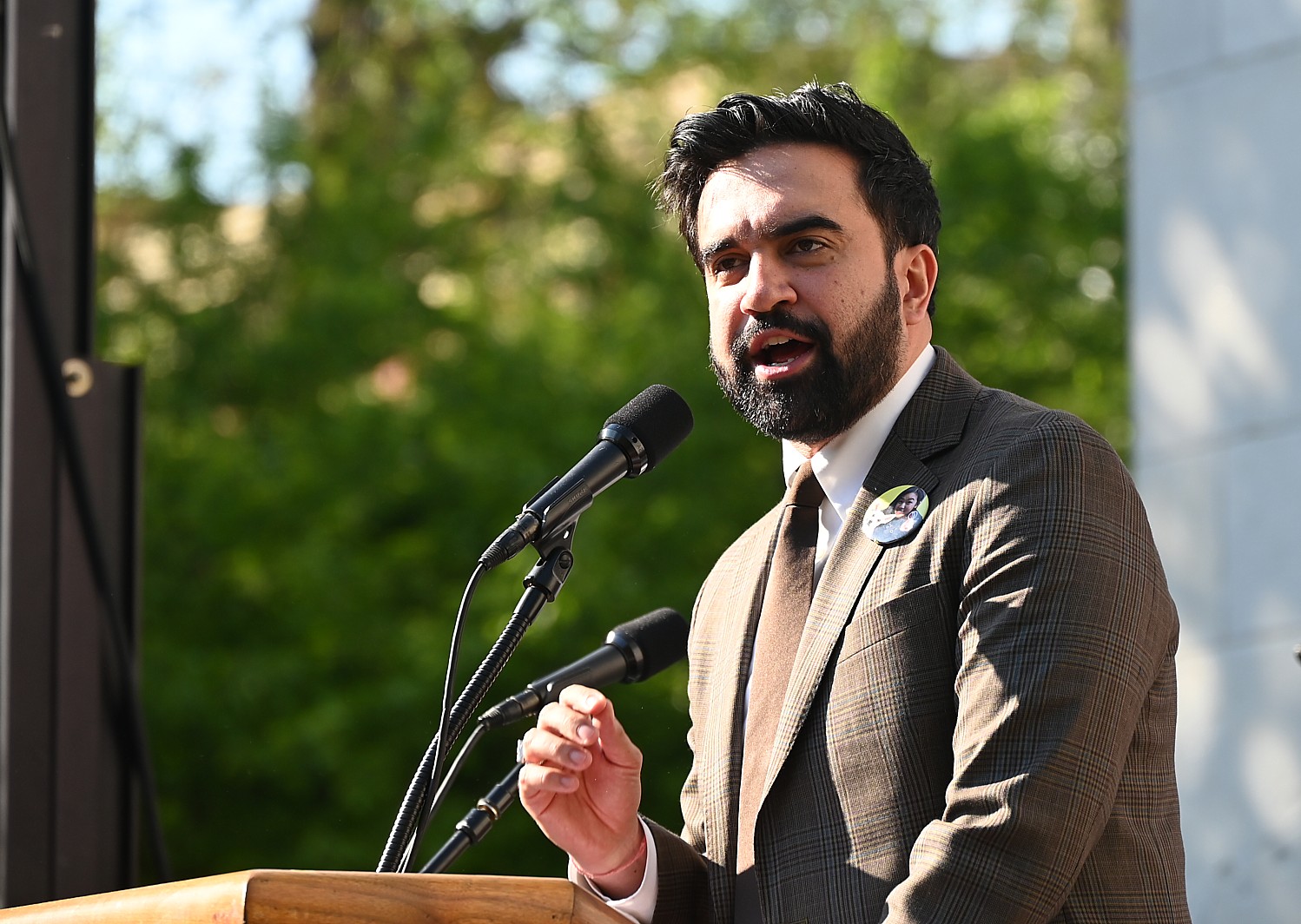
The headliner was undoubtedly Mayor Zohran Mamdani.
“Union strong is more than a slogan it is a practice of solidarity,” he declared, standing under the famous Washington Square arch.
“Workers have won the rights that are taken for granted today – 40 hour week, the weekend, overtime pay, minimum wage, social security workplace safety standards – these have all been won by the people before us.
“Yet we know those rights are not inevitable. We have to work together to not just protect them, but to advance that same agenda,” Mamdani said. “Our city hall is committed to doing all we can to put working people right at the heart of that agenda.”
Among the actions – not words – his administration has taken within the first 100 days:
Delivered millions of dollars to workers in small businesses ripped off by mega corporations
Appointed the first deputy mayor for economic justice, Julie Su
Stood alongside nurses on the picket line
“And it is why we continue to fight for those – deliver universal childcare, faster buses, cheaper groceries, protecting from ICE and yes, working to tax the wealthiest and most profitable corporations in New York City.”
He added, “We know that one of the best ways to uplift worker power is to stand with our unions. A union town is union strong. Union strong is more than just a slogan it is a practice of solidarity.
“Today we will show what solidarity means, a people united, organized cannot be defeated,” Mamdani declared to cheers.
More than 60 unions and organizations, including NYC Central Labor Council, AFL-CIO, New York Immigration Coalition, participated in what is International Workers’ Day, which was one of some 3,000 across the country.
Protecting immigrants against the Trump Administration’s cruel policies was a strong theme, with several calling for the state to pass Governor Kathy Hochul’s New York for All legislation, establishing protections from federal authorities.
The May Day Strong protest represented union workers across a spectrum including teamsters, teachers, health workers, construction workers, musicians, stage and film workers, hospitality and gaming workers.
Notably, though despite being at the doorstep of New York University, the preponderance of people attending the rally were seniors. Among them, 98-year old World War II Navy veteran Arthur A. Wasserman and 87-year old Kathleen Hager, who expressed concern that in their lifetime, they have never felt the country at such risk.
Here are photo highlights from the May Day Strong rally and march in New York City:
Common Sense Reforms to State Environmental Quality Review Act Will Speed Up Building of Housing Localities Want While Preserving Environmental Safeguards
Agenda Will Cut Red Tape That Delays the Building of Critical Infrastructure like Clean Water, Green Infrastructure, and Parks
State Will Establish Clear Timelines for Environmental Review, Standardize and Simplify Review Process, and Expedite Major Projects
Builds on Governor’s Historic Agenda To Address New York’s Housing Crisis and Make the State More Affordable and Livable for All New Yorkers
Governor Kathy Hochul rallied with local leaders from across the state to highlight her “Let Them Build” agenda, a series of landmark reforms to speed up housing and infrastructure development and lower costs as part of her 2026 State of the State. This initiative will spur a series of common sense reforms to New York’s State Environmental Quality Review Act (SEQRA) and executive actions to expedite critical projects that have consistently been found to not have significant environmental impacts, but caught up in red tape and subject to lengthy delays. Together, these actions will make it easier to build the housing and infrastructure that localities want.
The Governor’s proposal has now secured the backing of the New York State Association of Counties (NYSAC), the New York State Association of Towns (NYAOT), and the New York State Conference of Mayors (NYCOM), along with New York City Mayor Zohran Mamdani and dozens of other local elected officials from communities across New York.
“For far too long needless, outdated red tape has stood in the way of the housing and infrastructure that New Yorkers need to address the housing crisis and make life more affordable in communities across our state,” Governor Hochul said. “New York is a place defined by our boundless ambition — we are a state that builds. It is time that we cut the red tape that too often slows down projects and let communities build, so we can offer all New Yorkers the more affordable and livable state that they deserve and attract new residents who want to call New York home.”
Today, it is too difficult to build major projects in New York: manufacturing, housing and energy projects can take as much as 56 percent longer in New York State to get from concept to groundbreaking compared to peer states. Longer projects mean higher costs, a challenge that is especially critical in New York’s housing crisis, where the only solution to high costs and scarce homes is to build more housing faster and cheaper than before. According to a report from the Citizens Budget Commission, red tape increases the cost to build a unit of housing in New York City by as much as $82,000 per unit. Similarly, burdensome requirements delay needed investment in clean water infrastructure, child care centers, and parks.
New York City Mayor Zohran Mamdani said, “We cannot address our housing crisis without making it easier to build housing in New York City. Environmental review reform would bring our regulations into the 21st century and ensure we can deliver an affordability agenda on the timetable needed. I commend Governor Hochul for this commonsense proposal and hope it will be a part of the enacted state budget this year. New Yorkers can’t wait any longer for action on housing.”
New York State Association of Counties Executive Director Stephen J. Acquario said,“Counties across New York State recognize that the State Environmental Quality Review Act plays an important role in protecting our natural resources and communities, but we also know that the current SEQR process can be overly complex, time-consuming, and costly — often delaying housing and infrastructure projects that have little or no environmental impact. We welcome the Governor’s review of the SEQR framework and look forward to working with her and the Legislature to modernize the process in a way that preserves strong environmental protections while allowing counties and municipalities to deliver the housing and infrastructure New Yorkers urgently need.”
New York State Conference of Mayors Executive Director Barbara Van Epps said, “NYCOM applauds Governor Hochul for her efforts to streamline the State Environmental Quality Review Act (SEQRA) process, while preserving local control. SEQRA was designed to protect the environment, but it has too often been used to delay or block projects that would deliver clear environmental and community benefits. These targeted reforms would strike an important balance by expediting projects with minimal environmental impact while allowing communities to move forward with critical investments in housing, water and wastewater infrastructure, and other essential services.”
“The New York Association of Towns supports the governor’s effort to cut red tape and modernize the State Environmental Quality Review Act (SEQRA),” said New York Association of Towns’ Executive Director Christopher A. Koetzle. “We look forward to our continued partnership with the governor and our shared work together helping local governments become more efficient while still ensuring the integrity of the land-use review process.”
When Governor Hochul took office, she vowed to tackle the housing crisis and bring down costs by building the housing that New Yorkers desperately need so that more hard working households and families can afford a place to call home. However, too much critically-needed affordable housing development is forced to navigate a web of red tape created by state mandates that add unnecessary costs and years of needless delays, despite such housing development consistently being found to have no significant environmental impact. Studies have quantified how State-mandated environmental review can slow down housing projects by an average of two years, costing hundreds of thousands of dollars per project, at a time when New Yorkers can least afford the wait for the housing they need to continue to live and thrive in New York.
To speed up the development of housing to create a more affordable and sustainable New York, Governor Hochul is proposing to amend the State Environmental Quality Review Act (SEQRA) to exempt certain types of housing that have no significant impacts on the environment from additional SEQRA review. Housing exempted from SEQRA will still be required to comply with crucial State regulatory and permit requirements governing water use, air quality, environmental justice, and protection of natural resources. The proposal does not supersede local zoning and other permitting requirements, and exempted housing also must be located outside of flood risk areas in order to qualify.
Years of experience in both New York City and across the state, involving more than a thousand projects, has shown that virtually none of such projects ultimately were found to have significant environmental impacts, but nevertheless were still subject to lengthy reviews. These reforms will accelerate the delivery of much needed housing and reduce the cost of building in ways that are consistent with sustainable and environmentally-protective development, driving down the cost of housing and rents across the state while protecting our natural resources.
“We’re not eliminating local review permits or approvals. And we’re not saying anything goes,” Governor Hochul stated.” What we are saying, and I’ll repeat it. When a community says yes, they know that it’ll not impact the government, that the State is going to step out of the way and let them go forward and build. And right here in New York City, we can significantly speed up construction of housing units up to 250 citywide.
“But in areas that are medium and higher density, up to 500 units without having to go through this redundant review. And of course they have to comply with preliminary environmental regulations, State and local law permitting. None of that’s changing, but my reformers will be a game changer and send a strong message to communities and developers alike. We are open for business and just like all the other challenges I approach, as I mentioned, I approach this one with urgency. I am impatient as our New Yorkers, we cannot wait anymore. And those who oppose us, who want to keep the status quo. You explain that to the family living in a homeless shelter, waiting for a home. You explain your opposition to the young couple who wanted to start a family here in New York, but can’t.”
Accelerating Critical Infrastructure Projects That New Yorkers Depend On
Governor Hochul also has proposed to facilitate the speedier, cheaper delivery of a broad range of beneficial infrastructure projects that New Yorkers depend on. Specifically, the Governor has proposed to adjust SEQRA’s classifications to exempt the following important categories of infrastructure that meet specific criteria from additional SEQRA review to start serving New Yorkers faster:
Clean Water Infrastructure: Critical water infrastructure that avoids impacts to natural resources.
Green Infrastructure: Nature-based storm water management.
Parks and Trails: Public parks and recreational bike/pedestrian paths
Child Care: New or renovated child care centers
Governor Hochul’s proposal would reserve these fast-track environmental review processes for only infrastructure that would be located at previously disturbed areas, protecting our natural resources and undisturbed lands, while strengthening our neighborhoods. The Governor’s approach would yield tangible environmental benefits including improved air and water quality, a reduction in greenhouse gas emissions, and the preservation of critical habitats when compared to policies which encourage sprawl and unchecked development of natural areas.
Currently SEQRA review timelines vary greatly across projects, creating unpredictability for local communities, project sponsors, and state agencies alike. To cut through the red tape, Governor Hochul has proposed to:
Deliver faster decisions for local communities by setting clear timelines for environmental impact statements and driving accountability
Streamline environmental impact statements to cut down on review timelines for key categories of projects
Modernize New York’s permitting processes to save time and money for localities by improving processes and utilizing new technologies
Expedite major state infrastructure projects to serve New Yorkers faster
Support local communities through a new permitting academy
New York State Homes and Community Renewal Commissioner RuthAnne Visnauskas said,“New Yorkers desperately need more opportunities to rent apartments and buy homes they can afford. The SEQRA reforms outlined in the Governor’s Let Them Build agenda will deliver that by bringing clarity, speed, and fairness to the process of increasing housing supply and building the infrastructure and community resources that go along with it. The changes and modernization that the Governor is proposing will reduce the time it takes to get shovels in the ground by more than fifty percent while continuing to preserve and protect our natural resources. This is a brilliant idea that will make an enormous difference toward creating the homes and the thriving communities that people deserve.”
New York State Department of Environmental Conservation Commissioner Amanda Lefton said,“Governor Hochul’s ‘Let Them Build’ agenda is centered around incentivizing doing the right thing, avoiding impacts to natural resources, by driving development to previously disturbed sites. Common-sense reforms to SEQRA will speed up the delivery of zoned and permitted affordable housing and other critical infrastructure projects that New Yorkers need, and secure more certainty in environmental review timelines on vital transportation improvements, municipal infrastructure, and other projects benefitting local communities. The Governor’s approach will yield tangible environmental benefits compared to policies that encourage sprawl and unchecked development of natural areas.”
Empire State Development President, CEO and Commissioner Hope Knight said, “Governor Hochul’s ‘Let Them Build’ agenda is a critical step toward delivering the housing, infrastructure, and clean energy projects to benefit all New Yorkers. By modernizing environmental review, setting clear and accountable timelines, and removing unnecessary barriers while maintaining strong environmental protections, these reforms will lower costs, speed responsible development, and strengthen communities throughout the state.”
Governor Hochul’s Housing Agenda
Governor Hochul is dedicated to addressing New York’s housing crisis and making the State more affordable and more livable for all New Yorkers. Since FY23, the Governor has worked to increase housing supply through nearly $4 billion in targeted investments, a comprehensive Housing Plan, and implemented new protections for renters and homeowners. Under Governor Hochul’s leadership, HCR has created new programs that jumpstart development of affordable and mixed-income homes — for both renters and homebuyers. These include the Pro-Housing Community Program, which allows certified localities exclusive access to up to $750 million in discretionary State funding. Currently, more than 400 communities have received Pro-Housing certification.
The FY27 Executive Budget completes the Governor’s current five-year, $25 billion Housing Plan to create or preserve 100,000 affordable homes statewide, including 10,000 with support services for vulnerable populations plus the electrification of an additional 50,000 homes. More than 77,000 affordable homes have been created or preserved to date. The Executive Budget also invests $250 million to accelerate affordable housing construction to speed up the building of thousands more affordable homes.
East Hampton Town Supervisor Kathee Burke-Gonzalez said,“East Hampton needs more affordable housing so the people who keep our town running can continue living here, including teachers, health care workers, first responders, town employees, and young families. I appreciate Governor Hochul for making this a priority and for backing a clearer, more consistent review process that helps communities build the homes New Yorkers need while continuing to protect our environment, our water, and our open space.”
“I applaud Governor Hochul’s proposed SEQRA reforms through her Let Them Build Agenda,” said White Plains Mayor Justin Brasch. “These common-sense changes cut through unnecessary red tape while striking the right balance-encouraging smart growth and preserving zoning authority, home rule, and environmental integrity. As the fastest-growing city in New York State, White Plains needs tools that allow us to build faster and more affordably, and this plan delivers.”
Queens Borough President Donovan Richards Jr. said, “Our city and state face a generational housing crisis that endangers countless families living on the sharp edge of homelessness, and we must leave no stone unturned in order to protect, preserve and rapidly build affordable housing. That is exactly what these reforms put forth by Governor Hochul will do by removing the red tape that has contributed to this crisis by unnecessarily delaying and blocking construction. I commend the Governor for putting forward her comprehensive Let Them Build initiative, and I am proud to partner with her in this effort.”
New York State Association for Affordable Housing President and CEO Carlina Rivera said, “New York is running out of time to address its affordable housing crisis, and unnecessary delays in the SEQRA process are making it harder and more expensive to build the homes New Yorkers need. Governor Hochul’s proposed SEQRA reforms strike the right balance by streamlining review for appropriate affordable housing projects while preserving critical environmental protections. These changes will reduce costs, create predictability, and help deliver more homes faster. We urge the Legislature to work with the Governor to ensure these important reforms remain in the final budget.”
New York Housing Conference Executive Director Rachel Free said,“Reforming SEQRA is critical to unlocking housing production in New York. The current process often creates years of delay, drives up costs, and blocks housing and infrastructure projects without delivering better environmental outcomes. The Governor’s suggested modernization would rightly focus on projects with truly significant impacts, while reducing the delay on key housing projects. SEQRA reform is essential to advancing affordable housing and the economic vitality New York urgently needs while maintaining strong environmental protections.”
National Federation of Independent Business New York State Director Ashley Ranslow said, “Governor Kathy Hochul’s proposal to reform SEQRA is a practical and necessary step to help streamline and expedite the development and building process. In New York, it takes too much time and resources to get a project off the ground — inevitably driving up the cost of construction. Reforming SEQRA will cut red tape, accelerate building projects, and make them more affordable, ultimately helping the state’s economy, small businesses, and communities across the state.”
Partnership for New York City President and CEO Steven Fulop said,“I hear often from Board members at the Partnership that SEQRA has needed fixing for a long time. It is needlessly bureaucratic, and it drags out projects. I am glad Governor Hochul is taking this on, because it is an unnecessary factor driving up the cost of housing development in the city.”
Open New York Executive Director Annemarie Gray said, “Modernizing SEQRA is about restoring faith that our government can deliver on the things New Yorkers need. When critical projects spend five years being delayed by paperwork, people lose faith in government. Right now, we’re facing both an affordability crisis and a climate crisis — these demand immediate action, and New York families can’t afford to wait years for delays driven by frivolous lawsuits. We commend Governor Kathy Hochul for taking this on and urge the State Legislature to pass SEQRA reform in this year’s state budget.”
Citizens Budget Commission President Andrew Rein said, “We commend Governor Hochul for proposing this bold step to boost much-needed housing production. Reforming the onerous environmental review process will make building housing cheaper and faster, without additional cost to the State. That’s the sort of smart choice that will make our state more affordable and competitive.”
Regional Plan Association President and CEO Tom Wright said,“Reforms to the State Environmental Quality Review Act (SEQRA) will help fast-track the smart, sustainable infrastructure our region needs, and we commend Governor Kathy Hochul for her bold leadership in taking on this long-overdue work. For over one hundred years, RPA has focused on one core mission: improving quality of life across the tri-state region by advancing solutions that lead to economic vitality, environmental resilience, and healthy, thriving communities. SEQR modernization will greenlight the housing, energy, and transit investments New Yorkers support, and that our region needs to remain competitive, equitable, and resilient.”
Association for a Better Long Island Executive Director Kyle Strober said,“This is a significant update for the New York economic development community. One of the biggest hurdles that economic development projects face is unpredictable timelines and prohibitive soft costs for small to mid-sized projects. These reforms, proposed by Governor Hochul, will help spur economic development, create housing and help make New York more affordable.”
Long Island Contractors’ Association Executive Director Marc Herbst said, “Contractors across Long Island welcome efforts to modernize SEQRA so essential infrastructure projects can move forward in a more timely and predictable way. Streamlining reviews for projects with minimal environmental impact will help communities deliver critical upgrades to roads, water, energy, and public facilities — supporting good-paying local jobs while maintaining strong environmental standards.”
Permanent Citizens Advisory Committee to the MTA Executive Director Lisa Daglian said, “SEQR reform is a crucial complement to transit-oriented development projects around the MTA region, simultaneously combating the housing affordability and climate change crises. We applaud Governor Hochul for taking on this common-sense legislation that will cut red tape and encourage more transit ridership across the region.”
New York State Economic Development Council Executive Director Ryan M. Silva said, “Cutting through red tape and reducing timelines for project approvals is critical to achieve our housing, economic development, and renewable energy goals. The governor’s proposal to exempt housing projects from SEQRA and install a two year cap for review is an important and necessary first step to help support New York’s business climate. These initiatives will help reduce project costs, create predictability in the permitting approval process, and create economic opportunity across the state.”
Westchester County Association President & CEO Michael N. Romita said, “Governor Hochul’s SEQRA reforms are a very important step toward addressing the state’s critical housing shortage. Notwithstanding its noble underpinnings, over the past half century, SERQRA has become increasingly abused by overuse and modernization is overdue. These reforms do not override local control, and they don’t require communities to change their zoning. Rather, they empower local officials to meet today’s needs.”
Long Island Association President & CEO Matt Cohen said, “Red tape and overregulation stifles innovation and hinders sorely needed projects that contribute to economic growth. The LIA commends the Governor’s proposal to streamline environmental reviews for new housing, which would go a long way to addressing our existential cost-of-living crisis on Long Island.”
New York State Business Council President & CEO Heather Mulligan said, “New York’s housing shortage is an ongoing economic concern in all regions of New York State. Modernizing environmental review rules — without hindering protections — can cut years of red tape, lower construction costs, and accelerate the delivery of housing that families and workers can afford. Expediting essential investment projects — will support job creation, community growth, and help make New York more competitive.”
Rockland Business Association CEO Jeffrey Greenberg said, “Governor Hochul’s proposal to cut red tape and modernize permitting is a smart, common-sense step for New York. By streamlining outdated processes while preserving environmental protections and public input, these reforms will help Rockland move critical projects forward faster and at a lower cost while simultaneously supporting economic growth across New York State.”
Westchester Business Council Vice President John Ravits said,“The BCW has always advocated for SEQR Reform. Governor Hochul’s proposal to streamline New York’s permitting and environmental review process is a practical step toward helping communities get projects built more efficiently. By reducing unnecessary delays while maintaining strong environmental safeguards and public engagement, these reforms will lower costs, improve timelines, and support the housing, infrastructure, and economic development projects our region needs.”
New York State Builders Association President Peter Florey said,“It is important that we get back to the original intent of the SEQR process which was to protect our environment. SEQR was not intended to be used as a means of slowing or preventing much needed housing production. Governor Hochul’s meaningful recommendations will go a long way towards ensuring that SEQR is used to help housing production and affordability while also safeguarding our environment.”
Enterprise Community Partners Senior Vice President of Programs Baaba Halm said, “When it comes to delivering affordable housing, every second counts. Too often, SEQR creates lengthy, costly, and sometimes insurmountable barriers to affordable housing projects. Enterprise applauds Governor Hochul for recognizing sensible SEQR reform as a way to accelerate the delivery of the affordable homes that New Yorkers so desperately need.”
Real Estate Board of New York Executive Vice President of Public Policy Basha Gerhards said,“The Governor’s thoughtful reforms to SEQRA will accelerate new housing production and save significant time and money. We applaud the administration for identifying a solution to streamline this process while protecting the opportunity for local review.”
Long Island Builders Institute CEO Mike Florio said,“New York’s housing shortage is a crisis that demands action, and Governor Hochul’s proposed reforms to SEQRA are a critical step in the right direction. SEQRA was never intended to be a tool to delay or block much-needed housing for years at a time. Modernizing the review process while maintaining strong environmental protections will help communities add housing faster, reduce costs for families, and support smart, responsible growth across Long Island and New York State.”
Long Island Housing Services Executive Director Ian Wilder said, “On Long Island, SEQRA has long been an essential tool for protecting our drinking water, open space, and air quality, and those protections must remain strong. At the same time, a small number of bad-faith challenges have abused the statute to delay or derail lawful, environmentally responsible housing — particularly infill development, code-compliant homes with appropriate sewage systems, and accessory dwelling units. Thoughtful SEQRA reform restores balance. It preserves meaningful environmental review while reducing misuse that has worsened traffic congestion and fueled sprawl that puts greater strain on groundwater and infrastructure. On an island with limited land and a severe housing shortage, smart, compact housing is not in conflict with environmental protection — it is one of the most effective ways to achieve it.”
New York Housing Conference Executive Director Rachel Fee said, “Reforming SEQRA is critical to unlocking housing production in New York. The current process often creates years of delay, drives up costs, and blocks housing and infrastructure projects without delivering better environmental outcomes. The Governor’s suggested modernization would rightly focus on projects with truly significant impacts, while reducing the delay on key housing projects. SEQRA reform is essential to advancing affordable housing and the economic vitality New York urgently needs while maintaining strong environmental protections.”
New York State Association of REALTORS® President Ron Garafalo said“The New York State Association of REALTORS® supports Governor Hochul’s proposal to streamline New York’s State Environmental Quality Review Act (SEQRA). The proposals will expedite project timelines for key initiatives like the critical need for housing, accelerate the implementation of necessary infrastructure projects, reduce red tape and focus on meaningful revisions while maintaining strong environmental protections. These reforms are essential to addressing housing affordability across New York.”
Suffolk County Village Officials Association President and Village of Brightwaters Mayor John Valdini said, “The Suffolk County Village Officials Association supports common sense efforts to cut unnecessary red tape and help communities with smart, responsible growth. Governor Hochul’s approach respects local zoning and home rule while streamlining a process that too often delays projects our residents need.”
Rebuilding Together NYC Executive Director Valerie Payne said,“As the Executive Director of Rebuilding Together NYC, whose mission is to repair homes, rebuild lives, and revitalize communities, our work is directly aligned with the Governor’s initiative to “Let Them Build”. As a nonprofit that provides critical repairs to preserve existing homes in the midst of a housing crisis, we acutely understand the need to build more and to improve the infrastructure of New York City neighborhoods. We work with so many homeowners who cannot afford to keep up their homes and are living on fixed incomes and without our support, have nowhere to turn. Our critical home repairs prevent displacement, as well as avoidable hospitalizations due to older adults living with environmental hazards and preserving family assets. If forced to move, homeowners would not be able to afford the rent in a new building. “Let them Build” offers hope that in the future, our low-income NYC homeowners will not be in such a vulnerable position. Thank you, Governor Hochul!”
Supportive Housing Network of New York Executive Director Pascale Leone said, “The Network strongly shares the Governor’s commitment to building more housing, including urgently needed supportive housing. The proposed reforms in this year’s budget thoughtfully balance environmental protections with the pressing need to address New York’s housing crisis,”
LISC NY Head of National Housing Strategic Initiatives & Senior Executive Director Valerie White said, “The most effective way to address New York’s housing crisis is to build more housing, and removing barriers that slow projects down or stop them altogether by cutting red tape and modernizing outdated rules will help achieve that goal. Governor Hochul advancing these important reforms will spur housing development across New York State and we look forward to seeing how they will help neighborhoods grow in ways that are community-centered, sustainable, and responsive to real housing need.”
CDC LI President and CEO Gwen O’Shea said, “Long Island’s has a serious housing crisis; driven in part by lack of inventory and affordability. Removing unnecessary barriers to allow more housing opportunities to develop is a win for all Long Island. This proposal will allow more homes to be available to Long Islanders while protecting the uniqueness and beauty of Long Island’s environment.”
NYU Furman Center Faculty Director Vicki Been said, “NYU’s Furman Center has long raised concerns about whether the costs of the environmental review process for infill housing and some other types of development outweigh the benefits. A few other states have begun to make progress in streamlining and targeting environmental review, and we commend Governor Hochul and her team for tackling this critical issue for New York.”
Nassau County Village Officials Association president Elena Villafane said, “The Nassau County Village Officials Association backs efforts to simplify the approval process, eliminate needless hurdles, and give communities the tools to act efficiently. Preserving local decision-making on zoning is extremely important, and Governor Hochul’s plan allows villages to advance sensible growth.”
Bruce Blakeman, Nassau County Executive who is the Republican challenging Hochul for governor, has consistently opposed Hochul’s efforts to address the state’s housing and affordability crisis. He has done nothing to improve critical infrastructure; the only infrastructure improvements, such as to the Long Island Railroad, and downtown revitalization programs have been funded by the state. His one economic development project during his term was to award the Nassau Coliseum property (dubbed “The Hub”) to the Sands to build a casino resort, which was opposed by much of the surrounding community.
With the new tax year beginning January 1, 2026, Governor Kathy Hochul is informing New Yorkers about a number of tax relief and affordability measures that will begin in the New Year. The Governor is also announcing that in her upcoming FY2027 Executive Budget proposal, she will put forth legislation that eliminates state income taxes on up to $25,000 of tipped income in tax year 2026, which follows federal guidance. This effort is a continuation of the Governor’s Affordability Agenda. Since taking office, the Governor has advanced policies that have put over $9 billion back in the pockets of New York households through tax relief efforts.
“As we welcome in the New Year, affordability remains my top priority and I am doubling down on my commitment to put money back in New Yorkers’ pockets,” Governor Hochul said.“Starting today, tax rates for the vast majority of lower and middle-class New Yorkers will be cut, families with children will see a sweeping increase in the child tax credit, and minimum wage workers across the state will see their wages go up. I’m kicking the new year off with a proposal of no state income tax on tips, continuing my efforts to make New York more affordable for hard working New Yorkers.”
Over the last 5 years, the costs on everyday essentials like groceries, insurance, utility bills, and goods and services has increased significantly, and Governor Hochul has heard directly from New Yorkers how difficult it can be to make ends meet. As a result, the Governor created her Affordability Agenda, which has delivered over $9 billion in tax relief to New York’s individuals and families since taking office. This most recent proposal of No Tax on Tips, is the latest in a series of efforts to put money back in New Yorkers pockets.
Middle Class Tax Cuts
In the FY 2026 Enacted Budget, Governor Hochul secured a middle class tax cut, which, beginning January 1, 2026, will deliver nearly $1 billion in tax relief to more than 8.3 million New Yorkers. This will provide savings to taxpayers earning up to $323,000 for joint filers. When fully phased in, the middle class tax cut will deliver hundreds of dollars in average savings to nearly 77 percent of filers — representing three out of every four taxpayers.
Sweeping Increase in Child Tax Credit
In the FY2026 Enacted Budget, Governor Hochul continued her efforts to expand New York’s child tax credit, providing critical financial support for more than 2.75 million children statewide. This latest expansion doubled or in many cases, tripled the current credit, offering up to $1,000 annually per child under four and up to $500 per child aged four to 16. This latest expansion marked the largest increase in the credit’s history, significantly surpassing the previous maximum of $330 per child. The expansion will be phased in over two years, with New Yorkers receiving expanded benefits starting in 2026 for children under four and extending to older children in 2027.
Increasing the Minimum Wage
Included in the FY2024 Enacted Budget, Governor Hochul created a transformative plan to help low-wage New Yorkers keep up with the rising costs of living by increasing New York’s minimum wage for three years and tying future increases to inflation. Beginning January 1, 2026, New York State’s minimum wage increased to $17.00 per hour in New York City, Westchester, and Long Island, and $16.00 per hour in the rest of the state. Starting in 2027, the minimum wage will increase annually at a rate determined by the Consumer Price Index for Urban Wage Earned and Clerical Workers (CPI-W) for the Northeast Region — the most accurate regional measure of inflation.
Governor Hochul’s Affordability Agenda
This announcement builds on Governor Hochul’s Affordability Agenda which delivered a $2B Inflation Refund program, delivering up to $400 to over 8.2 billion New Yorkers, and universal free school meals, saving parents and families up to $1,600 a year.