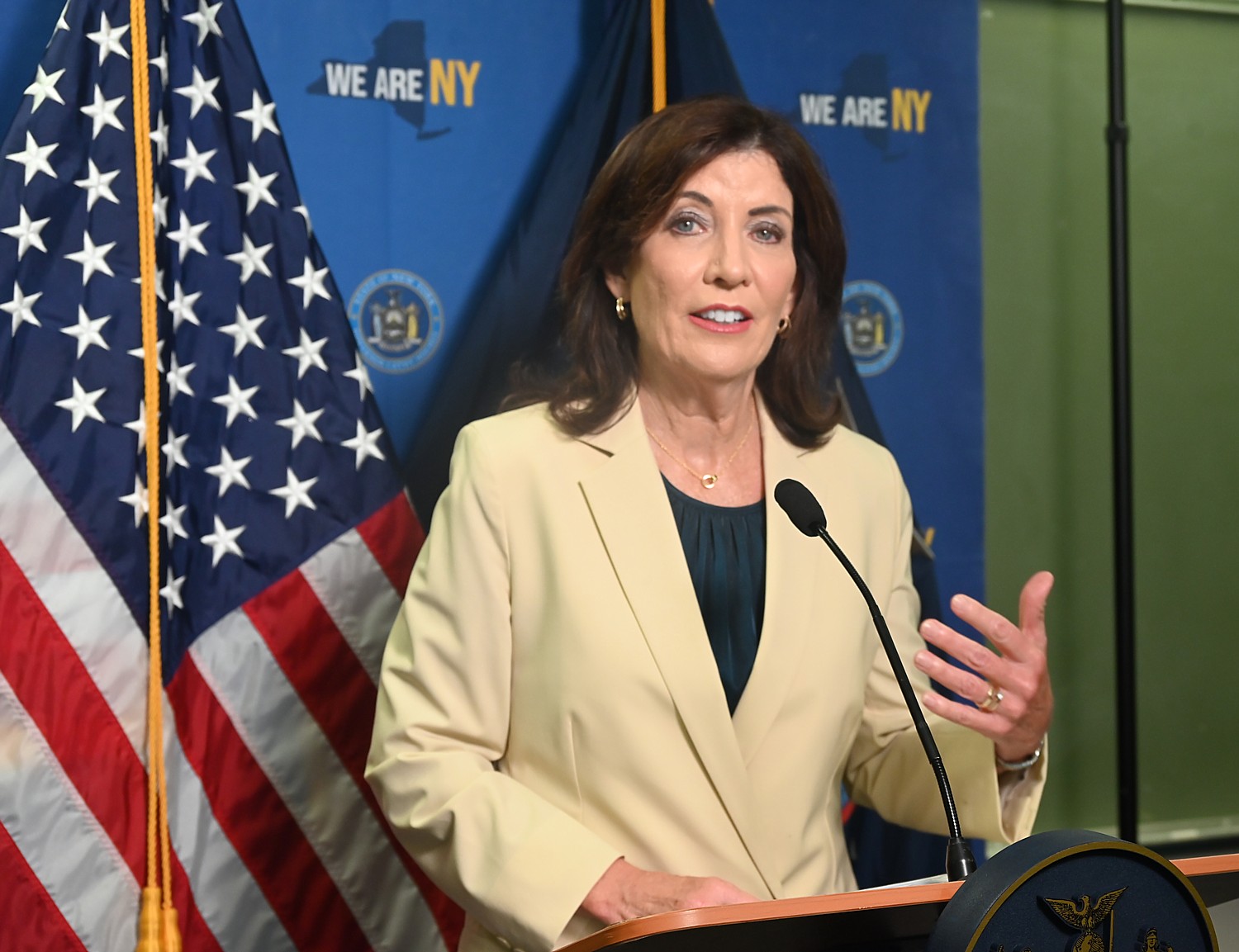
In his State of the County speech, Nassau County Executive Bruce Blakeman focused on public safety, law enforcement, boasted about the county’s alliance with ICE and its ban on transgender school kids playing on girls’ teams, as the key accomplishments of his administration.
Blakeman, who declared his intention to run for governor the day after his reelection, thanked the audience of county officials and electeds for the honor of serving as the county executive, closed out his 20-minute speech saying, “Looking ahead my commitment will remain stronger than ever. I want us all to continue to thrive. We have the lowest poverty rate in the state- that makes me happy. I want all our residents to live in prosperity, have a good job, good benefits, enjoy not just the necessities but luxuries – vacation, going out to dinner, buying daughter a prom dress. I want Nassau County to remain safest, most affordable, healthiest to live, work, and raise a family in all of America”
Missing from this speech was his usual jabs at Governor Hochul – such as Hochul’s audacity at proposing a no-nonsense plan to build affordable housing – which is interesting in light of his declaration to challenge her for governor. But the speech deliberately omitted any mention of his aspirations or the fact that if he is serious about running for governor, that will be his focus until November, leaving the county’s administration to an unelected underling.
Blakeman offered little in the way of economic development achievements, beyond reducing the time for approvals for business applications. Most of the significant projects were actually through the state’s Downtown Revitalization Program, infrastructure grants and other programs. But he was unable to cite any projects to mitigate climate change, enhance resilience or sustainability, or build upon efforts to turn Long Island into a biomedical, science and research hub.
Blakeman, who vigorously opposed Governor Hochul’s efforts to increase the supply of affordable housing, uncharacteristically cited one project: Frank Stiller’s Tunnels to Towers Foundation is investing $20 million to turn “a rundown, crime ridden” stretch of Long Beach into 50 new homes for vets, first responders and Gold Star families, “which guarantees all who served … a safe and welcoming place in Nassau.”
He boasted of not having raised property taxes for the entirety of his time in office – not mentioning that he has been sitting on close to $1 billion in unspent federal and state grant money, including almost $100 million in opioid settlement funds, in order to use the interest revenue.
But what he is most proud of are the policies and programs that mimic the Trump/MAGA administration’s “anti-woke” – that is anti-political correctness – policies:
“Under our leadership, we stand up for fairness, commonsense in sports- in Nassau County boys play with boys, girls play with girls,” he declared to a standing ovation. “Girls should not be forced to compete in an unfair, unsafe environment. We won’t have bullying. We always protect our girls.”
Blakeman also took a jab at the state’s Education Department which has banned the use of Native American mascots. “My admin will continue to support the traditions and histories of local communities. We are a staunch ally to keep Massapequa the Chiefs, and Wantagh the Warriors, resisting Albany’s efforts to erase our history.” (Actually, the Indian American mascots they have used are not the same tribe that actually lived in Massapequa or Wantagh.)
But he is most visibly connecting to Trump’s policy with his anti-immigrant stance, boasting “Nassau County under my executive order is not a sanctuary county,” receiving another standing ovation.
“In partnership with our federal partners in ICE, Nassau County coordinated the largest gang take down in history – hundreds of arrests, we removed dangerous criminals – MS13.. Our partnership with ICE has removed over 200 illegal migrants who committed crimes such as murder, rape, robbery, carjacking and human trafficking,” Blakeman said, adding that there were no raids at schools, hospitals, churches, daycare. “All arrests are targeted to removing criminals from community.”
He was referring to an incident where over the course of four days in August, 42 people were arrested, of which 25 were gang members, mostly of MS-13.
Of these, 33 of the offenders were in ICE custody without bond, pending removal.
But he tried to moderate his stance, announcing he is working with federal officials to launch a guest worker program aimed at helping businesses fill jobs across Nassau County. The program would focus on what he described as “law-abiding” immigrants.
“Our business community needs these workers. We will continue to work to improve their situations in Nassau County by working with federal officials,” Blakeman said.
Blakeman focused almost entirely on law enforcement, noting that Nassau County is once again (as it was under his Democratic predecessor Laura Curran) the safest county of its size in the country.
But while Blakeman likes to focus on public safety, he has ignored the epidemic of traffic crashes, injuries and fatalities in Nassau County, a no-show at summits and conferences dedicated to road safety.
Traffic fatalities in Nassau County rose to at least 78 in 2025, up from 67 in 2024, according to data from Newsday’s fatality tracker, while serious injuries increased significantly in 2024 (latest available data) to 873, up from 744 in 2023, according to Newsday. The increase in traffic fatalities in Nassau County is despite the fact traffic fatalities fell across New York State in 2025. Newsday has had an ongoing investigation into Long Island’s Dangerous Roads, concluding that the area has experienced higher rates of fatal crashes due to heavy car reliance, aggressive driving, and dangerous road designs for pedestrians and cyclists.
Almost at the same time as Blakeman was delivering his speech at the County’s Theodore Roosevelt Legislative Building, two pedestrians were struck and killed in separate accidents in Roslyn. 63-year old Elena Crowley, worked as a security aide at Roslyn HIgh School, was struck by a 57-year-old man driving a 2025 GMC pickup truck on Briard Street; earlier in the day, 69-year-old woman, Claudia Moncada of Glen Cove, was crossing the eastbound lanes of Glen Cove Road when she was struck by a red 2018 Dodge Challenger driven by a 26-year-old man traveling north.
Blakeman has done nothing to attempt to incorporate the recommendations of traffic engineers to improve road safety, nor promote a public education campaign aimed at encouraging a responsible, safe-driving culture.
His one public statement on traffic enforcement came from an attack on the state legislature which was contemplating restricting law enforcement’s ability to stop drivers as a pretext to checking their immigration status.
By the same token, he has done nothing for public health, using the same “ostrich with head in the sand” as Trump, resulting in hundreds of thousands of needless deaths. Coming into the office during the Omnicron version of the COVID-19 epidemic, he immediately declared COVID finished, and has never published incidents of coronavirus or flu, or urged residents to get vaccinations and boosters, in light of the administration’s anti-vax crusade.
In her Democratic response, Nassau County Legislature Minority Leader Delia DeRiggi-Whitton declared, “Tonight we heard a polished speech filled with promises. But Nassau County residents deserve results, and after five years, the gap between Bruce Blakeman’s rhetoric and reality couldn’t be clearer.”
DeRiggi-Whitton pointed to several key promises the County Executive made when he first ran for office that remain unfulfilled.
“When he ran in 2021, Bruce Blakeman promised to fix Nassau’s broken assessment system,” she said. “Five years later, it’s more broken than ever because he kept assessment rolls frozen, a move that hurts taxpayers while benefiting tax grievance firms that fund his campaigns.”
She also criticized the administration for failing to deliver on promised tax relief.
“He promised tax cuts. Not one has been delivered,” DeRiggi-Whitton said. “Instead, $385 million in federal pandemic relief meant to help families and small businesses was used to plug budget holes while millions were spent on politically connected lawyers, parades, and galas.”
In contrast to his boasts about adding 600 police officers to the ranks and intention to add more, DeRiggi-Whitton said the administration has failed to address critical public safety staffing shortages.
“Police staffing is below required levels. 911 operator positions remain dangerously understaffed,” she said. “Those are basic responsibilities of government, and this administration is falling short.”
She also raised concerns about the County Executive’s decision to divert detectives to assist federal immigration enforcement while local staffing shortages persist.
DeRiggi-Whitton further criticized the administration for failing to deploy opioid settlement funding meant to combat addiction.
“More than $100 million in opioid settlement funds are sitting unspent while families continue to lose loved ones to addiction,” she said. “Those funds were meant to save lives — not make a budget look better.”
She also cited a lack of transparency surrounding the County Executive’s controversial armed volunteer deputy program – derided as his private militia.
“Nassau residents deserve transparency, especially when taxpayer dollars and public safety are involved,” DeRiggi-Whitton said.
DeRiggi-Whitton concluded by urging residents to judge the administration by its record.
“Campaign promises are easy,” she said. “Governing requires focus. Nassau residents deserve leadership that is focused on their needs, not personal political ambition.”
Governor Kathy Hochul announced the launch of a public awareness campaign to educate New Yorkers on regulations that improve access to mental health and substance use disorder care. The ‘Real Care, Real Access to Behavioral Health Services’ campaign highlights regulations that give New Yorkers with qualifying health plans access to initial outpatient appointments for behavioral health care within ten business days of the request and require insurers to help insured individuals access the care they are entitled to receive. The campaign also includes a new website with information about patient rights and how to file a complaint if those rights are violated.
“Every New Yorker deserves to have access to the care they need, and it is crucial now more than ever that the State continues to expand services,” Governor Hochul said. “By launching this public awareness campaign, more people across the state will be able to know their rights when it comes to behavioral health treatments and find more affordable options for providers.”
Led by the State’s Department of Financial Services and Office of Mental Health, the statewide public education campaign is aimed at encouraging more New Yorkers to access in-network mental health and substance use disorder care and understand their rights under these rules. Through June, multi-lingual ads will be featured on multiple digital and out-of-home platforms, including social media; transportation signage and digital kiosks; traditional television and radio; and on other digital platforms, including search and streaming services.
The campaign highlights the pillars of New York’s behavioral health regulations, including:
Timely Appointments
New Yorkers covered by individual and group health insurance policies that are subject to New York law, including policies purchased through the New York State of Health Marketplace, Medicaid Managed Care, Child Health Plus, and the Essential Plan, are entitled to see a mental health or substance use disorder provider within ten business days for initial outpatient visits, or seven calendar days for a follow-up after being discharged from a hospital or emergency room.
Help Finding Providers
Health plans must post on their websites an accurate and up-to-date directory of their health care provider network, including the provider’s city/town and zip code, telehealth options, languages spoken if the provider is a health care professional, any restrictions concerning the conditions treated or ages served, and any affiliations the provider has with participating facilities, among other information.
The regulations also require health plans to have dedicated employees who can help their insureds find an in-network provider that treats the insured’s specific behavioral health condition. Additionally, the health plans must provide a list of in-network providers available to treat the insured’s specific behavioral health condition within three business days, following the request of an insured or the insured’s designee.
Out-of-Network Care
If an insured is unable to schedule an appointment with an in-network behavioral health care provider within certain specified wait times because there is no such provider available, then the insured, or the insured’s designee, may submit an access complaint to the health plan. The health plan has three business days from receipt of the access complaint to locate an in-network provider that can treat the insured’s behavioral health condition and is able to meet the appointment wait times.
If no in-network behavioral health care provider is available after an insured or the insured’s designee files an access complaint, the health plan must approve care from an out-of-network provider that can meet the appointment wait times. To ensure cost is never a barrier to getting care, if an out-of-network provider is approved because in-network care is not available, the insured only must pay the in-network copay, coinsurance, and deductible.
These rules do not apply to self-funded Employee Retirement Income Security Act (ERISA) plans. New Yorkers who are unsure of their coverage should contact their insurer or employer. Those needing mental health or substance use disorder services should also check their health insurance policies for a list of what is covered.
New Yorkers can file a complaint against health plans not in compliance. New Yorkers covered by Medicaid, Essential Plan, or Child Health Plus may file a complaint with the State Department of Health, while New Yorkers with state-regulated commercial insurance coverage may file a complaint with DFS. The new website has pages dedicated to providing more information about mental health and substance use disorder coverage requirements, protections and how to file a complaint, visit here.
The Community Health Access to Addiction & Mental Healthcare Project or ‘CHAMP’ is a resource available to help people with insurance issues related to substance use disorder and mental health care. CHAMP can answer questions, help file complaints against insurance companies, and assist with insurance denial appeals. To learn more, visit www.champny.org or call the CHAMP hotline at 1-888-614-5400.
New Yorkers struggling with an addiction, or whose loved ones are struggling, can find help and hope by calling the state’s toll-free, 24-hour, 7-day-a-week HOPEline at 1-877-8-HOPENY (1-877-846-7369) or by texting HOPENY (Short Code 467369)
New York State Department of Financial Services Acting Superintendent Kaitlin Asrow said, “DFS is committed to ensuring New Yorkers have access to the essential care they are entitled to. A critical component to access is awareness — and this campaign strives to ensure that every policyholder understands their rights to behavioral care in New York.”
New York State Office of Mental Health Commissioner Dr. Ann Sullivan said, “These regulatory changes are helping to ensure New Yorkers have timely access to behavioral health care and that health plans, including commercial insurers, have adequate networks to serve them. This public awareness campaign will enable individuals and families to understand the changes now in effect and ensure they have access to high-quality mental health and substance use services whenever needed. Spreading word of the changes reflects Governor Hochul’s continued efforts to expand access to behavioral health care for all New Yorkers.”
New York State Health Commissioner Dr. James McDonald said, “Governor Hochul understands that often the first step for those in need of mental health or substance use health care is knowing what services are available and where to find them. This public awareness campaign will help New Yorkers navigate the options that are available to them so they can access timely appointments, find in-network providers and can access care at no extra cost when in-network care is not available. New York State will continue to be a leader in expanding access to lifesaving health and behavioral health services while removing barriers to care.”
New York State Office of Addiction Services and Support Commissioner Dr. Chinazo Cunningham said, “New Yorkers shouldn’t have to struggle to find the mental health and substance use disorder care they need, when they need it. Under Governor Hochul’s leadership, New York State has made significant strides in strengthening access to behavioral health care, and this initiative further advances equitable access by ensuring timely appointments and stronger accountability across health plans.”
Common Sense Reforms to State Environmental Quality Review Act Will Speed Up Building of Housing Localities Want While Preserving Environmental Safeguards
Agenda Will Cut Red Tape That Delays the Building of Critical Infrastructure like Clean Water, Green Infrastructure, and Parks
State Will Establish Clear Timelines for Environmental Review, Standardize and Simplify Review Process, and Expedite Major Projects
Builds on Governor’s Historic Agenda To Address New York’s Housing Crisis and Make the State More Affordable and Livable for All New Yorkers
Governor Kathy Hochul rallied with local leaders from across the state to highlight her “Let Them Build” agenda, a series of landmark reforms to speed up housing and infrastructure development and lower costs as part of her 2026 State of the State. This initiative will spur a series of common sense reforms to New York’s State Environmental Quality Review Act (SEQRA) and executive actions to expedite critical projects that have consistently been found to not have significant environmental impacts, but caught up in red tape and subject to lengthy delays. Together, these actions will make it easier to build the housing and infrastructure that localities want.
The Governor’s proposal has now secured the backing of the New York State Association of Counties (NYSAC), the New York State Association of Towns (NYAOT), and the New York State Conference of Mayors (NYCOM), along with New York City Mayor Zohran Mamdani and dozens of other local elected officials from communities across New York.
“For far too long needless, outdated red tape has stood in the way of the housing and infrastructure that New Yorkers need to address the housing crisis and make life more affordable in communities across our state,” Governor Hochul said. “New York is a place defined by our boundless ambition — we are a state that builds. It is time that we cut the red tape that too often slows down projects and let communities build, so we can offer all New Yorkers the more affordable and livable state that they deserve and attract new residents who want to call New York home.”
Today, it is too difficult to build major projects in New York: manufacturing, housing and energy projects can take as much as 56 percent longer in New York State to get from concept to groundbreaking compared to peer states. Longer projects mean higher costs, a challenge that is especially critical in New York’s housing crisis, where the only solution to high costs and scarce homes is to build more housing faster and cheaper than before. According to a report from the Citizens Budget Commission, red tape increases the cost to build a unit of housing in New York City by as much as $82,000 per unit. Similarly, burdensome requirements delay needed investment in clean water infrastructure, child care centers, and parks.
New York City Mayor Zohran Mamdani said, “We cannot address our housing crisis without making it easier to build housing in New York City. Environmental review reform would bring our regulations into the 21st century and ensure we can deliver an affordability agenda on the timetable needed. I commend Governor Hochul for this commonsense proposal and hope it will be a part of the enacted state budget this year. New Yorkers can’t wait any longer for action on housing.”
New York State Association of Counties Executive Director Stephen J. Acquario said,“Counties across New York State recognize that the State Environmental Quality Review Act plays an important role in protecting our natural resources and communities, but we also know that the current SEQR process can be overly complex, time-consuming, and costly — often delaying housing and infrastructure projects that have little or no environmental impact. We welcome the Governor’s review of the SEQR framework and look forward to working with her and the Legislature to modernize the process in a way that preserves strong environmental protections while allowing counties and municipalities to deliver the housing and infrastructure New Yorkers urgently need.”
New York State Conference of Mayors Executive Director Barbara Van Epps said, “NYCOM applauds Governor Hochul for her efforts to streamline the State Environmental Quality Review Act (SEQRA) process, while preserving local control. SEQRA was designed to protect the environment, but it has too often been used to delay or block projects that would deliver clear environmental and community benefits. These targeted reforms would strike an important balance by expediting projects with minimal environmental impact while allowing communities to move forward with critical investments in housing, water and wastewater infrastructure, and other essential services.”
“The New York Association of Towns supports the governor’s effort to cut red tape and modernize the State Environmental Quality Review Act (SEQRA),” said New York Association of Towns’ Executive Director Christopher A. Koetzle. “We look forward to our continued partnership with the governor and our shared work together helping local governments become more efficient while still ensuring the integrity of the land-use review process.”
When Governor Hochul took office, she vowed to tackle the housing crisis and bring down costs by building the housing that New Yorkers desperately need so that more hard working households and families can afford a place to call home. However, too much critically-needed affordable housing development is forced to navigate a web of red tape created by state mandates that add unnecessary costs and years of needless delays, despite such housing development consistently being found to have no significant environmental impact. Studies have quantified how State-mandated environmental review can slow down housing projects by an average of two years, costing hundreds of thousands of dollars per project, at a time when New Yorkers can least afford the wait for the housing they need to continue to live and thrive in New York.
To speed up the development of housing to create a more affordable and sustainable New York, Governor Hochul is proposing to amend the State Environmental Quality Review Act (SEQRA) to exempt certain types of housing that have no significant impacts on the environment from additional SEQRA review. Housing exempted from SEQRA will still be required to comply with crucial State regulatory and permit requirements governing water use, air quality, environmental justice, and protection of natural resources. The proposal does not supersede local zoning and other permitting requirements, and exempted housing also must be located outside of flood risk areas in order to qualify.
Years of experience in both New York City and across the state, involving more than a thousand projects, has shown that virtually none of such projects ultimately were found to have significant environmental impacts, but nevertheless were still subject to lengthy reviews. These reforms will accelerate the delivery of much needed housing and reduce the cost of building in ways that are consistent with sustainable and environmentally-protective development, driving down the cost of housing and rents across the state while protecting our natural resources.
“We’re not eliminating local review permits or approvals. And we’re not saying anything goes,” Governor Hochul stated.” What we are saying, and I’ll repeat it. When a community says yes, they know that it’ll not impact the government, that the State is going to step out of the way and let them go forward and build. And right here in New York City, we can significantly speed up construction of housing units up to 250 citywide.
“But in areas that are medium and higher density, up to 500 units without having to go through this redundant review. And of course they have to comply with preliminary environmental regulations, State and local law permitting. None of that’s changing, but my reformers will be a game changer and send a strong message to communities and developers alike. We are open for business and just like all the other challenges I approach, as I mentioned, I approach this one with urgency. I am impatient as our New Yorkers, we cannot wait anymore. And those who oppose us, who want to keep the status quo. You explain that to the family living in a homeless shelter, waiting for a home. You explain your opposition to the young couple who wanted to start a family here in New York, but can’t.”
Accelerating Critical Infrastructure Projects That New Yorkers Depend On
Governor Hochul also has proposed to facilitate the speedier, cheaper delivery of a broad range of beneficial infrastructure projects that New Yorkers depend on. Specifically, the Governor has proposed to adjust SEQRA’s classifications to exempt the following important categories of infrastructure that meet specific criteria from additional SEQRA review to start serving New Yorkers faster:
Clean Water Infrastructure: Critical water infrastructure that avoids impacts to natural resources.
Green Infrastructure: Nature-based storm water management.
Parks and Trails: Public parks and recreational bike/pedestrian paths
Child Care: New or renovated child care centers
Governor Hochul’s proposal would reserve these fast-track environmental review processes for only infrastructure that would be located at previously disturbed areas, protecting our natural resources and undisturbed lands, while strengthening our neighborhoods. The Governor’s approach would yield tangible environmental benefits including improved air and water quality, a reduction in greenhouse gas emissions, and the preservation of critical habitats when compared to policies which encourage sprawl and unchecked development of natural areas.
Currently SEQRA review timelines vary greatly across projects, creating unpredictability for local communities, project sponsors, and state agencies alike. To cut through the red tape, Governor Hochul has proposed to:
Deliver faster decisions for local communities by setting clear timelines for environmental impact statements and driving accountability
Streamline environmental impact statements to cut down on review timelines for key categories of projects
Modernize New York’s permitting processes to save time and money for localities by improving processes and utilizing new technologies
Expedite major state infrastructure projects to serve New Yorkers faster
Support local communities through a new permitting academy
New York State Homes and Community Renewal Commissioner RuthAnne Visnauskas said,“New Yorkers desperately need more opportunities to rent apartments and buy homes they can afford. The SEQRA reforms outlined in the Governor’s Let Them Build agenda will deliver that by bringing clarity, speed, and fairness to the process of increasing housing supply and building the infrastructure and community resources that go along with it. The changes and modernization that the Governor is proposing will reduce the time it takes to get shovels in the ground by more than fifty percent while continuing to preserve and protect our natural resources. This is a brilliant idea that will make an enormous difference toward creating the homes and the thriving communities that people deserve.”
New York State Department of Environmental Conservation Commissioner Amanda Lefton said,“Governor Hochul’s ‘Let Them Build’ agenda is centered around incentivizing doing the right thing, avoiding impacts to natural resources, by driving development to previously disturbed sites. Common-sense reforms to SEQRA will speed up the delivery of zoned and permitted affordable housing and other critical infrastructure projects that New Yorkers need, and secure more certainty in environmental review timelines on vital transportation improvements, municipal infrastructure, and other projects benefitting local communities. The Governor’s approach will yield tangible environmental benefits compared to policies that encourage sprawl and unchecked development of natural areas.”
Empire State Development President, CEO and Commissioner Hope Knight said, “Governor Hochul’s ‘Let Them Build’ agenda is a critical step toward delivering the housing, infrastructure, and clean energy projects to benefit all New Yorkers. By modernizing environmental review, setting clear and accountable timelines, and removing unnecessary barriers while maintaining strong environmental protections, these reforms will lower costs, speed responsible development, and strengthen communities throughout the state.”
Governor Hochul’s Housing Agenda
Governor Hochul is dedicated to addressing New York’s housing crisis and making the State more affordable and more livable for all New Yorkers. Since FY23, the Governor has worked to increase housing supply through nearly $4 billion in targeted investments, a comprehensive Housing Plan, and implemented new protections for renters and homeowners. Under Governor Hochul’s leadership, HCR has created new programs that jumpstart development of affordable and mixed-income homes — for both renters and homebuyers. These include the Pro-Housing Community Program, which allows certified localities exclusive access to up to $750 million in discretionary State funding. Currently, more than 400 communities have received Pro-Housing certification.
The FY27 Executive Budget completes the Governor’s current five-year, $25 billion Housing Plan to create or preserve 100,000 affordable homes statewide, including 10,000 with support services for vulnerable populations plus the electrification of an additional 50,000 homes. More than 77,000 affordable homes have been created or preserved to date. The Executive Budget also invests $250 million to accelerate affordable housing construction to speed up the building of thousands more affordable homes.
East Hampton Town Supervisor Kathee Burke-Gonzalez said,“East Hampton needs more affordable housing so the people who keep our town running can continue living here, including teachers, health care workers, first responders, town employees, and young families. I appreciate Governor Hochul for making this a priority and for backing a clearer, more consistent review process that helps communities build the homes New Yorkers need while continuing to protect our environment, our water, and our open space.”
“I applaud Governor Hochul’s proposed SEQRA reforms through her Let Them Build Agenda,” said White Plains Mayor Justin Brasch. “These common-sense changes cut through unnecessary red tape while striking the right balance-encouraging smart growth and preserving zoning authority, home rule, and environmental integrity. As the fastest-growing city in New York State, White Plains needs tools that allow us to build faster and more affordably, and this plan delivers.”
Queens Borough President Donovan Richards Jr. said, “Our city and state face a generational housing crisis that endangers countless families living on the sharp edge of homelessness, and we must leave no stone unturned in order to protect, preserve and rapidly build affordable housing. That is exactly what these reforms put forth by Governor Hochul will do by removing the red tape that has contributed to this crisis by unnecessarily delaying and blocking construction. I commend the Governor for putting forward her comprehensive Let Them Build initiative, and I am proud to partner with her in this effort.”
New York State Association for Affordable Housing President and CEO Carlina Rivera said, “New York is running out of time to address its affordable housing crisis, and unnecessary delays in the SEQRA process are making it harder and more expensive to build the homes New Yorkers need. Governor Hochul’s proposed SEQRA reforms strike the right balance by streamlining review for appropriate affordable housing projects while preserving critical environmental protections. These changes will reduce costs, create predictability, and help deliver more homes faster. We urge the Legislature to work with the Governor to ensure these important reforms remain in the final budget.”
New York Housing Conference Executive Director Rachel Free said,“Reforming SEQRA is critical to unlocking housing production in New York. The current process often creates years of delay, drives up costs, and blocks housing and infrastructure projects without delivering better environmental outcomes. The Governor’s suggested modernization would rightly focus on projects with truly significant impacts, while reducing the delay on key housing projects. SEQRA reform is essential to advancing affordable housing and the economic vitality New York urgently needs while maintaining strong environmental protections.”
National Federation of Independent Business New York State Director Ashley Ranslow said, “Governor Kathy Hochul’s proposal to reform SEQRA is a practical and necessary step to help streamline and expedite the development and building process. In New York, it takes too much time and resources to get a project off the ground — inevitably driving up the cost of construction. Reforming SEQRA will cut red tape, accelerate building projects, and make them more affordable, ultimately helping the state’s economy, small businesses, and communities across the state.”
Partnership for New York City President and CEO Steven Fulop said,“I hear often from Board members at the Partnership that SEQRA has needed fixing for a long time. It is needlessly bureaucratic, and it drags out projects. I am glad Governor Hochul is taking this on, because it is an unnecessary factor driving up the cost of housing development in the city.”
Open New York Executive Director Annemarie Gray said, “Modernizing SEQRA is about restoring faith that our government can deliver on the things New Yorkers need. When critical projects spend five years being delayed by paperwork, people lose faith in government. Right now, we’re facing both an affordability crisis and a climate crisis — these demand immediate action, and New York families can’t afford to wait years for delays driven by frivolous lawsuits. We commend Governor Kathy Hochul for taking this on and urge the State Legislature to pass SEQRA reform in this year’s state budget.”
Citizens Budget Commission President Andrew Rein said, “We commend Governor Hochul for proposing this bold step to boost much-needed housing production. Reforming the onerous environmental review process will make building housing cheaper and faster, without additional cost to the State. That’s the sort of smart choice that will make our state more affordable and competitive.”
Regional Plan Association President and CEO Tom Wright said,“Reforms to the State Environmental Quality Review Act (SEQRA) will help fast-track the smart, sustainable infrastructure our region needs, and we commend Governor Kathy Hochul for her bold leadership in taking on this long-overdue work. For over one hundred years, RPA has focused on one core mission: improving quality of life across the tri-state region by advancing solutions that lead to economic vitality, environmental resilience, and healthy, thriving communities. SEQR modernization will greenlight the housing, energy, and transit investments New Yorkers support, and that our region needs to remain competitive, equitable, and resilient.”
Association for a Better Long Island Executive Director Kyle Strober said,“This is a significant update for the New York economic development community. One of the biggest hurdles that economic development projects face is unpredictable timelines and prohibitive soft costs for small to mid-sized projects. These reforms, proposed by Governor Hochul, will help spur economic development, create housing and help make New York more affordable.”
Long Island Contractors’ Association Executive Director Marc Herbst said, “Contractors across Long Island welcome efforts to modernize SEQRA so essential infrastructure projects can move forward in a more timely and predictable way. Streamlining reviews for projects with minimal environmental impact will help communities deliver critical upgrades to roads, water, energy, and public facilities — supporting good-paying local jobs while maintaining strong environmental standards.”
Permanent Citizens Advisory Committee to the MTA Executive Director Lisa Daglian said, “SEQR reform is a crucial complement to transit-oriented development projects around the MTA region, simultaneously combating the housing affordability and climate change crises. We applaud Governor Hochul for taking on this common-sense legislation that will cut red tape and encourage more transit ridership across the region.”
New York State Economic Development Council Executive Director Ryan M. Silva said, “Cutting through red tape and reducing timelines for project approvals is critical to achieve our housing, economic development, and renewable energy goals. The governor’s proposal to exempt housing projects from SEQRA and install a two year cap for review is an important and necessary first step to help support New York’s business climate. These initiatives will help reduce project costs, create predictability in the permitting approval process, and create economic opportunity across the state.”
Westchester County Association President & CEO Michael N. Romita said, “Governor Hochul’s SEQRA reforms are a very important step toward addressing the state’s critical housing shortage. Notwithstanding its noble underpinnings, over the past half century, SERQRA has become increasingly abused by overuse and modernization is overdue. These reforms do not override local control, and they don’t require communities to change their zoning. Rather, they empower local officials to meet today’s needs.”
Long Island Association President & CEO Matt Cohen said, “Red tape and overregulation stifles innovation and hinders sorely needed projects that contribute to economic growth. The LIA commends the Governor’s proposal to streamline environmental reviews for new housing, which would go a long way to addressing our existential cost-of-living crisis on Long Island.”
New York State Business Council President & CEO Heather Mulligan said, “New York’s housing shortage is an ongoing economic concern in all regions of New York State. Modernizing environmental review rules — without hindering protections — can cut years of red tape, lower construction costs, and accelerate the delivery of housing that families and workers can afford. Expediting essential investment projects — will support job creation, community growth, and help make New York more competitive.”
Rockland Business Association CEO Jeffrey Greenberg said, “Governor Hochul’s proposal to cut red tape and modernize permitting is a smart, common-sense step for New York. By streamlining outdated processes while preserving environmental protections and public input, these reforms will help Rockland move critical projects forward faster and at a lower cost while simultaneously supporting economic growth across New York State.”
Westchester Business Council Vice President John Ravits said,“The BCW has always advocated for SEQR Reform. Governor Hochul’s proposal to streamline New York’s permitting and environmental review process is a practical step toward helping communities get projects built more efficiently. By reducing unnecessary delays while maintaining strong environmental safeguards and public engagement, these reforms will lower costs, improve timelines, and support the housing, infrastructure, and economic development projects our region needs.”
New York State Builders Association President Peter Florey said,“It is important that we get back to the original intent of the SEQR process which was to protect our environment. SEQR was not intended to be used as a means of slowing or preventing much needed housing production. Governor Hochul’s meaningful recommendations will go a long way towards ensuring that SEQR is used to help housing production and affordability while also safeguarding our environment.”
Enterprise Community Partners Senior Vice President of Programs Baaba Halm said, “When it comes to delivering affordable housing, every second counts. Too often, SEQR creates lengthy, costly, and sometimes insurmountable barriers to affordable housing projects. Enterprise applauds Governor Hochul for recognizing sensible SEQR reform as a way to accelerate the delivery of the affordable homes that New Yorkers so desperately need.”
Real Estate Board of New York Executive Vice President of Public Policy Basha Gerhards said,“The Governor’s thoughtful reforms to SEQRA will accelerate new housing production and save significant time and money. We applaud the administration for identifying a solution to streamline this process while protecting the opportunity for local review.”
Long Island Builders Institute CEO Mike Florio said,“New York’s housing shortage is a crisis that demands action, and Governor Hochul’s proposed reforms to SEQRA are a critical step in the right direction. SEQRA was never intended to be a tool to delay or block much-needed housing for years at a time. Modernizing the review process while maintaining strong environmental protections will help communities add housing faster, reduce costs for families, and support smart, responsible growth across Long Island and New York State.”
Long Island Housing Services Executive Director Ian Wilder said, “On Long Island, SEQRA has long been an essential tool for protecting our drinking water, open space, and air quality, and those protections must remain strong. At the same time, a small number of bad-faith challenges have abused the statute to delay or derail lawful, environmentally responsible housing — particularly infill development, code-compliant homes with appropriate sewage systems, and accessory dwelling units. Thoughtful SEQRA reform restores balance. It preserves meaningful environmental review while reducing misuse that has worsened traffic congestion and fueled sprawl that puts greater strain on groundwater and infrastructure. On an island with limited land and a severe housing shortage, smart, compact housing is not in conflict with environmental protection — it is one of the most effective ways to achieve it.”
New York Housing Conference Executive Director Rachel Fee said, “Reforming SEQRA is critical to unlocking housing production in New York. The current process often creates years of delay, drives up costs, and blocks housing and infrastructure projects without delivering better environmental outcomes. The Governor’s suggested modernization would rightly focus on projects with truly significant impacts, while reducing the delay on key housing projects. SEQRA reform is essential to advancing affordable housing and the economic vitality New York urgently needs while maintaining strong environmental protections.”
New York State Association of REALTORS® President Ron Garafalo said“The New York State Association of REALTORS® supports Governor Hochul’s proposal to streamline New York’s State Environmental Quality Review Act (SEQRA). The proposals will expedite project timelines for key initiatives like the critical need for housing, accelerate the implementation of necessary infrastructure projects, reduce red tape and focus on meaningful revisions while maintaining strong environmental protections. These reforms are essential to addressing housing affordability across New York.”
Suffolk County Village Officials Association President and Village of Brightwaters Mayor John Valdini said, “The Suffolk County Village Officials Association supports common sense efforts to cut unnecessary red tape and help communities with smart, responsible growth. Governor Hochul’s approach respects local zoning and home rule while streamlining a process that too often delays projects our residents need.”
Rebuilding Together NYC Executive Director Valerie Payne said,“As the Executive Director of Rebuilding Together NYC, whose mission is to repair homes, rebuild lives, and revitalize communities, our work is directly aligned with the Governor’s initiative to “Let Them Build”. As a nonprofit that provides critical repairs to preserve existing homes in the midst of a housing crisis, we acutely understand the need to build more and to improve the infrastructure of New York City neighborhoods. We work with so many homeowners who cannot afford to keep up their homes and are living on fixed incomes and without our support, have nowhere to turn. Our critical home repairs prevent displacement, as well as avoidable hospitalizations due to older adults living with environmental hazards and preserving family assets. If forced to move, homeowners would not be able to afford the rent in a new building. “Let them Build” offers hope that in the future, our low-income NYC homeowners will not be in such a vulnerable position. Thank you, Governor Hochul!”
Supportive Housing Network of New York Executive Director Pascale Leone said, “The Network strongly shares the Governor’s commitment to building more housing, including urgently needed supportive housing. The proposed reforms in this year’s budget thoughtfully balance environmental protections with the pressing need to address New York’s housing crisis,”
LISC NY Head of National Housing Strategic Initiatives & Senior Executive Director Valerie White said, “The most effective way to address New York’s housing crisis is to build more housing, and removing barriers that slow projects down or stop them altogether by cutting red tape and modernizing outdated rules will help achieve that goal. Governor Hochul advancing these important reforms will spur housing development across New York State and we look forward to seeing how they will help neighborhoods grow in ways that are community-centered, sustainable, and responsive to real housing need.”
CDC LI President and CEO Gwen O’Shea said, “Long Island’s has a serious housing crisis; driven in part by lack of inventory and affordability. Removing unnecessary barriers to allow more housing opportunities to develop is a win for all Long Island. This proposal will allow more homes to be available to Long Islanders while protecting the uniqueness and beauty of Long Island’s environment.”
NYU Furman Center Faculty Director Vicki Been said, “NYU’s Furman Center has long raised concerns about whether the costs of the environmental review process for infill housing and some other types of development outweigh the benefits. A few other states have begun to make progress in streamlining and targeting environmental review, and we commend Governor Hochul and her team for tackling this critical issue for New York.”
Nassau County Village Officials Association president Elena Villafane said, “The Nassau County Village Officials Association backs efforts to simplify the approval process, eliminate needless hurdles, and give communities the tools to act efficiently. Preserving local decision-making on zoning is extremely important, and Governor Hochul’s plan allows villages to advance sensible growth.”
Bruce Blakeman, Nassau County Executive who is the Republican challenging Hochul for governor, has consistently opposed Hochul’s efforts to address the state’s housing and affordability crisis. He has done nothing to improve critical infrastructure; the only infrastructure improvements, such as to the Long Island Railroad, and downtown revitalization programs have been funded by the state. His one economic development project during his term was to award the Nassau Coliseum property (dubbed “The Hub”) to the Sands to build a casino resort, which was opposed by much of the surrounding community.
Less than a full day before the murder of a 37-year old Minneapolis ICU nurse at the hands of ICE, thousands of New Yorkers were out on the street rallying and marching in support of removing ICE from Minneapolis, in solidarity with the unions, workers and businesses that walked out and shut down the city on January 23rd under the banner, “ICE OUT FOR GOOD National Day of Solidarity.”
They unified in horror and outrage after the murder of 37-year old mother and activist Renee Good, but mere hours later, there was yet another, as 37-year old ICU nurse Alex Pretti, acting as a monitor and assisting a woman assaulted by ICE, was also brutally murdered even after he was thrown down by half dozen agents, in a volley of bullets at close range, in the back of his head. It looked more like an execution than a “law enforcement action.” Because that is what it was. The feds immediately blocked out medical aid and state investigators, and had to be mandated by a judge not to destroy evidence.
Organized by DSA, Hands Off NYC, the NY Immigration Coalition, 1199SEIU, Make the Road NY, UFT, New York Working Families Party, Rise and Resist, DC37, Indivisible NYC, and dozens of partners, the protesters numbering the thousands were representative of every race, ethnicity, and age group – a reflection of New York City.
They spoke out against rising fascism and to pressure corporations, including Target, Amazon, Home Depot, and Palantir, “to stop collaborating with would-be authoritarians and instead stand up for our communities.”
“Every week sees a new escalation — they are arresting children and local movement leaders in Minneapolis! It’s vital that we stand together and speak out against these attacks on our rights and our people.”
“Silence is too costly,” declared one of the faithleaders. “They are killing our neighbors, our souls…March for justice. Enough is enough.”
“No more family detentions, detentions for profit. Reject cruelty of greed. We want justice now. Abolish ICE,” another said.
Gathering in front of a statue of George Washington, they decried a wannbe king and a society where lives are cheap but property sacred.”Stand up against the most sinister enemy.”
A Hands Off Coalition leader, a teacher and climate organizer and mother of two, said, “We are heart broken at the lawless, violence ICE assaults, who murdered a mother in cold blood, raid schools and day care centers, tear gas protesters, separate children from parents, detain a five year old in the cold.” And not just in Minneapolis, but in New York City. “These innocent children will never be the same. This regime is waging war on families, cutting funding for food, education, health care, violating the environment” for the benefit of corporate greed of Amazon, Palantir, and Home Depot.
Palantir is particularly singled out as an accomplice to the violence, using its super-duper AI data collection and spying technology at hospitals, schools, transportation systems it sells to government to target immigrants and activists, so ICE can kidnap, corporations can replace workers with machines, and governments can bomb and Peter Thiel and Alex Karp can make more money in one week, propping up the dictator wannabe Trump, than the average worker earns in a lifetime of toil.
“I refuse to live in a country where the feds terrorize, families are torn apart.,” Brendan Griffith, President of the New York City Central Labor Council, AFL-CIO, told the crowd. “Stand together. An attack on one is an attack on all… NYC stands with Minnesota. Nearly 50 percent of NYC workers are immigrants. NYC is a union town. We want a country where workers can move through their lives with dignity.
Another speaker equated what is happening as tantamount to the Fugitive Slave Act. “No Slave Patrol 2.0, profiting off rounding up people based on the color of their skin. This isn’t about citizenship. It’s about creating a white ethno state.”
They implored every level of New York government to stand up for immigrants, defend our people.
One of the striking NYC nurses urged the state government to keep our immigrant patients safe, refuse to collaborate, and protect the immigrants who are the medical and health care providers. One fourth of New York’s healthcare workforce are immigrants. “Our staff fears ICE.”
They are advocating for the state to pass the New York for All Act (S2235/A3506), proposed state legislation restricting cooperation between local/state law enforcement and federal immigration authorities (ICE/CBP). It would prohibit local agencies from inquiring about immigration status, sharing sensitive information with federal agents, or facilitating detentions, aiming to protect immigrant communities – in other words expanding the Sanctuary City to the state.
Trump has used sanctuary cities and states to justify withholding federal funding in the billions.
The acceleration of violence and lawlessness by federal agents, hyped up by Trump aide Stephen Miller, Attorney General Pam Bondi, Homeland Security Secretary Kristi Noem, and Greg Bovino who commands the enforcers to believe they are above all law and can disregard civil rights with impunity, has prompted Senators, Congressmen and Governors to lash out (but not until after the House, helped with seven Democratic votes, passed increasing funding for ICE, hopefully prompting Senate Democrats to take a stand).
Governor Kathy Hochul, who has sued the Trump administration for withholding billions of dollars in appropriated funds to New York to extort support for his mass deportation policies, came out forcefully against ICE, after the latest horrific killing of Alex Pretti,and called for Homeland Security Secretary Kristi Noem, who repeatedly lies and covers up her agency’s criminality, to resign.
“Videos don’t lie. And don’t stop believing what your eyes tell you,” Governor Hochul declared. “Their cruelty, these instances, what is going on and unfolding in streets of America today shocks the conscience of every human being with a heart.
“When federal agents use lethal force against civilians and then prevent state authorities from fully investigating, it violates the basic principles of a democracy. What it does is makes everyone feel unsafe — everyone. Nationwide over the last 13 months, ICE has detained hundreds of U.S. citizens, and dozens of people have died in their custody.
“Now, Donald Trump’s handpicked leader of the Department of Homeland Security has proven to be unable and unwilling to follow the law to stop these killings. Kristi Noem has referred to these peaceful protesters as “domestic terrorists” and lied about the shooting victims being the aggressors. She told law enforcement officers to put on masks and military fatigues to basically treat the American public as the enemy.
“[Noem] has shown a profound disregard for human life and created a culture where people feel unrestrained in how they’re handling encounters with the people in this country. Kristi Noem has forfeited her right to lead, and I’m calling on her to resign as Secretary of Homeland Security or Donald Trump to do the right thing and just fire her. And if not, she must be removed or impeached. And Gregory Bovino — who has helped lead, and defend and escalate these operations — should also be fired.
“It’s a shame I have to say this in America, but no one is above the law. No one, not an ICE agent, not a federal officer, not the President of the United States. And make no mistake, when these people who have abused the power entrusted to them by their offices are finally out of power, states, including New York, will hold them accountable.”
I’m betting Nassau County Bruce Blakeman doesn’t bother seeking any of this $265 million in state funding for water quality and climate resiliency projects because he doesn’t want to give Hochul a win. Likes to claim she hasn’t done anything in 5 years, but that’s because he’s shut County out of all the state programs that would fund infrastructure projects, including making Nassau’s dangerous roads safer. I would also bet that Blakeman, if he (god forbid) becomes NYS Governor, will end the state’s leading climate action and resiliency initiatives, and reverse course like his puppetmaster Trump did, opening the state to drilling and pipelines again, canceling the clean energy projects – wind and solar, EV charging stations – that have been so-hard fought for and just taking hold. Hochul’s focus on water quality and climate resiliency projects is all the more vital coming just after the ex-Long Island Congressman, now EPA Chief Lee Zeldin declared that lives lost would no longer be factored in decisions to regulate air and water quality. Take that in.
Meanwhile, Governor Hochul issued a statement after a federal judge in Washington issued a ruling allowing the Empire Wind 1 offshore wind project to move forward – projects considered vital to supplying Long Island with sufficient, affordable energy without contributing to climate change – after the Trump Administration tried to shut them down: – Karen Rubin, editor@news-photos-features.com
We just received word that a federal judge in Washington has sided with us and the company Equinor, and other companies who are providers of offshore wind. The developer, Equinor, sued because the Trump administration arbitrarily issued a stop work order on a project that had been underway, contemplated for over a decade as part of our [renewable] energy strategy. The work was done. The platforms are built. Thousands of workers from Long Island to New York City and beyond have been working through all kinds of weather — extreme weather — to do something that is critically important for our energy future and has been contemplated as part of our grid. The Trump administration shut it down, we went to court and now the stop work order must be lifted and people get back to their jobs.
And I’m sick and tired of having to go to court time and time and time again to stop these decisions. They’re designed to do nothing other than hurt workers, hurt our states, hurt our economy and hurt our energy future.
So we won. The federal court ruled in favor of restarting the work at Empire Wind Offshore Wind Project, clearing the way for it to go forward. And this is what we’re talking about, two of these projects that were shut down along the East Coast. Two were in New York, Empire Wind and Sunrise Wind off the coast of Long Island.
They were stopped under the bogus pretense of national security. When I heard this, I said one thing, “I’m the Governor of New York. If there is a national security threat off the coast of New York, you need to tell me what it is — I want a briefing right now.” Low and behold, they had no answer. They had fake claims about radar. Radar can be addressed and handled as it has happened on many other projects in the past.
So, we rallied just last Friday on Long Island, surrounded by hundreds of hardworking union members, environmentalists, residents, businesses, who are part of the supply chain. Businesses, Republicans and Democrats stood together with us to say, “Turn it back on, lift the stop work order.” And I’m really proud that a judge has agreed with this, that the billions of dollars of private investment can stay right here in New York. And also reminding us that energy security is part of national security. We have been contemplating on this for years to literally next year, or perhaps even later this year to turn on this clean renewable energy source, to power half a million homes in Brooklyn alone.
When they shut this down right before Christmas, shut it down, it drove a huge hole in our energy resiliency grid planning. So, I’m proud to say that the company has been successful in court. We’re going to continue doing what we have to do every single step of the way, but for now the wind turbines will be turning on.
–Karen Rubin, editor/news-photo-features.
$211 Million inWater Quality Improvement Grants for 175 Projects Protecting Drinking Water, Updating Water Infrastructure, Reducing Contributors to Harmful Algal Blooms
$55 Million in Resilient Watersheds Grants for 24 Climate Resiliency Projects To Alleviate Flooding and Safeguard New Yorkers from Severe Weather
Governor Kathy Hochul today announced more than $265 million in grants to support projects that will help protect drinking water, improve climate resilience, update aging water infrastructure, reduce contributors to harmful algal blooms, and secure access to clean water. The funding complements the historic environmental investments announced earlier this week in the 2026 State of the State, building upon the record support for New York’s premier grant programs that fund critical water infrastructure, protect drinking water and safeguard communities.
“Every New Yorker deserves clean water, which has been a top priority of mine since taking office,” Governor Hochul said. “These grants continue our critical investments to update aging water infrastructure across the state. They will also help our local governments enhance resiliency against flooding caused by severe weather, again demonstrating our commitment to a safe, affordable, and sustainable future for all New Yorkers.”
Today’s announcement is supported by funding from multiple grant programs administered by the State Department of Environmental Conservation (DEC) and Environmental Facilities Corporation (EFC) and investments from the Clean Water, Clean Air and Green Jobs Environmental Bond Act, Environmental Protection Fund and other sources. The programs help protect New York State communities and water quality, while reinforcing the State’s support for municipalities by making these critical projects more affordable and minimizing the financial burden on local taxpayers.
More than $209 million was awarded to 131 projects through DEC’s Water Quality Improvement Project (WQIP) grant program. WQIP grants fund projects that directly improve water quality or habitat, promote flood risk reduction, restoration, and enhanced flood and climate resiliency or protect a drinking water source. A full list of grant awards can be found here.
A total of $2.9 million is being awarded to 44 projects through DEC’s Non-Agricultural Nonpoint Source Planning and MS4 System Mapping Grant (NPG) to fund projects that help pay for the initial planning of water quality improvement projects such as replacing undersized culvert, green infrastructure, and State permit-required storm sewer mapping in urban areas. NPG projects reduce the amount of polluted stormwater runoff entering lakes, rivers, and streams and improve resiliency against the impacts of climate change. A full list of grant awards can be found here.
Governor Hochul also announced $55 million in new grant funding for 24 climate resiliency projects in 15 communities across New York State. EFC, in coordination with DEC, administers the Resilient Watersheds Grants (RWG) program funded through the Bond Act. RWG projects were selected to reflect the diverse, statewide issues that New Yorkers are facing and include stream and floodplain restoration, removal of dams, culverts and other barriers, culvert replacements and property buyouts. The RWG program builds on the success of DEC’s Resilient NY, which delivers state-of-the-art studies of flood-prone, high-risk watersheds across the State. All awarded projects were recommended actions by Resilient NY studies or a comparable flood study. A full list of grant awards can be found here.
RWG awards include two projects in Yonkers, where an announcement was made with State and local partners. The City of Yonkers will receive two grants totaling more than $6.66 million for culvert replacement and streambank stabilization along Troublesome Brook near the Scarsdale Road and Manhattan Avenue crossings. The announcement also celebrated two WQIP grants in the Lower Westchester area: the Village of Sleepy Hollow and the Sleepy Hollow Local Development Corporation will receive $600,000 to construct a salt storage facility and protect water quality in the Hudson River and groundwater. Save the Sound, Inc., will receive $2 million for dam removal and critical habitat restoration along the Bronx River.
New York State Department of Environmental Conservation Commissioner Amanda Lefton said, ”Since taking office, and most recently in the 2026 State of the State, Governor Hochul continues to provide unprecedented resources to invest in climate resiliency and water infrastructure to support communities across the State. With more than $265 million from multiple programs, including $185 million supporting improvements in environmental justice communities, the awarded projects will help our municipal partners achieve meaningful reductions in flood risk, protect drinking water, improve aquatic habitat and safeguard residents from increasingly severe weather events.”
New York State Environmental Facilities Corporation President and CEO Maureen Coleman said, “Governor Hochul is investing billions in water infrastructure every year to help local governments affordably advance crucial water quality and resiliency projects. By pairing Environmental Bond Act funding with other State program funding to support new and signature programs, every dollar goes further and brings New York closer to a safer, more sustainable future. The new Resilient Watersheds Grant program will jumpstart flood-mitigation projects in some of the most at-risk communities while creating good-paying jobs that drive local economies.”
Majority Leader Andrea Stewart-Cousins said, “Now more than ever, when the federal government is trying to halt New York’s progress towards environmental goals, it is crucial that our state continue leading on environmental stewardship. Today’s announcement of $211 million in grant funding through the Water Quality Improvement Project Program is a reflection of the Senate’s commitment to ensuring New York’s communities are more resilient to extreme weather events and safeguarding our state’s water resources. I am proud to stand with my partners in government, including Governor Hochul and DEC Commissioner Lefton, to announce these vital investments.”
State Senator Peter Harckham said, “This major investment from the state through water quality improvement grants will ensure public health standards, support local municipalities and businesses, and create good jobs as well. Maintaining safe, accessible drinking water sources and supply systems is integral to future growth and prosperity, and I thank Governor Hochul, my colleagues in the State Legislature and the Department of Environmental Conservation for making the financial commitment to see this through.”
New York State’s Commitment to Water QualityImprovements
Governor Hochul remains committed to ensuring New Yorkers have access to safe, clean drinking water. As outlined in the 2026 State of the State, Governor Hochul is proposing a bold five-year, $3.75 billion commitment to modernize New York’s water systems, providing $750 million annually to provide clean water while also unlocking the state’s economic potential. This historic funding level will also continue to uplift and support New York’s premier water programs, such as WQIP, the Water Infrastructure Improvement program and the Lead Infrastructure Forgiveness and Transformation program. In addition, the new Smart Growth Water Grant Program will fund the essential sewer and water infrastructure required to build new housing and support the state’s growing economy.
Since 2017, Governor Hochul and the State Legislature have invested $6 billion in clean water infrastructure to replace aging water mains, upgrade sewage treatment plants, replace lead pipes, filter toxic PFAS chemicals and much more. The Governor’s new commitment would raise that total to nearly $10 billion.
New York’s Clean Water, Clean Air and Green Jobs Environmental Bond Act
On November 8, 2022, New Yorkers overwhelmingly approved the $4.2 billion Environmental Bond Act. State agencies, local governments, and partners will be able to access funding to protect water quality, help communities adapt to climate change, improve resiliency and create green jobs. Bond Act funding will support new and expanded projects across the state to safeguard drinking water sources, reduce pollution, and protect communities and natural resources from climate change. A total of $1.9 billion is invested to date. Learn more at www.environmentalbondact.ny.gov.
About the Consolidated Funding Application
The grants announced today were issued following completion through the Consolidated Funding Application (CFA) process. The CFA was created to streamline and expedite the grant application process. The CFA process marks a fundamental shift in the way state resources are allocated, ensuring less bureaucracy and greater efficiency to fulfill local economic development needs. The CFA serves as the single-entry point for access to economic development funding, ensuring applicants no longer have to slowly navigate multiple agencies and sources without any mechanism for coordination. Now, economic development projects use the CFA as a support mechanism to access multiple state funding sources through one application, making the process quicker, easier, and more productive. Learn more about the CFA here.
Governor Kathy Hochul, Mayor Zohran Mamdani and NYPD Commissioner Jessica Tisch today announced that New York City remains the safest big city in the country. New 2025 data released by the NYPD and detailed this morning during a press conference show that the city is safer above and below ground, with murders, retail theft, robberies, and subway crime continuing to decline. Shooting incidents and the number of individuals harmed by gunfire also reached record lows last year across the city.
“When I became Governor, I made keeping New Yorkers safe my top priority and tackled crime head-on in New York City and across the state. Since then, I have made unprecedented investments in police and public safety – more than $3 billion – to make New York’s neighborhoods and subways safer,” Governor Hochul said.“Our aggressive approach is paying off: crime has fallen to record lows, making New York a safer place to live, work and visit. I look forward to continuing this work with Mayor Mamdani, Police Commissioner Tisch and the brave men and women of law enforcement who sacrifice so much to ensure New York remains the safest big city in the country.”
New York City Mayor Zohran Mamdani said, “Last year, New York City had its safest year for gun violence ever. This achievement—among many others—is a testament to the leadership of Police Commissioner Jessica Tisch, the dedication of the NYPD, and the tireless work of community-based organizations that help keep our neighborhoods safe. This work, however, is not done. Together with Police Commissioner Tisch and Governor Kathy Hochul, we will continue to drive down crime—addressing the needs of New Yorkers and working with our officers to deliver public safety.”
“These historic reductions in crime did not happen by chance or accident — they are the direct product of a deliberate, data-driven strategy achieving unprecedented public safety milestones for New York City,” NYPD Commissioner Jessica S. Tisch said. “The NYPD drove shooting incidents and shooting victims to the lowest levels in recorded history and delivered the safest year on our subway system, outside of the pandemic era, since 2009. These numbers describe an agency that’s firing on all cylinders: taking down violent gangs, removing thousands of guns off the street, and shattering record-low violent crime numbers. New York City is still the safest big city in the country, thanks to the extraordinary work of the women and men of the NYPD who answer the call every day to protect and serve.”
The following data were compiled by the New York City Police Department as of December 31, 2025.
Record-Lows for Shooting Incidents and Victims, Shattering Previous Records
In 2025, New York City recorded 688 shooting incidents, shattering the previous record low set in 2018 by 10 percent with 66 fewer shootings (688 vs. 754). Compared to 2024, shooting incidents declined 24 percent, a staggering 216 fewer shootings (688 vs. 904). In the fourth quarter of 2025, shooting incidents decreased 36 percent (134 vs. 211) compared to the same period last year. In December, there were only 35 shooting incidents citywide — the fewest shootings ever recorded in any single month in New York City history.
For comparison, Chicago – a city of roughly 3 million people — recorded more than 1,400 shooting incidents last year, more than double New York City’s total, despite having roughly one-third of the population. Philadelphia — less than one-fifth of the size of New York City, with 1.5 million people — recorded more than 825 shooting incidents in 2025.
The number of people shot in New York City also fell 5 percent to a historic low in 2025 with 856 shooting victims citywide, compared to the previous low of 897 reported in 2018. Compared to 2024, shooting victims declined by 22 percent, a stunning 247 fewer people shot (856 vs. 1,103). In the fourth quarter, the number of shooting victims fell by more than 34 percent (161 vs. 246), with December experiencing the lowest victim total ever recorded.
The historic decline reflected a citywide effort, with reductions across all five boroughs in 2025 and Brooklyn, Queens and Staten Island each recording the lowest number of shooting incidents in their history. Shooting incidents declined by 38 percent in Manhattan, 26.7 percent in Staten Island, 25.4 percent in the Bronx, 24.4 percent in Queens, and 15 percent in Brooklyn.
The NYPD’s work to remove guns from the streets and take down the most dangerous gangs also helped achieve historic lows in shootings. Last year, officers seized more than 5,293 illegal guns and NYPD detectives carried out 70 gang-related takedowns, getting the most dangerous criminals off the streets and out of our communities.
Reductions in Major Crime Across All Five Boroughs
In addition to addressing gun violence, the NYPD successfully drove down major crime by implementing a data-driven, precision policing strategy that resulted in consistent declines throughout the entire year. The Department deployed an unprecedented number of officers assigned to nightly foot posts to areas with high crime across precincts, public housing, and the subway system. This targeted strategy led to a three percent decline in major crime in 2025 (121,542 vs. 125,026).
Across the city, murders declined by 20.2 percent (305 vs. 382), with 77 fewer murders compared to 2024. In December, there were only 15 murders citywide, down nearly 38 percent from 2024 (15 vs. 24). Alongside those reductions, the NYPD’s Detective Bureau maintained a murder clearance rate of 69 percent in 2025. Murders also decreased in four of the five boroughs. On Staten Island, murders fell by more than 60 percent in 2025, with no murders reported in December. Murders decreased 33 percent in Manhattan, 24 percent in Brooklyn, and 18 percent in the Bronx. In Queens, murders increased seven percent.
Citywide, robberies declined by nearly 10 percent, with 1,600 fewer incidents compared to last year (15,065 vs. 16,696). For the month of December, robberies declined by 15 percent (1,039 vs 1,224). Burglary dropped nearly four percent (12,777 vs. 13,301), marking the third consecutive year of declines. In December, burglary decreased by more than 15 percent (1,017 vs. 1,201) and by 9.9 percent (3,168 vs. 3,518) in the fourth quarter. Auto theft decreased by five percent (13,520 vs. 14,233) citywide in 2025, with a nearly eight percent (3,127 vs. 3,386) drop in the fourth quarter compared to 2024. Grand larceny declined nearly two percent (48,034 vs. 48,963).
In the city’s housing developments, crime declined by 3.6 percent (5,794 vs. 6,009). Hate crimes decreased by 12 percent compared to 2024 (576 vs. 657). Antisemitic incidents were down three percent, but still accounted for 57 percent of all hate crimes reported in 2025, despite Jewish New Yorkers representing approximately 10 percent of the city’s population.
Rape incidents increased by 16 percent (2,049 vs. 1,767). The rise in reported incidents is partly attributed to legislative changes made in September 2024 that importantly broadened the legal definition of rape in New York State to include additional forms of sexual assault.
Domestic-violence-related rapes increased by 25 percent, and now account for roughly half of all reported rape cases citywide. To address this concerning trend, the NYPD launched the Domestic Violence Unit (DVU) in October 2025 — the largest unit of its kind in the nation with 450 fully dedicated domestic violence investigators — to investigate domestic violence cases, build stronger relationships with survivors, and receive enhanced training. The NYPD continues to encourage survivors of sexual assault to come forward and report these incidents.
Felony assault increased slightly: 29,792 vs. 29,684, or 0.4 percent. During the month of December, however, there were 106 fewer felony assault victims compared to the same period in 2024 (2,235 vs. 2,341), a decrease of 4.5 percent citywide. The increase in felony assaults is largely driven by assaults on public sector employees and domestic violence. Assaults on public sector employees, which include police officers, increased by roughly 25 percent in 2025. Domestic violence incidents accounted for 41 percent of recorded felony assaults. To address this issue directly, the Domestic Violence Unit will continue its work with providers and survivors to prevent and investigate domestic violence incidents.
Safest Year on the Subways in 16 Years, Excluding the Pandemic Years
Below ground, the NYPD delivered the safest year on the subways since 2009, excluding the pandemic years. For six consecutive months, major crime on the subways declined, contributing to a four percent reduction in 2025 (2,160 vs. 2,251). Officers recovered an all-time high of 77 firearms, which helped drive a reduction in shooting incidents from eight to three as well as a reduction in shooting victims from 14 to three. This decline in violence also contributed to a drop in murders in the subway system, which reached their lowest levels in five years and declined by 60 percent (four vs. 10) from 2024.
Transit robberies reached their lowest levels ever, including the pandemic years, and fell 12.5 percent (398 vs. 455), compared to last year. Grand larceny pickpocketing within the subways declined to its lowest level outside of the pandemic years, down nearly 44 percent (122 vs. 217), compared to last year.
In January, the NYPD strategically shifted officers onto trains and platforms where the vast majority of transit crime — 73 percent in 2025 — occurs. Governor Hochul secured $77 million in the current state budget to support this effort and has committed to funding an additional $77 million for enhanced patrols in her FY 27 Executive Budget proposal. This additional funding and targeted deployment has led to a more secure, orderly transit system. New Yorkers are feeling the results: a recent MTA poll revealed that seven out of ten subway riders say they feel safe in the transit system, an increase of 12 percent from the start of 2025. Finally, the NYPD continues to deploy drones to monitor, respond to, and intervene in subway surfing incidents. Drones enabled 163 rescues and overall subway surfing incidents declined 37 percent (11 vs. 16) compared to 2024.
Addressing Retail Theft
In addition to these historic declines the NYPD’s revamped strategy on retail theft led to a 14 percent (52,696 vs. 61,328) decline in retail theft citywide compared to 2024. Last year, the NYPD developed and executed a new strategy to respond to retail theft, a recidivist-driven crime, including identifying the patterns driving retail theft, concentrating resources at high-propensity locations during peak hours, and shifting from pass-through enforcement to sustained investigation.
New Legislation Will Help Protect Kids from Predators, Scammers and Harmful AI Chatbots on Online Platforms
New York Will Lead the Nation in Teen Mental Health First Aid Training
Expands Resources To Allow Every Tenth Grader to Be Trained in Teen Mental Health First Aid, Empowering Kids to Support Their Peers
Builds on Governor’s Nation-Leading Work To Ban Smartphones in Schools, Enact Social Media Warning Labels and Restrict Addictive Feeds, Create Safeguards Against Harmful AI Companions, and Open More than 1,300 School-Based Mental Health Clinics
Governor Kathy Hochul today unveiled her first State of the State proposals, which will continue to build on her progress to keep New York’s kids safe online and combat the youth mental health crisis statewide. The new legislation will help protect children from online predators, scammers and harmful AI chatbots integrated on online platforms. Additionally, the Governor is proposing a first-of-its-kind, statewide expansion of Teen Mental Health First Aid training, designed to give young people the tools to identify, understand, and effectively respond to signs of mental health and substance abuse challenges among their friends and peers. These proposals build on Governor Hochul’s nation-leading work to ban smartphones in schools, enact social media warning labels, restrict addictive feeds, and create safeguards against harmful AI companions. Governor Hochul’s focus on youth mental health also led to the creation of more school-based mental health clinics, community-based treatment options, and peer-based supports for youth and adults.
“As New York’s first mom Governor, the well-being and safety of our children has always been one of my top priorities, and today we are continuing to break new ground to give our kids the tools and safeguards they need to contend with the unprecedented mental health challenges and real world dangers that can sometimes be a byproduct of navigating today’s digital world,” Governor Hochul said.“These proposals will create a nation-leading standard that will ensure our kids’ safety in online and real world environments where they spend time.”
New Protections for Kids on Online Platforms
Numerous lawsuits and investigations have alleged that online platforms have not taken appropriate steps to protect the children using them. These online platforms allow children and adults to contact each other worldwide — which leaves children susceptible to grooming, child abuse, and exposure to violent and inappropriate content, including suicide.
The Governor’s proposed legislative package to keep kids safe from emerging threats on social media and online gaming platforms will include:
Expanding Age Verification: Expanding requirements for platforms to conduct age verification, including online game platforms.
Privacy by Default: Kids will be set to the highest privacy settings on covered platforms by default, meaning non-connections cannot message kids, view their profile, or tag them in content. Location settings will be turned off by default, and children under 13 must receive parental approval for new connections.
Disabling AI Chatbot Features: Disabling certain AI chatbot features on social media platforms for kids.
Parental Controls: Parents must be able to set limits on children’s financial transactions.
This package draws on existing legislation sponsored by State Senator Andrew Gounardes and Assemblymember Nily Rozic.
New York Attorney General Letitia James said, “Online platforms like Roblox are enabling unsafe environments for children, including allowing predators to send explicit messages to children. We urgently need to pass crucial online safety protections to stop predators from exploiting children and create safer online environments for children to play. I am proud to continue working with Governor Hochul, Senator Gounardes, and Assemblymember Rozic to push for nation-leading legislation that will protect children and families online.”
Senator Andrew Gounardes said,“It’s a grim reality of the modern internet: the online platforms where our kids spend so much time are failing to protect them from predators. From toys to food to cars, we regulate all sorts of products to keep children safe. There’s no reason platforms like Roblox should be different. This proposal sends a clear message that New York will always prioritize our kids’ safety over Big Tech’s profits. I’m grateful to Governor Hochul for her partnership on this important proposal.”
“Protecting kids online means more than limiting harm. It means empowering them with knowledge, skills, and resources,” Assemblymember Nily Rozic said. “This legislation responds directly to the concerns parents like me have raised about harmful and addictive online design, and it gives us the tools to hold companies accountable. I’m grateful to Governor Hochul for listening to parents across our state and taking decisive action to protect our kids’ mental health and well-being.”
Common Sense Media Founder and CEO James P. Steyer said, “Common Sense Media applauds Governor Hochul’s inclusion of these important new children’s online safety protections in her State of the State proposal and we thank Senator Gounardes and Assemblymember Rozic for their leadership on this issue. The online games kids play and the social media platforms they use for hours and hours a day have become veritable hunting grounds for predators. Kids and teens need these new protections now more than ever.”
“These common-sense proposals by Governor Hochul will better safeguard New York’s youth from the harms of addictive and manipulative tech, and help put an end to the ongoing national emergency in child and adolescent mental health,” Mothers Against Media Addiction (MAMA) Founder and Executive Director Julie Scelfo said. :The parents of the MAMA movement are grateful for the Governor’s continued national leadership on this issue, and we look forward to working with her and with the State Legislature to enact policies that protect our kids.”
Expanding Youth Mental Health Training For 180,000 Teens
Governor Hochul will propose to make Teen Mental Health First Aid training available to all 10th graders across New York State. New York would phase in a commitment to make training available to more than 180,000 students annually, ensuring that over time most high school students will have the basic skills to support themselves and each other.
When teens experience mental health and substance use challenges, often their first resort is to talk to their peers. Likewise, friends are often best positioned to identify and empathize with stressors that may be acting on fellow students. Research demonstrates that with training, young people have the capacity to both identify and effectively respond to mental health challenges in ways that can improve and even save lives.
This training is designed for young people between the ages 15 and 18 so they can identify, understand, and respond to signs of mental health and substance use challenges in their friends and peers. It equips them with skills to recognize common signs and symptoms of mental health and substance use challenges; the impact of bullying and school violence on mental health; how to have impactful conversations with classmates about mental health concerns or to seek help from an adult; formal and informal support, and self-care.
As part of this initiative, the State will also offer new Youth Mental Health First Aid training for adults who regularly interact with youth in schools and community programs. This nationally-recognized curriculum introduces common mental health challenges for youth, reviews typical adolescent development, and teaches a 5-step action plan for how to help young people in both crisis and non-crisis situations.
New York State Office of Mental Health Commissioner Dr. Ann Sullivan said, “In our discussions with young people about mental health issues, one consistent thread became clear — youth reach out to their peers when they are in distress. Teen Mental Health First Aid helps young New Yorkers talk with their classmates and friends about mental health issues and provides them with the know-how to get them help when it is needed. By expanding this program, Governor Hochul is continuing her steadfast commitment to improving youth mental health and providing our young people with the skills they can rely on to live and thrive among the challenges they face today.”
President and CEO of the National Council for Mental Wellbeing Chuck Ingoglia and Vice President of Mental Health First Aid Tramaine EL-Amin said, “This announcement represents a historic and transformative investment in youth mental health. We are deeply grateful to Governor Hochul for her bold leadership and unwavering commitment to the mental wellbeing of New York’s students. By expanding teen Mental Health First Aid to reach all 10th graders statewide, New York is setting a powerful national standard — normalizing conversations about mental health, reducing stigma and equipping an entire generation with critical, potentially lifesaving skills. The National Council is proud to partner in this effort and remains fully committed to supporting schools, educators, parents and communities as this landmark initiative moves forward.”
This State of the State proposal builds on Governor Hochul’s ongoing efforts to address the youth mental health crisis statewide and help keep kids safe online. This work has established New York as a global leader in securing a safer online world for children. Initiatives include:
The SAFE for Kids Act, which restricts addictive features of social media for kids, and establishes important national precedent about age verification.
The Child Data Protection Act that prevents online operators from collecting and monetizing children’s data without informed consent.
AI Companion legislation which set first-in-the-nation safeguards, diverting user conversations about self-harm to mental health resources and interrupting unhealthy addictive behaviors. The Governor also outlawed AI-Generated Child Sexual Abuse Material.
The Unplug and Play Agenda which helps encourage the healthy socialization and child development by funding social infrastructure, physical sites like playgrounds, community centers, and pools, and expanded youth programming.
New York’s Distraction Free Learning Policy which is already resulting in greater academic achievement, improved student wellbeing, and safer school environments for students.
The recently signed Warning Labels bill that will require social media companies post warnings about the platform’s potential impact on mental health.
Governor Hochul’s nation-leading $1 billion mental health initiative and hundreds of millions of dollars in funding in subsequent budgets is significantly expanding access to care for young people and their families –from increasing inpatient and residential treatment capacity to building community-based services designed to help youth remain at home and in their community.
Governor Hochul also expanded school-based mental health clinics, which help students get a licensed mental health care provider in a familiar stigma-free setting on their school campus. The state now supports 1,300 clinic satellites, up from 872 in 2020, covering 25 percent of all NYS public schools.
Governor Hochul’s focus on youth mental health also led to the creation of new Youth Assertive Community Treatment teams to support young people with serious emotional disturbances who are either at risk of entering, or are returning home from high intensity services, such as inpatient settings or residential services. New York funds 42 new Youth ACT teams — 23 now operational — in 31 counties, providing youth and family therapy, medication management, family and peer support, and skill-building.
There are also now 65 Home Based Crisis Intervention Teams – including 60 that are now accepting referrals – which serve youth between the ages of 5 and 20 and provide intensive individualized services to help families support young people recovering from mental illness in their own homes.
Governor Hochul also established the Youth Mental Health Advisory Board, a 30-member advisory board which includes youth between the ages of 11 and 17. The advisory board convenes quarterly and is designed to ensure that youth-informed best practices continue to be incorporated in developing behavioral health programs and policies.
Governor Hochul also expanded Youth Safe Spaces programs, which provide a place for young people between the ages of 12 and 24 to access behavioral health and wellness resources, foster positive relationships with their peers, and receive support in a comfortable setting. To support the initiative developed with input from the Governor’s Youth Mental Health Advisory Board, the Office of Mental Health awarded $7.5 million to establish four sites this fall and is soliciting proposals for additional locations to be awarded early next year.
27 Million Fewer Vehicles Entered the Congestion Relief Zone, Traffic Down 11%; Crossing Speeds Up by as Much as 51%; Transit Ridership Up 7%
Congestion Pricing Delivers Cleaner Air and Safer Streets: Pollution Down 22% in the Zone and Down Throughout Region; Crashes Down 7% and Traffic Injuries Down 8%
Manhattan Economy is Thriving: Best Year for Office Leasing in 23 Years; Foot Traffic Up From 2024; Sales Tax Receipts up Over 6%
$15 Billion in Funding Unlocked to Advance Critical Transit Improvements Including New Railcars, Signal Upgrades and the Second Avenue Subway
Governor Kathy Hochul today announced that on its one-year anniversary, New York City’s first-in-the-nation congestion pricing program has been a transformational success, reducing traffic, improving quality of life and supporting billions in transit upgrades. In its first year, congestion pricing resulted in 27 million fewer vehicles entering the Congestion Relief Zone (CRZ) of Manhattan south of 60th St, an 11 percent reduction in traffic. Reduced gridlock has improved commute times across the region, especially at crossings into the CRZ, with some drivers saving as much as 15 minutes each way. Congestion pricing has reduced emissions, made streets safer, improved quality of life, and has generated over $550 million in net revenue in its first year, allowing the MTA to proceed with $15 billion in transit improvement projects. Governor Hochul has also stood strong to defend congestion pricing from unlawful federal efforts to terminate the program. One year in, congestion pricing is working and it is legal.
“The results are in and it is clear that in just one year, congestion pricing has been an unprecedented success in New York,”Governor Hochul said. “By every measure, this program has met or exceeded expectations: traffic and gridlock are down substantially, people are moving faster, air quality is improved, streets are safer and our economy is stronger. New Yorkers are benefitting from congestion pricing every day, and that’s why we have fought to stop any unlawful federal attempt to end this program. And there are even more benefits to come: $15 billion in transit upgrades with major projects already underway, improving the commutes of millions of New Yorkers.”
New York City Mayor Zohran Mamdani said, “As we mark the one-year anniversary of congestion pricing going into effect, its benefits are clearer than ever. Traffic crashes and noise complaints are dropping, while funding for the MTA and air quality are rising. Working New Yorkers deserve less congestion, a well-funded transit system, and a safer and quieter place to call home, and I’m proud to see congestion pricing deliver on that promise.”
MTA Chair and CEO Janno Lieber said, “I want to thank all who worked on this program over the years. The congestion pricing experience demonstrates what the new MTA can accomplish working with our State and City partners. The result here is flawless execution and unprecedented benefits for all New Yorkers.”
New York State and the MTA have successfully fought off repeated legal challenges to congestion pricing and have stood up to block the unlawful attempts of the United States Department of Transportation (USDOT) and the Trump Administration to terminate the program. In May, a preliminary injunction was issued in the case of Metropolitan Transportation Authority v. Duffy, keeping congestion pricing in effect pending further court proceedings and enjoining the federal government from taking retaliatory measures in response.
Since congestion pricing commenced at 12:00 am on January 5, 2025, it has delivered a wide array of benefits according to data from the MTA and other reports from business groups, government agencies and academic institutions.
Congestion Pricing Has Reduced Gridlock
Following the launch of congestion pricing, over 27 million fewer cars have entered the CRZ. On any given day, over 73,000 fewer vehicles are entering the zone, an 11 percent reduction on average. Crossings entering and exiting the CRZ experienced especially pronounced speed improvements, with morning rush hour traffic speeds up an average of 23 percent.
Brooklyn Bridge: 15 percent faster
Holland Tunnel: 51 percent faster
Hugh L Carey Tunnel: 10.8 percent faster
Lincoln Tunnel: 24.7 percent faster
Manhattan Bridge: 6.7 percent faster
Queensboro Bridge: 29.3 percent faster
Queens-Midtown Tunnel: 18.4 percent faster
Williamsburg Bridge: 28.3 percent faster
Reduced gridlock is speeding up trips for motorists and transit riders. Within the CRZ, bus speeds increased 2.3 percent, reversing the trend of declining speeds seen in 2023 and 2024. Weekday vehicle speeds in the CRZ were up 4 percent compared to 2024, with weekends seeing a 6.2 percent improvement. Deliveries and the movement of goods in the CRZ are also being completed faster, with truck speeds up 5.6 percent compared to 2024.
The amount of driving done in the CRZ has declined as well, with the total Vehicle Miles Traveled (VMT) down by 7.1 percent. The share of personal vehicles like cars, pickup trucks and vans entering the CRZ has declined by six percentage points since the launch of congestion pricing.
Congestion pricing has also yielded benefits outside of the CRZ, including in previously identified Environmental Justice Communities. The BQE saw a 5 percent reduction in total traffic and a 10.2 percent reduction in truck traffic. The Cross Bronx Expressway saw total traffic decline by 7.4 percent and truck traffic drop by 4.3 percent. The Major Deegan Expressway in Mott Haven experienced a total traffic reduction of 7.1 percent, with truck traffic down 9.2 percent.
Roads approaching the CRZ are moving faster as well: sections of Flatbush Ave approaching the Manhattan Bridge saw speed increases of 6 percent, I-495 in New Jersey has experienced a 15 percent speed increase approaching the Lincoln Tunnel, and the Gowanus Expressway saw a 7 percent improvement between the Verrazzano-Narrows Bridge and the Hugh L. Carey Tunnel.
New York City’s Economy is Thriving
The launch of congestion pricing has coincided with a booming Manhattan economy. On metrics ranging from office leasing rates to Broadway ticket sales, 2025 saw business up in the CRZ and in New York City as a whole.
Manhattan’s office economy is thriving. In July of 2025, New York City became the first major American city to exceed pre-pandemic office traffic, according to data from placer.ai. Office leasing has surged in 2025: according to a recent report from Colliers, office leasing activity in Q3 2025 was up 9.2 percent year over year, exceeding pre-pandemic levels and on track for the highest volume of new office leases since 2002. There are one percentage point fewer vacant storefronts in the CRZ in the year since the program launched, according to NYC Economic Development Corporation data. Jobs increased as well, with NYS Department of Labor statistics showing private sector employment in New York City up 2.0 percent in August, more than double the national rate of 0.9 percent.
Economic activity has increased both in the CRZ and across New York City. Data from the NYS Department of Taxation and Finance shows that sales tax receipts were up 6.3 percent in New York City in 2025 through November, exceeding the state’s average, three times higher than neighboring Westchester County and more than six times higher than neighboring Nassau county. In 2025, Broadway had its best season in history, with $1.9 billion in ticket sales, up 23 percent from the previous season. Restaurant reservations and retail sales were also up in the CRZ, according to industry reports.
More people are entering the CRZ to work and visit since the launch of congestion pricing. Foot traffic increased by 3.4 percent in the zone, compared to a boroughwide increase of 1.4 percent. Transit ridership also rose entering and within the CRZ; according to MTA data, subway trips entering the zone increased by 9 percent, with express bus trips up 7.8 percent and local bus trips up 8.4 percent.
Congestion Pricing Has Improved Quality of Life
Congestion pricing has produced benefits that extend far beyond reduced traffic and faster trips; it has yielded transformative benefits to the quality of life of New Yorkers.
Preliminary data has shown improved air quality since congestion pricing launched. A recent study from Cornell University found that air pollution, in the form of particulate matter 2.5 micrometers and smaller, dropped by 22 percent in the CRZ, with reductions seen across the five boroughs and surrounding suburbs. MTA data also found a 6.1 percent reduction in greenhouse gas emissions within the zone through Q3 of 2025. Reduced gridlock is also driving down noise pollution. According to 311 data, vehicle noise complaints for issues like horn honking decreased in the CRZ by 17 percent compared to 2024.
Reduced traffic has corresponded with a record year for street safety in New York City. Crashes within the CRZ declined by 7 percent, with traffic injuries down 8 percent. Traffic fatalities were down by 40 percent in the CRZ as of July, according to data from the NYPD. Citywide, 2025 saw the fewest traffic deaths in recorded history, with fatalities down 19 percent from 2024. Safety was improved for motorists, pedestrians, and the cyclists who take 600,000 trips each day: pedestrian fatalities were down 9 percent, and cyclist fatalities on New York City’s streets decreased to 20, compared to 23 in 2024.
Critical Transit Improvement Projects are Underway
Congestion pricing has consistently met monthly revenue targets needed to generate the projected $500 million in annual net revenue. As of November 2025, $518 million in net tolling revenue has been collected and allocated to support transit improvements and mitigation initiatives, with preliminary projections for year-end exceeding $550 million in net revenues.
Overall, the program allows the MTA to proceed with $15 billion in funding for the 2020-2024 Capital Plan, advancing projects to rebuild, improve and expand the transit system. A third of that funding is dedicated towards performing critical state of good repair work to ensure the continued reliability of the transit system.
Projects funded by congestion pricing include:
Second Avenue Subway Phase 2 ($3B)
Signal upgrades along the AC and BDFM lines ($3B)
Accessibility improvements to 23+ subway stations ($2B)
New railcars and buses ($2B)
State of Good Repair projects ($5B)
As of January 1, 2026, more than $6 billion in projects unlocked by Congestion Relief are in construction, including Second Avenue Subway Phase 2, ADA upgrades at nine stations, new signals serving more than 600,000 A/C riders in Brooklyn and Queens, and systemwide state of good repair work.
Mitigation Initiative Progress
The MTA and its project sponsors continue to deliver on the mitigation and monitoring commitments outlined in the Final Environmental Assessment (EA). The MTA and sponsors committed to $125 million in total mitigations across eight initiatives, with every initiative now in progress. Final implementation has now begun for three mitigations:
Expand NYC Clean Trucks Program ($20M): Implementation has begun. NYC DOT will begin accepting new applications for rebate incentives by the spring.
Expand NYC DOT Off-Hours Delivery Program ($5M): Implementation is in progress. In partnership with NYC DOT to improve safety and reduce daytime truck traffic, NYC DOT will begin onboarding new participants in Q1 2026.
Replacement of Truck Refrigeration Units (TRUs) at Hunts Point Market ($15M): Implementation is in progress. Replacing up to 1,000 TRUs will result in major nitrogen oxide and particulate matter reductions — replacement of a single TRU avoids the equivalent of particulate-matter emissions from 330 truck trips a day on the Cross Bronx Expressway. The first unit was delivered in December 2025.
New York City Department of Transportation Commissioner Mike Flynn said, “In just congestion pricing’s first year, we’ve seen fewer vehicles entering Manhattan’s central business district, cleaner air, safer streets, and more people choosing to bike, walk, and take mass transit. All New Yorkers are benefiting, with new investments in mass transit and other projects that make it easier to get around without a car. Congestion pricing is a reminder that when you dare to be bold, you can achieve big things. That is why NYC DOT will lead with ambition and innovation—determined not just to make our streets better, but to make them the envy of the world. I thank the Governor and the MTA for their leadership, as well as the NYC DOT staff who are working every day to support this invaluable program.”
Representative Jerry Nadler said, “The bottom line is this: One year later congestion pricing is making New York better. We know it works. It’s cut down on traffic, and commuting times into the city are dramatically faster. Less traffic brings faster emergency response times, cleaner air, and safer streets—all while funding MTA accessibility improvements and transit extensions like the Second Avenue Subway that rely on the revenue congestion pricing generates. So I say this to anyone who tries to derail congestion pricing: get out of the way. This train is staying on the tracks. Congestion pricing will continue. We will fund the MTA. And we will protect the rights of New Yorkers to make decisions about their own city.”
Representative Dan Goldman said, “The results of the first year of Congestion Pricing in Lower Manhattan are clear: reduced congestion, fewer traffic accidents, cleaner air, increased foot traffic, and new revenue that will be used to improve the nation’s largest public transportation system that services the vast majority of New York City commuters. I’m looking forward to continuing to work alongside Governor Hochul and the MTA to make sure our commuters, our city and our environment continue to reap the benefits of this vitally important policy.”
State Senator Kristen Gonzalez said, “Congestion pricing is working for New York City. One year after implementation, we are already seeing the benefits of safer streets, cleaner air, and a better funded transportation system. These benefits improve the quality of life for working class New Yorkers across the five boroughs and regions. I commend Governor Hochul, Mayor Mamdani, and MTA Chair Lieber on their commitment to congestion pricing and defending this vital program from attacks from the Trump administration.”
Assemblymember Tony Simone said, “Fighting for the working class is never easy, but always worth it. We are one year in, and Congestion Pricing is already delivering results far beyond expectation. For the millions of New Yorkers who rely on transit, we have invested billions into expansion and improvement. For New Yorkers who choose to drive, traffic is down and speeds are up. And for my constituents who live in the zone, noise is down, pollution is down, and business is up. Congestion Pricing has quickly proven to be one of the single most effective public policy measures in history.”
Assemblymember Deborah J. Glick said, “The first year of the congestion pricing program has delivered to the MTA more resources than anticipated to support critical capital improvements to our essential transit system. I’m heartened to see this strong foundation that will enable the MTA to make desperately needed upgrades to our transit system, upon which millions of New Yorkers rely. It’s also great to see reduced traffic, improved commute times, and a reduction in air pollution throughout the Congestion Relief Zone.”
Assemblymember Linda B. Rosenthal said, “The cumulative impacts of congestion pricing cannot be overstated as we confront the realities of climate change. The Legislature understood the immense benefits that such a policy would have on the Big Apple when we originally passed it back in 2019 – and that foresight is certainly paying off. In just one year, Midtown is being released from gridlock, noise complaints are down, traffic-related incidents are becoming less frequent and the MTA is using the fees to make much-needed repairs to our transportation system. That is why we must remain steadfast in our commitment to this policy and continue rejecting any federal overtures to end this transformative program.”
New York City Comptroller Mark Levine said, “After just one year, congestion pricing has proven to be a resounding victory for transit riders, our communities, and the city. Despite the early hand-wringing, congestion pricing has stimulated economic activity across our restaurants, storefronts, and cultural hubs, all while generating millions for the MTA. By standing up to the Trump administration, Governor Hochul has ensured New York can invest in subway accessibility, reduce traffic and crashes, improve air quality, and deliver a reliable transportation system for generations to come.”
New York City Councilmember Gale Brewer said, “One year in, congestion pricing has proven to be exactly what New York needed. It’s been incredibly effective at reducing car trips, easing gridlock, and expanding subway and bus usage, while also delivering cleaner air and safer streets. The data shows that fewer vehicles are entering Manhattan, transit ridership is up, and our economy continues to thrive — all at the same time. This program is working. I look forward to the report that NYC DOT is producing with recommendations for the future so we can build on this success and ensure congestion pricing continues to benefit New Yorkers across the city and the region.”
New York City Councilmember Harvey Epstein said, “After one year, it is clear that congestion pricing is delivering real benefits for everyday New Yorkers. We’re seeing less traffic and noise, cleaner air, and faster, more reliable transit, creating a safer, greener, more efficient city for everyone.”
New York City Councilmember Erik Bottcher said, “After one year, congestion pricing has proven what so many New Yorkers believed all along: when we put people first, our city works better. We are seeing fewer cars, cleaner air, safer streets, and faster commutes, while unlocking billions of dollars to modernize and expand our transit system. This is a win for working New Yorkers, for our environment, and for the long-term health of our economy. I commend Governor Hochul for standing strong and defending this program, because the data is clear—congestion pricing is working, and New York City is better because of it.”
New York City Councilmember Virginia Maloney said, “Traffic has always been a headache for New Yorkers, especially here in the heart of Manhattan. One year later, congestion pricing has delivered on its two main goals: cutting down on gridlock and raising much-needed funding for mass transit. I look forward to working with my colleagues in the City Council and in Albany to make sure the Congestion Pricing Program continues to deliver results and works for all New Yorkers.”
Manhattan Borough President Brad Hoylman-Sigal said, “Again and again, congestion pricing works. One year in, with traffic down 11 percent and over half a billion dollars in substantial new revenue for the MTA raised, the program is proving exactly why bold, smart policy matters. New Yorkers are feeling the benefits of fewer cars, faster commutes, cleaner air, and safer streets every day. Thank you to Governor Hochul for her continued leadership standing up for this critical program and New Yorkers.”
Roosevelt House at Hunter College Transportation Research Program Chair Samuel I. Schwartz (Gridlock Sam) said, “I’ve been wrestling with NYC traffic for nearly 60 years having started as a cabdriver circa 1967 and 15 years later as traffic commissioner. I’ve seen avenues converted to one-way, traffic signals retimed, several thousand traffic agents hired but I never saw a program as effective as congestion pricing in improving traffic flow and safety. Kudos to the governor and the MTA for a near flawless roll-out.”
Environmental Defense Fund Senior Advisor Andy Darrell said, “One year in, congestion pricing has delivered on its promise of cleaner air, safer streets, and a healthier city. Fewer cars mean less pollution, faster buses, and cleaner air for communities citywide. And the program is strengthening New York’s economy by funding transit improvements that keep New York City affordable for millions of people every day and supporting good jobs across the state. New York has set a national example for how environmental leadership can drive economic opportunity and improve quality of life.”
Regional Plan Association President and CEO Tom Wright said, “By every measure we have data for, the nation’s first-ever congestion pricing program has delivered positive results for commuters and residents both in New York City and across the tri-state metropolitan region. Residents, businesses, and commuters are enjoying cleaner air, faster travel with less delays, and improved transit. New York’s congestion pricing program has proven to be a wildly successful proof of concept for policy interventions that improve quality of life in every community it touches. Thank you Governor Hochul for leading the way.”
Natural Resources Defense Council (NRDC) New York City Environment Director Eric A. Goldstein said, “The success to date of New York’s congestion pricing program is no accident. It took years of planning and analysis, public engagement, and attention to detail. But on the program’s one year anniversary, the results are clear – reduced congestion, faster commutes, reduced pollution, and enhancements to the region’s irreplaceable transit network that moves millions of commuters every day. Bravo to Governor Kathy Hochul, MTA Chair Janno Lieber, and their staff for the accomplishments to date and the progress yet to come from implementation of this landmark transportation strategy.”
StreetsPAC Executive Director Eric McClure said, “New York City’s congestion pricing program has been an unequivocal success and has delivered on all of its promises – reduced traffic volumes, improved travel times, cleaner air, critical revenue for the transit system – and then some, like fewer crashes and increased pedestrian and retail activity. We should have implemented it decades ago, but we’re grateful to be celebrating its first anniversary. Congratulations to everyone responsible for making it happen.”
New York Building Congress President & CEO Carlo A. Scissura said, “One year in, New York’s congestion relief program has shown that when we invest in moving people better, we move the entire region forward. In just 12 months, the program has started to generate the reliable funding needed to modernize our aging transit system and help keep the city flowing. We’re already seeing accelerated repair work, progress on long-planned infrastructure projects, and new economic activity across the state, including in upstate communities that build the railcars and equipment that power our system. This first year has proved that smart policy can reduce gridlock and air pollution, and lay the foundation for a stronger, greener, more connected New York.”
Permanent Citizens Advisory Committee to the MTA (PCAC) Executive Director Lisa Daglian said, “By every measure imaginable, the congestion relief program has exceeded expectations in its first year, benefiting transit riders and drivers alike while breaking the gridlock that has choked our city and region. As longtime advocates for this program, we could not be prouder of its enormous successes, even as we continue to defend it from its misguided detractors. We celebrate today’s anniversary milestone because it is a win for all New Yorkers, and thank Governor Hochul, MTA leadership, and the many people who had the political courage to implement this historic and transformative program.”
CIVITAS Executive Director Sharon Pope-Marshall said, “New York City’s Congestion Pricing Program has yielded undeniable benefits, particularly significant reductions in traffic volume, particulate pollution, motor vehicle crashes, traffic-related injuries, and noise. Data also shows that traffic is down outside of the congestion relief zone. The Program generated $500 million in substantial new revenue for the Metropolitan Transportation Authority. This vital funding stream will help advance transit infrastructure and other transit-related projects across the city. Investment in public transit reinforces a core tenet of urban planning: efficient and accessible transportation is an essential link to support thriving, sustainable, and resilient urban neighborhoods.”
Real Estate Board of New York (REBNY) President James Whelan said, “Congestion pricing has delivered tangible benefits for the people of New York City — decreased traffic, improved air quality, and a critical revenue stream for important transit improvements. We commend Governor Hochul for her ongoing commitment to this program, and we expect to see even greater benefits from congestion pricing in the years to come.”
New York Lawyers for the Public Interest Disability Justice Program Managing Attorney Christopher Schuyler said, “Congestion pricing benefits all New Yorkers, particularly people with disabilities. Congestion pricing funds subway accessibility improvement projects, reduces traffic so that people who use Access-A-Ride and emergency vehicles can get to where they are going faster, makes the roads and crosswalks safer for all pedestrians including people who use wheelchairs – a group disproportionately harmed by traffic related-incidents, and reduces emissions in the zone thereby improving air quality. One year in, the data proves that congestion pricing is a resounding success for all New Yorkers!”
Tri-State Transportation Campaign Executive Director Renae Reynolds said, “One year in, we can finally settle the debate: congestion pricing was the right move not just for New York City but for the entire region and the people who call it home. Traffic is down, streets are safer, crashes and noise complaints have dropped, truck traffic is easing, and we can breathe cleaner air. We’re seeing long overdue subway improvements, the establishment of an asthma case management program in the Bronx, and more visitors enjoying what the city has to offer, proof that this world-class city is building the world-class transportation system we imagined, with even better days ahead.”
Evergreen Action Senior Transportation Policy Lead Liya Rechtman said, “One year of congestion pricing in New York has been an unmitigated success for commuters and the climate. We are thrilled that New Yorkers are sitting in less traffic, breathing cleaner air, and investing in long awaited public transit upgrades. And we are deeply grateful to Governor Hochul and leaders in this state for holding the line in the face of ongoing spurious attacks from the Trump administration. Congestion pricing is here to stay and we’re excited for New Yorkers to continue reaping the benefits.”
New York League of Conservation Voters President Julie Tighe said, “One year in, congestion pricing is delivering what New Yorkers were promised. Traffic is down 11 percent. Travel times are faster and more reliable. Bus, train, and subway ridership are up, and the MTA is investing $15 billion to modernize the system and deliver more frequent, reliable service. At its core, congestion pricing reflects a simple truth: we can’t drive our way out of the climate crisis. By reducing the number of cars on the road, it’s cutting congestion while strengthening the transit system millions of New Yorkers rely on. It takes bold leadership to advance policies that improve our communities and daily lives — especially when they aren’t universally popular at the start. That’s exactly what Governor Hochul showed by moving congestion pricing forward to deliver real results for New Yorkers.”
Riders Alliance Policy & Communications Director Danny Pearlstein said, “Public transit riders organized and won congestion relief, which has now survived infancy and shows great promise at the start of year two. America’s slowest buses are moving faster. New revenue is improving subway service and upgrading stations. New York’s air quality is getting better. Of the entire parade of horribles that the program’s opponents threatened, just one has come true: Success has once again proven the worth of government action and emboldened everyday New Yorkers to continue to tackle persistent challenges together.”
Hudson Square Business Improvement District President & CEO Samara Karasyk said, “At the doorstep of the Holland Tunnel, Hudson Square is seeing firsthand how effective congestion pricing can be. With fewer cars on our streets and dramatically faster tunnel crossings, the neighborhood feels calmer, safer, and more welcoming. Pedestrian activity has risen by nearly 20 percent year over year, and we’re seeing the benefits in improved air quality, reduced horn honking, and growing momentum in our retail and commercial spaces. For the Hudson Square community, congestion pricing is helping create a healthier, more vibrant environment where people, not traffic, take priority.”
With the new tax year beginning January 1, 2026, Governor Kathy Hochul is informing New Yorkers about a number of tax relief and affordability measures that will begin in the New Year. The Governor is also announcing that in her upcoming FY2027 Executive Budget proposal, she will put forth legislation that eliminates state income taxes on up to $25,000 of tipped income in tax year 2026, which follows federal guidance. This effort is a continuation of the Governor’s Affordability Agenda. Since taking office, the Governor has advanced policies that have put over $9 billion back in the pockets of New York households through tax relief efforts.
“As we welcome in the New Year, affordability remains my top priority and I am doubling down on my commitment to put money back in New Yorkers’ pockets,” Governor Hochul said.“Starting today, tax rates for the vast majority of lower and middle-class New Yorkers will be cut, families with children will see a sweeping increase in the child tax credit, and minimum wage workers across the state will see their wages go up. I’m kicking the new year off with a proposal of no state income tax on tips, continuing my efforts to make New York more affordable for hard working New Yorkers.”
Over the last 5 years, the costs on everyday essentials like groceries, insurance, utility bills, and goods and services has increased significantly, and Governor Hochul has heard directly from New Yorkers how difficult it can be to make ends meet. As a result, the Governor created her Affordability Agenda, which has delivered over $9 billion in tax relief to New York’s individuals and families since taking office. This most recent proposal of No Tax on Tips, is the latest in a series of efforts to put money back in New Yorkers pockets.
Middle Class Tax Cuts
In the FY 2026 Enacted Budget, Governor Hochul secured a middle class tax cut, which, beginning January 1, 2026, will deliver nearly $1 billion in tax relief to more than 8.3 million New Yorkers. This will provide savings to taxpayers earning up to $323,000 for joint filers. When fully phased in, the middle class tax cut will deliver hundreds of dollars in average savings to nearly 77 percent of filers — representing three out of every four taxpayers.
Sweeping Increase in Child Tax Credit
In the FY2026 Enacted Budget, Governor Hochul continued her efforts to expand New York’s child tax credit, providing critical financial support for more than 2.75 million children statewide. This latest expansion doubled or in many cases, tripled the current credit, offering up to $1,000 annually per child under four and up to $500 per child aged four to 16. This latest expansion marked the largest increase in the credit’s history, significantly surpassing the previous maximum of $330 per child. The expansion will be phased in over two years, with New Yorkers receiving expanded benefits starting in 2026 for children under four and extending to older children in 2027.
Increasing the Minimum Wage
Included in the FY2024 Enacted Budget, Governor Hochul created a transformative plan to help low-wage New Yorkers keep up with the rising costs of living by increasing New York’s minimum wage for three years and tying future increases to inflation. Beginning January 1, 2026, New York State’s minimum wage increased to $17.00 per hour in New York City, Westchester, and Long Island, and $16.00 per hour in the rest of the state. Starting in 2027, the minimum wage will increase annually at a rate determined by the Consumer Price Index for Urban Wage Earned and Clerical Workers (CPI-W) for the Northeast Region — the most accurate regional measure of inflation.
Governor Hochul’s Affordability Agenda
This announcement builds on Governor Hochul’s Affordability Agenda which delivered a $2B Inflation Refund program, delivering up to $400 to over 8.2 billion New Yorkers, and universal free school meals, saving parents and families up to $1,600 a year.
Governor Kathy Hochul announced $10 million will be made available for the second round of the Municipal Parks and Recreation (MPR) Grant Program to fund the development and improvement of municipal parks and recreation sites statewide for the public to enjoy. Funding for this program comes from the Clean Water, Clean Air, and Green Jobs Environmental Bond Act.
“This second round of Municipal Parks and Recreation Grant funding will help improve the state’s social infrastructure to encourage New Yorkers to disconnect from their digital devices and reconnect with the outdoors,” Governor Hochul said. “Expanding access to quality parks and recreational facilities makes our communities healthier and ensures children have places to play, learn, and grow in a safe and engaging environment.”
The MPR grant funding is available for the construction of recreational facilities and other improvements to municipally owned recreational sites and parks. Examples include playgrounds, courts, playing fields, and facilities for swimming, biking, boating, picnicking, hiking, fishing, camping, or other recreational activities. Program guidelines, including how to apply, will be available beginning December 31, 2025, on the State Parks website. The first round of the MPR grant program awarded $10 million to 17 projects across the state.
Eligible applicants include counties, cities, towns and villages within New York State that own the property where the proposed project will take place. Grants will primarily fund construction costs. Preconstruction activities, such as developing plans and design specifications, may be included in the project budget, but the grant cannot fund projects that are solely for planning and design without a construction component.
To maximize accessibility to funding, the MPR grant opportunity can fund up to 90 percent of the total eligible project costs, with a matching share requirement of 10 percent. The maximum grant award is $900,000. Grants are administered on a reimbursement basis.
The application period opened on December 31, 2025 and applications must be submitted by February 9, 2026 at 4 p.m. Awards are expected to be announced no earlier than May 22, 2026.
The MPR grant program complements Governor Hochul’s Unplug and Play initiative to promote kids’ mental and physical health by continuing to rebuild the state’s social infrastructure and help steer children away from the harms of social media and toward positive activities like youth sports, arts programs, civic engagement, and community building. Unplug and Play includes three grant programs that invest in swimming infrastructure, playground construction and renovation, and the building and renovation of community centers.
New York State Office of Parks, Recreation and Historic Preservation Acting Commissioner Kathy Moser said, “Our agency is proud to support Governor Hochul’s priority initiative to expand affordable recreational opportunities throughout New York State. Through this continued grant funding, we are helping more New Yorkers get outside to enjoy community-based parks and outdoor spaces year-round, while making it easier to engage in healthy activities that enhance overall quality of life.
“The Municipal Parks and Recreation Grant Program is another prime example of Governor Hochul’s commitment to outdoor recreation opportunities for all New Yorkers,” New York State Department of Environmental Conservation Commissioner Amanda Lefton said. “With $10 million funded through the truly transformative Clean Water, Clean Air, and Green Jobs Environmental Bond Act, more youth will be able to unplug and play at new or upgraded parks and recreation sites statewide.”
State Senator Jose Serrano said, “The Municipal Parks and Recreation (MPR) Grant Program is an important investment to fund the development and improvement of municipal parks and recreation sites statewide for the public to enjoy. The development and improvement of municipal parks and recreation sites allow for increased access to vital green spaces. As Chair of the Senate Committee on Cultural Affairs, Tourism, Parks and Recreation, I firmly believe that outdoor recreation can provide many physical and mental health benefits for New Yorkers. Many thanks to Governor Kathy Hochul, The New York State Office of Parks, Recreation and Historic Preservation, and my colleagues in government for working to maintain and expand this important initiative.”
Assemblymember Ron Kim said, “The Municipal Parks and Recreation Grant Program is an important, impactful plan to create and develop public spaces in New York for recreation. We need to protect and expand the number of fields, courts, and playgrounds available in our state to people of all ages, and give New Yorkers as many opportunities as possible to reconnect with and enjoy the great outdoors. I thank Governor Hochul and our State Department of Parks, Recreation and Historic Preservation for their work in implementing this program and encourage all eligible applicants to apply.”
New York’s Clean Water, Clean Air and Green Jobs Environmental Bond Act
On November 8, 2022, New York voters overwhelmingly approved the $4.2 billion Environmental Bond Act. State agencies, local governments, and partners will be able to access funding to protect water quality, help communities adapt to climate change, improve resiliency, and create green jobs. Bond Act funding will support new and expanded projects across the state to safeguard drinking water sources, reduce pollution, and protect communities and natural resources from climate change. Progress on implementing funding continues, with New York State awarding approximately $1.25 billion, or 25 percent, of Bond Act funds to date. For more information and to sign up for progress updates, go to the Environmental Bond Act webpage.