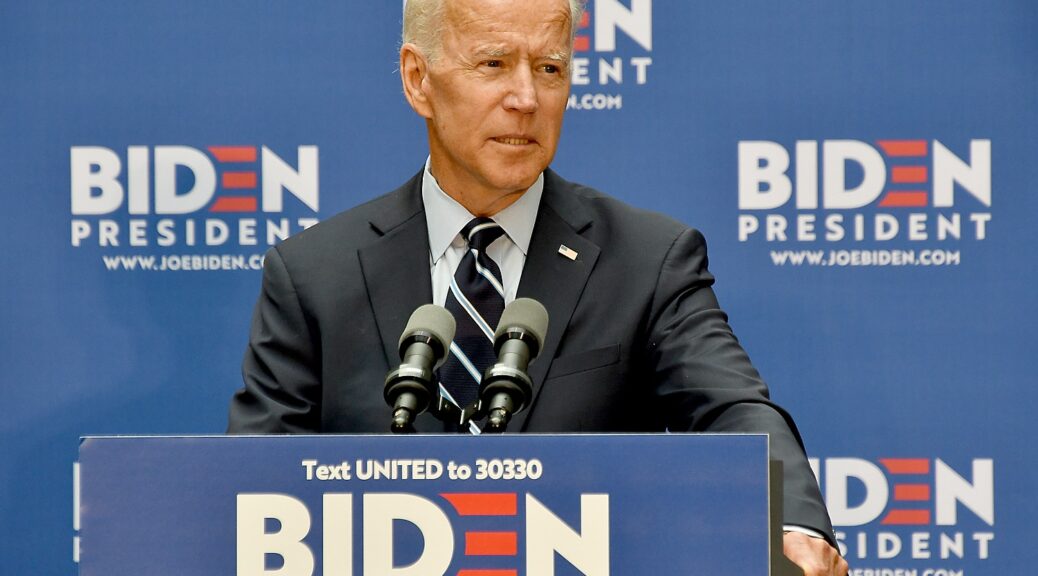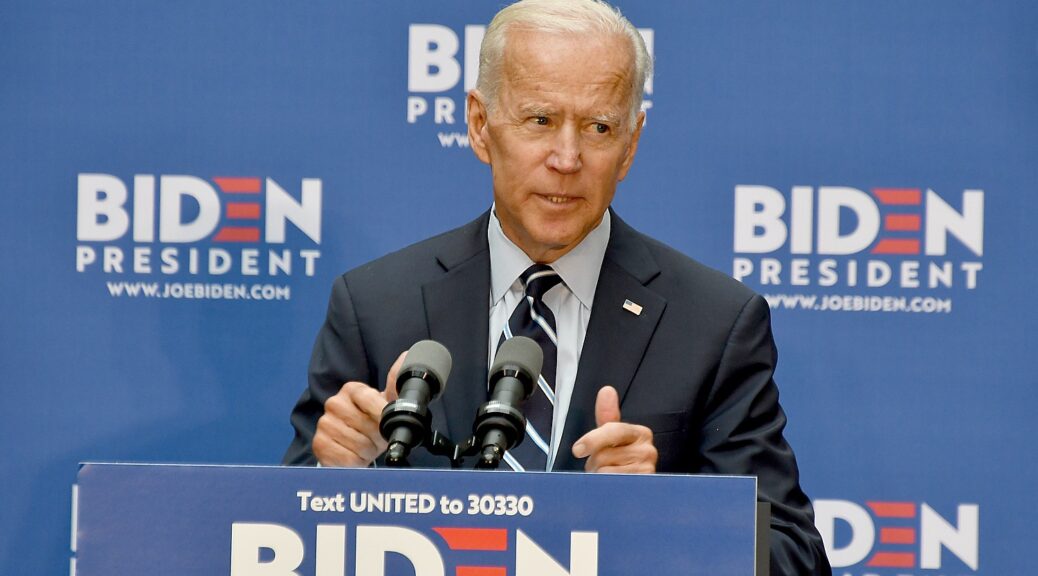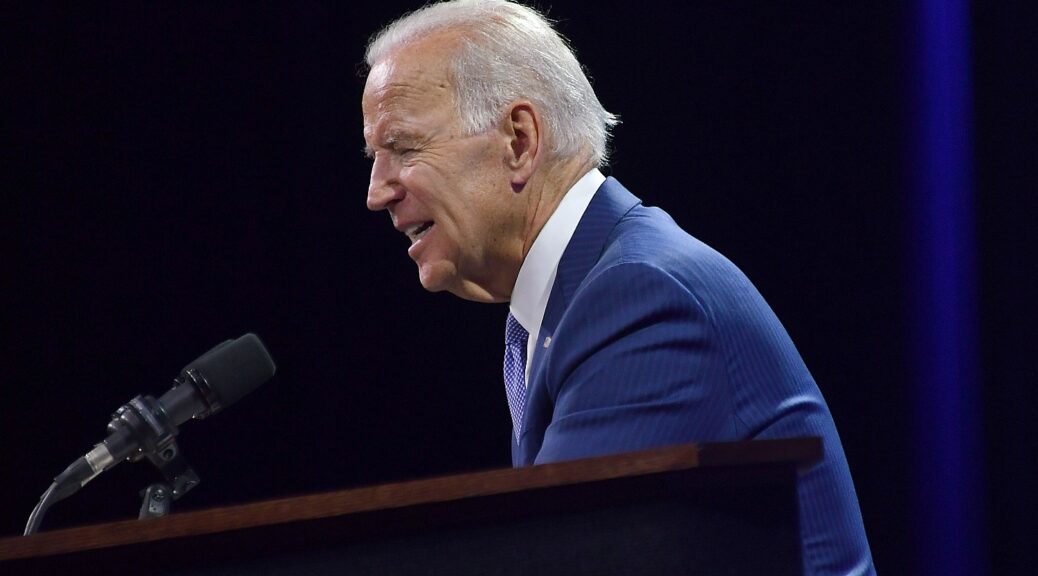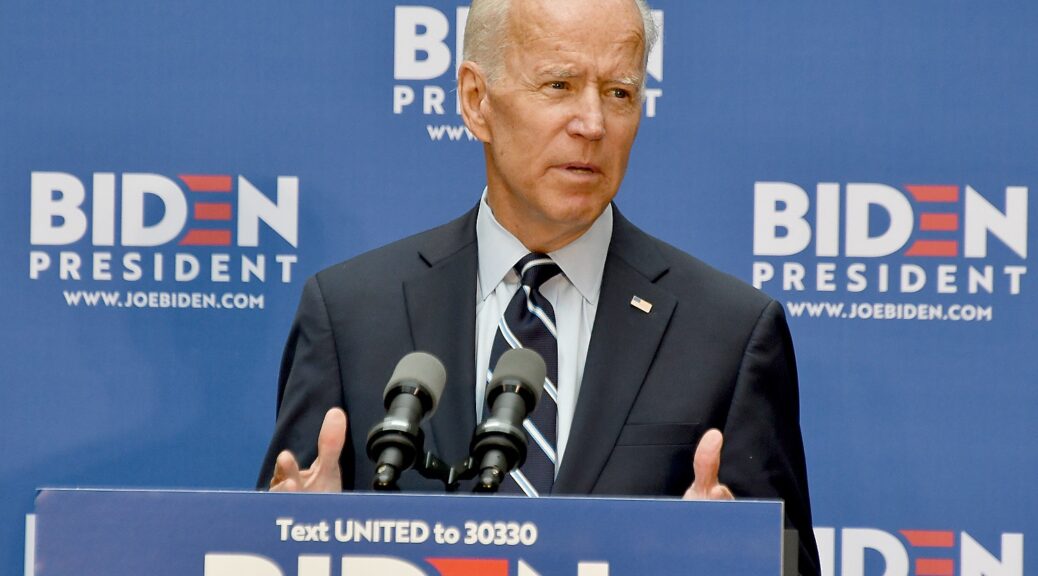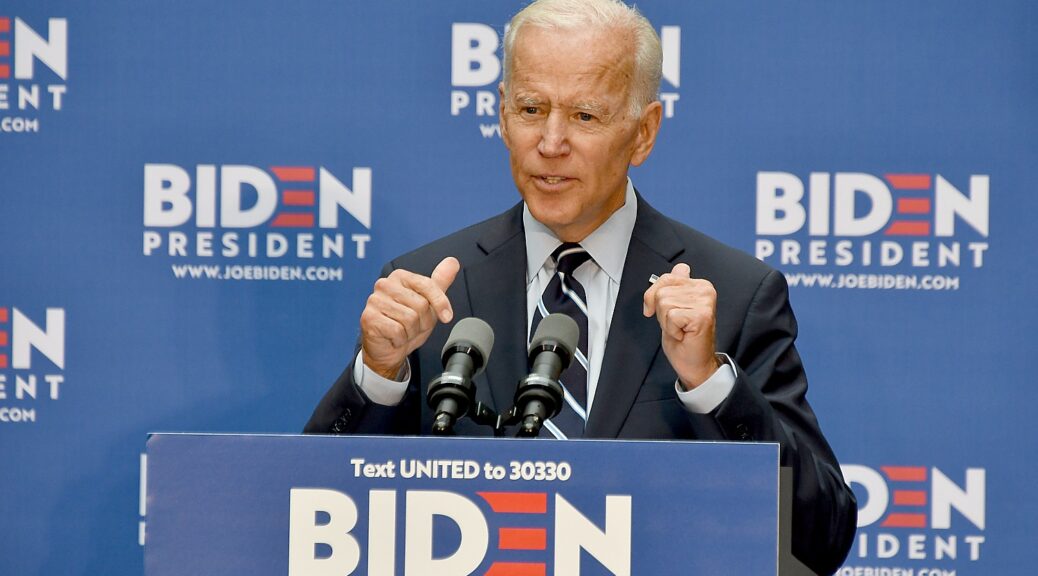
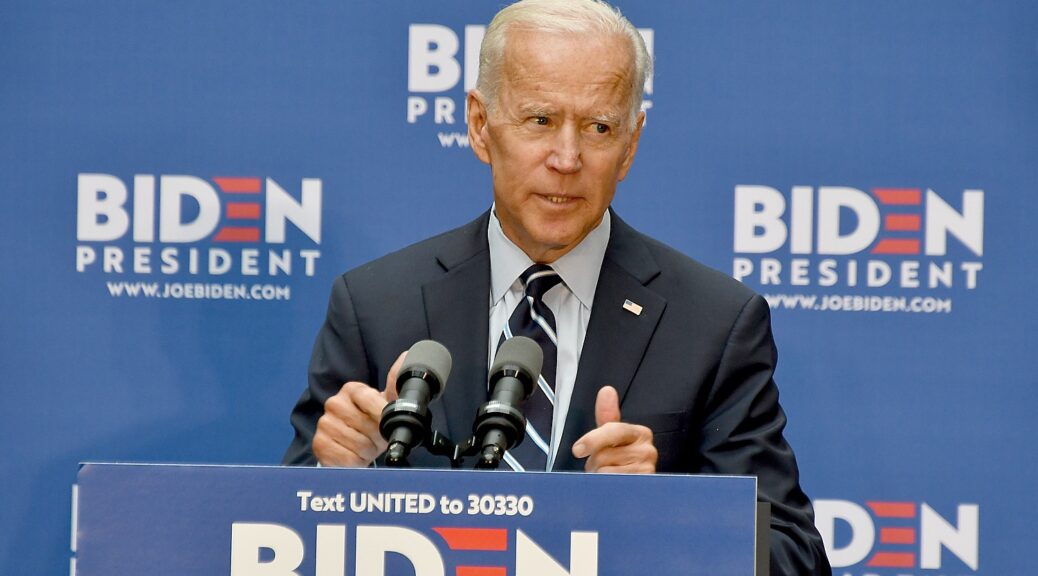
Vice President Joe Biden, the presumptive Democratic nominee for president, delivered remarks on the economy and the May jobs report which unexpectedly showed 2.5 million jobs added and an unemployment rate dipping slightly to 13.3%, instead of rising to as much as 20%. (c) Karen Rubin/news-photos-features.com
Vice President Joe Biden, the presumptive Democratic nominee for president, delivered remarks on the economy and the May jobs report which unexpectedly showed 2.5 million jobs added and an unemployment rate dipping slightly to 13.3%, instead of rising to as much as 20%. But that 2.5 million jobs reflects the fact that states have begun reopening; there were 40 million people who have filed for unemployment, so an unimaginable 37 million are still without jobs. And 13.3% is still higher than at any time during the 2008 Great Recession. Moreover, the Trump administration apparently changed the way certain numbers are calculated, so the actual unemployment rate could be 3 points higher, or 16.3%, which would be closer to what economists forecast. Trump also manages to ignore the fact that the stimulus program pushed by Democrats over Republicans’ objections, worked to keep the economy from descending into a Great Depression. He also ignored the disproportionate unemployment rates among Blacks and Hispanics, groups that are also suffering disproportionately from COVID-19. But Trump is desperate to put a rosy face on an economy while ignoring the fact the coronavirus pandemic is still spreading and his administration has done virtually nothing to provide a national program for testing, tracing and isolating, nor even set standards for workplaces and schools only some tepid guidelines. And Trump was desperate to shift attention from his Fascistic overreach of using military power used against peaceful protesters calling for an end to race-based police brutality.
Instead, Vice President Biden took Trump to task and offered his own analysis of the depth of harm to the economy and public health caused by Trump’s failure of leadership and his preoccupation with Wall Street over Main Street, wealth over wages.
Here is a transcript of Biden’s remarks: –Karen Rubin/news-photos-features.com
Good afternoon.
Before I speak to the economic situation, I have to take a moment to address something the President said this morning.
Toward the end of his remarks today, Donald Trump said he hopes that George Floyd “is looking down and seeing this is a great day for our country.”
He was speaking of a man who was brutally killed by an act of needless violence — and by a larger tide of injustice — that has metastasized on this President’s watch.
George Floyd’s last words — “I can’t breathe, I can’t breathe” — have echoed across our nation.
For the President to try to put any other words in the mouth of George Floyd — is frankly despicable.
And, the fact that he did so on a day when Black unemployment rose and black youth unemployment skyrocketed — tells you everything you need to know about who this man is and what he cares about.
Today, like all Americans, I was glad to see that two-and-a-half million Americans have gotten their jobs back.
For those families, that’s a sigh of relief.
And for all of us, it’s a reminder of the resilience of the American people.
To those Americans, I’m so proud of you, and so happy for you and your families.
I was disturbed, however, to see the President crowing this morning — basically hanging a “mission accomplished”’ banner when there is so much work to be done — and so many Americans are still hurting.
More than twenty million Americans — one out of every seven U.S. workers — are still out of work.
For an enormous swath of our country, their dreams are still on hold. They are still struggling to put food on the table. The unemployment rate remains the highest it’s been in nearly a century.
As I said, Black unemployment went up this month. Latino youth unemployment jumped to over 37 percent. Hispanic unemployment overall is four times higher than it was before the President botched his response to the pandemic. And I’m worried, when you look deeper at the data, that while temporary layoffs went down,permanent layoffs went up.
Donald Trump still doesn’t get it.
He’s out there spiking the football — completely oblivious to the tens of millions of people who are facing the greatest struggle of their lives. Those folks aren’t feeling any less pain today than they were yesterday.
People who’ve lost their health care in this crisis, they’re not celebrating today — especially when Donald Trump is still in court fighting to strip away health care protections from even more Americans.
The fact is, there are about 13 million less jobs today for American workers than the day that President Obama and I left office.
So while it’s wonderful to see ten percent of the families who lost their jobs due to Trump’s disastrous pandemic response start to make their way back — the President’s behavior makes me deeply worried for the 90 percent who haven’t.
So to all those families — who are scared, and hurting, and wondering what’s going to happen next: I want you to know I see you. I won’t ever forget you. And I won’t be satisfied – until this economy starts working for all of you.
Let’s be clear about something. The depth of this job crisis is not attributable to an act of God — but to the failure of a President. The truth is every country dealt with job losses due to the pandemic, but America was hit much harder out of the gate due to Trump’s complete mismanagement of the response.
This morning, he tried to compare our response to Germany’s and South Korea’s.
Okay, let’s compare. Germany has one-third of the deaths per capita that we do. South Korea has less than 300 deaths — total. America has four percent of the world’s population — and more than a quarter of the world’s deaths from this pandemic.
It’s no secret why that is.
Let’s get something straight: he did not act quickly.
For months, he downplayed the threat — falsely promising us that anyone could get a test — and claiming that “like a miracle it will disappear.”
He repeatedly praised China’s containment response – despite a litany of public appeals — including from me — not to bet American lives and the U.S. economy on the word of the Chinese government.
He refused to take action to get adequate testing in place — allowing the virus to spread further than it should have.
Columbia University found that 54,000 lives could have been saved if the administration had acted just two weeks earlier.
His failure didn’t just cost lives. It cost jobs.
New studies this week from Moody’s and Brookings confirm that half or more of those who lost their jobs would still be employed had Trump mounted a competent response like Germany and South Korea and other countries did.
We know why this happened. Donald Trump was more focused on the stock wealth of the biggest corporations than he was on the well-being of the American people.
It’s why he had his top economic advisors telling people to buy stocks instead of preparing our nation to brace for the pandemic.
Now — after 110,000 deaths and more than 20 million people still out of work — the consequences are clear.
We are still facing devastating unemployment, an historic health crisis, and a continuing crisis of violence, injustice, and indignity that is devastating Black Americans and diminishing the soul of our country.
These are some of the sternest challenges our nation has ever faced, and Trump is patting himself on the back.
He just has no idea what’s really going on in this country. He has no idea the depth of pain that people are facing. He remains completely oblivious to the human toll of his indifference. It is time for him to step out of his bunker and take a look around at the consequences of his words and actions.
Let’s be clear — a president who takes no responsibility for costing millions and millions of Americans their jobs deserves no credit when a fraction of them return.
But there’s a deeper concern here. As we recover, some of the temporary job losses we are still not on track to grow back in a way that will actually serve working people.
President Trump is still rewarding wealth over work.
All we hear coming out of the White House is calls for more tax cuts for big investors and big corporations. Well, they didn’t build this country. The middle class did — that’s who I fight for.
And if Trump continues to put the interests of CEOs and shareholders ahead of American workers, we’ll never get to where we need to be as a country.
Look, every American has a choice to make this November. Not simply what kind of President we want , but what kind of country we want. What kind of economy we want — and who that economy serves.
In the coming weeks, I will lay out in detail my comprehensive plan— not just to build things back to the way they were before COVID-19, but to build back better.
To create millions of new, good-paying jobs with benefits where people get a fair return for work and we make our country stronger, more resilient, and more just.
That plan will be anchored in job-creating investments, in small businesses, infrastructure – innovation, manufacturing, and caregiving, and in rewiring the faulty structures of our economy to ensure the dignity and equity of all American workers.
The public health crisis, the job crisis, and the crisis of inequity and indignity being endured by African Americans — those three challenges are deeply connected to one another.
The solutions must be, as well.
Any economic plan must start with a public health plan to make sure tests are available, to get our society functioning, to build back the confidence we need to truly bring back jobs and small businesses.
But that is only the first step.
My jobs plan will also be about restoring dignity to the American people.
In addition to pursuing badly-needed reforms, we need to be growing wages, leveling the playing field, and creating tens of millions of the new jobs we need to build a better American future.
There is a monumental amount of work to do to repair the damage that has been done. And simply tweeting slogans like “transition to greatness” won’t solve anything for families who are hurting.
I look forward to introducing and implementing a real jobs plan that will meet this challenging moment.
Americans can’t afford to have any more of their time wasted.
They need an economy that works for them — now.
They need jobs that bring dignity — now.
They need equal justice — and equal opportunities — now.
They need a president who cares about them, and cares about helping them heal — now.
VP Joe Biden declares, “The moment has come for our nation to deal with systemic racism. To deal with the growing economic inequality in our nation. And to deal with the denial of the promise of this nation — to so many.” (c) Karen Rubin/news-photos-features.com
Amid national protests over police brutality and the murder of George Floyd in Minneapolis, and Donald Trump calling out the military against peaceful protesters outside the White House, VP Joe Biden, the presumptive Democratic candidate for president, declares, “The moment has come for our nation to deal with systemic racism. To deal with the growing economic inequality in our nation. And to deal with the denial of the promise of this nation — to so many.“
“We are a nation in pain,” Biden declared. “but we must not allow this pain to destroy us. We are a nation enraged, but we cannot allow our rage to consume us. We are a nation exhausted, but we will not allow our exhaustion to defeat us.
“As President, it is my commitment to all of you to lead on these issues — to listen. Because I truly believe in my heart of hearts, that we can overcome. And when we stand together, finally, as One America, we will rise stronger than before.”
Here is a transcript of Vice President Joe Biden’s speech delivered from the Mayor’s Reception Room in Philadelphia City Hall in front of an audience that included Mayor Jim Kenney, Congressman Brendan Boyle, and state and local elected officials.:
“I can’t breathe.” “I can’t breathe.”
George Floyd’s last words. But they didn’t die with him. They’re still being heard. They’re echoing across this nation.
They speak to a nation where too often just the color of your skin puts your life at risk.
They speak to a nation where more than 100,000 people have lost their lives to a virus – and 40 million Americans have filed for unemployment – with a disproportionate number of these deaths and job losses concentrated in black and brown communities.
And they speak to a nation where every day millions of people – not at the moment of losing their life – but in the course of living their life – are saying to themselves, “I can’t breathe.”
It’s a wake-up call for our nation. For all of us.
And I mean all of us. It’s not the first time we’ve heard these words – they’re the same words we heard from Eric Garner when his life was taken six years ago.
But it’s time to listen to these words. Understand them. And respond to them – with real action.
The country is crying out for leadership. Leadership that can unite us. Leadership that can bring us together. Leadership that can recognize the pain and deep grief of communities that have had a knee on their neck for too long.
But there is no place for violence.
No place for looting or destroying property or burning churches, or destroying businesses — many of them built by people of color who for the first time were beginning to realize their dreams and build wealth for their families.
Nor is it acceptable for our police — sworn to protect and serve all people — to escalate tensions or resort to excessive violence.
We need to distinguish between legitimate peaceful protest — and opportunistic violent destruction.
And we must be vigilant about the violence that’s being done by the incumbent president to our democracy and to the pursuit of justice.
When peaceful protestors are dispersed by the order of the President from the doorstep of the people’s house, the White House — using tear gas and flash grenades — in order to stage a photo op at a noble church, we can be forgiven for believing that the president is more interested in power than in principle.
More interested in serving the passions of his base than the needs of the people in his care.
For that’s what the presidency is: a duty of care — to all of us, not just our voters, not just our donors, but all of us.
The President held up a bible at St. John’s church yesterday.
If he opened it instead of brandishing it, he could have learned something: That we are all called to love one another as we love ourselves.
That’s hard work. But it’s the work of America.
Donald Trump isn’t interested in doing that work.
Instead he’s preening and sweeping away all the guardrails that have long protected our democracy.
Guardrails that have helped make possible this nation’s path to a more perfect union.
A union that constantly requires reform and rededication – and yes the protests from voices of those mistreated, ignored, left out and left behind.
But it’s a union worth fighting for and that’s why I’m running for President.
In addition to the Bible, he might also want to open the U.S. Constitution.
If he did, he’d find the First Amendment. It protects “the right of the people peaceably to assemble, and to petition the government for a redress of grievances.”
Mr. President: That is America.
Not horses rising up on their hind legs to push back a peaceful protest. Not using the American military to move against the American people. This nation is a nation of values. Our freedom to speak is the cherished knowledge that lives inside every American.
We will not allow any President to quiet our voice.
We won’t let those who see this as an opportunity to sow chaos throw up a smokescreen to distract us from the very real and legitimate grievances at the heart of these protests.
And we can’t leave this moment thinking we can once again turn away and do nothing. We can’t.
The moment has come for our nation to deal with systemic racism. To deal with the growing economic inequality in our nation. And to deal with the denial of the promise of this nation — to so many.
I’ve said from the outset of this election that we are in a battle for the soul of this nation. Who we are. What we believe. And maybe most important — who we want to be.
It’s all at stake. That is truer today than ever. And it’s in this urgency we can find the path forward.
The history of this nation teaches us that it’s in some of our darkest moments of despair that we’ve made some of our greatest progress.
The 13th and 14th and 15th Amendments followed the Civil War. The greatest economy in the history of the world grew out of the Great Depression. The Civil Rights Act of 1964 and Voting Rights Act of 1965 came in the tracks of Bull Connor’s vicious dogs.
To paraphrase Reverend Barber — it’s in the mourning we find hope.
It will take more than talk. We’ve had talk before. We’ve had protests before.
Let us vow to make this, at last, an era of action to reverse systemic racism with long overdue and concrete changes.
That action will not be completed in the first 100 days of my Presidency — or even an entire term.
It is the work of a generation.
But if this agenda will take time to complete, it should not wait for the first 100 days of my Presidency to get started.
A down payment on what is long overdue should come now. Immediately.
I call on Congress to act this month on measures that would be a first step in this direction. Starting with real police reform.
Congressman Jeffries has a bill to outlaw choke holds. Congress should put it on President Trump’s desk in the next few days.
There are other measures: to stop transferring weapons of war to police forces, to improve oversight and accountability, to create a model use of force standard — that also should be made law this month.
No more excuses. No more delays.
If the Senate has time to confirm Trump’s unqualified judicial nominees who will run roughshod over our Constitution, it has time to pass legislation that will give true meaning to our Constitution’s promise of “equal protection of the laws.”
Looking ahead, in the first 100 days of my presidency, I have committed to creating a national police oversight commission.
I’ve long believed we need real community policing.
And we need each and every police department in the country to undertake a comprehensive review of their hiring, their training, and their de-escalation practices.
And the federal government should give them the tools and resources they need to implement reforms.
Most cops meet the highest standards of their profession. All the more reason that bad cops should be dealt with severely and swiftly. We all need to take a hard look at the culture that allows for these senseless tragedies to keep happening.
And we need to learn from the cities and precincts that are getting it right.
We know, though, that to have true justice in America, we need economic justice, too.
Here, too, there is much to be done.
As an immediate step, Congress should act to rectify racial inequities in the allocation of COVID-19 recovery funds.
I will be setting forth more of my agenda on economic justice and opportunity in the weeks and months ahead.
But it begins with health care. It should be a right not a privilege. The quickest route to universal coverage in this country is to expand Obamacare.
We could do it. We should do it.
But this president — even now — in the midst of a public health crisis with massive unemployment wants to destroy it.
He doesn’t care how many millions of Americans will be hurt— because he is consumed with his blinding ego when it comes to President Obama.
The President should withdraw his lawsuit to strike down Obamacare, and the Congress should prepare to act on my proposal to expand Obamacare to millions more.
These last few months we have seen America’s true heroes. The health care workers, the nurses, delivery truck drivers, grocery store workers.
We have a new phrase for them: Essential workers.
But we need to do more than praise them. We need to pay them.
Because if it wasn’t clear before, it’s clear now. This country wasn’t built by Wall Street bankers and CEOs. It was built by America’s great middle class — by our essential workers.
I know there is enormous fear and uncertainty and anger in the country. I understand.
And I know so many Americans are suffering. Suffering the loss of a loved one. Suffering economic hardships. Suffering under the weight of generation after generation after generation of hurt inflicted on people of color — and on black and Native communities in particular.
I know what it means to grieve. My losses are not the same as the losses felt by so many. But I know what it is to feel like you cannot go on.
I know what it means to have a black hole of grief sucking at your chest.
Just a few days ago marked the fifth anniversary of my son Beau’s passing from cancer. There are still moments when the pain is so great it feels no different from the day he died. But I also know that the best way to bear loss and pain is to turn all that anger and anguish to purpose.
And, Americans know what our purpose is as a nation. It has guided us from the very beginning.
It’s been reported. That on the day John F. Kennedy was assassinated, little Yolanda King came home from school in Atlanta and jumped in her father’s arms.
“Oh, Daddy,” she said, “now we will never get our freedom.”
Her daddy was reassuring, strong, and brave.
“Now don’t you worry, baby,” said Martin Luther King, Jr. “It’s going to be all right.”
Amid violence and fear, Dr. King persevered.
He was driven by his dream of a nation where “justice runs down like water and righteousness like a mighty stream.”
Then, in 1968 hate would cut him down in Memphis.
A few days before Dr. King was murdered, he gave a final Sunday sermon in Washington.
He told us that though the arc of a moral universe is long, it bends toward justice.
And we know we can bend it — because we have. We have to believe that still. That is our purpose. It’s been our purpose from the beginning.
To become the nation where all men and women are not only created equal — but treated equally.
To become the nation defined — in Dr. King’s words — not only by the absence of tension, but by the presence of justice.
Today in America it’s hard to keep faith that justice is at hand. I know that. You know that.
The pain is raw. The pain is real.
A president of the United States must be part of the solution, not the problem. But our president today is part of the problem.
When he tweeted the words “When the looting starts, the shooting starts” – those weren’t the words of a president. They were the words of a racist Miami police chief from the 1960s.
When he tweeted that protesters “would have been greeted with the most vicious dogs … that’s when people would have been really badly hurt.” Those weren’t the words of a president — those were the kind of words a Bull Connor would have used unleashing his dogs.
The American story is about action and reaction. That’s the way history works. We can’t be naïve about that.
I wish I could say this hate began with Donald Trump and will end with him. It didn’t and it won’t. American history isn’t a fairytale with a guaranteed happy ending.
The battle for the soul of this nation has been a constant push-and-pull for more than 240 years.
A tug of war between the American ideal that we are all created equal and the harsh reality that racism has long torn us apart. The honest truth is both elements are part of the American character.
At our best, the American ideal wins out.
It’s never a rout. It’s always a fight. And the battle is never finally won.
But we can’t ignore the truth that we are at our best when we open our hearts, not when we clench our fists. Donald Trump has turned our country into a battlefield riven by old resentments and fresh fears.
He thinks division helps him.
His narcissism has become more important than the nation’s well-being he leads.
I ask every American to look at where we are now, and think anew: Is this who we are? Is this who we want to be? Is this what we pass on to our kids’ and grandkids’ lives? Fear and finger-pointing rather than hope and the pursuit of happiness? Incompetence and anxiety? Self-absorption and selfishness?
Or do we want to be the America we know we can be. The America we know in our hearts we could be and should be.
Look, the presidency is a big job. Nobody will get everything right. And I won’t either.
But I promise you this. I won’t traffic in fear and division. I won’t fan the flames of hate.
I will seek to heal the racial wounds that have long plagued this country – not use them for political gain.
I’ll do my job and take responsibility. I won’t blame others. I’ll never forget that the job isn’t about me.
It’s about you.
And I’ll work to not only rebuild this nation. But to build it better than it was.
To build a better future. That’s what America does.
We build the future. It may in fact be the most American thing to do.
We hunger for liberty the way Harriet Tubman and Frederick Douglass did.
We thirst for the vote the way Susan B. Anthony and Ella Baker and John Lewis did. We strive to explore the stars, to cure disease, to make this imperfect Union as perfect as we can.
We may come up short — but at our best we try.
We are facing formidable enemies.
They include not only the coronavirus and its terrible impact on our lives and livelihoods, but also the selfishness and fear that have loomed over our national life for the last three years.
Defeating those enemies requires us to do our duty — and that duty includes remembering who we should be.
We should be the America of FDR and Eisenhower, of Rosa Parks and Martin Luther King Jr., of Jonas Salk and Neil Armstrong.
We should be the America that cherishes life and liberty and courage.
Above all, we should be the America that cherishes each other – each and every one.
We are a nation in pain, but we must not allow this pain to destroy us. We are a nation enraged, but we cannot allow our rage to consume us. We are a nation exhausted, but we will not allow our exhaustion to defeat us.
As President, it is my commitment to all of you to lead on these issues — to listen. Because I truly believe in my heart of hearts, that we can overcome. And when we stand together, finally, as One America, we will rise stronger than before.
So reach out to one another. Speak out for one another. And please, please take care of each other.
This is the United States of America. And there is nothing we can’t do. If we do it together.
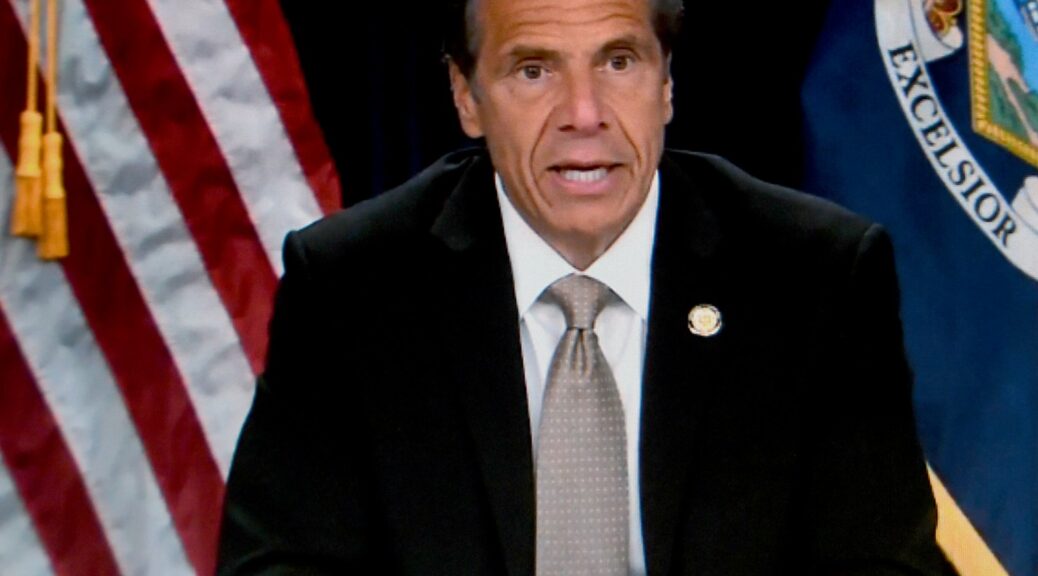
Governor Andrew M. Cuomo proposed a positive reform agenda to address systemic racism and police brutality amidst the ongoing protests across the state and nation in response to the killing of George Floyd. The reform agenda includes a national ban on excessive force and chokeholds by law enforcement officers; independent investigations of police brutality conducted by independent, outside agencies – not by local prosecutors; and disclosure of disciplinary records of police officers being investigated.
While standing firmly in support of the protests against police brutality, the Governor said that protest for its own sake would only work against the cause, but that there needs to be a clearly defined list of actions that need to be articulated.
“You want to make that moment work,” he declared. “Yes, you express the outrage. But then you say, ‘Here’s my agenda. Here’s what I want.’ That’s what we have to be doing in this moment. And the protesters are making a point. And most of them are making a smart, sensible point. But you have to add the positive reform agenda that every voice calls for so the government, the politicians know what to do. And there is a positive reform agenda here. There should be a national ban on excessive force by police officers. There should be a national ban on chokeholds. Period. There should be independent investigations of police abuse.”
And Cuomo also differentiated between the those who are exercising their Constitutional First Amendment right to protest against those who are taking advantage to loot and vandalize, giving Trump the opportunity to deflect and discount, and shift focus to himself as the “law-and-order” strongman. Indeed, there are reports that White Nationalist group is posing as Antifa on Twitter, calling for violence. Trump is proposing to designate Antifa a terrorist group, and is using them to justify calling out military against protesters – which would be a violation of the Posse Comitatus Act.
“There’s no doubt that what the President’s trying to do here is turn the attention to the looters rather than the point of the protest, which is genuine outrage,” Cuomo said in an interview with Nicolle Wallace on MSNBC. “”You look at what happened with Mr. Floyd, you have to be outraged. It’s not just Mr. Floyd in an isolated situation, it’s been years and years of the same situation. You can go back to Rodney King, Amadou Diallo and Eric Garner – it’s a long list.
“They want to make this about looting and criminals rather than the killing. That’s what they’re trying to do. In New York, we did have large protests and we do have people who are, I think, exploiting the protest. There’s no doubt that there’s some people who came out and did looting and criminal activity. You have some disrupting organizations that are seizing upon the moment. We want to make sure that order is maintained and we’re putting in place a curfew.”
“Use this moment. You look in history, Nicolle, when did change come? Change came when the people insisted on change. Let’s talk about investigation of police abuse. No chokeholds, nation-wide standard for undue force. Let’s talk about funding of education and equal funding in education. Let’s talk about affordable housing. Let’s talk about a child poverty agenda. Let’s use the moment constructively.”
Cuomo ordered a curfew of 11 pm in New York City, and doubled the number of police, from 4,000 to 8,000. However, that was not enough to stop a spate of acts of looting and vandalism.
The protests come just as New York City was hitting the milestones in the fight against COVID-19, which has taken more lives – and more disproportionately in communities of color – in the city and state than anywhere in the country or world. The Governor said that if there was any “silver” lining in the timing, the protests are happening when the infection rate has been cut from 20 percent to 2 percent but still raised concerns of reigniting the spread of the pandemic.
Here is a transcript of Governor Cuomo’s remarks:
We’re talking about reopening in one week in New York City. Now we’re seeing these mass gatherings over the past several nights that could, in fact, exacerbate the COVID-19 spread. We spent all this time closed down, locked down, masked, socially distanced and then you turn on the TV and you see there’s mass gatherings that could potentially be infecting hundreds and hundreds of people. After everything that we have done. We have to talk a minute and ask ourselves what are we doing here? What are we trying to accomplish?
We have protests across the state that continued last night, they continued across the nation. Upstate we worked with the cities very closely. The State Police did a great job. We had, basically, a few scattered arrests, upstate New York. But the local governments did a great job, the people did a great job, law enforcement did a great job. The protestors were responsible. It wasn’t great, but it wasn’t bad, either, upstate.
I said from day one, I share the outrage and I stand with the protestors. You look at that video of the killing of an unarmed man, Mr. Floyd, it is horrendous. Horrendous. It’s frightening. It perverts everything you believe about this country. It does and there’s no excuse for it. No right minded American would make an excuse for it. So, protest yes. Be frustrated, yes. Outraged, yes of course. Is there a larger problem? Of course. It’s not just Mr. Floyd, it goes back – there are 50 cases that are just like Mr. Floyd. We’ve them here in New York City. What’s the difference between Mr. Floyd and Amadou Diallo? Or Abner Louima? Or Eric Garner? What is the difference? What have we learned? Nothing?
So, yes, we should be outraged. And yes, there’s a bigger point to make. It is abuse by police. But it’s something worse. It is racism. It is discrimination. It is fundamental inequality and injustice. My father spoke about it in 1984. The speech called “The Tale of Two Cities.” People still talk about it. The point of the tale of two cities is there’s two Americas. Two sets of rules. Two sets of outcomes. Two sets of expectations. It’s true. It was true then, it’s true now. Look at our prisons and tell me there’s not inherit injustice in society. Look at public housing, tell me there’s not inherent injustice.
Look at what happened with this COVID infection rate nationwide. More African Americans infected, more African Americans dead proportionally than white Americans. Of course, there’s chronic institutionalized discrimination. There is no doubt. There is no doubt. And there’s no doubt that it’s been going on for a long time and people are frustrated, and it has to be corrected and it has to be corrected now. And there’s no doubt, that this nation as great as it is has had the continuing sin of discrimination. From before the nation was formed and it started with slavery. And it has had different faces over the decades, but it’s still the same sin. That is true. That is true. So let’s use this moment as a moment of change? Yes.
When does change come? When the stars align and society focuses and the people focus, and they focus to such an extent that the politicians follow the people. That’s when change comes. “Well, the leaders lead!” Baloney. The people lead. And then the politicians see the people moving, and the politicians run to catch up with the people. How did we pass marriage equality in this State, giving a new civil right to the LGBTQ community? Because the people said, “enough is enough. How can you say only heterosexual people can marry, but the LGBTQ people— they can’t marry? How is that constitutional? How is that legal?” You have your own preference— God bless you. But how in the law, do you discriminate between two classes of people. We passed marriage equality.
After the Sandy Hook massacre, after all those years we tried to pass common sense gun safety. Do you really need an assault weapon to kill a deer? But then the Sandy Hook massacre happened, and the people said, “enough. You’re killing children? Young children in schools with an assault weapon? In the Sandy Hook massacre. Enough.”
And in that moment, we passed common sense gun safety in the State of New York. Record income inequality? People said, “enough” and passed a real minimum wage in this State that went all across the nation. There’s a moment for change, and is there a moment here? Yes. If we’re constructive and if we’re smart, and if we know what were asking for! It’s not enough to come out and say, “I’m angry, I’m frustrated.” OK. And what? “Well, I don’t know, but I’m angry and frustrated.”
And you want what done? You need the answer. “Well, I want common sense gun reform.” OK, what does it look like? Here it is— three points. “Well I want to address income inequality.” Well, what do you want? “Here’s what I want. Minimum wage at $15. Free college tuition.” What do you want?
You want to make that moment work. Yes, you express the outrage! But then you say, “here’s my agenda. Here’s what I want.” That’s what we have to be doing in this moment. And the protestors are making a point. And most of them are making a smart, sensible point. But you have to add the positive reform agenda that every voice calls for so the government, the politicians know what to do. And there is a positive reform agenda here. There should be a national ban on excessive force by police officers. There should be a national ban on chokeholds. Period. There should be independent investigations of police abuse. When you have the local District Attorney doing the investigations— I don’t care how good they are— there is the suggestion of a conflict of interest. Why? Because that DA works with that police department every day and now that prosecutor is going to do the investigation of that police department that they work with every day? Conflict of interests can be real or perceived. How can people believe that the local prosecutor who works with that police department is going to be fair in the investigation? It shouldn’t be state by state. Minnesota Governor Walz put the attorney general in charge. Good. In this state, I put attorney general in charge of investigations where police kill an unarmed person. Good. But it shouldn’t be the exception. It should be the rule. There is no self-policing. There’s an allegation, independent investigation. Give people comfort that the investigation is real.
If a police officer is being investigated, how is there disciplinary records not relevant? Once a police officer is being investigated, if they have disciplinary records that show this was a repeat pattern, how is that not relevant? By the way, the disciplinary records can also be used to exonerate. If they have disciplinary records that say he never, she never did anything like this before, fine. That’s relevant too.
We still have two education systems in this country. Everybody knows it. Your education is decided by your zip code. Poorer schools in poorer communities have a different level of funding than richer schools in this state. $36,000 per year we spend in a rich district. $13,000 in a poor district. How do you justify that? If anything, the children in a poorer community need more services in a school, not less. How do you justify that? You can’t. Do something about it. You still have children living in poverty in this nation? Well, when we had to, we found a trillion dollars to handle the COVID virus, but you can’t find funding to help children who live in poverty? No, you can find it, United States. You just don’t want to. It’s political will. When you need to find the money, you can find it. Let’s be honest, the federal government has a printing press in their basement. When they have the political will, they find the money.
The federal government went out of the housing business and never re-entered it. We have a national affordable housing crisis. Of course you do. You don’t fund affordable housing. I’m the former HUD secretary. I know better than anyone what the federal government used to do in terms of affordable housing with Section 8 and building new public housing. And we just stopped, and we left it to the market. Now you have an affordable housing plan. That’s what we should be addressing in this moment. And we should be saying to our federal officials, “There’s an election this year, a few months away. Here’s my agenda. Where do you stand?” Say to the congress, the House and Senate, “Where’s your bill on this?”
I heard some congressional people talking saying well maybe they’ll do a resolution. Yeah, resolutions are nice. Resolutions say in theory I support this. Pass a law, that’s what we want. A law that actually changes the reality, where something actually happens. That’s government’s job is to actually make change. Make change. You’re in a position to make change. Make change. Use this moment to galvanize public support. Use that outrage to actually make the change. And have the intelligence to say what changes you actually want. Otherwise, it’s just screaming into the wind if you don’t know exactly what changes we need to make.
And we have to be smart in this moment. The violence in these protests obscures the righteousness of the message. The people who are exploiting the situation, the looting, that’s not protesting. That’s not righteous indignation. That’s criminality and it plays into the hands of the people and the forces that don’t want to make the changes in the first place because then they get to dismiss the entire effort. I will tell you what they’re going to say. They’re going to say the first thing the President said when this happened. They’re going to say “These are looters.” Remember when the President put out that incendiary tweet? “We start shooting when they start looting or they start looting, we start shooting?” That’s an old ’60s call. The violence, the looting, the criminality plays right into those people who don’t want progressive change. And you mark my words, they’re going to say today, “Oh you see, they’re criminals. They’re looters. Did you see what they did breaking the store windows and going in and stealing?” And they’re going to try to paint this whole protest movement that they’re all criminals, they’re all looters. That’s what they’re going to do. Why? They don’t want to talk about Mr. Floyd’s death. They don’t want people seeing that video. They want people seeing the video of the looting. And when people see the video of the looting they say “Oh yeah, that’s scary. They’re criminals.” No, look at the video of the police officer killing Mr. Floyd. That’s the video we want people watching.
Now, I don’t even believe it’s the protesters. I believe there are people who are using this moment and using the protest for their own purpose. There are people who want to sow the seeds of anarchy, who want to disrupt. By the way, there are people who want to steal. And here’s a moment that you can use this moment to steal. You can use this moment to spread chaos. I hear the same thing from all the local officials. They have people in their communities who are there to quote unquote protest. They’re not from their community. They don’t know where they’re from, extremist groups, some people are going to blame the left, some people will blame the right. It will become politicized. But there is no doubt there are outside groups that come in to disrupt. There is no doubt that there are people who just use this moment to steal. What, it’s a coincidence they broke into a Rolex watch company? That was a coincidence? High end stores, Chanel. That was a coincidence? That was random? That was not random. So, can you have a legitimate protest movement hijacked? Yes, you can. Yes, you can. And there are people and forces who will exploit that moment and I believe that’s happening.
But we still have to be smart. And at the same time, we have a fundamental issue which is we just spent 93 days limiting behavior, closing down, no school, no business, thousands of small businesses destroyed. People will have lost their jobs. People wiped out their savings. And now mass gatherings with thousands of people in close proximity one week before we’re going to reopen New York City? What sense does this make? Control the spread, control the spread, control the spread. We don’t even know the consequence for the COVID virus of those mass gatherings. We don’t even know. We won’t know possibly for weeks. It’s the nature of the virus. How many super-spreaders were in that crowd? “Well, they were mostly young people.” How many young people went home and kissed their mother hello or shook hands with their father or hugged their father or their grandfather or their brother or their mother or their sister and spread a virus?
New York City opens next week. Took us 93 days to get here. Is this smart? New York tough. We went from the worst situation to reopening. From the worst situation to 54 deaths in 50 days. We went from the worst situation to reopening in 93 days. We did that because we were New York tough. New York tough was smart. We were smart. We were smart for 93 days. We were united, we were respectful of each other. We were disciplined. Wearing the mask is just discipline, it’s just discipline. Remember to put it on, remember to pick it up, remembering to put it on when see someone, it’s just discipline.
It was also about love. We did it because we love one another. That’s what a community is. We love one another. And yes, you can be loving even in New York. Even with the New York toughness, even with a New York accent, even with a New York swagger. We’re loving. That’s what we’ve done for 93 days in a way we’ve never done it before. Never in my lifetime. Never in my lifetime has this city and this state come together in the way we have. I don’t think it ever will again, in my lifetime. Now you can say maybe it takes a global pandemic for it to happen. I don’t know if that’s true and I don’t know that the power of what it was like when it came together might not be so beautiful that people want to do it again.
Remember when we all acted together during coronavirus and we rallied and we knocked coronavirus on its rear end. Remember when we all wore masks and we had to have hand sanitizer? Remember what we did? Wow. When we come together, we can do anything and it’s true. It’s true for the state, it’s true for a nation. When you come together and you have one agenda you can do anything. You want to change society, you want to end the tale of two cities, you want to make it one America? You can do that, just the way you knocked coronavirus on its rear end.
People united can do anything. We showed that, we just showed that the past 93 days. We can end the injustice and the discrimination and the intolerance and the police abuse. We have to be smart. We have to be smart right now. Right now in this state. We have to be smart tonight in this city because this is not advancing a reform agenda. This is not persuading government officials to change. This is not helping end coronavirus. We have to be smart.
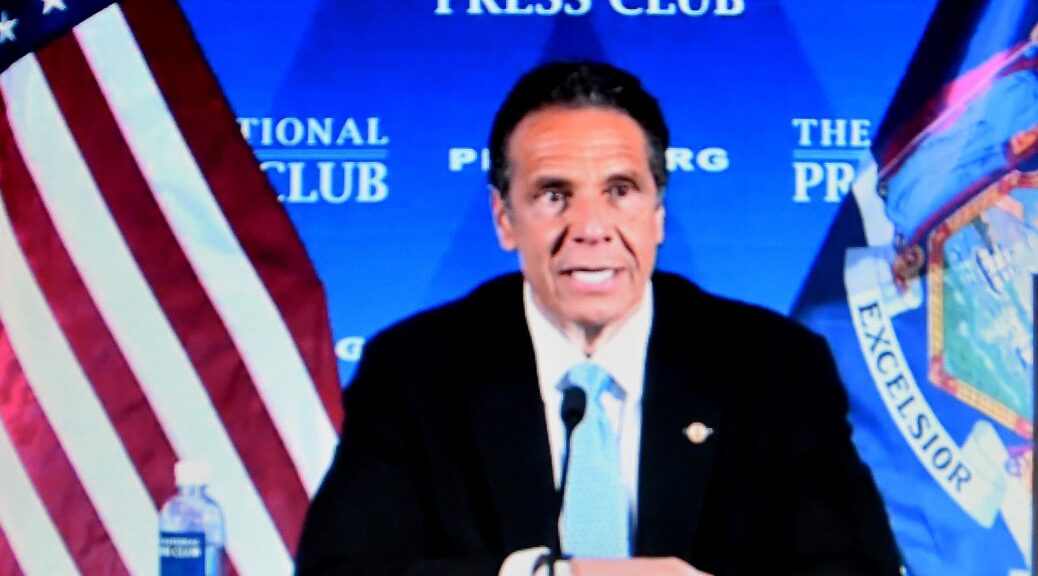
New York State Governor Andrew Cuomo at the National Press Club, Washington DC, after meeting Trump at the White House, calling for COVID-19 aid to states and localities, repeal of the SALT cap, and a bold infrastructure spending plan (c) Karen Rubin/news-photos-features.com
New York State Governor Andrew Cuomo, after a meeting with Donald Trump at the White House, chided Washington for politicizing the coronavirus pandemic, and not acting swiftly enough to provide crucial funding to states and localities, especially those – New York, New Jersey, Illinois, Massachusetts, California – where the outbreak of cases and the death toll has been the worst. “This hyper-partisan Washington environment is toxic for this country,” he stated in a press briefing shortly afterward at the National Press Club in Washington. He urged government to “do the right thing.”
Senate Republicans, led by Senate Majority Leader Mitch McConnell of Kentucky, have called such funding a “blue state bail out,” after having allocated billions to friendly industries and funneling millions to connected business interests. He stressed that New York and California, alone, represent one-third of the nation’s Gross Domestic Product, so you don’t have a reenergized economy without them. New York and California are also are the biggest donor states, sending billions of dollars more to taker-states like Kentucky than they get back in federal spending (New York sends $29 billion a year more than it gets back; Kentucky takes $29 billion more than it sends).If the states do not get federal aid, he stresseded, they will be forced to cut spending for hospitals, schools, police and fire – all the services most essential during a public health crisis – and excess thousands of workers, which won’t do the unemployment rate much good. Or, he said, the federal government can use this time as Franklin Roosevelt did during the Great Depression, to finally build the big, bold infrastructure projects that have been put on back-burners for 30 years.
Cuomo noted that the The House of Representatives has already passed its Heroes bill that includes $500 billion for states and $375 billion for locals; Medicaid funding for the most vulnerable; increased SNAP food assistance; 100 percent FEMA federal assistance; funding for testing; and repeals SALT cap to help states most affected by COVID-19, “the politically motivated first double tax in U.S. history” that was implemented by the federal tax law in 2017.
The Governor also renewed his call for Congress to pass the ‘Americans First Law’ to help prevent corporate bailouts following the COVID-19 pandemic. First proposed by the Governor on May 10th, the legislation states that a corporation cannot be eligible to receive government funding if it doesn’t maintain the same number of employees that the corporation had before the COVID-19 pandemic.
Cuomo also urged President Trump to support a real public infrastructure program and to advance infrastructure projects in New York — including the LaGuardia AirTrain, the Cross-Hudson Tunnels, and the Second Avenue Subway expansion — to help supercharge the economy.
He listed a series of projects in New York State that are ready to go – including the LaGuardia AirTrain, the Cross-Hudson Tunnels, and the Second Avenue Subway expansion – that are just awaiting federal approval “to help supercharge the economy.” Significantly, Trump earlier has told agencies to dispense with regulations that are obstacles to speedy development, and during the 2016 campaign, boasted he would be the builder, with a $1 trillion infrastructure spending plan.
Cuomo also renewed his call for ‘Americans First Law’ which would require any company that takes government funding to rehire the same number of employees it had before the COVID-19 pandemic, and not use the pandemic to “right-size” or “downsize” and cut costs to increase profits.
“Washington is now debating their next bill that would aid in the reopening and the recovery. Prior bills have helped businesses, large businesses, small businesses, hotels, airlines, all sorts of business interests,” Cuomo said. “That’s great but you also have states and local governments and state governments do things like fund schools and fund hospitals. Do you really want to cut schools now? Do you really want to cut hospitals now after what we have just gone through when we are talking about a possible second wave, when we are talking about a fall with possible more cases? Do you really think we should starve state governments and cut hospitals? Would that be smart? Do you really want to cut local governments right now? That is cutting police. That is cutting fire. Is now the time to savage essential services and don’t you realize that if do you this, if you cut state and local governments and you cause chaos on the state and local level, how does that help a nation striving to recover economically?
“The Covid states, the states that bore the brunt of the Covid virus are one third of the national GDP. How can you tell one third of the country to go to heck and then think you’re going to see an economic rebound? Also, state governments, state economies, local economies, that is what the national economy is made of. What is the national economy but for a function of the states? There is no nation without the states. They tend to forget that in this town. But it is the obvious fact and we have made this mistake before.
“Again, look at history. If you don’t learn from your mistakes you are going to repeat the mistakes. It is that simple and we have seen in the past what has happened when state and local governments were savaged and how it hurt the national recovery. Wall Street Journal, not exactly a liberal publication, makes the point that on the economy cuts to employment and spending likely to weigh on growth for years. So even if you believe the rhetoric we are about reopening, we are about getting the economy back, great. Then if that is what you believe you would provide funding to the state and local governments.
“The Federal Reserve Chairman Powell, very smart man respected on both sides of the aisle, said we have evidence the global financial crisis in the years afterward where state and local government layoffs and lack of hiring weighed on economic growth. We want to reopen the economy. We want to get this national economy better than ever. Fine. Then act accordingly and act appropriately.
“This hyper-partisan Washington environment is toxic for this country. You have people saying, well don’t want to pass a bill that we continue don’t want to pass a bill that helps Democratic states. It would be a blue state bailout is what some have said. Senator McConnell, stopping blue state bailouts. Senator Scott, we’re supposed to go bail them out? That’s not right. On Fox TV, Laffer, you want us to give our money to Cuomo and New York? Hello, not this week.
“First of all, this is really an ugly, ugly sentiment. It is an un-American response. We’re still the United States of America. Those words meant something. United States of America. First of all, Mr. federal legislator, you’re nothing without the states, and you represent the United States. Not only is it ugly, it is false. It is wholly untrue, what they are saying, 100 percent. And there are facts, if you want to pose the question, which is, I think, divisive at this period of time.
“But if you want to pose the question, what states give money and what states take money? Right? There is a financial equation that is the federal government. And if you want to ask, what states give money to other states and what states take money from other states, that’s a question that Senator McConnell and Senator Scott and Mr. Laffer don’t really want to ask, because the truth, the truth is totally the opposite of what they’re saying. You look at the states that give more money to the federal government than they get back. You know the top, what they call donor state, you know what one state pays in more to the pot than they take out to the federal pot than any other state than the United States? It’s the State of New York. New York pays more every year, $29 billion more, than they take back. You know the second state, New Jersey. Massachusetts, Connecticut, California, every year, they contribute more to the federal pot. You know who takes out more than they put in from that pot? You know whose hand goes in deeper and takes out than they put in? Virginia, Maryland, Kentucky, Alabama, Florida. Those are the facts, those are the numbers.
“The great irony is, the conservatives want to argue against redistribution of wealth. Why should you take money from the rich and give it to the poor? That’s exactly what you are doing. That is exactly what you have done every year. So it’s only redistribution unless you wind up getting more money. Then it’s fine, then it’s not redistribution. Take from the rich, give to the poor, that’s redistribution, yes, unless you’re the poor, Senator McConnell, Senator Scott because you were the ones who have your hand out. You were the ones who are taking more than others. Redistribution, you’re against it, except when the richer states give you more money every year. Then the great hypocrisy, they actually make the redistribution worse when they passed three years ago a provision ending what’s called state and local tax deductibility. That didn’t level the playing field.
“What they did was they took the states that were already paying more money into the federal government, the quote, unquote richer states and they increased the money they were taking from the richer states. They took another $23 billion from California and another $14 billion from New York, New Jersey, Massachusetts, Illinois, Connecticut. The hypocrisy is so insulting because when you start to talk about numbers, there is still facts. People can still add and people can still subtract and they know what they put in and they know what they take out.
“I know it’s Washington, D.C. but the truth actually still matters. Americans are smart and they find out the truth even in the fog and the blather of Washington, DC. My point to our friends in the Congress: Stop abusing New York. Stop abusing New Jersey. Stop abusing Massachusetts and Illinois and Michigan and Pennsylvania. Stop abusing the states who bore the brunt of the Covid virus through no fault of their own. Why did New York have so many cases. It’s nothing about New York. It’s because the virus came from Europe and no one in this nation told us.”
Cuomo hit back on suggestions that the state was at fault for having so many COVID-19 cases – indeed, more than almost any other nation, at 364,965, including 1129 cases added the day before, from 45 counties. Indeed, though Trump had intelligence briefings in January, he downplayed the threat and even later, only looked to China as a source, so the country’s attention was focused on cases in Washington and California.
“We were told the virus is coming from China. It’s coming from China, look to the West. We were looking to the West it came from the East. The virus left China, went to Europe. Three million Europeans come to New York, land in our airports January, February, March and bring the virus. And nobody knew. It was not New York’s job. We don’t do international, global health. It didn’t come from China. It came from Europe and we bore the brunt of it. Now, you want to hold that against us because we bore the brunt of a national mistake? And because we had more people die? We lost more lives and you want to now double the insult and the injury by saying, ‘Well, why should we help those states? Those states had more Covid deaths.’ That’s why you’re supposed to help those states because they did have more Covid deaths and this is the United States and when one state has a problem, the other states help.
“I was in the federal government for eight years. When Los Angeles had earthquakes, we helped. When the Midwest had the Red River floods, we helped. When Florida had Hurricane Andrew, we helped. When Texas had floods, we helped. When Louisiana had Hurricane Katrina, we helped. We didn’t say “well, that is Louisiana’s fault. They had the hurricane. Well, that is Texas’s fault, they had the floods.” It was nobody’s fault. And we were there to help because that is who we are and that is what we believe. What happened to that American spirit? What happened to that concept of mutuality?
“You know there still a simple premise that you can’t find in a book, and Washington hasn’t written regulations for, called doing the right thing. There is still a right thing in life. The right thing you feel inside you. The right thing is calibration of your principle and your belief and your soul and your heart and your spirit. And we do the right thing in this country, not because a law says do the right thing, but because we believe in doing the right thing. As individuals, as people, we believe in doing right by each other, by living your life by a code where you believe you are living it in an honorable way, acting on principle, and you are doing the right thing.
“Why can’t the government? Why can’t the Congress reflect the right thing principle that Americans live their life by? Pass a piece of legislation that is honorable and decent and does the right thing for all Americans. Why is that so hard? And if you want to talk about reopening the economy, then do it in a productive way. People think this economy is just going to bounce back. I don’t think it is going to bounce back. I think it will bounce back for some, and I think there will be collateral damage of others. We already know that tens of thousands of small businesses closed and probably won’t come back. We already know the large corporations are going to lay off thousands and thousands of workers, and they are going to use this pandemic as an excuse to get lean, to restructure, and they will boost their profits by reducing their payroll.
“We know it. We have been there before. We saw this in the 2008 Mortgage Crisis where the government bailed them out, the big banks that created the problem, and they used the money to pay themselves bonuses and they laid off their workers. They will do is same thing again that. That is why I propose the Americans First legislation that said a corporation can’t get a dime of government bailout unless they rehire the same number of workers they had pre-pandemic as post. Don’t take a gift from the taxpayer and then lay off Americans who are going to file for unemployment insurance paid for by the taxpayers. Don’t do that again.
“And if you want to be smart, we know that there is work to do in this nation. We have known it for years. You can fill a library with the number of books on the infrastructure and the decay of our infrastructure and how many roads and bridges have to be repaired, how this nation is grossly outpaced by nations across the world in terms of infrastructure, airports and development. Now is the time to stimulate the economy by doing that construction and doing that growth. You want to supercharge the reopening? That’s how do you it. This nation was smart enough to do it before. We did it in the midst of the great depression. We created 8 million jobs. We built an infrastructure that we’re still living on today. We’re still living on the infrastructure built by our grandparents, not even our parents. What are we going to leave our children? And now is the time to do it.
“We have major infrastructure projects in New York that are ready to go, that are desperately needed, that were desperately needed 30 years ago. Build them now. Supercharge the reopening. Grow the economy. That’s what we would do if we were smart. You’re not going to have a supercharged economy. You’re not going to see this nation get up and start running again, unless we do it together. That’s states working with other states. That’s a federal government that stands up and puts everything else aside.
“They were elected to provide good government. Nobody elected anyone to engage in partisan politics. There was a time when as a nation we were smart enough to say, “You want to play politics? That’s what a campaign is for.” Run your campaign against your opponent. Say all sorts of crazy things. That’s crazy campaign time. But when government starts, stop the politics, and do what’s right and smart. Don’t play your politics at the expense of the citizens you represent. There is no good government concept anymore. It’s politics 365 days a year. From the moment they’re elected to the moment they run again, it’s all politics. And that is poison. We have to get to a point, if only for a moment, if only for a moment, if only for a moment in response to a national crisis where we say it’s not red and blue. It’s red, white, and blue. It’s the United States and we’re going to act that way.
“In New York we say that by saying New York tough, but it’s America tough. Which is smart, and united, and disciplined, and loving, and loving.”
Cuomo said that the ninth of 10 regions, Long Island, began reopening today, joining Mid-Hudson Valley which opened yesterday, the Capital Region, Western New York, Central New York, North Country, Finger Lakes, Southern Tier and Mohawk Valley Regions, which all have met the seven metrics required for Phase One of a multi-phase process. Each of the regions has to have a monitoring commission in place to make sure reopening does not trigger new outbreaks, and that any upticks are addressed.
New York City still has more metrics to complete before it can begin its formal reopening, though the New York Stock Exchange did reopen yesterday.
Governor Cuomo: “States are responsible for the enforcement of all the procedures around reopening but at the same time the federal government has a role to play and the federal government has to do its part as we work our way through this crisis. There cannot be at national recovery if the state and local governments are not funded.”
NYS Governor Andrew Cuomo points to success in flattening the curve of coronavirus infection in the state which already has more cases than any other country, but warns against complacency, saying it is the stay-at-home policies that have worked (c) Karen Rubin/news-photos-features.com
Governor Offers Full Partnership with Federal Government as Part of State’s Continued Efforts to Bring Mass Testing to Scale; New York Will Partner with Connecticut and New Jersey to Create a Regional Testing Partnership
Announces $200 Million in Emergency Food Assistance for More Than 700,000 Low-Income Households Enrolled in SNAP
Governor is Working with Congressional Delegation to Create a COVID-19 Heroes Compensation Fund
Announces New Partnerships with Private Sector to Provide Free Housing for Frontline Medical Workers
Releases ‘New York Tough’ Video Showing How New Yorkers are Spending Their Time at Home, Building on Ongoing State Efforts to Reach All Communities in New York with the Life-Saving Stay Home Message – Video is Available Here
Confirms 10,575 Additional Coronavirus Cases in New York State – Bringing Statewide Total to 170,512; New Cases in 54 Counties
The reason that the national coronavirus numbers are plateauing is because New York State, with more coronavirus cases than any other country, has brought down the rates of new infections, even as the daily death toll remains high. But it is not clear whether COVID-19 has yet to strike places where the numbers seem relatively low, because there is not sufficient testing. Trump is pushing to reopen the economy – desperate to be able to go into the election with a strong economy, low unemployment rates, high Dow – without care that lifting stay-at-home mitigation will trigger new spikes in infections and new waves, as are already being experienced in some Asian countries.
New York Governor Andrew Cuomo, who has received high marks for his command-and-control that clearly has resulted in significantly lower rates of infection than a slew of statisticians predicted could happen if steps to contain the virus were not implemented, said as much. Looking ahead to how and when the state could get back to work, he warned against doing it too early or too suddenly. Testing – both to diagnose and to determine if someone has the antibodies to effectively be immune to the coronavirus – is critical and he called for the federal government to exercise the Defense Production Act to get private labs and manufacturers to bring tests up to scale, that is, by the tens of millions.—Karen Rubin, news-photos-features.com.
Amid the ongoing COVID-19 pandemic, Governor Andrew M. Cuomo today announced New York State is ramping up antibody testing, a key component of any plan to reopen the economy. The state is currently conducting 300 of these antibody tests, and is on track to conduct 1,000 per day by next Friday and 2,000 per day by the following week. As part of the state’s continued efforts to bring mass testing to scale, the Governor offered a full partnership with the federal government to conduct this important work. In the interim, the Governor announced that New York, Connecticut and New Jersey will create a regional testing partnership to bring mass testing to scale for residents in these states.
Governor Cuomo also announced an additional $200 million in emergency food assistance will be available for more than 700,000 low-income households enrolled in the Supplemental Nutrition Assistance Program. Those enrolled in SNAP and not yet receiving the maximum benefit will receive an additional payment to bring them up to this amount in March and April. The supplemental benefits will be issued in April and delivered directly to recipients’ existing Electronic Benefit Transfer accounts. Households eligible for the supplement that live in counties outside of New York City will begin receiving the supplemental emergency benefit starting on April 13, and all eligible households will have received it by April 24. In New York City, the emergency benefits will be issued starting on April 14, and the issuance completed on April 25.
Governor Cuomo is also working with New York’s Congressional delegation to create a COVID-19 Heroes Compensation Fund to support health care and other frontline workers and their families who contracted COVID-19.
The Governor also announced new partnerships with the private sector to provide housing for frontline medical workers. Airbnb co-founder and CEO Brian Chesky will contribute $2 million to help provide rooms in union hotels at no cost to frontline workers. As part of this effort, 1199SEIU is partnering with Airbnb to offer housing to its members — comprised of hospital and other healthcare workers — as they fight the COVID-19 crisis statewide. Additionally, the InterContinental Times Square, Yotel and the Hudson Hotel are providing an additional 800 free rooms for health care workers coming to New York City from out of state, collaborating with the Hotel Association of New York City, MetLife and the Related Companies.
As part of Governor Cuomo’s social media awareness campaign, the state today released a video that features New Yorkers showing us their reality as they stay home under the state-wide Pause restrictions. Working in partnership with Resonant Pictures, the state put out a call for photographs of life in the city over the past three weeks. The video, set to the iconic song by The Fray, truly illustrates “How to Save a Life,” during the pandemic.
“The data has shown that what we do today will determine the infection rate two or three days from now, so we must continue to do what we are doing even though it is difficult –because it is working,” Governor Cuomo said. “The key to reopening is going to be testing. New York State has been very aggressive on testing, and our state lab is now developing an antibody test which is fast and non-invasive. The State Department of Health can currently do 300 tests a day and by next Friday, they will be able to do 1,000 tests and 2,000 tests the following week. That’s great, sounds like a lot, but 2,000 tests are still a drop in the bucket, and I’m proud of how New York has advanced on testing.”
NYS Governor Andrew Cuomo on needing a stimulus bill that actually addresses the needs of state and local governments: “ou need a fair federal stimulus bill that is not a political pork barrel bill. You know where the cases are. You know where the need is. I understand the political dynamics of the U.S. Senate but this is not a time to be passing bills that really are to make sure your home state gets enough funding. That’s not what this is about. This is about helping the country coming back and focusing on the need. When I says the bills were unfair to New York, the past bills, it is not just that I am advocating to New York. Look at the need. Look at where the cases are. Look at where the damage has been done.” (c) Karen Rubin/news-photos-features.com
Here is more of what Governor Cuomo said in his daily briefing:
“New York State has been very aggressive on testing and our state lab has been very aggressive on testing. Our state lab is now developing an antibody test which is a fast and not invasive test. The State Department of Health can do 300 tests a day. By next Friday, they will be able to do 1,000 tests and 2,000 tests the following week. That’s great, sounds like a lot but 2,000 tests are still a drop in the bucket, and I’m proud of how New Yorkers advanced on testing. You look at how quickly New York State has moved on testing and how many tests we have done – we’ve done a higher percentage of tests in New York State than other countries have done and New York State far exceeds what this nation as a whole is doing on testing. Even with our high capacity and high performance on testing it’s still not enough. It’s not enough if you want to reopen on a meaningful scale and reopen quickly so the testing front is going to be a challenge for us.
“Why can’t New York just develop more tests and do more testing? How do we get New York State Department of Health to scale? That’s an issue that we’ve been working on it’s harder than it sounds. You need certain reagents so you can do the testing. You need certain materials so you can do the testing. It’s very hard to get these reagents right. You’re in a situation where countries all across the globe are trying to do the same thing.
“Federal government has something called the Defense Production Act, DPA they call it, which I’ve been saying from day one is a very powerful tool for the federal government to use when they need to secure a product in the defense of this nation. This is in the defense of this nation. The federal government has used it effectively. They’ve used that in this situation more as a point of leverage than anything else, basically saying to a company, you know, we need you to do this, we do have the Defense Production Act that we could use. But we need an unprecedented mobilization where government can produce these tests in the millions.
“New York State Department of Health is doing is doing several thousand. We have 9 million people we want to get back to work. You need more than several thousand tests per week if this is going to happen any time soon. Private sector companies on their own, I don’t believe will be able to come to scale. We’re working with the private sector companies. They have the tests but they don’t have the capacity to come to scale. You’re going to need government intervention to make that happen and the federal government is in the best position to do that.
“New York State offers to be a full partner with the federal government. We do have the largest number of cases in New York. New York is an economic engine. I can’t do it as a state. If I had a Defense Production Act in the state, I would use it. I would use it. I don’t have that tool, the federal government does. Any way we can partner with the federal government to get these tests up to scale as quickly as possible, we are all in. I like to operate as a coalition with New Jersey and Connecticut because we are the tri-state area. I have spoken to Governor Murphy and Governor Lamont of Connecticut. They will join in a testing coalition. So, I ask the federal government if you are willing to step in and use the federal powers, New York State and New Jersey and Connecticut would partner with the federal government. And let’s get the testing up to scale quickly so we can start to build that bridge to reopening the economy.
“Second on reopening, you need a federal stimulus bill. You need a federal stimulus bill – they passed a couple already. But you need a fair federal stimulus bill that is not a political pork barrel bill. You know where the cases are. You know where the need is. I understand the political dynamics of the U.S. Senate but this is not a time to be passing bills that really are to make sure your home state gets enough funding. That’s not what this is about. This is about helping the country coming back and focusing on the need. When I says the bills were unfair to New York, the past bills, it is not just that I am advocating to New York. Look at the need. Look at where the cases are. Look at where the damage has been done. The federal government is trying to address that damage. You know where it has been done. Look at the chart on where the cases exist. Look at the number of deaths, the number of cases, the number of hospitalizations and help those places come back and come back quickly. That’s what the stimulus bill is supposed to be doing.
“Also, let’s make sure we are learning from what we just went through and are going through. Because there are lessons I think we should all be aware of over the past few months. And before you take a step forward, let’s make sure we know what we are stepping into. A question I had from day one, when you look back at this, where were the horns that should have been triggered back in December and January. Where were the warning signs? Who was supposed to blow the whistle? The President has asked this question and if think he’s right. The President’s answer is the World Health Organization should have been blowing the whistle. I don’t know enough to know if that’s right or wrong, but I know the question is right and sometimes the question is more important than the answer.
“How did this happen? I still want to know how this happened. Because the warning signs were there. And if you don’t know the answer, then how do you know it is not going to happen again, right? Fool me once – January, you go back and look at the headlines in January and you see questions and you see warnings. Now, they were all over the map, but we saw what was happening in Asia. We saw what was happening in Europe. Where were the international experts saying, ‘Well, if this is happening there, this is what we should expect to happen in the United States? Or prepare to happen in the United States?’ January, February, you still had sources in this country saying basically there’s nothing to worry about. You know, how did that happen? Did we really need to be in this situation where the United States winds up with a higher number of cases than the places that went before? We sat here and we watched China. China winds up have 84,000 cases, we wind up having 474,000 cases. I mean, how does that happen? We saw South Korea. They wind up with 10,000 cases. Italy, where we saw a collapse of the whole health system, winds up with 143,000 cases.
“I raise the question because the answer, again, is less important than the question, but before we move forward let’s make sure we’re not repeating the same mistake that we made, right? George Santayana. ‘Those who do not remember the past are condemned to repeat it.’ I don’t want to repeat what we just repeated, what we just went through over this past month.
“So, what are the relevant questions? Is there going to be a second wave? Let’s look at the countries that have gone through this reopening process and what can we learn from them? Right? Well, we have to start to reopen. Let’s look at what the other countries who have gone before us, what they did, what worked and what didn’t work. When you take just a cursory review you see caution signs. Hong Kong appeared to have the virus under control, they let its guard down, the virus came back. Hong Kong recorded the biggest rise in cases and a new wave of infections. Is that true? Could it happen here? Article yesterday, Italy has seen a bump in the number of cases. You know, before we take a step make sure we are more informed and more aware than we were in the past. They’re talking about a second wave in Singapore.
“You got back and you look at the 1918 flu epidemic. That was over 10 months. There was a first wave, there was a second wave. The second wave was worse than the first wave because the virus mutated. Third peak and the whole experience was 10 months. Is there any extrapolation to where we are today? I don’t know the answers. This is not what I do. It’s not what a state does.
“But, we know the questions and we should have the questions answered before we take a step forward. Yes, no one has been here before. These are totally uncharted waters. But we do know that none of this is predetermined and it is all a function of our actions. We are in total control of our destiny here. What we do will effect literally live and death for hundreds of people.
“So, where do we go from here? First, keep doing what we’re doing. Stay home because that works. We are flattening the curve, we must continue to flatten the curve. We have to get testing to scale. That is an entirely new exercise. It’s something we still haven’t done well in this country. We need both diagnostic testing and antibody testing. We need millions and millions of them. We need them in a matter of weeks, not months.
“We have to be more prepared as a nation. We should never go through this scramble that we went through with states competing against other states to buy masks from China. I mean, we should just never have been here in the first place, but certainly we should never be here again. And then let’s make sure we study the waters ahead and proceed with caution before we set off on the next journey. When we talk about reopening, let’s study the data and let’s look at what has happened around the world. Let’s make sure the best health minds in the country are giving us their best advice.
“How do we go forward? We stay New York tough. New York tough means more than just tough, it means discipline. It means unified. It means loving. And it means smart. Now is a time to be smart. Now more than ever. That’s what it means to be New York tough and we are.”
“The actual curve, today 18,569, is much, much better. How do you create a curve so different from the projections? In fairness to experts, nobody has been here before, and a big variable was what policies would put in place, and a bigger variable is whether people listen to the policies you put in place. Just because you announce a policy– to close businesses and everybody stay home – if people don’t take seriously or feel is political, they wouldn’t follow it.”
Finally, the Governor confirmed 10,575 additional cases of novel coronavirus, bringing the statewide total to 170,512 confirmed cases in New York State. Of the 170,512 total individuals who tested positive for the virus, the geographic breakdown is as follows:
Absolutely none of the plans to mitigate against the twin crises posed by the coronavirus pandemic on Americans’ healthcare and the nation’s economy have come from Trump, but rather he has played catch up finally responding to the pleas and shaming from Congressional Democrats, who turned the trillion dollar slush fund for corporations into a $2.2 trillion relief bill, and from Governors and Mayors desperate for life-saving medical equipment and supplies. But his administration has proved woefully inadequate to implement. The $350 billion earmarked to rescue small businesses that is supposed to go into effect has no actual means; the billions in relief checks that are supposed to go to individuals are bogged down by a dysfunctional administration. While Trump has used the coronavirus pandemic to attack Democrats, and take advantage of the limited ability of Democratic candidates Joe Biden and Bernie Sanders to campaign by turning briefings into rallies and extort praise and adulation from desperate government officials, Biden has sought to point to the contrast his leadership would offer.
Joe Biden released a “Make It Work” checklist to provide the federal government with specific recommendations surrounding the implementation and oversight of the CARES Act, the recent stimulus package passed by Congress to ensure the economic relief and recovery effort works for families, workers, and small businesses. (Recall Trump’s signing statement which basically obviated the oversight the Democrats put into the Act.) The checklist builds on Biden’s plan to combat coronavirus (COVID-19) released on March 12 and his emergency action plan for the economy released on March 26. This is from the Biden campaign –Karen Rubin, news-photos-features.com.
Implementation and Oversight of the CARES Act: The Biden “Make It Work” Checklist
1. Making Americans who lose their jobs financially whole by ensuring that they get their unemployment insurance on time and in full. The CARES Act provides for the equivalent of full wage replacement for average American wage-earners. With millions of Americans making claims for lost jobs in a single week – nearly five times the previous record – getting workers their wage replacement checks fast has never been more important. Let’s be clear: even with new funds from the CARES Act, if the White House does not do everything in its power to help all of our states swiftly implement these new unemployment (UI) benefits, states will be even more overwhelmed. Our states will need help with staffing capacity, technology solutions, training for new claims processors, and best practices from other jurisdictions. This must happen immediately – before the crush of UI claims becomes even more overwhelming. Americans desperate for relief to pay the rent and keep food on the tables for their children will judge states’ performance on the number of UI claims successfully processed, the number of Americans paid as quickly as possible, and how quickly they receive relief – beginning this week. Biden would:
Establish a UI delivery team to help states solve any implementation problems they face. He would authorize that team to provide funds beyond the $1 billion appropriated to states to add staffing and server capacity.
Apply a financial version of the Defense Production Act to ensure that banks that have contracts with states deliver unemployment benefit payments to laid-off workers do so in a timely manner, and that they offer prompt electronic payment options.
Issue clear guidance about the broadest possible eligibility and communicate that guidance effectively so that all Americans understand what benefits they are entitled to.
Make clear that gig workers can get partial benefits when they are still working if their compensation and hours have been significantly reduced.
Work with Congress to extend the provisions for the duration of the crisis. Four months is not enough to provide families the aid they need throughout this economic crisis.
2. Get direct cash relief as quickly as possible to as many Americans as possible. The CARES Act provides for $1,200 per person and $500 per child in cash relief for millions of working families. Biden would prioritize getting Americans the cash relief they are owed and making it easy to access the relief. The Trump administration is already failing at this by causing needless worry for millions of seniors and people with disabilities. Biden would do so by:
Delivering the payments electronically whenever possible and delivering pre-paid debit cards to those who don’t have bank accounts. Payments should not be delayed just so that President Trump can put his signature on a physical check.
Making payments automatic for millions who haven’t filed a tax return based on information the government already has– and streamlining filing for others. The Trump Administration has needlessly confused millions by first announcing that Social Security recipients and people with disabilities would have to file a tax return to receive their stimulus rebate, before reversing themselves. The reversal is welcome. The CARES Act clearly allows the Treasury Department to send cash relief payments automatically to millions of seniors, people with disabilities, veterans, and others without burdening them with new paperwork during a pandemic. Treasury can send these payments using information that the Social Security Administration, the Veterans Administration, and other agencies already possess to get payments to these people. From the start, Biden would have announced an automatic, clear, and simple process of getting stimulus payments to these individuals. And he would extend these same automatic payments to others, like veterans, who still would not get automatic payments under the Administration’s plan. For those who do need to file a new form, Biden would establish an immediate, streamlined cash relief application process to make sure the neediest Americans are being taken care of. There is no reason that most of these Americans cannot be paid within days of filing this paperwork with the right focus, the right process, and the right prioritization.
Expanding the CARES Act relief to dependents left out of the legislation. Democrats fought and won cash relief for most working families, but the legislation left out relief for dependents aged 17 and older, whether a high school student or an older relative living with a family. That is a huge hole in support for working families. As he pushes for relief to extend as long as is needed to pull us through this crisis, Biden would immediately ask Congress to correct this and give these families the support they deserve.
Preparing for additional payments. As the crisis continues, Biden would provide additional cash payments as necessary.
3. Keep as many people on payroll as possible by working with all 50 states, the District of Columbia, Puerto Rico, and the Virgin Islands to make maximum use of “work-sharing” and “short-time compensation” programs. The Obama-Biden administration expanded an innovative form of “employment insurance,” called “work-sharing” or “short-time compensation.” Under these programs, when a business keeps its workers on payroll – but with reduced hours – federally-backed insurance will compensate those workers to make up for their reduced hours. Expanding short-time compensation has never been more important than today, when keeping workers on payrolls is an urgent national economic priority. Before this crisis, more than 20 states didn’t have programs to allow for short-time compensation, and they were often underutilized even in the states that did. The CARES Act provides for additional federal financing to expand work-sharing. To make that financing work, Biden would:
Direct the Department of Labor to ensure these programs are offered in 50 states, the District of Columbia, Puerto Rico, and the Virgin Islands.
Provide resources and guidance for states to create a simple application for small businesses, as well as larger businesses, to take advantage of work-sharing.
Direct the Department of Labor to issue guidance applying the $600 per week emergency boost in unemployment insurance under the CARES Act to work-sharing programs.
Work with Congress to allow, on an emergency basis, work-sharing programs to pay benefits when hours are reduced dramatically, but employees are still working part-time.
4. Take the necessary steps to ensure that all small businesses can access relief fast, not just those with the right connections. The CARES Act includes a small business program to provide loans and funds to help small businesses survive this storm and keep their workers on their payroll. It also provides the same relief to small nonprofits, many of whom are needed more than ever in a national crisis. However, there is no assurance that all eligible small businesses will receive support — and the program relies on private banks’ willingness and ability to swiftly provide these government-backed loans. An approach that simply assumes major banks will do this in a fair, efficient, and comprehensive way is likely to result in too few loans being made, too slowly, and mostly to larger and more well-resourced businesses with established relationships and connections. To get loans out quickly to the millions of qualifying Main Street small businesses that need relief — especially in rural and urban communities and those owned by women and minorities — we need a network of financial institutions committed to and capable of efficiently extending credit to every small business and nonprofit in need of support. The rules must be clear and simple to give every eligible small business the confidence that relief is coming, and that they can plan for the future with that relief in mind. There are millions of struggling businesses that do not have time to wait. Success cannot be judged by incremental progress or splashy announcements – we need an effort to direct hundreds of thousands of loans to businesses, beginning this week. For Biden, this would be designated as a vital national priority. Immediately, he would:
Apply a financial version of the Defense Production Act, to make all banks prioritize the swift processing of small business loans, putting them at the front of the line as a national priority. Banks would have to process loan applications within a few working days from all small businesses seeking relief, including the mom-and-pop shops that need help the most and are frequently pushed to the back of the line and those in low-income and traditionally underbanked geographies.
Cut red tape: immediately use the authority in the CARES Act to set simple and clear eligibility criteria; a hyper-streamlined application process; and an expedited process for the smallest of businesses who are most likely to be left out.
Explore creative solutions like working with payroll processing companies to speed up disbursement, including a one-click process for accessing funds.
Produce a weekly dashboard to show which small businesses are accessing loans – to make sure that the program isn’t leaving out communities, minority- and women-owned businesses, or the smallest businesses – and whether they are maintaining payroll.
Make sure that the small business loan program is connected with the work-sharing strategy so that these initiatives are providing the maximum support towards keeping workers on payroll.
Halt evictions and foreclosures of small businesses, and work to provide forbearance on rent and mortgages to provide a lifeline as loans are being processed
Immediately reengage Congress to allow for small business loans that can keep workers on the payroll for far longer than eight weeks.
Immediately seek bipartisan agreement that additional resources will be available as needed to cover loans to eligible small businesses and nonprofits, so that there is not a race to exhaust the $350 billion that leaves some of the most deserving family and smaller-businesses out in the cold because they were not as well-connected or served well by banks.
5. Set clear rules on any industry support – they must help workers and communities, not bail out shareholders or financial industry creditors. The CARES Act gives the Treasury Secretary authority to provide financial assistance directly to large companies. While Democrats secured important protections against stock buybacks and executive compensation, Biden would set a higher bar to make sure that any industry bailout package helps workers and communities where the company operates – not the existing shareholders or creditors of some of the largest companies in the country. He would require that, in return for any financial assistance, large companies accept further conditions along the lines outlined by Senators Brown and Warren, including that they:
Demonstrate they are prepared to actively participate in the public health effort, including production, distribution, and logistics capacity.
Agree to maintain payrolls at reasonable levels, for both full-time employees and contractors.
Allow taxpayers to share in the upside of any recovery, as was practiced during the last downturn, while ensuring existing shareholders and creditors share in any losses.
Agree to worker representation on their Board of Directors.
Commit to not transfer jobs out of the United States.
6. Establish strong oversight and transparency to police abuse and misappropriation by the Administration and the corporations who receive funds. In addition to enforcing strict conditions, Biden would ensure there are no sweetheart deals, no special favors, and no slush fund, and that corporations follow through on their hard commitments. This is a major concern given the track record of the Trump administration. In the CARES Act, Congress established a Special Inspector General to police the $500 billion in funding for large corporations and to make sure it is going to the right places for the right reasons. But last week, Trump’s White House announced that it intends to restrict the work of the Special Inspector General, in defiance of the bipartisan legislation and the will of the American people to have strong transparency and oversight. Biden would provide full freedom to the Special Inspector General to conduct oversight, meet regularly with him or her, and ensure he or she had all the resources required for effective oversight. That is what he did with the Inspector General under the Recovery Act, and the result was less than 0.2% fraud .
7. Move much-needed funds for public health and emergency medical needs to hospitals, and local, state, and tribal governments. The CARES Act includes critical provisions to meet the needs of this public health emergency, including funding for cash-strapped hospitals. Biden would focus on getting those funds out the door, with a special focus on rural hospitals that were already financially constrained before COVID-19. He would also provide additional reimbursement plus-ups for Medicare providers who are risking their lives to treat patients. Finally, Biden would ensure that hospitals are not cutting the pay of doctors and nurses during this emergency, as some reports have indicated. The allocation of federal dollars should be conditioned on an explicit commitment to not cut back on wages or benefits of hospital-based health care workers. As funds are disbursed, Biden would work to ensure the administration is tracking what else hospitals need so that we can ensure that we incorporate that into future legislation and budgets.
8. Ensure equitable allocation of recovery funds. There is a growing body of evidence that recovery funding after crises actually widens pre-existing racial disparities. For example, researchers at Rice University and the University of Pittsburgh found that “whites accumulate more wealth after natural disasters while residents of color accumulate less.” Federal leadership will be required to ensure that recovery from the pandemic helps everyone hurt in the crisis in a fair and equitable way, with a special focus on populations that have historically been left out or left behind. Jurisdictions that receive funding should be required to develop and report on metrics for addressing potential racial disparities, and the SBA and Treasury should similarly track lending to ensure that minority business owners – who have traditionally faced unequal access to credit and capital – are not treated unfairly. And, the Trump Administration should suspend their public charge rule. Allowing immigration officials to make an individual’s ability to receive a visa or gain permanent residency contingent on their use of government services such as SNAP benefits or Medicaid, their household income, and other discriminatory criteria not only undermines America’s character as land of opportunity that is open and welcoming to all, but also may stop immigrants from getting help during this pandemic and pose broader issues for public health.
9. Establish a CARES Act Implementation Office with responsibility for ensuring (a) people understand and can effectively access all the relief to which they are entitled; and (b) states have all the capacities they need to get the money out as fast as possible. The CARES Act is hundreds of pages long. Big businesses have armies of lawyers to help them figure it out. But many small businesses and families won’t know what’s available to them like: who qualifies for mortgage forbearance? What do small businesses need to qualify not just for loans but for loan forgiveness? Biden would establish a team that would put together a plain-language, comprehensive guide to the benefits in the bill and who they are meant for — and a strategy to communicate to the American people. The Office would set up both online- and telephone-based customer service to answer questions. It would work with community leaders across the country who are on the front lines of this crisis. And, Biden would dedicate staff to every single state as action officers to assist states in accessing the CARES Act funds and disbursing them efficiently.
10. Start working on the Fourth Package now. We already know that more will have to be done; potentially a massive amount more. Biden wouldn’t wait. He would bring together the leaders of Congress to design a fourth package that accomplishes three things: (a) fixes things that aren’t working in CARES Act implementation and fills in gaps that become apparent; (b) takes care of the people the CARES Act left out; and (c) does whatever it takes, spends whatever it takes, to help the American people and the American economy emerge from the other side of this stronger. He would also make sure the new package automatically extends relief as long as is needed to support families and communities through this crisis. In addition to provisions mentioned above, Biden would ask Congress to include in new legislation:
Any further resources and authority required to break down barriers to implementation, whether on small business, or unemployment insurance, or short-time compensation.
Additional provisions to meet needs not fully covered in the CARES Act, including:
Additional funds for states. As this crisis unfolds, states are going to get crushed under the weight of falling revenues combined with far higher emergency financial burdens. Cops and firefighters and teachers are going to be at risk of losing pay. Biden would make sure the federal government provides the relief that communities on the front lines need to put their full resources behind the public health response without forcing painful and damaging cuts to public services, education, and public safety, and to deal with extraordinary economic circumstances like helping with missed rent and other payments for those facing significant hardship.
Cost-free treatment for COVID-19, regardless of immigration status.
Student debt forgiveness through the duration of the crisis, with a minimum of $10,000.
Boosts to Social Security by $200 per month for seniors and persons with disabilities.
Paid sick leave and paid family and medical leave for every worker, and making these benefits permanent.
An increase in SNAP benefits by 15 percent during the deepening recession, and temporarily provide low-income families with about $100 per month in extra nutritional support.
A rent freeze for qualifying individuals for the duration of the crisis
A halt to foreclosures and evictions as people get on their feet.
Key long-term investments, stronger public health systems, and automatic stabilizers so that in future crises the social safety net is there for Americans who need it.
Demonstrating once again a clear contrast between the failed leadership of a clueless Donald Trump, who only knows how to politicize, attack and destroy, Vice President Joe Biden is calling for the US to lift sanctions on Iran, which is undergoing one of the deadliest COVID-19 outbreaks in the world.(c) Karen Rubin/news-photos-features.com
Demonstrating once again a clear contrast between the failed leadership of a clueless Donald Trump, who only knows how to politicize, attack and destroy, Vice President Joe Biden is calling for the US to lift sanctions on Iran, which is undergoing one of the deadliest COVID-19 outbreaks in the world. “America should lead. We should be the first to offer help to people who are hurting or in danger… To stop this pandemic effectively, every country on earth will need to work together.” Here is Biden’s statement: –Karen Rubin, news-photos-features.com.
In times of global crisis, America should lead. We should be the first to offer help to people who are hurting or in danger. That’s who we are. That’s who we’ve always been. And, in the midst of this deadly pandemic that respects no borders, the United States should take steps to offer what relief we can to those nations hardest hit by this virus — including Iran — even as we prioritize the health of the American people.
Iran is struggling to contain one of the deadliest COVID-19 outbreaks in the world. While the Iranian government has failed to respond effectively to this crisis, including lying and concealing the truth from its own people, and it continues to act provocatively in the region, the Iranian people are hurting desperately. It is bad enough that the Trump administration abandoned the Iran nuclear deal in favor of a “maximum pressure” strategy that has badly backfired, encouraging Iran to become even more aggressive and restart its nuclear program. It makes no sense, in a global health crisis, to compound that failure with cruelty by inhibiting access to needed humanitarian assistance. Whatever our profound differences with the Iranian government, we should support the Iranian people.
There are already humanitarian exceptions in place for sanctions, but in practice, most governments and organizations are too concerned about running afoul of U.S. sanctions to offer assistance. As a result, our sanctions are limiting Iran’s access to medical supplies and needed equipment. The Trump Administration should take immediate steps to address this problem and streamline channels for banking and public health assistance from other countries in response to the health emergency in Iran.
Specific steps should include: issuing broad licenses to pharmaceutical and medical device companies; creating a dedicated channel for international banks, transportation companies, insurers, and other service firms to help Iranians access life-saving medical treatment; issuing new sanctions guidance to these groups and international aid organizations to make it clear how they can immediately, directly, and legally respond to the tragedy in Iran, without fear of penalty; and, for entities already conducting enhanced due diligence, it should issue comfort letters to reassure them that they will not be subject to U.S. sanctions if they engage in humanitarian trade with Iran to support its COVID-19 response. The administration should also consider similar steps to ensure that U.S. sanctions do not inhibit live-saving medical assistance to other countries hard hit by the virus.
The administration’s offer of aid to Iran is insufficient if not backed by concrete steps to ensure the United States is not exacerbating this growing humanitarian crisis. Whatever our many, many disagreements with the Iranian government, it’s the right and the humane thing to do. And Iran also should make a humanitarian gesture and allow detained American citizens to return home.
To stop this pandemic effectively, every country on earth will need to work together. We must address COVID-19 outbreaks wherever they occur, because as long as this virus is spreading anywhere in the world, it is a danger to public health everywhere. Artificially limiting the flow of international humanitarian assistance to pursue a political point will not only allow the Iranian government to deflect responsibility for its own botched response, it will increase the threat this virus poses to the American people, now and in the future.
Vice President Joe Biden offers stark difference to Donald Trump in focus and approach to addressing coronavirus pandemic poses five questions to Trump that should be asked at the daily briefing (c) Karen Rubin/news-photos-features.com
The coronavirus pandemic has completely derailed the 2020 presidential campaigns. While Trump has a bully pulpit and turns daily briefings into political rallies, challengers including Vice President Joe Biden cannot compete for visibility or reach. We will do our part, as much as possible, to broadcast their messages so that voters may discern for themselves who should be elected to lead this country. This is from the Joe Biden campaign, which came before Trump, switching focus from the 10 minutes he spent concerned about the spread of the disease and having an adequate health care system, turned again to prioritize the economy, saying he would look to end measures in a matter of weeks (not months) designed to slow the spread of COVID-19 in order to goose the economy. Trump said that the economic impact could become worse than COVID-19 itself. “We cannot let cure be worse than the problem,” causing the medical community to scratch heads.The desire to prioritize economic health over people is echoed by other Republicans and rightwingers. Texas Lt. Gov. Dan Patrick saidlots of grandparents would be willing to die in order to save the economy for their grandchildren. This is from the Biden campaign, in advance of Trump’s March 23 briefing–Karen Rubin, News & Photo Features.
Five Questions for Donald Trump
at Today’s Briefing
As Trump Attempts to Spin Away His Historic Failure to
Combat the Coronavirus, Here Are Five Questions He Needs to Answer at Today’s
Press Conference
1. Why do you continue to
support efforts to roll back the Affordable Care Act and kick tens of millions
of Americans off their insurance in the middle of a global pandemic?
Ten years ago today, President Obama signed the Affordable Care Act into law,
expanding access to quality, affordable health care for millions of Americans.
But, even in the midst of a global pandemic, Donald Trump continues to lead
fellow Republicans in efforts to do away with the law and the critical
protections it put in place.
Over 20 million Americans have received health insurance through the ACA, and
it’s given better care and peace of mind to countless others — that’s why Vice President Biden sent a
letter today to President Trump and Republican leaders
demanding that they drop their efforts to jeopardize Americans’ health care.
2. Why did you put the
profits of big corporations ahead of desperately needed medical supplies for
health care workers, first responders, and coronavirus victims?
New reporting today from CNN shows
that Trump abruptly reversed himself on using the Defense Production Act to
speed up the manufacture of critical medical equipment because big businesses
aggressively lobbied the White House out of fear of “profit loss.”
Trump is continuing to put the bottom lines of his corporate cronies ahead of
the safety of first responders and coronavirus victims — even as a bipartisan group of governors
and mayors has demanded that he finally use the DPA to help
secure life-saving gear.
3. Why did you ignore the
repeated warnings of your own intelligence officials in January and February
about the impending risk of the coronavirus and decide to downplay the threat
instead of preparing a response?
The Washington Post reported that
Trump ignored repeated warnings from top intelligence officials in January and
February that the coronavirus was spreading globally and that it posed a dire
threat to the safety of the United States, with one official telling the Post
that “the system was blinking red.”
Instead of preparing for the imminent spread of coronavirus in America, Trump repeatedly ignored experts
and downplayed its significance, claiming, “it’s going to disappear.
One day — it’s like a miracle — it will disappear.” The result: a “chaotic” response as
basic needs for tests and life-saving equipment go unmet, and as Administration
officials scramble to cover up for Trump’s lies about the response.
While Trump was ignoring the experts and downplayed the threat of the
coronavirus, Vice President Biden laid out a clear-eyed vision in January for
how we could come together as a country to stop the emerging pandemic and has
built on that with a comprehensive plan to
combat the coronavirus.
4. Why did you take China’s
word and praise Xi’s response for weeks as the coronavirus continued to spread,
ignoring Vice President Biden’s warning about their misleading statements?
Now Trump has laughably pivoted to
criticizing China, attempting to rewrite history and brush aside countlessexamples of him heapingpraise on Xi and
the Chinese government. Moreover, is Trump saying that he wasn’t supposed to
take steps to protect the American people simply because this virus emerged in
another country?
5. Why are you supporting a
$500 billion slush fund for corporations with no strings attached and no
protections for workers?
With America’s economy teetering, and with countless families facing financial
ruin, Trump continues to back a massive corporate bailout package with almost
no conditions, and no restraints on corporations using taxpayer dollars for
executive bonuses and stock buybacks.
That’s why Vice President Biden has called for workers and families to be put
first in any stimulus package — with no blank checks for big corporations — so
Americans will have the financial support they need to weather this storm.
Trump offers his “historic actions” to address the coronavirus pandemic: payroll tax cut, tax deferral, travel ban from Europe (c) Karen Rubin/news-photos-features.com.
Trump, in an address to the nation from the Oval Office, tried to calm fears and most importantly (for him) calm the financial markets after the World Health Organization declared the coronavirus a pandemic and chided nations for underplaying the crisis. Trump spent most of the time self-congratulating himself, calling the crisis “unprecedented” (it’s not), and his actions “historic” (hardly). Trump said nothing about making the health care infrastructure work to save Americans from suffering and needless dying, or for bolstering finances for people who have lost their means of earning money, paying bills, caring for children. His solution, to unilaterally ban travel from Europe (not UK) is absurd. Still no idea how many Americans harbor the infection. He used words like “unprecedented” when this is hardly unprecedented (Spanish flu, Swine flu, Ebola, and months of seeing what happened in China, South Korea, Italy). He kept saying that America will get by because we are the strongest, smartest, best nation that ever existed. Trump’s solution is medieval: pull up the drawbridge, build a wall against foreign invasion. Balderdash. And by the way, YOU DIDN’T BUILD THAT: the strong economy was bequeathed by Obama and other predecessors that Trump is frittering away with $1 trillion budget deficits despite (as Trump constantly claims) a historic, strong economy. And what does strong military have to do with coronavirus pandemic? The amount of back-slapping Trump does to himself (“unprecedented steps” which are hardly unprecedented or even dramatic or adequate or on target for the health crisis at hand), and his sychophants, even the “experts” have had to lather praise is disgusting. As for abandoning the partisanship, he means “adore me, go along with whatever I say.” Immediately after, he attacked Nancy Pelosi and Democrats. Here s the speech annotated – Karen Rubin/news-photos-features.com.
REMARKS BY PRESIDENT TRUMP IN ADDRESS TO THE NATION
Oval Office
9:02 P.M. EDT
THE PRESIDENT: My fellow Americans: Tonight, I want to speak with you about our nation’s unprecedented response to the coronavirus outbreak that started in China and is now spreading throughout the world.
Today, the World Health Organization officially announced that this is a global pandemic.
We have been in frequent contact with our allies, and we are marshalling the full power of the federal government and the private sector to protect the American people.
[And yet the European Union was blindsided by Trump’s sudden ban on travel from Europe but not the UK].
This is the most aggressive and comprehensive effort to confronta foreign virusin modern history. I am confident that by counting and continuing to take these tough measures, we will significantly reduce the threat to our citizens, and we will ultimately and expeditiously defeat this virus.
From the beginning of time, nations and people have faced unforeseen challenges, including large-scale and very dangerous health threats. This is the way it always was and always will be. It only matters how you respond, and we are responding with great speed and professionalism.
[Hardly ‘unforeseen’ when the outbreak began in December in China and his first response came in March after pooh-poohing.]
Our team is the best anywhere in the world. At the very start of the outbreak, we instituted sweeping travel restrictions on China and put in place the first federally mandated quarantine in over 50 years. We declared a public health emergency and issued the highest level of travel warning on other countries as the virus spread its horrible infection.
And taking early intense action,we have seen dramatically fewer cases of the virus in the United States than are now present in Europe. [Except you really don’t know how many Americans are harboring the coronavirus because there hasn’t been adequate testing. And back in January, when Seattle doctor suspected coronavirus, federal agencies refused allowing testing, continued to reject the test kits from W.H.O. and relied on faulty, inadequate tests of its own.]
The European Union failed to take the same precautions and restrict travel from China and other hotspots. As a result, a large number of new clusters in the United States were seeded by travelers from Europe.
[That is one of Trump’s ‘blame others’ ‘blame them’ ‘blame Europe’ out of his ass comments. He doesn’t know how the infection came here or where it came from. Those cruise goers didn’t come from Europe.]
After consulting with our top government health professionals, I have decided to takeseveral strong but necessary actions to protect the health and wellbeing of all Americans.
To keep new cases from entering our shores, we will be suspending all travel from Europe to the United States for the next 30 days. The new rules will go into effect Friday at midnight. These restrictions will be adjusted subject to conditions on the ground.
There will be exemptions for Americans who have undergone appropriate screenings, and these prohibitions will not only apply to the tremendous amount of trade and cargo, but various other things as we get approval. Anything coming from Europe to the United States is what we are discussing. These restrictions will also not apply to the United Kingdom.
At the same time, we are monitoring the situation in China and in South Korea. And, as their situation improves, we will reevaluate the restrictions and warnings that are currently in place for a possible early opening. [There is no travel ban on South Korea.]
Earlier this week, I met with the leaders of health insurance industry who have agreed to waive all copayments for coronavirus treatments, extend insurance coverage to these treatments, and to prevent surprise medical billing.
We are cutting massive amounts of red tape to make antiviral therapies available in record time. These treatments will significantly reduce the impact and reach of the virus.
[Treatment still not likely to be available for a year.]
Additionally, last week, I signed into law an $8.3 billion funding bill to help CDC and other government agencies fight the virus and support vaccines, treatments, and distribution of medical supplies. Testing and testing capabilities are expanding rapidly, day by day. We are moving very quickly.
[Who will get that money and supplies? Will Trump steer to “loyal” states and communities like Texas and Florida, and away from places like New York, California, Massachusetts, just as he did with Ukraine’s military aid, George w. Bush did with anti-terror funding after 9/11 and Chris Christie did by shutting down the George Washington bridge to punish Democratic mayors who refused to endorse him?]
The vast majority of Americans: The risk is very, very low.Young and healthy people can expect to recover fully and quickly if they should get the virus. The highest risk is for elderly population with underlying health conditions. The elderly population must be very, very careful.
[The problem here is that the ‘young, healthy’ people can transmit the infection to others who are vulnerable.]
In particular, we are strongly advising that nursing homes for the elderly suspend all medically unnecessary visits. In general, older Americans should also avoid nonessential travel in crowded areas.
My administration is coordinating directly with communities with the largest outbreaks, and we have issued guidance on school closures, social distancing, and reducing large gatherings.
Smart action today will prevent the spread of the virus tomorrow.
Every community faces different risks and it is critical for you to follow the guidelines of your local officials who are working closely with our federal health experts — and they are the best.
[Here is the key piece: the federal government is failing and useless and has no clue what to do, so Trump needs to rely – and probably blame – state and local officials who are doing their best to keep up with the needs. But key policies need to be made at the federal level. See Nicholas Kristof, “12 Steps to Tackle the Coronavirus” in New York Times of what Trump should have said and done.]
For all Americans, it is essential that everyone take extra precautions and practice good hygiene. Each of us has a role to play in defeating this virus. Wash your hands, clean often-used surfaces, cover your face and mouth if you sneeze or cough, and most of all, if you are sick or not feeling well, stay home.
To ensure that working Americans impacted by the virus can stay home without fear of financial hardship, I will soon be taking emergency action, which is unprecedented, to provide financial relief. This will be targeted for workers who are ill, quarantined, or caring for others due to coronavirus.
I will be asking Congress to take legislative action to extend this relief.
Because of the economic policies that we have put into place over the last three years, we have the greatest economy anywhere in the world, by far. [To the extent the US has in fact has greatest economy in the world, it is largely because of his abuse of tariff wars, sanctions, ending aid to undermine other economies.]
Our banks and financial institutions are fully capitalized and incredibly strong.
[Thanks Obama! And Dodd Frank.]
Our unemployment is at a historic low. This vast economic prosperity gives us flexibility, reserves, and resources to handle any threat that comes our way.
[He neglects to mention the $1 trillion budget deficits he has run despite his ‘historic’ strong economy, low unemployment. The fact that 40% of all Americans don’t have $400 available to cover an emergency.]
This is not a financial crisis, this is just a temporary moment of time that we will overcome together as a nation and as a world.
[The next morning, the Dow plummeted another 2000 points, more than 7%, down to 21,400 from a high of 29,000 just a couple of weeks earlier. Trump was reported to have leveled a tirade at Federal Reserve Chair Powell for failing to cut interest rates even further than the half-point “emergency” cut a week ago.]
However, to provide extra support for American workers, families, and businesses, tonight I am announcing the following additional actions: I am instructing the Small Business Administration to exercise available authority to provide capital and liquidity to firms affected by the coronavirus.
Effective immediately, the SBA will begin providing economic loans in affected states and territories. These low-interest loans will help small businesses overcome temporary economic disruptions caused by the virus. To this end, I am asking Congress to increase funding for this program by an additional $50 billion.
Using emergency authority, I will be instructing the Treasury Department to defer tax payments, without interest or penalties, for certain individuals and businesses negatively impacted. This action will provide more than $200 billion of additional liquidity to the economy.
[How are the individuals and businesses chosen? What will this do to the Treasury’s ability to pay bills? How does starving the federal government of resources help the situation]
Finally, I am calling on Congress to provide Americans with immediate payroll tax relief. Hopefully they will consider this very strongly.
[Payroll tax only helps people who are earning wages, not the people who are laid off or lose their jobs. The amount of money is so miniscule, people don’t even realize. And how does starving Medicare and Social Security of funding help? Instead, should be requiring paid sick leave, unemployment benefits expanded to people with fewer hours and contract workers. See Nicholas Kristof.]
We are at a critical time in the fight against the virus. We made a life-saving move with early action on China. Now we must take the same action with Europe. We will not delay. I will never hesitate to take any necessary steps to protect the lives, health, and safety of the American people. I will always put the wellbeing of America first.
[Yet another undeserved pat on the back, and misguided focus on putting up walls instead of gearing up for the spreading epidemic in the country. Some 100 million are projected to get the illness; more than 1 million expected to die. Millions will jam emergency rooms and ICUs. There are only 1 million hospital beds and 700,000 of these are already occupied. People will die of heart attacks and other ailments because they cannot be accommodated. Doctors and nurses and health care workers will get sick or become so overworked they can’t function. Who is available to replace? What is Trump doing about that? Is he setting up mobile clinics, like MASH units? Sending out mobile testing vehicles. Doing drive-by testing as in South Korea which is handling 20,000 tests a day?]
If we are vigilant — and we can reduce the chance of infection, which we will — we will significantly impede the transmission of the virus. The virus will not have a chance against us.
No nation is more prepared or more resilient than the United States. We have the best economy, the most advanced healthcare, and the most talented doctors, scientists, and researchers anywhere in the world.
[More jingoism, American Exceptionalism. America First. Balderdash. Basically his argument is, ‘We will defeat this epidemic because we are The Greatest.’ And by the way, YOU DIDN’T BUILD THAT! Obama and predecessors handed Trump a strong economy, rescued from the depths of the Great Recession. Obama created the Affordable Care Act which covered 30 million more people than before, controlled health care costs, enabled more people to become doctors, nurses, health care workers.]
We are all in this together. We must put politics aside, stop the partisanship, and unify together as one nation and one family. [Biggest joke-on-America ever, since Trump, who wears a MAGA hat on CDC tour, and tells Pence not to praise Washington Governor Jay Inslee (“a snake”, and accuses Democrats and Nancy Pelosi of perpetrating a hoax in raising alarm about coronavirus in order to undermine him. As for abandoning the partisanship, what he really means, as Moscow Mitch always means when he uses the term “compromise” is “Do what we say, don’t criticize or point out why we are inept, corrupt, and out only for ourselves.”]
[Trump assailed Democrats hours after he implored lawmakers to “stop the partisanship.” Then the markets cratered, unassuaged by his economic proposals, New York Times reported.]
As history has proven time and time again, Americans always rise to the challenge and overcome adversity.
Our future remains brighter than anyone can imagine.Acting with compassion and love, we will heal the sick, care for those in need, help our fellow citizens, and emerge from this challenge stronger and more unified than ever before.
[Such pablum. Trump reads the teleprompter in a monotone, the sentences running one into another. He has no idea what he just said.]
The vigorous contest of Democrats
seeking the 2020 presidential nomination has produced excellent policy
proposals to address major issues. Senator Elizabeth Warren released her
plan to “Restore Integrity and Competence to Government After Donald Trump”
“Donald Trump’s
presidency has been a dark period in American history. That period won’t end
just because Donald Trump has left office. If we want to write a new chapter in
the American story — one in which the government and economy actually work for
the people — we will have to cleanse the corruption from our government and
urgently act to appoint officials who will bring integrity to public service,”
Warren states.
This is from the Warren campaign:
Charlestown, MA – In one year, the next
president will start her first full day of work. Donald Trump will be leaving
behind a disaster: agencies gutted, others run by lobbyists and rife with
corruption and policies that have thrown our country into crisis. The next president
will need to have the energy, expertise, and vision to safeguard our country,
rebuild the government swiftly, and make fundamental changes so that it works
for the American people.
Elizabeth has a plan to restore integrity and competence to government after
Donald Trump. She will:
Address the corruption and incompetence of the Trump Administration by:
Asking for the resignations of all political appointees,
including U.S. Attorneys, with an exception only for those positions necessary
to preserve continuity and protect national security during the transition
period.
Establishing an independent Justice Department Task Force to
investigate violations by Trump administration officials of federal bribery
laws, insider trading laws, and other anti-corruption and public integrity
laws, and give that task force independent authority to pursue any
substantiated criminal and civil violations.
Reviewing the performance of independent agencies and
removing leading officials for cause where there is justification to do
so.
Identifying federal contracting arrangements that arose as a
result of corruption in the Trump administration – and ending them.
Swiftly appoint new personnel:
Elizabeth will announce her choices for the Cabinet by
December 1, 2020, other top nominations by December 15, 2020, and fully staff
all senior and mid-level White House positions by Inauguration Day.
She will not hire any current lobbyists. If someone has
served as a corporate lobbyist in the past, they will have a six year cooling
off period and there will be no waivers or exceptions. Non-corporate lobbyists
will have a two year cooling off period, and any waivers will be made public.
She will also institute a number of rules to make sure that
executive branch officials are working on behalf of the people – not themselves
or their former employers.
She will use a number of existing tools to swiftly fill
government vacancies.
Build a government that reflects the energy and diversity of
America:
The Cabinet and senior leadership team will reflect the full
diversity of America, including having at least 50% of Cabinet positions filled
by women and non binary people.
LGBTQ+ people will be represented across all levels of
government, including in leadership roles.
She will diversify recruitment to direct real resources
toward attracting entry-level applicants for public service from HBCUs, Tribal
Colleges and Universities, Hispanic Serving Institutions, and other
minority-serving institutions, and reform high-level recruiting processes to
attract diverse experienced hires into senior management positions.
She will create new paid fellowship programs for federal
jobs for people from marginalized communities and low-income applicants,
including formerly incarcerated individuals.
She will open up promotion pathways by requiring every
federal agency to incorporate diversity as part of their core strategic plan
and creating support networks through a government-wide mentorship program that
centers Black and Brown employees.
And she will recommit to President Obama’s efforts to raise
the level of people with disabilities in federal service.
One year from today, the next president will begin her first full day of work.
She will be inheriting a government in crisis: from children in cages at
detention facilities near the border to a reckless foreign policy that
endangers our country and a bigoted ban on travelers from Muslim-majority
countries, our country will be in desperate need of immediate course
correction. Further, Donald Trump will leave behind a government that has been
infected by corruption and incompetence, and his vindictive actions as
president suggest that he is likely to do everything he can to undermine the
next president. We cannot assume that everything will be fine once Donald Trump
leaves office. The next president will need to have the energy, expertise, and
vision to safeguard our country, rebuild the government swiftly, and make
fundamental changes so that it works for the American people.
I know how to get the government working for the people because I’ve done it
before. Back in 2010, President Obama picked me to get the Consumer Financial
Protection Bureau (CFPB) up and running. We recruited a mission-driven staff
and set up the organization, and it took swift action to protect Americans from
financial predators and make financial products safer. From defending people
with crushing levels of student debt to fighting for servicemembers and their
families who were targeted by financial vultures, the agency used every tool in
its toolbox to stand up for ordinary Americans. And that agency has now returned
more than $12 billion directly to people who were cheated.
I have also spent the last seven years in the Senate studying the intimate
details of how our government works, finding the levers that can bring about
big structural change, and identifying the key positions that are responsible
for making these changes. And I have learned from a diverse community of
experts who share my vision for progressive, structural change and who know the
executive branch inside and out.
My agenda would make our government and our economy work for everyone. It
starts with anti-corruption reforms, democracy reforms, campaign finance
reforms — reforms that will break the stranglehold that corporate interests
have on Washington and get our government working for the people. We’ll also
make our economy work for everyone — from cancelling student loan debt to
providing universal child care for every kid age 0 to 5 to investing in green
manufacturing. But achieving this agenda while also addressing the crises that
Donald Trump has created will require an energetic president with expertise on
how the executive branch works, a real commitment to making the executive
branch free from corruption, and the courage to use every tool available to
deliver for working families.
Donald Trump has done serious damage to our government. Of over 700 key
government posts requiring Senate confirmation, the Trump administration
has failed to confirm nearly a third.
At both the Department of Homeland Security and the Department of
Justice, less than half of all key positions
have been filled. The Trump administration has had 28 acting cabinet secretaries over
three years – more than the total number of acting secretaries
in either Bill Clinton or Barack Obama’s eight years in office. Senior career
civil servants have been leaving the Trump administration at a record
pace. Approximately 1 in 5 members of the
Senior Executive Service left the administration in 2017 – a
far greater share than during previous transitions, draining the agencies of
long-held expertise and institutional knowledge.
Of the positions he has filled, Donald Trump has been stacking the government
with lobbyists, campaign donors, and cronies. Halfway through his first
term, he had already hired 281 lobbyists into
political appointments. Shortly after being elected, thirty-eight percent of those he
picked for high-level government jobs were donors and during
his first two years, 40% of his ambassadors came
from outside the foreign service. The mix of industry insiders and donors has
both created turmoil and opened up an opportunity for big businesses to tilt
the rules in their favor. This government run by and for lobbyists has
dismantled workplace safety and environmental rules, health care protections,
and dozens of other programs and regulations that benefit working people.
Rebuilding our government to work for the people won’t just happen. It’s going
to require painstaking work, extraordinary drive and urgency, and a serious
plan to root out the corruption and incompetence that Trump will leave behind.
That means cleaning out the corruption that has infected the government, and it
means moving immediately to fill key jobs and set up agencies with capable
officials committed to putting the public interest first.
Addressing the Corruption and Incompetence of the Trump Administration
On day one of my presidency, I will take aggressive steps to root out the
corruption and incompetence of the Trump administration and to hold that
administration accountable. I will:
Remove all political appointees. Rooting out the
corruption in our government starts with wiping the slate clean on political
appointments. Donald Trump gave influential, high-ranking positions to his
donors, friends, and political allies. I will ask for the resignations of all
political appointees, including U.S. Attorneys, save only those positions
necessary to preserve continuity and protect national security during the
transition period.
Prevent political appointees from burrowing into career
positions. The law outlinesclear rules that
help prevent political appointees from circumventing standard hiring practices
and “burrowing” into the government by converting from a political appointment
into a career position. I will strengthen enforcement of rules around
conversion from appointed positions to career civil service to root out
officials who attempt to burrow into agencies.
Establish a Justice Department Task Force to investigate
corruption during the Trump administration and to hold government officials
accountable for illegal activity. Donald Trump has run the most
corrupt administration in history. He was impeached for withholding foreign
aid in an effort to try to benefit his re-election campaign. He
has enriched himself and his business through
the power of his office. And there are public reports of potentially illegal
corruption in everycorner of hisadministration. If we
are to move forward to restore public confidence in government and deter future
wrongdoing, we cannot simply sweep this corruption under the rug in a new
administration. That’s why I will direct the Justice Department to establish a
task force to investigate violations by Trump administration officials of
federal bribery laws, insider trading laws, and other anti-corruption and
public integrity laws, and give that task force independent authority to pursue
any substantiated criminal and civil violations. I have also committed to
establishing a task force to investigate accusations of serious violations by
immigration officials during the Trump era.
Review the performance of independent agencies and remove
leading officials for cause where there is justification to do so. For
good reason, the heads of independent agencies can only be removed for cause —
for example, if they neglect their duties or engage in malfeasance while in
office. My administration will review these agencies and determine whether any
of these agency heads warrant removal for cause — and I will not hesitate to
use my for-cause removal authority if the facts justify it.
Identify federal contracting arrangements that arose as a
result of corruption in the Trump administration – and end them. The
corruption in the Trump administration extends beyond those who work for the government
directly to those who have won contracts to execute government services. For
example, Donald Trump repeatedly pushed the
Army Corps of Engineers to award a border wall contract to a particular company;
the company won the contract despite not meeting the standards for a bid. My
administration will review major contracts executed under the Trump
administration to identify conflicts of interest and other forms of corruption
and take action to cancel any contracts procured as a result of corrupting
influences.
Swiftly Appoint New Personnel Who Will Undo the Trump
Administration’s Disastrous Policies, Restore Integrity to Government, and
Fight on Behalf of the American People
It would be foolish to assume that after Trump is gone, the government will
start moving in the right direction all on its own. This will be no ordinary
transition between administrations. One year from now, the next president will
take charge in the middle of multiple crises – from the border, to our foreign
policy, to the undermining of health, safety, and environmental rules, to the
hollowing out and corruption of our public institutions.
My transition will move faster than any transition in modern history to
identify appointees and develop plans for making change starting on day one. Unlike
previous transitions, we will not be able to assume good faith cooperation on
the part of the outgoing administration, and we do not have an outgoing
administration that shares even the most basic values. There will be no time to
lose in putting teams in place to address the crises this administration has
brought on our country – and to take action on the extraordinary challenges
that the American people face.
And that is why I am committing to announcing my choices for the Cabinet by
December 1, 2020, other top nominations by December 15, 2020, and fully staff
all senior and mid-level White House positions by Inauguration Day. Historically,
the Obama administration was the most successful at sending nominations to the
Senate, delivering 35 nominations for confirmation on his first day in office.
As president, I will send the largest package of nominees to the Senate for
confirmation on day one. In addition, I will have the senior and mid-level
ranks of my White House fully staffed on day one, so that we can hit the ground
running.
Trump
Obama
GW
Bush
Clinton
GHW
Bush
Day 1
28
35
13
25
18
Day 100
71
190
85
176
95
Day
200
277
433
414
345
315
Source: Partnership for
Public Service, Center for Presidential Transition
I have often said that personnel is policy. The
choices of who to appoint are policy choices, because individuals make policy
decisions. But personnel is also performance. If our government doesn’t have
good people, it can’t perform for the American people. To meet this ambitious
schedule while also ensuring that our government reflects the interests of all
Americans, I will focus on three key areas: instituting hiring rules and
practices that end the revolving door and prevent corruption; building an
administration that reflects the experiences and diversity of our country; and
using all available tools to swiftly fill vacancies.
Ending the Revolving Door and Preventing Corruption
We must ensure that the next administration isn’t afflicted by the corrupting
influence of money that plagues Washington. I have introduced the biggest
anti-corruption legislation since Watergate and my first priority as president
is to pass my Anti-Corruption and Public Integrity Act, so that we can clean up
every aspect of Washington policymaking.
But there are many actions a president can take all by herself, and my
administration will adopt the strictest anti-corruption hiring rules of any
administration in American history. And that starts by ending
the revolving door between big corporations and their lobbyists and government
jobs.
My administration will not hire any current
lobbyists. If someone has served as a corporate lobbyist in the
past, my administration will require them to have a six year cooling off period
before they are eligible for a government position, and there will be no
waivers or exceptions. Non-corporate lobbyists will have a two year cooling off
period, and any waivers will be made public.
My administration will not hire employees of for-profit
federal contractors, unless I personally review the situation and decide it is
in the national interest. For-profit contractors and licensees do
business with the government – they are often awarded huge contracts and
licenses for important federal projects. Unless I make a specific exception, my
administration will not hire employees of such firms into the agencies or
departments that awarded contracts to their former employers for four years
after their last contract or license was awarded.
My administration will not hire executives of companies
that break federal law or are under investigation unless six years have passed
since the conclusion of the investigation or enforcement action. People
in the private sector can have valuable experience to bring to public service.
But too often, government agencies hire senior executives at companies and
banks that have broken federal law, are subject to enforcement actions, or are
under investigation. Leaders of companies and banks that don’t follow the law
should not be in a position of public trust developing and enforcing the law.
These appointments stop in my administration.
My administration will not hire any person who receives a
“golden parachute” from their employer. “Golden parachutes” – payments,
bonuses, salaries, or other forms of compensation contingent on accepting a
position in the federal government – create the impression that the recipients
will work in their former employers’ best interest – not the public’s. A Warren
administration will not allow such arrangements.
In addition to these hiring restrictions, my administration
will institute rules to make sure that executive branch officials are working
on behalf of the people – not themselves or their former employers:
To prevent conflicts of interest, officials in my
administration will have to divest from any individual stock, bond, or other
investment that federal ethics officials determine may be directly influenced
by the actions of the employee’s agency.
Senior officials in my administration will be required to
divest from all complex investments – including individual stocks and bonds, as
well as commercial real estate and privately-owned or closely-held
businesses.
Senior officials must also commit to divesting any interests
in family trusts if ethics officials determine that an asset belonging to the
trust might pose a conflict of interest.
Further, executive branch officials who have not been Senate
confirmed must recuse themselves from matters affecting their former employer,
direct competitor, client, or organization that an employee belonged to in the
last four years. Senior officials will be prohibited from being employed
by or consulting for the private sector while simultaneously working in the federal
government. And anyone who volunteers for the federal government, including
White House staff and advisors, will have to agree to abide by all federal
ethics rules too.
The revolving door goes both ways, and too often, people in government depart
and take jobs working at the very firms they had been regulating. At best, this
creates the appearance of corruption. At worst, individuals who are thinking
about their next job corrupt the policymaking process to favor potential
employers. We will end this kind of revolving door corruption.
Senior members of my administration will be required to
pledge not to accept a lobbying appointment after finishing their official
duties – for life. This will apply to all members of my Cabinet, heads of
agencies, my Vice President – and me.
All other members of my administration will have to commit
to not lobby their former office or agency for two years after they leave the
administration – and six years if they become corporate lobbyists – or
until the administration ends, whichever is longer.
Senior government officials in my administration will also
have to pledge for a year not to work for or accept payment from any company
that has lobbied their department or office within the past two years.
Senior government officials in my administration will be
asked to commit not to work for any giant bank or company worth more than $150
billion, any federal contractor receiving more than $5 billion in revenue from
federal contracts, or any market-dominant company, as determined by the
Attorney General, for four years after leaving their post. And anyone in my
administration who participated in the process of granting a contract or
license to a for-profit contractor will also be required to agree not to accept
a job with that contractor for at least four years after leaving government
service.
Both President Obama and President Trump issued their ownethics pledges at
the start of their administrations – and despite good intentions, both failedto curb the number
of lobbyists and government officials that spin through the revolving door.
That’s why the steps I have outlined here will eliminate the loopholes in
previous ethics pledges, principally by expanding the definition of ‘lobbyist’
to include anyone who is hired to influence government, not just those who are
required to register as a lobbyist under current law. Additionally, my plan
requires every executive branch employee – not just political appointees – to
abide by these rules as a condition of their government service and extends the
cooling off periods for executive branch staff to prevent them from lobbying
their former agency or office through the end of an administration. And it
removes the president’s ability to waive these requirements for corporate
lobbyists and executives of law-breaking companies.
Building a Government that Reflects the Energy and Diversity of America
It is not enough, of course, to have people in government who don’t have
conflicts of interest. We need people who are passionate about the mission of
their agencies, deeply understand the needs and experiences of all Americans,
and reflect the diversity of the American people.
Under the Trump Administration, we have seen appointees who are actively
hostile to the mission of their agencies. Secretary of Education Betsy Devos
doesn’t believe in public education. EPA Administrator Andrew Wheeler doesn’t
think climate change is a top priority. As President, I will appoint
people who want to fulfill the purposes of our government, not undermine it —
and that starts with some serious departures from the Trump Administration. For
example, I will appoint:
A Secretary of Education who has been a public
school teacher.
A Secretary of Labor who has been a labor
leader, and appointees to the National Labor Relations Board who have a record
of fighting for workers.
A Secretary of Agriculture who has a
demonstrated commitment to advocating for Black farmers.
A Secretary of Homeland Security who is committed
to undoing the damage caused by the Trump administration and who believes that
immigration makes our country stronger, not weaker.
Department of Justice officials who believe in
voting rights and the rule of law – including for the president.
Antitrust officials who will aggressively
scrutinize mergers, bring challenges to vertical and horizontal mergers, and
are not afraid to take on big tech, big ag, big pharma, and other consolidated
industries.
A Securities and Exchange Commission chair who
will require corporate political spending disclosure, strictly enforce our
securities laws, and use all existing tools to require robust disclosure of
climate-related risks.
A Federal Communications Commission chair who
will restore the 2015 Net Neutrality rules, block monopolistic mergers by media
and telecom corporations, and protect the Lifeline program that helps
low-income Americans afford broadband Internet.
An EPA head who believes in the urgency of
addressing climate change and protecting our environment.
Federal Reserve officials who believe in the
agency’s full employment mandate, recognize that inflation fears have been
overblown for years, and who are willing to let wages grow.
Our government officials can best serve the American public
when they reflect the diversity of the country itself. The federal government
does a dismal job on diversity and inclusion. The share of Latinas in the
federal workforce is about half that of the entire workforce. Even though Black
women are disproportionately represented in the federal workforce, they are
nearly absent from its leadership ranks. White workers make up nearly 80% of
the senior civil service despite making up only 63% of the overall federal
workforce. The Obama administration worked to raise the proportion of people
with disabilities to more than 14% of the federal workforce, but that dropped to 9.2% under Trump.
My administration will be committed to diversity and inclusion, starting on day
one. I will:
Build a Cabinet and senior leadership team that reflects the
full diversity of America, including having at least 50% of Cabinet positions
filled by women and non binary people.
Ensure representation of LGBTQ+ people across all levels of
government, including in leadership roles.
Diversify recruitment to direct real resources toward
attracting entry-level applicants for public service from HBCUs, Tribal
Colleges and Universities, Hispanic Serving Institutions, and other
minority-serving institutions, and reform high-level recruiting processes to
attract diverse experienced hires into senior management positions.
Create new paid fellowship programs for federal jobs for
people from marginalized communities and low-income applicants, including
formerly incarcerated individuals.
Open up promotion pathways by requiring every federal agency
to incorporate diversity as part of their core strategic plan and creating
support networks through a government-wide mentorship program that centers
Black and Brown employees.
Recommit to President Obama’s efforts to raise the level of
people with disabilities in federal service — and I will include federal
contractors and internship programs too.
Using Existing Tools to Swiftly Fill Government Vacancies
To implement the kind of big, structural changes I have proposed, we will need
to address the substantial vacancies in career civil service positions left
behind by the Trump administration. For example, the State Department lost
a significant percentage of
its employees in the first year of the Trump Administration alone. The federal
government has a number of tools to expedite
hiring processes, and a Warren administration would use them to put
well-qualified public servants to work as quickly as possible. For example:
My Office of Personnel and Management (OPM) will use
its direct hire authority to
identify areas of severe shortage and allow agencies to waive competitive
hiring processes in these areas of critical need.
Finally, I will designate officials at OPM to work with agencies to ensure that they are using their hiring authorities as effectively as possible while also prioritizing diversity in hiring and following all relevant laws, regulations, and administration policies.