Each year since 2005, the Clinton Global Initiative’s gathering in New York City has been like an alternative universe – one of possibility, progress, inclusivity, equity. The positivity and possibility so starkly contrasted with what was happening outside: intractable problems of poverty, illiteracy, abuse, climate crisis, disease and hardship, homelessness, eternal war and crimes against humanity, with those with the power and influence to make changes simply throwing up their hands, ignoring their responsibility. But here, for the two days of the conference, there are real solutions, ones that were making actual progress until Trump came into the most powerful office in the world – the first time, halting progress, the second time reversing progress, and actively putting up cruel obstacles. As only one example, literally making investment in clean renewable energy illegal, canceling ongoing projects, ordering the recommissioning of old coal plants and declaring proudly that no windmill will be constructed during his term.
But we still gather together, hearing what has succeeded, what does work, trying to work around what is hoped to be a blip in the onward course of civilization. While the conference brings together the philanthropists, civil society, government leaders, the powerful and the experts, ordinary people can listen in and learn and become armed with the information to make their own communities more successful, and know what to demand of those they elect – Karen Rubin, editor@news-photos-features.com
This year’s CGI will once again bring together public, private, and philanthropic leaders to take action on democracy, economic and energy security, climate, health, affordability, humanitarian aid, freedom of the press, women’s equality.
NEW YORK — The Clinton Global Initiative (CGI), a signature program of the Clinton Foundation that unites global leaders to take action on the world’s most pressing challenges, announced that the 2026 Annual Meeting will take place September 22–23, 2026 in New York City.
2026 marks the 25th anniversary of the Clinton Foundation opening its doors in Harlem. Last week, Inside Philanthropy ran an in-depth assessment of President Clinton’s philanthropic legacy, concluding “Clinton has compiled a record of philanthropic impact since leaving office in 2001 that is unmatched by any former president and far more extensive than most people realize… CGI remains one of the more innovative and potent philanthropic efforts of our time.”
CGI’s Annual Meeting brings together heads of state, business leaders, philanthropists, social entrepreneurs, and representatives from civil society to forge new partnerships, develop solutions to urgent global challenges, and drive measurable progress. Since its founding in 2005 by President Bill Clinton, members of the CGI community have mademore than 4,300 Commitments to Action in partnership withover 13,000 organizations across the public, private, and nonprofit sectors that have touched the lives of more than 500 million people in more than 180 countries.
The 2025 CGI Annual Meeting marked a key moment for the community of doers, concluding with more than 100 new Commitments to Action.
Highlights from last year’s program included:
A groundbreaking global health agreement on HIV prevention led by the Clinton Health Access Initiative (CHAI) with partners to expand access to a new HIV-preventive medicine in 120 countries by 2027.
A landmark policy roadmap to advance women’s rights into the next decade, announced by Secretary Hillary Rodham Clinton in celebration of the 30th anniversary of her historic UN speech on women’s equality.
Strategic discussions on democracy, media literacy, and AI’s role in public life, featuring experts such as Dr. Chelsea Clinton and Audrey Tang, Taiwan’s cyber ambassador.
A focus on Working Groups – new, carefully curated, intensive sessions designed to develop collaborative solutions in finance, health, education, human rights, climate, and humanitarian response.
Building on a lifetime of public service, President Clinton established the Clinton Foundation on the simple belief that everyone deserves a chance to succeed, everyone has a responsibility to act, and we all do better when we work together. For two decades, those values have energized the work of the Foundation in overcoming complex challenges and improving the lives of people across the United States and around the world.
The Clinton Foundation works on issues directly or with strategic partners from the business, government, and nonprofit sectors to create economic opportunity, improve public health, and inspire civic engagement and service. Our programs are designed to make a real difference today while serving as proven models for tomorrow. The goal of every effort is to use available resources to get better results faster – at the lowest possible cost.
“We firmly believe that when diverse groups of people bring resources together in the spirit of true cooperation, transformative ideas will emerge to drive life-changing action.”
The repeal of Roe v. Wade by the ultra-right majority Supreme Court’s Dobbs decision in 2022 not only overturned women’s ability to control their own body, decide their own future, even save their own life, but the next phase, endowing a fertilized egg, embryo or fetus with personhood, essentially strips women of their personhood, altogether.
Women are not just second-class citizens, without the right to self-determination as a man is entitled to, women are mere brood mares, a slave of to the state, not much different than a beast of burden, without any rights at all – not the right to life, due process, equal protection, privacy, cruel and unusual punishment.
And the SAVE Act will make it difficult for women to regain their rights, their personhood by putting up discriminatory barriers to voting.
“Didn’t we already fight these battles?” one asked at a recent ReachOut America-Long Island meeting hosting Lynn M. Paltrow, the founder and former executive director of National Advocates for Pregnant Women (now Pregnancy Justice), now a leader of The Beacon for Democracy, who has been fighting these same battles since the 1960s.
In 13 states with absolute abortion bans, women no longer have the same protection under Health Insurance Portability and Accountability Act (HIPAA) of 1996 to keep their sensitive health information private from vigilantes, bounty hunters, spurned partners or prosecutors who are arresting women for using abortion medication and even women who have suffered a miscarriage.
Women who are on the brink of death, suffering in pain, or losing their ability to ever have a baby, no longer have the same right to Emergency Medical Treatment and Active Labor Act (EMTALA), mandating care, or for that matter, the same protection against cruel and unusual punishment as a mass murderer awaiting capital punishment.
And to make sure a woman has no ability to obtain reproductive health care, they are prosecuting doctors, nurses, healthcare workers – even those out of state where abortion care is legal.
The result is to create “maternity deserts” – places that no longer have doctors, healthworkers, too afraid of prosecution for providing care – and a rise in maternal and infant mortality. So much for “pro-life.”
Even when abortion was theoretically protected under the Constitution, states built barriers to access – requiring abortion clinics to meet unnecessary standards, allowing protesters to intimidate patients and healthworkers, even forcing pregnant women to undergo invasive probes and to look at the image of the fetus in their womb to shame her into abandoning her intention to abort. You would think that would violate the 4th amendment’s protections against unreasonable searches.
Or how about banning doctors from giving factual information about reproductive health – a violation of their First Amendment right to free speech?
Texas and Alabama are among the states that are trying to ban pregnant women from traveling out of state to places like New York State, even prosecuting family members who might provide aid. It doesn’t matter, as the Justice Department is now arguing, that the Constitution protects the right to travel across state lines and engage in conduct that is lawful where it is performed and that states cannot prevent third parties from assisting others in exercising that right. Florida was monitoring girl athletes’ menstrual cycles.
There’s a Pregnant Workers Fairness Act that went into effect in 2023 (thanks Biden-Harris) that requires employers to give reasonable accommodation to pregnant women, but Texas has decided it can ignore it.
And none of these have anything to do with “protecting life” (if that were true, these same people wouldn’t be blocking gun control even preventing doctors from inquiring whether parents store their gun safely, despite the fact gun violence is the greatest killer of children). Rather, it is about controlling, disenfranchising, disempowering and dehumanizing women.
“Abortion laws were a way of controlling women without seeming to. But abortion is about a medical procedure and ending pregnancy,” said Lynn M. Paltrow, an attorney and activist on behalf of reproductive justice, who has been fighting for reproductive justice since the 1960s/before Roe.
Indeed, while the anti-abortionists like to portray women seeing reproductive care are Jezebels, wanton or promiscuous women (no mention of those who are raped or victims of incest), six in 10 are already mothers and half have two or more children. As Paltrow noted, women seek abortion care for many different, personal reasons including not being able to afford more children or having health issues that would be compromised by pregnancy. Also, one in four pregnancies result in miscarriage, which requires a procedure, dilation and curettage (D&C), that falls under the same definition (and ban) as “abortion,” while 80 percent of pregnancy deaths are preventable, according to the CDC.
The United States, already with the highest rate of maternal and infant mortality of any high-income country due to the lack of universal health care, is seeing these rates surge in states that have total or near total bans on abortion. And yet, the number of abortions is not going down – only access to prenatal care and to legal, safe abortions.
Right wingers use abortion to rally the Christian Right, waving the banner of “pro-life.” Reproductive Rights activists made a mistake by framing the issue as the right to abortion rather than a woman’s human rights, Paltrow maintained – an echo of Hillary Clinton’s famous speech in Beijing 30 years ago, “Women’s rights are human rights,” the First Lady declared.
“The movement tends to narrow everything down to abortion rights but the issue is not defending particular medical procedure, it’s about defending the people who sometimes need to have the procedure as a full, whole person…Abortion laws were a way of controlling women without seeming to. But abortion is about a medical procedure and ending pregnancy,” said Paltrow.
But the most serious an assault on women’s rights, freedom, liberty and self-determination is the Religious Right’s crusade to establish the personhood of an embryo, fetus – essentially giving this entity, that cannot exist on its own, more rights than the mother whose own “personhood” becomes irrelevant.
Since the embryo or fetus cannot speak for itself, this gives the state authority and power over the woman – making her nothing more than a breeder cow or literally a slave of the state. (You would think this would violate 13th amendment, “Neither slavery nor involuntary servitude, except as a punishment for crime whereof the party shall have been duly convicted, shall exist within the United States.”)
She notes that personhood – or citizenship – according to the Constitution’s post-Civil War amendments, applies to “all persons born or naturalized in the United States…No State shall make or enforce any law which shall abridge the privileges or immunities of citizens of the United States; nor shall any State deprive any person of life, liberty, or property, without due process of law; nor deny to any person within its jurisdiction the equal protection of the laws.”
You would think that equal protection and due process would apply to the mother (and should have been used to establish Roe v. Wade, instead of the right to privacy), but if an embryo or fetus has “personhood rights”, the woman does not.
A Catholic judge ruled that the expectant mother “has placed herself in a special class of persons who are bringing another person into existence. I submit a woman who carries a child to viability is in fact a member of a unique category of persons.”
What does “a unique category of persons” mean in practical terms? Fewer rights, no bodily autonomy.
Persons in this “unique category,” Paltrow said, lose their right to life, liberty, freedom of religion, due process of law (procedural), bodily integrity (medical decision making), privacy in medical information, privacy in reproductive decision making, being free of unreasonable searches and seizures and being free of cruel and unusual punishment, their right to reasonable bail, counsel, right to parent, right to equal protection of the law (race and sex), right to freedom of speech and conscience, as well as human rights more broadly.
In other words, a slave of the state.
What does that mean? It gives the state, the authorities, some nasty neighbor the ability to prosecute a woman for her behavior during pregnancy – if she has a glass of wine, uses marijuana, smokes a cigarette, goes skiing, even drives a car or falls down the stairs – while women are forced by the state to come to the brink of death or lose their future futility without receiving health care.
Between 1973 (the year Roe v. Wade was decided), up to 2005 (32 years), there were 413 arrests of women who miscarried. Between 2006 and 2022 (17 years), there were 1387 arrests – that is three times the incidents in less than twice the time interval. But in just the two years since 2024, the year Dobbs overturned Roe, there have already been 412 arrests of women who miscarried – a number equal to the 32 years.
Among those prosecuted: a woman who fell down steps while pregnant, went to the hospital for treatment, was reported and arrested on her way home to her two other children, for attempted feticide.
Paltrow provided some horrifying examples from cases she fought:
Pamela Rae Steward Monson had a baby that died shortly after birth. She was arrested for medical neglect – not getting to the hospital quickly enough on the day of delivery, not getting prenatal care early enough. And when she did go to the doctor, everything the doctor told her became a weapon against her. Ultimately, she was found to be at fault because “she subjected herself to the rigors of sexual intercourse.”
Though Paltrow won the case (it was featured on “Nightline,”) “it launched hundreds of cases because prosecutors saw arresting a woman for something she did or did not do during pregnancy as a way of getting on TV.”
Another case involved Angela Carter, who had survived childhood bone cancer but had lost a leg. But after she was pregnant, she found a tumor the size of a football. “She wanted to live, so wanted to have the chemo or surgery that would save her life, even if it posed a risk to the fetus” Paltrow related. Instead, her desires were ignored and a judge – who never met her – appointed a lawyer to represent the interests of the fetus and ruled that she would have to undergo a Caesarean section to remove the 25-week old fetus – which in those days, had little chance of survival – even though the operation could kill Angela. Though she refused the C-section, the judge ordered it anyway. The baby lived two hours then died; Angela lived two days, then died.
In 2008, Jennifer Jorgensen, a Long Islander, was pregnant when she was involved in an automobile crash that killed two others. She was arrested and charged with driving while intoxicated and manslaughter, and though the baby was born alive, the prosecutor couldn’t convict her for anything but her behavior while pregnant that caused the accident. “They couldn’t convict her for the two who died, but violating her special obligation to unborn child.”
But this is New York State. Patrow’s group, National Advocates for Pregnant Women and Pregnancy Justice, filed an amicus brief in state Supreme Court arguing that there is no state law that says a woman can be held criminally liable for something she did or didn’t do while pregnant.
In a 2011 case (Dray v. Staten Island University Hospital), a Northwell Hospital had a secret policy allowing a doctor to overrule a mother’s decision if the doctor felt the fetus was at risk. That led to a woman being given a c-section against her will.
Since then, New York has passed an Equal Rights Amendment to the state constitution, outlawing discrimination on the basis of sex, pregnancy, or pregnancy outcome. “Abortion can’t be banned in New York State and women cannot be held criminally liable for doing something in pregnancy that somebody else doesn’t like.”
In contrast, 80% of arrests and prosecution of pregnant women that NAPW documented come from states that have passed abortion bans, like Mississippi and Texas.
“Blaming women is particularly cruel because, thanks largely to the abortion bans, there are now ‘maternity care deserts’. Since August 2023, more than 5.6 million women live in counties with no or limited access to maternity care services.
“They have nowhere to go because doctors don’t want to be in a state where they can be prosecuted for addressing a woman’s pregnancy crisis.”
Not surprisingly, the United States has the highest rate of maternal mortality of any high-income nation, and the rates of maternal and infant mortality are highest in states with abortion bans.
“Over 80 percent of those deaths are preventable. MAGA wants to lock up women as murderers – South Carolina, Georgia, Kentucky and Oklahoma are proposing to make homicide laws applicable to women who have abortions.”
A Nebraska teenager who had a medicinal abortion was sentenced to 90 days in jail. A Texas woman, Mallori Patrice Strait, 33, was arrested (the charge was abuse of a corpse) and spent nearly five months in jail after a December 19, 2024, incident where she experienced a miscarriage in a Whataburger bathroom in Converse, Texas. (The charge was later overturned for lack of evidence, but still.)
“If fetuses are declared children, they will be covered under criminal law,” she notes, citing a case where a woman who had a cocaine addiction, gave birth, and was convicted of delivery of drugs to a minor through her umbilical cord.
There is also renewed effort to extend abortion bans to banning contraception as murder.
If the “pre-born” have personhood and a right to life, “we lose our right to life.”
“The push to have fetus as person – fetal rights – is an argument based on fantasy that fertilized egg, embryo, fetus inside woman’s body are really outside” and have more constitutional rights than any person (including mother).
Instead, “make [reproductive justice] a conversation about our personhood, our experience, someone who needs to be treated with a right to healthcare.”
Feeling empowered to deny a woman’s personhood, though, goes back to the fact this country was founded on the notion that one could own and control people (slavery). After being shipped to America, slave women were raped – forced reproduction was a primary way slaveholders made money – producing more slaves to sell, she said.
“We need to change the conversation [from abortion] to personhood… We win when we make argument that this isn’t just about abortion, it is about women being recognized as people.”
The nearly 50 years of legal abortion made a huge difference for women – their lives were better, maternal and infant mortality went down.
Before even before 1973 when abortion was illegal, as many as 12 million were having illegal abortions – “a form of mass civil disobedience.”
Before Roe, she said, 20-25 percent of pregnancies ended in abortion.
Today, post Dobbs, despite the bans, the number of abortions has actually increased – because there is safe, effective medication and groups organized to get it – a post-Roe abortion “underground railroad”. (Actually, more than 50 percent of abortions are through medication and not that gruesome surgical procedure the anti-abortionists love to display.)
“Research shows restricting reproductive freedoms does not lead to fewer abortions- abortion bans only make abortion dangerous as people turn to unregulated back alley procedures. Maternal, infant mortality rise especially in marginalized communities.”
How ironic that other countries have seen a green wave of abortion rights. Over the past 30 years, more than 60 countries and territories – many Catholic conservative countries like Ireland – liberalized their abortion laws.
(After Dobbs, France amended its Constitution to make sure women would have their reproductive rights. “The rights of women are reversible — you are never sure to have really won,” said Geneviève Fraisse, a French feminist philosopher. “The proof is in the United States.”)
Meanwhile, Sen. Josh Hawley (R-MO) just this month (Women’s History Month) introduced legislation in the Senate that would revoke FDA approval of mifepristone and make it illegal to distribute nationwide. The bill builds on legislation Hawley introduced last year that targeted mifepristone access through the mail.
The Mississippi House and Senate voted to advance House Bill 1613 that creates criminal penalties for anyone who manufactures, sells, distributes, dispenses, or prescribes medication abortion, including mifepristone and misoprostol. House Bill 1613 takes Mississippi’s already extreme abortion ban a step further by seeking to criminalize any manufacturer or provider of abortion medication, punishing any violation of this law with up to 10 years in prison, and empowering the state’s attorney general to sue people for violating the law and to recover monetary damages. (Wouldn’t you love this kind of penalty for manufacturers of assault weapons that are used in mass murder?)
Last year, Texas initiated legal action against New York doctor Maggie Carpenter for mailing mifepristone to a Texas resident, marking a major legal test of state abortion bans vs. shield laws. New York officials refused to enforce the $100,000 judgment due to state shield laws. (So just imagine if a Republican, like Bruce Blakeman, defeats Kathy Hochul for governor.)
So, with 60 percent of Americans saying abortion should be legal in all or most cases (38% say it should be legal) and 55 percent supporting medication abortion, to succeed in nationalizing abortion bans and dehumanizing women, they have to strip or suppress voting rights – fundamental to protecting every other right – especially by women, a majority of whom consistently vote Democrat.
The SAVE Act would require every American citizen to show a passport or birth certificate and government ID with the same name to vote. While 146 MILLION Americans do not have a passport (which is expensive, and is akin to charging a poll tax in the Jim Crow days; also passports take weeks to get, Trump has shut down thousands of places that issued them, are valid for 10 years during which a person could get married/divorced/remarried), 69 MILLION women do not have a valid birth certificate due to surname changes -a clear violation of 19th Amendment, “The right of citizens of the United States to vote shall not be denied or abridged by the United States or by any State on account of sex.”
Under the SAVE Act, with exception of NY, WA, VT, Mi, MN, your RealID driver’s license would not be acceptable proof of US citizenship; the birth certificate will not be proof of citizenship if the name does not match; a marriage license will not be acceptable proof of the change of name from the birth certificate and RealID, a woman would have to have her name legally changed. And while already registered women might feel secure, the act would allow purges of voters without notification and time to correct any error.
And just as there is more control over a woman’s uterus than an assault weapon, the same party that blocks universal background checks or any regulation of gun ownership when “gun” or “firearm” is NEVER used in the Constitution (“arms”, which in 1781 meant any weapon worn on the body, is used once), but “vote” and “voting” is used 37 times in the Constitution, in order to set up a government “by the People, for the People,” it will be easier to buy an assault weapon than to vote.
Come out March 28 for the third No Kings protests.
This would be the third No Kings protest – each one bigger than the last, with ever more grievances to protest (ICE/deportations, military in the streets, launching wars without Congress, suppressing free press, public education, free speech, voting rights, environment and climate destruction).
But what is disturbing is that Women’s Rights have kind of receded into a background (it was more prevalent at the earlier Hands Off! Protests).
On March 28, bring Women’s Rights back to the forefront.
Go to www.nokings.org to find a protest to join. So far, close to 3,000 protests are planned.
New Yorkers stood in frigid cold on January 20, 2026, marking one full year since trump’s return to office, under a “Free America Walk Out” umbrella. A crowd swelled to hundreds across the street from trump tower on Fifth Avenue – one of multiple demonstrations across the city and more than 600 across the country – to chant, sing and sneer, waving signs calling for ICE OUT NOW, stay out if Greenland and impeach tRump.
An hour later an even more animated crowd organized by the Party for Socialism & Liberation, rallied in front of the New York Public Library to call for revolution by workers to throw out the imperialists, capitalists here and around the world, and remake America to work for and by the people. They gave more of a vision of what might happen if Congress doesn’t rein in trump’s daily abuses of the Constitution and dismantling of the institutions that are foundational to a functioning democracy in the United States. They are calling for a general strike, beginning on Friday, January 23, in support of Minneapolis’ plan to strike.
Protesters decried the deployment of unconstitutional attacks on Americans in the course of his mass deportation crusade by ICE and other federal agents, decried the invasion of Venezuela and pirating of oil, and his latest threats to take over Greenland whether or not Greenlanders want to be acquired. (No where in his remarks about Greenland does he even suggest that Greenlanders have a say.)
A review of trump and his administration’s actions during this first year of enacting his Project 2025 shows some predominant themes: extortion and bullying and using gangster tactics to force, intimidate, threaten governments, corporations, universities, law firms, media companies to his will; defying the Constitution and court decisions; use of military force abroad (bombed 7 countries including Venezuela, iran, Nigeria and threatening Greenland) as well as in American cities; not to taking actions for his personal enrichment; unleashing a retribution campaign that overturns the Rule of Law, including pardoning the 1600 January 6 insurrectionists responsible for 5 deaths and injuring 140 Capitol police and turning the entire Justice and law enforcement apparatus for his own benefit, while giving a go-ahead to every fraudster, drug trafficker, domestic abuser who pays him a toll , including selling pardons for millions of dollars. Rule of Law? Pshaw.
Here’s a bit of a Year in Review of what you may have forgotten:
Day One, tRump signed (no doubt using an auto-pen!) 1,600 pardons for the January 6 insurrectionists who tried to overturn the 2020 election, in the process causing 5 deaths and injuries to 140 Capitol officers. With that action, trump sent a message that illegality in the service of Trump will be pardoned (next up, 2026 midterms, then 2028 election!).
He has continued to sell pardons to every fraudster, drug and human trafficker, and domestic abuser who pays him $1 million or more, as well as those who commit violence in support of him.
He breaks the Constitution’s prohibition against emoluments by on a daily basis accepting gifts and favors from those who then get favors from his administration, including accepting a $400 million “gift” from Qatar of a jet to be reconfigured for Air Force One at a cost to taxpayers of $1 billion, which he has said he would keep after (if ever) he leaves office. That set the stage for a parade of gifts from billionaires, corporate executives, government heads, climaxing with Machedo bestowing her Nobel peace prize on trump in the hopes he would support her to take over Venezuela’s government (fat chance), on top of the billions of dollars from foreign sources and criminals to purchase and bolster the value of his crypto crap, winning his okay on everything from arms sales and relief from his onerous and unconstitutional tariffs. In justt his first year, he has squeezed $1.4 billion from the presidency for his own pocket, not counting the millions in selling pardons (for which he has forgiven over $1 trillion in restitution to the victims).
He has unleashed tariff war (in violation of Constitution which gives that power to Congress), using tariffs to extort countries and companies to do his bidding, while pushing up financial desperation of Americans who pay the tariffs like a tax.
Unleashing DOGE to fire 20% of the federal workforce, shut down agencies, research, and public services, pushing out experts in everything from climate change to public health to cancer research, and decimating the entities that gave the USA “soft power” across the world, such as USAID (shutting it down has already caused 600,000 deaths and growing), and shutting down Voice of America, Radio Free Europe, Radio Free Asia and Radio Liberty (now moving to force Stars & Stripes to only report positively on Pentagon, while shutting out media entities that did not take a pledge to the Pentagon).
Trump has cancelled billions in grants, funding to blue states and municipalities (while he charges Democrats who call for police reform as “defunding police” he is the only one who has actually defunded law enforcement), to extort them to follow his anti-immigrant and anti-DEI vendettas.
While tRump inherited from President Biden the strongest economy on the planet, his policies have resulted in the loss of 1 million jobs and a breathtaking $2 TRILLION increase to the national debt – even without a global pandemic or Great Recession.
Meanwhile, Americans suffer from inflation that has not come down where Biden brought the rate to, 3%.
He has withdrawn from every international climate action, immigration, human rights organization and treaty, and is bullying other countries into throwing out the migrants that have sought asylum.
He has unleashed retribution campaign on political enemies, while shifting focus of every law enforcement agency from international crime, cybercrime, election interference, political corruption, drug cartels, human and drug trafficking, domestic violence to his mass deportation crusade, at the same time he has overturned any concept of Rule of Law, fair and equal justice for all, and justice “without fear or favor” – hallmarks of a functioning democracy.
He has extorted universities, law firms, media to end DEI and pay him homage – systematically trying to undue and remake the culture that over the last 30 years has become accepting and respectful of differences in race, religion, ethnicity, gender and age. Instead, he has shut down the civil rights division, overturned police brutality consent decrees and instructed the DoJ to instead invite white males to sue for some fantasy of being discriminated against in education or jobs.
He has reversed any steps toward environmental protection and climate action – forcefully undoing standards and funding in order to reestablish fossil fuels as the predominant energy of the economy, while also undermining public health. EPA Administrator Lee Zeldin has basically said that lost lives would no longer be considered in evaluating environmental regulation. Think about that.
His tax policy has shifted trillions of dollars to the top 1% who now have more wealth than the bottom 90% of Americans, while taking away health care from 22 million people, and threatening to topple the entire health care system. He doesn’t care.
He has gone after every alliance that has prevented the outbreak of a World War III, and enabled unprecedented prosperity – that is, until he took power. Showing he is merely Putin’s Puppet, he is bringing NATO to the brink of collapse, while he policies have incentivized Putin to continue his genocidal war against Ukraine and Netanyahu to continue his aggression against Gaza (while trump promised he could end the war on his first day, it is Kamala Harris who would have ended the war in Ukraine and in Gaza within months of taking office.)
And he has provoked war without notifying Congress, let alone get the authorization required under the Constitution (so much for his claim of “ending 8 ½ wars”, spending billions and billions of dollars in order for him to giddily watch the violence unfold on a video screen. And he basically said that because Norway snubbed him for the Nobel Prize, he felt no obligation to pursue peace.) Actually, he is itching to provoke a war because he desperately wants to be a War President, cementing power using Martial Law and the Insurrection Act, let alone having the fantasy of the country patriotically rallying around his flag.
Rather than “Make America Great Again” trump’s policies are incentivizing all our allies, from Europe and the United Kingdom, to Canada, Mexico and Brazil to detach from the United States – making new deals with China and Latin America. “America Alone.”
Trump at Davos has embarrassed the United States, yet again, and caused the rest of the world to mock and distrust Americans for bringing back this corrupt, ignorant, degenerate, deranged megalomaniac sociopath to office.
In response to Canadian PM Mark Carney describing the tearing apart of the Canada-US alliance as “a rupture, not a transition,” Trump chided, “They should be grateful to us. Canada lives because of the United States, remember that…”
And he mocked European leaders, and dismissed the sacrifices that Europeans made in World War II, and that NATO members, including Greenlanders, made on behalf of the United States after 9/11 – the only time in history when Article 5 was triggered.
If there is a bottom line, it can be summed up this way: Billionaires added more than $1 trillion in wealth in 2025, surging by 16 per cent, three times faster than the past five-year average, to $18.3 trillion The wealthiest 1% of U.S. households held 31.7% of all wealth – $55 trillion– the highest percentage (and the greatest wealth gap) since tracking began in 1989, and exceeds the combined wealth of the bottom 90%. Elon Musk, alone, has more wealth than the combined wealth of the bottom half of the population. The gap is now as great as it was in France at the time of the French Revolution, and during the Gilded Age (before income tax and unions).
Here are more photo highlights of the day’s events:
Each year for the past 20, there has been a respite, an oasis of hope, positivity, possibility and promise: the Clinton Global Initiative (CGI). The invention of the Clinton Foundation, CGI devised a platform and mechanisms to actually solve the most intractable problems confronting the world, that politicians love to talk about but are too hamstrung to.
Each year there were challenges to overcome, but this year, there was an unusual pall over the gathering as the reality of backsliding on all the progress that has been made in health care, clean air and water (which 3 billion people lack), democracy, free press, conflict resolution, education, poverty, women’s rights and empowerment, gender rights, climate change, global migration. In many ways, there were the same topics of 20 years ago, but instead of focusing on the crisis in democracy, free press, disease and health care in developing countries across oceans, there was equal focus on the USA.
In the past, there have been American administrations which did not further the aims of a more just, equitable future in which each could fulfill their potential, but never in the past was an administration using the might and wealth its predecessors built to actively undermine and reverse the progress of 150 years.
They are up against huge forces – the US with just 5% of the world’s population, has amassed 35% of global wealth and generates 14% of the carbon emissions (down from 20% thanks to Obama and Biden) that so endanger public health, food and water supply, and created the disasters that forced millions to flee their homes, creating the migrant crisis that has destabilized liberal democratic governments.
The conference convened just a day after Donald Trump, who has made good on his fantasy to tear up the Constitution and become a “dictator on day 1”, who effectively made illegal DEI (Diversity, Equity, Inclusion – foundational principles of CGI) and who clawed back billions in foreign aid and humanitarian aid, and withdrawn from agencies including the World Health Organization, addressed the United Nations (a “failed” organization). Trump told the General Assembly that climate change was a “hoax” and a “green scam” and that as nations, they should do what the US has done: evict migrants and shut their borders to refugees in order to preserve their “heritage” and nationhood or else, “your countries are going to hell.”
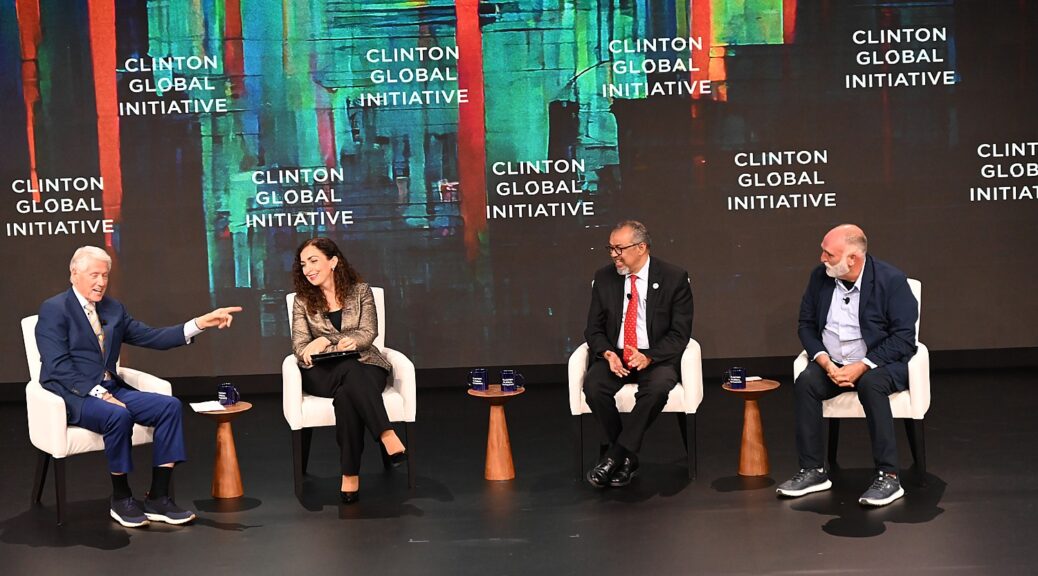
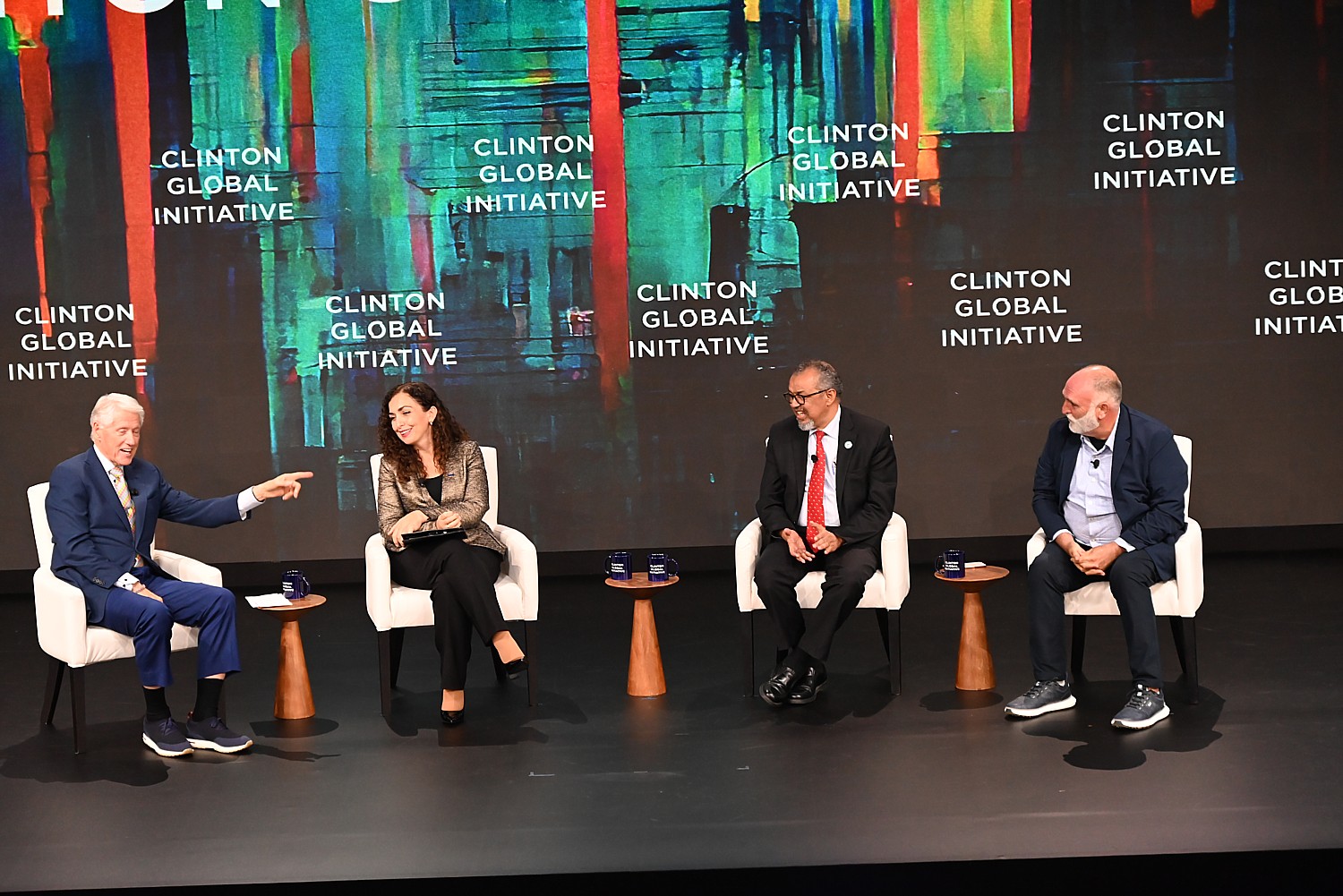
In the final CGI panel discussion, “We’re Next,” Tedros Adhanom Ghebreyesus, Director-General of the World Health Organization (WHO), recalled where he was on the day he heard (was not informed by Trump) that the USA, its largest donor, was withdrawing and taking with it its funding, immediately – not in six months to give the WHO time to reorganize. He noted that where he was when he heard was in Sana’a, capital of Yemen, when Israel bombed it, killing someone close to him and wounding others. It triggered memory as a child of war in his native country of Ethiopia –“the smell, image, even the sound” – when close relatives were killed, and reignited the PTSD.
“In 2020, with the first US withdrawal, the first round of cuts came, and war in my country and Covid. it was difficult situation. but if there is one thing that But I try to see what is beyond my control and focus on what I can do. It encourages me encourages me to do more as an individual.” And so he will figure out a way for the World Health Organization to continue to function.
Another child of war, President Vjosa Osmani of Kosovo told President Bill Clinton, that it is peace and democracy that brings economic prosperity and progress (not tariffs and authoritarianism). “When you never take your freedom, your freedoms for granted, when you focus on the rule of law, democracy, human rights, then economic empowerment and prosperity comes. What you stand for in the most difficult times matters.”
But in inimitable fashion, the Clintons set a tone of positivity and everyone set out with renewed resolve, determination and resilience to figure “workarounds” to the unprecedented challenge.
CGI, offered panels themed “A Critical Moment for Humanitarian Response,” “Protecting Progress, Prevention and Management of Infections and NonCommunicable Diseases,” “A New Blueprint for Global Health,” “New Approaches to Climate Finance,” “Bold Solutions for Effective Philanthropy,” “Protecting Truth and Information in a Fractured World,” “Putting People First,” all asking the question, “What’s Next,” and, finally, “We’re Next.” It went back to an earlier framework to focus on “working groups” – small groups focused around a particular issue to bring together NGOs, business entities, philanthropists, activists and experts who could form partnerships to fulfill innovative commitments.
Matt Damon, the acclaimed actor, relayed how Clinton Global Initiative 17 years ago helped him realize his goal of bringing safe water and sanitation to the millions upon millions of people who lacked such basic necessities. CGI introduced him to Gary White, an engineer, who also had no idea how to achieve that goal, and together they formed Water.org.
“It was like a first date – nervousness, awkwardness. But we realized that together could do a lot more than on own and really scale.” The first year’s CGI commitment was to build systems to serve 100,000. “Innovation-led, partners would follow. We got bigger and the numbers ran up. We hoped to reach 1 million a year. Today, we reach 1 million every six weeks.
“Our current commitment is already underway. In 2022, we pledged to help 100 million in Africa, Asia, and Latin America gain access to water, sanitation. We have already reached more than 30 million people who no longer have to take long walk for water.
“For Gary and me, CGI was the start. We thank President Clinton for introducing us, inspiring us to think better and doing all he can to help us reach those goals. There is more distance to go, with more than 2 billion people who lack access to safe water; 3 billion to sanitation.”
It was an invitation for others to join the partnership, or form their own, which is the essence of CGI.
We saw it in real time when Hawaii Governor Josh Green, on the “Investing in Community Resilience” panel with Jennifer Pryce, CEO of Calvert Impact Capital, learned about new ways to multiply the benefit of Hawaii’s newly imposed climate fee on visitors through community development bond instruments such as issued by Calvert Impact. Hawaii hopes to use the fee (about $3 on a $400/night hotel stay) to bond out $2 billion which will go to sustainability, environmental protection, prevention, resiliency (helps with insurance costs), and to sustain tourism, replenish coral reefs and beaches.
4,200 Commitments, 500 Million People, 180 Countries, 10,000 Partners
This year President Bill Clinton, Secretary Hillary Rodham Clinton, and Foundation Vice Chair Dr. Chelsea Clinton concluded the Clinton Global Initiative (CGI) 2025 Annual Meeting with the launch of 106 new Commitments to Action.
Since President Clinton founded CGI in 2005, the convening has asked attendees to come with Commitments to Action — specific, measurable partnerships and projects that address an urgent global challenge (there are regular reports issued).
Over the last 20 years, members of the CGI community across business, philanthropy, and government – more than 10,000 organizations and individuals – have partnered to launch more than 4,200 commitments that have improved the lives of more than 500 million people in over 180 countries. As a result of these partnerships:
Nearly 78 million people have improved access to financial services or capital.
More than $1.6 billion has been invested or loaned to small- and medium-sized enterprises.
Nearly 2.7 billion metric tons of CO2 were cut or abated.
More than 402 million acres of forest have been protected or restored.
Nearly 4 million clean jobs have been created.
More than 130 million people can more easily access maternal and child health and survival programs.
Nearly 38 million people can more easily access safe drinking water and sanitation.
More than 36 million people have received treatment for neglected tropical diseases.
More than $362 million in research and development funds has been spent on new vaccines, medicines, and diagnostics.
A bold opening address by President Clinton, condemning political violence, defending free speech, the free press and democracy, and how to bring the divided country together.
The Clinton Health Access Initiative (CHAI), along with Unitaid, Wits RHI, and Dr. Reddy’s Laboratories, announced a groundbreaking agreement on HIV prevention to dramatically open access to lenacapavir, a revolutionary medicine that effectively prevents HIV transmission with two injections a year. Under the CHAI-negotiated deal, this will be affordable and available for just $40 per year in 120 low- and middle-income countries by 2027.
Secretary Clinton marked the 30th anniversary of her remarks at the UN World Conference on Women, and announced a new Commitment to Action – a landmark report by the Women’s Initiative at Columbia SIPA’s Institute of Global Politics (IGP) and GWL Voices: Beijing+30: A Roadmap for Women’s Rights for the Next Thirty Years. The report outlines policy priorities critical to advancing the full and equal participation of women and girls in the twenty-first century, including in the areas of democracy and human rights, technology, economic participation, and conflict and climate.
Dr. Chelsea Clinton spoke with Audrey Tang, the cyber Ambassador of Taiwan, about overcoming polarization, how the public views democracy, and the importance of media literacy.
The Clinton Presidential Center, along with the City of Little Rock and ENFRA, announced a partnership to build the Clinton Sustainable Energy District (CSED) to offset carbon emissions and reduce utility costs through a new district energy system and a 5-megawatt solar array.
This year’s CGI Annual Meeting was reimagined to promote collaboration through Working Groups – facilitated, action-focused sessions where leaders will collaborate with mission-aligned organizations to drive real solutions in the areas that matter most and are under the greatest threat. Secretary Clinton announced progress from these Working Groups that CGI will build action on in the coming years and months:
Out of the Innovative Finance Working Group, Kiva Microfunds will launch a new social enterprise fund of at least $10 million in 2026, in partnership with corporate foundations.
The Health Working Group focused on using AI to overcome systemic gaps in chronic care; one project that came out of this group will expand maternal telehealth in Zimbabwe.
In the Education Working Group, the Clinton Foundation’s Too Small to Fail initiative and UNIDOS US led a conversation about expanding access to early learning. The group is exploring a pilot program in three U.S. cities in 2026 to provide immigrant families with early education resources.
The Human Rights and Democracy Working Group focused on issues including accelerating women’s democratic participation and defending LGBTQ+ rights, and developed ideas from civic education programs for at-risk youth in Northern Ireland to anti-authoritarian initiatives worldwide.
Members of the Climate Working Group dug into the tough realities of climate change and mapped out bold plans, including creating a water fund to unlock economic opportunities for millions; building climate adaptation hubs across the tropical belt, starting at COP30 in November; and opening new markets to support regenerative farmers.
The Economy Working Group focused on challenges like the care economy and access to capital. Out of that discussion came a commitment to launch a Global Network for National Service that will strengthen, expand, and scale national service programs around the world.
The Truth and Information Working Group discussed ways to cut through misinformation and focus on building community. In the next year, a top priority will be advocating for state and local leaders to enact responsible regulations on tech platforms and give users more ownership over their data.
The Humanitarian Response Working Group emphasized the need for innovation, preparedness, and localized responses to humanitarian crises around the world; with action items including a shared information system among responding NGOs, new funding opportunities, and innovative research-based tools.
President Bill Clinton, Secretary Hillary Clinton and Dr. Chelsea Clinton award the Clinton Global Citizen Award to entrepreneur and philanthropist B. Thomas Golisano for his transformative philanthropic work, including contributing $900 million to disability services, education, animal welfare, healthcare and numerous other community focused non-profits. Golisano was also an early supporter of the Clinton Global Initiative.
President Clinton also awarded the Clinton Global Citizen Award to entrepreneur and philanthropist B. Thomas Golisano for his transformative philanthropic work. As Founder of Paychex, a human resources software and service provider for small to medium sized businesses, Golisano has invested in endeavors that advance entrepreneurship and drive the success of numerous businesses and start-ups; he has also made more than $900 million in philanthropic contributions to disability services, education, animal welfare, healthcare — including four children’s hospitals that bear his name; Rochester, Syracuse, Ft. Myers and Buffalo — and numerous other community focused non-profits. Past recipients of the Clinton Global Citizen Award include President Joseph R. Biden, Jr., First Lady of Ukraine Olena Zelenska, Nadia Murad, and Dr. Muhammad Yunus.
Find information on all 106Commitments to Action announced at CGI 2025 at clintonglobal.org.
As CGI marks its 20th anniversary, the 2025 Annual Meeting has been reimagined to drive action on urgent global challenges, around the theme of “What’s Next”
Featured participants announced today include Noubar Afeyan, Founder and CEO, Flagship Pioneering; Co-Founder and Chairman, Moderna; Matt Damon, Co-Founder, Water.org and WaterEquity; Anthony Capuano, President and CEO, Marriott International; Cindy McCain, Executive Director, World Food Programme; Hamdi Ulukaya, CEO and Founder, Chobani; Abigail Disney, Filmmaker, Writer, Philanthropist, and Activist; Ryan Gellert, CEO, Patagonia; Audrey Tang, Cyber Ambassador, Taiwan; Wendy Abrams, Co-Founder and CEO, Eleven Eleven Foundation; Donna Karan, Founder, Urban Zen Foundation; Katherine Maher, President and CEO, NPR; Neil Buddy Shah, CEO, Clinton Health Access Initiative; and more. Learn more about this year’s full program and participants at https://clintonglobal.org/2025
NEW YORK, NY — The Clinton Global Initiative (CGI) announced more leaders from across business, government, philanthropy, and civil society, convening at the CGI 2025 Annual Meeting September 24-25, uniting around this year’s theme of “What’s Next.” These leaders are poised to take action to confront new and worsening challenges on climate, health, the economy, humanitarian response, democracy and human rights, truth and information, education, and innovative finance.
This year marks the 20th anniversary of CGI. Since 2005, more than 500 million people in more than 180 countries have had their lives improved by more than 4,000 Commitments to Action launched through CGI.
Last month, in a letter marking CGI’s 20th anniversary, President Clinton issued a stark call to action to the CGI community, outlining changes to this year’s meeting: “Given the scope of the challenges we face, this year’s CGI meeting will be different – by necessity. We need to redefine how we show up, how we work, and how we find ways to honor our common humanity.”Read President Clinton’s Call to Action here.
To tackle these challenges, the CGI 2025 Annual Meeting is bringing together leaders of major charitable foundations, nonprofits, businesses, governments, unions, and more to chart solutions. Featured participants announced today include:
Global advocates and activists including Stacey Abrams, Founder, American Pride Rises Network; Wendy Abrams, Co-Founder & CEO, Eleven Eleven Foundation; Vedika Bhandarkar, President and Chief Operating Officer, Water.org; Deepak Bhargava, President, Freedom Together Foundation; Matt Damon, Co-Founder, Water.org & WaterEquity; Abigail Disney, Filmmaker, Writer, Philanthropist, and Activist; Lindsay Ell, Artist, Songwriter, and Philanthropist; Dr. David C. Fajgenbaum, Co-Founder, Every Cure; Donna Karan, Founder, Urban Zen Foundation; and Audrey Tang, Cyber Ambassador, Taiwan;
Journalists and leaders across media including Errin Haines, Editor at Large, The 19th; Margaret Hoover, Host, Firing Line with Margaret Hoover, PBS; Andrew Jack, Global Education Editor, Financial Times; Raj Kumar, Founding President and Editor-in-Chief, Devex; Nishant Lalwani, CEO, International Fund for Public Interest Media; Katherine Maher, President and CEO, NPR; Alan Murray, Founding President, The Wall Street Journal Leadership Institute; Matthew Segal, Co-Founder, ATTN; Jessica Sibley, CEO, TIME; Vitus Spehar, Creator, Under The Desk News; and Michael Vito Valentino, Editor-in-Chief, NowThis;
Business leaders including Noubar Afeyan, Founder and CEO, Flagship Pioneering; Co-Founder and Chairman, Moderna; Rima Al Mokarrab, Chair, Tamkeen; Anthony Capuano, President and CEO, Marriott International; Michael Dowling, CEO, Northwell Health; Ryan Gellert, CEO, Patagonia; Lutz Hegemann, President Global Health, Novartis International AG; Joe Kiani, Founder and Executive Chairman, Willow Labs; and Hamdi Ulukaya, CEO and Founder, Chobani;
Philanthropic leaders including Tonya Allen, President, the McKnight Foundation; DeAngela Burns-Wallace, President and CEO, Ewing Marion Kauffman Foundation; Marla Blow, CEO, Skoll Foundation; Somachi Chris-Asoluka, CEO, The Tony Elumelu Foundation; Kellea Miller, Executive Director, Human Rights Funders Network; Jacqueline Novogratz, Founder and CEO, Acumen; Carmen Rojas, President and CEO, Marguerite Casey Foundation; John-Arne Røttingen, CEO, Wellcome Trust; and Mark Suzman, CEO and Board Member, Gates Foundation;
Civil society and NGO leaders including Manish Bapna, President and CEO, Natural Resources Defense Council (NRDC); Kathy Higgins, CEO, the Alliance for a Healthier Generation; Lisha McCormick, CEO, Last Mile Health; Sania Nishtar, CEO, Gavi, the Vaccine Alliance; Kelley Robinson, President, Human Rights Campaign; Peter Sands, Executive Director, The Global Fund; Neil Buddy Shah, CEO, Clinton Health Access Initiative; and Janti Soeripto, President and CEO, Save the Children US;
Government and multi-lateral leaders including U.S. Senator Chris Coons of Delaware; St. Kitts and Nevis Prime Minister Terrance Drew; Tom Fletcher, Under-Secretary-General for Humanitarian Affairs and Emergency Relief Coordinator, United Nations Office for the Coordination of Humanitarian Affairs; Michelle Lujan Grisham, Governor, New Mexico; Cindy McCain, Executive Director, World Food Programme; and more.
As part of President Clinton’s call to action last month, this year’s CGI Annual Meeting will be reimagined to promote collaboration through Working Groups – facilitated, action-focused sessions where leaders will collaborate with mission-aligned organizations to drive real solutions in the areas that matter most and are under the greatest threat. These Working Groups include cross-sector collaborations on Climate, Democracy and Human Rights, The Economy, Education, Health, Humanitarian Response, Innovative Finance, and Truth and Information.
Sponsors for the CGI 2025 Annual Meeting include AFT, All Hands & Hearts, Amalgamated Bank, APCO, Aurora Humanitarian Initiative, Bob and Jane Harrison, Cure, Doha Forum, Equity Group Holdings Plc, Flagship Pioneering, Former Congressman David Trone, Gilead Sciences, Inc., Integra Capital, Interenergy Group, John S. and James L. Knight Foundation, Kokoro, MEBO International, Northwell Health, Pfizer, Pinterest, Sino-European Manufacturing Club, Strauss Media Strategies, Inc., Tarsadia Foundation, The EKTA Foundation, The Nima Taghavi Foundation, The John D. Evans Foundation, The Kiani Foundation, The Marc Haas Foundation, Ukraine Children’s Action Project, Varkey Foundation, and W.K. Kellogg Foundation. Postcode Lottery Group is serving as a partner for the CGI 2025 Annual Meeting. Devex and Grist are media partners for the CGI 2025 Annual Meeting.
To mark the Clinton Global Initiative’s 20th Anniversary, Social Goods — a purpose-driven small business — and the Clinton Foundation are partnering to unveil a new, limited-edition collection where every item sold supports Foundation programs that advance solutions on economic opportunity, climate, public health, gender equality, and more.
Previously announced participants include Prime Minister Gaston Browne of Antigua and Barbuda; Prime Minister Philip Davis of The Bahamas; Prime Minister Mia Mottley of Barbados; President Vjosa Osmani of Kosovo; Nazanin Ash, CEO, Welcome.US; Suyen Barahona Cuan, Executive Director, Colmena Fund; Priscilla Sims Brown, President and CEO, Amalgamated Bank; Rolando Gonzalez Bunster, Chairman and CEO, InterEnergy Group; Brendan Carr, CEO, Mount Sinai Health System; Tim Cadogan, CEO, GoFundMe; John Hope Bryant, Founder, Chairman and CEO, Operation HOPE, Inc.; Ellen Johnson Sirleaf, Founder and Chair Emeritus, The Ellen Johnson Sirleaf Presidential Center for Women and Development; John King, Chancellor, State University of New York; Ann Lee, Co-Founder and CEO, Community Organized Relief Effort (CORE); Nancy Lindborg, President and CEO, The David and Lucile Packard Foundation; Lisha McCormick, CEO, Last Mile Health; Patricia McIlreavy, President and CEO, Center for Disaster Philanthropy; Denis Mukwege, President and Founder, Panzi Hospital; James Mwangi, Group CEO, Equity Group Holdings; Reema Nanavaty, Director, Self-Employed Women’s Association (SEWA); Binaifer Nowrojee, President, Open Society Foundations; Michelle Nunn, President and CEO, CARE USA; Daniel O’Day, Chairman and CEO, Gilead Sciences; Kennedy Odede. Co-Founder and CEO, Shining Hope for Communities; Maribel Pérez Wadsworth, President and CEO, John S. and James L. Knight Foundation; Ai-jen Poo, President and Executive Director, National Domestic Workers Alliance (NDWA) and Caring Across Generations; Bill Ready, CEO, Pinterest; Maria Ressa, Co-Founder and CEO, Rappler; Liz Shuler, President, AFL–CIO; Karlee Silver, CEO, Grand Challenges Canada; Charlotte Slente, Secretary General, Danish Refugee Council; Darren Walker, President, Ford Foundation; Randi Weingarten, President, American Federation of Teachers; and more.
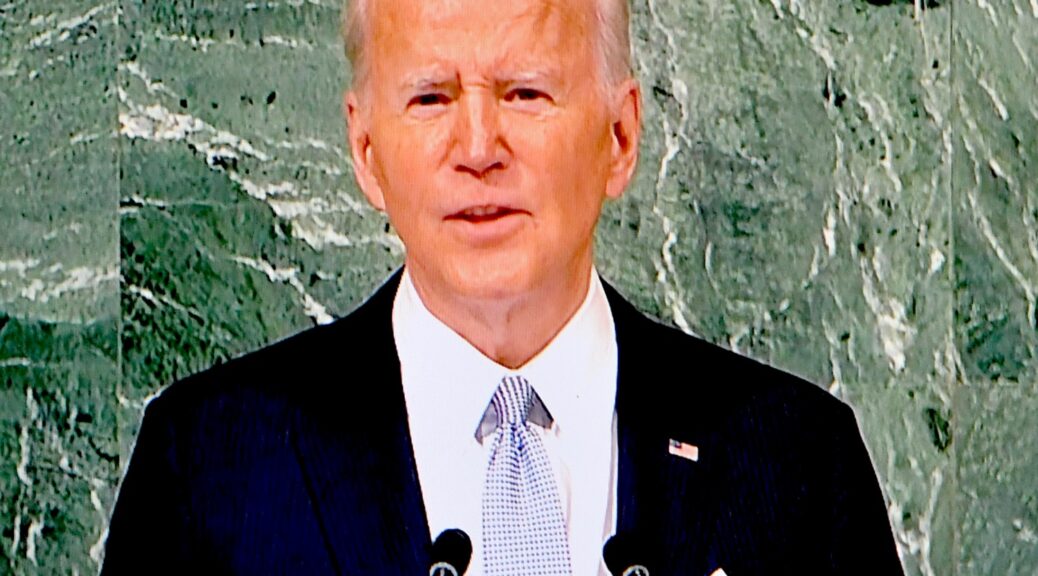
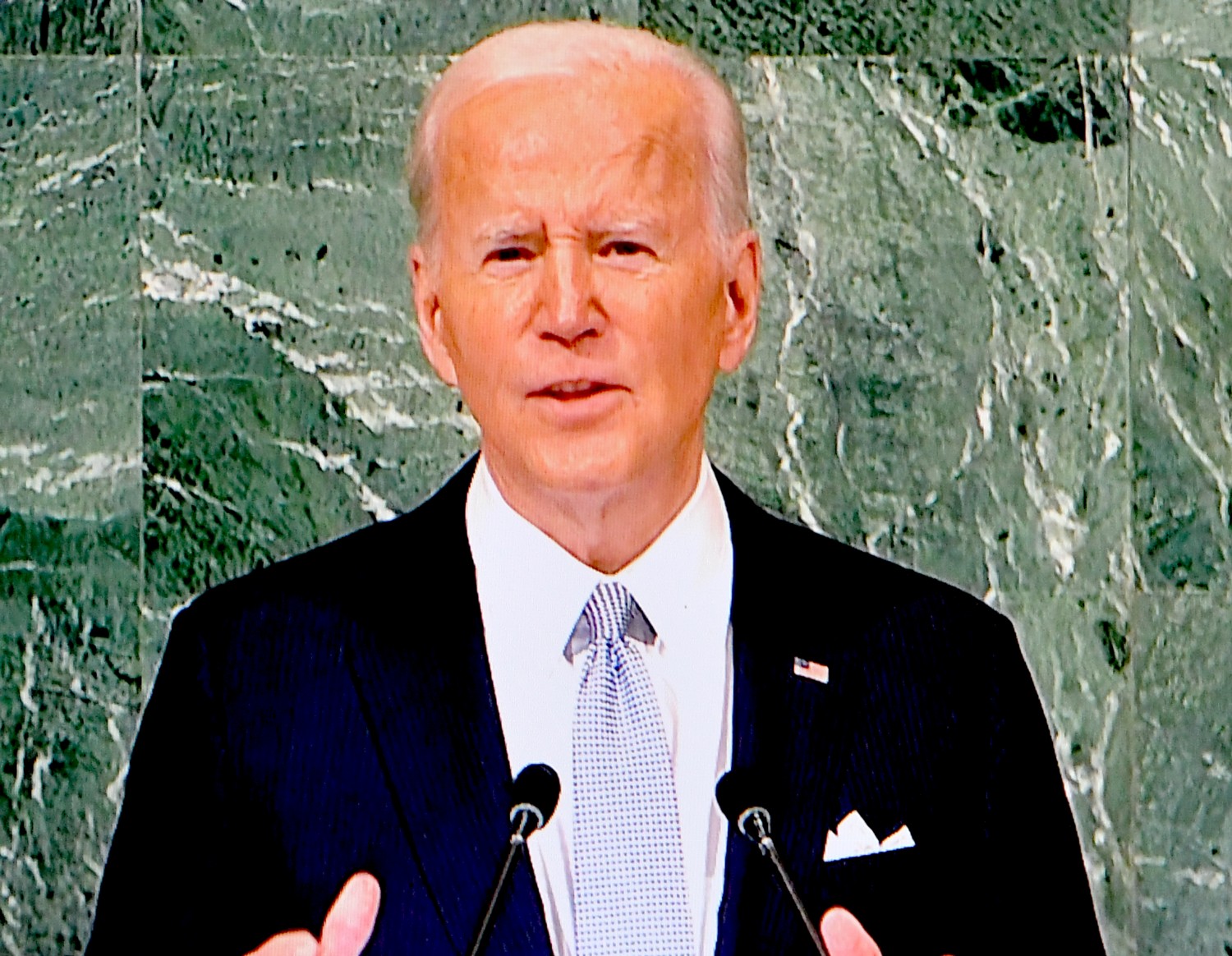
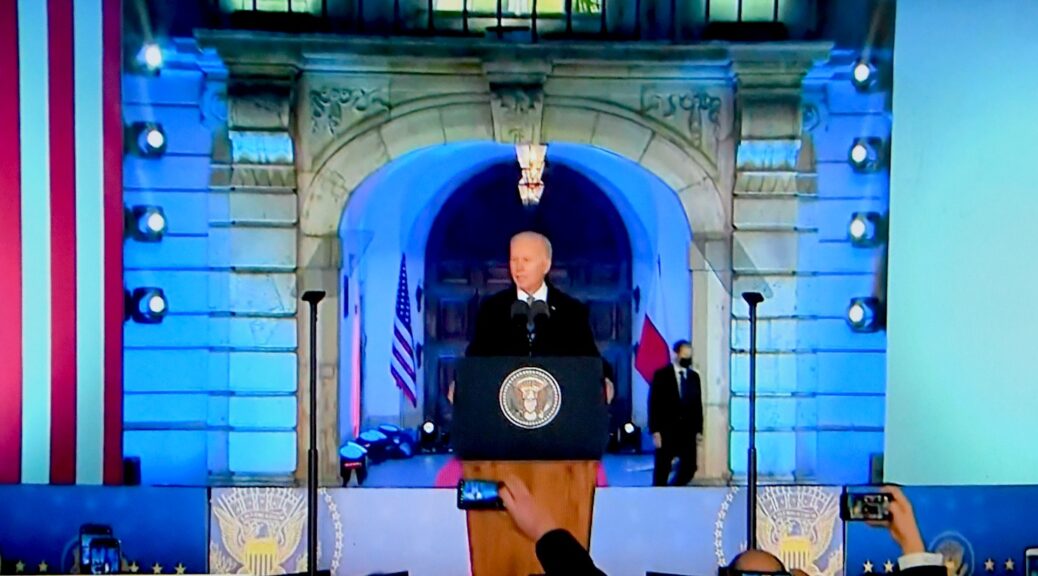
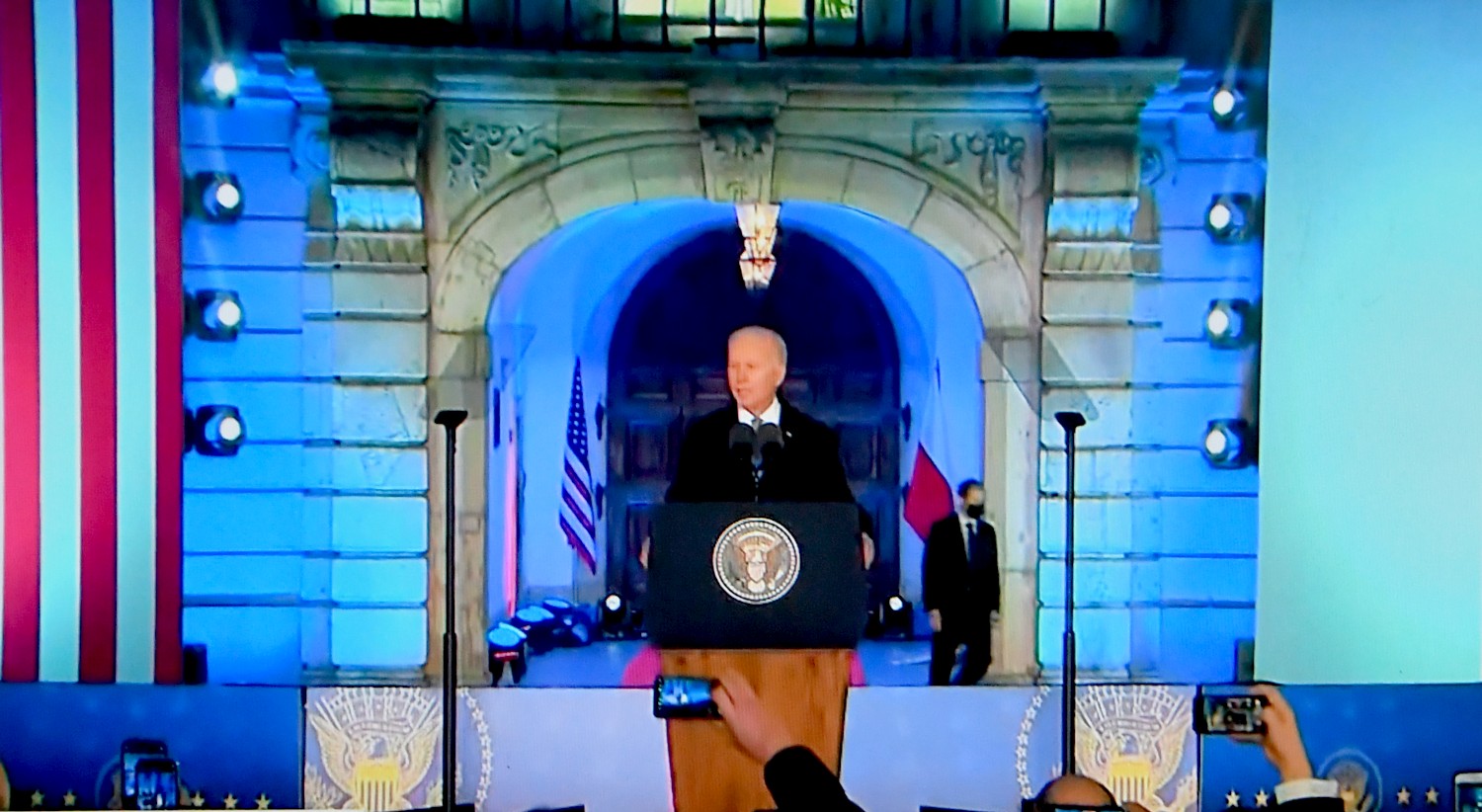
President Joe Biden presented America’s foreign policy manifesto in his speech to the United Nations 77th General Assembly in New York, asserting a world striving toward equity, shared progress, social, economic and environmental justice, just as he has endeavored to implement at home. He called out Russia, China and others for their human rights abuses, called for climate action, global health initiatives, food security, cooperation rather than competition on the technology advances to improve the lives of everyone. He called for diplomacy instead of conflict and a reaffirmation of the rule of law and the essential founding principles embodied in the United Nations Charter.
“So let’s stand together to again declare the unmistakable resolve that nations of the world are united still, that we stand for the values of the U.N. Charter, that we still believe by working together we can bend the arc of history toward a freer and more just world for all our children, although none of us have fully achieved it,” Biden declared. “We’re not passive witnesses to history; we are the authors of history. We can do this — we have to do it — for ourselves and for our future, for humankind.”
Here is an edited, highlighted transcript – Karen Rubin/news-photos-features.com
11:08 A.M. EDT
THE PRESIDENT: Thank you.
Mr. President, Mr. Secretary-General, my fellow leaders, in the last year, our world has experienced great upheaval: a growing crisis in food insecurity; record heat, floods, and droughts; COVID-19; inflation; and a brutal, needless war — a war chosen by one man, to be very blunt.
Russia’s Invasion of Ukraine
Let us speak plainly. A permanent member of the United Nations Security Council invaded its neighbor, attempted to erase a sovereign state from the map.
Russia has shamelessly violated the core tenets of the United Nations Charter — no more important than the clear prohibition against countries taking the territory of their neighbor by force.
Again, just today, President Putin has made overt nuclear threats against Europe and a reckless disregard for the responsibilities of the non-proliferation regime.
Now Russia is calling — calling up more soldiers to join the fight. And the Kremlin is organizing a sham referenda to try to annex parts of Ukraine, an extremely significant violation of the U.N. Charter.
This world should see these outrageous acts for what they are. Putin claims he had to act because Russia was threatened. But no one threatened Russia, and no one other than Russia sought conflict.
In fact, we warned it was coming. And with many of you, we worked to try to avert it.
Putin’s own words make his true purpose unmistakable. Just before he invaded, Putin asserted — and I quote — Ukraine was “created by Russia” and never had, quote, “real statehood.”
And now we see attacks on schools, railway stations, hospitals, wa- — on centers of Ukrainian history and culture.
In the past, even more horrifying evidence of Russia’s atrocity and war crimes: mass graves uncovered in Izyum; bodies, according to those that excavated those bodies, showing signs of torture.
This war is about extinguishing Ukraine’s right to exist as a state, plain and simple, and Ukraine’s right to exist as a people. Whoever you are, wherever you live, whatever you believe, that should not — that should make your blood run cold.
That’s why 141 nations in the General Assembly came together to unequivocally condemn Russia’s war against Ukraine.The United States has marshaled massive levels of security assistance and humanitarian aid and direct economic support for Ukraine — more than $25 billion to date.
Our allies and partners around the world have stepped up as well. And today, more than 40 countries represented in here have contributed billions of their own money and equipment to help Ukraine defend itself.
The United States is also working closely with our allies and partners to impose costs on Russia, to deter attacks against NATO territory, to hold Russia accountable for the atrocities and war crimes.
Because if nations can pursue their imperial ambitions without consequences, then we put at risk everything this very institution stands for. Everything.
Every victory won on the battlefield belongs to the courageous Ukrainian soldiers. But this past year, the world was tested as well, and we did not hesitate.
We chose liberty. We chose sovereignty. We chose principles to which every party to the United Nations Charter is beholding. We stood with Ukraine.
Like you, the United States wants this war to end on just terms, on terms we all signed up for: that you cannot seize a nation’s territory by force. The only country standing in the way of that is Russia.
So, we — each of us in this body who is determined to uphold the principles and beliefs we pledge to defend as members of the United Nations — must be clear, firm, and unwavering in our resolve.
Ukraine has the same rights that belong to every sovereign nation. We will stand in solidarity with Ukraine. We will stand in solidarity against Russia’s aggression. Period.
The US Will Defend Democracy
Now, it’s no secret that in the contest between democracy and autocracy, the United States — and I, as President — champion a vision for our world that is grounded in the values of democracy.
The United States is determined to defend and strengthen democracy at home and around the world. Because I believe democracy remains humanity’s greatest instrument to address the challenges of our time.
We’re working with the G7 and likeminded countries to prove democracies can deliver for their citizens but also deliver for the rest of the world as well.
Reaffirm the United Nations’ Founding Principles
But as we meet today, the U.N. Charter — the U.N. Charter’s very basis of a stable and just rule-based order is under attack by those who wish to tear it down or distort it for their own political advantage.
And the United Nations Charter was not only signed by democracies of the world, it was negotiated among citizens of dozens of nations with vastly different histories and ideologies, united in their commitment to work for peace.
As President Truman said in 1945, the U.N. Charter — and I quote — is “proof that nations, like men, can state their differences, can face them, and then can find common ground on which to stand.” End of quote.
That common ground was so straightforward, so basic that, today, 193 of you — 193 member states — have willingly embraced its principles. And standing up for those principles for the U.N. Charter is the job of every responsible member state.
I reject the use of violence and war to conquer nations or expand borders through bloodshed.
To stand against global politics of fear and coercion; to defend the sovereign rights of smaller nations as equal to those of larger ones; to embrace basic principles like freedom of navigation, respect for international law, and arms control — no matter what else we may disagree on, that is the common ground upon which we must stand.
If you’re still committed to a strong foundation for the good of every nation around the world, then the United States wants to work with you.
The UN Should Become More Inclusive
I also believe the time has come for this institution to become more inclusive so that it can better respond to the needs of today’s world.
Members of the U.N. Security Council, including the United States, should consistently uphold and defend the U.N. Charter and refrain — refrain from the use of the veto, except in rare, extraordinary situations, to ensure that the Council remains credible and effective.
That is also why the United States supports increasing the number of both permanent and non-permanent representatives of the Council. This includes permanent seats for those nations we’ve long supported and permanent seats for countries in Africa, Latin America, and the Caribbean.
The United States is committed to this vital work. In every region, we pursued new, constructive ways to work with partners to advance shared interests, from elevating the Quad in the Indo-Pacific; to signing the Los Angeles Declaration of Migration and Protection at the Summit of the Americas; to joining a historic meeting of nine Arab leaders to work toward a more peaceful, integrated Middle East; to hosting the U.S.-Africa Leaders’ Summit in — this December.
Relentless Diplomacy to Tackle Challenges
As I said last year, the United States is opening an era of relentless diplomacy to address the challenges that matter most to people’s lives — all people’s lives: tackling the climate crisis, as the previous speaker spoke to; strengthening global health security; feeding the world — feeding the world.
We made that priority. And one year later, we’re keeping that promise.
From the day I came to office, we’ve led with a bold climate agenda. We rejoined the Paris Agreement, convened major climate summits, helped deliver critical agreements on COP26. And we helped get two thirds of the world GDP on track to limit warming to 1.5 degrees Celsius.
And now I’ve signed a historic piece of legislation here in the United States that includes the biggest, most important climate commitment we have ever made in the history of our country: $369 billion toward climate change. That includes tens of billions in new investments in offshore wind and solar, doubling down on zero emission vehicles, increasing energy efficiency, supporting clean manufacturing.
Our Department of Energy estimates that this new law will reduce U.S. emissions by one gigaton a year by 2030 while unleashing a new era of clean-energy-powered economic growth.
Our investments will also help reduce the cost of developing clean energy technologies worldwide, not just the United States. This is a global gamechanger — and none too soon. We don’t have much time.
Climate Crisis
We all know we’re already living in a climate crisis. No one seems to doubt it after this past year. As we meet, much of Pakistan is still underwater; it needs help. Meanwhile, the Horn of Africa faces unprecedented drought.
Families are facing impossible choices, choosing which child to feed and wondering whether they’ll survive.
This is the human cost of climate change. And it’s growing, not lessening.
So, as I announced last year, to meet our global responsibility, my administration is working with our Congress to deliver more than $11 billion a year to international climate finance to help lower-income countries implement their climate goals and ensure a just energy transition.
The key part of that will be our [PREPARE] plan, which will help half a billion people, and especially vulnerable countries, adapt to the impacts of climate change and build resilience.
This need is enormous. So let this be the moment we find within ourselves the will to turn back the tide of climate devastation and unlock a resilient, sustainable, clean energy economy to preserve our planet.
Global Health
On global health, we’ve delivered more than 620 million doses of COVID-19 vaccine to 116 countries around the world, with more available to help meet countries’ needs — all free of charge, no strings attached.
And we’re working closely with the G20 and other countries. And the United States helped lead the change to establish a groundbreakingnew Fund for Pandemic Prevention, Preparedness, and Response at the World Bank.
At the same time, we’ve continued to advance the ball on enduring global health challenges.
Later today, I’ll host the Seventh Replenishment Conference for the Global Fund to Fight AIDS, Tuberculosis, and Malaria. With bipartisan support in our Congress, I have pledged to contribute up to $6 billion to that effort.
So I look forward to welcoming a historic round of pledges at the conference resulting in one of the largest global health fundraisers ever held in all of history.
Food Crisis
We’re also taking on the food crisis head on. With as many as 193 million people around the world experiencing acute — acute food insecurity — a jump of 40 million in a year — today I’m announcing another $2.9 billion in U.S. support for lifesaving humanitarian and food security assistance for this year alone.
Russia, in the meantime, is pumping out lies, trying to pin the blame for the crisis — the food crisis — onto sanctions imposed by many in the world for the aggression against Ukraine.
So let me be perfectly clear about something: Our sanctions explicitly allow — explicitly allow Russia the ability to export food and fertilizer. No limitation. It’s Russia’s war that is worsening food insecurity, and only Russia can end it.
I’m grateful for the work here at the U.N. — including your leadership, Mr. Secretary-General — establishing a mechanism toexport grain from Black Sea ports in Ukraine that Russia had blocked for months, and we need to make sure it’s extended.
We believe strongly in the need to feed the world. That’s why the United States is the world’s largest supporter of the World Food Programme, with more than 40 percent of its budget.
We’re leading support — we’re leading support of the UNICEF efforts to feed children around the world.
And to take on the larger challenge of food insecurity, the United States introduced a Call to Action: a roadmap eliminating global food insecurity — to eliminating global food insecurity that more than 100 nation member states have already supported.
In June, the G7 announced more than $4.5 billion to strengthen food security around the world.
Through USAID’s Feed the Future initiative, the United States is scaling up innovative ways to get drought- and heat-resistant seeds into the hands of farmers who need them, while distributing fertilizer and improving fertilizer efficiency so that farmers can grow more while using less.
And we’re calling on all countries to refrain from banning food exports or hoarding grain while so many people are suffering. Because in every country in the world, no matter what else divides us, if parents cannot feed their children, nothing — nothing else matters if parents cannot feed their children.
Rules of the Road for International Cooperation
As we look to the future, we’re working with our partners to update and create rules of the road for new challenges we face in the 21st century.
We launched the Trade and Technology Council with the European Union to ensure that key technologies — key technologies are developed and governed in the way that benefits everyone.
With our partner countries and through the U.N., we’re supporting and strengthening the norms of responsibility — responsible state behavior in cyberspace and working to hold accountable those who use cyberattacks to threaten international peace and security.
With partners in the Americas, Africa, Europe, and the Middle East, and the Indo-Pacific, we’re working to build a new economic ecosystem while — where every nation — every nation gets a fair shot and economic growth is resilient, sustainable, and shared.
That’s why the United States has championed a global minimum tax. And we will work to see it implemented so major corporations pay their fair share everywhere — everywhere.
It’s also been the idea behind the Indo-Pacific Economic Framework, which the United States launched this year with 13 other Indo-Pacific economies. We’re working with our partners in ASEAN and the Pacific Islands to support a vision for a critical Indo-Pacific region that is free and open, connected and prosperous, secure and resilient.
Together with partners around the world, we’re working to secure resilient supply chains that protect everyone from coercion or domination and ensure that no country can use energy as a weapon.
And as Russia’s war riles the global economy, we’re also calling on major global creditors, including the non-Paris Club countries, to transparently negotiate debt forgiveness for lower-income countriesto forestall broader economic and political crises around the world.
Instead of infrastructure projects that generate huge and large debt without delivering on the promised advantages, let’s meet the enormous infrastructure needs around the world with transparent investments — high-standard projects that protect the rights of workers and the environment — keyed to the needs of the communities they serve, not to the contributor.
That’s why the United States, together with fellow G7 partners, launched a Partnership for Global Infrastructure and Investment. We intend to collectively mobilize $600 billion in investment through this partnership by 2027.
Dozens of projects are already underway: industrial-scale vaccine manufacturing in Senegal, transformative solar projects in Angola, first-of-its-kind small modular nuclear power plant in Romania.
These are investments that are going to deliver returns not just for those countries, but for everyone. The United States will work with every nation, including our competitors, to solve global problems like climate change. Climate diplomacy is not a favor to the United States or any other nation, and walking away hurts the entire world.
Relations with China, Nations
Let me be direct about the competition between the United States and China. As we manage shifting geopolitical trends, the United States will conduct itself as a reasonable leader. We do not seek conflict. We do not seek a Cold War. We do not ask any nation to choose between the United States or any other partner.
But the United States will be unabashed in promoting our vision of a free, open, secure, and prosperous world and what we have to offer communities of nations: investments that are designed not to foster dependency, but to alleviate burdens and help nations become self-sufficient; partnerships not to create political obligation, but because we know our own success — each of our success is increased when other nations succeed as well.
When individuals have the chance to live in dignity and develop their talents, everyone benefits. Critical to that is living up to the highest goals of this institution: increasing peace and security for everyone, everywhere.
The United States will not waver in our unrelenting determination to counter and thwart the continuing terrorist threats to our world. And we will lead with our diplomacy to strive for peaceful resolution of conflicts.
We seek to uphold peace and stability across the Taiwan Straits.
We remain committed to our One China policy, which has helped prevent conflict for four decades. And we continue to oppose unilateral changes in the status quo by either side.
We support an African Union-led peace process to end the fight in Ethiopia and restore security for all its people.
In Venezuela, where years of the political oppression have driven more than 6 million people from that country, we urge a Venezuelan-led dialogue and a return to free and fair elections.
We continue to stand with our neighbor in Haiti as it faces political-fueled gang violence and an enormous human crisis.
And we call on the world to do the same. We have more to do.
We’ll continue to back the U.N.-mediated truce in Yemen, which has delivered precious months of peace to people that have suffered years of war.
And we will continue to advocate for lasting negotiating peace between the Jewish and democratic state of Israel and the Palestinian people. The United States is committed to Israel’s security, full stop. And a negotiated two-state solution remains, in our view, the best way to ensure Israel’s security and prosperity for the future and give the Palestinians the state which — to which they are entitled — both sides to fully respect the equal rights of their citizens; both people enjoying equal measure of freedom and dignity.
Nuclear Non-Proliferation
Let me also urge every nation to recommit to strengthening the nuclear non-proliferation regime through diplomacy. No matter what else is happening in the world, the United States is ready to pursue critical arms control measures. A nuclear war cannot be won and must never be fought.
The five permanent members of the Security Council just reaffirmed that commitment in January. But today, we’re seeing disturbing trends. Russia shunned the Non-Proliferation ideals embraced by every other nation at the 10th NPT Review Conference.
And again, today, as I said, they’re making irresponsible nuclear threats to use nuclear weapons. China is conducting an unprecedented, concerning nuclear buildup without any transparency.
Despite our efforts to begin serious and sustained diplomacy, the Democratic People’s Republic of Korea continues to blatantly violate U.N. sanctions.
And while the United States is prepared for a mutual return to the Joint Comprehensive Plan of Action if Iran steps up to its obligations, the United States is clear: We will not allow Iran to acquire a nuclear weapon.
I continue to believe that diplomacy is the best way to achieve this outcome. The nonproliferation regime is one of the greatest successes of this institution. We cannot let the world now slide backwards, nor can we turn a blind eye to the erosion of human rights.
Human Rights
Perhaps singular among this body’s achievements stands the Universal Declaration of Human Rights, which is the standard by which our forebears challenged us to measure ourselves.
They made clear in 1948: Human rights are the basis for all that we seek to achieve. And yet today, in 2022, fundamental freedoms are at risk in every part of our world, from the violations in Xinjiang detailed in recent reports by the Office of U.N. High Commissioner, to the horrible abuses against pro-democracy activists and ethnic minorities by the military regime in Burma, to the increased repression of women and girls by the Taliban in Afghanistan.
And today, we stand with the brave citizens and the brave women of Iran who right now are demonstrating to secure their basic rights.
But here’s what I know: The future will be won by those countries that unleash the full potential of their populations, where women and girls can exercise equal rights, including basic reproductive rights, and contribute fully to building a stronger economies and more resilient societies; where religious and ethnic minorities can live their lives without harassment and contribute to the fabric of their communities; where the LGBTQ+ community individuals live and love freely without being targeted with violence; where citizens can question and criticize their leaders without fear of reprisal.
The United States will always promote human rights and the values enshrined in the U.N. Charter in our own country and around the world.
Let me end with this: This institution, guided by the U.N. Charter and the Universal Declaration of Human Rights, is at its core an act of dauntless hope.
Let me say that again: It’s an act of dauntless hope.
Think about the vision of those first delegates who undertook a seemingly impossible task while the world was still smoldering.
Think about how divided the people of the world must have felt with the fresh grief of millions dead, the genocidal horrors of the Holocaust exposed.
They had every right to believe only the worst of humanity. Instead, they reached for what was best in all of us, and they strove to build something better: enduring peace; comity among nations; equal rights for every member of the human family; cooperation for the advancement of all humankind.
My fellow leaders, the challenges we face today are great indeed, but our capacity is greater. Our commitment must be greater still.
So let’s stand together to again declare the unmistakable resolve that nations of the world are united still, that we stand for the values of the U.N. Charter, that we still believe by working together we can bend the arc of history toward a freer and more just world for all our children, although none of us have fully achieved it.
We’re not passive witnesses to history; we are the authors of history.
We can do this — we have to do it — for ourselves and for our future, for humankind.
Thank you for your tolerance, for listening to me. I appreciate it very much. God bless you all. (Applause.)
The world stands today at the dawn of a decisive decade — a moment of consequence and peril, of profound pain and extraordinary possibility. Perhaps now more than ever, we have seen how the most urgent challenges of our time do not confine themselves within national borders. A global pandemic that has claimed more than six million lives. A climate crisis that threatens the future of every continent. An emboldening of autocrats who believe that democracy and multilateralism cannot deliver in the 21st century. These tests, and more, are among the sternest that the world has ever faced.
It is against this backdrop — at this inflection point in history — that America must lead. We know all too well that today’s most pressing challenges — their root causes as well as their impacts — are global in nature. We know that America’s security and success hinge in no small measure on the peace and stability of the world beyond our borders. We know that beneath the global crises we face lie breathtaking opportunities for our Nation and the world — if we can summon the will to seize them.
This document — a prologue to the U.S. Strategy to Prevent Conflict and Promote Stability — represents an assertion of American leadership to take on the defining global challenges of our time. Driven in large part by the tireless commitment of humanitarian advocates and civil society organizations working on the front lines of conflict, this Strategy is the product of a bipartisan vision, manifested by the passage of the Global Fragility Act in December 2019 with overwhelming bipartisan majorities. It provides a roadmap: a 10-year effort to strengthen the security and prosperity of people everywhere by helping to fortify the footing of parts of the world that continue to grapple with challenges that can lead to destabilizing conflict and violence. It is, in short, an investment in global peace and security — one which will deliver critical returns not only in the nations with whom we’ll be working, but, most of all, here in the United States.
The heartbreaking images we are seeing in Ukraine — the result of a vicious and unprovoked attack by Vladimir Putin — are only the latest reminder of the tragic consequences of global conflict and the need to avert violence before it erupts. We know that working broadly, strategically, and cooperatively to prevent conflict and instability is the greatest investment we can make in America’s future, and in the future of the entire world. In Ukraine, as in Ethiopia, Syria, Yemen, and elsewhere around the world, the incalculable toll of lives lost, families separated, economies destroyed, and social fabrics torn threatens to spiral whole regions into cycles of violence and loss that can linger for generations. Doing all that we can to assist communities around the world in their conflict prevention efforts is more than just the right thing to do. It saves lives, safeguards Americans’ own security and prosperity, and establishes the United States as a trusted partner — a force for peace and stability in the world, and a nation that can be counted on to work and learn productively alongside the nations of every region to tackle common challenges and strengthen our shared future.
This Strategy lays out a whole-of-government approach to advancing America’s national interests on the world stage. This means tapping into the expansive expertise and resources that reside across our Government, sharpening and updating those tools where needed, humbly applying the costly and painful lessons from the past, and transforming the way we work with each other. Our diplomats, officers, and experts in the State Department, the United States Agency for International Development, the Department of Defense, the Department of the Treasury, and others across Government, as well as members of the Foreign Service and Armed Forces, will work in close cooperation with multilateral organizations and a wide variety of local partners in each nation where these efforts will be pursued — including civil society organizations, community leaders, businesses, and government officials.
Those who are closest and most vulnerable to these challenges know best where the opportunities for peace and stability lie — they represent the strongest source of promise and immunity from destabilizing forces, and we must support their strength and resilience. From strengthening social institutions and state-society relations, to mitigating the spread of extremist ideologies, to confronting the corrosive impact of gender inequality, to cultivating greater trust between security forces and citizens, to guarding against the destabilizing threat of climate change — we will help foster locally led, locally owned solutions grounded in mutual trust and long-term accountability.
Prevention is hard work — measured not in days and weeks, but in years and generations. Its successes are never as evident as its failures, and it requires us to remain focused on lasting peace and stability over the allure of easier, more temporary gains that may not strengthen our position in the long term. But, with this Strategy, we are committing ourselves to the effort. As we implement this Strategy, my Administration looks forward to working closely with the Congress on a bipartisan basis, and in close consultation with civil society institutions and stakeholders on every level. United in our vision, America can and must lead this essential new effort to interrupt potential pathways to conflict, alleviate threats before they escalate and arrive on our shores, and help safeguard the economy, health, and security of our Nation for generations to come. –Joseph R. Biden, Jr.
Addressing the Collective Challenges of our Time:
Implementing the U.S. Strategy to Prevent Conflict and Promote Stability
Every country, including our own, experiences risks and challenges related to stability and conflict. The international community grapples with issues that cut across borders, societies, ways of life, and economies. As the world has witnessed too often, the effects of conflict and instability are not constrained by borders or technologies. Cooperation and long-term investments in conflict prevention and stabilization are needed now more than ever to build peace across divided communities and boundaries. We must collectively bolster societal resilience to prevent and reduce the heavy human and financial costs of conflicts that undermine global peace, security and sustainable development.
On March 24, 2022, the Biden-Harris Administration launched the implementation of the U.S. Strategy to Prevent Conflict and Promote Stability with partner countries across the globe. The Strategy outlines a ten-year, evidence-based, whole-of-government effort to foster peace and long-term stability through integrated U.S. diplomacy, development, and security-sector engagement with dual goals of strengthening national and regional peace, resilience and stability and enhancing the way our government operates in a variety of contexts.
Through collective action and partnership, the United States seeks to advance the vision and goals of the landmark Global Fragility Act through this Strategy in four diverse countries and one sub-region facing a wide variety of challenges to peace and stability. This Strategy advances U.S. national security and interests. The work now underway represents an important milestone, and next step, in the implementation of the Global Fragility Act, which continues to enjoy strong support within the U.S. Congress and among civil society. Through a spirit of partnership, we can and will build on strengths of communities, governments, and nations to rebound from shocks, confront negative global trends and create new paradigms for broader cooperation. The Strategy and Prologue chart a new path toward positive results that strengthen democracy, rule of law, security, good governance, gender equity and equality, health, education, and respect for human rights all aligned to fuel reservoirs of peace, strength and recovery and extinguish potential discord before it is sparked.
The United States will partner with Haiti, Libya, Mozambique, Papua New Guinea, and Coastal West Africa (Benin, Côte d’Ivoire, Ghana, Guinea, and Togo) guided by these principles:
Work collaboratively with government and civic partners on an integrated approach to prevent conflict, promote resilience and stability, and advance economic development;
Look beyond urgent crises and near-term needs to focus on mutually determined strategic goals and interests through whole-of-government ten-year plans;
Utilize development, diplomacy, and security-sector means in a coordinated way to support the pursuit of goals, foster an enabling environment, and solidify progress;
Provide new tools and insights to strengthen democratic institutions, for example in the areas of rule of law, anti-corruption, law enforcement, and fiscal transparency, and to promote human rights and gender equity and equality;
Adapt to and learning from changing conditions, anchor efforts in local communities, and make strategic adjustments based on joint analyses, research, and monitoring and evaluation; and
Take a multifaceted approach to address other current and emerging challenges, such as the climate crisis, global pandemics and declining democratic practices.
The U.S. Congress authorized up to $200 million a year for these efforts and appropriated $125 million in Fiscal Year 2022 for the Prevention and Stabilization Fund, which supplements existing bilateral U.S. assistance to these partner countries. This funding will support the development of ten-year implementation plans and related regional and multilateral activities.
The Biden-Harris Administration will closely monitor progress, milestones, and accomplishments under the Strategy. These efforts will endure across future U.S. Administrations and advance much needed innovative approaches to peace and stability.
This is a fact sheet from the White House detailing the Biden Administration’s commitment to advancing global health:
The United States Government is proud to be the largest donor for global health. As we work to end the COVID-19 pandemic, we remain committed to strengthening health systems and institutions; advancing global health security; combatting HIV/AIDS, malaria, and tuberculosis; advancing sexual and reproductive health and rights, and maternal, neonatal, and child health; closing gaps in nutrition and non-communicable diseases; and accelerating efforts towards universal health coverage and the Sustainable Development Agenda. In Fiscal Year (FY) 2021, the United States appropriated over $9 billion in global health programs, in addition to almost $16 billion in emergency supplemental funding for COVID-19.
We continue to lead the global community toward a safer, more equitable future. Over the last year, the Biden-Harris Administration has renewed the U.S. leadership in global health, and taken decisive steps to advance global health priorities, including:
Supporting and strengthening the WHO. Among his first acts in office one year ago, President Biden declared the United States would reengage with the World Health Organization (WHO), highlighting our nation’s commitment to advancing multilateral cooperation in a time of international health crisis. Last week, the United States once again demonstrated that commitment, by leading a successful decision at the WHO Executive Board meeting to strengthen the International Health Regulations (2005). This strengthening will enhance the world’s ability to prevent, detect, and rapidly respond to infectious disease outbreaks in the future. Beyond COVID-19, the United States is collaborating with global partners through WHO on a wide range of global health challenges such as childhood immunization, nutrition, polio eradication, strengthening the global health workforce to achieve universal health coverage, and tackling the threat that climate change poses to health. These and other issues remain critical priorities, especially in the wake of COVID-19, and demonstrate the importance of strong, equitable health systems that serve those most at risk.
Leading the global COVID-19 response. Under President Biden’s leadership, the United States has committed to donate 1.2 billion doses of safe and effective vaccine to the world, more than any other nation. To date, we have shipped over 400 million of those vaccines to 112 countries around the world, all for free, with no strings attached or promises extracted. We were the first nation to purchase doses solely for the purpose of donation, with the historic purchase of 1 billion doses of Pfizer vaccine. We were the first nation to step out of the queue for Moderna vaccines, allowing the African Union quicker access to tens of millions of doses. We were the first to broker access to doses for individuals in humanitarian crises. And now, we are leading the push to turn vaccines into vaccinations, with the creation of the Global Vaccine Initiative. To date, the United States is providing nearly $16 billion for life-saving health, economic, and humanitarian COVID-19 assistance to our partners to fight this virus and its impacts. These funds are delivering shots in arms, lifesaving supplies to hospitals, and support that reaches the most vulnerable communities.
Advancing sexual and reproductive health and rights. One of President Biden’s first actions was issuing a Presidential Memorandum on Protecting Women’s Health at Home and Abroad, which revoked the expanded Mexico City Policy and directed agencies to resume funding to the United Nations Population Fund (UNFPA) in support of its essential work to prevent maternal deaths, expand access to voluntary family planning, and prevent and respond to gender-based violence around the world. The Administration continues to advance sexual and reproductive health and rights (SRHR) for all in the face of continued threats. The White House Gender Policy Council released the first-ever National Strategy on Gender Equity and Equality, which emphasizes the core role of advancing SRHR to achieve gender equality. As the largest bilateral donor to family planning, the United States also leads globally by advancing SRHR in multilateral fora and with bilateral partners. As we address the indirect impacts of the COVID-19 pandemic on health systems and vulnerable populations, the United States has supported increased access to SRHR services, particularly in emergency contexts.
Continued global leadership on addressing HIV/AIDS, malaria, and tuberculosis. Last week, the U.S. President’s Emergency Plan for AIDS Relief (PEPFAR) celebrated its nineteen-year anniversary. Since its inception and with bilateral support, the U.S. Government has invested $100 billion to transform the global AIDS response. PEPFAR has saved more than 21 million lives, prevented millions of HIV infections, and helped countries build a strong foundation to prevent, detect, and respond to other health threats, including COVID-19. Across 55 countries, PEPFAR invests over $1 billion annually in local health systems strengthening to respond to HIV. At the end of FY21, PEPFAR supported 63.4 million people with HIV testing services, and 18.96 million people with antiretroviral treatment. With $250 million in funding through the American Rescue Plan Act, PEPFAR has continued to advance HIV gains and supported the global COVID-19 response. The U.S. President’s Malaria Initiative invested $770 million in 2020 to forge forward in the fight against malaria, despite the COVID-19 pandemic, reaching almost 60 million people with malaria medicine and protecting more than 7.5 million pregnant women with preventive treatment for malaria. Through the most recent five-year U.S. Government Global TB Strategy, U.S. government investments led to the treatment of 15.7 million people with TB, starting 438,000 individuals with drug resistant TB on second-line drug therapy, and accomplished a treatment success rate of almost 90 percent.
Building health security capacities. The United States continues to work with partners across the globe, including 19 intensive support partner countries, to provide assistance to better prevent, detect, and respond to infectious disease threats and to meet the target of the multilateral Global Health Security Agenda. The need for these capacities has never been more clear, and robust interagency efforts helped address numerous outbreaks including Ebola, Anthrax, Influenza, Rabies, Polio, Cholera, and more. The U.S. Government’s global health security programs also pivoted to support critical COVID-19 response activities.
Sustaining commitments in maternal and child health. The United States’ sustained commitment, financial investment, and adaptability has ensured that critical health services continue reaching women, children, and families. In 2020, the United States helped more than 92 million women and children access essential—and often lifesaving—care. The U.S. Government’s investments towards polio eradication have also helped ensure over 400 million children are vaccinated against polio each year; last year was a significant milestone as Africa was declared wild polio free.
In the coming year, the Administration will take the following steps to continue to advance global health priorities:
Continue supporting and strengthening the World Health Organization. The United States looks forward to rejoining the WHO Executive Board in May 2022, and will launch a Strategic Dialogue with WHO to ensure our mutual priorities are fully aligned. The United States will continue to work closely with WHO and partners around the world, to ensure that the prevention of sexual exploitation and abuse, and support for victims and survivors, remain priority issues.
Accelerate global COVID-19 response efforts. The U.S. Government will continue to roll out the Initiative for Global Vaccine Access (Global VAX) to accelerate global efforts to get COVID-19 shots into arms and enhance international coordination. This whole of government effort will bolster cold chain supply and logistics, service delivery, vaccine confidence and demand, human resources, data and analytics, local planning, and vaccine safety and effectiveness. The United States has committed more than $1.6 billion in funding to help get shots into arms around the world.
Advance health security and pandemic preparedness. The United States will continue to advance health security and pandemic preparedness abroad, including through strengthening WHO, working with partners towards targeted IHR amendments and a new pandemic instrument, building country capacities towards the Global Health Security Agenda target, strengthening sustained financing including establishing a new financial intermediary fund at the World Bank, building back better biosafety and biosecurity norms and mitigating biotechnological risks, innovating our science and technological capabilities to shorten the cycle for development of safe, effect, and affordable vaccines, therapeutics, and diagnostics, and more.
Continue investments to strengthen health systems. The United States will continue to advance the newly launched Vision for Health System Strengthening and will work to align global partners toward shared commitments for the health workforce. The United States has committed to supporting and protecting health workers, and affirmed support for WHO’s Gender Equal Health and Care Workforce Initiative, which aim to address gender inequities and inequalities health workers face globally. The United States will continue to invest resources and provide assistance to strengthen countries’ disease surveillance and laboratory detection capacities, continue to lead efforts to eradicate polio, and also strengthen immunization systems and vaccine delivery to ensure a world where people live healthier, safer lives.
Continue championing and expanding sexual and reproductive health and rights. In addition to maintaining strong financial support, the United States will continue to collaborate with allies and partners through multilateral, bilateral and civil society partnerships to expand progress and leadership to advance sexual and reproductive health and rights. Federal agencies are developing SRHR implementation plans and the National Security Council will continue to elevate and expand SRHR as a core component of our global health policy.
Continue the fight against HIV/AIDS, malaria, and tuberculosis. This year, President Biden will host the Global Fund’s Seventh Replenishment Conference, advancing global efforts to address HIV/AIDS, malaria, and tuberculosis, alongside the U.S. government’s programs. PEPFAR is saving lives and curbing new HIV infections while supporting the health systems infrastructure in countries that continue to serve as a backbone of the COVID-19 response. PEPFAR’s assets can be further leveraged to support the COVID-19 response, while protecting and expanding HIV services and serving the most vulnerable populations around the world. PMI is reshaping its fight against malaria, focusing on reaching the unreached, further building community health systems, and increasing the impact of community health workers as part of its new “End Malaria Faster” Strategy. Current investments are building countries’ capacities to respond to both tuberculosis and COVID-19 with support for bi-directional testing approaches for both diseases, joint contact investigations and community screenings, stigma reduction and community empowerment, and expanding infection prevention and control measures—providing vital platforms to address both diseases and respond to future airborne pandemics.
Continue demonstrating strong global leadership on nutrition. At the 2021 Tokyo Nutrition for Growth Summit, the United States announced a financial commitment of up to $11 billion over three years to combat global malnutrition. The United States also launched the Global Nutrition Coordination Plan, which will guide the collaborative work of seven U.S. government agencies engaged in scaling up proven approaches to better nutrition.
There was the sense at the United
Nations Climate Action Summit that took place September 23, that the Trump
Administration – but not the United States – is irrelevant to the crusade to
mitigate the most devastating impacts of climate change. Indeed, the rest of
the world, American states, localities and businesses, is forging full steam
ahead to prevent the earth from warming more than 1.5 degrees Celsius – and all
the devastation that would result – within the next 12 years.
“We know why tackling climate change is important”, said Deputy
Secretary-General Amina Mohammed before the Climate Action Summit began. “The
devastation wreaked by Dorian on the Bahamas, what the Secretary-General called
a Category Hell hurricane, is a glimpse into one aspect of a future powered by
climate change – a future with super storms that grow in intensity and
frequency, where those countries with the lowest greenhouse gas emissions,
continue to feel the worst impacts of the planet’s rising temperatures.”
“The summit will present practical and new measures, speed transition from
coal to clean energy, cut pollution harming health, protect nature, unlock the potential
of nature to deliver on climate, create cleaner greener waste, speed up transition
from grey to green economies, mitigate impacts of climate change, leave no one
behind, transition must be ramped up now,” she said at a press briefing before
the summit.
The Climate Action Summit was
designed to showcase only the boldest, transformative actions – specifics, not
hyperbole or speechifying.
“We will see what climate leadership
looks like – progress toward carbon neutral future.”
Trump snubbed the summit, choosing instead to host a Religious Freedom Forum, and highlighted America’s military might but did not mention climate change once, in his address to the General Assembly. But just about every other leader did refer to the critical need and their commitment to climate action in their speech.
“Can
we afford to ignore the crisis of extinction, or will we do the right thing,
support energies and talents of all the world’s youth and drive all the
economies forward to fair and inclusive society?” Abdullah
II bin Al–Hussein, King of Jordan, declared. “What will our world
become if we do not work together for a healthy and safe climate. We already
know the dangers of climate change – how can we excuse [inaction]”
Kolinda Grabar-Kitarović, president of
Croatia, declared, “Climate
change- rising sea levels – is the greatest threat. Without protection of
waters and marine life, there will be nothing to leave.”
Russia, one of the few holdouts and
one of the world’s largest carbon emitters with an economy largely based on
fossil fuel extraction and export, used the occasion to officially adopt the
Paris Climate Agreement. The document signed by Prime Minister Dmitry Medvedev says
Russia will now “allocate financial resources… to developing countries
for prevention and adaptation to climate change. The threat of climate change
is (the) destruction of the ecological balance, increased risks for successful
development of key industries… and most importantly, threat to safety of
people living on permafrost and increase of natural disasters.”
Governor Janet Mills of Maine challenged
leaders of the world to take action against climate change, saying the State of
Maine will do its part and announcing that she has signed an Executive Order
committing the state to carbon neutrality by 2045.
Separately,
Governor Andrew M. Cuomo announced
New York State is pursuing partnerships with Ireland and Denmark that will lead
to improved electric infrastructure and the advancement of more renewable
energy sources, including offshore wind. The agreements were announced during
Climate Week and will advance both New York’s nation-leading plan to combat
climate change and the Governor’s Green New Deal agenda. This summer,
Governor Cuomo signed the Climate Leadership and Community Protection Act,
which mandates New York’s power be 100 percent clean and carbon-free by 2040. New
York is one of 25 states including California that have formed the US Climate
Alliance (USclimatealliance.org) to
uphold the Paris Agreement. – collectively representing over 50% of the US
population and 60% of the United States’
GDP.
Mohammed acknowledged that the transition “is not one-size fits all
– in some countries, renewable energy is already cheaper than coal; others need
funding options. It’s not enough that we stop funding coal and actively move to
making renewable possible –there is tension there. We must be realistic – you can’t
click fingers and create a renewable grid overnight but we also determined there
are over 100 coal plants in pipeline and emissions are still rising – that pathway
is a serious threat to human survival.”
Informed by the perspectives of more than 130 Governments, a newly issued
report, The Heat is On – Taking Stock of Global Climate Ambition,
reveals that business as usual, is not good enough and requires more
mitigation, adaptation and finance – all which must be done quickly.
“When I look back on this Climate
Action Summit, I want us to see it as a sling shot – that helped to change our
common trajectory towards sustainability”, said Ms. Mohammed, building trust
“between this generation of adults and the next – between our children and
ourselves – that we are all working together to our fullest potential to tackle
the climate emergency”.
She recapped that the Intergovernmental Panel on Climate Change report
stressed the need to ensure that “the global temperature rise does not go
beyond 1.5 degrees Celsius” through “cutting emissions by 45 per cent by 2030”,
warning that “we have very little time to take the decisions needed to get
there”.
Those decisions should be set out in each country’s Nationally Determined
Contributions (NDCs) on climate change, which she called “the cornerstone of
the Paris
Agreement”.
“The world’s poorest 1 billion, we
are least responsible for climate crisis – emitting less than 1% of global
emissions, yet, our small gross national
incomes and limited resources means we suffer the most,” said Sonam P.
Wangdi, Secretary of the National Environment Commission, Bhutan.
The United
States, with only 5% of the population is responsible for 25% of carbon
emissions, and the present administration, which hides behind science denial in
order to preserve the status quo of their economic systems, will have a huge
impact on whether the efforts made by 190 countries succeed in preserving the
planet. But though the government was a no-show at the Climate Action Summit,
states, localities and business interests were on hand, offering their
commitments so that the United States will achieve the goals of the Paris
Climate Agreement led by Obama and rejected by Trump.
Indeed, it
was just as if the world has moved on, rendering the United States irrelevant.
The thought of holding the US accountable for reparations when an island nation
like the Bahamas is devastated by Hurricane Dorian, was discounted. “Who would
enforce a decision?” said Wilfred P.
Elrington, Minister of Foreign Affairs, Belize, a statement made from the
experience of Trinidad & Tobago which won a judgment against the US in the
World Trade Organization that has yet to be paid.
Small Island
Developing States are stepping up and striking back.
“The recent activity of Dorian in Bahamas – devastated that island, and unless you really have experience this kind of devastation it is hard to appreciate how difficult, how absolutely destructive it is,” said Elrington, recalling his own terror at the age of 4 years old when a Category 4 hurricane hit. “From one moment being in a safe, secure structure or building, the next to be completely out in environment with absolutely nothing – you have absolutely nothing – no clothes, medicine, food, completely at the mercy of God. We think of the damage to human beings and the destruction, but equally tragic is the destruction done to floral and fauna – exceedingly depressing to see the entire landscape devastated and and of course, does not come back quickly.”
Apart from saving habitats, climate
mitigation and adaptation has the added benefit of addressing poverty and
inequality, in part perpetuated by the cost – and reliance –on fossil fuels as
the basis for an economy. Shifting to clean, renewable like solar, wind, water,
geothermal, lowers the expenditure and increases the independence from
concentrated utility companies. Eliminating fossil fuels also reduces pollution
and improves health.
But with
worldwide pressure – by citizens and consumers – the private sector is being
forced to take action as well. Sixteen
countries are phasing out gasoline-powered cars over the next several years,
rendering US-manufactured cars unexportable, regardless of how Trump attempts
to overturn California’s call for higher fuel efficiency standards and lower
emissions.
Coalition for Climate Resilient Investment
Just announced, “first of its kind,” Coalition for Climate Resilient Investment “will transform mainstream infrastructure investment and drive a permanent shift toward climate resilient economy for all countries, but especially for low and mid income countries which bear the brunt,” said John Haley, CEO, Willis Towers Watson, one of the world’s largest insurance companies. One of the ways it will change the way money is invested in business ventures and infrastructure is by creating new data analytics that incorporate the cost-benefit of climate adaptation, mitigation and resiliency into the model. “Rapid advancement in data analytics, coupled in momentum of regulatory initiatives and growing pressure from global society is what allows this initiative to be as ambitious as it is.”
He said, “I come from the world of
insurance. We work on a lot of analytical tools to price the effect of climate
disasters. We will take those kind of analytical tools and build them into
understanding what kind of investments we should make in infrastructure – measure
the impacts of climate on infrastructure everywhere in the world – more
important in vulnerable communities but everywhere in the world [including US,
where former Treasury Secretary Henry Paulson has been saying the very thing in
pushing for a carbon tax].
“Pricing the risks
posed by climate change will create opportunities to build a network of
resilient infrastructure in high, medium and low-income countries, enabling us
to better prevent future human and financial disasters.”
The coalition will
develop case studies to build the business case, and identify the critical
enabling environments, for climate resilient infrastructure investment.
By the end of
2020, analytical tools including a physical risk pricing framework and
methodology to prioritize national resilient investment needs, will be
developed, alongside a range of instruments to prevent capital flight from
vulnerable regions.
Biggest Names in Video Game Industry
Commit to Climate Action
And,
in a major mind-blowing commitment, 21 of the biggest names in the video games
industry, with a combined audience of 970 million players, formally committed
to harness the power of their platforms to take action in response to the
climate crisis. Combined, these commitments will result in a 30 million ton
reduction of CO2 emissions by 2030, will see millions of trees planted, new
“green nudges” in game design and improvements to energy management, packaging,
and device recycling. Equally significantly, under
the banner of Playing for the Planet Alliance, many will incorporate
sustainability and climate action into the games, themselves, letting gamers,
for example, toy with building sustainable societies.
These
voluntary commitments were announced during the UN Climate Action Summit. CEOs
from 14 platforms and games makers, including Sony Interactive Entertainment,
Microsoft, Google Stadia, Rovio, Supercell, Sybo, Ubisoft and WildWorks, were
present to showcase their commitments. The Alliance intends to support
companies in sharing learning and monitoring progress on the environmental
agenda.
A
full list of the announcements and commitments made at the Climate Summit can
be found at www.un.org/climatechange
Pakistan’s Prime Minister Imran Khan, at a press briefing at the United Nations General Assembly on Wednesday, September 24, gave a chilling depiction of prospects for Kashmir, whose 8 million inhabitants are under virtual house arrest by India. He noted multiple times that these are two nuclear powers being brought to the brink over the disputed territory, and charged the “rich countries” with ignoring the possibility of what he called a “massacre” or ethnic-cleansing by India because of their craven interest in wooing India’s market of 1 billion people. He reminded the United Nations that it was their Security Council resolution that gave Kashmir their right of self-determination.
“The main reason I came to the UN General
Assembly was to highlight highlight what is going on in Kashmir. The world
would not know the oppression going on, nor would the world understand that
this is just the beginning, it will get worse, and there is a potential that
two nuclear armed countries will come face to face at some stage.”
“For 50 days, the Kashmiri people have
been locked down –a news black out.” He said there have been mass arrests, “the
entire leadership of Kashmir, even leaders who were pro-India, even those Kashmiri
leaders are now in jail somewhere in India.
“This is unprecedented – 8 million
people in open jail is unprecedented in this day and age.”
“And this nonsense that this is part of India so the world should stay out – just to remind, there are 11 UN Security Council resolutions that recognize Kashmir as disputed territory, which gave the right of Kashmir people of self-determination through plebiscite to decide their destiny – for 70 years this plebiscite never took place, then unilaterally [the Modi] government has annexed Kashmir – revoked article 370.”
But, he said, he fears what is next: that the Modi government will change the demography of Kashmir. “Changing the demography of an occupied piece of land is against the 4th Geneva Convention –it is considered a war crime.”
He categorically blamed India and Prime
Minister Narendra Modi for a racist nationalist policy.
“My second biggest worry is what happens once the
curfew lifted – we fear with 900,000 soldiers there, there will be massacre. I
am trying to tell the world community to act.
“Another fear is that, whatever is happening
in Kashmir, India will blame Pakistan.
“Unfortunately India today is governed by a racist, a Hindu supremacist, a party that was banned in India two or three times as a terrorist organization. Unfortunately, India has been this past 6 years governed by an extremist party that believes in ethnic cleansing.
“They don’t consider Muslims or Christians equal citizens, don’t believe in Nehru-Gandhi secular society. India has changed in 6 years.
“I am alarmed and I think the world leaders need to know. I’ve spoken to world leaders – Trump, Boris Johnson – and by telephone spoke to Merkel, Macron, Muslim leaders. This is the time for the world to act before this goes too far.
“If ever the Security Council had to
act, it’s now, for two reasons: the people of Kashmir are suffering simply
because the Security Council couldn’t implement its own decision for Kashmir’s right
of self-determination.
“And second, this has the potential of the unthinkable: two nuclear armed countries face to face. Surely the Security Council came into being to stop this. This is as bad as it gets.
“I would not have come out of Pakistan, just coming out of really difficult economic situation…I am alarmed. A sane mind can’t think of a nuclear war, no sane mind can think of it. We grew up after the Cuban crisis, all of us knew what cold war was because other war unimaginable,. But what you have in India now – this is ideology, racist ideology which believes in supremacy of Hindu race. How do you reason with them, with what they’ve done in Kashmir – would you expect a civilized society to do what they have done. I worry as this goes on – that’s why the UN must act.”
“This is the first time since the
Cuban crisis that two nuclear armed countries will come face to face. What we
fear are already the statements – ‘terrorists lined up on border of Kashmir
waiting to go in’. What benefit would Pakistan have to send terrorists when
900,000 security forces – only more oppression on people of Kashmir – what would
be achieved except that Pakistan would be blamed and more oppression of people
of Kashmir.
Khan will make Kashmir the focus of his General Assembly address on Friday.
“If 8 million Europeans, or Jews, or
Americans – forget Americans – were put under siege for 50 days ,would reaction
have been same? They make statements but there is no pressure on Modi to lift
the siege so we will keep mounting the pressure. I will tell the UN that if a
massacre, I mean what are 900,000 troops doing there? 900,000 troops are not to
fight terrorists, they are to control, intimidate, subjugate a population – the
entire Muslim population – this is why this will have repercussions far beyond
Kashmir – 1.3 billion Muslims are watching.
“Where is the world community, where are laws? The UN Security Council gave them right of self-determination – this will have repercussions, will create radicalization. It will get worse. I’m flagging it now, because this is just the beginning. Once the curfew lifted, God knows what will happen- Kashmir lost 100,000 people in 30 years. Do they think because India revoked Article 370, that Kashmiris will just accept? There is every likelihood of a massacre and the world community will be responsible.”
“The UN has a responsibility – it is
a UN Security Council resolution that gave Kashmiris their right of self-determination
– but what happening now- responsibility lies on them, too. – big countries,
powerful countries, I urge them to look beyond big markets. If this thing goes
wrong, the effects will go way beyond b orders of subcontinent – this obsession
with big markets and trade, this is serious, and I again repeat, we don’t know
what will happen after curfew lifted. I fear that with 900,000 troops, will be
massacre.”
Very possibly, too, Prime Minister
Khan sees an opportunity, after years in which the Kashmiris may have become
complacent about choosing between India and Pakistan. As he said, many Kashmiri
leaders were pro-India, but after this, he would expect Kashmiris to vote to
ally with Pakistan.
“I know why the response is lukewarm
and why Modi is not (pressured)- People look at it as market of 1.2 billion
people – sadly, this is what is happening. Material comes over the human –
because it’s a big market.
“ My simple message to all those looking at a big market, is this can go very wrong… once conflict starts between two nuclear armed countries – it would go beyond us, madness. Things will only deteriorate. What will happen when lift the curfew? What do they think the Kashmiris, after they have treated them, will they quietly accept India taking over Kashmir? I fear there will be blood bath, and that’s when things deteriorate very rapidly.”
During the press briefing, Khan also
said that he was asked to play a role to deescalate the situation between the
US and Iran, and that US President Donald Trump called on him to help broker
the deal with the Taliban and the United States that was to have enabled the
American troops to leave Afghanistan, before learning by tweet that the meeting
at which the deal would have been signed was canceled. He said he still had
hopes that the deal could be resurrected, and once a deal was set between the
US and the Taliban, then the Taliban and Afghan government could make their own
deal.
Before the Iranian attacks on Saudi
Arabia’s oil facility, “Trump asked if we could deescalate the situation and
maybe come up with another deal [to replace the Nuclear deal]. I did convey
this, and trying out best, can’t reveal more than that.
“Yes, I am mediating between the
United States and Iran,” Khan acknowledged. “I spoke to [Iran President] Rouhani
yesterday, after the meeting with Trump – but can’t say more, except we are
trying to mediate.
About Afghanistan, he said, “I spoke
to Trump –I am trying to get the talks restarted between Taliban and Americans.
“On a tweet we found out the deal
was off. It’s sad because that was close and once the deal was made, progress
would have been made. There is no military solution – as I have been saying a
long time – once Afghans get together, they will find a solution. If the
government sits down with the Taliban, they will find solution.”
As for the threat to the global
supply of oil if the situation with Iran and the Mideast escalates, he said, “It
would be a tragedy not just for Pakistan but all developing countries, with
their budgets affected if war takes place and oil prices shoot up .It will
cause much more poverty.”
Kashmir for 30 years, freedom of
movement has grown – today, act of shutting people in homes for 50 years has
alienated entire spectrum of Kashmiri public – there were times when Kashmiris
were pro-india, today no one would be ever get a vote pro-India in Kashmir.
What the India government has done is to tell Kashmiris they are not equal
human beings. They are not thinking through what happens after siege is lifted.
“The only reason people of Kashmir
are being subjected to this is because they are Muslims. If Muslim countries
don’t take a stand –because of trade – that’s what leads to radicalization,
when governments don’t act on wishes of people and people see injustice.”
He said that in his meeting with
Trump, “I apprised him of the gravity of the situation – intelligent human
beings think ahead – have to hope for best but prepare for worst – worst
scenario is unthinkable – normal human beings don’t think of that….
“You could do anything as long as you brand people ‘Islamic terrorists.’ That’s what Modi is doing –and hoping to get away with it. That’s why we are telling civilized world, Send your observers, if India has nothing to worry about. Their excuse for putting people under curfew, shutting them in houses, their excuse is to ‘develop’ Kashmir, for ‘prosperity of Kashmir’ – this is the Modi position. It is important for us to tell the world so at least everyone knows. I have apprised all the world leaders.
“What Modi has done is box himself into a blind alley. There is nowhere to go except massacre of people of Kashmir when the curfew is lifted, there is no other way to go. The people of Kashmir for 30 years have been fighting for independence – 100,000 lost their lives, lost their fear of death. When 8 million lose fear of dying and freedom becomes much more important than living a life of slavery, I don’t think he will be able to stop it. I think momentum will gain pace and I know where will eventually lead: freedom for people of Kashmir.
“But for some reason countries put economic interest ahead of human beings – it is the same with climate change – because they don’t want to lose growth rate, they don’t accept the impending change that climate change brings to the world.”
Money, he said, is at the root of the evil, and the corruption. “Money laundering, from the developing world into rich countries through corruption, the ruling elites of developing world taking money out. This is plunder of poor countries. Poor countries are getting poorer, rich getting richer and criminals who plunder have an easy way of parking money, buying flats in London. Richer countries should have stronger money laundering laws. If we can identify that money is stolen, it should be given back. The problem is that the existing laws are so complicated. If the rich countries want, they can easily tighten laws to deter criminals in third world to take money out.”