Note: in his Senate confirmation hearings as Attorney General, Todd Blanche assured Texas Senator Ted Cruz he would go after women’s right to obtain the abortion medication mifepristone through the mail, applying the Comstock Act’s prohibition of mailing “obscene materials” (guns okay to send through mail, mail-in ballots not okay) and opening the door to a national abortion ban. With this reward to a convicted anti-abortion extremist, the trump administration is also opening the door to intimidation and violence against women and healthcare practitioners, much as they have given blessing to January 6 insurrectionists. Meanwhile, Trump is still pushing for his $1.776 BILLION fund to pay January 6 insurrectionists 7-figure “settlements”. – Karen Rubin, editor@news-photos-features.com
Washington, D.C. — The trump administration is handing a seven-figure, taxpayer-funded settlement to a convicted anti-abortion extremist who prevented patients from accessing reproductive healthcare. Paul Vaughn was convicted of violating the Freedom of Access to Clinic Entrances (FACE) Act after helping blockade a Tennessee clinic. This hefty payout is an alarming escalation after President Trump pardoned Vaughn and 22 other anti-abortion extremists convicted under the FACE Act just days into his second term.
This news comes as acting Attorney General Todd Blanche, a staunch opponent of the FACE Act, awaits Senate confirmation to become the Attorney General permanently. Under Blanche, the DOJ fired the career attorneys responsible for enforcing clinic protections, dismissed pending FACE Act cases, and released a sham report attacking FACE Act enforcement. Blanche’s leadership of the DOJ threatens to effectively greenlight the terrorization of people seeking basic healthcare and shield extremists from accountability.
“While everyday families are struggling to pay for essentials, Trump and his administration are using taxpayer money to hand out massive payments to anti-abortion extremists,” Reproductive Freedom for All President and CEO Mini Timmaraju said in a statement. “Trump and Blanche have remade the DOJ into an institution that rewards violent criminals instead of holding them accountable—putting providers and patients at risk. They have once again flipped justice on its head. Voters won’t forget Republicans’ staggering corruption and warped priorities this November.”
The Trump administration’s attacks on the FACE Act threaten to erode the law’s protections and embolden anti-abortion extremists to escalate harassment, intimidation, and clinic blockades. Reproductive Freedom for All will continue fighting to defend the FACE Act, hold the Trump administration accountable for politicizing the Justice Department, and protect every person’s ability to access reproductive healthcare safely and without fear.
For over 55 years, Reproductive Freedom for All (formerly NARAL Pro-Choice America) has fought to protect and advance reproductive freedom at the federal and state levels—including access to abortion care, birth control, pregnancy and post-partum care, and paid family leave—for everybody. Reproductive Freedom for All is powered by its more than 4.5 million members from every state and congressional district in the country, representing the 8 in 10 Americans who support legal abortion.
Today, on the anniversary of the Supreme Court’s decision in ‘Dobbs v. Jackson Women’s Health Organization’, which sharply restricted access to abortion nationwide, Governor Kathy Hochul and Mayor Zohran Kwame Mamdani announced that the New York State Department of Health and the NYC Department of Health and Mental Hygiene are investing $495,000 to expand theNew York City Abortion Access Hub’s referral network. The expansion will allow the Hub to connect callers with a broader network of abortion providers and support organizations outside the five boroughs, helping more people access reproductive health care regardless of where they live.
“As we commemorate four years since the Supreme Court’s disastrous Dobbs decision, New York is sending a clear message to the rest of the country: We’re not going to let Washington Republicans take us backwards,” Governor Hochul said.“Thanks to our support, we are expanding the reach of this vital resource so more people have access to safe reproductive health care.”
New York City Mayor Zohran Kwame Mamdani said,“Four years ago, the disastrous Dobbs decision stripped away a fundamental right and put reproductive health care out of reach for millions of Americans across this country. Since then, New York has led the fight to protect abortion care. On this anniversary, we are expanding the successful Abortion Access Hub so that anyone seeking care can more easily find it. Together with New York State, we are strengthening a lifeline that connects people to abortion care, medication, transportation, lodging and support. Because abortion is health care. And health care is a human right.”
New York State Health Commissioner Dr. James McDonald said,“New York State will continue to fight to protect access to abortion care and reproductive healthcare for anyone in need of these vital services, despite ongoing politically motivated efforts to remove these hard-fought rights. Our partnership with New York City and the expansion of the Abortion Access Hub enables New York State to further protect these fundamental rights and remain a safe harbor for anyone seeking care.”
Deputy Mayor for Health and Human Services Dr. Helen Arteaga said,”The importance of safe, accessible abortion care cannot be overstated, especially as states across the country continue to attack reproductive freedom. The people most harmed by these restrictions are often those already facing the greatest barriers to care — including low-income communities and communities of color. This expansion will help ensure that thousands more people can access the services they need with dignity and support.”
New York City Health Commissioner Dr. Alister Martin said,“Reproductive healthcare remains under attack across the country, but New York City and State are unwavering in our commitment to protecting and uplifting access to care for anyone in need. Despite robust protections, too many people still face barriers to care. On the anniversary of the Supreme Court’s disastrous Dobbs decision, I’m proud to work with our partners across the state to reduce the burden for more New Yorkers.”
New York State’s annual investment of $250,000 will support the Hub’s coordination with abortion providers outside New York City and organizations that assist patients with travel, financial support and lodging associated with obtaining care.
Under Governor Hochul’s leadership, New York State has authorized millions of dollars to protect and expand access to reproductive health care. Through the Supplemental Abortion Provider Support Program and the Reproductive Freedom and Equity Grant Program, the state has provided funding to clinics and providers offering abortion and reproductive health services across New York.
NYC Abortion Access Hub
The NYC Abortion Access Hub is a confidential hotline that connects callers to abortion care and related services, including financial assistance, insurance enrollment, transportation and lodging. The Hub was launched in response to the Dobbs decision.
Since its launch, the Hub has answered more than 10,400 calls and nearly 5,000 live chat messages. More than half of callers seek medication abortion services, while one-quarter of calls come from outside New York state. Among out-of-state callers, the largest shares come from Florida (35 percent), Texas (27 percent) and Georgia (15 percent), where abortion access is heavily restricted.
Most callers are younger than 30 years old (60 percent). Nearly half identify as Latino (47 percent), nearly one-quarter identify as Black (24 percent), and most report annual household incomes below $25,000 (59 percent).
NYC Sexual Health Clinics
In addition to direct referrals to independent providers, the Hub connects callers toNYC Sexual Health Clinics, which offer no-cost medication abortion, contraception and on-site pregnancy testing at four sites. More than 60 percent of clinic patients receive same-day care, and services are provided regardless of immigration status or ability to pay. Additional services offered by the clinics include birth control, emergency contraception, pap smears, and onsite iron level tests for potential medication abortion patients.
The new partnership between State and City health departments will allow the Hub to engage a broader network of providers and expand referral options statewide.
Washington, DC —On the four-year anniversary of the Supreme Court’s decision in Dobbs v. Jackson Women’s Health Organization, Reproductive Freedom for All announces the launch of My Body. My Ballot., a $23.5 million campaign to mobilize voters, hold anti-abortion politicians accountable, and elect reproductive freedom champions in key races across the country in order to restore women’s reproductive freedom and rights.
At the center of this campaign is a simple truth: support for abortion access is popular across party lines – more popular than any individual politician or political party. As many voters turn away from Trump and the MAGA movement because of their continued attacks on abortion access, Reproductive Freedom for All is seizing the opportunity to elect pro-abortion candidates up and down the ballot.
The campaign marks Reproductive Freedom for All’s largest-ever midterm electoral program and will focus on persuading and mobilizing voters – including independents, soft Republicans, and split-ticket voters – whose support for abortion access puts them at odds with Trump and his endorsed candidates. It will deploy a layered strategy that includes on-the-ground organizing, research, digital engagement, and political accountability. The program will include deep investments in direct voter contact, including coordinated canvassing programs designed in direct partnership with specific campaigns. It will also include relational organizing training with our members, with priority investments across Arizona, Michigan, Nevada, California, and Georgia. Top-tier targets will include AZ-06, MI-07, and NV-03 congressional districts, alongside critical statewide races and ballot initiatives. The campaign will also include a national communications and digital program designed to reach voters across legacy media, podcasts, creator platforms, and social media ecosystems where public opinion and cultural conversation are increasingly shaped.
Four years after Dobbs, reproductive freedom remains one of the most salient issues in American politics. Anti-abortion politicians and extremists have made clear they will not stop at overturning Roe. They are attacking medication abortion, undermining emergency abortion care, defunding Planned Parenthood, gutting Medicaid, and pushing policies that raise costs for families already struggling to make ends meet. My Body. My Ballot. seizes on a critical political moment as divisions deepen within the Republican Party. As anti-abortion groups pressure the Trump administration to go even further, Republicans are caught between a radical anti-abortion movement demanding a nationwide ban and the 8 in 10 voters who support legal abortion and overwhelmingly oppose political interference in personal medical decisions.
“Abortion is popular – more popular than any individual politician. What’s not popular is Trump and the MAGA movement, who continue to lose voter support with every new attack on abortion access. Instead of lowering costs or helping families plan their futures, MAGA Republicans have advanced policies that make it harder for people to decide whether, when, and how to grow their families,” stated Reproductive Freedom for All President and CEO Mini Timmaraju.
“My Body. My Ballot. is about making sure every voter understands how the issues they care most about are connected: our bodies, our families, our health care, our economic security, and our freedom. We have the members, the political power, and the organizing infrastructure to turn outrage into action.
“Four years after Dobbs, abortion bans have created a dangerous and chaotic patchwork where access to care depends on where someone lives, how much money they have, and whether they can travel. Anti-abortion politicians created this crisis, and this November, Americans will make sure they are held accountable.”
Impact of Losing Reproductive Freedom
According to data compiled by314 Action, a national organization working to recruit, train and elect Democratic scientists across all levels of government, the Supreme Court’s overturning of Roe four years ago has had significant impact on lives:
41 states have some form of an abortion ban in effect.
Miscarriage care is being directly impacted in hospitals. There’s been a 2.8% increase in miscarrying patients being sent home to ‘wait and see.’ There’s been a 2.2% decrease in medication management and a 13.8% increase in doctors only treating miscarriages with misoprostol, which isn’t the US standard of care and can cause longer, more painful miscarriages.
51 Planned Parenthoods were forced to close in 2025 alone (which impacts reproductive care beyond abortions).
There are more and morereports emerging about women dying due to lack of miscarriage care, because of doctors fearing prosecution for giving life-saving abortions. The exact number is obviously unknown due to HIPPA, fear of speaking out, and cross-state laws, but ProPublica has been doing an incredible investigative series.
OBGYNs are leaving states with abortion bans in mass exodus, which creates a gap in reproductive care for all—not just those who need an abortion.
Republicans are using the courts to try to make it illegal to ship safe medical abortion drugs like mifepristone.
“The full devastation and exact numbers of women harmed by this decision can’t fully be quantified for a range of reasons (including, as you mentioned, abusive relationships, lack of reporting from states with abortion bans, fear of speaking out, etc.)—but the damage that is documented show that women are at risk, no matter where they live. It’s why 314 Action is working to elect pro-choice doctors and scientists to office—to put healthcare back in the hands of the patients, not politicians,” the organization stated.
“Four years ago, the Supreme Court of the United States turned back time on one of the most fundamental rights in America—the freedom to choose. Today, in Donald Trump’s America, women are routinely denied access to reproductive healthcare for abortion, pregnancy complications or miscarriage. Post-Dobbs, women in every state are at risk because of this decision, even where abortion remains legal and protected.
“Reproductive healthcare isn’t a game, it’s life or death. Republicans are attacking reproductive healthcare at every level, which is why 314 Action is electing candidates at every level. This year, a record number of doctors and scientists have stepped up to run for office. In the face of these attacks, 314 Action’s mission remains crystal clear: elect pro-choice scientists and doctors to office who will place healthcare decisions back in the hands of patients.”
314 Action launched Guardians of Public Health in 2025 and is working to elect 100 new doctors, up and down the ballot and across the nation by 2030, raising and spending over $25 million in the effort.
Voters Support Reproductive Freedom
New polling by Reproductive Freedom for All (formerly known of NARAL Pro-Choice America, which has been advocating for women’s rights for 55 years), underscores the opportunity for its campaign. The research, conducted by Impact Research, surveyed likely voters in battleground U.S. House districts, including an oversample of voters who did not support Kamala Harris in 2024 but voted “yes” on abortion rights ballot measures statewide in Arizona, Michigan, and Nevada. The results show that voters overwhelmingly want lawmakers to protect reproductive health care—and that communicating clearly about politicians’ efforts to gut health care access, undermine medical privacy, and prioritize abortion restrictions over families’ needs can meaningfully move voters.
Eight in 10 voters surveyed said it is important for lawmakers to protect access to reproductive care, including 58% who said it is very important. Battleground voters also rejected additional abortion restrictions: Half said lawmakers should pass laws protecting abortion access nationwide.
Support for a nationwide abortion ban carries significant political consequences. More than 4 in 10 voters said a politician’s support for a nationwide abortion ban would be a total dealbreaker—placing it among the most disqualifying positions tested, alongside raising taxes on middle-class families and cutting Medicaid. After hearing messaging about attacks on health care access and privacy and politicians’ misplaced priorities, voters backed a generic Democratic congressional candidate by 12 points, 48% to 36%—a net five-point gain from the start of the poll (45% to 38%).
Reproductive Freedom for All’s National Week of Action
The campaign launch also kicks off Reproductive Freedom for All’s National Week of Action, running June 22–28, with events across the country designed to educate voters, train volunteers, elevate storytellers, and drive direct action in target states and districts. The week will feature 11 in-person events across our chapter states, alongside 12 national activations — including multiple phone banking actions and shifts, as well as a national text bank.
Key components of the campaign include:
● A national organizing program powered by members: Reproductive Freedom for All will activate its 4.5 million members nationwide to grow its volunteer leadership infrastructure and launch direct voter contact and visibility events in priority districts and regions. The campaign will span canvases across our chapter states — including cities like Phoenix, Tucson, Bakersfield, and Savannah — alongside Pride marches, rallies, community roundtables, and press conferences with elected leaders and stakeholders. It will also feature multi-day phone banks at both the in-person and virtual levels.
● Direct voter contact in priority states and districts: The program will include deep investments in direct voter contact, including coordinated canvassing programs designed in direct partnership with specific campaigns. It will persuade and mobilize voters – including independents, soft Republicans, and split-ticket voters – whose support for abortion access puts them at odds with Trump and his endorsed candidates. The program will also include relational organizing training with our members, with priority investments across Arizona, Michigan, Nevada, California, and Georgia. Top-tier targets will include AZ-06, MI-07, and NV-03 congressional districts, alongside critical statewide races and ballot initiatives.
● Research-backed messaging on freedom, care, and economic security: The campaign will use Reproductive Freedom for All’s latest research to connect abortion access to the economic pressures families are already facing, including the reality that deciding whether to have a child is one of the biggest economic decisions a person can make. Campaign messaging will also educate voters on threats to medication abortion, emergency care, health privacy, and access to reproductive health care nationwide.
● Candidate endorsements and accountability: Reproductive Freedom for All will endorse reproductive freedom champions and hold anti-abortion politicians accountable for their records, including those aligned with anti-abortion groups pushing the Trump administration to restrict access even further. The campaign will make clear who is working to protect abortion access—and who is working to push care further out of reach.
● State ballot measures. Reproductive Freedom for All will support ballot measure work in Virginia, Missouri, and Nevada, as part of a broader strategy to engage voters around reproductive freedom up and down the ballot. This work will connect ballot measure engagement to the campaign’s broader voter contact, persuasion, and turnout strategy.
● Digital and creator program to mobilize voters: Reproductive Freedom for All will run a comprehensive digital program across social media, podcast platforms, creator partnerships, paid digital, email, SMS, and rapid-response content. The creator strategy will go beyond paid amplification by partnering with trusted messengers, independent creators, storytellers, and issue-adjacent voices who can authentically reach persuadable audiences and encourage voter engagement.
The campaign builds on Reproductive Freedom for All’s latest research, which connects reproductive freedom to economic security and the freedom to decide whether, when, and how to grow a family. That research will inform the campaign’s ads, field scripts, digital content, volunteer trainings, and voter conversations—including outreach to independent and soft Republican voters who are frustrated by rising costs and alarmed by continued attacks on abortion access.
For over 55 years, Reproductive Freedom for All (formerly NARAL Pro-Choice America) has fought to protect and advance reproductive freedom at the federal and state levels—including access to abortion care, birth control, pregnancy and post-partum care, and paid family leave—for everybody. Reproductive Freedom for All is powered by its more than 4 million members from every state and congressional district in the country, representing the 8 in 10 Americans who support legal abortion.
The repeal of Roe v. Wade by the ultra-right majority Supreme Court’s Dobbs decision in 2022 not only overturned women’s ability to control their own body, decide their own future, even save their own life, but the next phase, endowing a fertilized egg, embryo or fetus with personhood, essentially strips women of their personhood, altogether.
Women are not just second-class citizens, without the right to self-determination as a man is entitled to, women are mere brood mares, a slave of to the state, not much different than a beast of burden, without any rights at all – not the right to life, due process, equal protection, privacy, cruel and unusual punishment.
And the SAVE Act will make it difficult for women to regain their rights, their personhood by putting up discriminatory barriers to voting.
“Didn’t we already fight these battles?” one asked at a recent ReachOut America-Long Island meeting hosting Lynn M. Paltrow, the founder and former executive director of National Advocates for Pregnant Women (now Pregnancy Justice), now a leader of The Beacon for Democracy, who has been fighting these same battles since the 1960s.
In 13 states with absolute abortion bans, women no longer have the same protection under Health Insurance Portability and Accountability Act (HIPAA) of 1996 to keep their sensitive health information private from vigilantes, bounty hunters, spurned partners or prosecutors who are arresting women for using abortion medication and even women who have suffered a miscarriage.
Women who are on the brink of death, suffering in pain, or losing their ability to ever have a baby, no longer have the same right to Emergency Medical Treatment and Active Labor Act (EMTALA), mandating care, or for that matter, the same protection against cruel and unusual punishment as a mass murderer awaiting capital punishment.
And to make sure a woman has no ability to obtain reproductive health care, they are prosecuting doctors, nurses, healthcare workers – even those out of state where abortion care is legal.
The result is to create “maternity deserts” – places that no longer have doctors, healthworkers, too afraid of prosecution for providing care – and a rise in maternal and infant mortality. So much for “pro-life.”
Even when abortion was theoretically protected under the Constitution, states built barriers to access – requiring abortion clinics to meet unnecessary standards, allowing protesters to intimidate patients and healthworkers, even forcing pregnant women to undergo invasive probes and to look at the image of the fetus in their womb to shame her into abandoning her intention to abort. You would think that would violate the 4th amendment’s protections against unreasonable searches.
Or how about banning doctors from giving factual information about reproductive health – a violation of their First Amendment right to free speech?
Texas and Alabama are among the states that are trying to ban pregnant women from traveling out of state to places like New York State, even prosecuting family members who might provide aid. It doesn’t matter, as the Justice Department is now arguing, that the Constitution protects the right to travel across state lines and engage in conduct that is lawful where it is performed and that states cannot prevent third parties from assisting others in exercising that right. Florida was monitoring girl athletes’ menstrual cycles.
There’s a Pregnant Workers Fairness Act that went into effect in 2023 (thanks Biden-Harris) that requires employers to give reasonable accommodation to pregnant women, but Texas has decided it can ignore it.
And none of these have anything to do with “protecting life” (if that were true, these same people wouldn’t be blocking gun control even preventing doctors from inquiring whether parents store their gun safely, despite the fact gun violence is the greatest killer of children). Rather, it is about controlling, disenfranchising, disempowering and dehumanizing women.
“Abortion laws were a way of controlling women without seeming to. But abortion is about a medical procedure and ending pregnancy,” said Lynn M. Paltrow, an attorney and activist on behalf of reproductive justice, who has been fighting for reproductive justice since the 1960s/before Roe.
Indeed, while the anti-abortionists like to portray women seeing reproductive care are Jezebels, wanton or promiscuous women (no mention of those who are raped or victims of incest), six in 10 are already mothers and half have two or more children. As Paltrow noted, women seek abortion care for many different, personal reasons including not being able to afford more children or having health issues that would be compromised by pregnancy. Also, one in four pregnancies result in miscarriage, which requires a procedure, dilation and curettage (D&C), that falls under the same definition (and ban) as “abortion,” while 80 percent of pregnancy deaths are preventable, according to the CDC.
The United States, already with the highest rate of maternal and infant mortality of any high-income country due to the lack of universal health care, is seeing these rates surge in states that have total or near total bans on abortion. And yet, the number of abortions is not going down – only access to prenatal care and to legal, safe abortions.
Right wingers use abortion to rally the Christian Right, waving the banner of “pro-life.” Reproductive Rights activists made a mistake by framing the issue as the right to abortion rather than a woman’s human rights, Paltrow maintained – an echo of Hillary Clinton’s famous speech in Beijing 30 years ago, “Women’s rights are human rights,” the First Lady declared.
“The movement tends to narrow everything down to abortion rights but the issue is not defending particular medical procedure, it’s about defending the people who sometimes need to have the procedure as a full, whole person…Abortion laws were a way of controlling women without seeming to. But abortion is about a medical procedure and ending pregnancy,” said Paltrow.
But the most serious an assault on women’s rights, freedom, liberty and self-determination is the Religious Right’s crusade to establish the personhood of an embryo, fetus – essentially giving this entity, that cannot exist on its own, more rights than the mother whose own “personhood” becomes irrelevant.
Since the embryo or fetus cannot speak for itself, this gives the state authority and power over the woman – making her nothing more than a breeder cow or literally a slave of the state. (You would think this would violate 13th amendment, “Neither slavery nor involuntary servitude, except as a punishment for crime whereof the party shall have been duly convicted, shall exist within the United States.”)
She notes that personhood – or citizenship – according to the Constitution’s post-Civil War amendments, applies to “all persons born or naturalized in the United States…No State shall make or enforce any law which shall abridge the privileges or immunities of citizens of the United States; nor shall any State deprive any person of life, liberty, or property, without due process of law; nor deny to any person within its jurisdiction the equal protection of the laws.”
You would think that equal protection and due process would apply to the mother (and should have been used to establish Roe v. Wade, instead of the right to privacy), but if an embryo or fetus has “personhood rights”, the woman does not.
A Catholic judge ruled that the expectant mother “has placed herself in a special class of persons who are bringing another person into existence. I submit a woman who carries a child to viability is in fact a member of a unique category of persons.”
What does “a unique category of persons” mean in practical terms? Fewer rights, no bodily autonomy.
Persons in this “unique category,” Paltrow said, lose their right to life, liberty, freedom of religion, due process of law (procedural), bodily integrity (medical decision making), privacy in medical information, privacy in reproductive decision making, being free of unreasonable searches and seizures and being free of cruel and unusual punishment, their right to reasonable bail, counsel, right to parent, right to equal protection of the law (race and sex), right to freedom of speech and conscience, as well as human rights more broadly.
In other words, a slave of the state.
What does that mean? It gives the state, the authorities, some nasty neighbor the ability to prosecute a woman for her behavior during pregnancy – if she has a glass of wine, uses marijuana, smokes a cigarette, goes skiing, even drives a car or falls down the stairs – while women are forced by the state to come to the brink of death or lose their future futility without receiving health care.
Between 1973 (the year Roe v. Wade was decided), up to 2005 (32 years), there were 413 arrests of women who miscarried. Between 2006 and 2022 (17 years), there were 1387 arrests – that is three times the incidents in less than twice the time interval. But in just the two years since 2024, the year Dobbs overturned Roe, there have already been 412 arrests of women who miscarried – a number equal to the 32 years.
Among those prosecuted: a woman who fell down steps while pregnant, went to the hospital for treatment, was reported and arrested on her way home to her two other children, for attempted feticide.
Paltrow provided some horrifying examples from cases she fought:
Pamela Rae Steward Monson had a baby that died shortly after birth. She was arrested for medical neglect – not getting to the hospital quickly enough on the day of delivery, not getting prenatal care early enough. And when she did go to the doctor, everything the doctor told her became a weapon against her. Ultimately, she was found to be at fault because “she subjected herself to the rigors of sexual intercourse.”
Though Paltrow won the case (it was featured on “Nightline,”) “it launched hundreds of cases because prosecutors saw arresting a woman for something she did or did not do during pregnancy as a way of getting on TV.”
Another case involved Angela Carter, who had survived childhood bone cancer but had lost a leg. But after she was pregnant, she found a tumor the size of a football. “She wanted to live, so wanted to have the chemo or surgery that would save her life, even if it posed a risk to the fetus” Paltrow related. Instead, her desires were ignored and a judge – who never met her – appointed a lawyer to represent the interests of the fetus and ruled that she would have to undergo a Caesarean section to remove the 25-week old fetus – which in those days, had little chance of survival – even though the operation could kill Angela. Though she refused the C-section, the judge ordered it anyway. The baby lived two hours then died; Angela lived two days, then died.
In 2008, Jennifer Jorgensen, a Long Islander, was pregnant when she was involved in an automobile crash that killed two others. She was arrested and charged with driving while intoxicated and manslaughter, and though the baby was born alive, the prosecutor couldn’t convict her for anything but her behavior while pregnant that caused the accident. “They couldn’t convict her for the two who died, but violating her special obligation to unborn child.”
But this is New York State. Patrow’s group, National Advocates for Pregnant Women and Pregnancy Justice, filed an amicus brief in state Supreme Court arguing that there is no state law that says a woman can be held criminally liable for something she did or didn’t do while pregnant.
In a 2011 case (Dray v. Staten Island University Hospital), a Northwell Hospital had a secret policy allowing a doctor to overrule a mother’s decision if the doctor felt the fetus was at risk. That led to a woman being given a c-section against her will.
Since then, New York has passed an Equal Rights Amendment to the state constitution, outlawing discrimination on the basis of sex, pregnancy, or pregnancy outcome. “Abortion can’t be banned in New York State and women cannot be held criminally liable for doing something in pregnancy that somebody else doesn’t like.”
In contrast, 80% of arrests and prosecution of pregnant women that NAPW documented come from states that have passed abortion bans, like Mississippi and Texas.
“Blaming women is particularly cruel because, thanks largely to the abortion bans, there are now ‘maternity care deserts’. Since August 2023, more than 5.6 million women live in counties with no or limited access to maternity care services.
“They have nowhere to go because doctors don’t want to be in a state where they can be prosecuted for addressing a woman’s pregnancy crisis.”
Not surprisingly, the United States has the highest rate of maternal mortality of any high-income nation, and the rates of maternal and infant mortality are highest in states with abortion bans.
“Over 80 percent of those deaths are preventable. MAGA wants to lock up women as murderers – South Carolina, Georgia, Kentucky and Oklahoma are proposing to make homicide laws applicable to women who have abortions.”
A Nebraska teenager who had a medicinal abortion was sentenced to 90 days in jail. A Texas woman, Mallori Patrice Strait, 33, was arrested (the charge was abuse of a corpse) and spent nearly five months in jail after a December 19, 2024, incident where she experienced a miscarriage in a Whataburger bathroom in Converse, Texas. (The charge was later overturned for lack of evidence, but still.)
“If fetuses are declared children, they will be covered under criminal law,” she notes, citing a case where a woman who had a cocaine addiction, gave birth, and was convicted of delivery of drugs to a minor through her umbilical cord.
There is also renewed effort to extend abortion bans to banning contraception as murder.
If the “pre-born” have personhood and a right to life, “we lose our right to life.”
“The push to have fetus as person – fetal rights – is an argument based on fantasy that fertilized egg, embryo, fetus inside woman’s body are really outside” and have more constitutional rights than any person (including mother).
Instead, “make [reproductive justice] a conversation about our personhood, our experience, someone who needs to be treated with a right to healthcare.”
Feeling empowered to deny a woman’s personhood, though, goes back to the fact this country was founded on the notion that one could own and control people (slavery). After being shipped to America, slave women were raped – forced reproduction was a primary way slaveholders made money – producing more slaves to sell, she said.
“We need to change the conversation [from abortion] to personhood… We win when we make argument that this isn’t just about abortion, it is about women being recognized as people.”
The nearly 50 years of legal abortion made a huge difference for women – their lives were better, maternal and infant mortality went down.
Before even before 1973 when abortion was illegal, as many as 12 million were having illegal abortions – “a form of mass civil disobedience.”
Before Roe, she said, 20-25 percent of pregnancies ended in abortion.
Today, post Dobbs, despite the bans, the number of abortions has actually increased – because there is safe, effective medication and groups organized to get it – a post-Roe abortion “underground railroad”. (Actually, more than 50 percent of abortions are through medication and not that gruesome surgical procedure the anti-abortionists love to display.)
“Research shows restricting reproductive freedoms does not lead to fewer abortions- abortion bans only make abortion dangerous as people turn to unregulated back alley procedures. Maternal, infant mortality rise especially in marginalized communities.”
How ironic that other countries have seen a green wave of abortion rights. Over the past 30 years, more than 60 countries and territories – many Catholic conservative countries like Ireland – liberalized their abortion laws.
(After Dobbs, France amended its Constitution to make sure women would have their reproductive rights. “The rights of women are reversible — you are never sure to have really won,” said Geneviève Fraisse, a French feminist philosopher. “The proof is in the United States.”)
Meanwhile, Sen. Josh Hawley (R-MO) just this month (Women’s History Month) introduced legislation in the Senate that would revoke FDA approval of mifepristone and make it illegal to distribute nationwide. The bill builds on legislation Hawley introduced last year that targeted mifepristone access through the mail.
The Mississippi House and Senate voted to advance House Bill 1613 that creates criminal penalties for anyone who manufactures, sells, distributes, dispenses, or prescribes medication abortion, including mifepristone and misoprostol. House Bill 1613 takes Mississippi’s already extreme abortion ban a step further by seeking to criminalize any manufacturer or provider of abortion medication, punishing any violation of this law with up to 10 years in prison, and empowering the state’s attorney general to sue people for violating the law and to recover monetary damages. (Wouldn’t you love this kind of penalty for manufacturers of assault weapons that are used in mass murder?)
Last year, Texas initiated legal action against New York doctor Maggie Carpenter for mailing mifepristone to a Texas resident, marking a major legal test of state abortion bans vs. shield laws. New York officials refused to enforce the $100,000 judgment due to state shield laws. (So just imagine if a Republican, like Bruce Blakeman, defeats Kathy Hochul for governor.)
So, with 60 percent of Americans saying abortion should be legal in all or most cases (38% say it should be legal) and 55 percent supporting medication abortion, to succeed in nationalizing abortion bans and dehumanizing women, they have to strip or suppress voting rights – fundamental to protecting every other right – especially by women, a majority of whom consistently vote Democrat.
The SAVE Act would require every American citizen to show a passport or birth certificate and government ID with the same name to vote. While 146 MILLION Americans do not have a passport (which is expensive, and is akin to charging a poll tax in the Jim Crow days; also passports take weeks to get, Trump has shut down thousands of places that issued them, are valid for 10 years during which a person could get married/divorced/remarried), 69 MILLION women do not have a valid birth certificate due to surname changes -a clear violation of 19th Amendment, “The right of citizens of the United States to vote shall not be denied or abridged by the United States or by any State on account of sex.”
Under the SAVE Act, with exception of NY, WA, VT, Mi, MN, your RealID driver’s license would not be acceptable proof of US citizenship; the birth certificate will not be proof of citizenship if the name does not match; a marriage license will not be acceptable proof of the change of name from the birth certificate and RealID, a woman would have to have her name legally changed. And while already registered women might feel secure, the act would allow purges of voters without notification and time to correct any error.
And just as there is more control over a woman’s uterus than an assault weapon, the same party that blocks universal background checks or any regulation of gun ownership when “gun” or “firearm” is NEVER used in the Constitution (“arms”, which in 1781 meant any weapon worn on the body, is used once), but “vote” and “voting” is used 37 times in the Constitution, in order to set up a government “by the People, for the People,” it will be easier to buy an assault weapon than to vote.
Come out March 28 for the third No Kings protests.
This would be the third No Kings protest – each one bigger than the last, with ever more grievances to protest (ICE/deportations, military in the streets, launching wars without Congress, suppressing free press, public education, free speech, voting rights, environment and climate destruction).
But what is disturbing is that Women’s Rights have kind of receded into a background (it was more prevalent at the earlier Hands Off! Protests).
On March 28, bring Women’s Rights back to the forefront.
Go to www.nokings.org to find a protest to join. So far, close to 3,000 protests are planned.
This fact sheet was provided by Reproductive Freedom for All(formerly NARAL Pro-Choice America) which for 55 years has fought to protect and advance reproductive freedom at the federal and state levels—including access to abortion care, birth control, pregnancy and post-partum care, and paid family leave—for everybody. Reproductive Freedom for All is powered by its more than 4 million members from every state and congressional district in the country, standing up to protect the rights of the 8 in 10 Americans who support legal abortion:
2025 affirmed critical truths that will be at the forefront of our fight in 2026—voters continue to reject abortion bans and support reproductive freedom champions at the ballot box; anti-abortion actors are escalating, not retreating, despite their proven unpopularity; and the human cost of abortion bans is mounting while the full damage is still untold.
Here are the topics that shaped 2025—and how we’re expecting them to play out in 2026:
1: GOP Attacks on Medication Abortion as Proxy for a National Ban
Trump and his allies spent this year mounting coordinated attacks on mifepristone, making clear that restricting medication abortion is the most immediate path to a national abortion ban. By targeting mifepristone through courts, federal agencies, and obscure laws, anti-abortion extremists are attempting to override state protections, medical consensus, and public opinion—and we expect them to double down in 2026. But the reality remains: Medication abortion is safe, effective, and widely used. While abortion bans have devastated access in many states, care persists thanks to telehealth and shield laws, and medication abortion is on the rise.
Key Moments in 2025:
● This year marked 25 years since the FDA approved mifepristone, which has been rigorously studied and used by more than 7.5 million people.
● Renewed litigation as states like Florida, Texas, and Missouri aim to further restrict mifepristone.
● Movement in Missouri v. FDA—GOP-led states’ attempt to revive a dismissed challenge and restrict mifepristone access. This comes after federal district Judge Matthew Kacsmaryk (in Texas) transferred the case to the Eastern District of Missouri, which is conveniently stacked with Trump-appointed, anti-abortion judges.
● Continued reliance on junk science as anti-abortion groups ramp up their outlandish, unscientific claims to stigmatize and surveil medication abortion.
● Quiet groundwork by the Trump administration to misuse the Comstock Act to ban the mailing of mifepristone.
2: “Leave It Up to the States”: Shield Laws vs. Criminalizing Abortion Care
2025 revealed a direct and growing clash between states protecting abortion care and states attempting to criminalize care within and beyond their borders. Shield laws protected patients and providers from extraterritorial legal actions by states that have banned abortion. This prompted aggressive backlash from anti-abortion extremists who have made it crystal clear that they never actually intended to leave abortion access up to individual states.
Key Moments in 2025:
● Sixteen Republican attorneys general urged Congress to override state shield laws.
● Texas enacted HB 7, yet another bounty-hunter abortion ban that encourages private individuals to sue manufacturers, distributors, and providers of medication abortion to receive a minimum of $100,000 in damages.
● States like Texas and Louisiana attempted to bypass other states’ shield laws, while California, New York, Vermont and other blue states strengthened and expanded protections for abortion providers and patients.
● New data from the Society of Family Planning showed an increase in telehealth-provided medication abortion care in the first half of 2025, including from legal shield-state providers.
What We’re Watching in 2026:
● Escalating interstate legal conflicts and congressional efforts to preempt shield laws as the GOP continues to pursue a national abortion ban.
● Copy-cat legislation as anti-abortion lawmakers in state legislatures across the country seek to replicate Texas’s HB 7, the new bounty-hunter ban targeting manufacturers, distributors, and providers of medication abortion. Some states will go even further and attempt to target people who help others access medication abortion care.
3: The GOP-Manufactured Health Care Crisis
Republicans used 2025 to advance a broader assault on health care access—gutting coverage, defunding providers, and driving up costs to push care even further out of reach. As we head into 2026, the Affordable Care Act (ACA) enhanced premium tax credits are set to expire, threatening coverage for more than 22 million people, and more health care clinics and rural hospitals across the country are at risk of closing.
Key Moments in 2025:
● In July, Trump and his allies in Congress passed a deeply unpopular budget bill that defunds Planned Parenthood, decimates Medicaid, and ultimately strips health coverage from 15 million people.
● In September, Congressional Republicans shut down the federal government for 43 days—the longest in history. While ignoring calls for a bipartisan spending bill to mitigate their manufactured health care crisis, they did find plenty of time to keep attacking abortion.
● Anti-abortion Republicans slashed funding for Title X, the nation’s only federal funding program dedicated to family planning.
What We’re Watching in 2026:
● An expected January vote on House Democrats’ clean three-year extension of the ACA enhanced premium tax credits. As the ACA fight continues, expect Republicans to keep pushing anti-abortion misinformation to distract from skyrocketing health care costs and their refusal to extend the tax credits.
● The Supreme Court potentially taking up Planned Parenthood Federation of America v. Kennedy—yet another case that threatens Medicaid funding for Planned Parenthood and other providers that offer abortion care.
● Intensifying scrutiny of increased public funding for anti-abortion centers, especially as legitimate medical providers lose critical resources.
4: So-Called “Personhood” and Expanding Attacks Beyond Abortion
Republicans accelerated efforts to codify harmful “personhood” ideology—granting legal rights to zygotes, embryos, or fetuses—confirming what reproductive freedom advocates have long warned: Anti-abortion extremists were never going to stop at abortion. “Personhood” ideology lays the groundwork to restrict in vitro fertilization (IVF), contraception, stem cell research, and pregnancy management. Trump and his allies want these threats to fly under the radar because they know just how extreme and unpopular they are. While these laws are often framed as technical changes or isolated incidents, the policies are part of an insidious strategy to launder these unpopular and unworkable ideas, assert even more control over our bodies, and redefine reproductive health care out of existence.
Key Moments in 2025:
● Trump signed an executive order that targeted trans people and defined life as beginning at conception, inserting “personhood” ideology into official administrative policy.
● The self-proclaimed “father of IVF,” Trump confirmed he does not plan to require health insurers to provide coverage for IVF—after campaigning on making these services free.
● House Speaker Mike Johnson quietly worked to successfully remove IVF coverage for active duty military members from the National Defense Authorization Act (NDAA).
● Nevada Governor Joe Lombardo vetoed SB 217, which would have expanded access to fertility care by lowering costs and protecting access amid GOP efforts to ban IVF.
● The South Carolina Legislature seriously considered SB 323, a total abortion ban that would have treated abortion as homicide and set the foundation to restrict birth control, IVF, and emergency contraception.
● The Trump administration destroyed $10 million worth of contraceptives, justifying it by falsely categorizing birth control as an “abortifacient.”
What We’re Watching in 2026:
● Renewed domestic gag rule threats (Trump already revived the global gag rule from his first term) that extend anti-abortion ideology into broader domestic health systems.
● The federal government’s continued attacks on birth control, including threats to falsely conflate IUDs and other forms of contraception as abortion care.
● Expanded criminalization efforts as states use laws based on “personhood” ideology to prosecute miscarriage and other pregnancy outcomes.
● Anti-abortion groups’ increased reliance on junk science to vilify IVF and providers who offer a full range of fertility care as part of their broader efforts to sow distrust in legitimate medical institutions and providers while pushing people toward the anti-abortion centers they fund.
5. Rigging the System from the Courts to the Ballot Box
Knowing 8 in 10 Americans support the legal right to abortion care, anti-abortion extremists have doubled down on consolidating power—stacking courts, rewriting rules, and manipulating democratic systems—to impose an unpopular agenda voters repeatedly reject. This strategy targets reproductive freedom alongside voting rights and democracy itself, even as voters continue to push back and are poised to do so again in 2026.
Key Moments in 2025:
● Abortion was a galvanizing issue that drove turnout and victories from coast to coast during the 2025 elections.
● After retaking office, Trump moved quickly to completely overhaul the federal government—stacking every level and branch with extremists ready to advance Project 2025’s priorities.
● The Trump administration also confirmed dozens of judicial nominees to the federal bench—including 13 that have extreme anti-abortion records. These confirmations have set the stage for judges to rubber-stamp Trump’s anti-abortion agenda in the courts.
● Californians overwhelmingly passed Prop 50 to push back against Trump’s redistricting in Texas and other attacks on democracy.
● In response to successful state abortion ballot measures, including in his home state of Missouri, Sen. Josh Hawley and his wife, Erin Hawley—an attorney and key figure in overturning Roe v. Wade—launched a dark money group to promote anti-abortion ballot measures across the country. The move reportedly sparked backlash even within the White House, underscoring just how politically toxic these efforts are.
● Anti-abortion lawmakers in Missouri passed legislation that puts a constitutional amendment on the ballot that, if approved by voters, would remove the abortion protections Missouri voters approved last year. Anti-abortion extremists in Arizona tried to do the same thing, but after advocacy led by Reproductive Freedom for All, this bill was defeated.
What We’re Watching in 2026:
● The 2026 midterms as a referendum on abortion bans and government overreach.
● Nevada’s Question 6, which aims to protect abortion rights in the state constitution, returning to the ballot for final voter approval after a decisive victory in 2024.
● Massive spending by anti-abortion group Susan B. Anthony Pro-Life America, which pledged millions to buy the Georgia and Michigan Senate seats.
● High-stakes redistricting and voting rights cases, including Louisiana v. Callaisbefore the Supreme Court, with major implications for representation and democracy.
6: Maternal Mortality and the Human Cost of Abortion Bans
The consequences of abortion bans became even more visible in 2025 as investigative reporting documented more heartbreaking and preventable deaths of pregnant people denied care. Maternal mortality rates are on the rise in states with abortion bans, yet those same states are making it harder to investigate by obfuscating and suppressing data.
Key Moments in 2025:
● Adriana Smith, a 30-year-old Black mother and nurse from Atlanta, was kept on life support for more than 90 days—against her family’s wishes, and long after being declared brain dead—because of Georgia’s extreme abortion ban and so-called fetal personhood ideology.
● Tierra Walker, a 37-year-old Black mother from San Antonio, died from preeclampsia after being denied an abortion during a high-risk pregnancy—despite repeatedly asking for care—under Texas’ extreme abortion ban.
● After Georgia dismissed all members of its Maternal Mortality Commission last year, the state is now keeping the new members secret.
● The Trump administration rescinded the 2022 Biden-era guidance that affirmed federal law protects emergency abortion care—putting lives at risk and creating confusion for providers who still have a legal obligation to provide this care.
What we’re watching in 2026:
● Continued erosion of emergency care protections.
● Ongoing suppression of maternal mortality data by anti-abortion extremists.
● More dangerous miscarriage and pregnancy outcomes in ban states, where emergency interventions and complications are rising.
The storylines that unfolded in 2025 have set the stage for 2026, and the stakes are clear: An extremist minority is escalating authoritarian efforts through every level of power—and our rights and freedoms are at risk. This next year will test whether democracy and science prevail over coordinated and escalating attacks, with control of Congress and the future of reproductive freedom on the line.
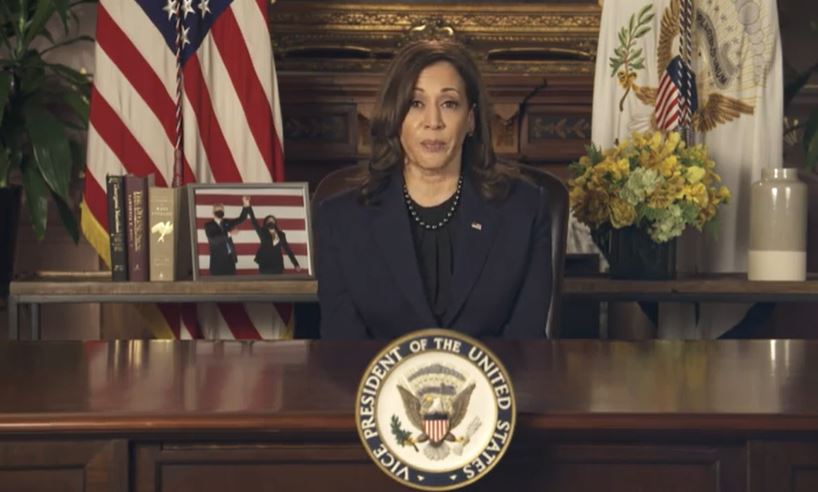
On the 49th anniversary of Roe v. Wade, President Joe Biden and Vice President Kamala Harris issued a statement asserting their commitment to protecting women’s reproductive freedom:
The constitutional right established in Roe v. Wade nearly 50 years ago today is under assault as never before. It is a right we believe should be codified into law, and we pledge to defend it with every tool we possess. We are deeply committed to protecting access to health care, including reproductive health care—and to ensuring that this country is not pushed backwards on women’s equality.
In recent years, we have seen efforts to restrict access to reproductive health care increase at an alarming rate. In Texas, Mississippi, and many other states around the country, access to reproductive health care is under attack. These state restrictions constrain the freedom of all women. And they are particularly devastating for those who have fewer options and fewer resources, such as those in underserved communities, including communities of color and many in rural areas.
The Biden-Harris Administration strongly supports efforts to codify Roe, and we will continue to work with Congress on the Women’s Health Protection Act. All people deserve access to reproductive health care regardless of their gender, income, race, zip code, health insurance status, immigration status, disability, or sexual orientation. And the continued defense of this constitutional right is essential to our health, safety, and progress as a nation.
We must ensure that our daughters and granddaughters have the same fundamental rights that their mothers and grandmothers fought for and won on this day, 49 years ago—including leaders like the late Sarah Weddington, whose successful arguments before the Supreme Court led to the landmark Roe v. Wade decision in 1973.
At this pivotal moment, we recommit to strengthening access to critical reproductive health care, defending the constitutional right established by Roe, and protecting the freedom of all people to build their own future.
The task force includes subject matter experts from across the department. The HHS Assistant Secretary for Health and the HHS Assistant Secretary for Global Affairs will serve as the co-chairs of this coordinating body. The task force’s primary goal is to facilitate collaborative, innovative, transparent, equitable, and action-oriented approaches to protect and bolster sexual and reproductive health.
“As we commemorate the 49th anniversary of Roe v. Wade, we recommit to protecting and strengthening access to reproductive health care, including the right to safe and legal abortion care that the Supreme Court has recognized for decades,” said Secretary Becerra. “Patients have the right to make decisions about their own bodies. In light of restrictive laws across the nation, HHS will evaluate the impact on patients and our communities. That’s why today, I have launched the first Intra-agency Task Force on Reproductive Healthcare Access. Once again, we are telling health care providers and patients, we have your back.”
“Across America, we must protect access to sexual and reproductive health,” said HHS Assistant Secretary for Health Admiral Rachel Levine, MD. “Establishing a new task force dedicated to this critical public health topic will advance policies that improve reproductive health care access within Federal programs and services, eliminate health disparities, and expand access to culturally competent health care services for underserved communities, including people of color, people with disabilities, young people, LGBTQI+ people, and others.”
“Advancing sexual and reproductive health and rights is central to our core global health goals, including our focus on addressing health inequities and expanding access to universal health coverage,” said HHS Assistant Secretary for Global Affairs Loyce Pace. “In order to build back better in the U.S. and around the world, we must ensure that all people can access high quality health care, including sexual and reproductive health care services.”
HHS has taken several meaningful actions under the Biden-Harris Administration to protect and bolster reproductive health, rights, and justice, including:
The Department issued a new final rule for Title X, the nation’s family planning program, to ensure access to equitable, affordable, client-centered, quality family planning services.
The Department announced $6.6 million through the Title X family planning program to address the demand for family planning services where restrictive laws and policies have impacted reproductive health access, or in states where there is a lack of or limited Title X access.
The Department has advanced maternal health priorities, including expanding access to postpartum Medicaid coverage, rural health care services, and implicit bias training.
The Department has issued guidance on both nondiscrimination requirements of the Church Amendments protecting health care providers through its Office for Civil Rights and providers’ legal obligations and protections under the Emergency Medical Treatment and Labor Act (EMTALA) through the Centers for Medicare & Medicaid Services to provide medical treatment to a pregnant patient who presents to the emergency department regardless of conflicting state laws or mandates that might seek to prevent such treatment.
By Karen Rubin, News & Photo Features, news-photos-features.com
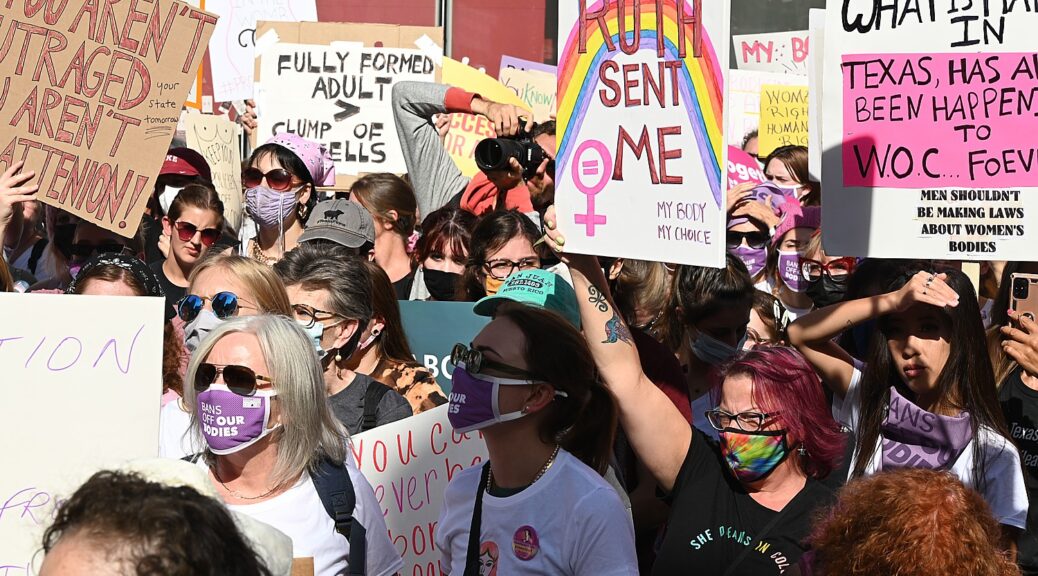
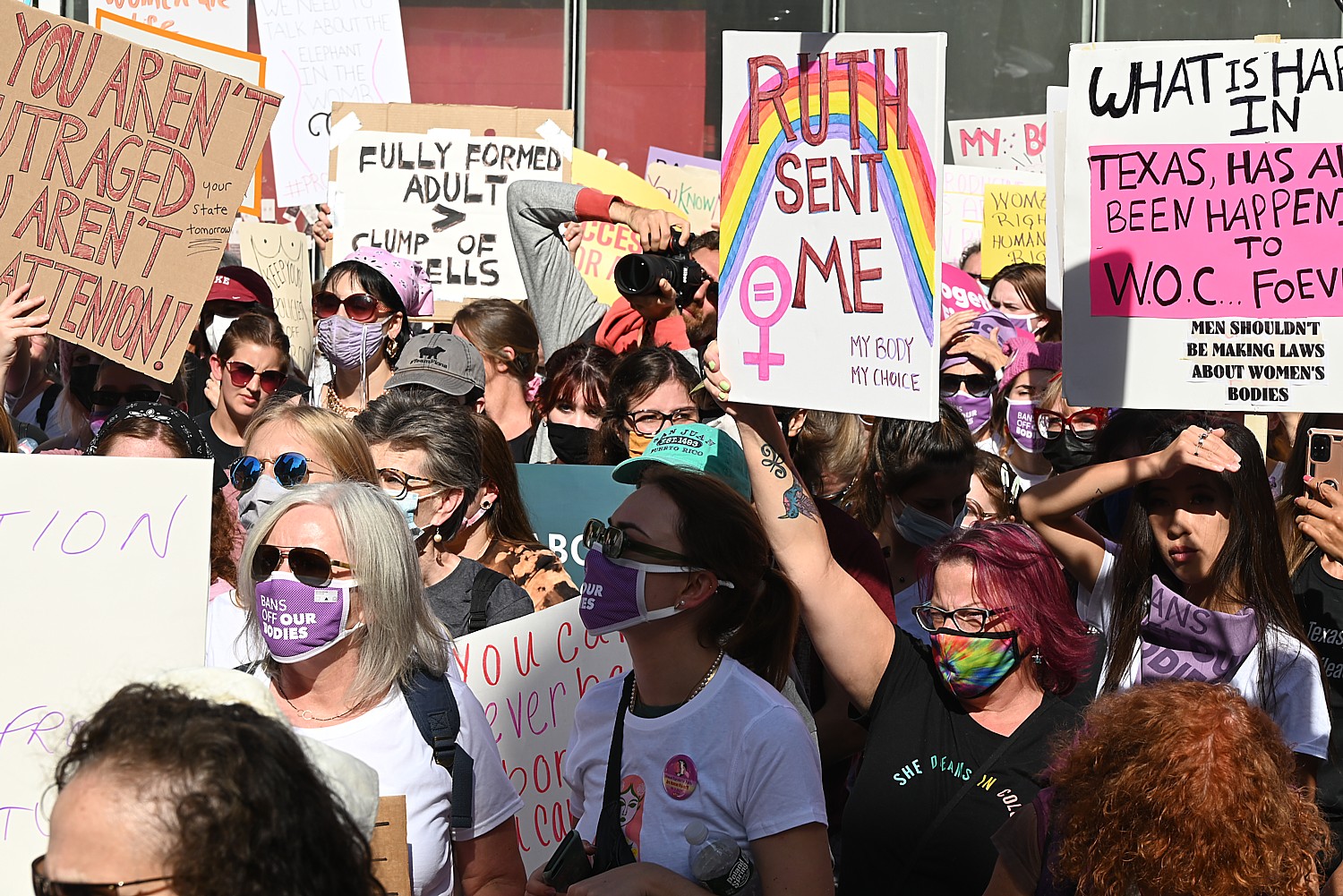
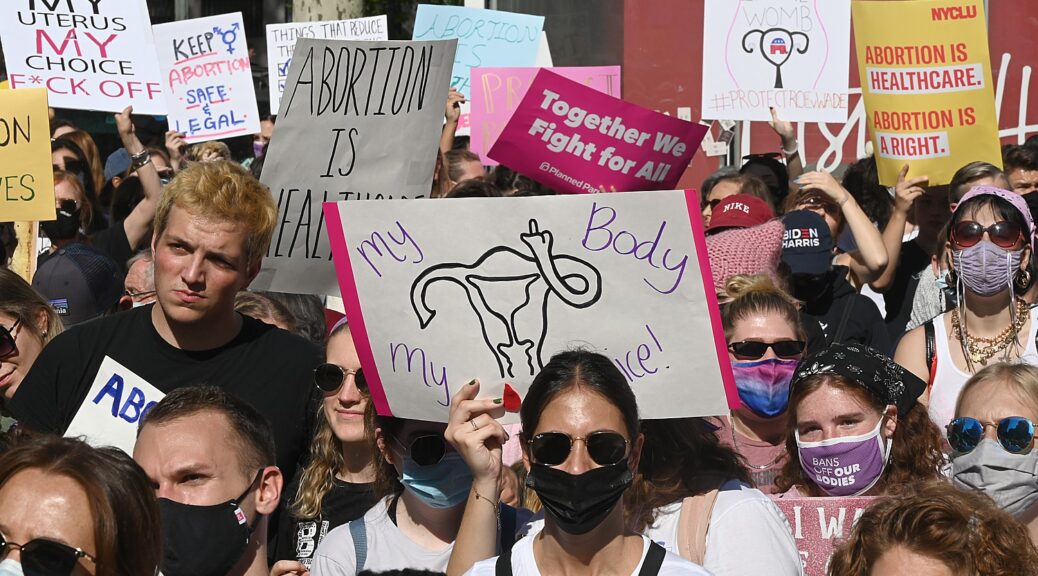
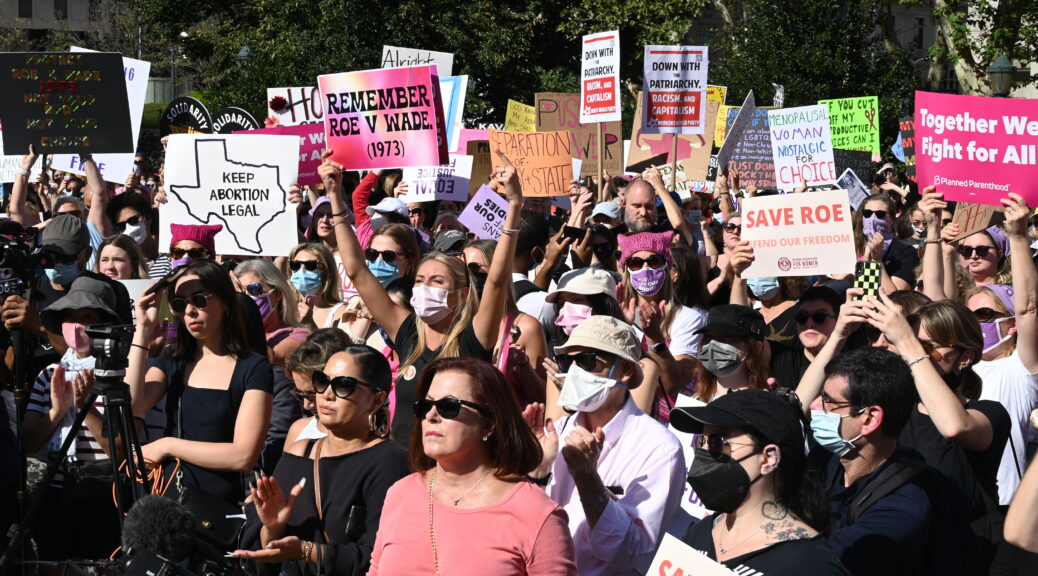
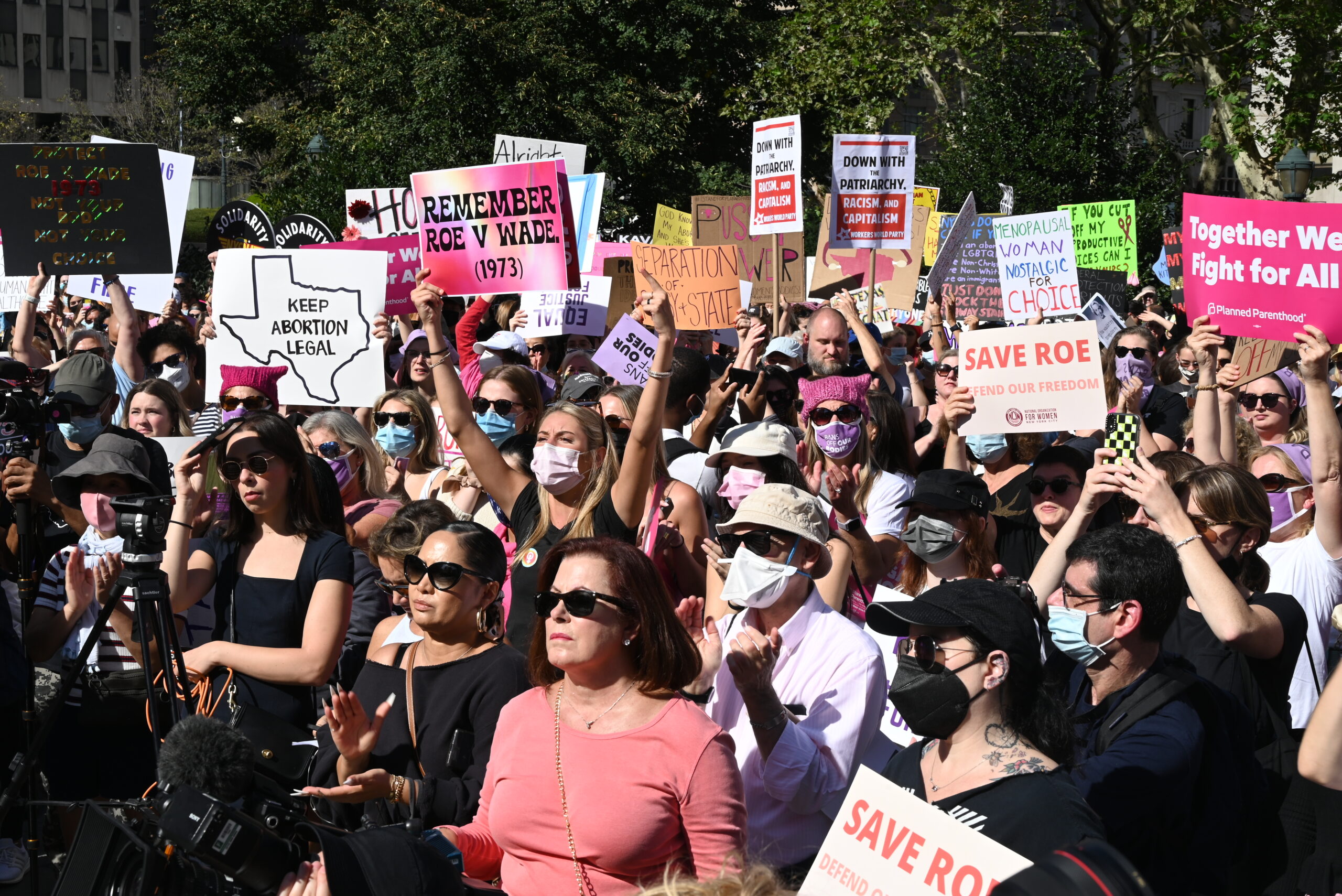
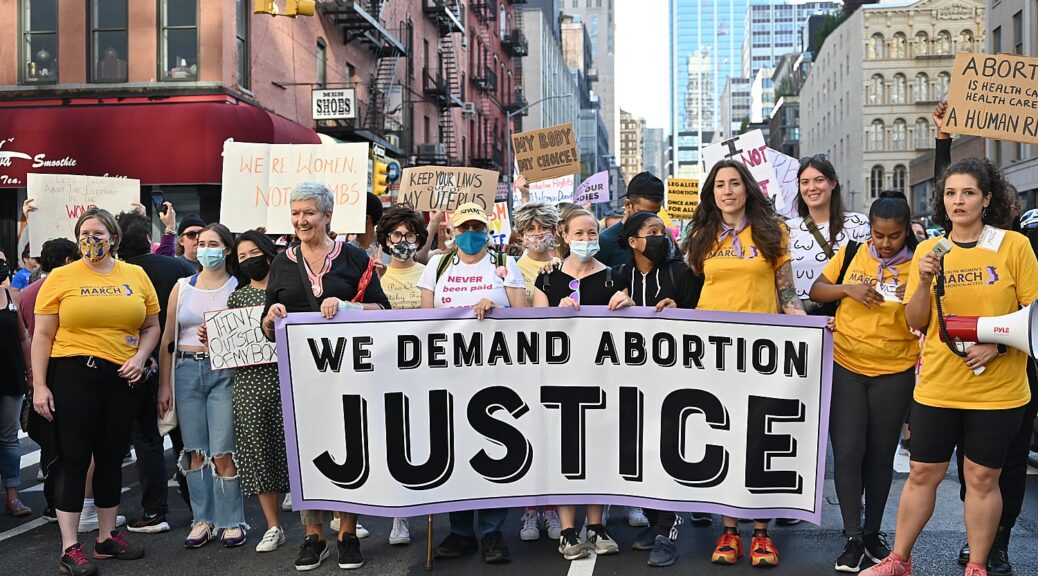
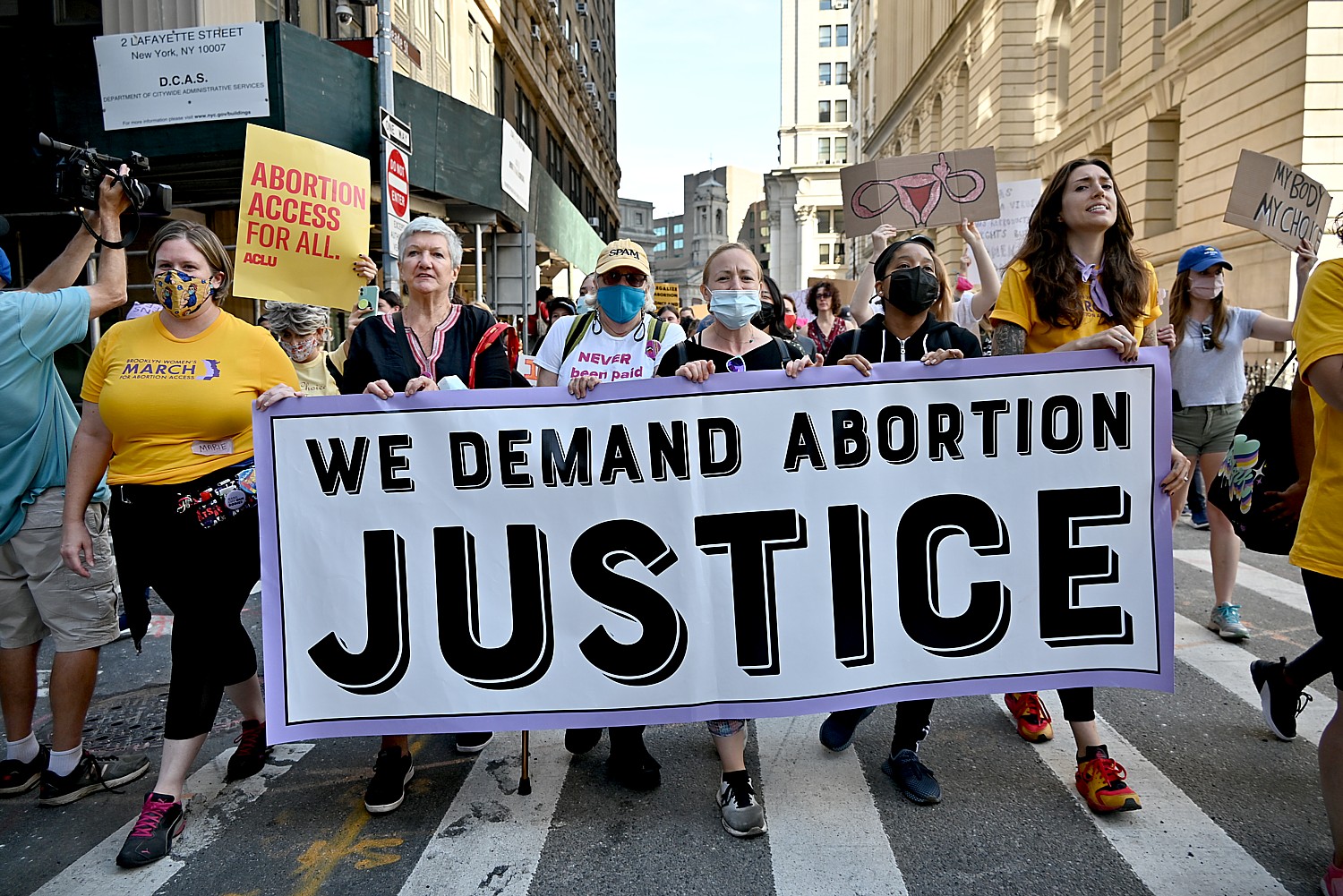
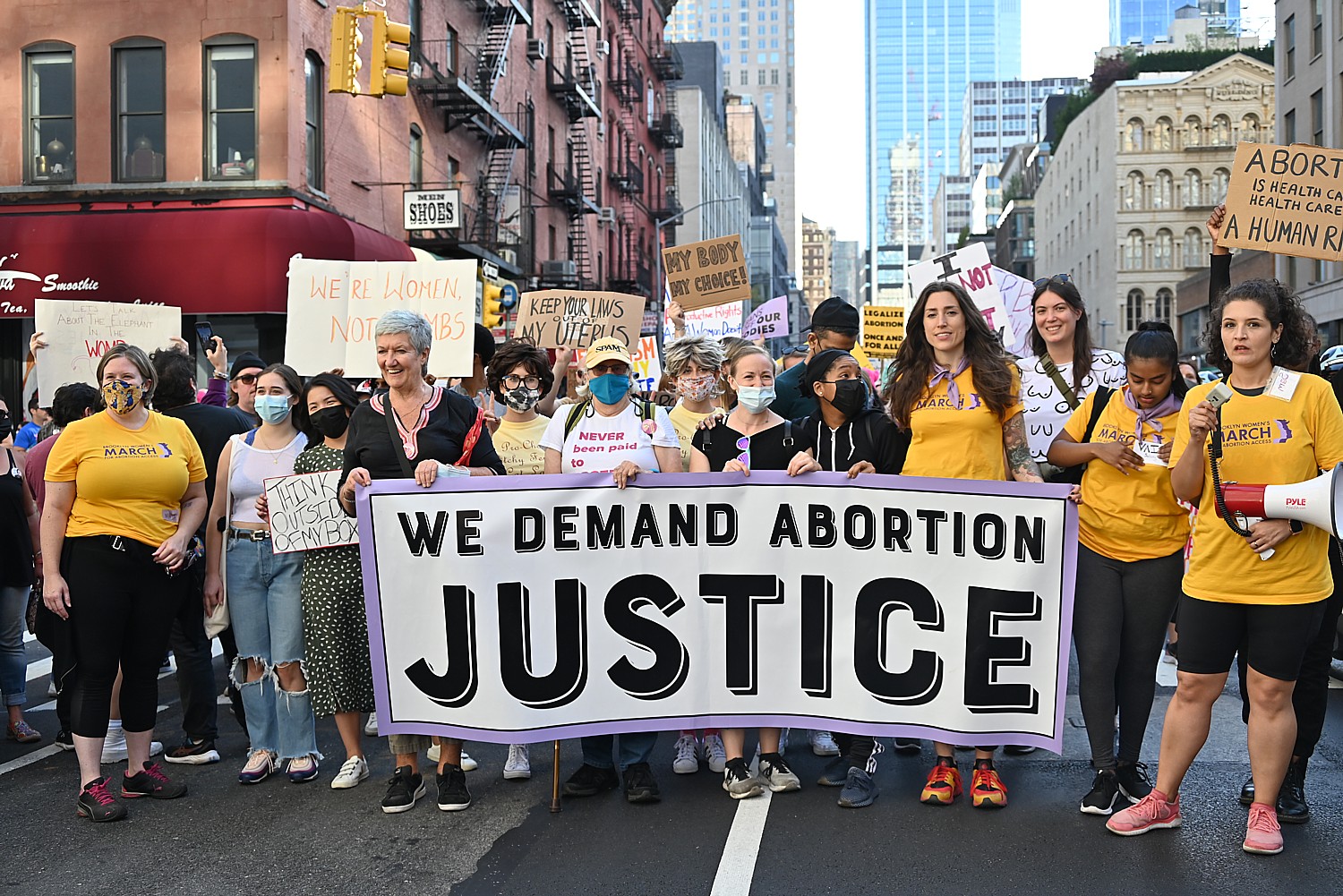
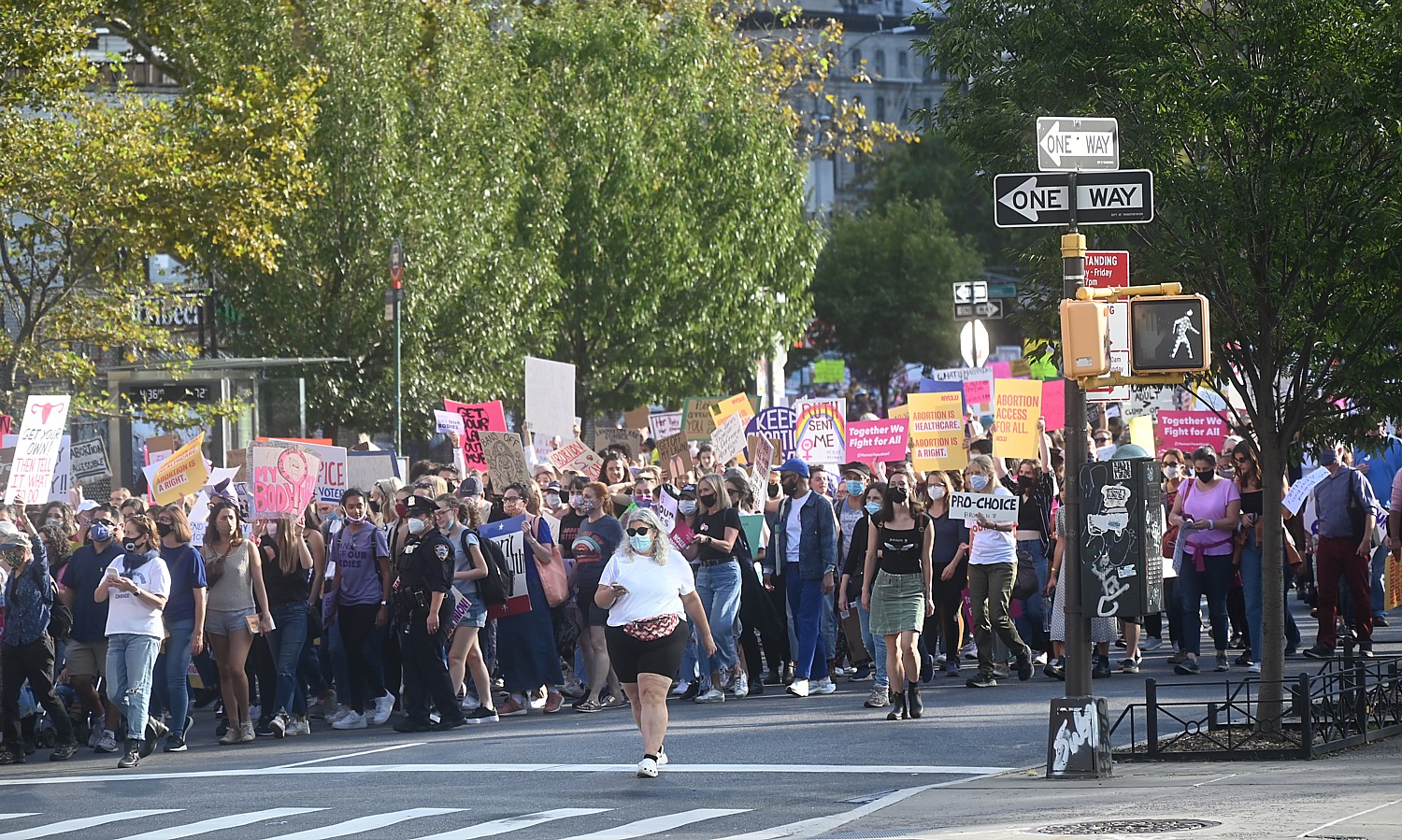
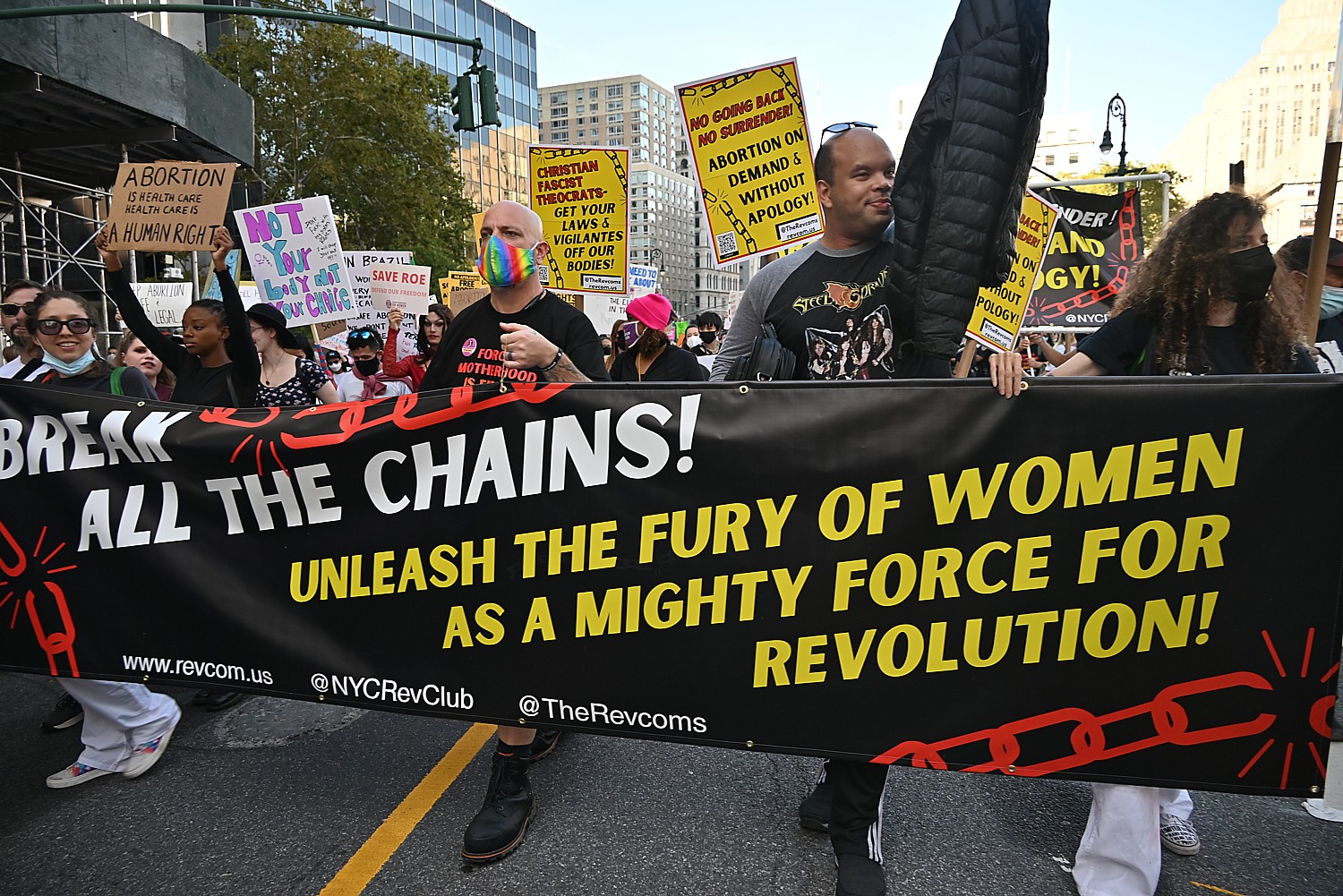
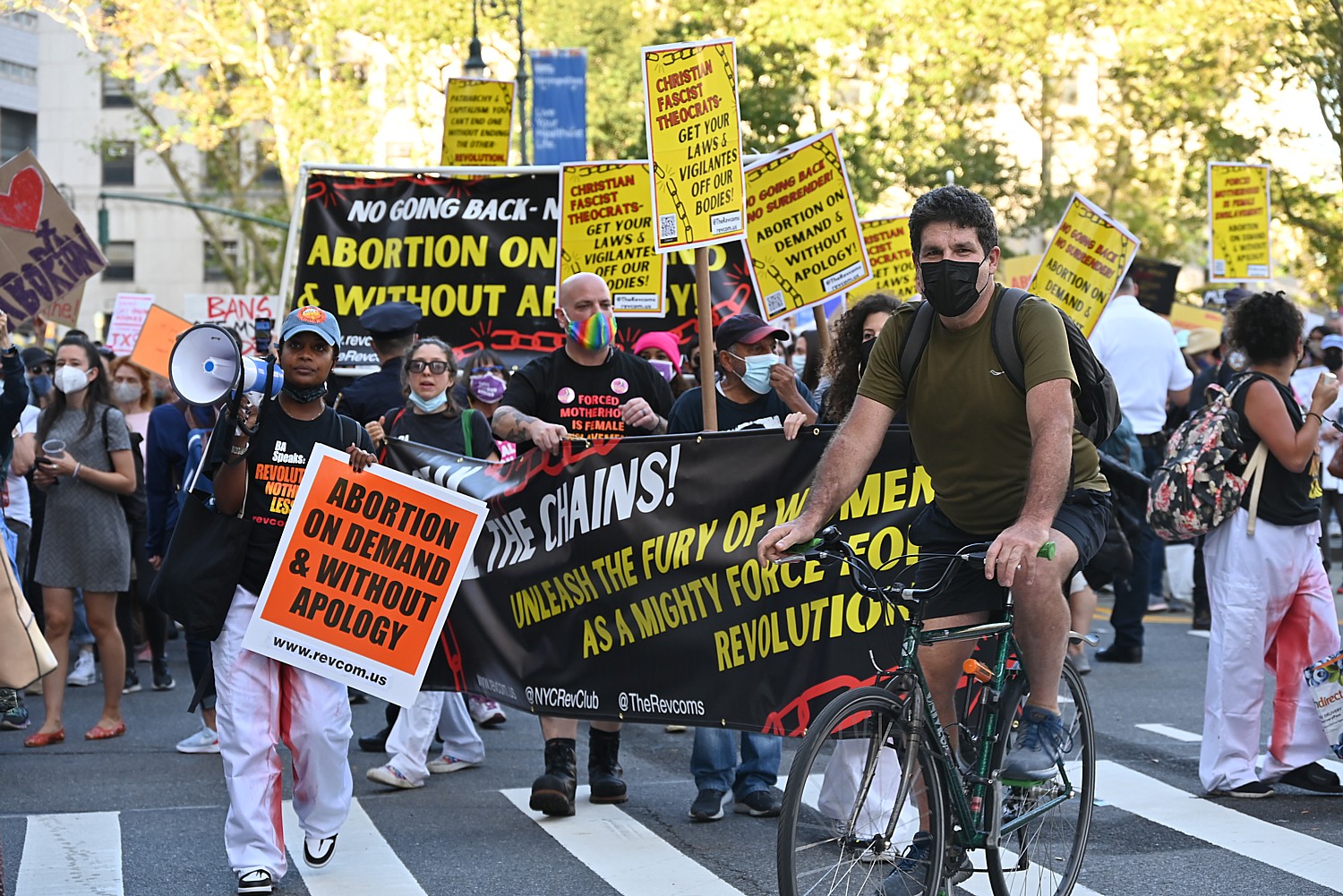
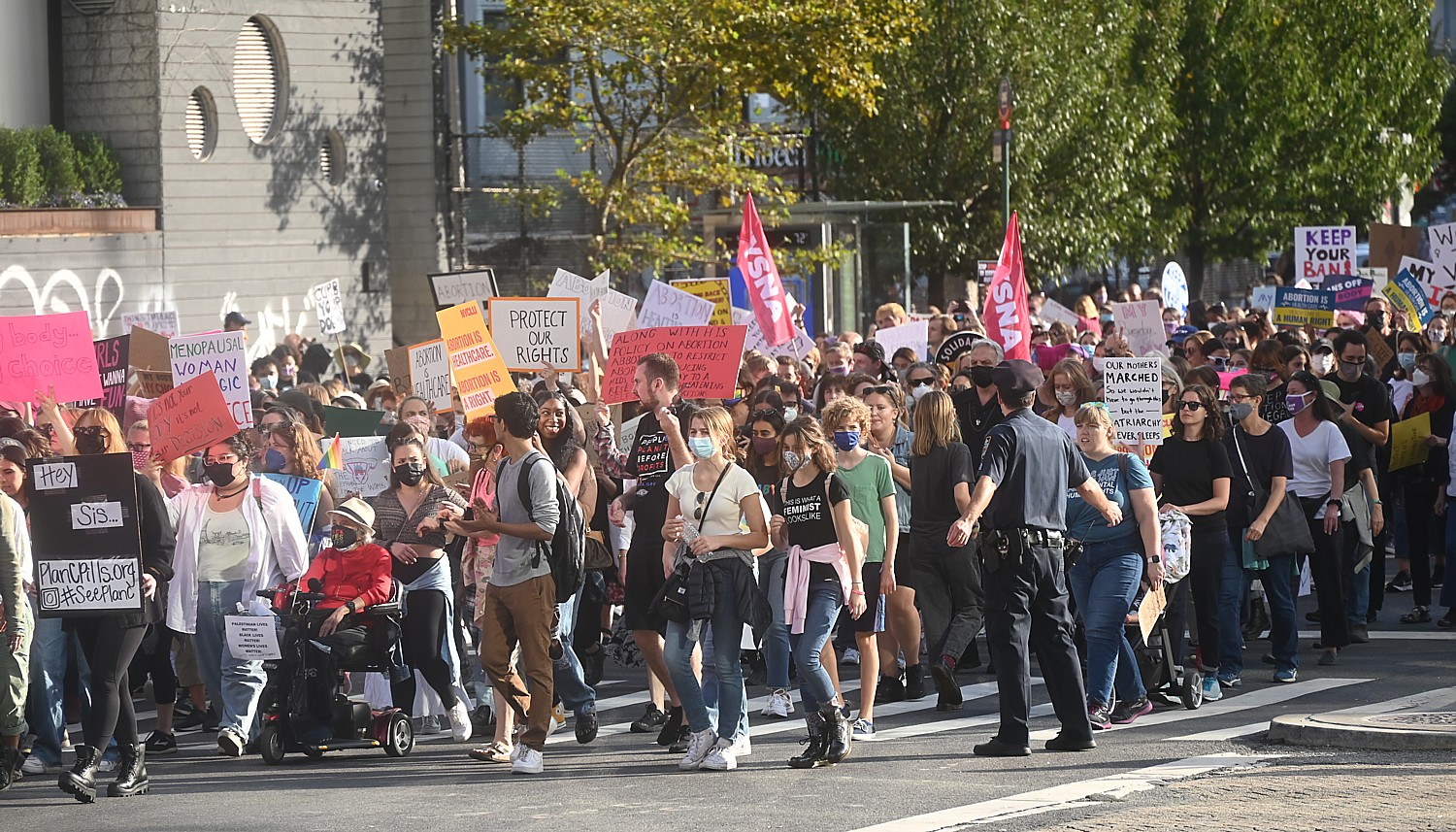
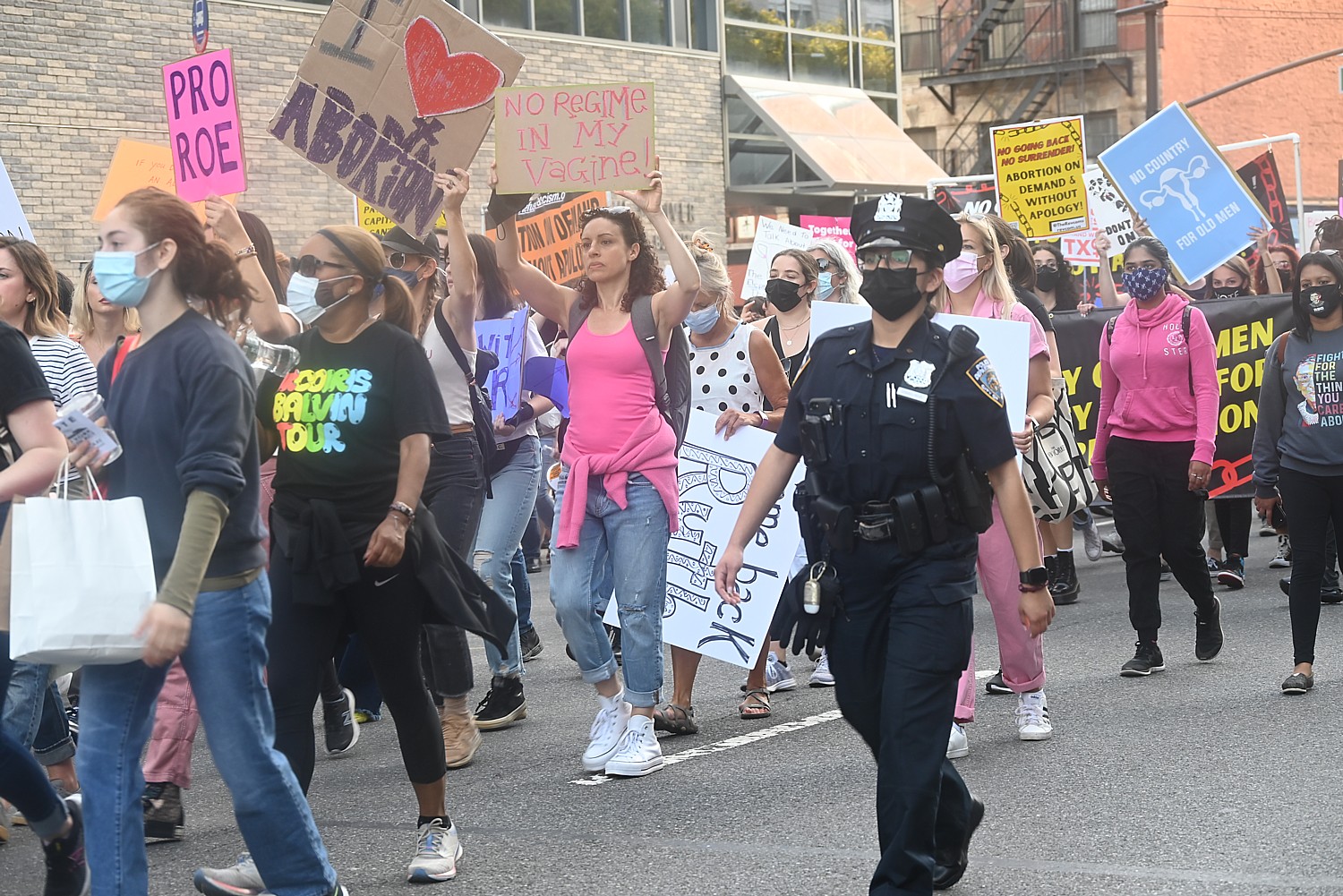
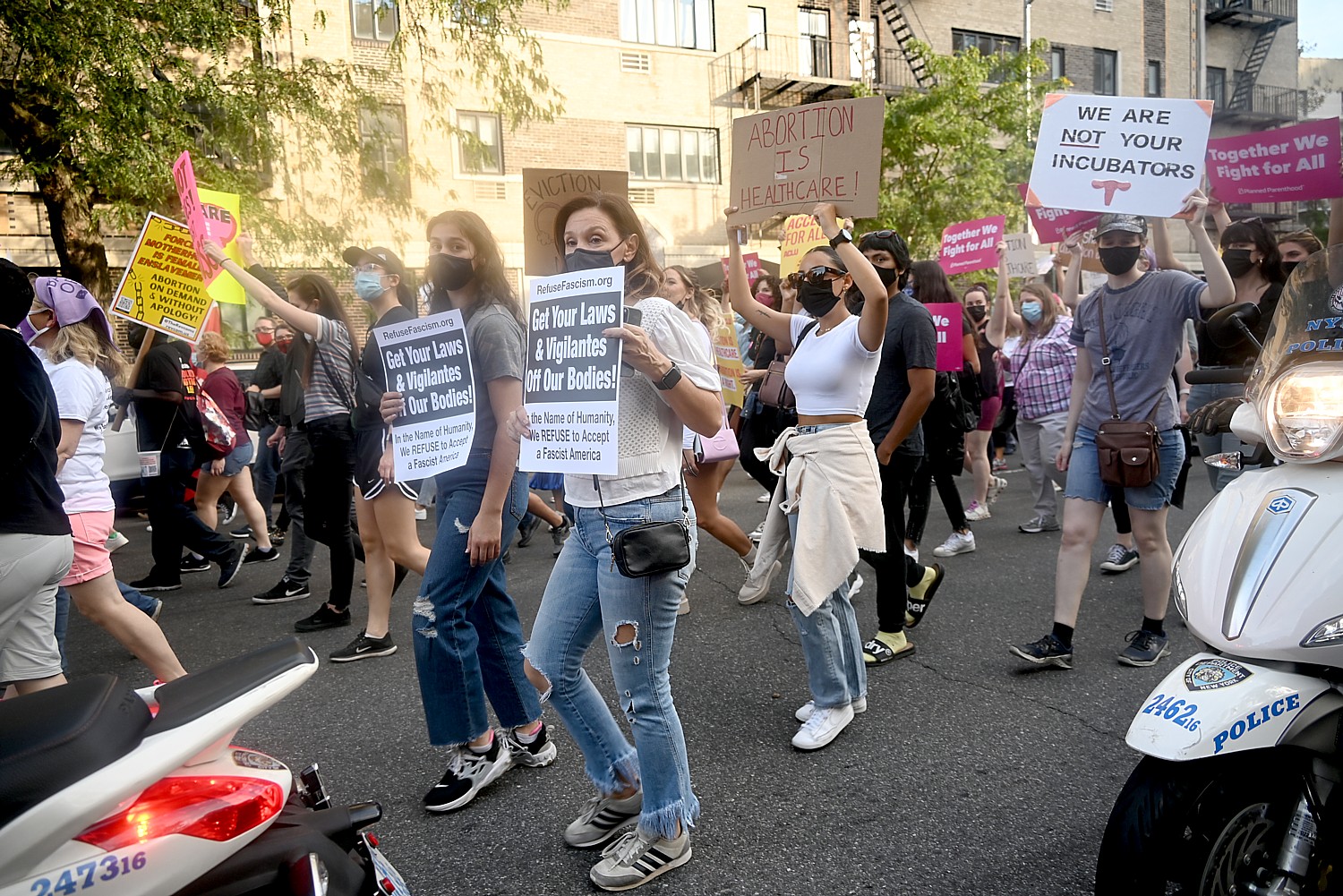
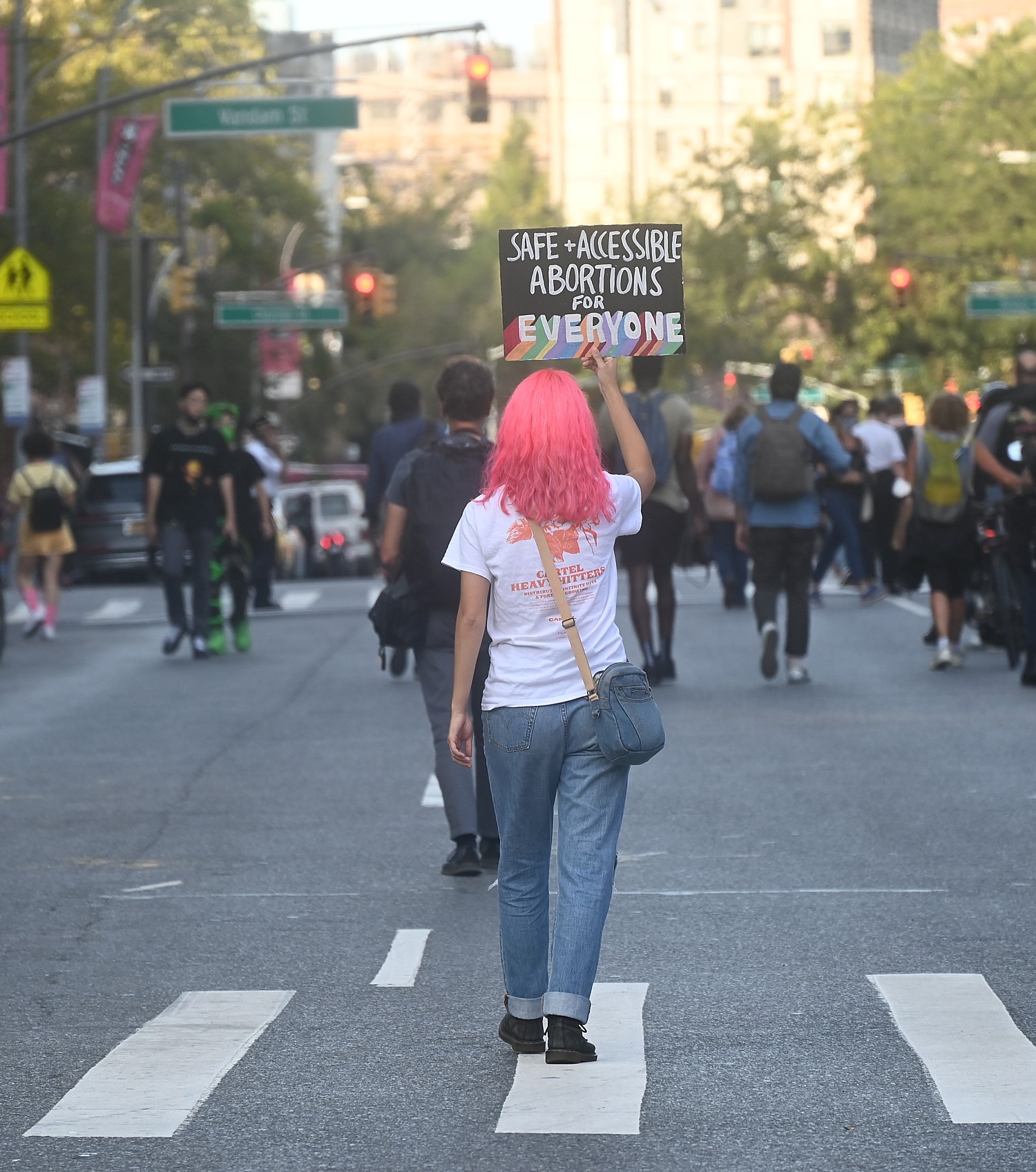
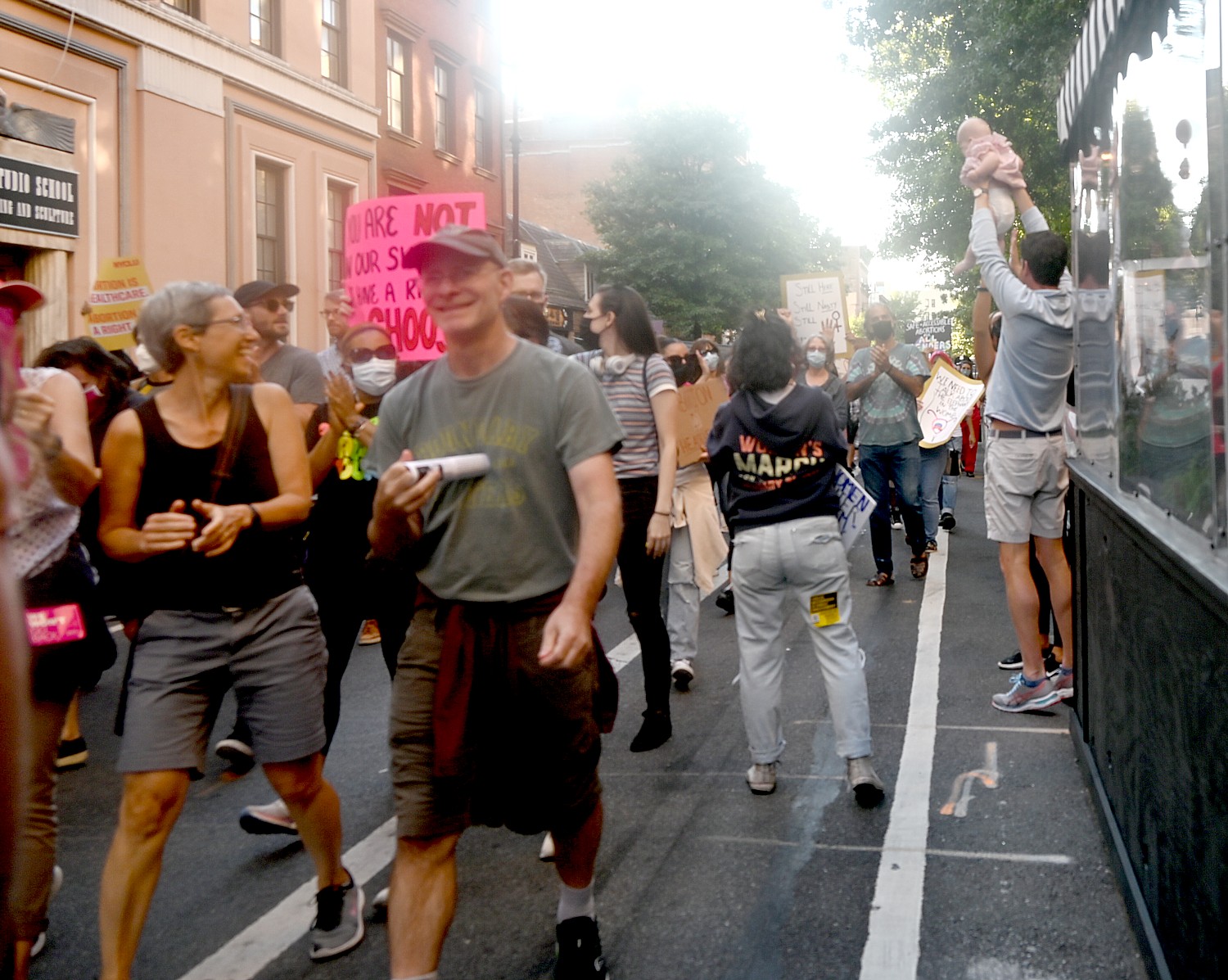
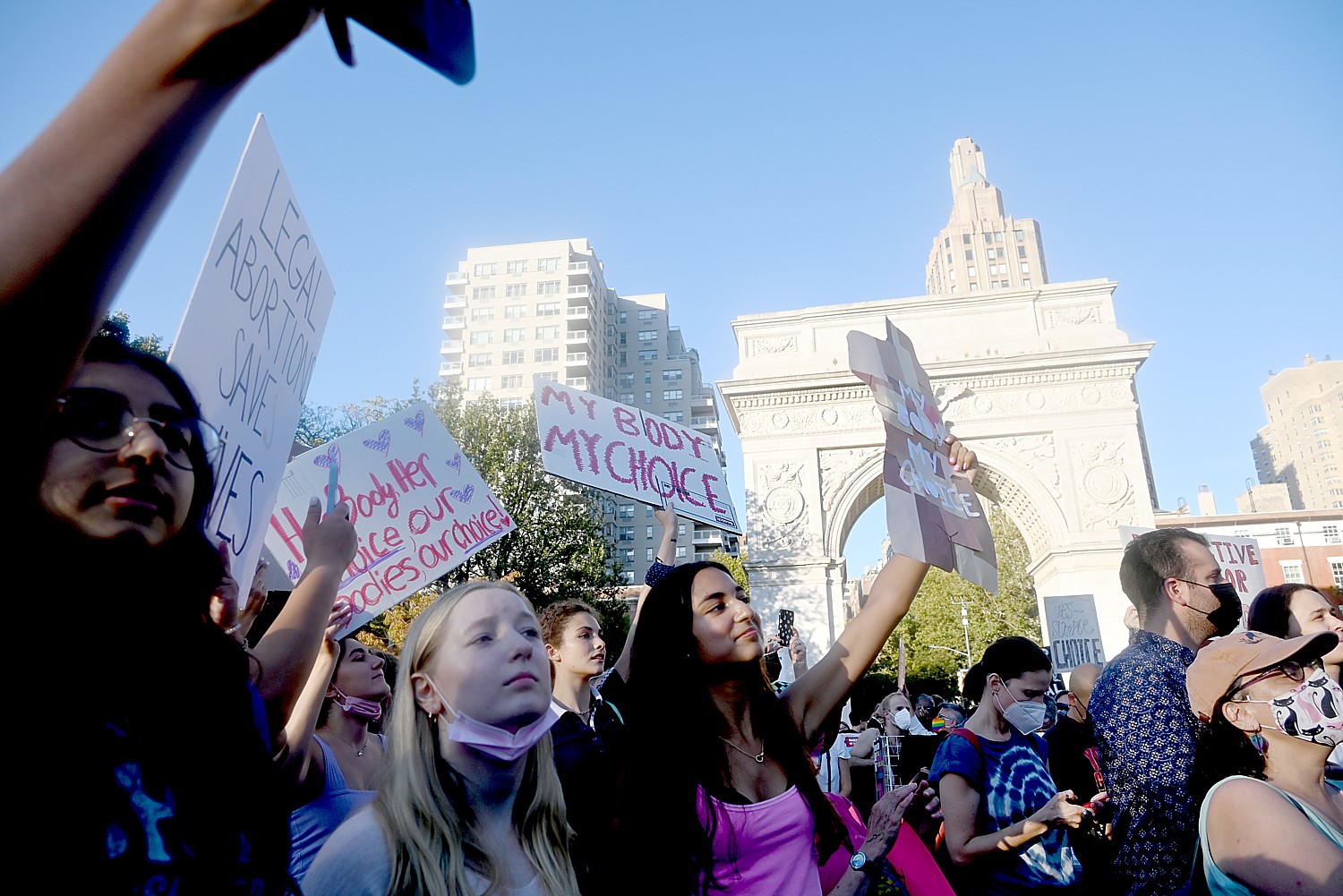
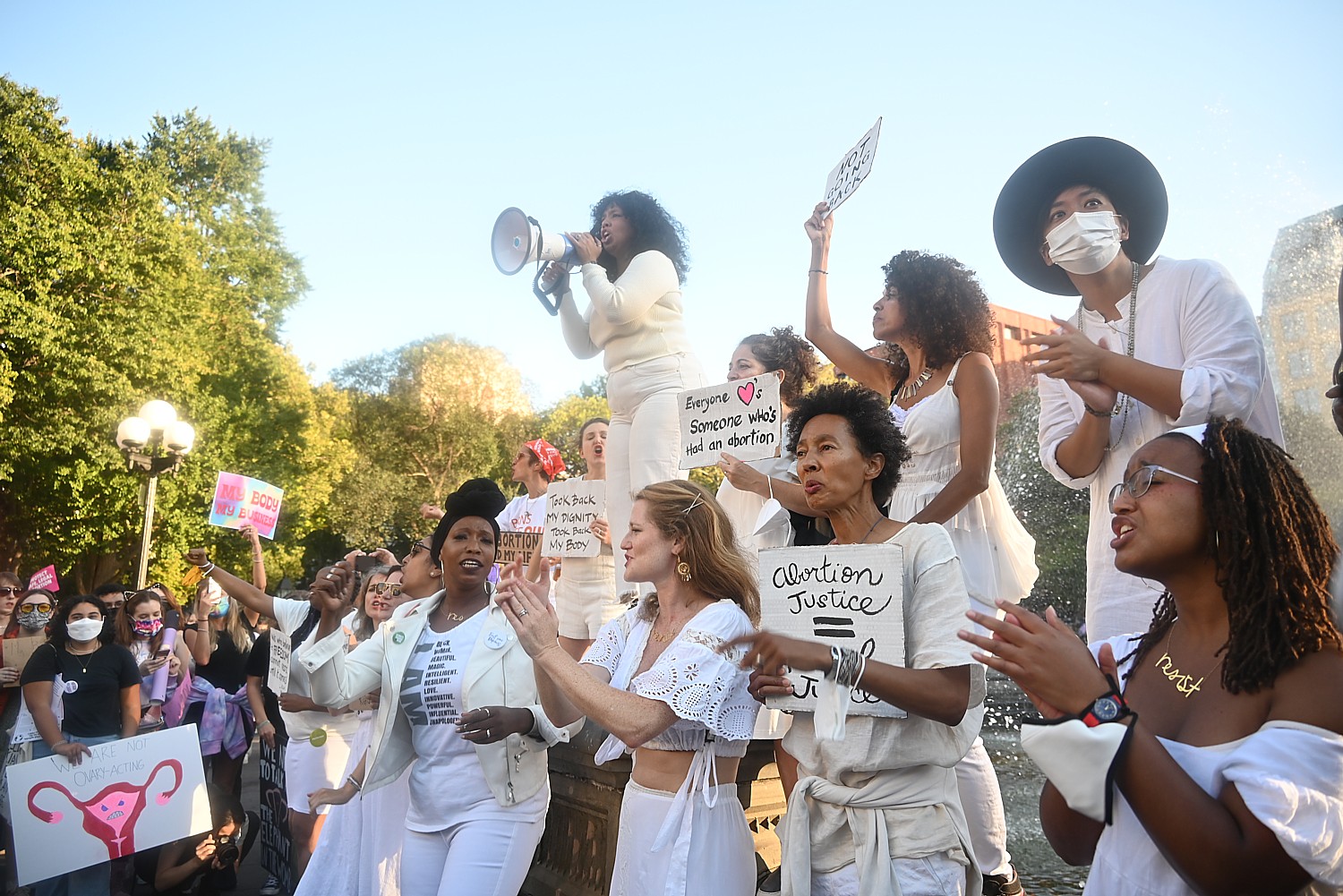
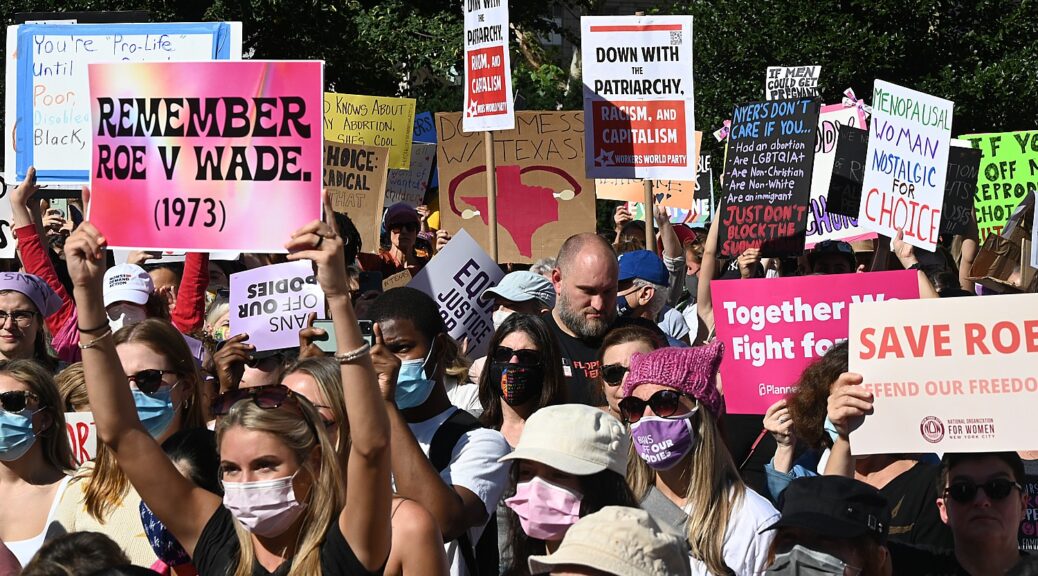
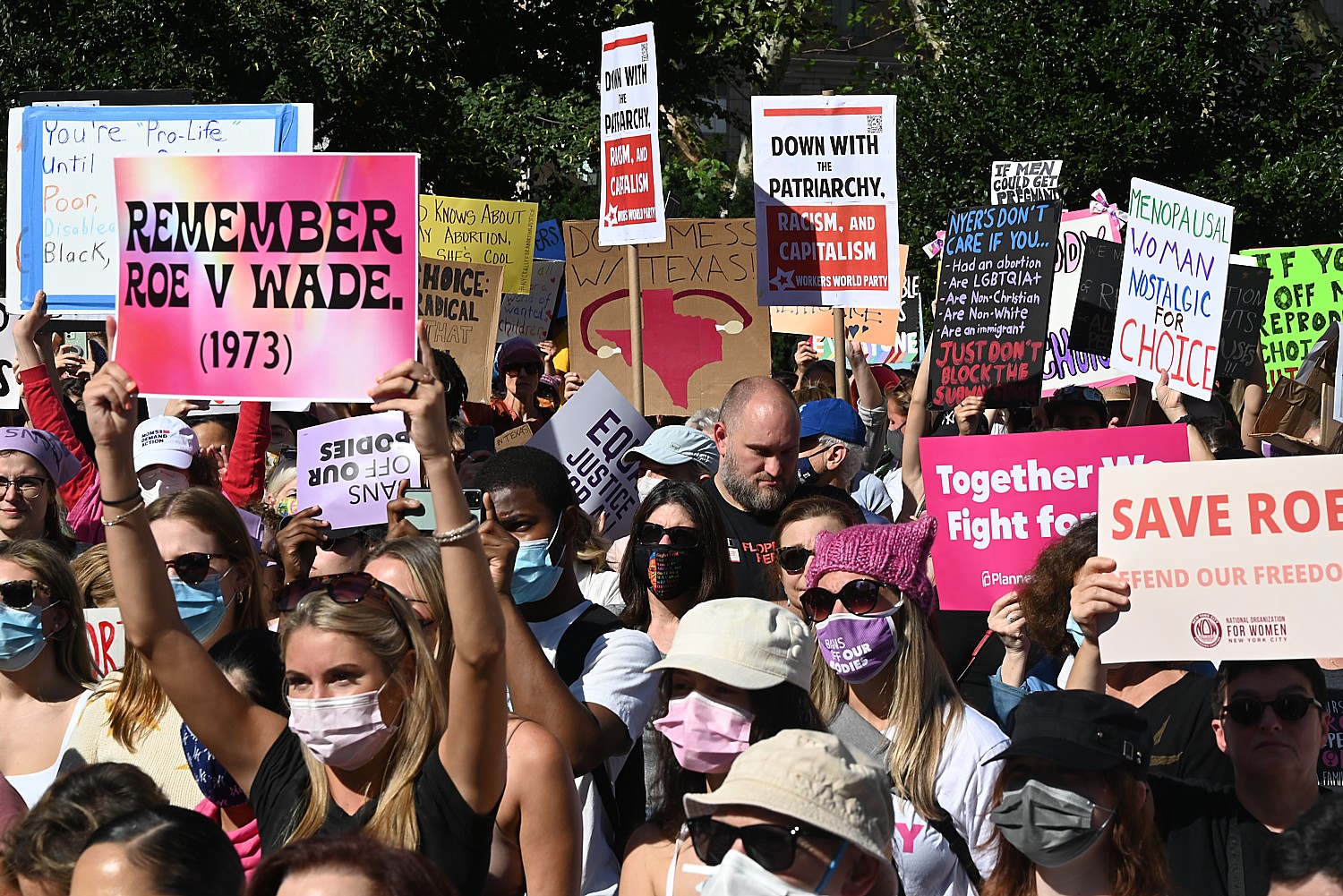
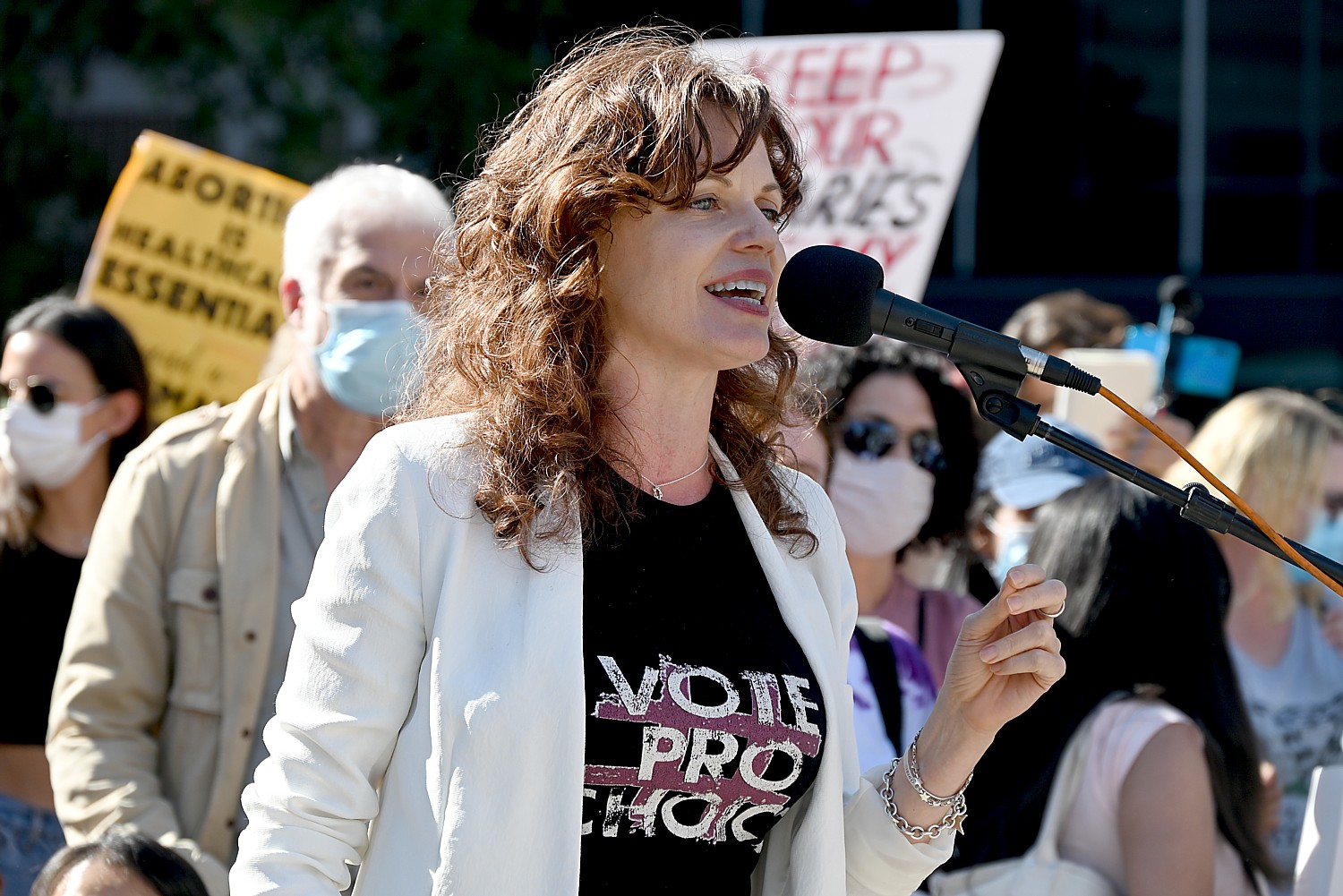
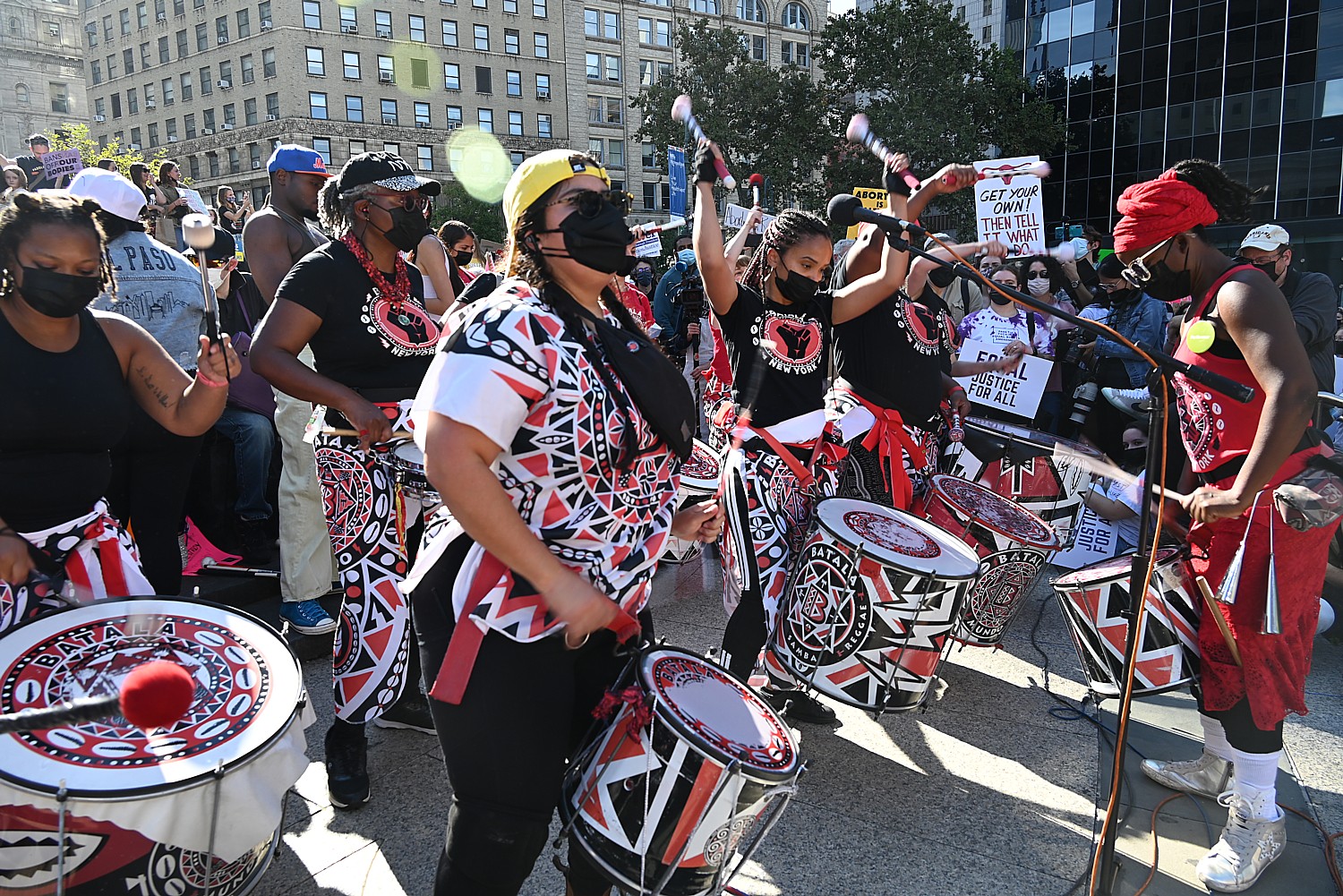
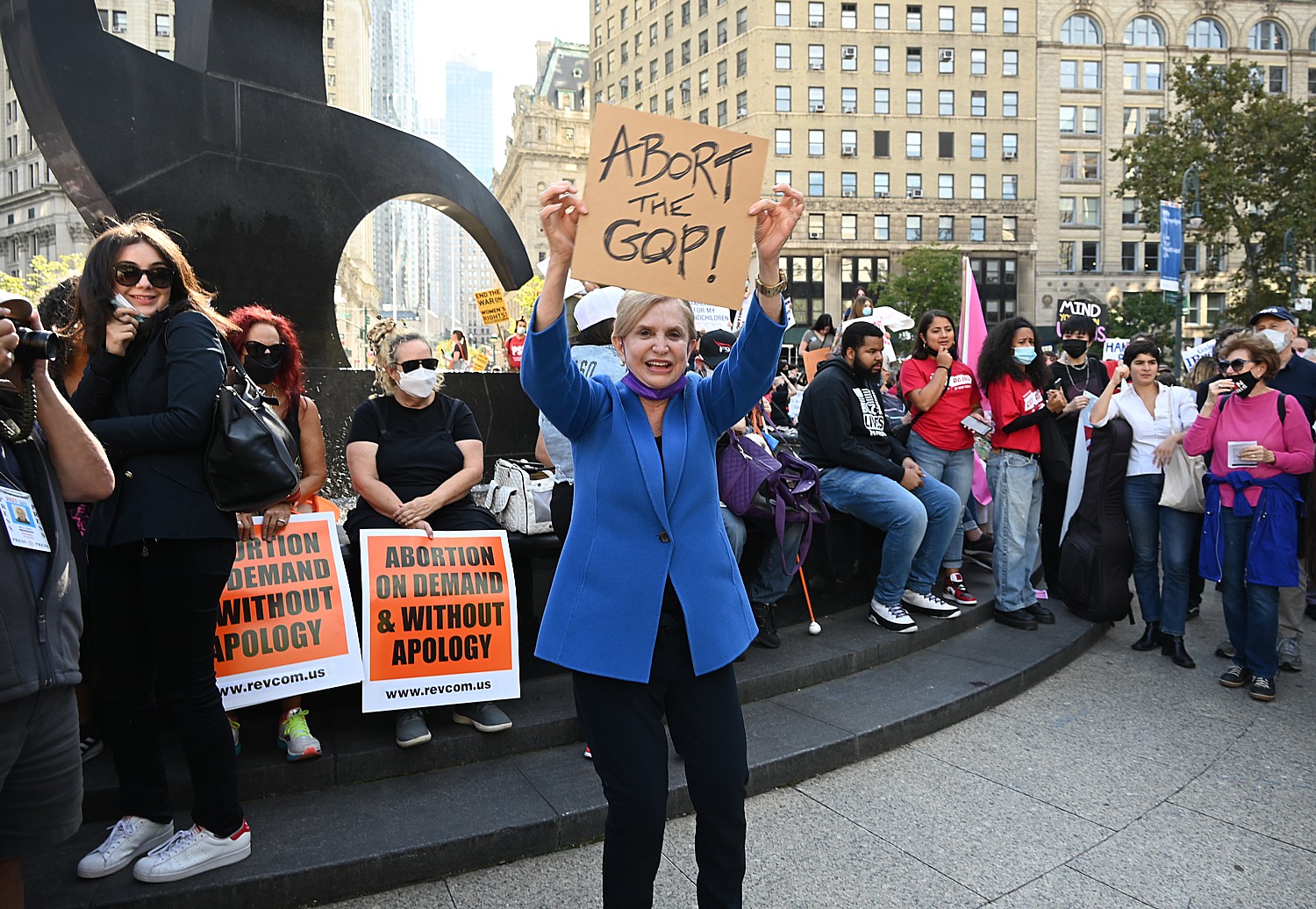
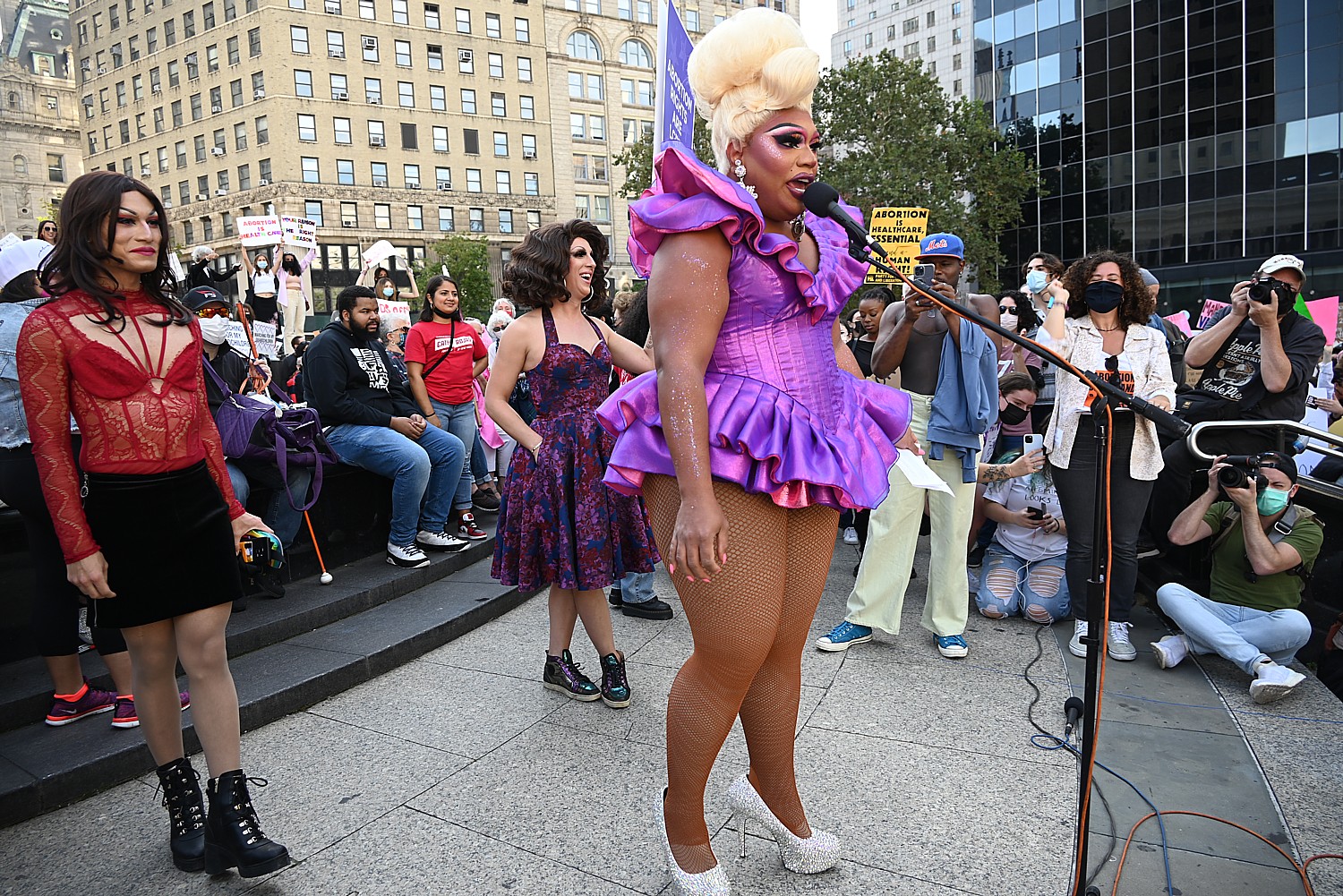
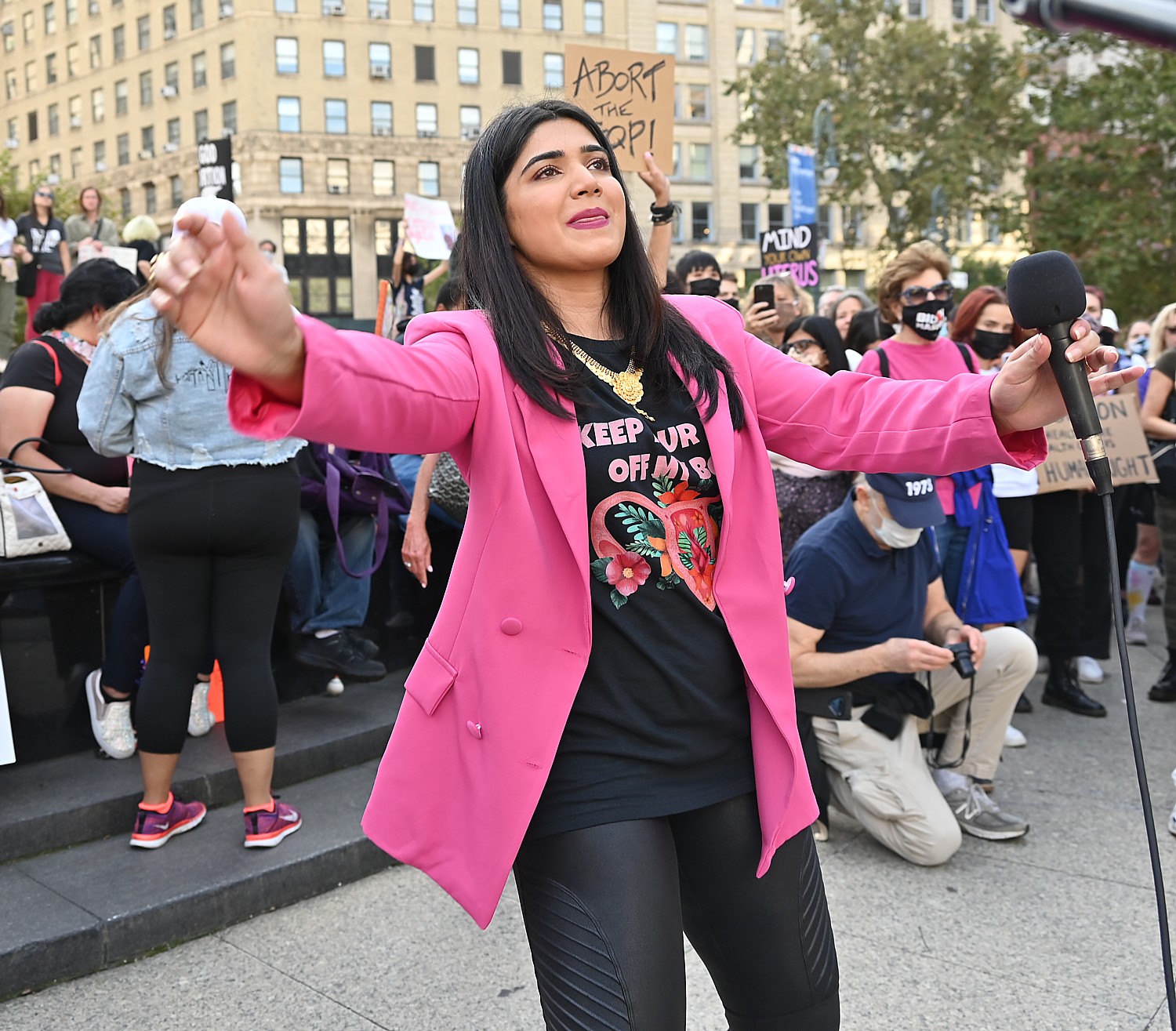
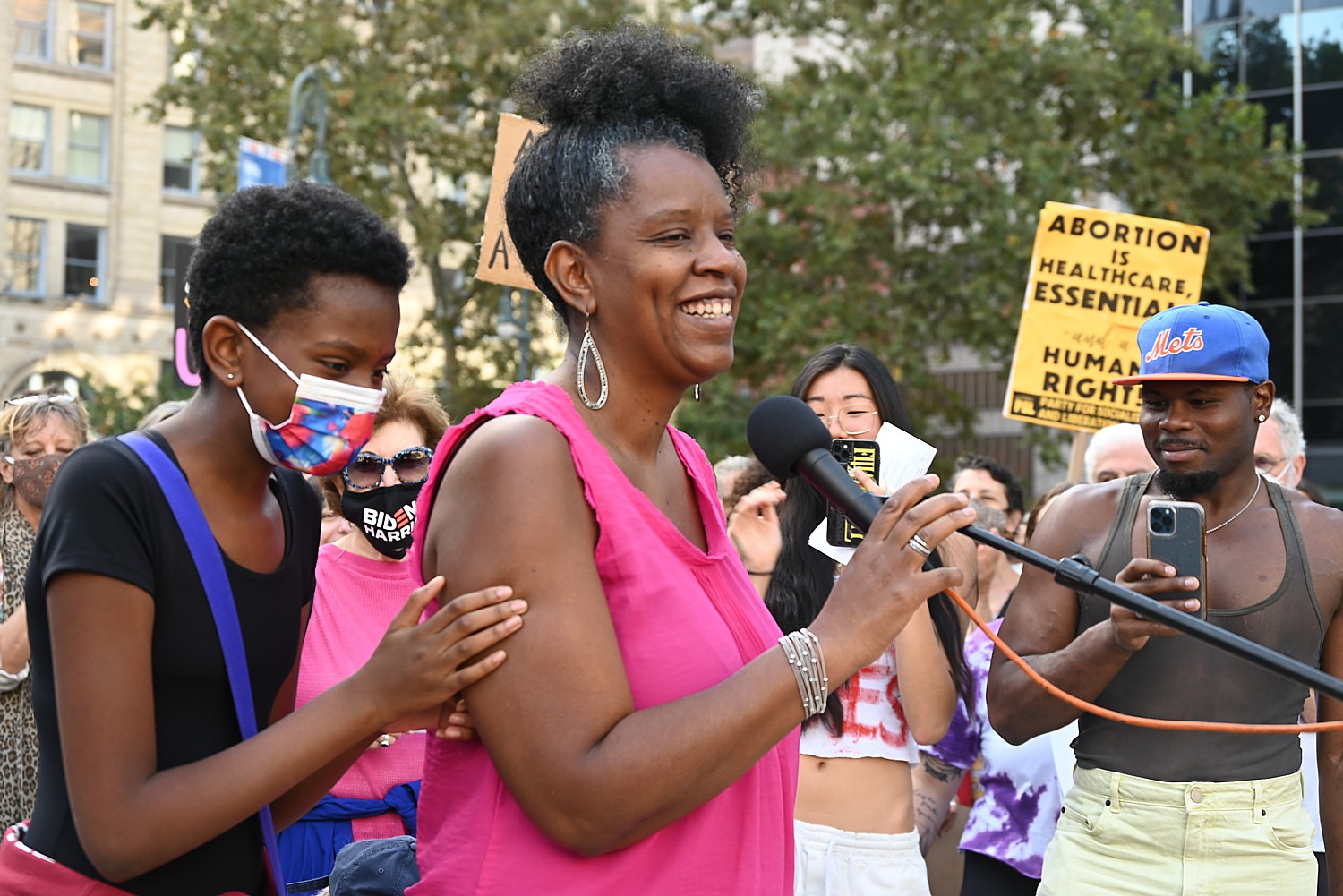
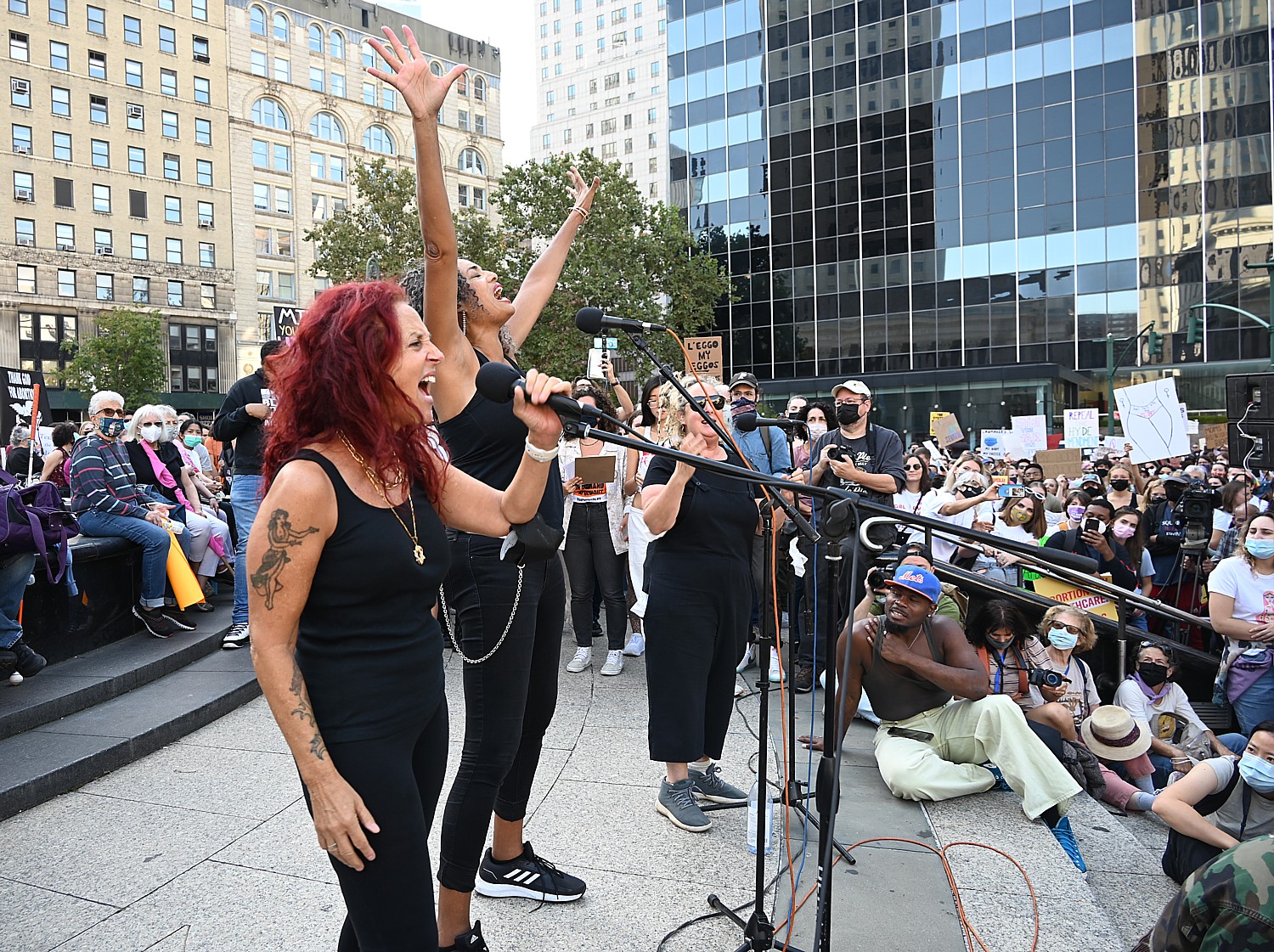
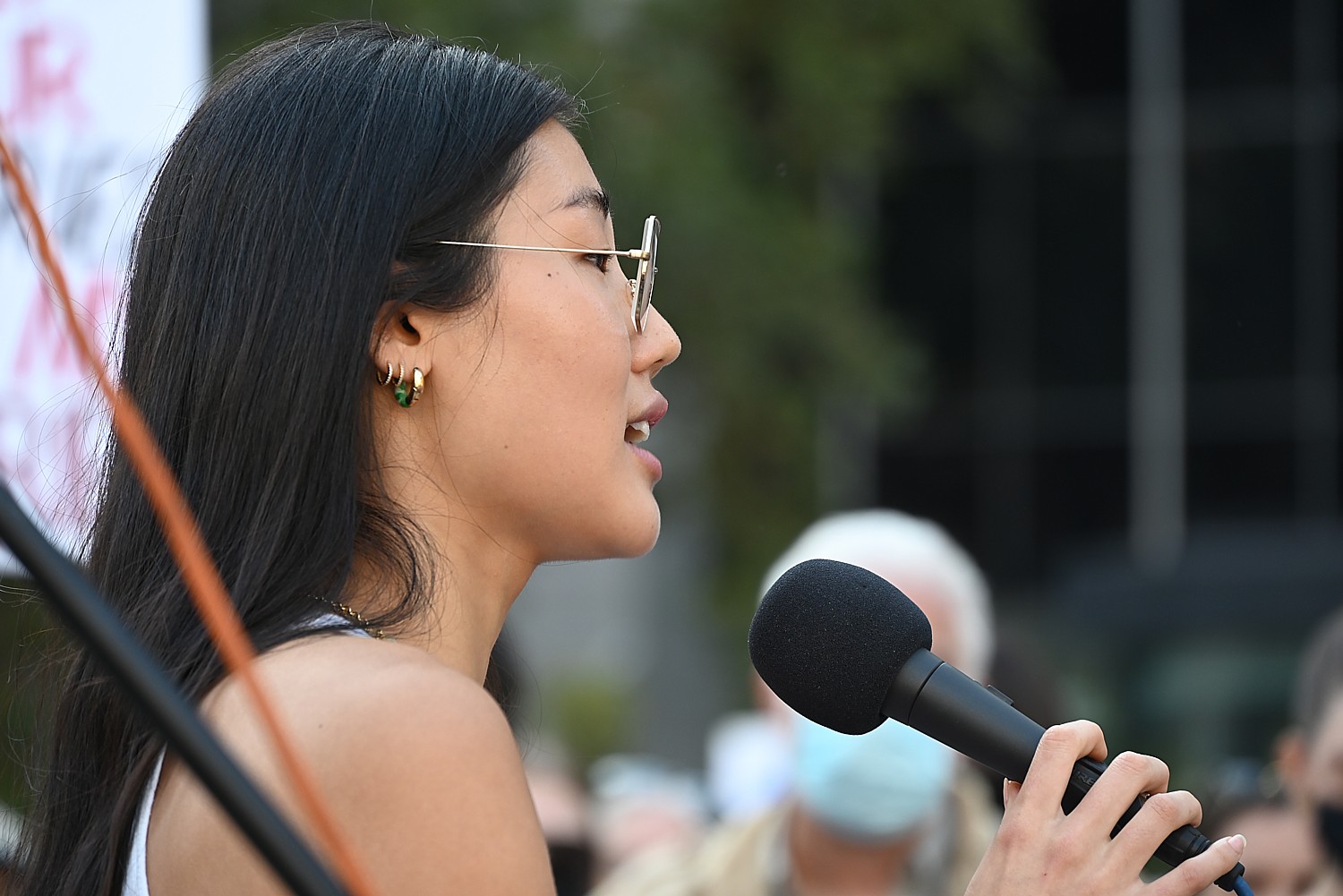
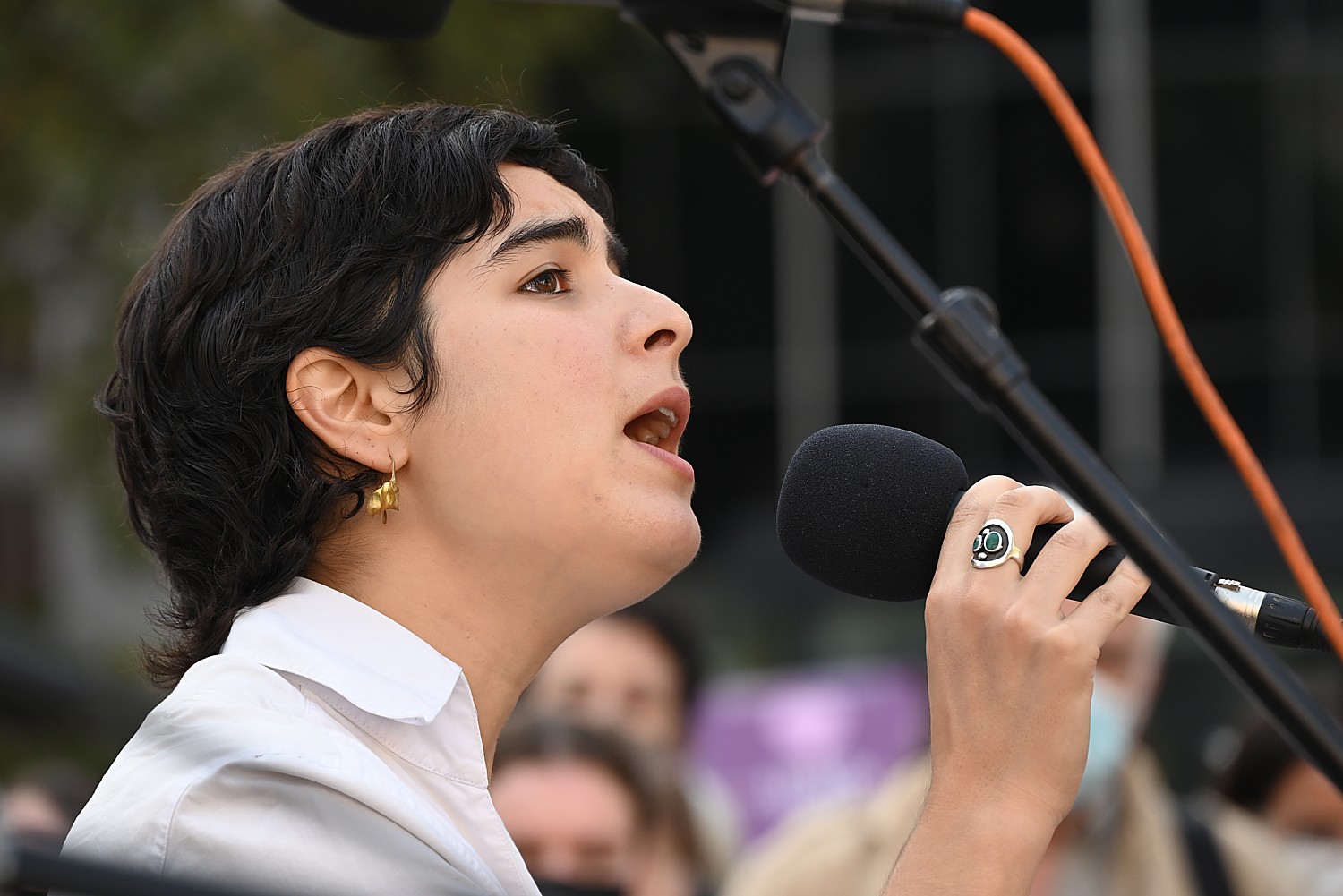
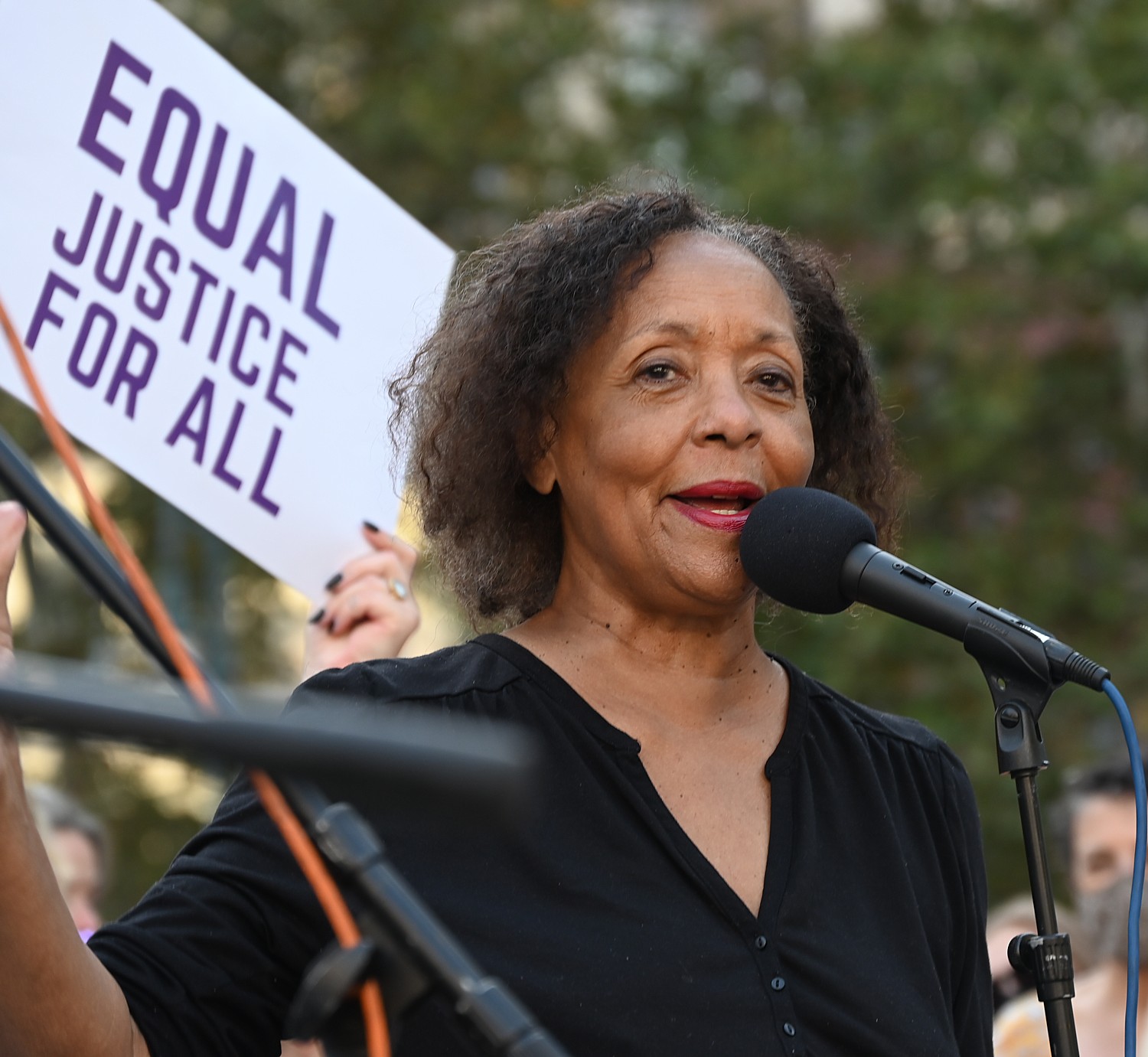
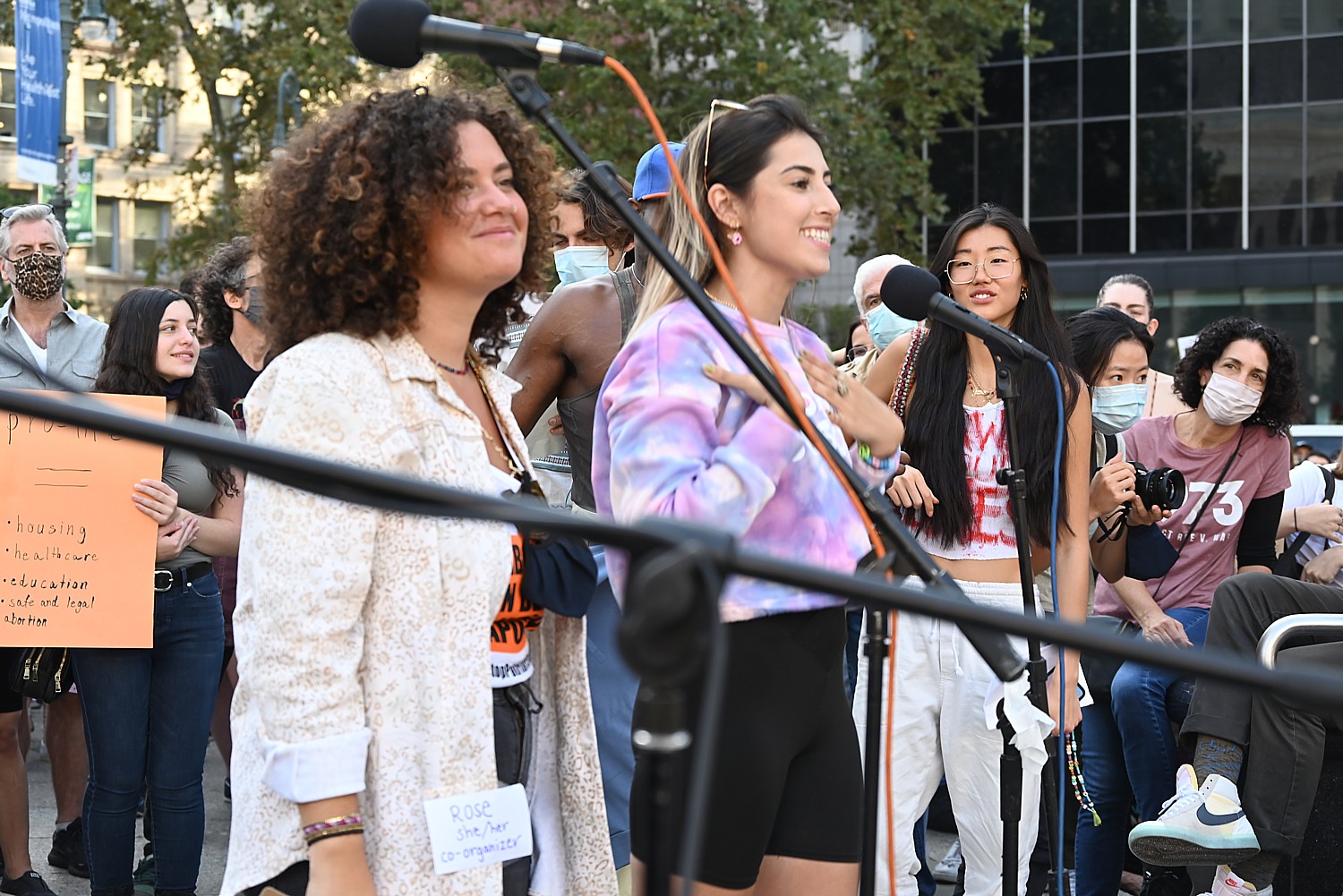
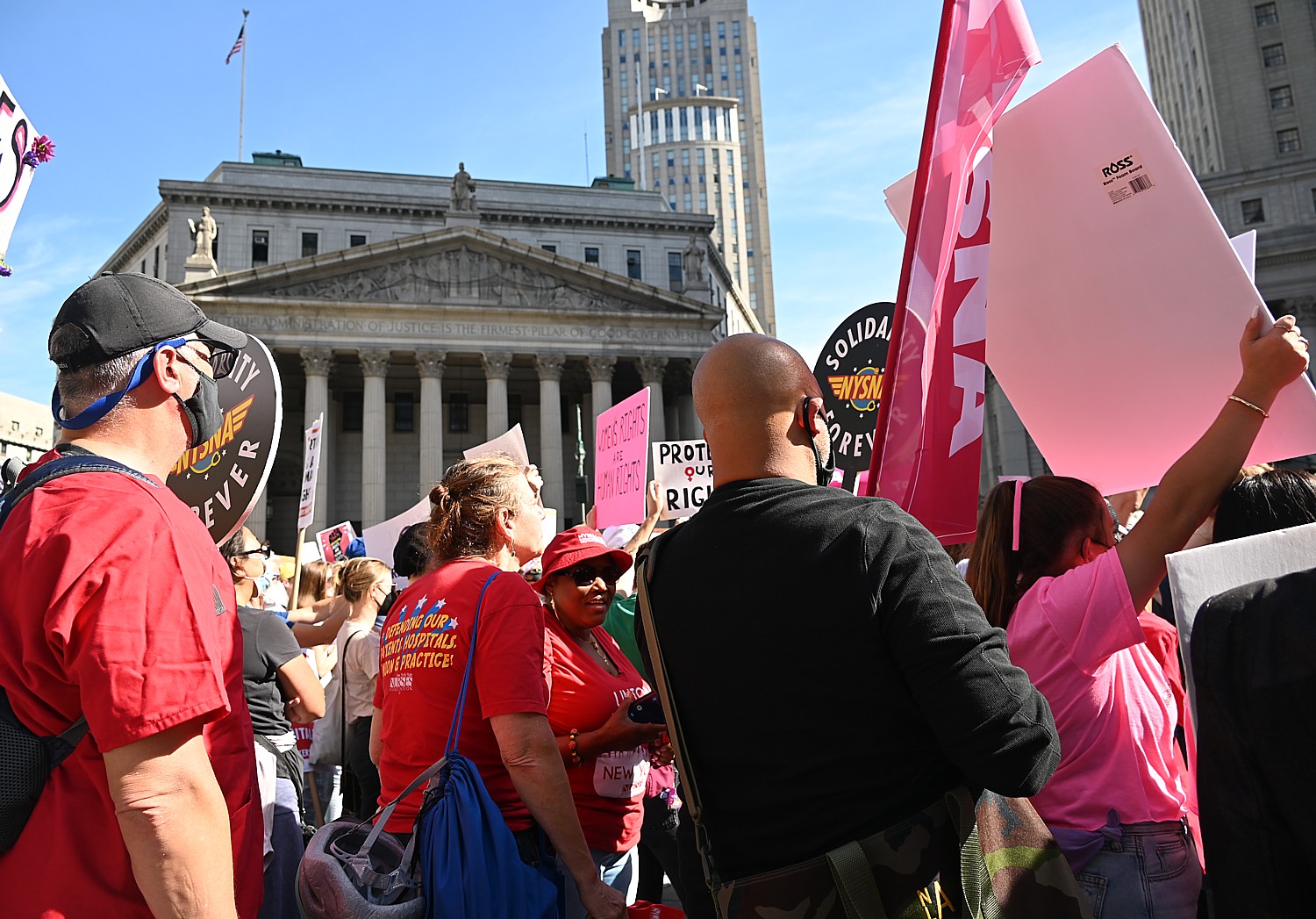
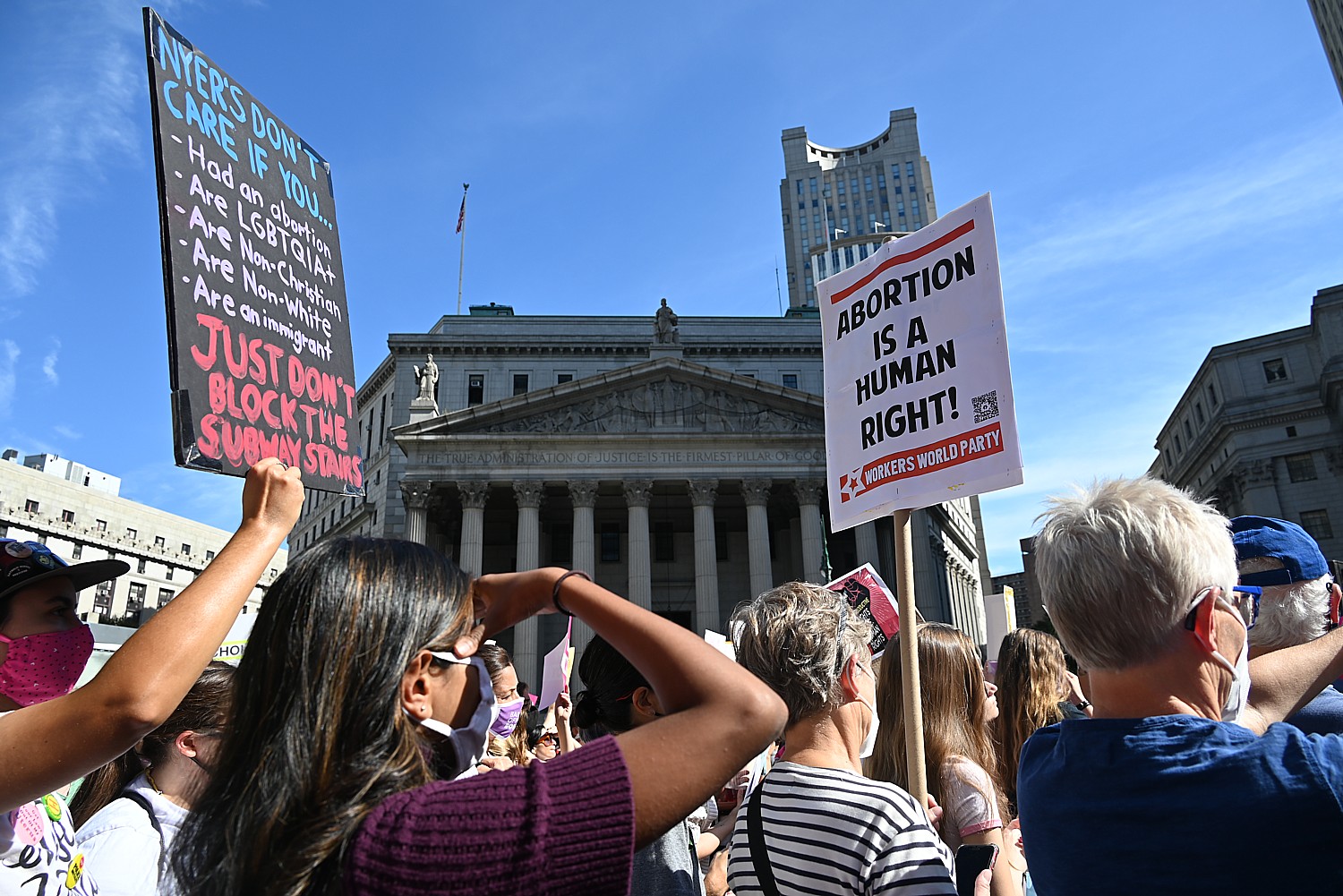
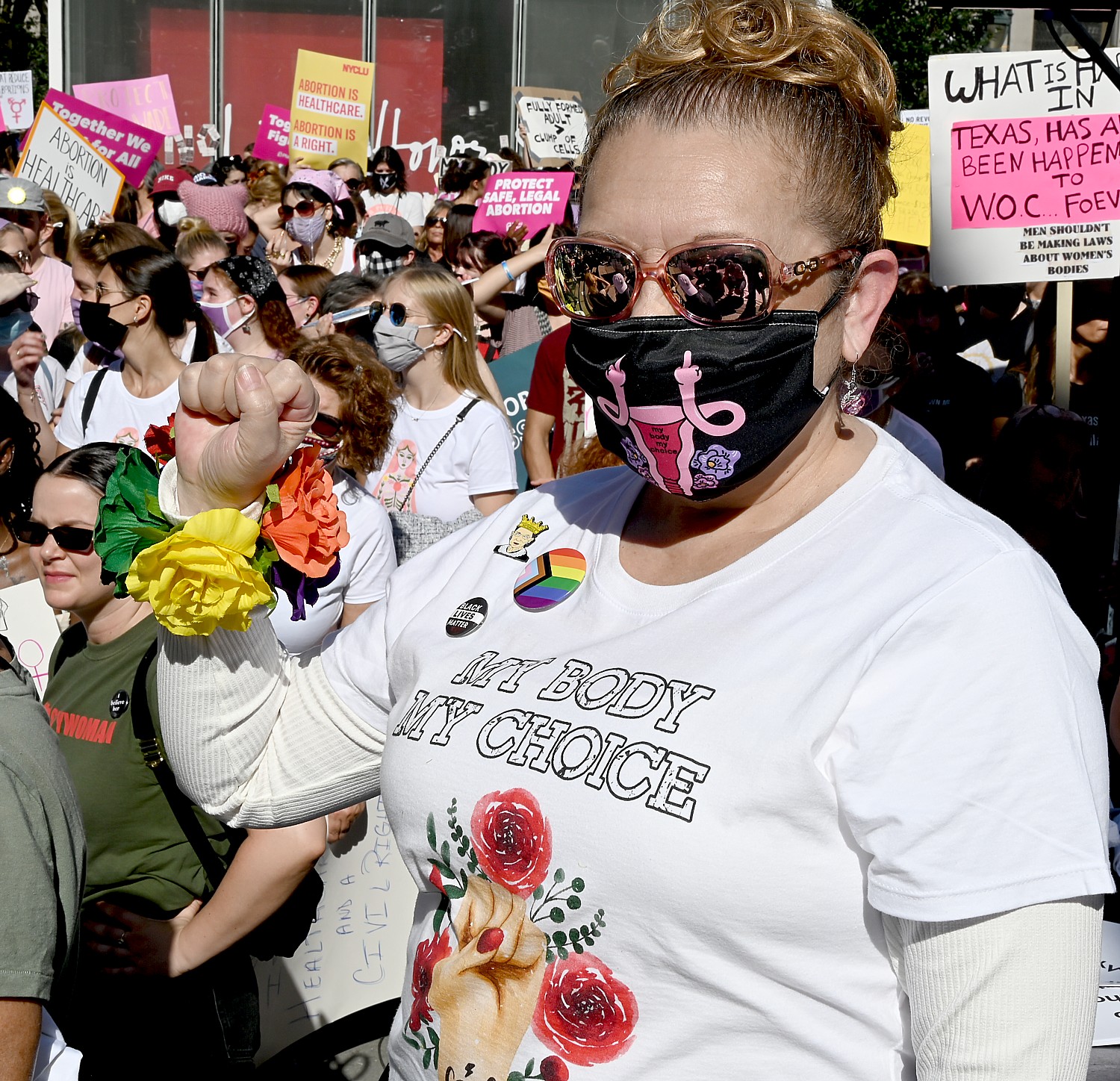
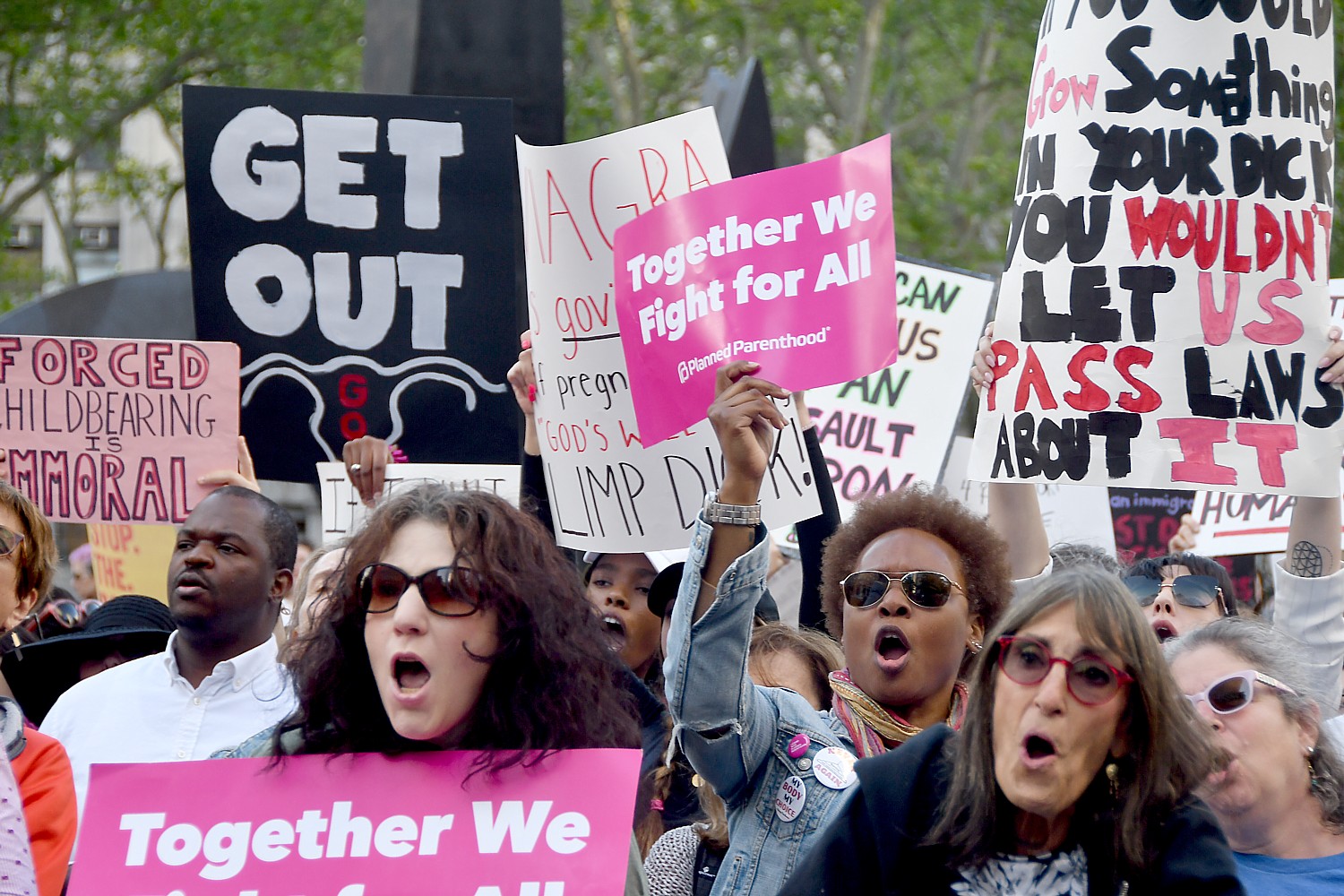
Thousands gathered in Foley Square, in front of the federal court house, to hear calls for justice, equal rights and full personhood for women in face of the assault on abortion rights from Texas and dozens of states and the right wing majority Supreme Court’s deference and then marched up to Washington Square Park, bringing their messages of “Save Roe” “Keep Your Rosaries Off My Ovaries”, “Hands off Our Privates” “We Won’t Go Back” and “Ruth Sent Us.” (See: NYC Joins Millions Across Country in Rallies, Marches for Women’s Reproductive Freedom)
Thousands gathered in Foley Square, in front of the federal court house, to protest for justice, equal rights and full personhood for women in face of the assault on abortion rights from Texas and dozens of states and the right wing majority Supreme Court’s deference. The timing was key, just days before the Supreme Court begins its session in which it will hear a Mississippi case banning abortions after 15 weeks. Texas SB8 bans abortions after six-weeks, the theoretical point when a fetus has a heartbeat, and deputizes vigilantes and bounty hunters to enforce it against anyone even suspected of aiding a woman who gets an abortion and collect $10,000.
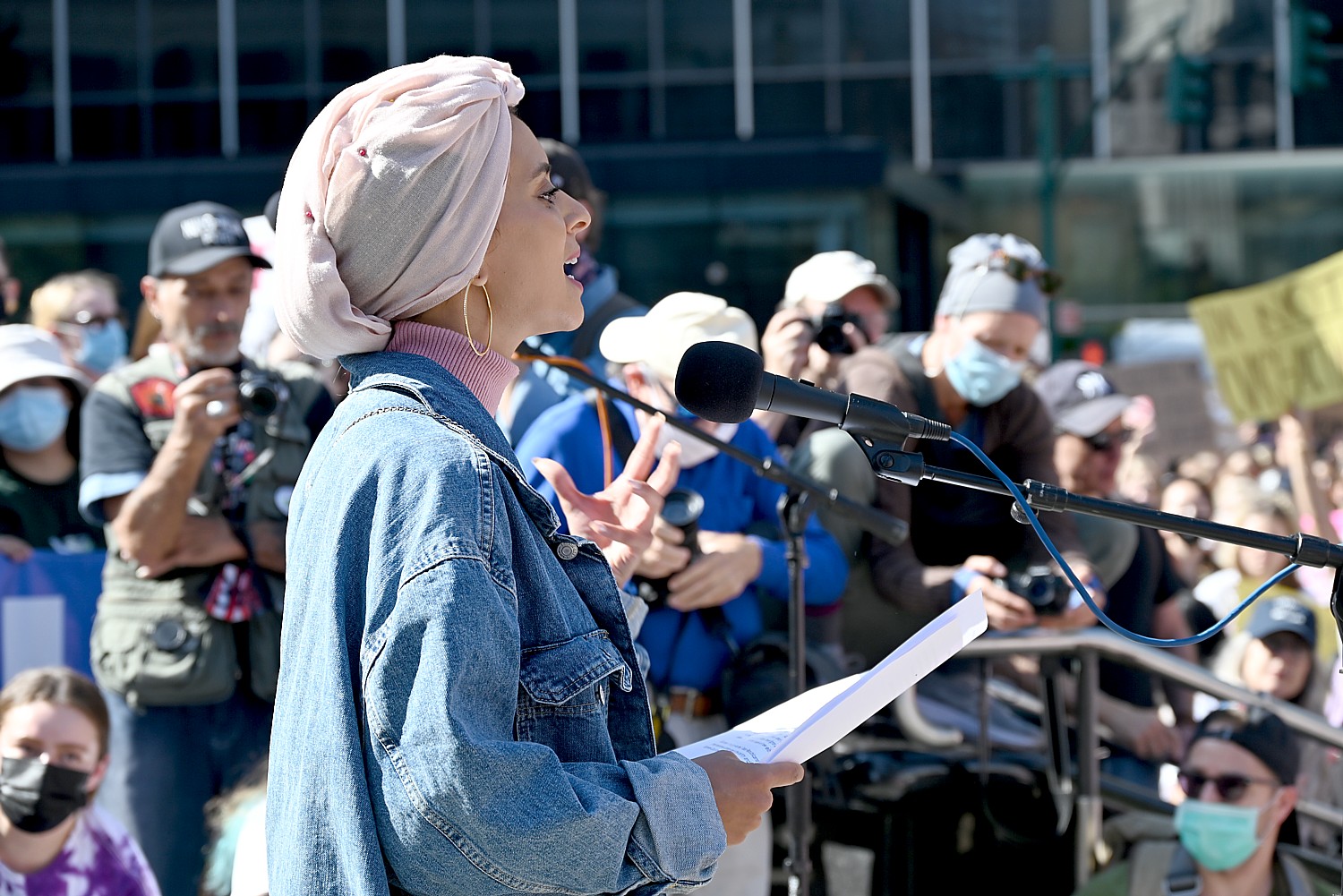
Rana Abdelhamid: “This is not about religion, not about life. They called us ‘hysterical’ for warning about the effort to overturn Roe v. Wade. It’s time for congress to do what’s right and protect our constitutional right to abortion. End the filibuster. We know what it is to have our bodies policed. Abolition Justice!
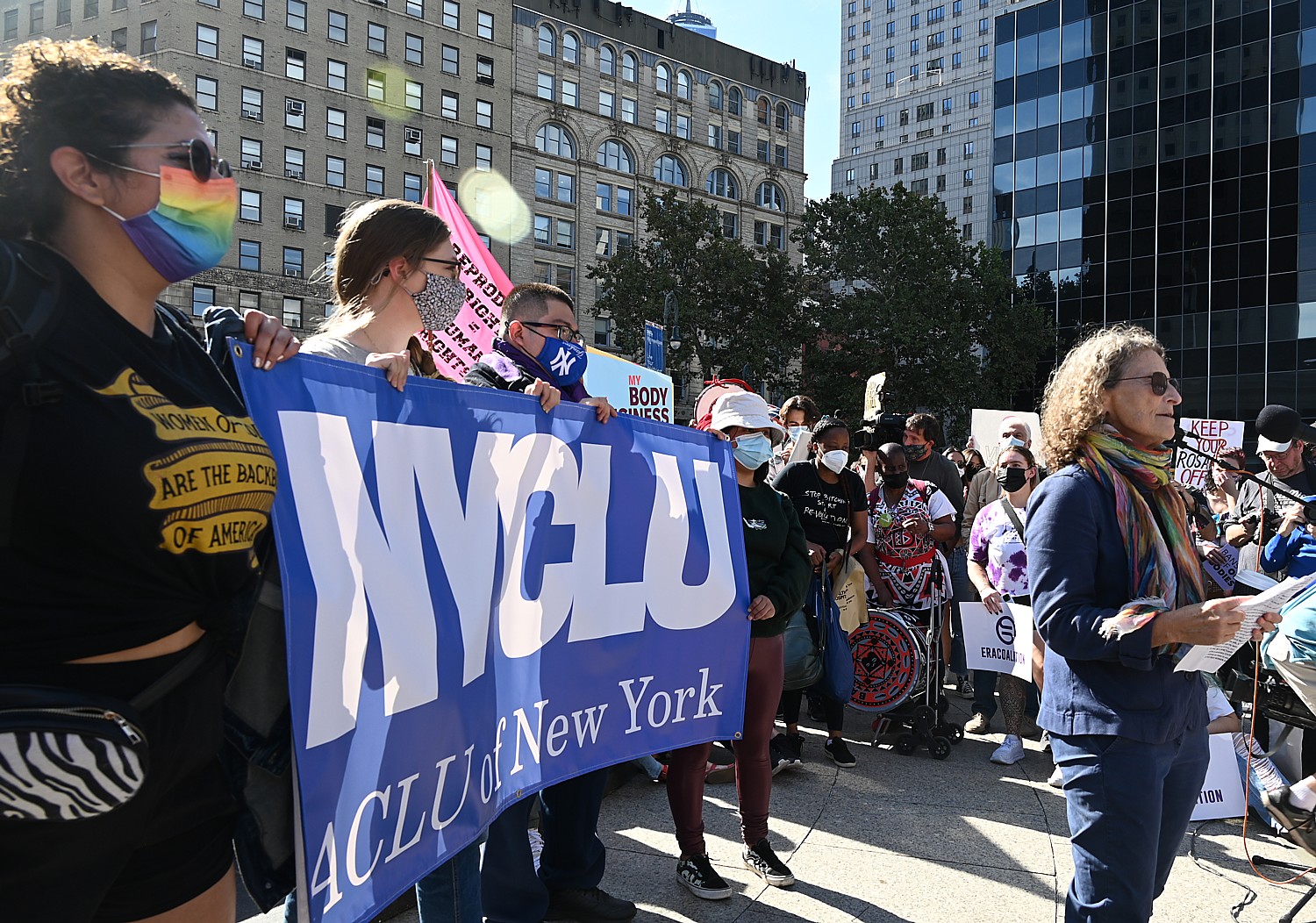
Donna Lieberman, executive director of the NYCLU: We stand with women in Texas, Mississippi and all over the country. Abortion Justice. Reproductive Justice. Make New York a safe haven, close every loophole in state law, so anyone can come for reproductive health. We won’t turn back. We will be at every polling place in every election. Hold elected leaders accountable.
Heidi Sieck, Vote Pro Choice: Reproductive freedom and abortion justice are at stake. Small, massively overfunded group of white supremacist, Christian conservatives have invested in state legislatures, built an anti-choice infrastructure. They stole two Supreme Court seats. That changes now. Over 80 percent support reproductive freedom. Pass the Women’s Health Protection Act (that passed the House, but not the senate), end the filibuster, rebalance Supreme Court. In November, 2021, 40,000 seats are up for election. Every ingle elected has a role to protect reproductive rights. Not just congress but state and local. Run for office, donate to VoteProChoice.us.
Congresswoman Carolyn Maloney: They have been chipping away at abortion rights for years, but now they are bulldozing our rights into the ground.Last week, chaired House Oversight Committee on Texas SB8, when three Congresswomen told their abortion stories. Women are speaking out. In December, Mississippi comes before the Supreme Court. For my entire time in Congress we hadn’t had a pro-choice majority, until this year. We passed the Women’s Health Protection Act, codifying Roe. It has to pass in the Senate. We could pass it except for the filibuster. We have to carve out an exception. There is no democracy if women cannot control their own bodies, make their own reproduction choices. It is so outrageous, I can’t believe we are still fighting for this.
Congressman Jerry Nadler, who, over 50 years ago, lobbied the New York State Assembly to legalize abortion: It’s been 30 days since women were stripped of their constitutional rights, their freedom to make their own decisions of their lives, their bodies. That’s 30 days too many.
Pascale Bernard, Planned Parenthood of New York City: History is repeating. We have been here before. Enough is enough. Women in Texas are having to drive to Oklahoma, having to choose between paying for an abortion or feeding their children. People are scared. Justice Ginsburg told us to dissent, she left a roadmap to protect reproductive rights. We are lucky in New York, but we nee dto close loopholes, we need an abortion fund so women can come to New York for care, for safety.
Cathy Rojas, a teacher and candidate for NYC mayor running as a Socialist: We need to build a sustainable people-powered movement ion New York City, In Texas, where people were freezing and is one of worst states to live – hunger, poverty of children, maternal mortality – they are leading the attack on abortion rights. So when claim is about protecting life, is really about protecting profit over lives.The right wing don’t give a damn about lives. Instead of dealing with the real crises are attacking abortion rights. Congress is ineffective at passing laws for basic necessities, but quick to bail out banks and the ultra rich. They always find time to attack women, LGBTQ and the vulnerable. This is not just about a bad law, but the whole damn system – the bigots, the politicians for hire, the courts up to the Supreme Court, the corporate control of the media, the police and ICE. I am fed up with capitalism. We need systemic change.
The Band Betty: We are one-fourth through the 21st century. I don’t see flying cars or universal health care. I see women being told to be ashamed. Until women have equal rights in the Constitution, we will continue to see how the state commands our fate.
Rev. Nori Rost, New York Society of Ethical Culture: They are “protecting” a fetus with a heartbeat? How about fighting for people who already have a heart beat. Anti-choice, anti-woman is nothing new – it is about subjugation, oppression. We will not give up, shut up, slow down, sit down until all people have agency over their own body. We are among millions marching as one, we will not be stopped.
Jeannie Park (Warriors in the Garden): Abortion bans have no humanity, no exception for rape, incenst. 3 million have experienced rape, the next 3 million will be forced to carry to term. The penalty to abort is more severe than to rape. Women’s bodies are more regulated than guns. What does it mean to be pro life if you only value certain lives. Encouraging vigilantes, bounty hunters is too lcose to the Fugitive Slave Act of 1850. I will not go back.
Miriam Elhajli sings a song 100 years old, “Wagoner’s Lad,” and sounding so much like Joan Baez who sang it: “Oh, hard is the fortune of all woman kind/She’s always controlled, she’s always confined/Controlled by her parents until she’s a wife/A slave to her husband the rest of her life”
Carol Jenkins, Co-President and CEO of The ERA Coalition and the Fund for Women’s Equality: The Equal Rights Amendment has been around for 100 years; it has been 50 years since passed in Congress, now 38 states have ratified it, so could be published in the Constitution. The only hold up is a time limit, put into the introduction, not the amendment. The root of sexism, misogyny, and racism is in the Constitution, written by slaveholding white males. Everything we’ve been doing since has been to repair what was left out of the Constitution. We have to put the ERA on list of things, so we don’t have to keep repairing the Constitution. Congress has removed the timeline twice, it is now in the Senate. We are done having to beg for rights, gather in the streets and ask “please”. Go to ERACoalition.org.
By Karen Rubin, News & Photo Features, news-photos-features.com
New York State Governor Kathy Hochul came out hopping mad over the Texas abortion ban strategy and swinging at the Planned Parenthood Day of Action Rally in support of abortion access, making a sweeping invitation to any woman in a state where abortion access is obstructed, to come to New York, a sanctuary.
“We are here to show the rest of the nation that New Yorkers stand with every single one of you. Women across this nation, we have your back.”
She declared, “Right now, we have oppression going on in our own country when people are trying to tell women what to do with their own bodies. It stops here in New York. Let’s take this battle all across the nation. To Washington, to Texas, and anywhere else that they think they have a right to have their hands on our bodies.
“Keep your damn hands off our bodies.”
In addition, Governor Hochul announced an agenda to affirm abortion rights and cement New York’s status as a place to welcome women seeking abortion care.
Governor Hochul was joined by Senator Kirsten Gillibrand to lay out their combined efforts to fight for reproductive rights. As part of these efforts, the Governor is directing State agencies to coordinate a statewide public information campaign, including the development of a patient bill of rights, in coordination with stakeholders. This campaign will help women know their rights and legal protections and ensure this information is accessible and widely available. The Governor also directed the Department of Health to take immediate action to develop and widely distribute modern and comprehensive provider guidance on the right to provide abortion care and to ensure updates to existing regulations are adopted so that medication abortion can be more easily accessed during telehealth visits.
“Abortion access is safe in New York – the rights of those who are seeking abortion services will always be protected here,” Governor Hochul said. “This plan will affirm that in our state, and leaders like Senator Gillibrand will fight on a national level. To the women of Texas, I want to say I am with you. Lady Liberty is here to welcome you with open arms.”
Recognizing that national attention on abortion issues may make misinformation more likely to spread, the Governor also wrote a letter to Facebook urging the company to provide information on any current efforts to mitigate the spread of abortion misinformation online and to take new action to combat misinformation about abortion laws, regulations, and availability.
Here is a highlighted transcript:
Are you all fired up? I am fired up. I love a good fight. But I’ll tell you, my friends, this is a fight that I thought ended when my mother was starting out as a parent, as a young person. I had no idea that all these years later we’d be fighting the same fight that grandma and my mom fought, that my own daughter now has her rights threatened by crazy people in places like Texas.
We are sick and tired of being sick and tired, are we not? Have you heard that before? We don’t want to be fighting this anymore, but we are ready. We are here to show the rest of the nation that New Yorkers stand with every single one of you.
Women across this nation, we have your back. We will not abandon you just because we are far more enlightened in our respect for women’s bodies, and I have been a fighter on the forefront of this battle since 27 years ago when I ran for local office, running for a simple town board in a small town, and I was told in this very conservative community, if I didn’t take the “Right to Life” political line that I would never get elected in a million years. And I said, well watch this. I would not touch that line. I ran for office and I won overwhelmingly, time and time and time again.
And I say that because that is what’s going on in other parts of our nation and even in parts of our own state. And I’ll tell you one more story. I am so passionately engaged in making sure that every woman never has to find her way to a back alley, or to fight for simply having contraception access. I will join this battle and I will help lead the nation in this fight because when I was a member of congress, as member of congress I fought for the Affordable Care Act, because I thought health rights are human rights. It’s that simple. Everybody deserves the dignity of good healthcare and included in that was the right to contraceptive coverage by employers. They had to provide this, and I stood firm for that, and as a result that was an issue that I lost my seat in Congress on, and I would do it all over again because sometimes you just have to stand up and do what’s right and stand up for other people. And that’s what you’re doing here, standing in the rain in Brooklyn today. I am so proud of you, every one of you.
I want to thank our great borough president, Eric Adams, who is hosting us. Thank you, future Mayor Eric Adams. And to all of the elected officials who are here today. This is a battle that’s always happening in the streets. It’s happening at the Planned Parenthoods facilities that I’ve gone to after they’ve been subjected to attacks and terrorist actions.
We have to stand together and let people know that there is a reason why we feel we should be the sanctuary for people across this nation whose rights are attacked, whether it’s Texas or anywhere else because in 1886 they erected a beautiful woman in our harbor with her hand held high with torch in it, a beacon of hope for people who are oppressed.
And right now, we have oppression going on in our own country when people are trying to tell women what to do with their own bodies. It stops here in New York. Let’s take this battle all across the nation. To Washington, to Texas, and anywhere else that they think they have a right to have their hands on our bodies.
Keep your damn hands off our bodies. Keep your damn hands off our bodies. We are sick and tired. We are going to take this battle anywhere it occurs, and I want to thank all of you. You inspire me. You inspire me, each and every one of you when I come out here and I see your passion to fight for other people and make they have their dignity and rights. I want to thank you, Joy, and all our friends at Planned Parenthood for being there when we need you the most.
I am going to join this army, I’m going to help lead this army, whatever you need me to do, I will be there my friends. It’s all about showing up just like you showed up here on this beautiful day in Brooklyn. Thank you everybody.
Standing Up for Women’s Reproductive Rights
Senator Gillibrand said,”Having control over your own body and your own future is a basic human right. But that right is being threatened every day. The recent law in Texas – and the Supreme Court’s refusal to block it – is dangerous and disturbing. This law is not just unconscionable, it’s unconstitutional. At the federal level, we must pass the Women’s Health Protection Act, which would create federal protections against state restrictions that fail to protect women’s health and intrude upon personal decision-making. Here in New York, we luckily have a governor who understands and champions fundamental reproductive rights. I stand ready to support Governor Hochul’s efforts to ensure that providers, patients and the people of New York have the best information about abortion care and the resources to get the care they need.”
Representative Carolyn B. Maloney said, “The Supreme Court’s failure to block the draconian Texas anti-choice SB8 law flies in the face of decades of precedent and is a major blow to Americans’ constitutional right to an abortion. SB 8 makes it illegal to end a pregnancy under nearly all circumstances after 6 weeks — before most people even know they’re pregnant. This devastating ruling by the highest court will most impact BIPOC and lower income individuals who often do not have the same access to health care or ability to travel out of state to access an abortion. The House has already voted to repeal the Hyde Amendment, and we must pass the Women’s Health Protection Act. Here in New York, I’m so proud to have a governor like Kathy Hochul, who I know will work each and every day to protect New Yorkers’ reproductive rights.”
New York Senate Majority Leader Andrea Stewart-Cousins said, “In New York, we have shown that we are ready to protect women’s right to choose and access high quality reproductive healthcare,” “I want to thank Gov. Hochul and all the partners involved in this campaign, for amplifying the message that in New York, we will continue to be the standard bearers for women’s reproductive rights. With this campaign we are saying that in New York, women’s health matters, women’s decisions matter and the reproductive rights of ALL New Yorkers’ and visitors alike are protected.”
Senator Liz Krueger, Co-Chair of Bipartisan Pro-Choice Legislative Caucus said, “For many years before we passed the Reproductive Health Act in New York, we were told by opponents of choice that it was unnecessary, because the Supreme Court would never overturn Roe v. Wade. And yet here we are: just two years after passing the RHA, a Court packed with radical extremists has upheld Texas Republicans’ flagrantly unconstitutional forced-birth law. Opponents of reproductive freedom have made clear that their attacks on women will not let up, so neither can we. I thank Governor Hochul for taking a strong stand for the rights of women and families to make their own reproductive decisions without government interference.”
Assemblymember Deborah J. Glick said, “Texas’ draconian abortion ban is deeply disturbing, but not surprising. Despite a majority of Americans supporting a pregnant person’s right to choose, anti-choice extremists continue to try to undermine our constitutional right to seek reproductive health care, including abortions. I have worked tirelessly to protect and strengthen reproductive rights, and I am proud to have led the charge to codify Roe v Wade in New York State state law in the Reproductive Health Act for just this eventuality. Texas’ disgraceful law shows us why we must continue to fight to protect our right to choose.”
Assemblymember Rodneyse Bichotte Hermelyn, incoming Chair of the New York State Assembly Task Force on Women’s Issues said, “We cannot allow oppressive, anti-woman bans on our bodies to penetrate our state or nation. The GOP-led stripping of women’s rights in Texas must be stopped. We need to protect women from the Court’s inaction, which could jeopardize our reproductive rights everywhere. I am grateful to the Governor, Kathy Hochul, and Sen. Gillibrand for taking a stand to make sure these archaic laws never undermine our health care in the state of New York.”
Assemblymember Kimberly Jean-Pierre, Chair of the Legislative Women’s Caucus said, “Make no mistake, Texas’s draconian new abortion law is an unconstitutional attack on the reproductive rights of women across our nation. Here in New York, we will always stand up for the right of women to make their own reproductive health choices, and under the leadership of Governor Hochul, I know that our state will continue to be a safe haven for women and their access to care in the face of this abhorrent assault on our fundamental rights to reproductive freedom.”
Assemblymember Karines Reyes, Co-Chair of Bipartisan Pro-Choice Legislative Caucus said, “The abortion ban recently enacted in Texas is completely reprehensible. A women’s right to an abortion is just that – a right – and in New York we will always do everything we can to protect a women’s right to choose. I thank Governor Hochul for taking aggressive actions to affirm abortion rights in New York and making sure that every woman in New York knows her rights.”
Manhattan Borough President Gale A. Brewer said, “While other states are cracking down on reproductive rights with needless and extreme laws, here in New York State Governor Kathy Hochul is taking action to ensure that we remain a beacon of hope. All reproductive health, including abortion must be legal, safe, accessible, and affordable. That’s what today’s announcement by Governor Hochul aims to promote.”
Robin Chappelle Golston, President & CEO of Planned Parenthood Empire State Acts said, “Make no mistake – there is a national effort to destroy access to abortion in this country and we must be just as aggressive to expand reproductive healthcare. This is our moment, to not just hold the line on access to abortion here in New York, but to boldly advance it. Everyone deserves the freedom to control their own body, make personal decisions and shape their own future. I want to thank Governor Hochul for her shared and unwavering commitment to this vision, and for the steps she is taking to ensure New York remains a beacon of freedom and access for all.”
Donna Lieberman, Executive Director of the New York Civil Liberties Union said, “We’ve done it before and we’ll do it again: New York will open its doors to those in need of an abortion and stand up against any state that puts a bounty on reproductive freedom. In the face of Texas’ blatantly unconstitutional attacks on abortion access, we applaud Governor Hochul’s decisive action in partnering with experts and stakeholders to ensure New York is a haven state for all who need abortion care. We will not let Texas, or any other state that tries to follow suit, turn back the clock.”
Camille A. Clare, MD, MPH, CPE, FACOG, chair of ACOG District II said, “In a time when women’s reproductive healthcare is under attack across this country, the American College of Obstetricians and Gynecologists, District II is proud to stand with Governor Hochul as she prioritizes access to comprehensive abortion services. Abortion is health care and ACOG District II supports and uplifts the voices of the women seeking abortion services and the medical professionals who provide them. New York State must become a safe haven for anyone seeking abortion care and our medical leadership looks forward to partnering with the Governor and the Department of Health as they work to ensure a comprehensive and transparent system of abortion care here in New York.”
Andrea Miller, President of the National Institute for Reproductive Health Action Fund said, “Texas has passed the most extreme abortion ban in the country, leading to a crisis point for abortion access. The NIRH Action Fund is pressing forward in every state and city we can to secure equitable access to abortion care — because everyone who needs care should receive with it with support, with dignity, and without fear. We applaud Governor Hochul for taking bold action to ensure that New York State is doing all it can to ensure access to all New Yorkers and all those who travel here for care. We invite governors and legislators in states across the country to follow her lead.”
Plan to Ensure the Right to Abortions in New York State
In an effort to ensure the right to abortions in New York State, the Department of Health will develop webpage on the provision of abortion care, complete with a Patient Bill of Rights. This will include information on abortion care in New York State, patients’ rights to abortion care within New York State, and links to identify providers who offer abortion services.
DOH will convene a group of experts to develop and issue a guidance document on the provision of abortion care in New York State. This will include collaboration from American College of Obstetricians & Gynecologists, National Abortion Federation, National Institute for Reproductive Health, Planned Parenthood Empire State Acts, New York Civil Liberties Union and clinical providers with an expertise in abortion care. Webinar on guidance document and clinical considerations will be open to providers across New York State and recorded for ongoing availability on the DOH website.
Guidance for Individual Provider Discretion Under Reproductive Health Act
The New York State Department of Health will develop guidance with an emphasis on clarifying the full scope of individual provider discretion under the Reproductive Health Act, and the definition of the term “commencement of pregnancy” as it relates to abortion care. The New York State Abortion Guidance Document will be shared with all New York State clinical providers able to perform abortion in New York State via the Health Commerce System.
Regulatory Updates
The Department of Health will enact regulatory updates including to allow for provision of services via telehealth. These updates will ensure that medication abortion is more easily accessed during telehealth visits, and with the goal of making this an option irrespective of the pandemic.
The Office of Management and Budget issued a statement strongly supporting passage of H.R. 1620, the Violence Against Women Reauthorization Act of 2021, introduced by Rep. Jackson Lee (D-TX) with 182 co-sponsors.
The statement comes as news reports circulate about a Georgia man who murdered 8 women in a shooting spree in Atlanta, March 16.
The Administration strongly supports House passage of H.R. 1620, the Violence Against Women Reauthorization Act of 2021. The Violence Against Women Act (VAWA) is a landmark piece of bipartisan legislation that was first enacted in 1994 and that was reauthorized in 2000, 2005, and 2013. VAWA has transformed the Nation’s response to violence against women and has brought critically needed resources to States, Territories, Tribes, and local communities to help prevent and improve the response to domestic violence, dating violence, sexual assault, and stalking. Strengthening and renewing VAWA, however, is long overdue. As many as 1 in 3 women are subjected to domestic violence, dating violence, sexual assault, and stalking at some point in their lives, and the rate is even higher for women of color, lesbian and bisexual women, and transgender people. VAWA reauthorization is more urgent now than ever, especially when the pandemic and economic crisis have only further increased the risks of abuse and the barriers to safety for women in the United States.
The Administration is pleased that H.R. 1620 continues to build upon previous VAWA authorizations, and includes new provisions to enhance efforts and address identified gaps and barriers. H.R. 1620 would authorize funding for VAWA grant programs for fiscal years 2022 through 2026 and would continue to invest in, and expand, strategies that advance access to safety, justice, and economic stability for victims and survivors. The bill would maintain established and effective protections and programs, while also addressing persistent gaps through more holistic approaches in order to address the complex realities and intersecting issues that impact survivors’ lives.
H.R. 1620 would reauthorize grant programs that support the development of a coordinated community response to domestic violence, sexual assault, dating violence, and stalking. It would expand the categories for which funds may be used in various grant programs to provide additional pathways to safety and support for survivors. Further, the bill seeks to reduce intimate partner homicides committed with firearms by expanding protections for victims and enhancing support for law enforcement agencies and courts to improve the enforcement of court orders. The bill would also improve the health care system’s response to domestic violence, sexual assault, dating violence, and stalking.
Domestic violence is a leading cause of homelessness for women and their children. Without the ability to access affordable housing, a victim must often times choose between becoming homeless or remaining in an abusive situation. H.R. 1620 includes provisions that would provide important housing protections to allow survivors in federally assisted housing to relocate to safe housing with victim relocation vouchers, maintain their housing after a perpetrator leaves, or terminate a lease early. The bill also would expand economic security protections for survivors.
H.R. 1620 would authorize increased funding to enhance culturally specific services for victims. This would include developing culturally-relevant training and education programs for health care professionals that are designed to be inclusive of the experiences of all individuals, including people of color and LGBTQ+ individuals. It would also include training on equity and anti-racism approaches to health services delivery, disparities in access to health care services and prevention resources, and current and historic systemic racism in health care services.
The Rape Prevention & Education (RPE) formula grants, administered by the Centers for Disease Control and Prevention, authorize essential funding to States and Territories to support rape prevention and education programs conducted by rape crisis centers, sexual assault coalitions, and other public and private nonprofit entities. H.R. 1620 would authorize higher levels of funding for prevention through the RPE program grants, as well as grant programs focused on prevention efforts with youth administered through the Department of Justice. It also would expand grants to support implementation of training programs to improve the capacity of early childhood programs to address domestic violence, dating violence, sexual assault, and stalking among the families they serve. H.R. 1620 would also support institutions of higher education in developing and disseminating comprehensive prevention education for all students and expanding training for school-based personnel and campus health centers to meet the needs of young victims of sexual violence.
The Administration strongly supports measures in H.R. 1620 that would expand access to justice for Native American victims. Native women are victimized at rates higher than any other population in the United States, and the vast majority of Native victims report being victimized by a non-native individual. This bill would build on the effectiveness of special criminal jurisdiction for domestic violence cases that was included in prior VAWA reauthorization laws and address other significant co-occurring crimes. It recognizes tribal jurisdiction that will allow participating Tribes to hold accountable non-native perpetrators of sexual violence, sex trafficking, domestic violence against child victims, stalking, elder abuse, and assault against law enforcement officers when they commit such crimes on tribal territory.
The Administration is pleased that H.R. 1620 recognizes the need to provide protection and services to all victims of abuse and includes proposals to strengthen existing policies that were supported by both Democrats and Republicans last year. The Administration urges swift passage of this legislation.